
A complete issue · 22 pages · 1904
Life — January 28, 1904
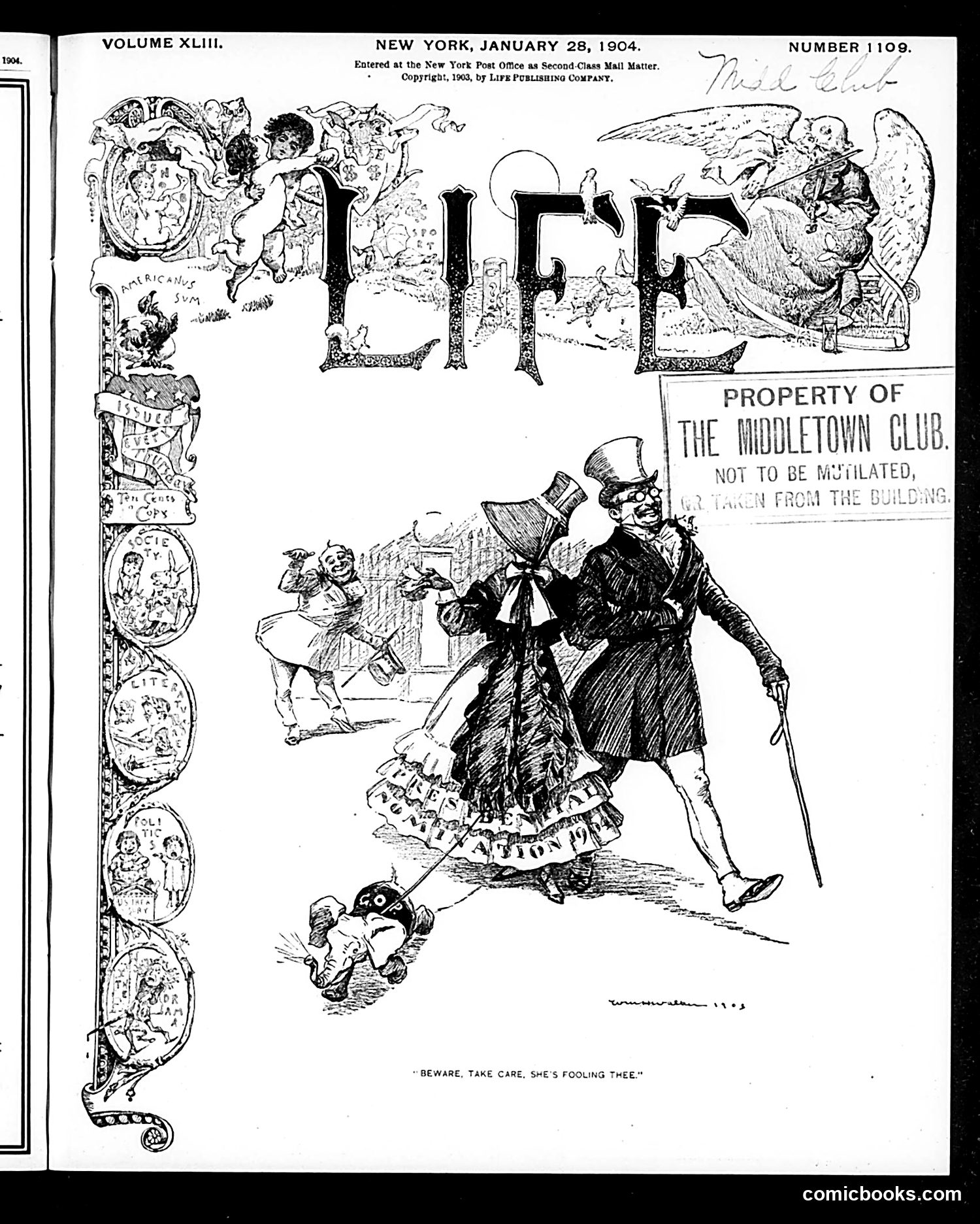
This satirical cover depicts an elegantly dressed gentleman with a top hat leading a small child on a leash, like a dog. The caption reads "BEWARE, TAKE CARE, SHE'S FOOLING THEE." The cartoon appears to satirize wealthy or aristocratic manipulation of innocence—the well-dressed figure (likely representing wealth, power, or a specific political/social figure) controls the vulnerable child through the leash. The warning caption suggests the child is not as naive as appears, or conversely, warns observers that the figure is exploiting apparent innocence. Without additional context identifying the specific figure or contemporary event, the cartoon likely critiques social exploitation, manipulation of the vulnerable, or hypocrisy among the privileged classes—common themes in Progressive Era satire.
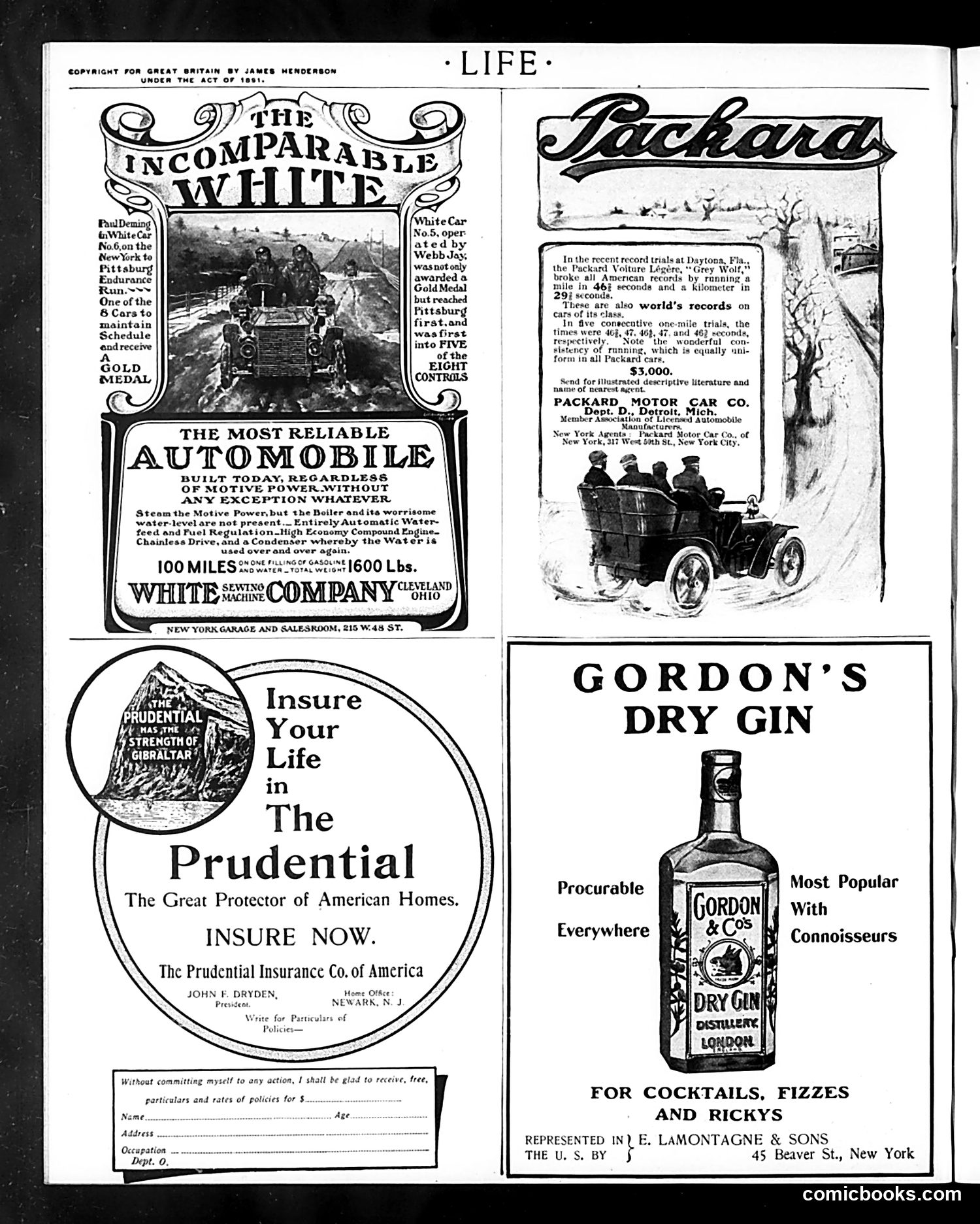
This page is **primarily advertisements** with no political cartoons or satirical content. The ads feature: 1. **White Automobile** (top left): Promotes a car as "The Most Reliable Automobile," emphasizing its 100-mile range and 1,600-pound capacity. This is straightforward automotive marketing. 2. **Packard Motor Car** (top right): Advertises world speed records achieved by Packard vehicles at Daytona, Florida. 3. **Prudential Insurance** (bottom left): Uses the Rock of Gibraltar as a symbol of strength, encouraging life insurance purchases. 4. **Gordon's Dry Gin** (bottom right): A British gin advertisement marketed as "Most Popular With Connoisseurs." The page reflects early 20th-century advertising conventions—luxury goods, nascent automobile industry promotion, and alcohol marketing (pre-Prohibition). No satire or political commentary is present.
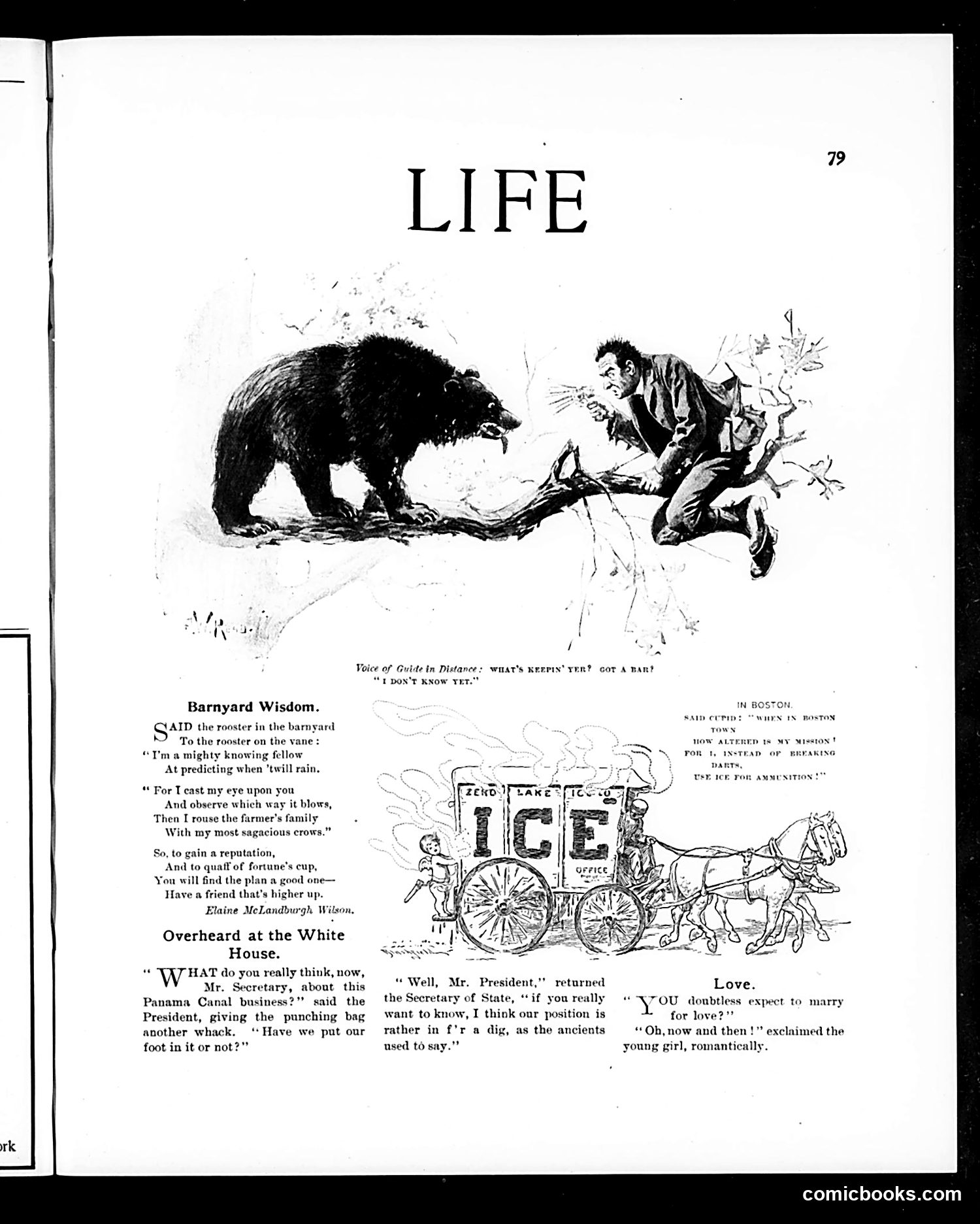
This page contains three satirical pieces from *Life* magazine (a humor publication, not the photo magazine): 1. **Top cartoon**: A man confronts a bear over a log, captioned as "Voice of Guide in Distance: 'What's keepin' yer? Got a bar?'" — mocking outdoor guides and their supposed bear encounters. 2. **"Barnyard Wisdom"**: A poem where a rooster boasts about his knowledge and ability to influence farmers' fortunes—satirizing self-important, bloviating figures who overestimate their influence. 3. **"Overheard at the White House"**: A brief dialogue mocking a Secretary of State's response to Panama Canal business concerns, comparing America's position to being "in f'r a dig, as the ancients used to say"—suggesting diplomatic evasiveness about colonial expansion. The page represents early 20th-century American political and social satire.
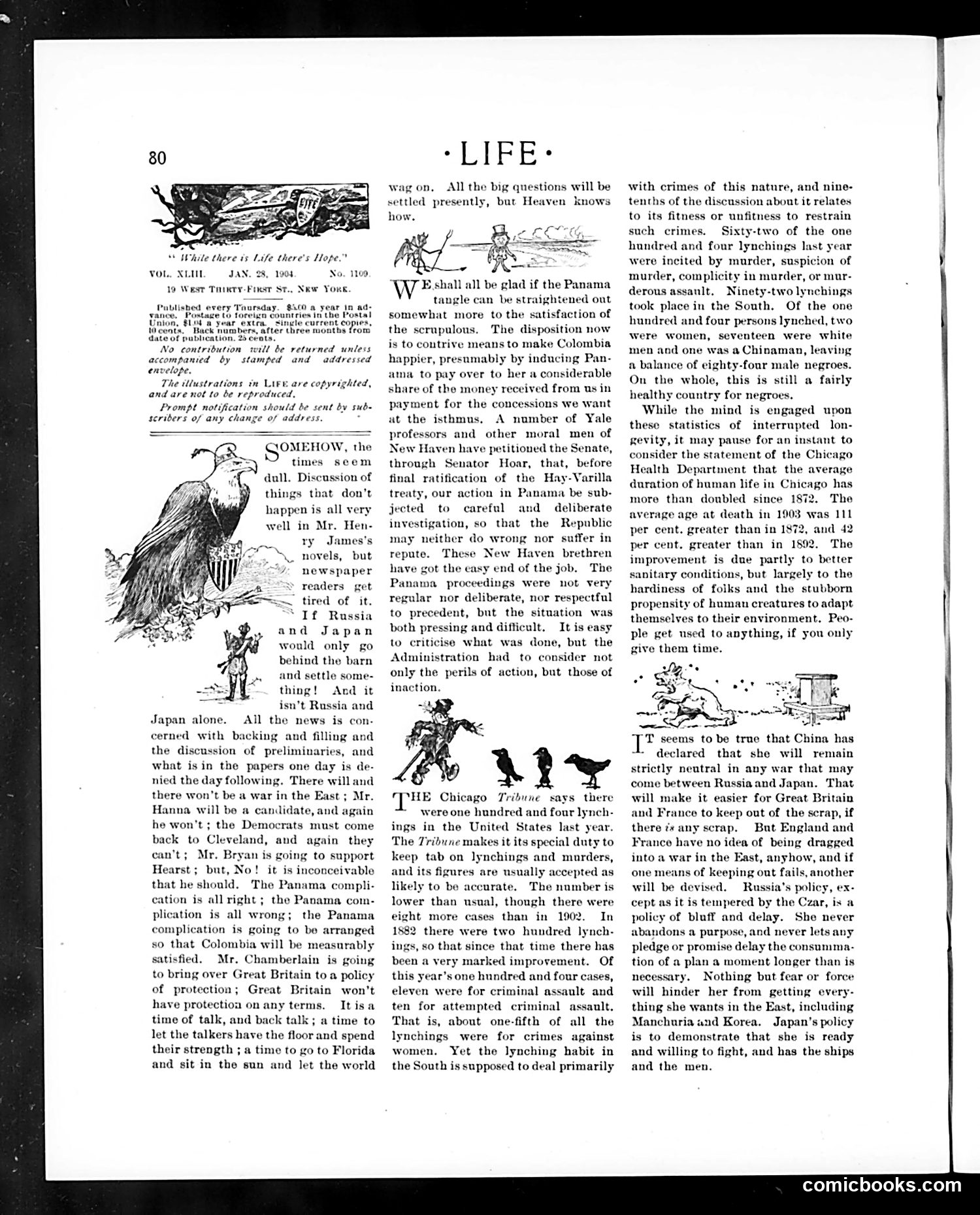
This page contains editorial commentary on contemporary political issues rather than traditional political cartoons. The illustrations are decorative rather than satirical caricatures. The text discusses the Panama Canal negotiations, criticizing both American intervention and the complexity of the situation. It references Senator Hanna and Yale professors advocating for careful deliberation before ratification. The page also critiques lynching in America, citing Chicago Tribune statistics showing 104 lynchings in the previous year. The writer contrasts American moral criticism of Russia and Japan's violence with America's own racial violence problem. Finally, it addresses China's declared neutrality regarding potential Russia-Japan conflict, suggesting Japan seeks to demonstrate readiness to fight while maintaining diplomatic advantage in Manchuria and Korea. The tone is satirical editorial commentary rather than visual satire.
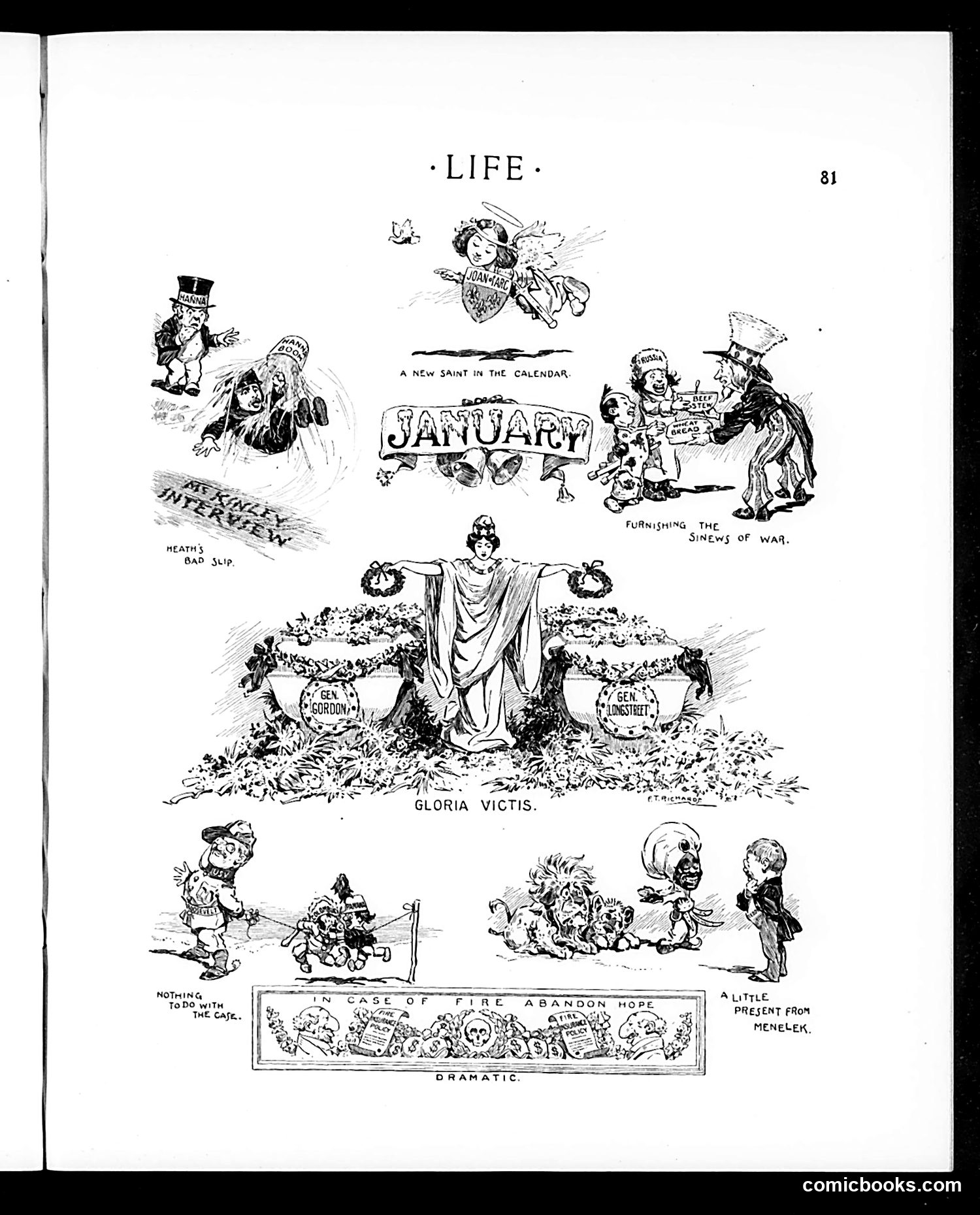
This page satirizes January events and figures from an unspecified year. "A New Saint in the Calendar" presents January personified, while "Heath's Bad Slip" and "Furnishing the Sinews of War" appear to reference political incidents—likely involving a figure named Heath and war preparations. The central image, "Gloria Victis" (Glory to the Vanquished), depicts two urns labeled "Gen. Gordon" and "Gen. Langstreet" beneath a classical female figure, suggesting commemoration of fallen generals. The bottom panel, "In Case of Fire Abandon Hope—Dramatic," satirizes emergency procedures. Additional vignettes include "Nothing to Do but Mind the Cafe" and "A Little Present from Menelek," the latter likely referencing Ethiopian Emperor Menelik II. Without the specific publication date, precise political identification remains uncertain.
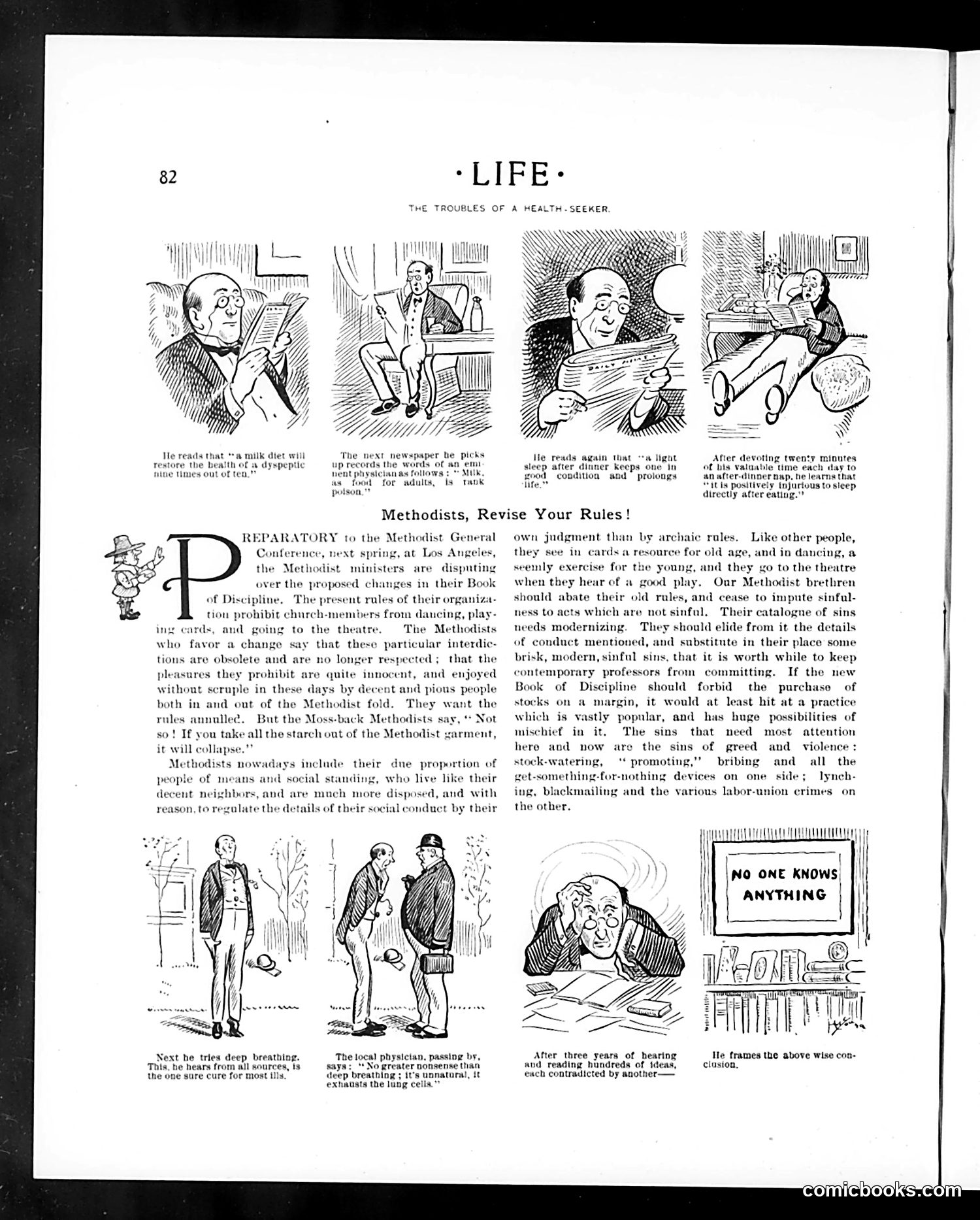
**Top section:** Four cartoon panels satirize health fads. A man reads contradictory medical advice—milk diet causes dyspepsia, newspapers cause eye strain, light meals cause poor digestion, sleeping after eating injures health. The joke: health-seekers face impossible, conflicting rules making wellness unachievable. **Bottom section:** The article criticizes Methodist Church leadership for maintaining strict, outdated rules in their Book of Discipline prohibiting dancing, playing cards, and theater attendance. The author argues these rules are unnecessarily rigid and counterproductive, especially when other denominations embrace modern social conduct. Supporting cartoons show the absurdity: a man tries "deep breathing" (awkward), seeks physician advice (futile), reads contradictory health books, and ultimately frames the maxim "NO ONE KNOWS ANYTHING"—mocking pseudo-scientific certainty.
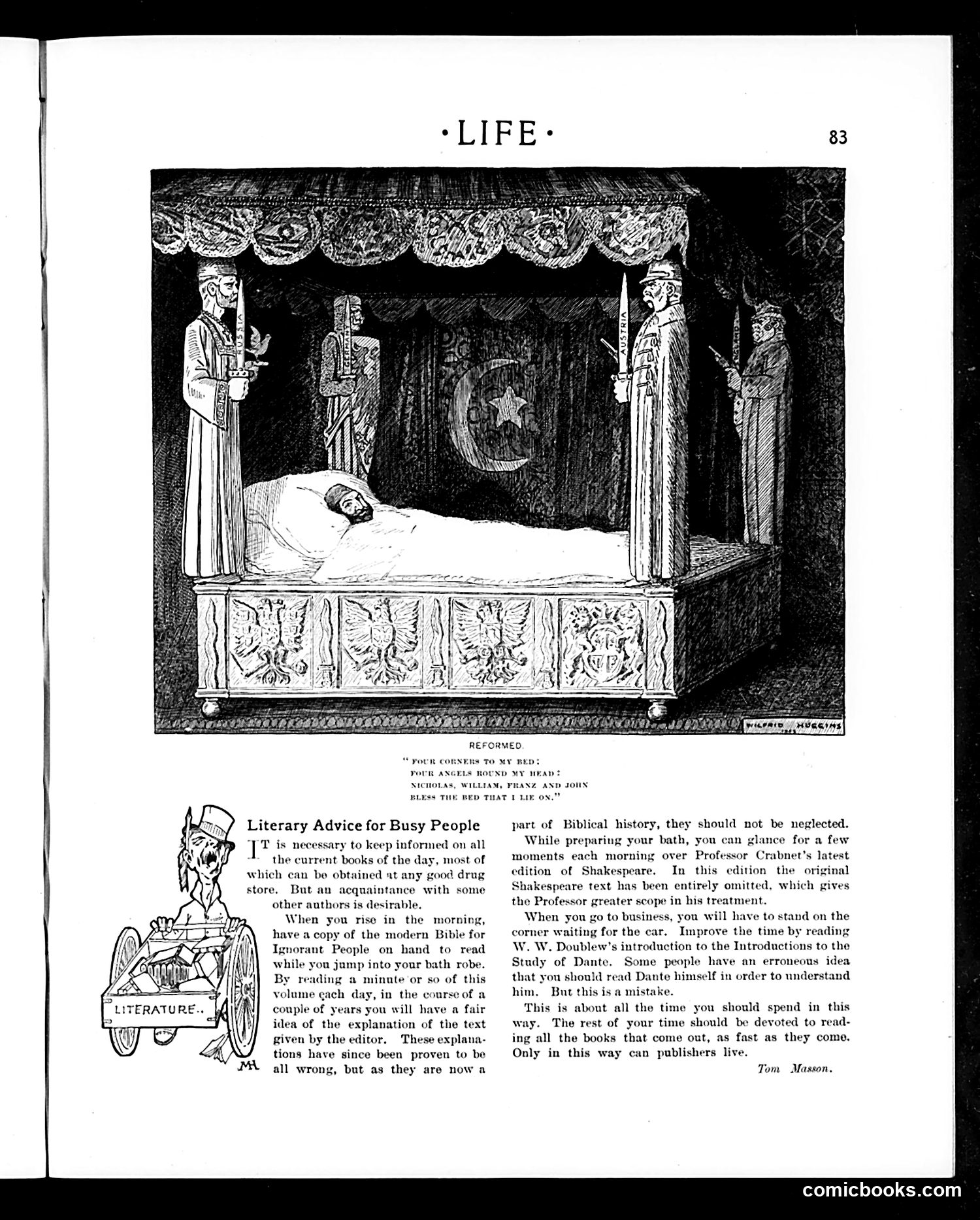
The top illustration, titled "REFORMED," depicts a deathbed scene with four robed figures (identified in the caption as Nicholas, William, Franz, and John) standing guard around a deceased person. A crescent moon and star symbol hangs above the bed. This appears to be satirizing religious conversion or reform—likely mocking figures who claimed spiritual transformation near death. The four named guardians suggest specific historical or contemporary religious figures, though without additional context, their exact identities are unclear. Below is an unrelated section titled "Literary Advice for Busy People," offering humorous suggestions for improving one's education through brief readings—Shakespeare, Dante, and religious texts—during otherwise idle moments. This is straightforward satire of self-improvement culture. The page number is 83.
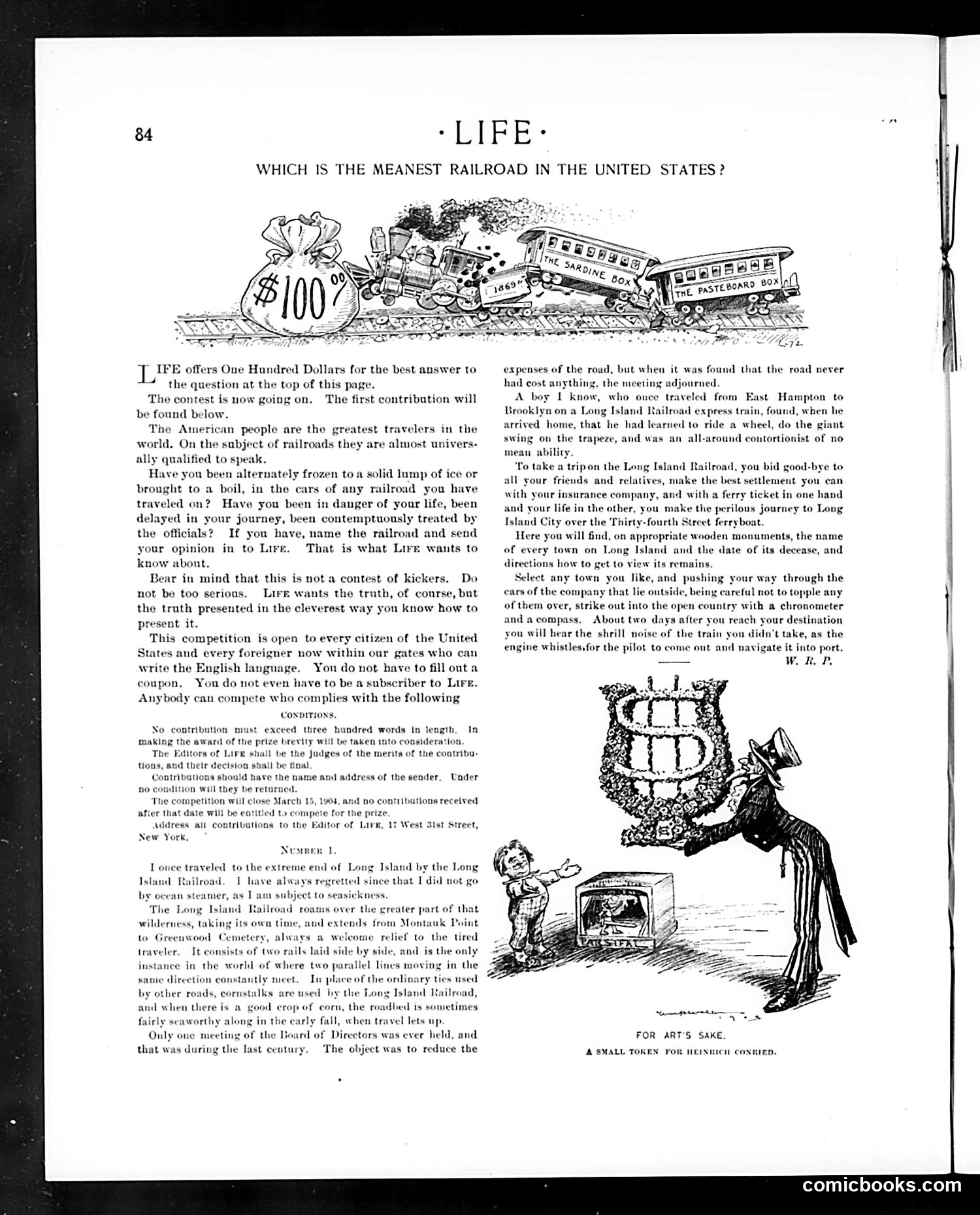
This is a contest announcement page from *Life* magazine offering $100 for the best answer to "Which is the meanest railroad in the United States?" The satirical cartoon at top shows a derailed train labeled "The Darling" and "The Pasteboard Box," suggesting absurdly flimsy construction—a visual pun on what makes a railroad "mean" (unreliable, dangerous). The page includes "Number 1," a submitted entry describing the Long Island Railroad's poor condition: rusty rails, parallel tracks that "constantly meet," and sparse service. The writer sarcastically notes it's the "only instance in the world of where two parallel lines having in the same direction constantly meet." This mocks a real railroad's notorious unreliability through pseudo-mathematical humor. The contest invited readers to submit their own railroad complaints in this satirical format.
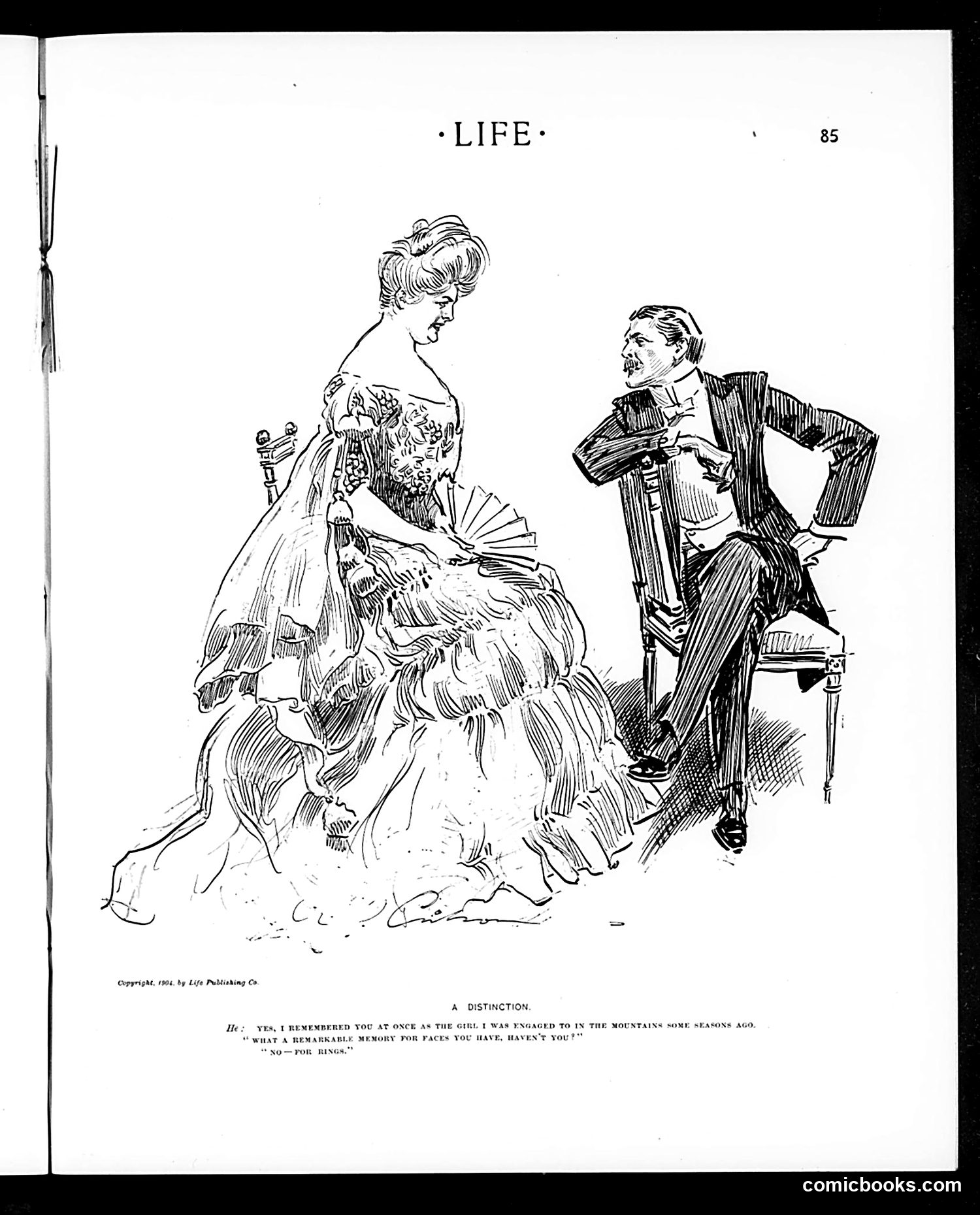
This early 1900s cartoon depicts a social encounter between a well-dressed man and an elaborately gowned woman. The title "A Distinction" and dialogue suggest satire about memory and social pretense. The man claims to remember the woman from being engaged to "a girl I was engaged to in the mountains some seasons ago," asking if she remembers his face. She replies "No—for rings," implying she only recalls the engagement ring, not the man himself. The joke satirizes wealthy women's materialism and superficiality—that a woman would remember a piece of jewelry more vividly than the suitor who gave it. It's commentary on class and gender dynamics, suggesting women valued financial tokens over genuine emotional connection or the men themselves.
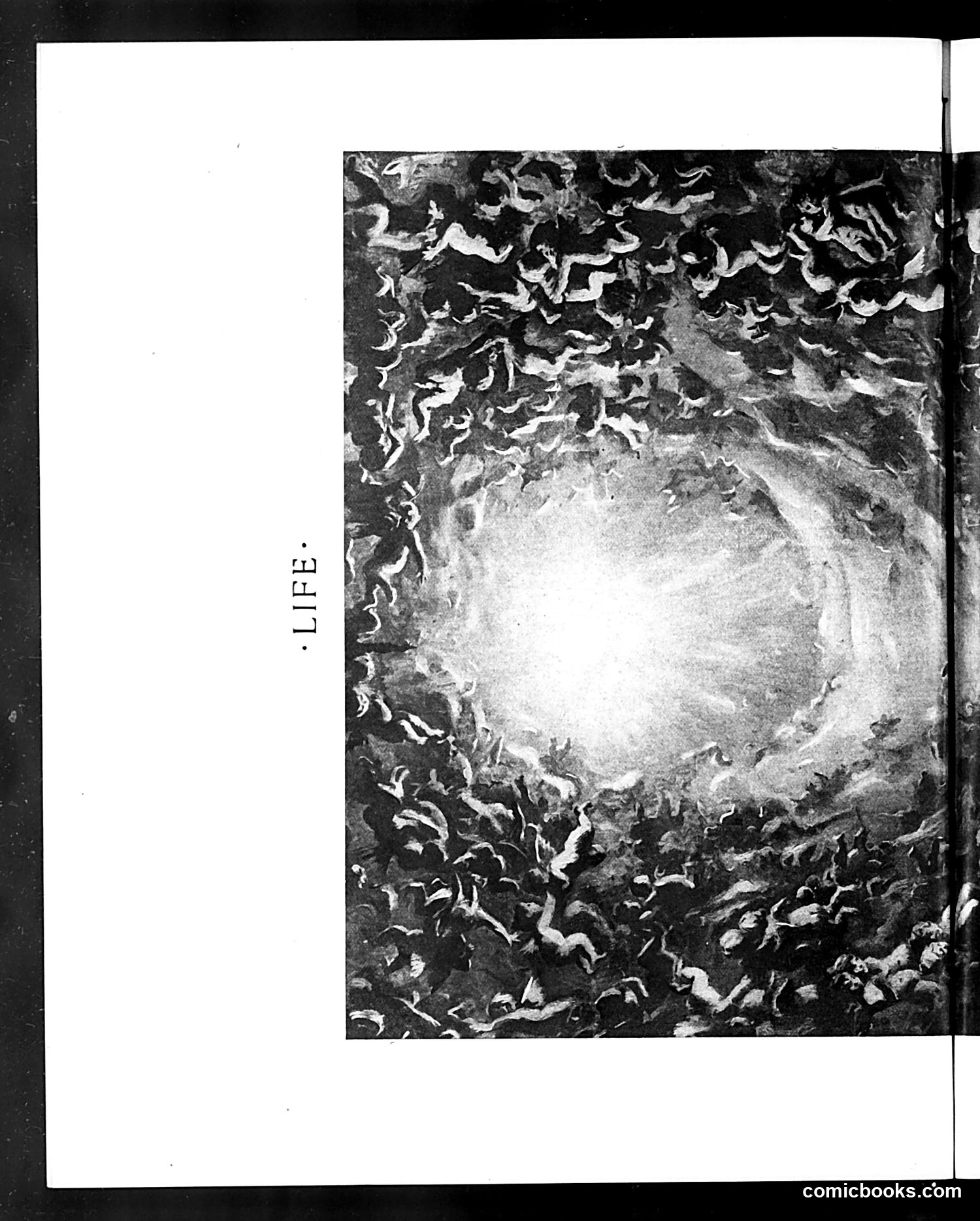
This page appears to be primarily a title or cover page for *Life* magazine, featuring the word "LIFE" printed vertically on the left side. The right side contains a dramatic black-and-white illustration showing a bright central light or celestial object surrounded by swirling, writhing figures or forms in dark tones around its edges. Without additional text visible on this page, I cannot definitively identify the specific political figures, events, or satirical targets being referenced. The artistic style suggests an allegorical or symbolic composition—possibly depicting some form of cosmic or spiritual imagery—but the exact meaning and historical context remain unclear from this image alone. Additional context or accompanying text would be needed for accurate interpretation.
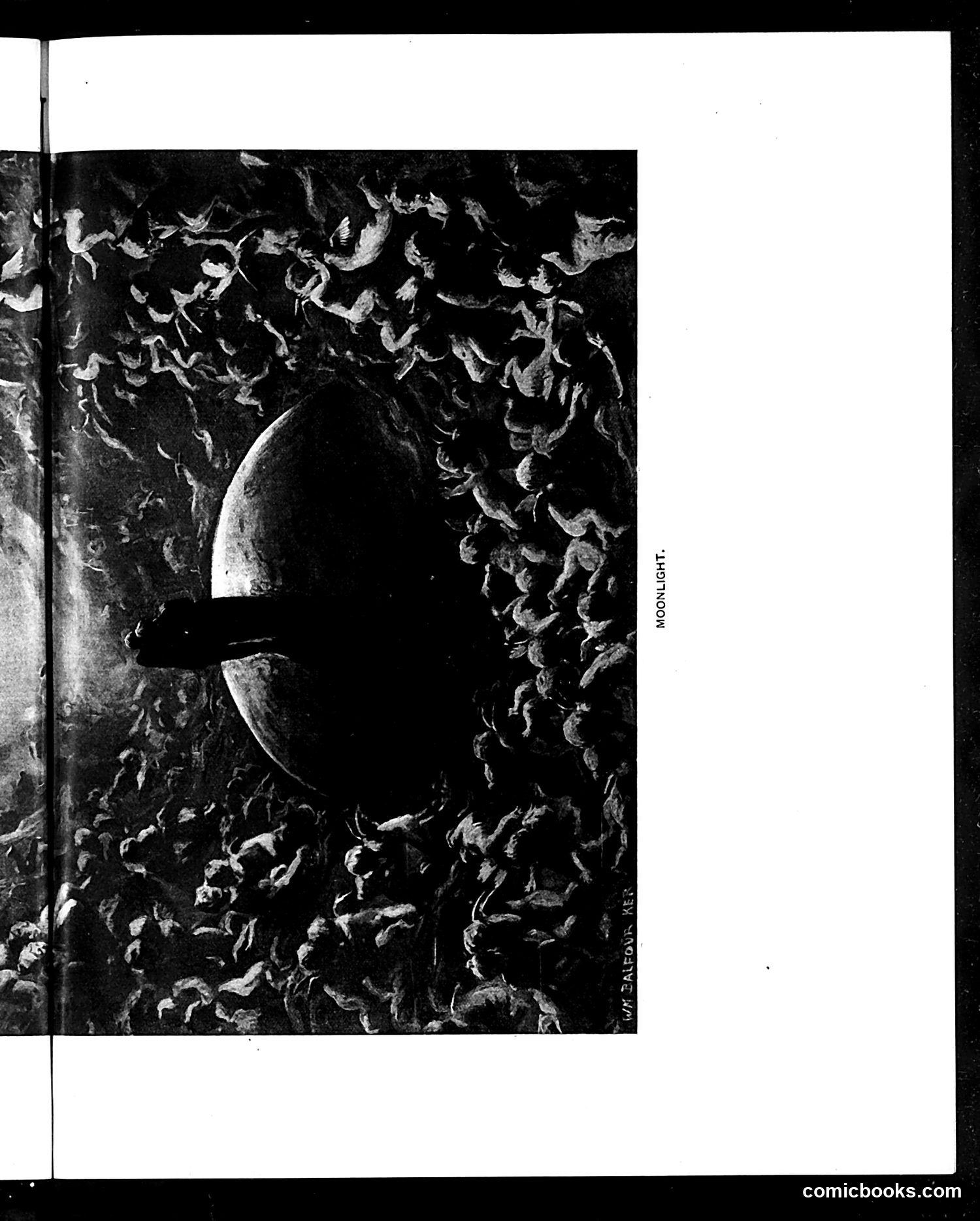
This page appears to be from Life magazine and shows a classical sculptural relief featuring a dramatic profile head surrounded by ornate decorative elements (possibly cherubs or putti). The stark black-and-white photograph emphasizes the sculptural contrast and baroque ornamentation. However, without additional visible text, context, or captions on this particular page, I cannot definitively identify: - What specific sculpture this depicts - What political or social satire it references - Who the figure represents - What the intended joke or commentary is The title "Moonlight" suggests possible romantic or classical themes, but the page as presented doesn't provide sufficient textual evidence to explain the satirical meaning to a modern reader. Additional context from surrounding pages would be needed.
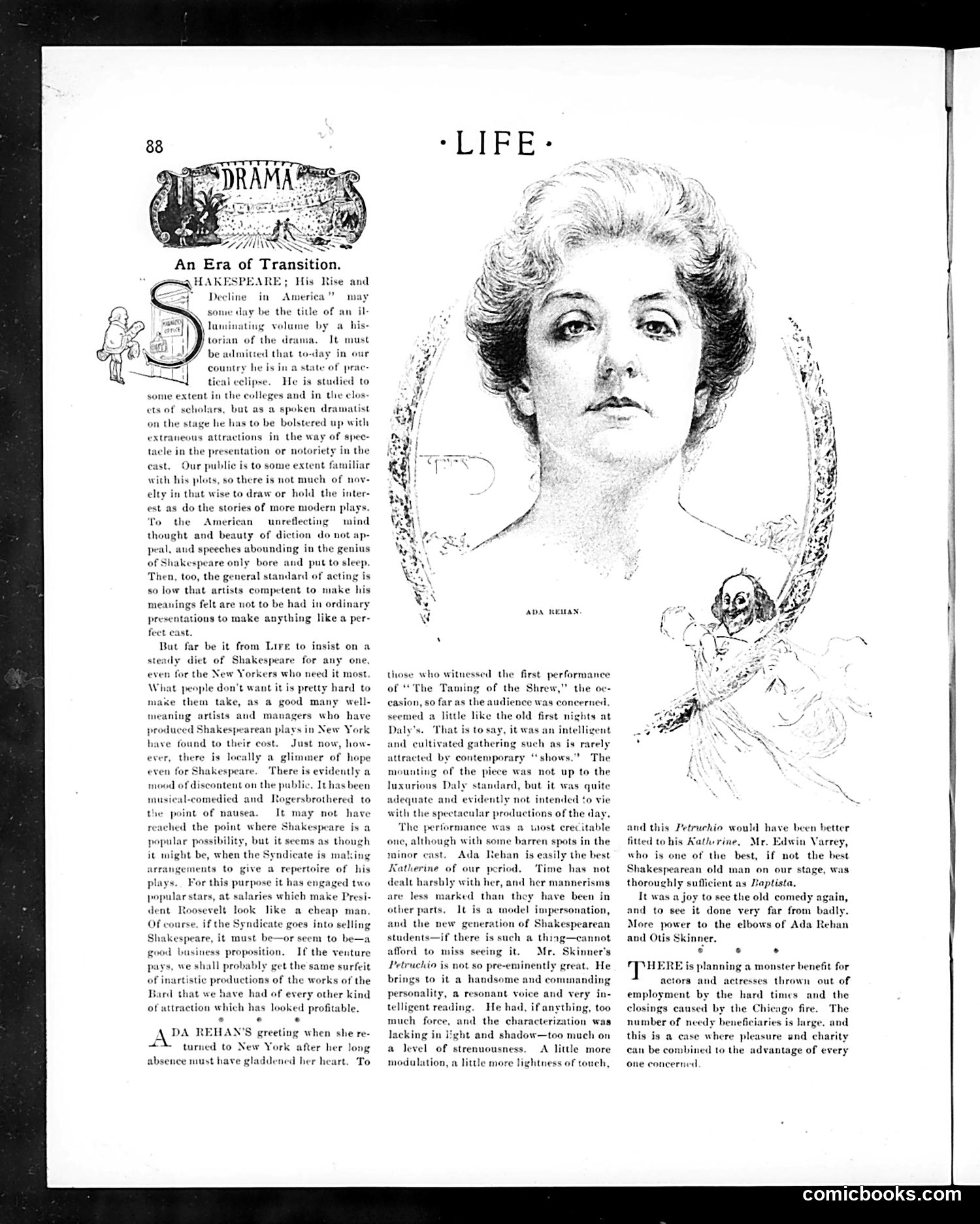
This is a **drama critique page**, not political satire. The main content discusses Shakespeare's relevance in contemporary theater, titled "An Era of Transition." The **large portrait** shows **Ada Rehan**, a prominent actress of the period. The accompanying text praises her performance in *The Taming of the Shrew*, calling her "easily the best Katherine of our period." The critique notes her intelligent, cultivated delivery and discusses how modern Shakespeare productions compare unfavorably to her work. The secondary article discusses a **benefit performance** for actors and actresses affected by recent Chicago fires, emphasizing how charity can combine with entertainment. **No political cartoons appear on this page.** It's primarily theatrical commentary and cultural criticism aimed at educated readers interested in drama and performance arts.
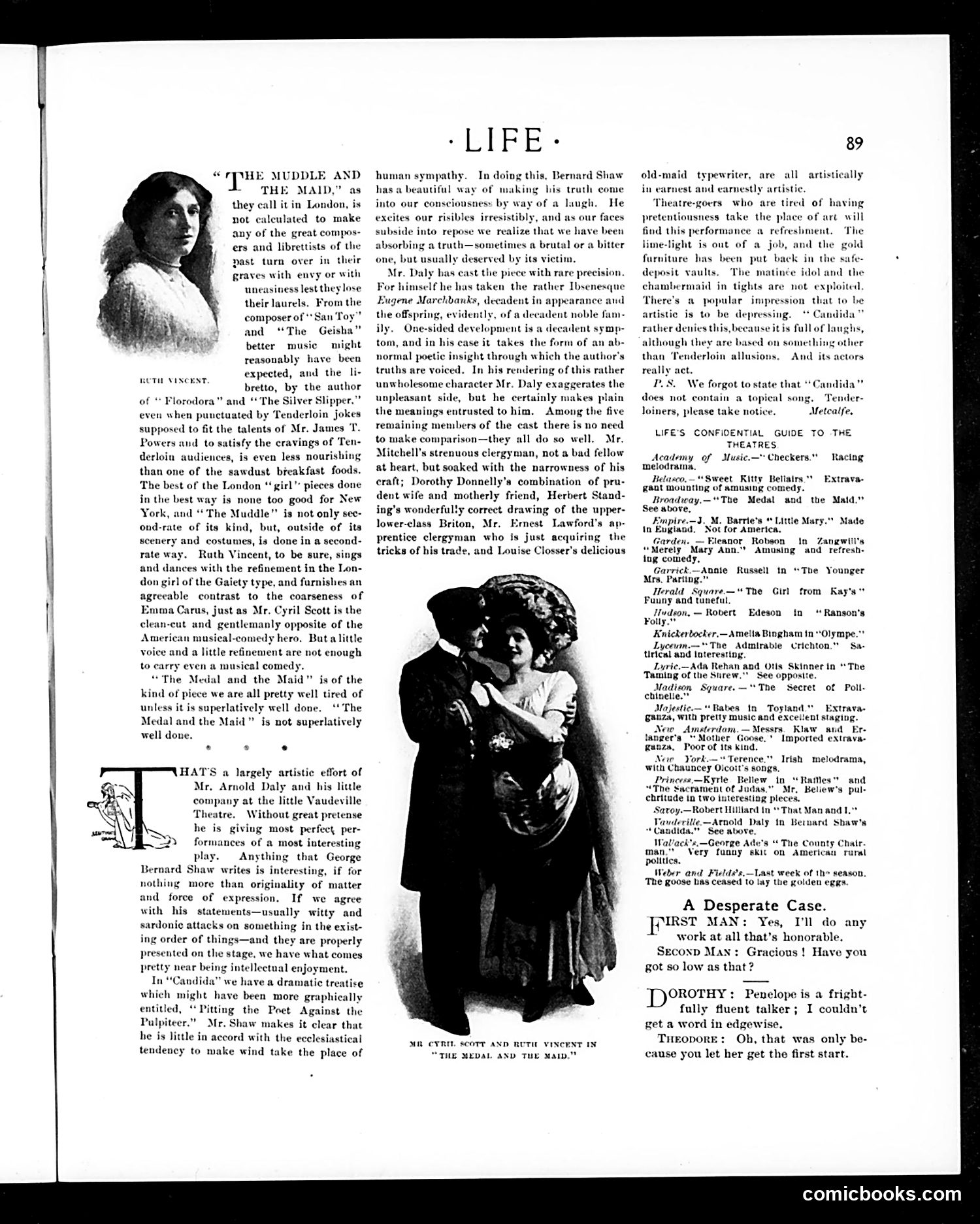
This page contains theater reviews of London productions staged in New York. The main critique discusses "The Medal and the Maid," a musical comedy the reviewer considers mediocre despite featuring refined performer Ruth Vincent. The critic argues that even talented cast members cannot salvage weak source material. The second review praises Arnold Daly's production of George Bernard Shaw's "Candida" at the Vaudeville Theatre. The reviewer emphasizes Shaw's skill at embedding social criticism through humor—attacking ecclesiastical hypocrisy and pretension. Daly is praised for his casting and his nuanced performance as Eugene Marchbanks, the "decadent" poet character through whom Shaw voices his satirical truths. The accompanying photograph shows two performers from "The Medal and the Maid," likely depicting a comedic moment.
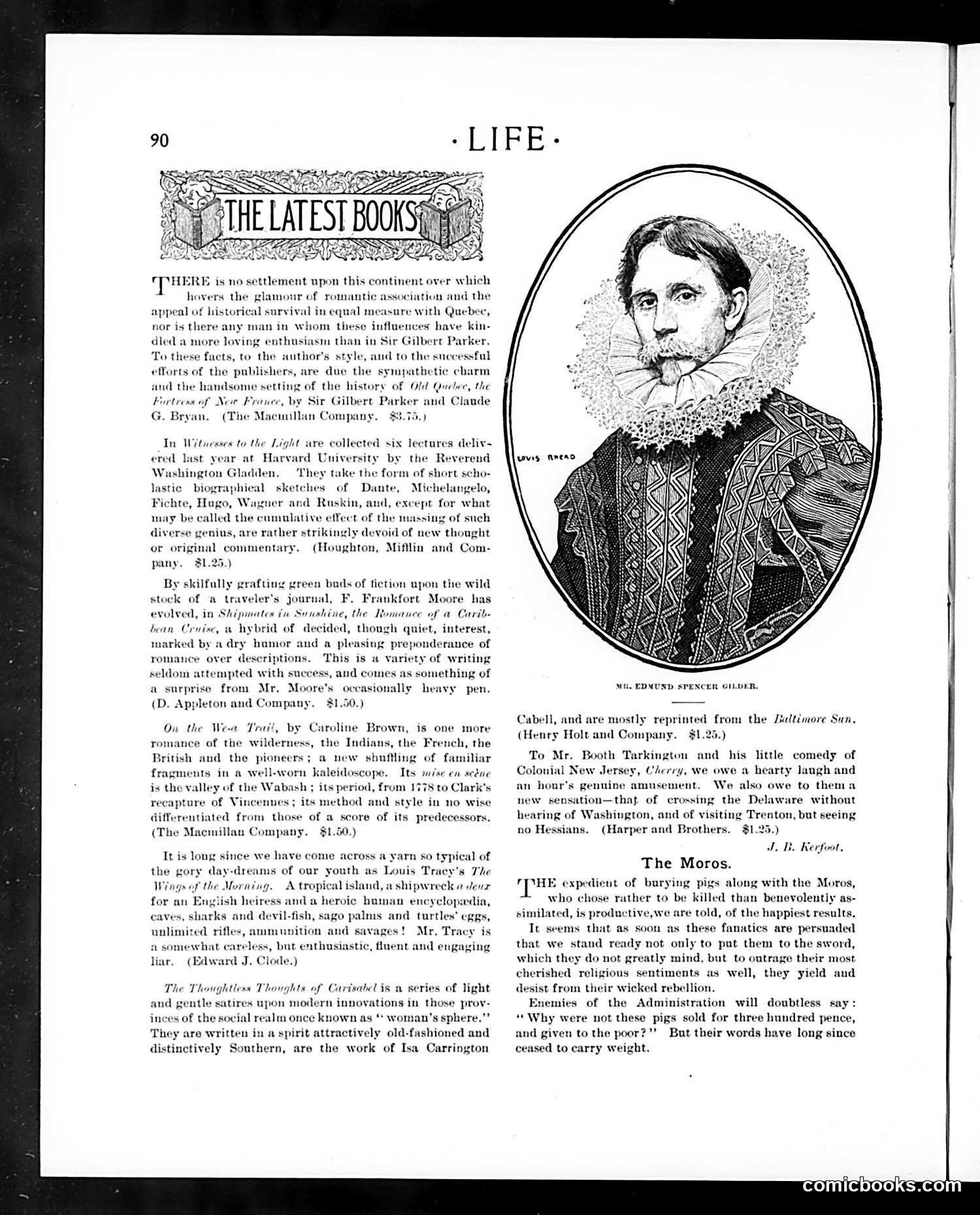
This is a book review section from *Life* magazine featuring literary criticism rather than political satire. The page reviews recent publications including Sir Gilbert Parker's history of Quebec, religious lectures by Reverend Washington Gladden, and various adventure novels. The only illustration is a portrait of **Edmund Spencer Gilder**, likely a literary figure of the period, shown in period costume with an elaborate ruffled collar. The final section, "The Moros," appears to be satirical commentary on U.S. colonial policy in the Philippines. It mocks the practice of burying pigs near Moro Muslim fighters (who would be religiously defiled by pigs) as a military tactic to suppress rebellion. The satire suggests this represents American willingness to violate religious sentiments to achieve pacification—critiquing both the brutality and the cynical calculation of colonial warfare. This is primarily a literary magazine section with one piece of social/political satire embedded within book reviews.
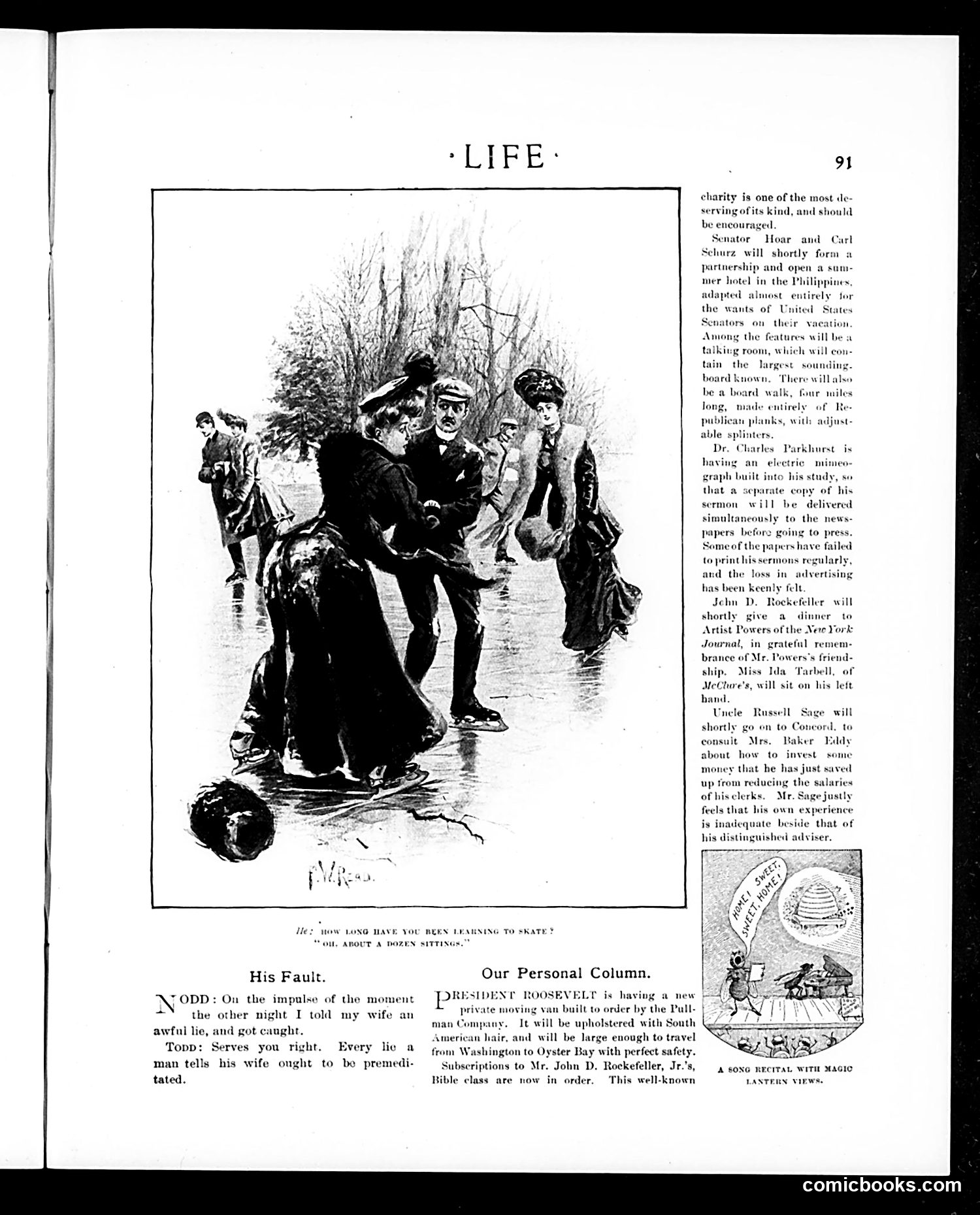
The main cartoon depicts a figure who has fallen on ice, surrounded by onlookers. The caption quotes someone asking "How long have you been learning to skate?" with the response "About a dozen sittings"—a visual pun on the repeated falls (sittings) experienced by a skating novice. This is straightforward slapstick humor about learning to skate poorly. The page also contains satirical gossip items mocking prominent figures of the era (referenced are Senator Hoar, Carl Schurz, Dr. Charles Parkhurst, John D. Rockefeller, and others). These brief notices playfully report on their supposed business ventures and activities in absurdly exaggerated or ironic ways. The "His Fault" joke at bottom presents a domestic humor exchange about marital dishonesty. The overall tone is light satirical commentary on public figures and everyday social situations typical of Life magazine's humor style.
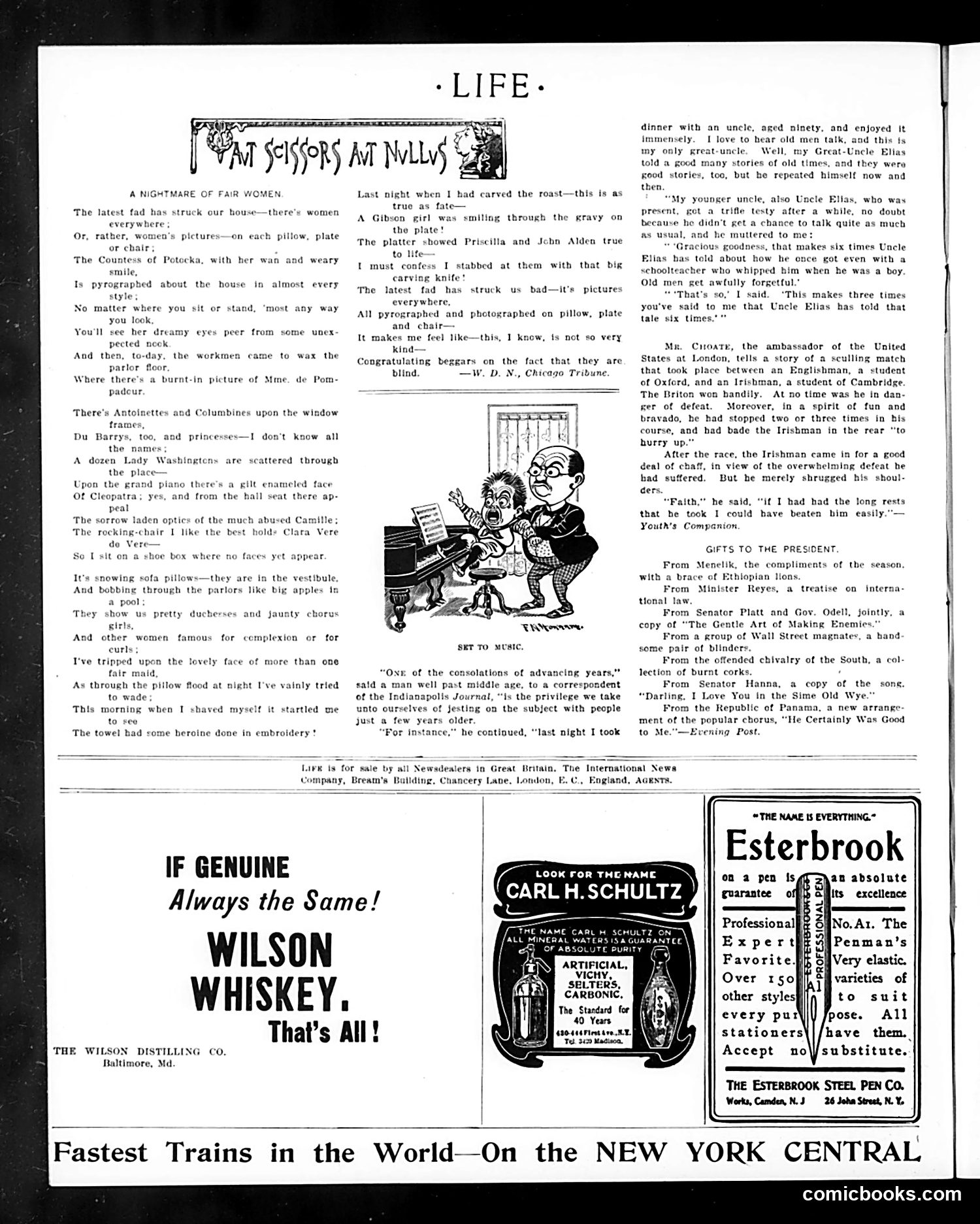
This page satirizes the early 1900s craze for **pyrography**—the decorative burning of images onto household items. The poem "A Nightmare of Fair Women" mocks how this fad has invaded every surface of the author's home: pillows, plates, chairs, and even the roast platter now feature portraits of famous women (Gibson Girls, historical figures like Cleopatra and Priscilla Alden, society women like the Countess of Potocka). The accompanying cartoon illustrates the absurdity: a man comically drowning in an avalanche of decorative pillows bearing women's faces. The satire targets both the fad's excess and the era's obsession with female imagery in domestic decoration. The poem's wit lies in treating this aesthetic invasion as a genuine household disaster—the author literally cannot navigate his own home without encountering idealized female faces. The remaining column contains humorous anecdotes about elderly men repeating stories and a sculling race, typical of Life's satirical content. The page is primarily editorial/humorous content with period advertisements below.
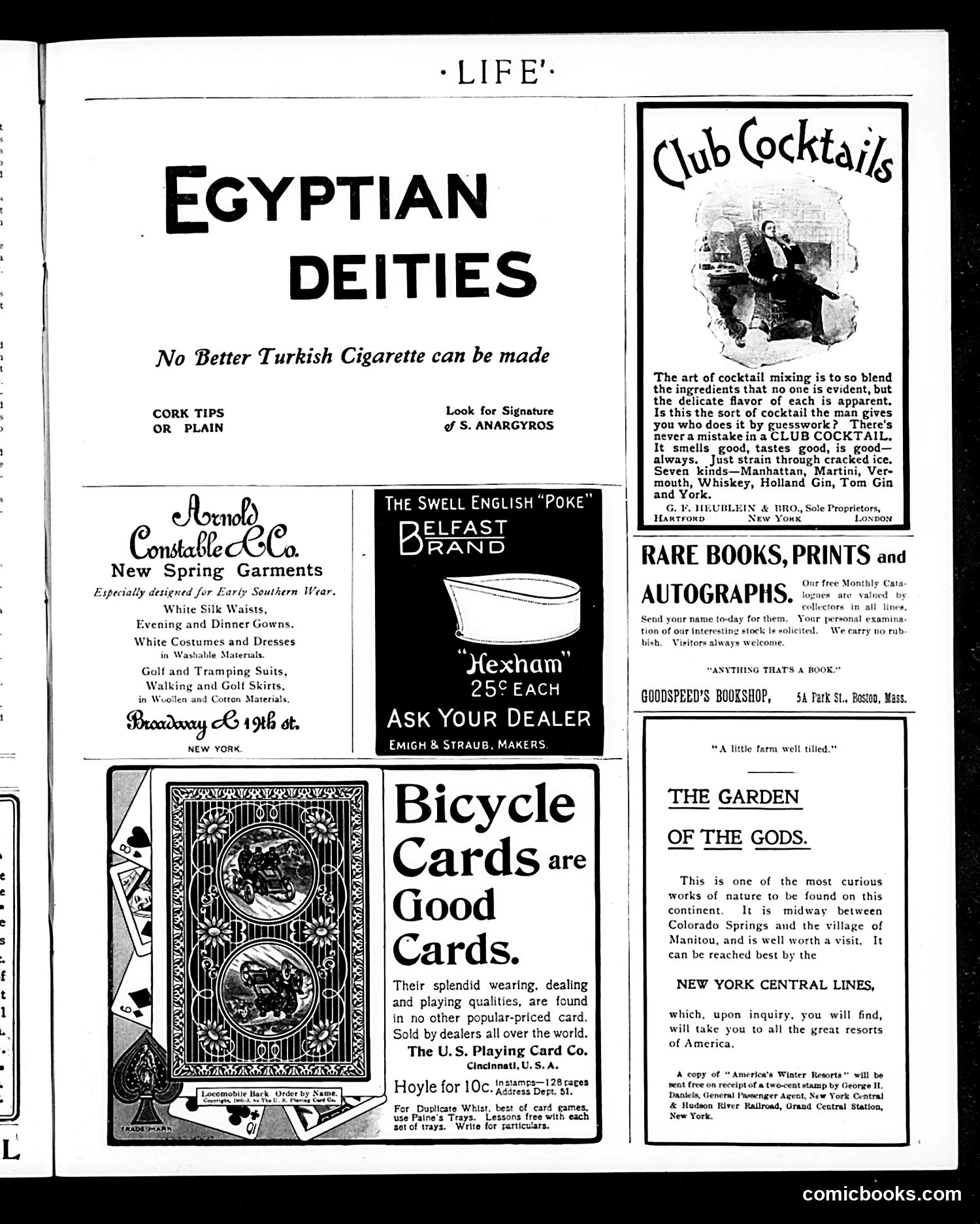
This page is primarily **advertising**, not editorial satire. The dominant content includes ads for Egyptian Deities cigarettes, Arnold Constable clothing, Hexham beef brains (canned meat), Bicycle playing cards, Club Cocktails, rare books, and travel to the Garden of the Gods. The single notable element is the **"Egyptian Deities" cigarette advertisement** at top-left, which uses the exotic appeal of Egyptian imagery as a marketing hook—a common early 20th-century advertising strategy. The claim "No Better Turkish Cigarette can be made" reflects the period's association of Turkish tobacco with premium quality. The page otherwise showcases typical Life-era advertisements targeting affluent readers: luxury garments, fine goods, and travel destinations. There is **no political cartoon or satirical content** visible. This appears to be a standard advertising section from the magazine.
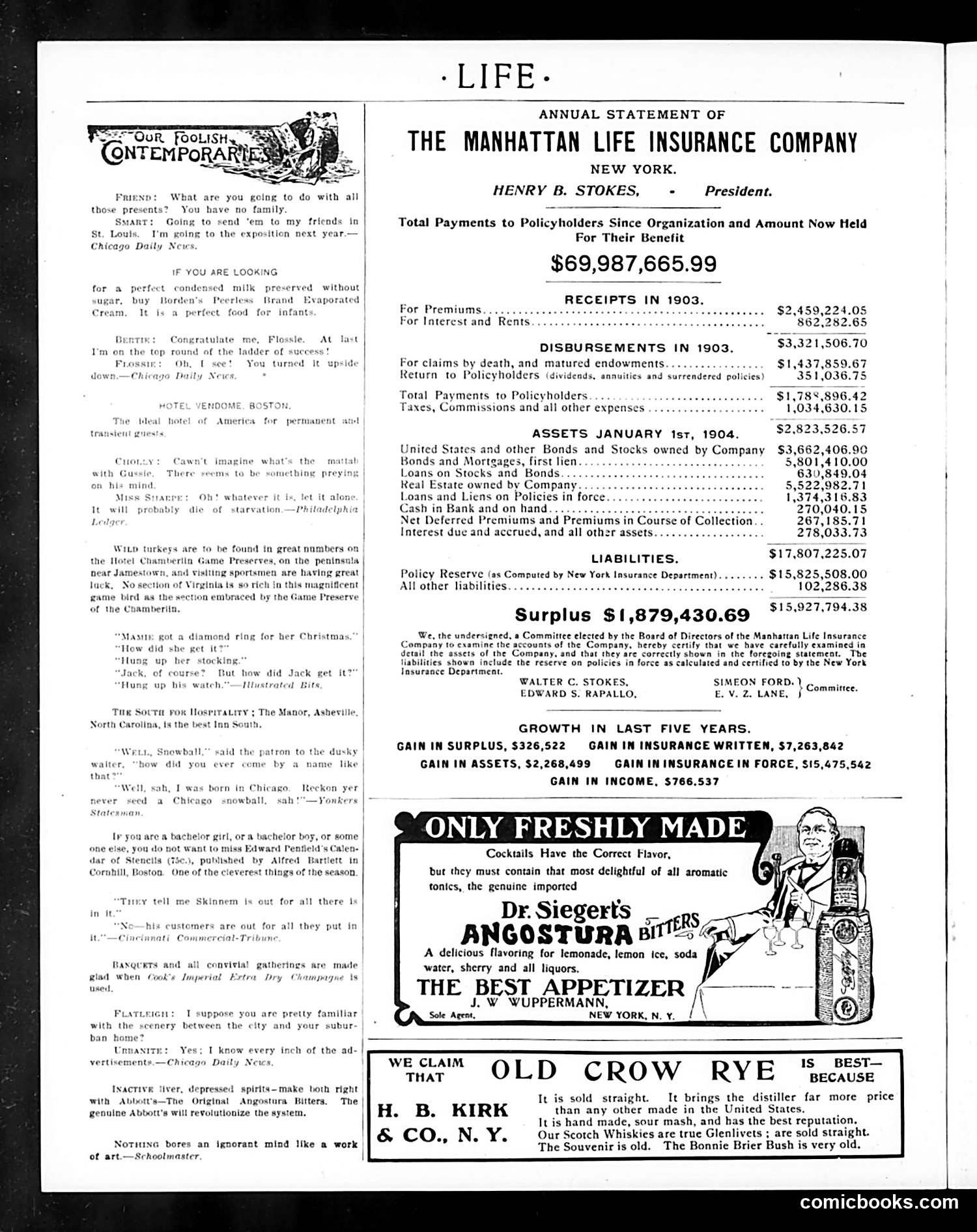
This page is primarily **a corporate financial statement** for the Manhattan Life Insurance Company (1904), not a political cartoon. The bulk of the page presents the company's assets, liabilities, receipts, and disbursements—essentially a detailed annual report showing $69.9 million in total payments to policyholders. The page includes several **humorous anecdotes and jokes** in the left margin (typical of *Life* magazine's format), featuring brief comedic exchanges about everyday topics: a man bragging about attending the 1904 St. Louis exposition, jokes about names and possessions, and Southern hospitality humor. These are gentle, apolitical jokes reflecting early-1900s American life. The **advertisements** dominate the lower half: Dr. Siegert's Angostura Bitters and H.B. Kirk & Co.'s Old Crow Rye whiskey. These ads use typical period marketing language, claiming superiority and authenticity. There are no political cartoons or caricatures on this page—it's a financial disclosure with light entertainment and commercial advertising, representing *Life*'s dual purpose as both satirical magazine and business journal.
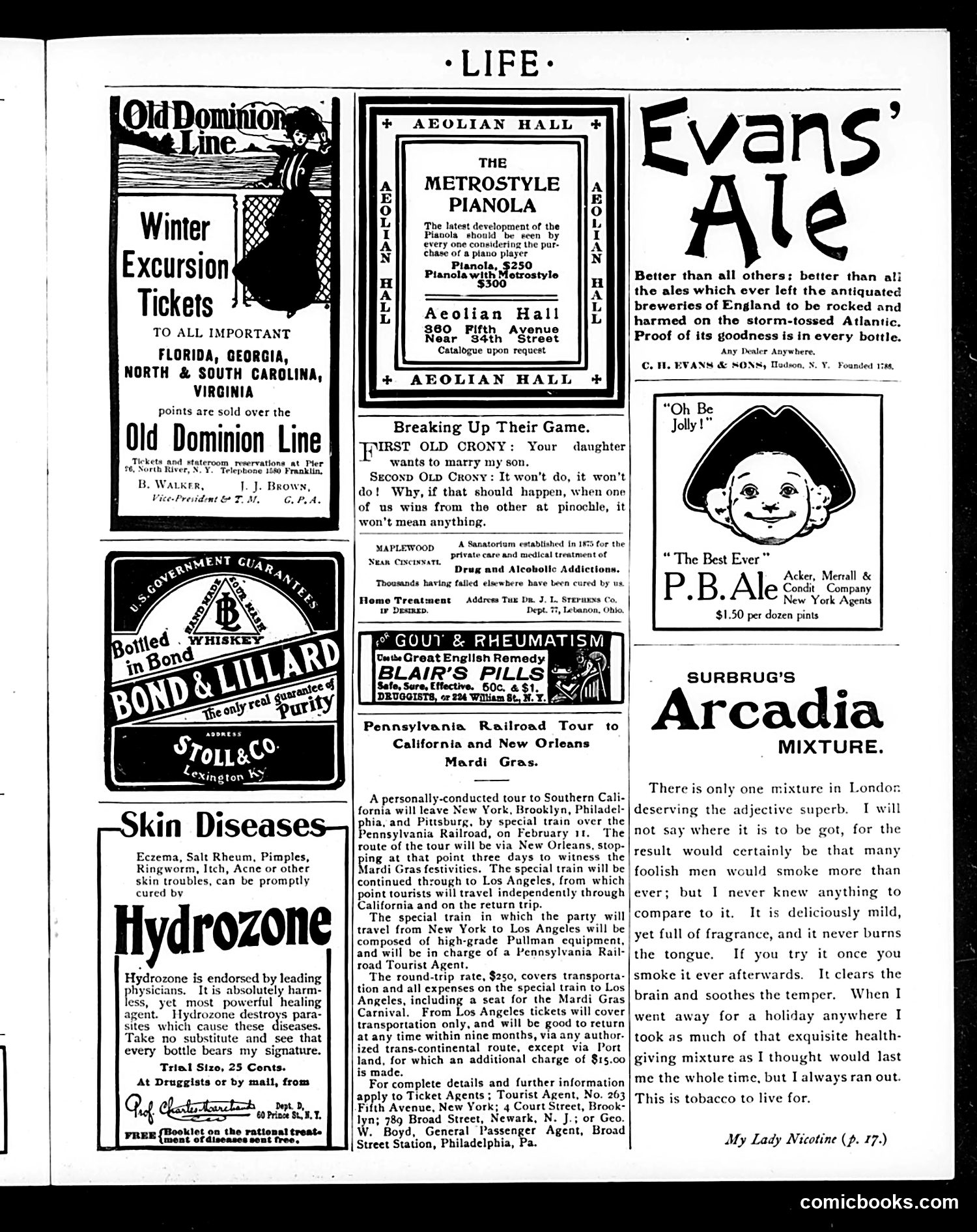
This page is primarily **advertisements** with one small cartoon joke. The cartoon ("Breaking Up Their Game") depicts two elderly men discussing their children's potential marriage. The humor lies in their concern that if their daughter and son marry, they'll lose the competitive stakes of their pinochle card games—winning money from each other will become meaningless within the family. The page otherwise features vintage advertisements for: - Travel (Old Dominion Line steamships, Pennsylvania Railroad Mardi Gras tours) - Patent medicines (Hydrozone for skin diseases, Blair's Pills for gout) - Consumer goods (Aeolian Hall player pianos, Evans' Ale, P.B. Ale, Surbrug's tobacco mixture) - Medical treatment (Maplewood sanitarium for addiction) These ads reflect early 20th-century commercial culture: unregulated medical claims, leisure travel for the wealthy, and alcohol/tobacco prominently advertised without health warnings. The page demonstrates *Life*'s dual role as satirical magazine and advertising vehicle.
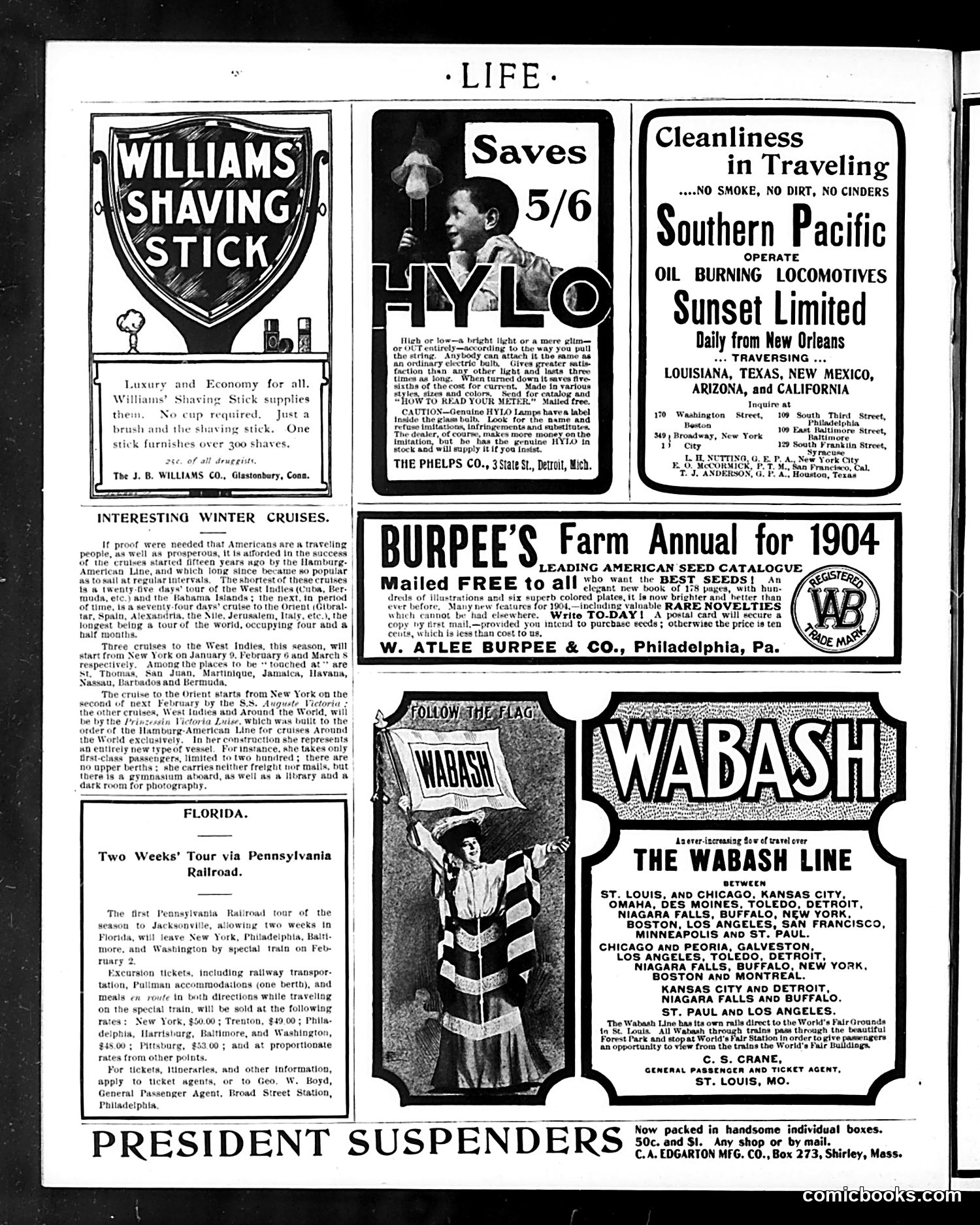
This page is primarily **advertising**, not satire or political commentary. It contains product and service advertisements typical of early 1900s publications: **Notable ads include:** - Williams Shaving Stick (personal grooming) - Hylo lamp (lighting technology) - Southern Pacific Railroad's "Sunset Limited" (oil-burning locomotives) - Winter cruise packages (Hamburg-American Line) - Pennsylvania Railroad Florida tours - Burpee's seed catalog - Wabash railroad line **Historical context for modern readers:** These ads reflect Gilded Age consumer culture—railroads dominated travel, steamship cruises were luxury leisure activities for the wealthy, and mail-order catalogs were major retail channels. The emphasis on "cleanliness" and "comfort" in transportation reflects early anxieties about industrial travel's dirt and dangers. The page documents how Americans of this era marketed modern conveniences and leisure opportunities to an affluent audience through magazines like Life.
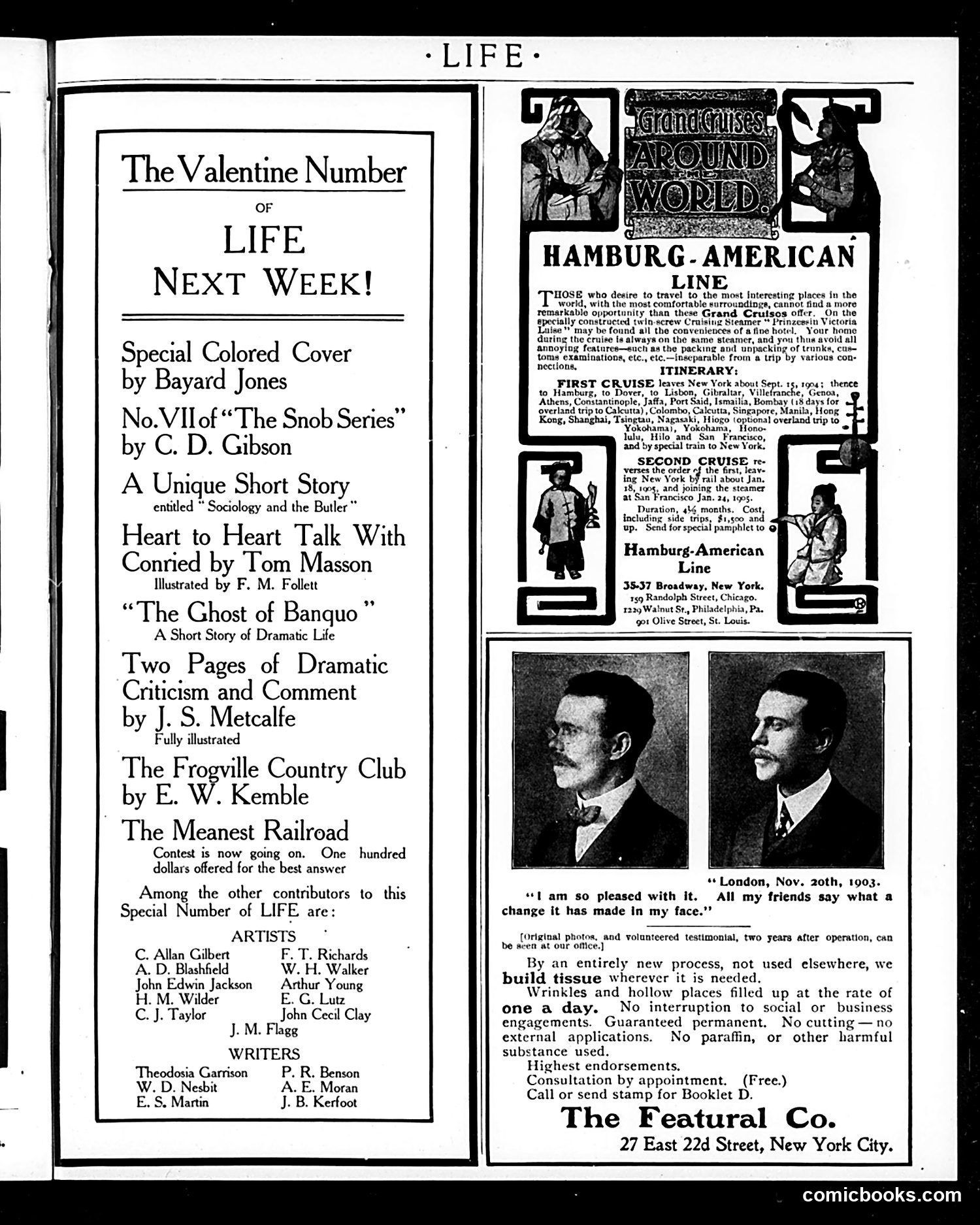
This page is primarily **promotional/advertising content** rather than political satire. It announces next week's "Valentine Number" of Life magazine, listing contributing writers and artists (including C.D. Gibson, known for "The Snob Series"). The right side features two distinct advertisements: 1. **Hamburg-American Line**: A cruise ship company advertising luxury world travel, with detailed itineraries for two separate cruises departing from New York. 2. **The Featural Co.**: A cosmetic/medical procedure advertisement featuring two men's portraits and a testimonial dated "London, Nov. 20th, 1903." The ad promotes tissue-building treatments for wrinkles, claiming results appear within "one a day" with "no cutting" required. This appears to be early 20th-century cosmetic surgery marketing, likely targeting wealthy clients concerned with aging. The ad's emphasis on discretion ("no interruption to social or business engagements") suggests the procedure was considered somewhat novel or sensitive at the time.
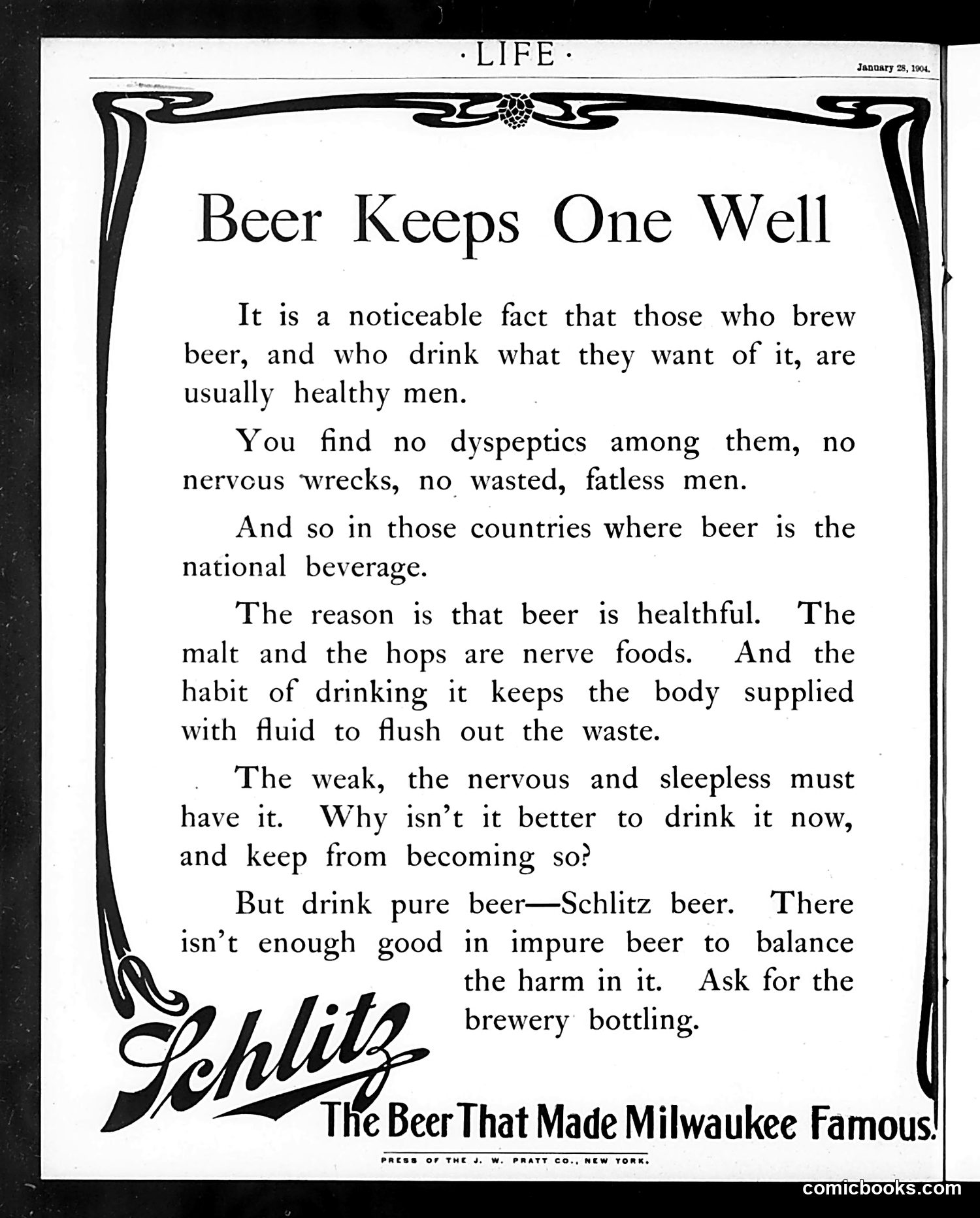
This is a **Schlitz beer advertisement**, not political satire. Published January 29, 1904, it promotes beer as a health tonic—a common marketing claim in the early 1900s before modern food and drug regulations. The ad claims beer prevents nervousness, digestive problems, and weakness. It positions Schlitz as superior because it's "pure," implying competitors' beers contained harmful impurities. The argument that beer provides "nerve foods" (malt and hops) and flushes bodily waste reflects period pseudo-scientific health claims. The phrase "The Beer That Made Milwaukee Famous" was Schlitz's actual slogan, reflecting Milwaukee's prominence in American brewing. **For modern readers**: This reveals how differently alcohol was marketed and perceived a century ago—as preventative medicine rather than a recreational beverage, before medical science debunked such claims.