
Life, 1904-01-28 · page 14 of 22
Life — January 28, 1904 — page 14: what you’re looking at
What you’re looking at
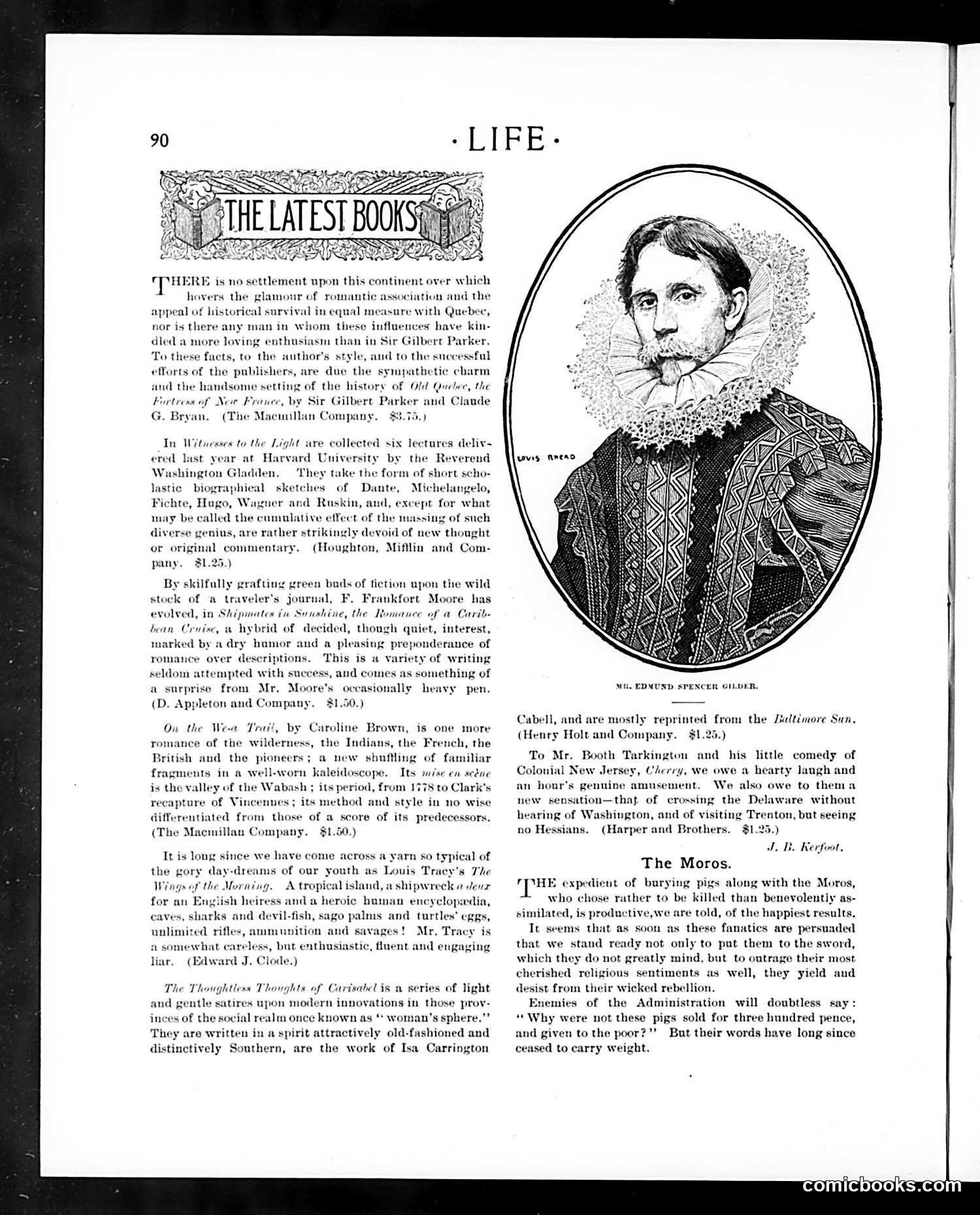
This is a book review section from *Life* magazine featuring literary criticism rather than political satire. The page reviews recent publications including Sir Gilbert Parker's history of Quebec, religious lectures by Reverend Washington Gladden, and various adventure novels. The only illustration is a portrait of **Edmund Spencer Gilder**, likely a literary figure of the period, shown in period costume with an elaborate ruffled collar. The final section, "The Moros," appears to be satirical commentary on U.S. colonial policy in the Philippines. It mocks the practice of burying pigs near Moro Muslim fighters (who would be religiously defiled by pigs) as a military tactic to suppress rebellion. The satire suggests this represents American willingness to violate religious sentiments to achieve pacification—critiquing both the brutality and the cynical calculation of colonial warfare. This is primarily a literary magazine section with one piece of social/political satire embedded within book reviews.
📄 Transcribed text from this page (OCR, searchable)
Machine-transcribed from the original scan — historical spelling and the odd misread are preserved.
[HERE is no settlement upon this continent over which hovers the glamour of romantic association and the appeal of historical survival in equal measure with Quebec, nor is there any man in whom these influences have kin- dled a more loving enthusiasm than in Gilbert Parker. To these facts, to the author's style, and to the successful efforts of the publishers, are duc the and the handsome setting of the history of Old Quebec, the New Franee, by Sir Gilbert Parker and Claude (The Macmillan Company. smpathetic charm G. Bryan. ‘ed six lectures deliv- iversity by the Reverend hington Gladden, ey take the form of short scho- biographical sketches of Dante, Michelangelo, Fichte, Hago, Waguer and Ruskin, and, except for what may be called the cumulative effect of the massing of such diverse genius, are rather strikingly devoid of new thought or original commentary. (Houghton, Mifflin and Com- pany. 5.) In Witnesses to the Light are ot last year at Ha By skilfully grafting green buds of fiction upon the wild stock of a traveler's journal, F. Frankfort Moore has evolved, in Shipmates in Sunshine, the Romance of a Carib- bean Cruise, a hybrid of decided, though quiet, interest, marked by a dry hamor and a pleasing preponderance of romance over descriptions. This is a variety of writing seldom attempted with success, and comes as something of a surprise from Mr, Moore’s occasionally heavy pen. (D. Appleton and Company, 31.50.) On the Wee Trail, by Caroline Brown, is one more romance of the wilderness, the Indians, the French, the British and the pioneers; a new shuffling of familiar fragments in a well-worn kaleidoscope. is the valley of the Wabash ; its period, from 1778 to Clark’ recapture of Vincennes; its method and style in no wise differentiated from those of a score of its predecessors. (The Macmillan Company. $1.50.) Its mise en scone It is long since we have come across a yarn so typical of the gory day-dreams of our youth as Louis Tracy's The A tropical island, a shipwreck @ der anda heroic human encyclopiwdia, I-fish, sago palms and turtles’ eggs, mmunition and savages! Mr. Tracy is 2 somewhat careless, but enthusiastic, fluent and engaging ‘d J. Clode.) Wings of the Mornin ughtless Thoughts of Carisabel is a series of light and gentle satires upon modern innovations in those prov- inces of the social realm once known as ‘ woman's sphere.”’ They are written in a spirit attractively old-fashioned and distinctively Southern, are the work of Isa Carrington doves ANEAD. Mi. EDMUND SPENCER GILDER, Cabell, and are mostly reprinted from the Dultimore Sun. (Henry Holt and Company. #) To Mr. Booth Tarkington and his little comedy of Colonial New Jersey, Cherry, we owe a hearty laugh and an hour's gennine amusement. We also owe to them a new sensation—that of crossing the Delaware without hearing of Washington, and of visiting Trenton, but seeing no Hessians. (Harper and Brothers. $1.25.) J.B. Kerfoot, The Moros. TPHE expedient of burying pigs along with the Moros, who chose rather to be killed than benevolently as- similated, is productive,we are told, of the happiest results. It seems that as soon as these fanatics are persuaded that we stand ready not only to put them to the sword, which they do not greatly mind, but to outrage their most cherished religious sentiments as well, they yield aud desist from their wicked rebellion. Enemies of the Admi ration will doubtless say: “Why were not these pigs sold for three hundred pence, and given to the poor?’’ But their words have long since ceased to carry weight.