
Life, 1904-01-28 · page 4 of 22
Life — January 28, 1904 — page 4: what you’re looking at
What you’re looking at
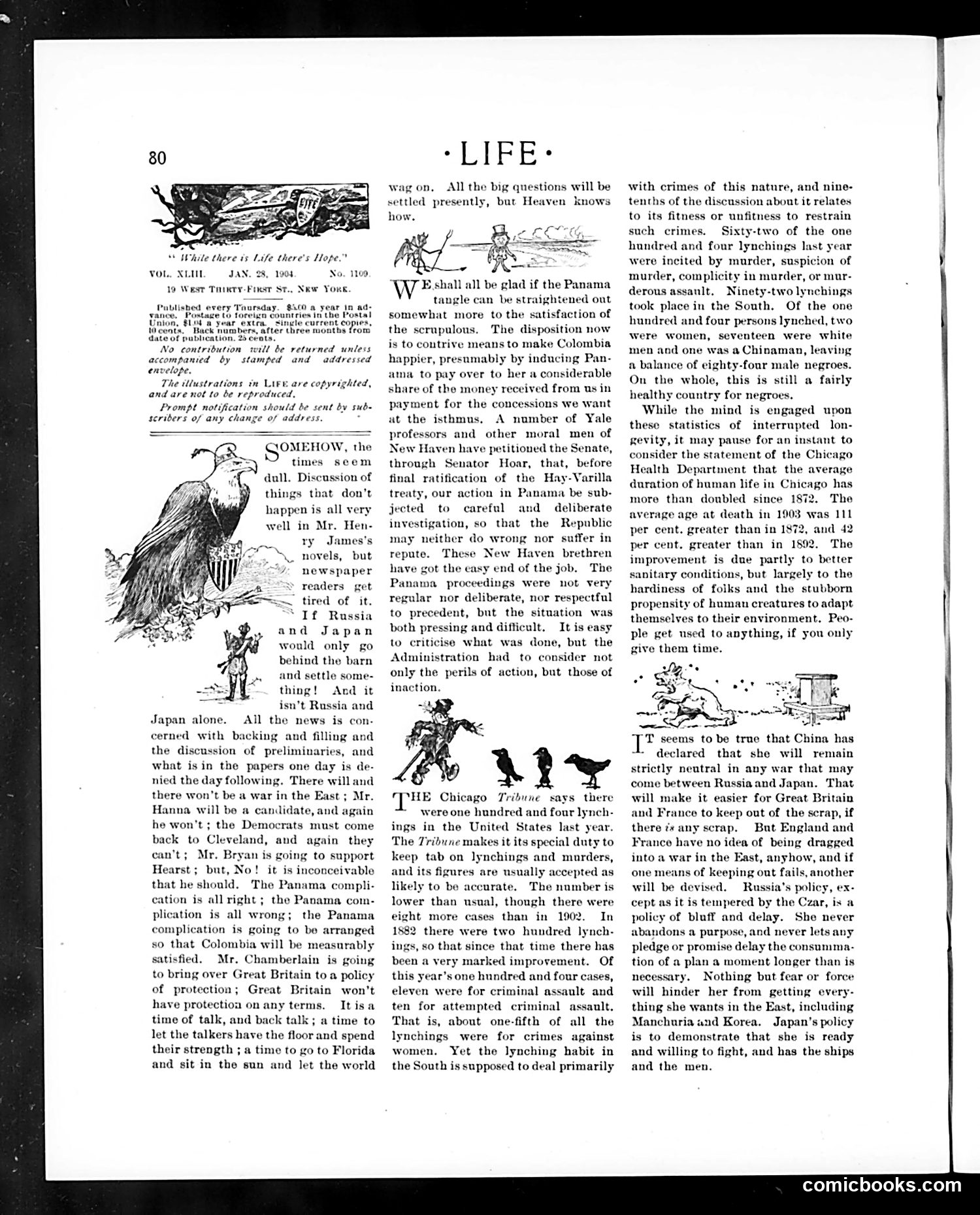
This page contains editorial commentary on contemporary political issues rather than traditional political cartoons. The illustrations are decorative rather than satirical caricatures. The text discusses the Panama Canal negotiations, criticizing both American intervention and the complexity of the situation. It references Senator Hanna and Yale professors advocating for careful deliberation before ratification. The page also critiques lynching in America, citing Chicago Tribune statistics showing 104 lynchings in the previous year. The writer contrasts American moral criticism of Russia and Japan's violence with America's own racial violence problem. Finally, it addresses China's declared neutrality regarding potential Russia-Japan conflict, suggesting Japan seeks to demonstrate readiness to fight while maintaining diplomatic advantage in Manchuria and Korea. The tone is satirical editorial commentary rather than visual satire.
📄 Transcribed text from this page (OCR, searchable)
Machine-transcribed from the original scan — historical spelling and the odd misread are preserved.
VoL. XLUL 0 No. New Yous. 1109. raday. $400 a year In ad- en countries in the Postal urrent copies, months from Union, $Lot a year ack numbers, after Uh of pabheation. 2 cents. No contribution will be returned untess accompanied by stamped and addressed envelope. The illustrations in Lire are copyrighted, and are not to be reproduced, Prompt notification should be sent by sube scribers of any change of address. QR Gom EHOW, the va) times seem dull. Discussion of things that don’t happen is all very well in Mr. Hen- ry Jame novels, but newspaper readers get tired of it. “If Russia and Japan would only go behind the barn and settle some- thing! And it isn’t Russia and All the news is con- cerned with backing and filling and the discussion of preliminaries, and what is in the papers one day is de- nied the day following. There will and there won't be a war in the East ; Mr. Hanna will be a candidate, and he won't ; the Democrats must come back to Cleveland, and again they can't; Mr. Bryan is going to support Hearst; but, No! it is inconceivable that he should. The Panama compli- cation is all right; the Panama com- plication is all wrong; the Panama complication is going to be arranged so that Colombia will be measurably satisfied. Mr. Chamberlain is going to bring over Great Britain to a policy of protection; Great Britain won't have protection on any terms. It is a time of talk, and back talk ; a time to let the talkers have the floor and spend their strength ; a time to go to Florida and sit in the sun and let the world Japan alone. + LIFE* wag on, All the big questions will be settled presently, but Heaven knows how. V E shall all be glad if the Panama tangle can be straightened out somewhat more to the satisfaction of the scrapulous. The disposition now is to contrive means to make Colombia happier, presumably by inducing Pan- ama to pay over to her a considerable share of the money received from us in payment for the concessions we want at the isthmus, A number of Yale professors and other moral men of New Haven have petitioned the Senate, through Senator Hoar, that, before final ratification of the H Varilla treaty, our action in Panama be sub- jected to careful and deliberate investigation, so that the Republic may neither do wrong nor suffer in repute. These New Haven brethren have got the easy end of the job. The Panama proceedings were not very regular nor deliberate, nor respectful to precedent, but the situation was both pressing and difficult. It is easy to criticise what was done, but the Administration had to consider not only the perils of action, but those of Aty (THE Chicago Tribune says there were one hundred and four lynch- ings in the United States last year. The Tribune makes it its special duty to keep tab on lynchings and murders, and its figures are usually accepted as likely to be accurate. The number lower than usual, though there we! eight more cases than in 1902. In 1882 there were two hundred lynch- ings, so that since that time there has been a very marked improvement. Of this year’s one hundred and four cases, eleven were for criminal assault and ten for attempted criminal assault. That is, about one-fifth of all the lynchings were for crimes against women. Yet the lynching habit in the South is supposed to deal primarily ~ with crimes of this nature, and nine- tenths of the discussion about it relates to its fitness or unfitness to restr: such crimes. Sixty-two of the one hundred and four lynchings last year were incited by murder, suspicion of murder, complicity in murder, or mur- derous assault, Ninety-two lynchings took place in the South. Of the one hundred and four persons lynched, two were women, seventeen were white men and one was a Chinaman, leaving a balance of eighty-four male negroes. On the whole, this is still a fairly healthy country for negroes, While the mind is engaged upon th statistics of interrupted lon- gevity, it may pause for an instant to consider the statement of the Chicago Health Department that the average duration of human life in Chicago has more than doubled since 1872, The average age at death in 1903 was 111 per cent. greater than in 1872, and 42 per cent. greater than in 1892. The improvement is due partly to better sanitary conditions, but largely to the hardiness of folks and the stubborn propensity of human creatures to adapt themselves to their environment. Peo- ple get used to anything, if you only give them time. d t a rT seems to be true that China has declared that she will remain strictly neutral in any war that may come between Russia and Japan. That will make it easier for Great Britain and France to keep out of the scrap, if there ‘x any scrap. But England and Franco have no idea of being dragged into a war in the East, anyhow, and if one means of keeping out , another will be devised. Russia's poli cept as it is tempered by the Czar, is a policy of bluff and delay. She never abandons a purpose, and never lets any pledge or promise delay the consumma- tion of a plan a moment longer than is necessary. Nothing but fear or force will hinder her from getting every- thing she wants in the East, including Manchuria and Korea. Japan's policy is to demonstrate that she is ready and willing to fight, and has the ships and the men. comicbooks.com