
Life, 1904-01-28 · page 13 of 22
Life — January 28, 1904 — page 13: what you’re looking at
What you’re looking at
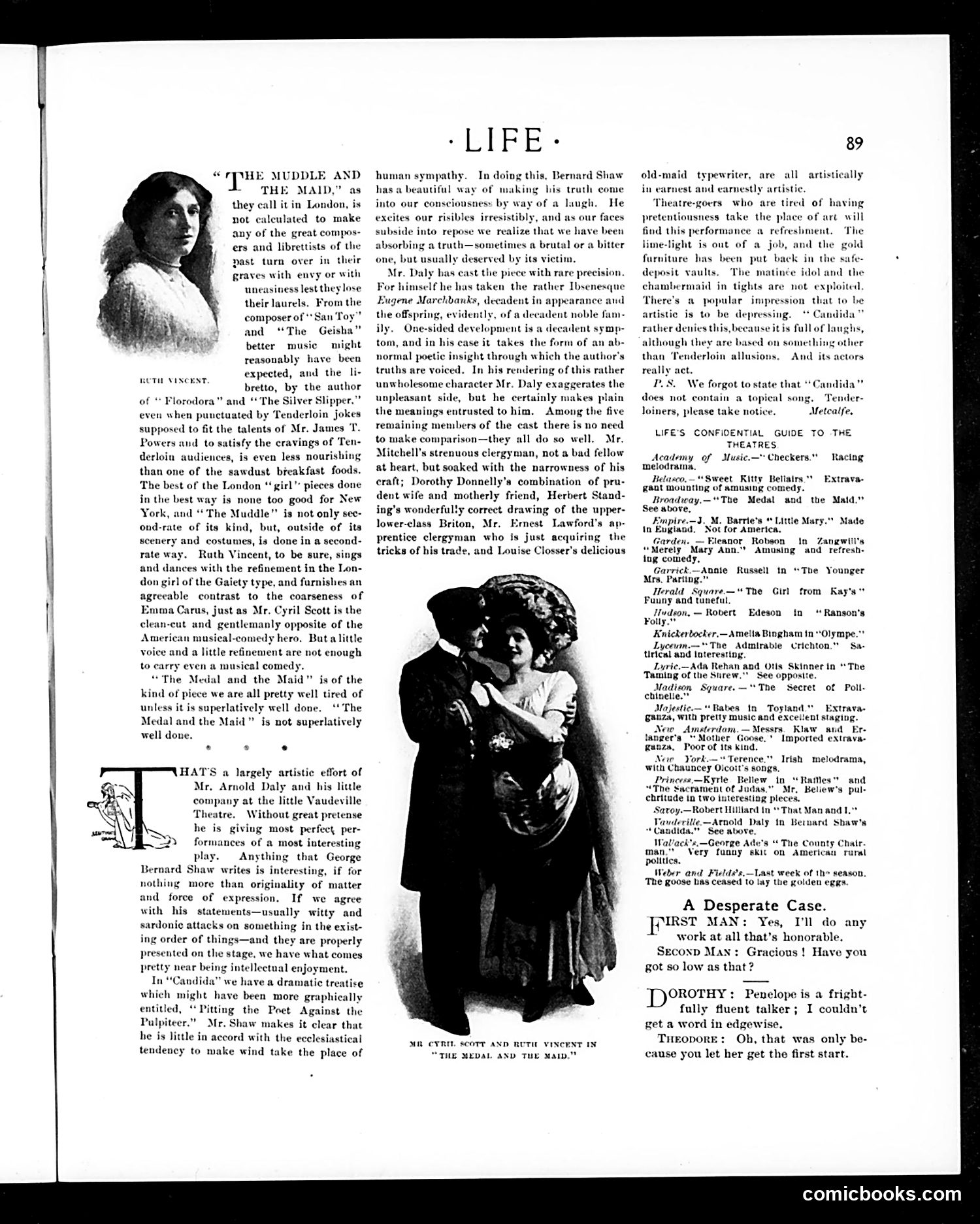
This page contains theater reviews of London productions staged in New York. The main critique discusses "The Medal and the Maid," a musical comedy the reviewer considers mediocre despite featuring refined performer Ruth Vincent. The critic argues that even talented cast members cannot salvage weak source material. The second review praises Arnold Daly's production of George Bernard Shaw's "Candida" at the Vaudeville Theatre. The reviewer emphasizes Shaw's skill at embedding social criticism through humor—attacking ecclesiastical hypocrisy and pretension. Daly is praised for his casting and his nuanced performance as Eugene Marchbanks, the "decadent" poet character through whom Shaw voices his satirical truths. The accompanying photograph shows two performers from "The Medal and the Maid," likely depicting a comedic moment.
📄 Transcribed text from this page (OCR, searchable)
Machine-transcribed from the original scan — historical spelling and the odd misread are preserved.
“NHE MUDDLE AND - THE MAID,” as they call it in London, is not calculated to make any of the great compos- ers and librettists of the past turn over in their graves with envy or with uneasiness lest they lose their laurels. From the composer of "San Toy” and “The Geisha” better music might reasonably have been expected, and the li- bretto, by the author of © Florodora” and ‘ The Silver Slipper.” even when punctuated by ‘Tenderloin supposed to fit the talents of Mr. James ‘T. Powers and to satisfy the cravings of Ten- derloin audiences, is even less nourishing than one of the sawdust breakfast food The best of the London “ girl” pieces done in the best way is none too good for New York, and “The Muddle”’ is not only sec- ond-rate of its kind, but, outside of its scenery and costumes, is done in a second- rate way. Ruth Vincent, to be sure, sings and dances with the refinement in the Lon- don girl of the Gaiety type, and furnishes an agreeable contrast to the coarseness of Emma Carus, just as Mr. Cyril Scott is the clean-cut and gentlemanly opposite of the American musical-comedy hero. Buta little voice and a little refinement are not enough to carry even a musical comedy. “The Medal and the Maid” is of the kind of piece we are all pretty well tired of unless it is superlativ well done. ‘The Medal and the Maid” is not superlatively well done. RUT VINCENT. HATS a largely artistic effort of Mr. Arnold Daly and his little company at the little Vaudeville ‘Theatre. Without great pretense he is giving most perfect per- formances of a most interesting pl Anything that George Bernard Shaw writes is interesting, if for nothing more than originality of matter and force of expression. If we agree with his statements—usually witty and sardonic attacks on something in the exist ing order of things—and they are properly presented on the stage, we have what comes pretty 1 being intellectual enjoyment. In “Candida” we have a dramatic treatise which might have been more graphically entitled, “Pitting the Poet Against the Pulpiteer.”| Mr. Shaw makes it clear that he is little in accord with the ecclesiastical tendency to make wind take the place of ao be cl olan y In doing this, Bernard Shaw has a beautiful way of making his truth come into our consciousness by way of a langh. He excites our risibles irresistibly, and as our ff subside into repose we realize that we have | absorbing a truth—sometimes a brutal or a bitter one, but usually deserved by its vietim, Mr. Daly has cast the piece with rare precision For himself he has taken the rather Ibsenesque Eugene Marchbanks, decadent in appearance and the offspring, evidently, of a decadent noble fam- ily. One-sided development is a decadent symp- tom, and in his case it takes the form of an ab- normal poetic insight through which the author's truths are voiced. In his rendering of this rather unwholesome character Mr. Daly exaggerates the unpleasant side, but he certainly makes plain the meanings entrusted to him. Among the five remaining members of the cast there is no need to make comparison—they all do so well. Mr. Mitchell's strenuous clergyman, not a bad fellow at heart, but soaked with the narrowness of his craft; Dorothy Donnelly’s combination of pru- dent wife and motherly friend, Herbert Stand- ing’s wonderful!y correct drawing of the upper- lower-class Briton, Mr. Emest Lawford's ap- prentice clergyman who is just acquiring the tricks of his trade, and Louise Closser’s delicious res q MR CYRIL. SCOTT AND RUTIC VINCENT IN “THE MEDAL AND THE warp,” 89 old-maid typewriter, are all artistically rtistic. nd earnestly i Theatre-goers who are tired of 1 pretentiousness take the place of art will find this performance a refreshment. The lime-light is out of a job, and the gold furniture has been put in the safe deposit vaults. The matince idol and the chambermaid in tights are not exploited There's a popular impression that to be artistic * Candida” rather denies this,beeause it is full of laughs, although the is to be depressin are based on something other than Tenderloin allusions, And its actors ct. real 2S. We forgot to state that “Candida” does not contain a te song. Tender- loiners, please take notice. Metcalfe, LIFES CONFIDENTIAL GUIDE TO THE THEATRES Academy of Music." Checkers." Racing melodrama, Belasco,“ Sweet Kitty Beliairs.” Extrava- gant mounting of amusing comedy. Broadway.—"The Medal and the Maid.” See above. Empire.—3, M. Barrie's * Little Mary. in Eugiand, Not for America. Garde Eleanor Robson in Zangwtil's “Merely Mary Ann.” Atnosing and refresh tng comedy, Garrick.—Anoie Russell in “The Younger Mrs, Parting.” Herald Square—The Girl from Kay's” Fuuny and tuneful. Hudson, — Robert Edeson in“ Ranson's Folly.” Knickertocker.— Amelia Bingham in “Olympe. Lycevm.—"The Adinirable Crichton." Sa- trical and tateresting. Lyric.— Ada Rehan and Ots Skinner in “The ‘Taming of the Shrew." See oppostte. Madison Sguare.—“The Secret of Poll- chinelie. Majestic.—“ Babes 1n Tosland.” Extrava- gauza, with pretty music and excellent staging. New, Amsterdam. — Messrs. Klaw and Ere langer's “Mother Goose, * Imported extrava- aza, Poor of tts kind, Nee York.—“ Terence." Irish melodrama, with Chauncey Olcoit’s songs, Princess Kyrie Bellew in *Railes* and. “The Sacrament of Judas." Mr, Beliew's pul- chritude in two interesting pleces. Satoy.—Robert Hilliard tn That Man and 1." Vanderille—Arnold Daly tn Betuard Shaw's “Candida.” See above. Watvack"s.—George Ade's “ Tue County Chair. man.” Very funny skit on American rural polltics. Weber and Fields's,—Last week of the season, ‘The goose has ceased to lay the golden eggs Made A Desperate Case. yrst MAN: Yes, I'll do any work at all that’s honorable. Seconp Man: Gracious ! Have you got so low as that? T)OROTHY : Penelope is a fright- fully fluent talker; I couldn't get a word in edgewise. TuroporE: Ob, that was only be- cause you let her get the first start. comicbooks.com