
A complete issue · 20 pages · 1903
Life — December 24, 1903
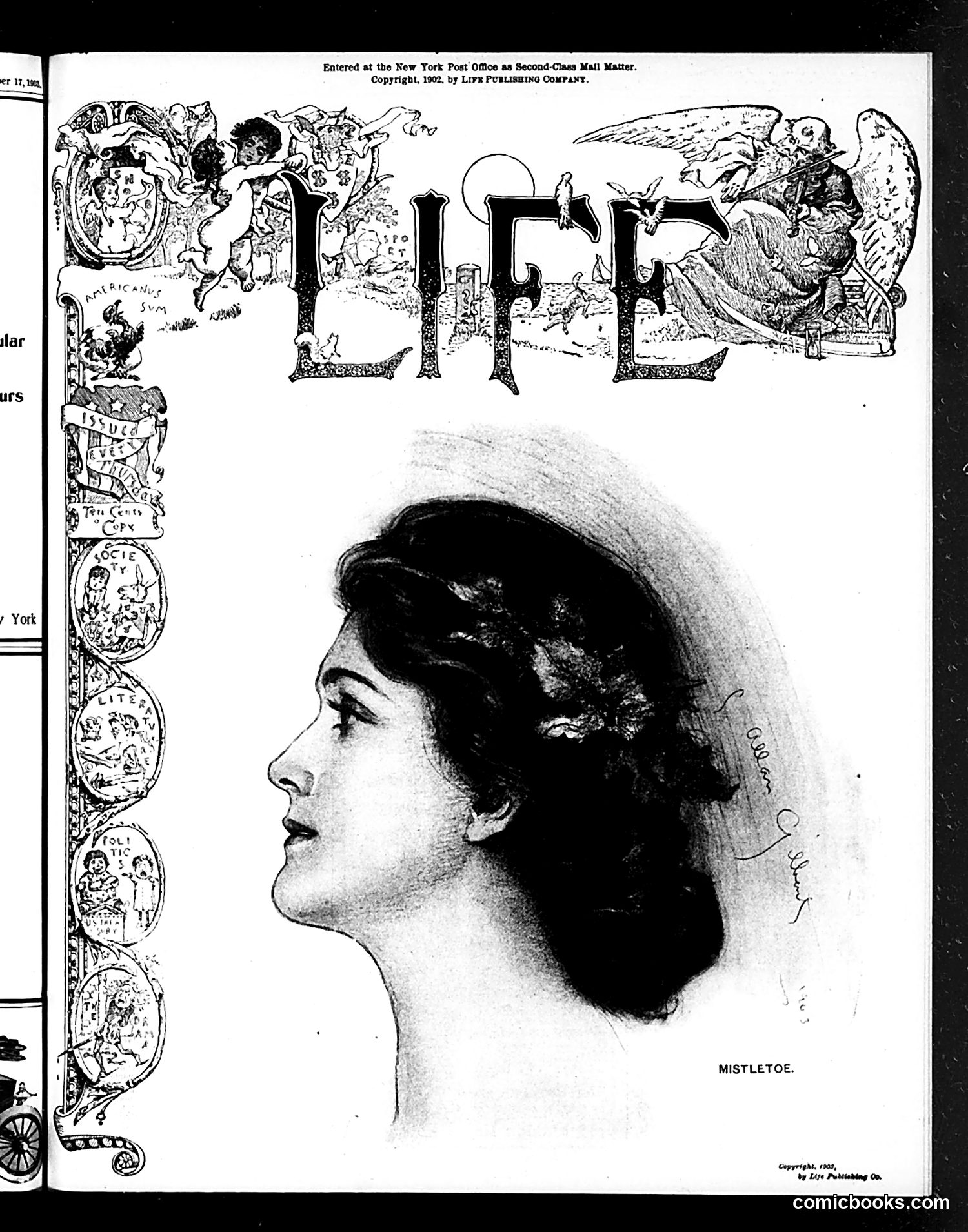
This appears to be a cover or feature page from Life magazine (copyright 1902). The elaborate decorative header features cherubs and classical imagery framing the word "LIFE" in ornamental lettering. The main illustration is titled "MISTLETOE" and depicts a woman's profile in classical style. The lefthand border contains small circular vignettes—likely illustrations for various story sections or departments within the magazine. Without additional OCR text or context, the specific satirical meaning remains unclear. However, the mistletoe reference suggests holiday/romantic themes typical of Life's satirical humor. The classical artistic style and decorative elements are characteristic of early 1900s American magazine design. The page's layout emphasizes artistic illustration over text, typical of Life's format as a visual satire publication of that era.
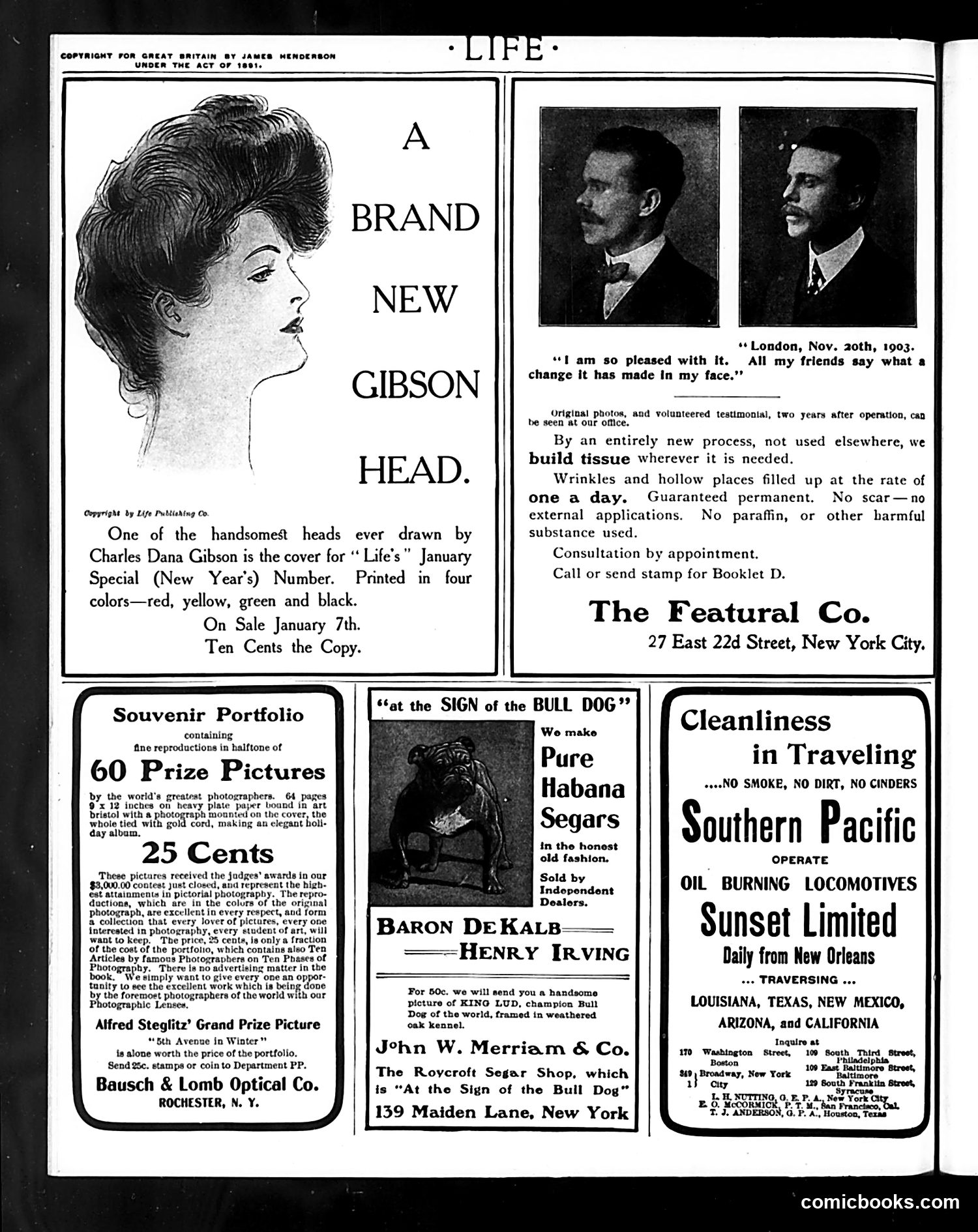
This page is primarily **advertising content** rather than editorial satire. The main feature advertises "A Brand New Gibson Head"—a Charles Dana Gibson illustration for *Life*'s January special issue, promoting it as one of Gibson's "handsomest heads ever drawn." The remaining content consists entirely of period advertisements: a souvenir photography portfolio, Habana cigars, a Bull Dog segar shop, and a Southern Pacific railroad advertisement promoting oil-burning locomotives. There is **no political cartoon or satirical commentary** on this page. It represents early 1900s magazine advertising practices, where publications like *Life* mixed editorial content with commercial promotions. The Gibson head drawing itself is purely illustrative, not satirical.
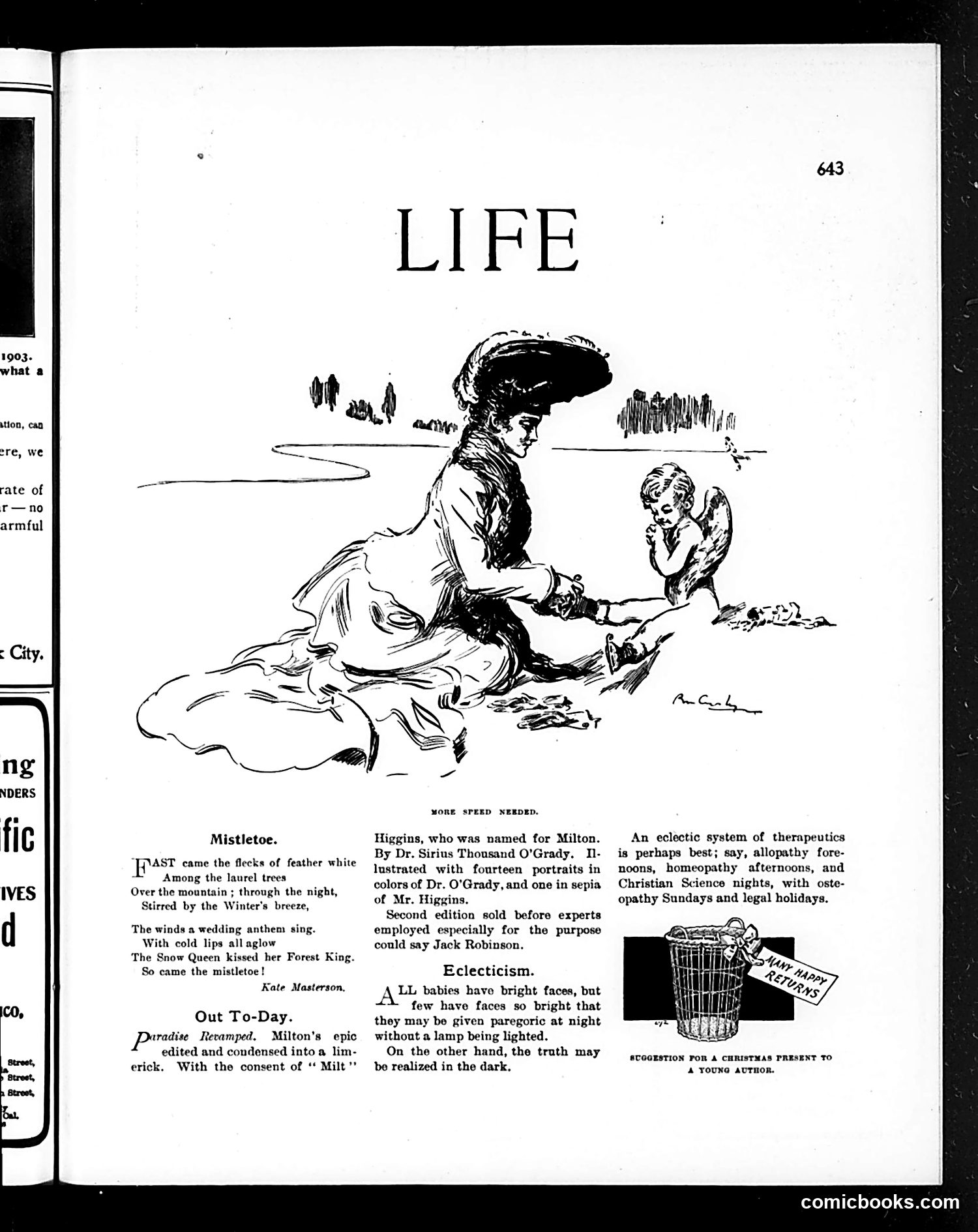
**Main Illustration:** A woman in Edwardian dress sits with a young child, playing with toys on the ground. The caption reads "MORE SPEED NEEDED." **Content Sections:** 1. **"Mistletoe"** - A poem by Kate Masterson about Christmas tradition 2. **"Out To-Day"** - Notes that Milton's epic *Paradise Lost* has been edited/condensed into a limerick 3. **"Mistletoe" (second item)** - References a Dr. Higgins and Jack Robinson 4. **"Eclecticism"** - A brief humorous piece about babies' bright faces and the paradox of visibility in darkness The page appears to be a typical Life magazine section mixing poetry, literary humor, and social commentary. The main cartoon's meaning is unclear from available context, though "MORE SPEED NEEDED" suggests satire about maternal attentiveness or child development expectations of the era.
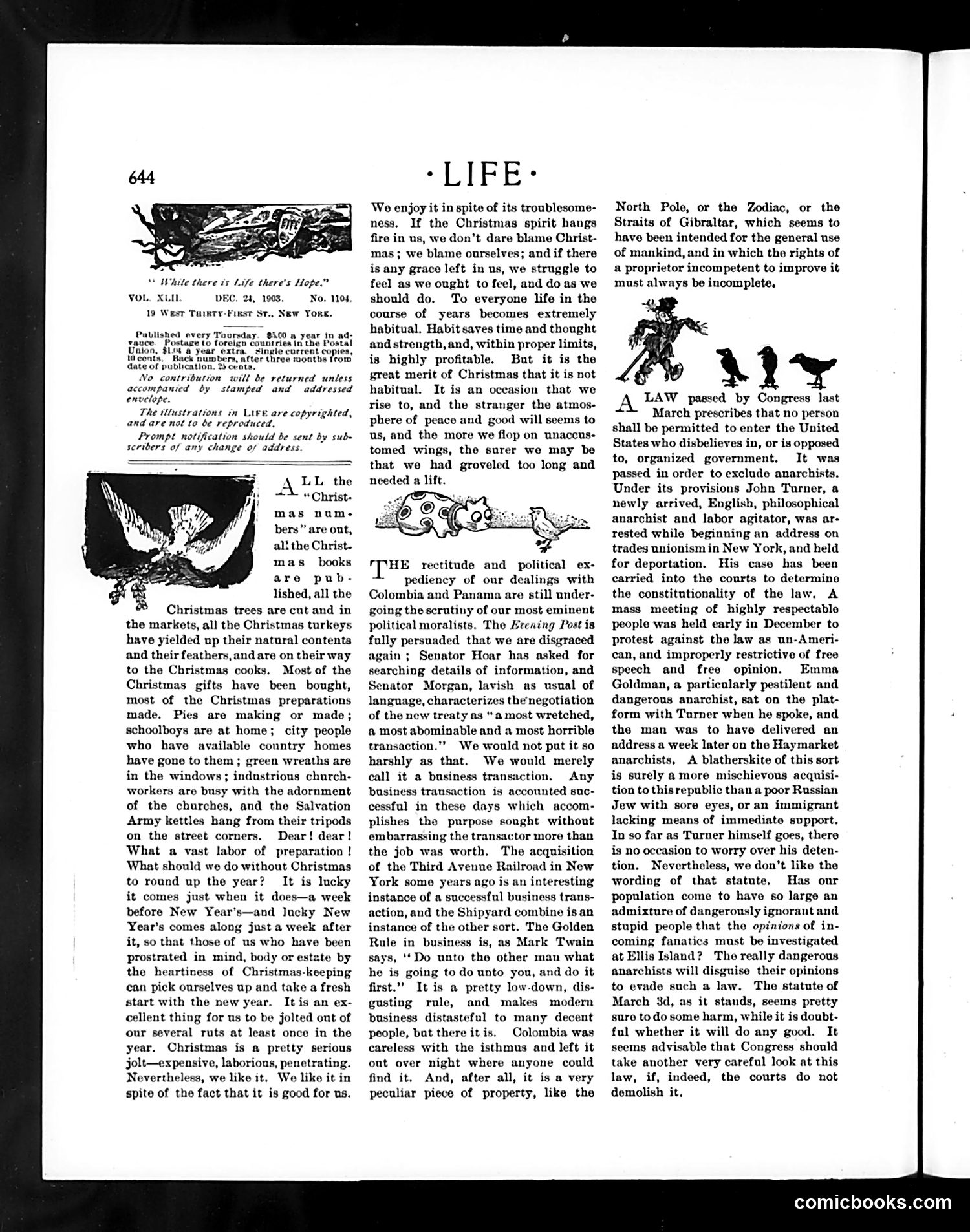
This page contains two distinct editorial sections rather than traditional political cartoons. The left column discusses Christmas preparations and the commercial aspects of the holiday, illustrated with a simple woodcut of a Christmas tree and decorations. The right column addresses a Congressional law restricting anarchists' entry into the United States. It critiques the statute's vagueness, specifically referencing the case of John Turner, an English anarchist and labor activist recently arrived, who faced deportation. The text argues the law is dangerously broad and poorly defined, sarcastically noting that even "stupid people" investigating Ellis Island might question its constitutionality. The piece advocates for either clarifying or repealing the statute rather than allowing such subjective enforcement. The small illustration of birds appears decorative rather than satirical.
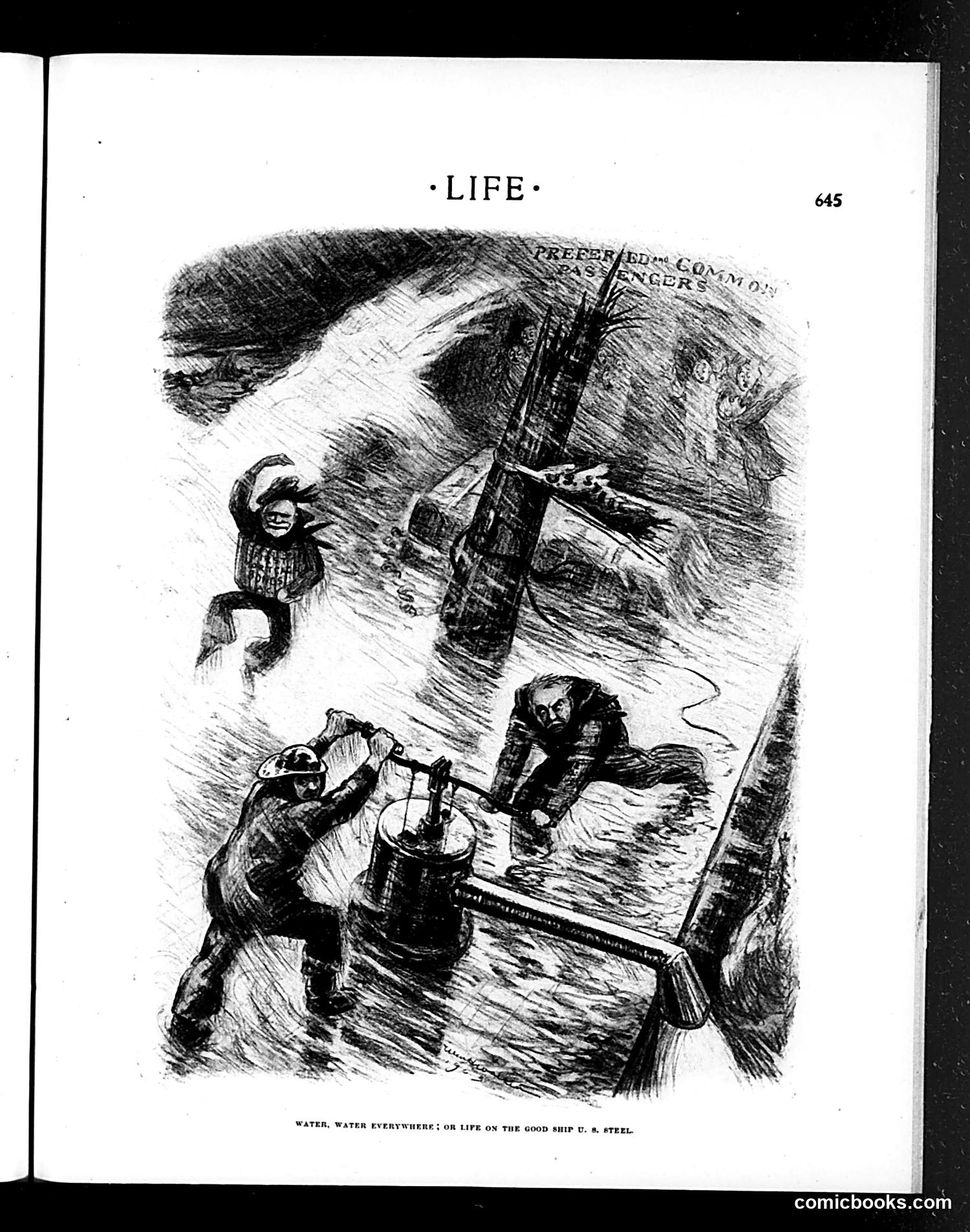
This political cartoon depicts sailors aboard a steel ship during rough seas, titled "Water, Water Everywhere! On Life the Good Ship U.S. Steel." The cartoon uses a shipwreck metaphor to satirize U.S. Steel's condition—likely during economic hardship or labor disputes. The desperately struggling sailors represent the company's workers or leadership attempting to manage a crisis situation. The text "Preferred Common" visible at top suggests commentary on the company's stock classes or financial structure. The turbulent waters and chaotic scene imply the company is in serious distress, sinking metaphorically. The satire critiques either U.S. Steel's management, labor relations, or broader economic problems affecting the industrial giant during the early 20th century, though the specific historical moment requires additional context.
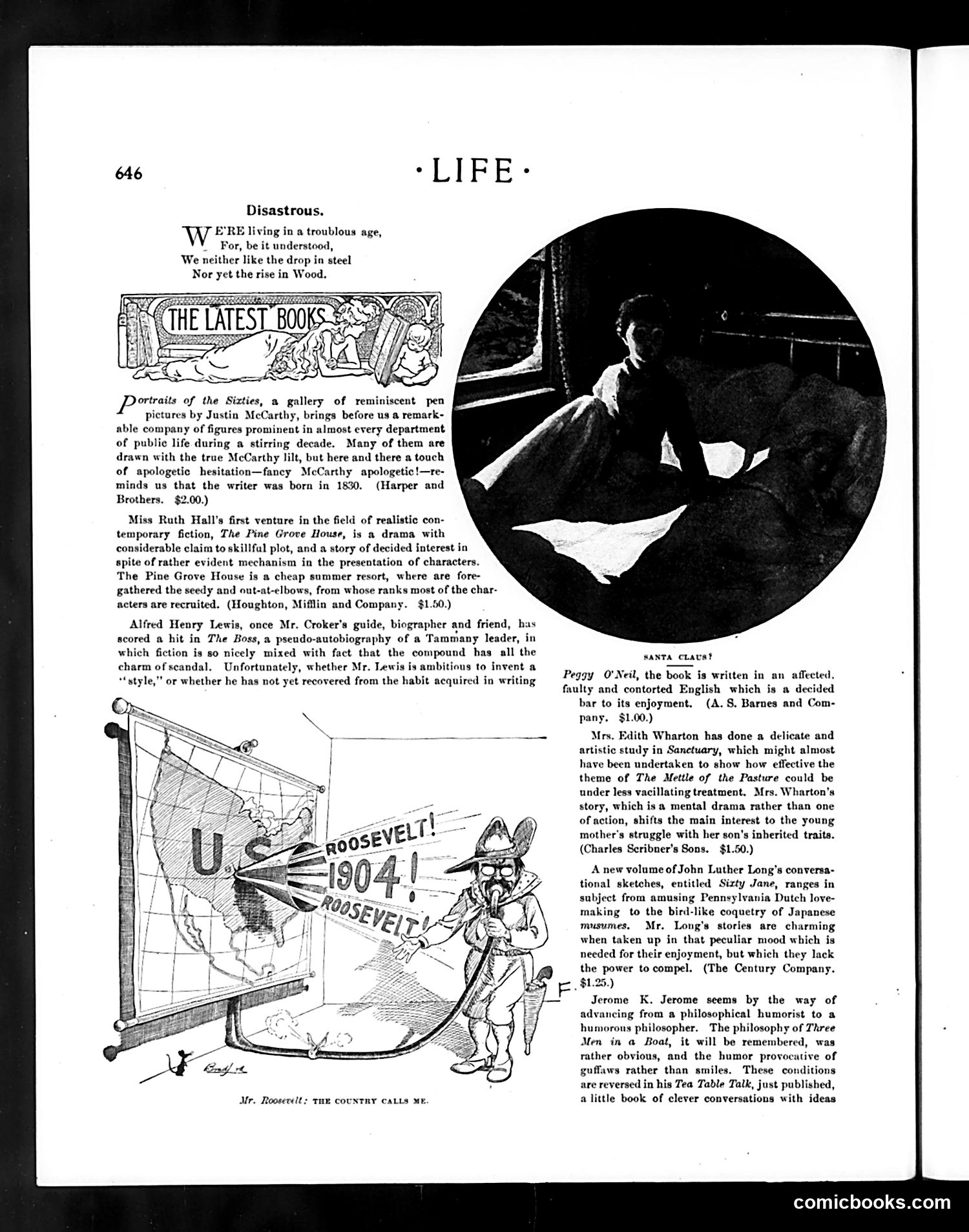
The cartoon labeled "Mr. Roosevelt: The Country Calls Me" depicts Theodore Roosevelt as a figure being pulled or called into action by the country, represented as a large mechanical device or contraption labeled "Roosevelt 1904." The caricature shows Roosevelt in characteristic pose, responding to what appears to be a draft or call for the 1904 presidential election. This satirizes Roosevelt's political position in 1904—whether he would seek another term after ascending to the presidency following McKinley's assassination in 1901. The "country calls" framing is ironic commentary on Roosevelt's own ambitions versus public demand. The mechanical imagery suggests the machinery of politics and electoral campaigns pulling him forward into the race.
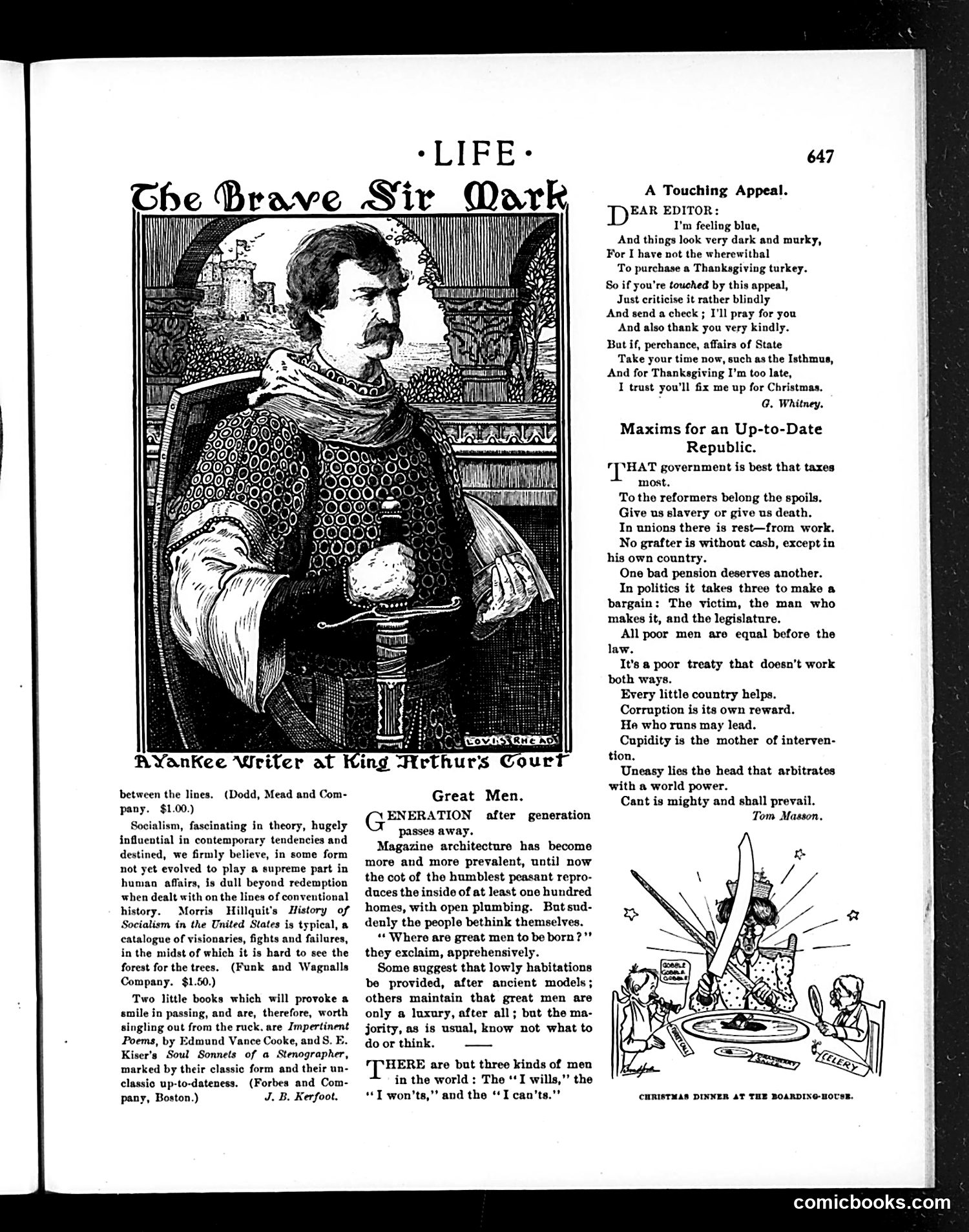
This page features "The Brave Sir Mark," a woodcut-style portrait labeled "A Yankee Writer at King Arthur's Court." The image depicts a man in medieval armor with period costume, likely referencing Mark Twain's novel *A Connecticut Yankee in King Arthur's Court* (1889), which satirizes medieval society through a modern American's perspective. The accompanying article "Great Men" discusses whether great men are born or made, noting that magazine architecture now depicts peasant homes with modern plumbing—suggesting society's advancement. Below is "A Touching Appeal," a humorous letter from G. Whitney asking for Thanksgiving turkey donations, and "Maxims for an Up-to-Date Republic," political satire by Tom Masson criticizing government corruption and inequality. A small cartoon shows "Christmas Dinner at the Boarding-House."
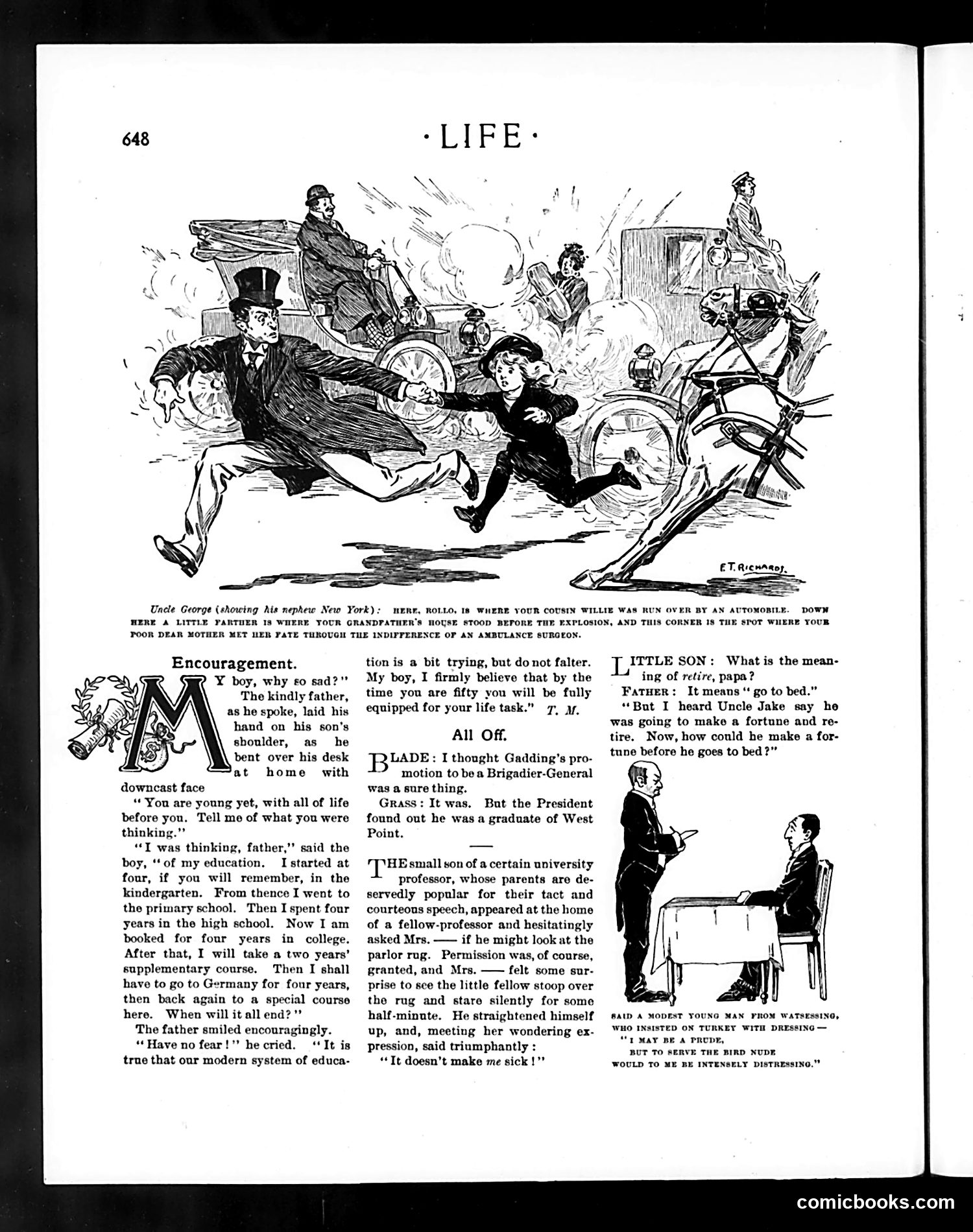
The top illustration depicts a chaotic street scene with an automobile accident. The caption references "Uncle George" showing his nephew from New York where a cousin was hit by a car, locating the accident near a grandfather's house and an ambulance surgeon's office—satirizing how accidents were becoming common urban hazards in the early automobile era. Below are three brief humorous anecdotes: 1. **"Encouragement"**: A father reassures his downcast son about life's possibilities, emphasizing modern education. 2. **"All Off"**: A joke about a university professor's son who disappoints expectations by failing to become a Brigadier-General, having only graduated from West Point. 3. **"A Modest Young Man"**: Satire about propriety—a young man insists on dressing turkey properly rather than serving it undressed, valuing etiquette over practicality. These pieces mock contemporary social pretensions and changing American life.
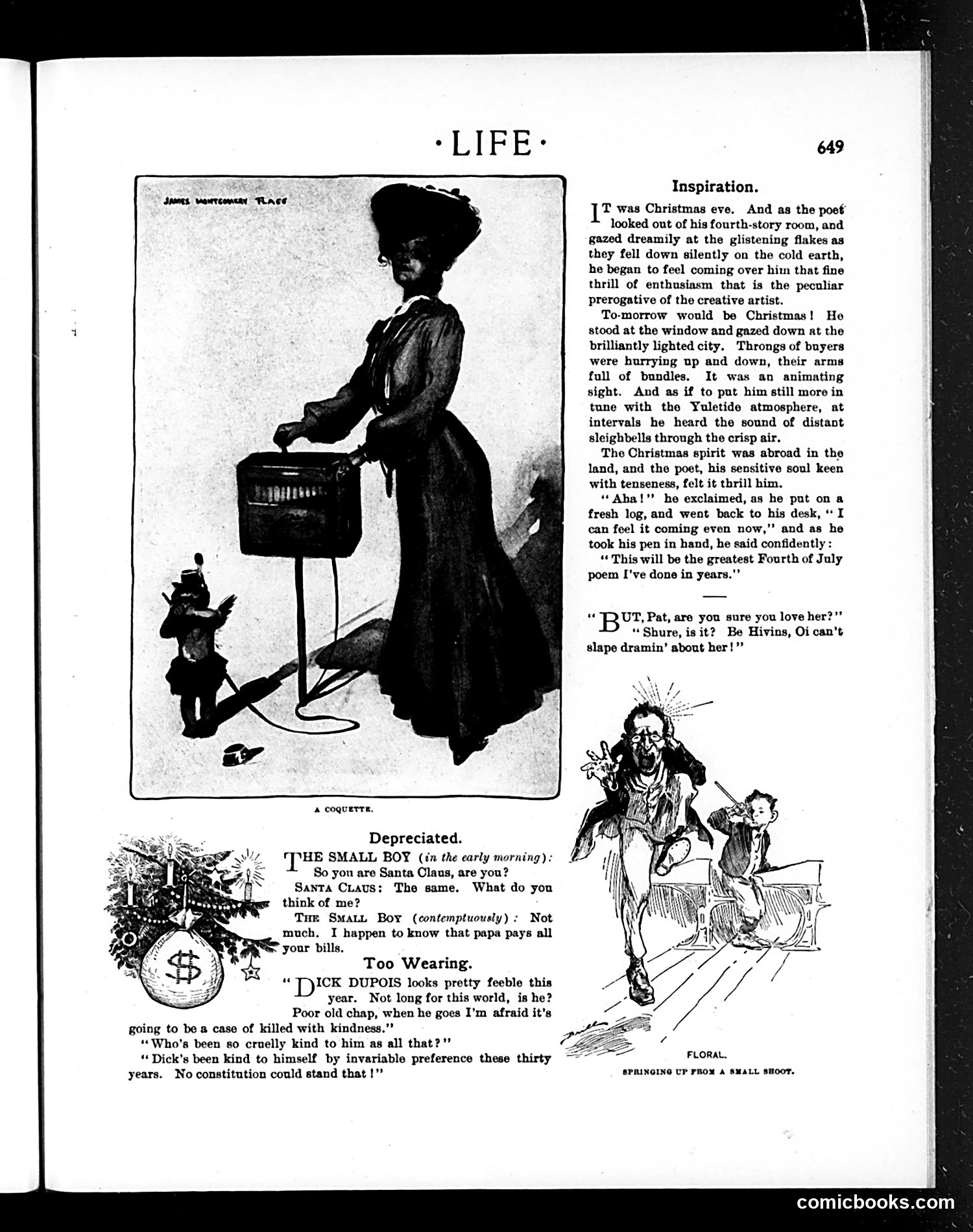
This page contains three brief humorous sketches satirizing contemporary life: 1. **"Inspiration"** – A poet observes Christmas scenes from his window, confidently declaring he'll write "the greatest Fourth of July poem I've done in years," missing the holiday entirely through distraction. 2. **"Depreciated"** – A child asks Santa Claus if he's real. Santa admits he's not Santa, then reveals papa pays all the bills—a cynical commentary on parental financial burden and lost childhood innocence. 3. **"Too Wearing"** – Characters discuss Dick Dupois appearing "feeble," attributing his decline to being "killed with kindness" after thirty years of receiving preferential treatment—satirizing how excessive favoritism can weaken character. Each sketch mocks human foibles through deadpan dialogue and ironic situations typical of early 20th-century American humor.
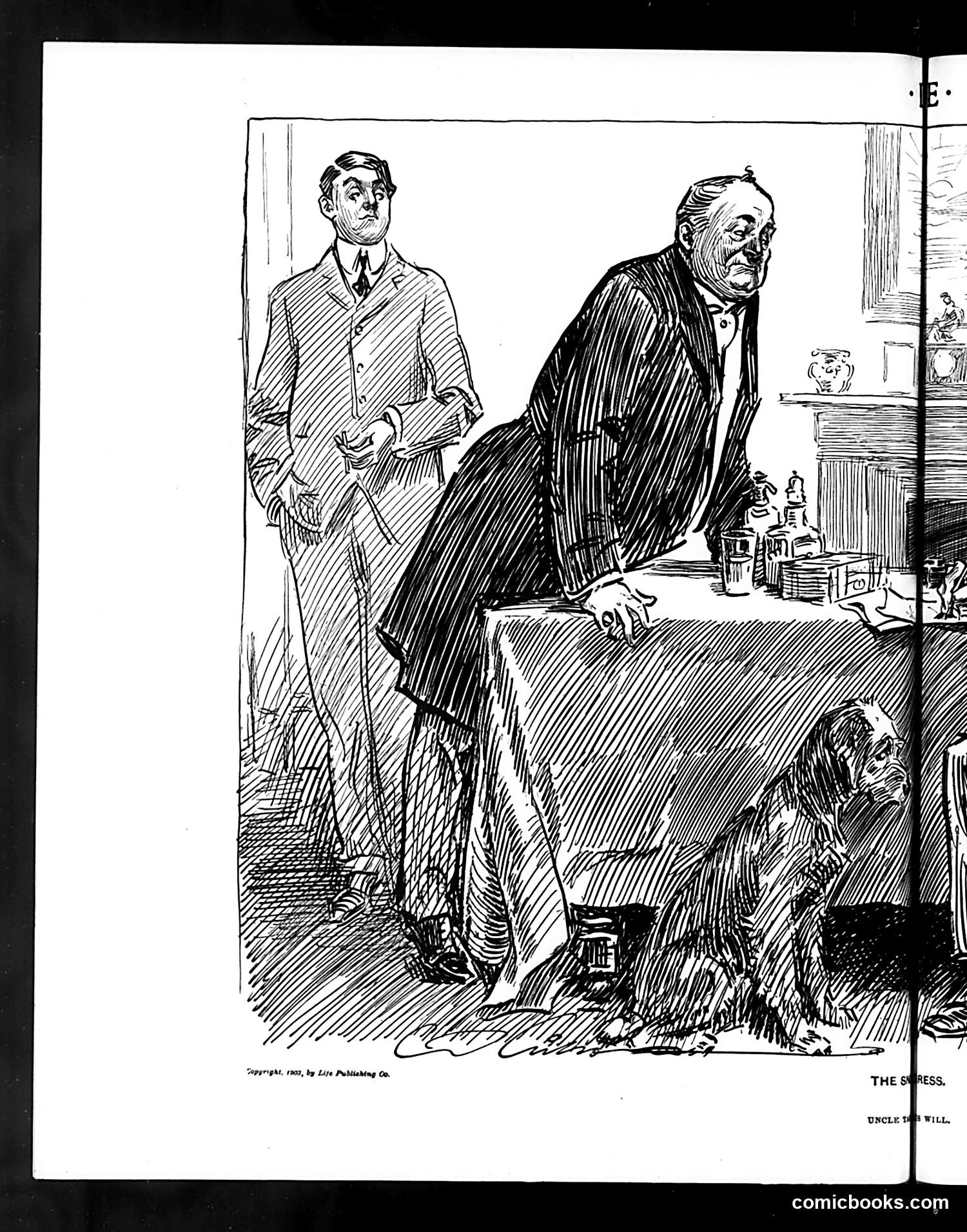
This political cartoon depicts two men in an office setting with a desk. The standing figure (left) appears anxious or concerned, while the seated figure (right) looks weary or stressed. At the bottom right, a small figure—likely representing a child or dependent—sits beneath the desk. The title "The Stress" and caption "Uncle Sam's Will" suggest this satirizes the burdens of American governance or responsibilities. The composition implies tension between duty and pressure: the seated figure bears the weight of decision-making while others depend on him. The specific historical context and identities of these figures remain unclear without additional source information, but the cartoon appears to critique the strain of leadership or administrative responsibility during this period.
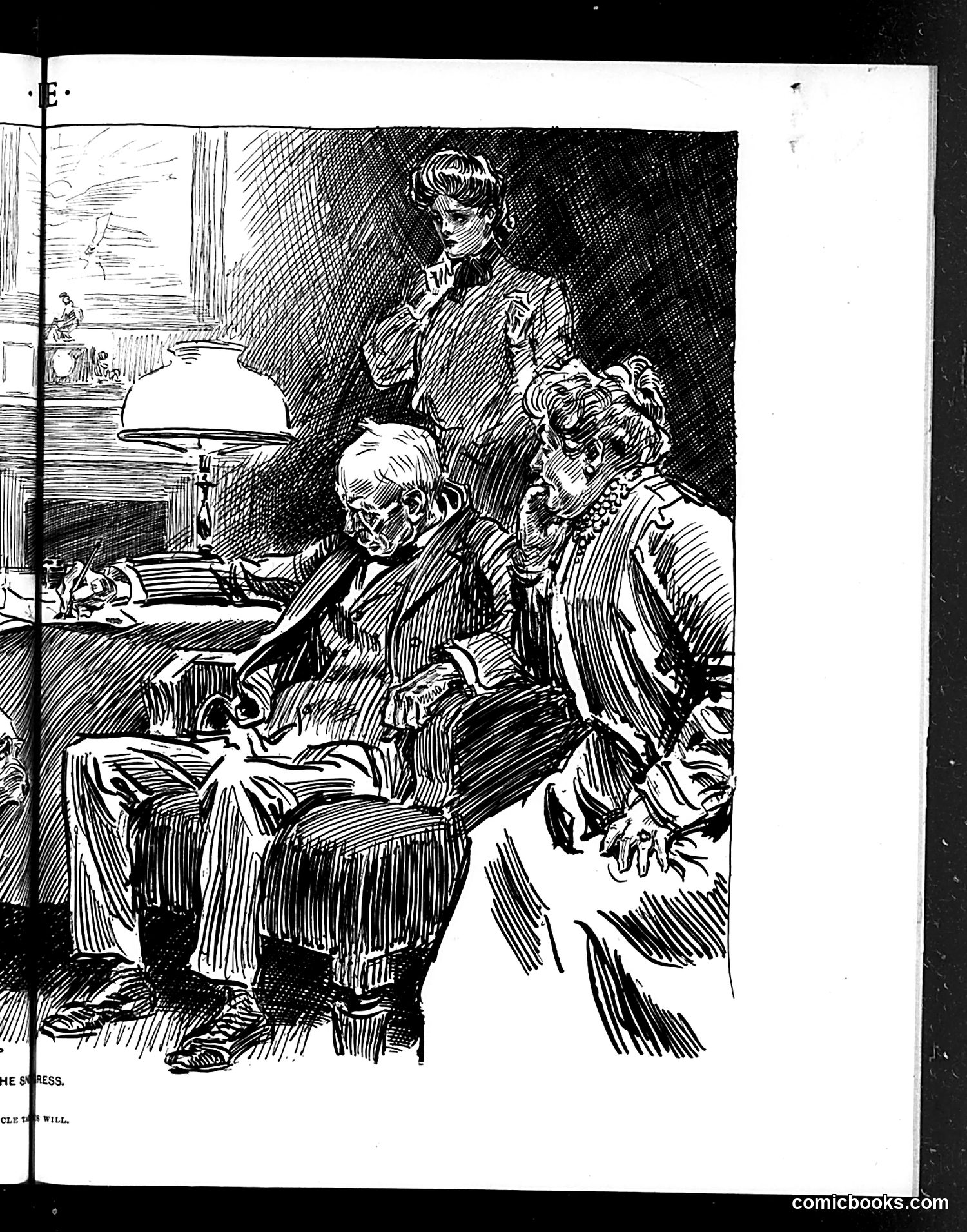
This is a sketch illustration showing an indoor scene with four figures. A woman stands in the background near a lamp, while three older men are seated - one at a desk or table on the left, and two others conversing on the right. The style and clothing suggest late 19th or early 20th century. However, the OCR text provided is incomplete and unclear (fragments like "HE S...RESS" and "CLE H WILL"), making it impossible to determine the specific political or social satire intended. Without legible text identifying the figures or explaining the scene's context, I cannot accurately identify who these characters represent or what contemporary event or issue is being satirized. To properly explain this cartoon's meaning, clearer source text would be needed.
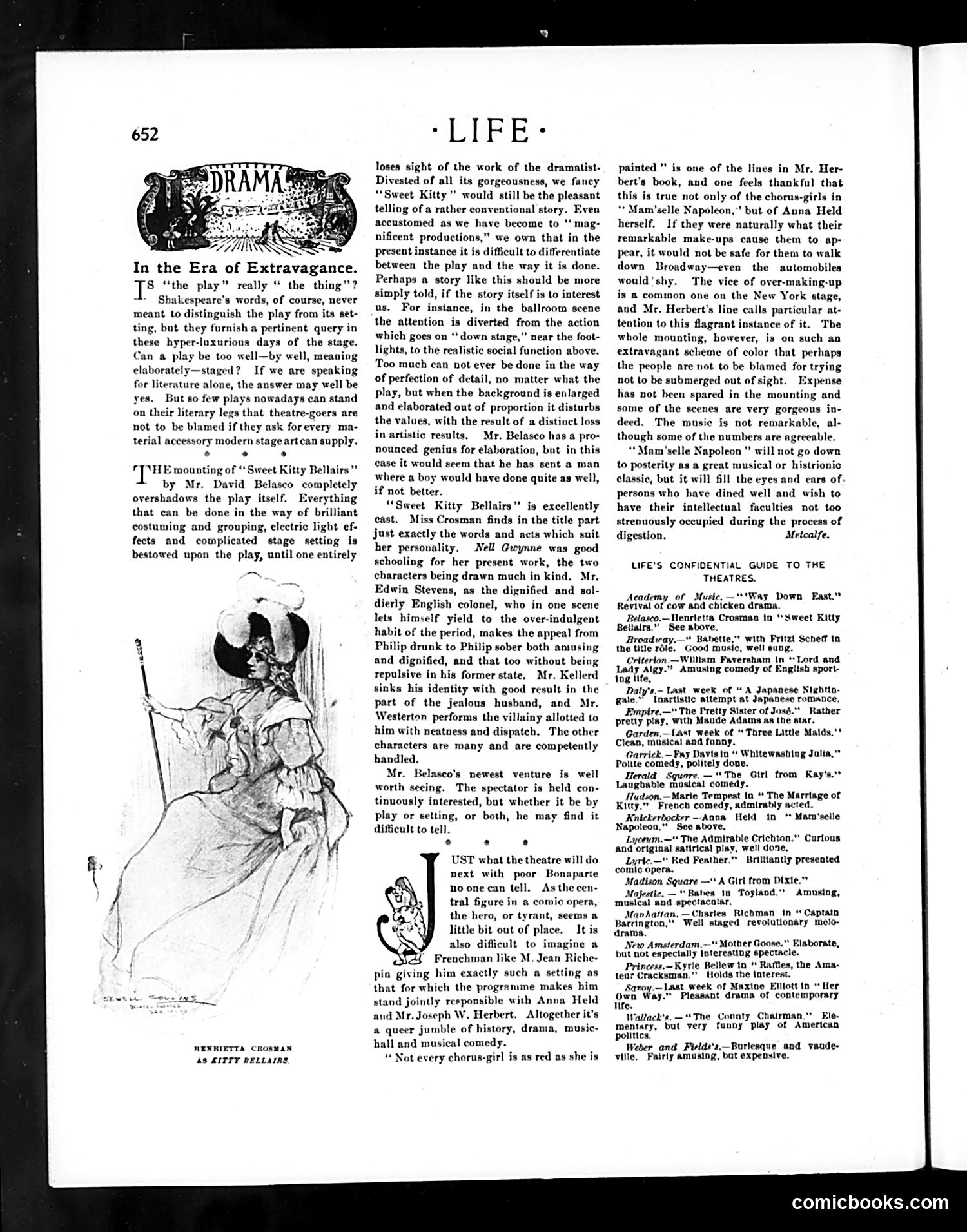
This page is primarily a **theater review column** titled "In the Era of Extravagance," not a political cartoon. The main illustration shows a sketch labeled "Henrietta Crosman as Kitty Bellairs"—an actress in costume for the play "Sweet Kitty Bellairs." The review discusses how modern theatrical productions prioritize elaborate staging and spectacle over storytelling clarity. The critic argues that while "Sweet Kitty Bellairs" is well-executed, audiences struggle to follow the plot because the ornate sets and over-scaled backgrounds distract from the action. The piece then lists current theatrical productions with brief reviews. This reflects **early 1900s theater criticism**, where the tension between artistic ambition and audience comprehension was a live debate.
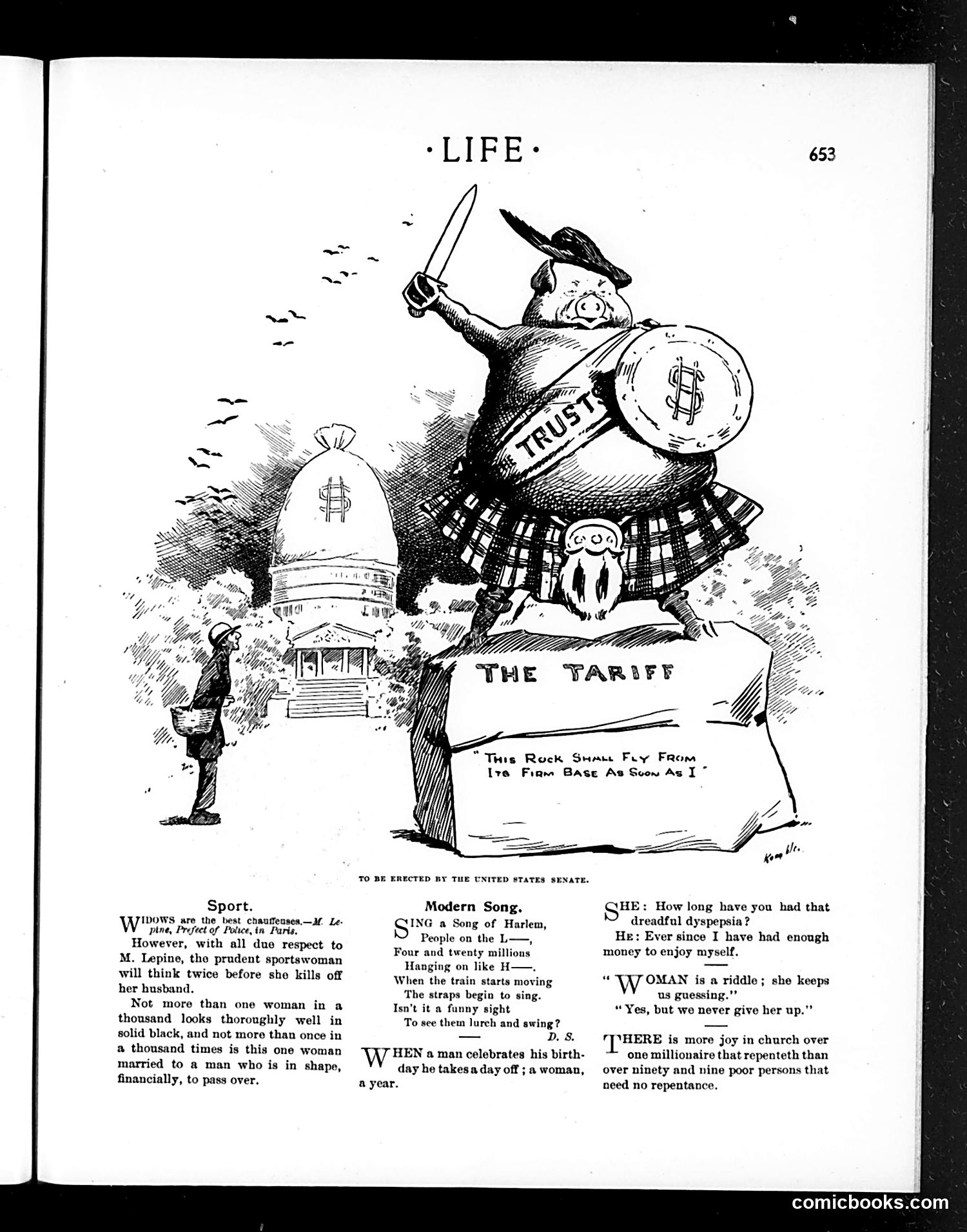
The main cartoon depicts a bloated plutocrat standing on a pedestal labeled "THE TARIFF," wielding a sword and shield marked with dollar signs. The figure wears a "TRUST" sash and stands atop the U.S. Capitol building. A small soldier below appears dwarfed by this giant. **The Point:** This is anti-tariff and anti-monopoly satire. The cartoon criticizes how protective tariffs enabled wealthy industrialists and monopolistic trusts to grow enormously powerful at ordinary Americans' expense. The tariff acts as the plutocrat's pedestal and weapon—the policy that inflates his wealth and influence. **Historical Context:** This likely dates to the early 1900s, when Progressive Era critics attacked high tariffs as benefiting only the wealthy while raising consumer prices for everyone else. The "trust" imagery references contemporary anxiety about corporate monopolies. The inscription "TO BE ERECTED BY THE UNITED STATES SENATE" sarcastically suggests Congress itself built this monument to greed.
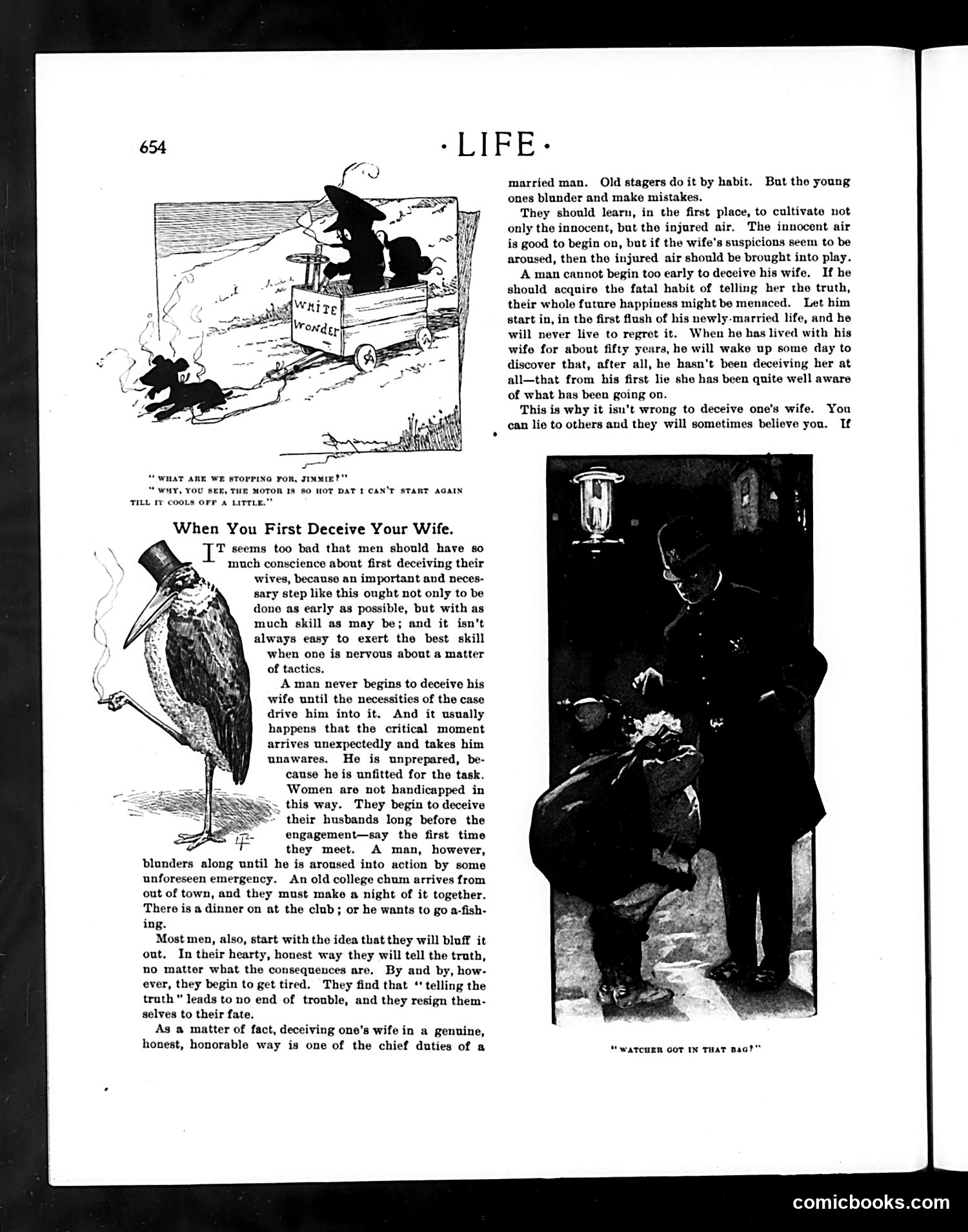
This satirical article mocks married men's attempts at deception, presenting dishonesty as a necessary marital "skill." The piece argues that men should begin lying to wives early in marriage—ostensibly to spare their feelings—yet paradoxically claims wives always discover the truth eventually anyway. The humor targets male hypocrisy: men pride themselves on honesty but resort to lies when convenient (to attend clubs, go fishing, meet old friends). The text suggests women are naturally better deceivers, having practiced since courtship, while men blunder into deception unprepared. The accompanying illustrations reinforce this: a stalled motorcar scene depicts a flimsy excuse ("the motor is too hot"), and a separate panel shows a "watcher" confronting someone, likely catching a lie in progress. The satire reflects early 20th-century gender attitudes—mocking both male dishonesty and suggesting female cunning—while ultimately suggesting marital deception is inevitable and somewhat comic rather than genuinely harmful.
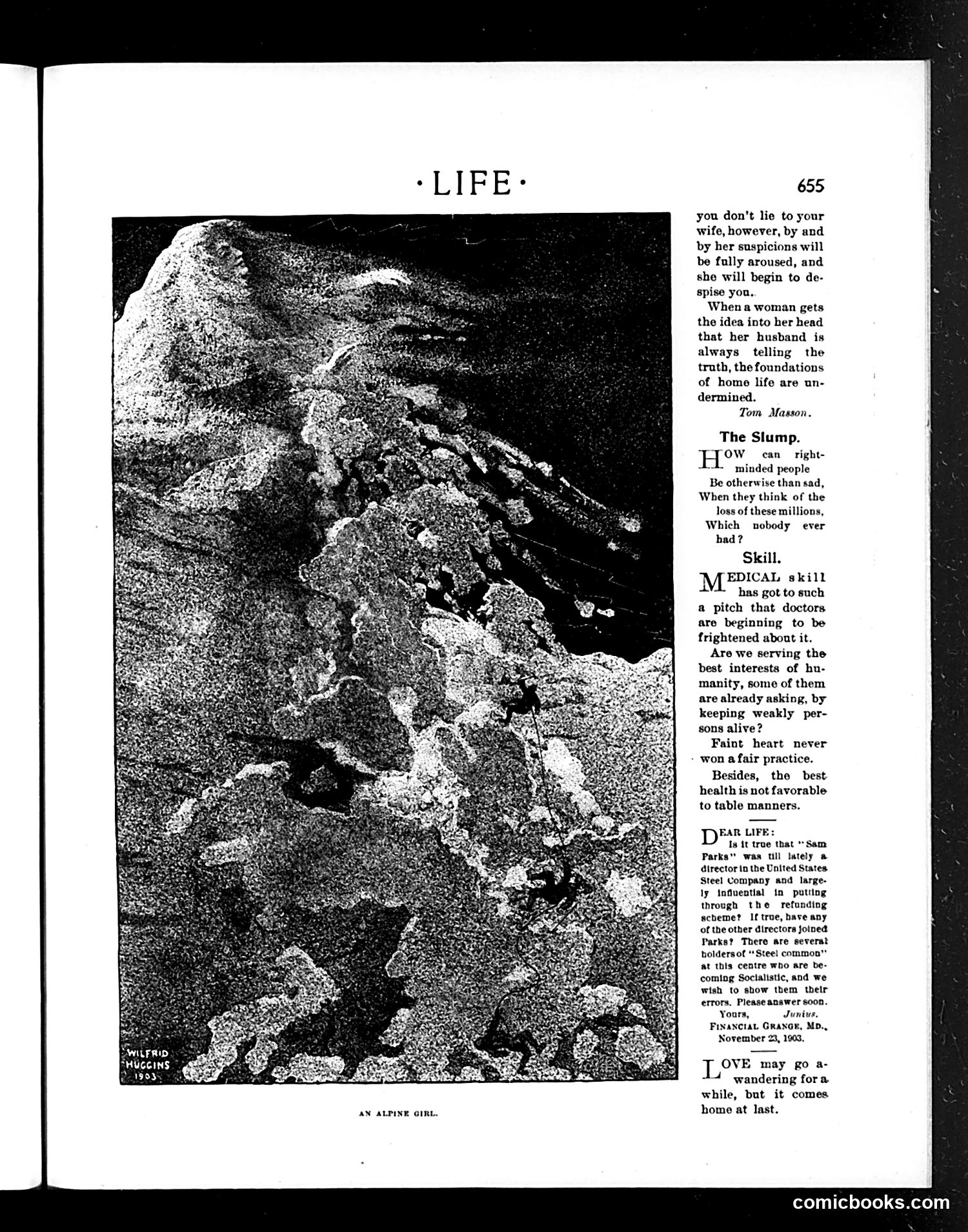
This page from *Life* magazine features a striking illustration titled "An Alpine Girl," credited to Wilfred Huggins (1903). The image depicts a young woman perched on rocky alpine terrain, rendered in dramatic black and white. The surrounding text consists of satirical commentary on various contemporary topics: - **Marriage advice** (attributed to Tom Masson) humorously warns that husbands shouldn't always tell the truth, or wives will lose respect for them - **"The Slump"** satirizes public concern over financial losses that "nobody ever had" - **"Skill"** ironically comments on doctors' growing anxiety about medical advances keeping weak people alive—undermining their practices - A reader's letter questions whether "Sam Parks" (apparently a Steel Company director) was involved in controversial refunding schemes, suggesting class tensions and growing socialist sympathies among investors The page represents *Life*'s characteristic blend of visual art and sharp social commentary on early 20th-century American concerns: marriage, economics, medicine, and corporate ethics.
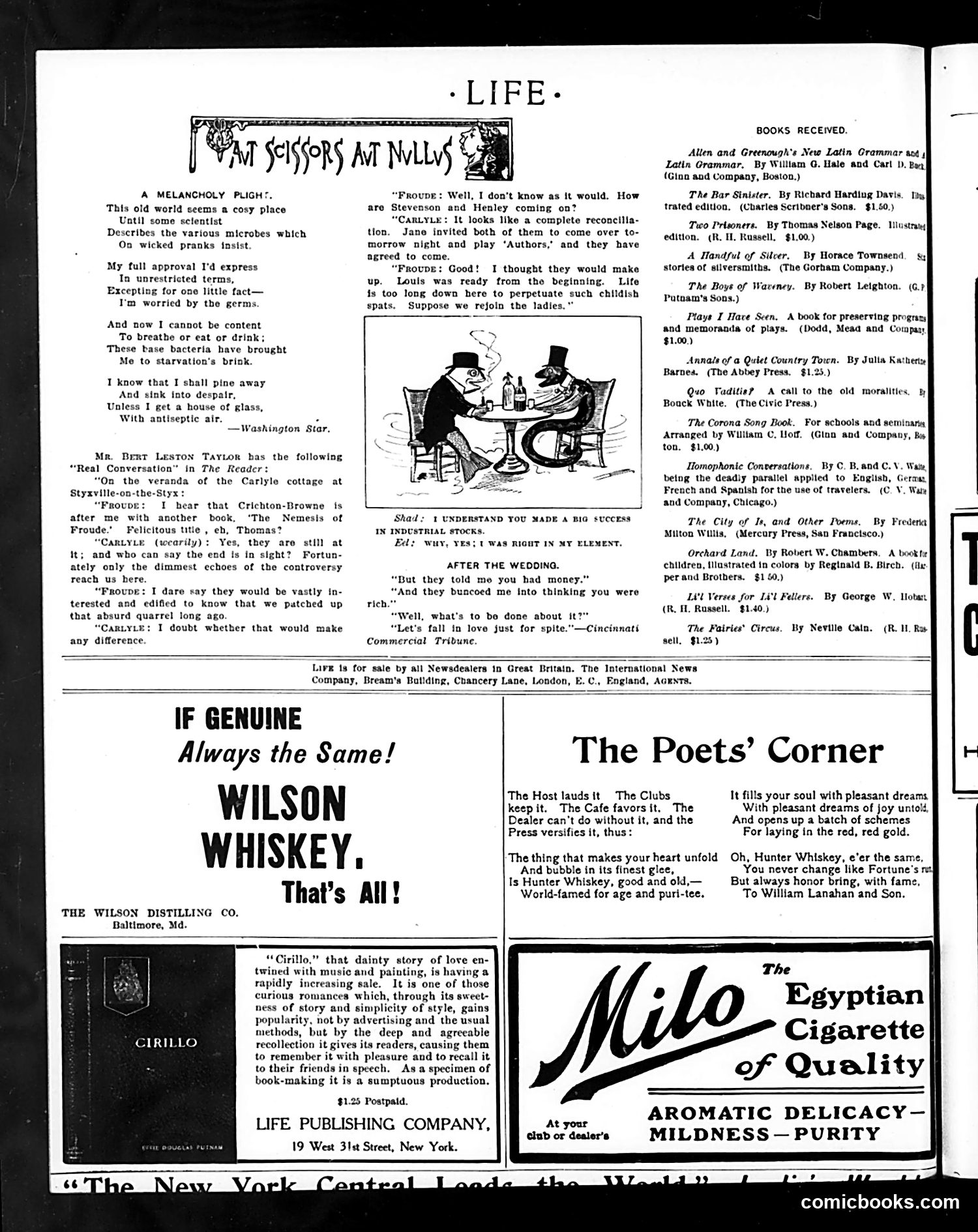
This page contains two satirical dialogues rather than political cartoons. Both mock intellectual pretension and reconciliation. **"A Melancholy Plight"** (top): A poem sardonically laments that scientific knowledge about disease-causing bacteria has ruined the narrator's ability to eat, drink, or enjoy life without fear. It's social satire on how popularized scientific information creates hypochondria. **"Real Conversation"** (middle): The dialogue parodies Victorian literary gossip. It references a real historical feud between historians Thomas Carlyle and James Anthony Froude, implying their reconciliation is superficial. The joke: even when former enemies agree to socialize ("play Authors"), nothing meaningful changes—they remain fundamentally at odds. "Froude" and "Carlyle" are the actual historical figures whose quarrel this satirizes. The page is primarily **book advertisements and reviews** rather than political commentary. The cartoons mock vanity, false civility, and anxiety rather than addressing specific political events.
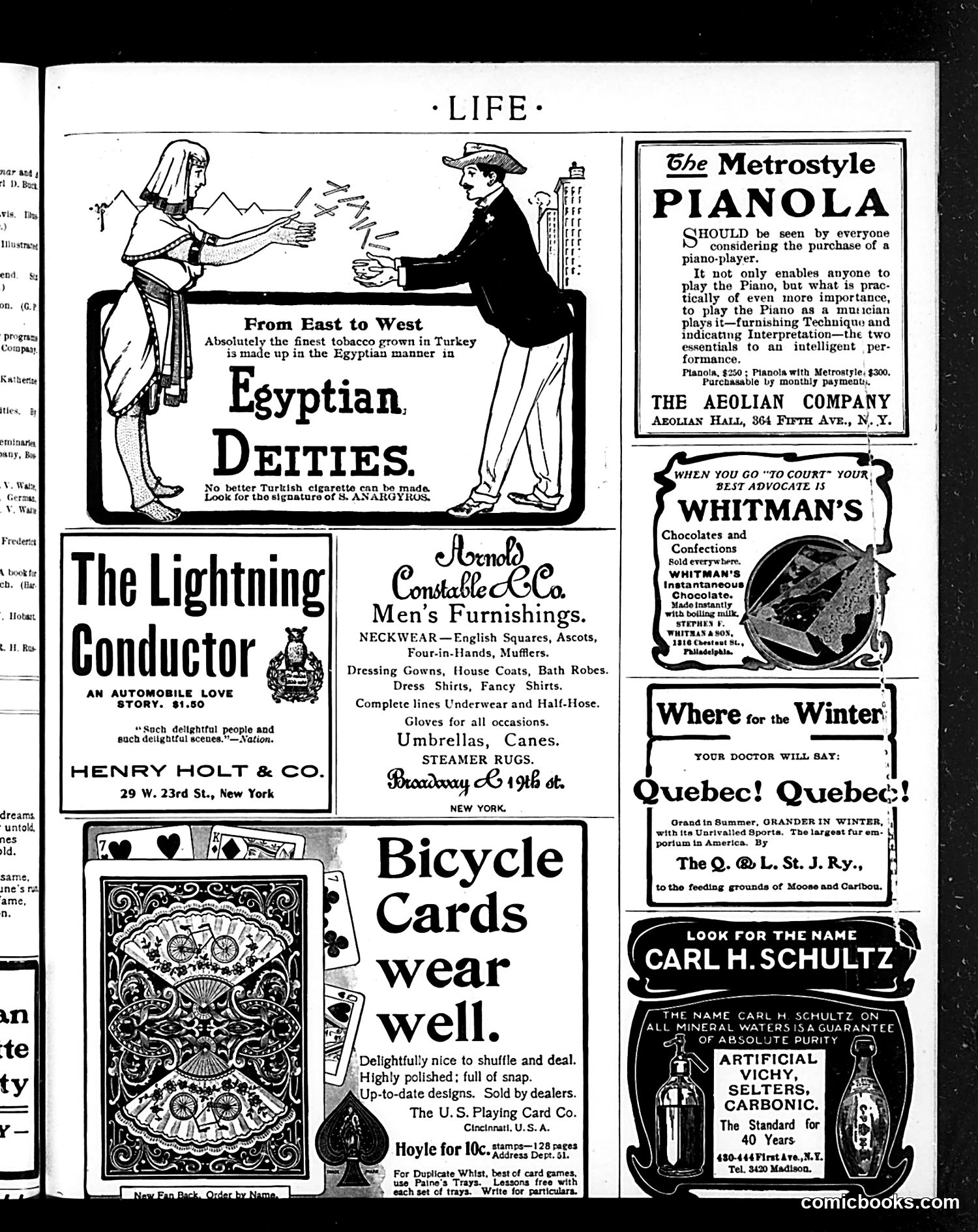
This page is **primarily advertising** with one satirical cartoon at the top. ## The "Egyptian Deities" Cartoon The main cartoon depicts a transaction between an Oriental woman (representing "the East") and a Western man (representing "the West"). The joke advertises Egyptian Deities cigarettes by playing on **stereotypes and trade imagery**: Turkish tobacco processed in "Egyptian manner" is positioned as exotic and desirable to Western consumers. The caricatured figures and the framing as an East-West exchange reflect early 20th-century attitudes that viewed non-Western products as luxurious imports. ## Remaining Content The page consists entirely of period advertisements for consumer goods: cigarettes, books, men's clothing, player pianos, chocolate, playing cards, mineral water, and tourist travel. These ads reveal what affluent Americans purchased circa 1910s and the marketing strategies of the era—appeals to sophistication, musicianship, and leisure travel. No other political satire or commentary is present on this page.
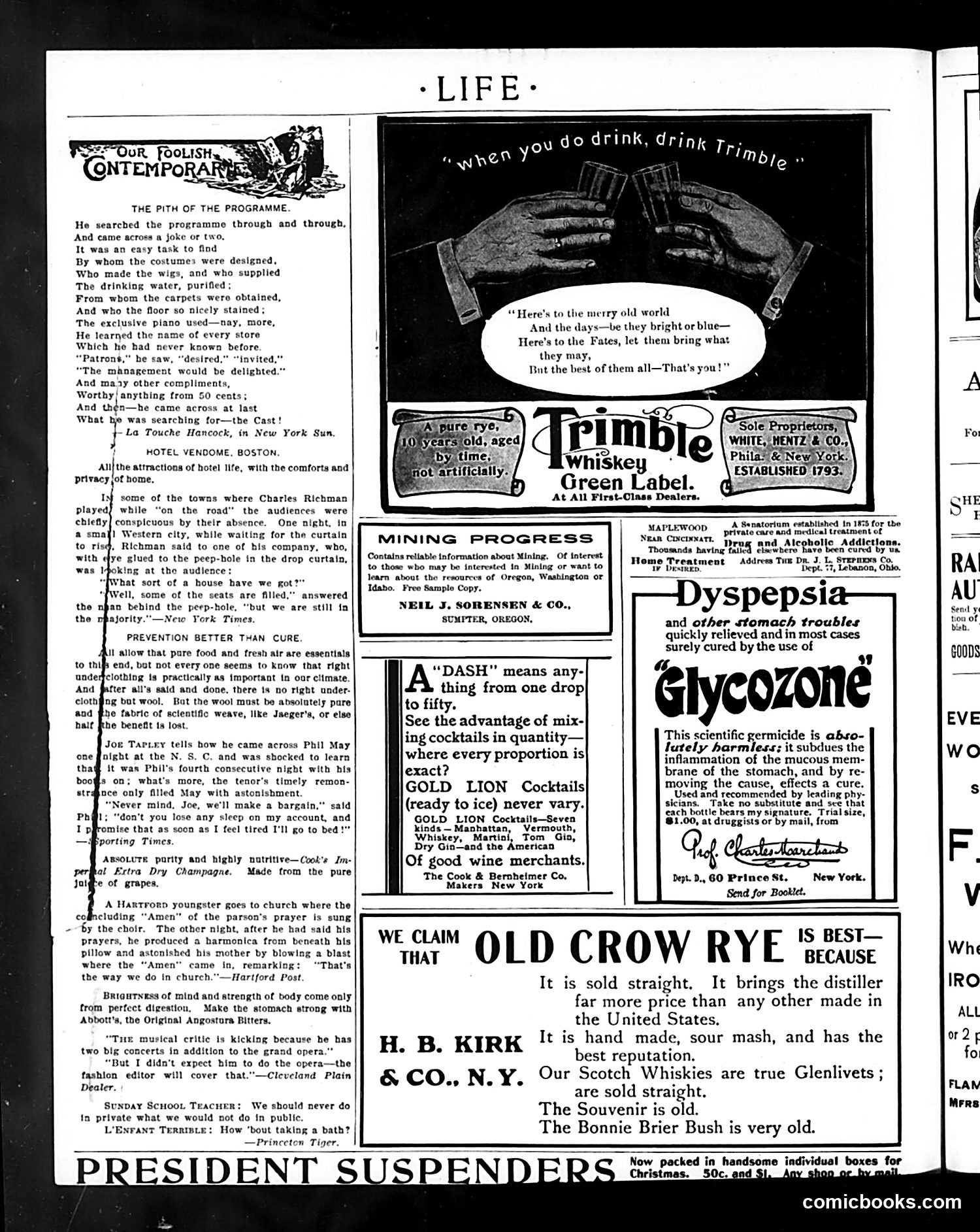
This Life magazine page combines satirical commentary with period advertising, primarily from the Prohibition era (note the whiskey and cocktail ads, suggesting pre-1920 publication). **The Cartoons/Satirical Content:** The opening piece, "The Pith of the Programme," mocks theater programs that list exhaustive credits and sponsor acknowledgments before audiences can find the actual cast list—a complaint about commercial clutter obscuring artistic content. Subsequent anecdotes satirize show business pretensions: a theater company performing to empty seats; a tenor who won't admit fatigue; a music critic overworked; a child bringing a harmonica to church's "Amen." **The Advertisements:** Liquor ads (Trimble Whiskey, Old Crow Rye, Gold Lion Cocktails) dominate, promoting drinking as sophisticated leisure. Medical advertisements for "Glycozone" and the Maplewood Sanitarium reference alcohol-related stomach ailments—directly contradicting the celebratory drinking culture the ads simultaneously promote. **The Point:** Life satirizes American commercial culture's hypocrisies while profiting from advertising those very hypocrisies.
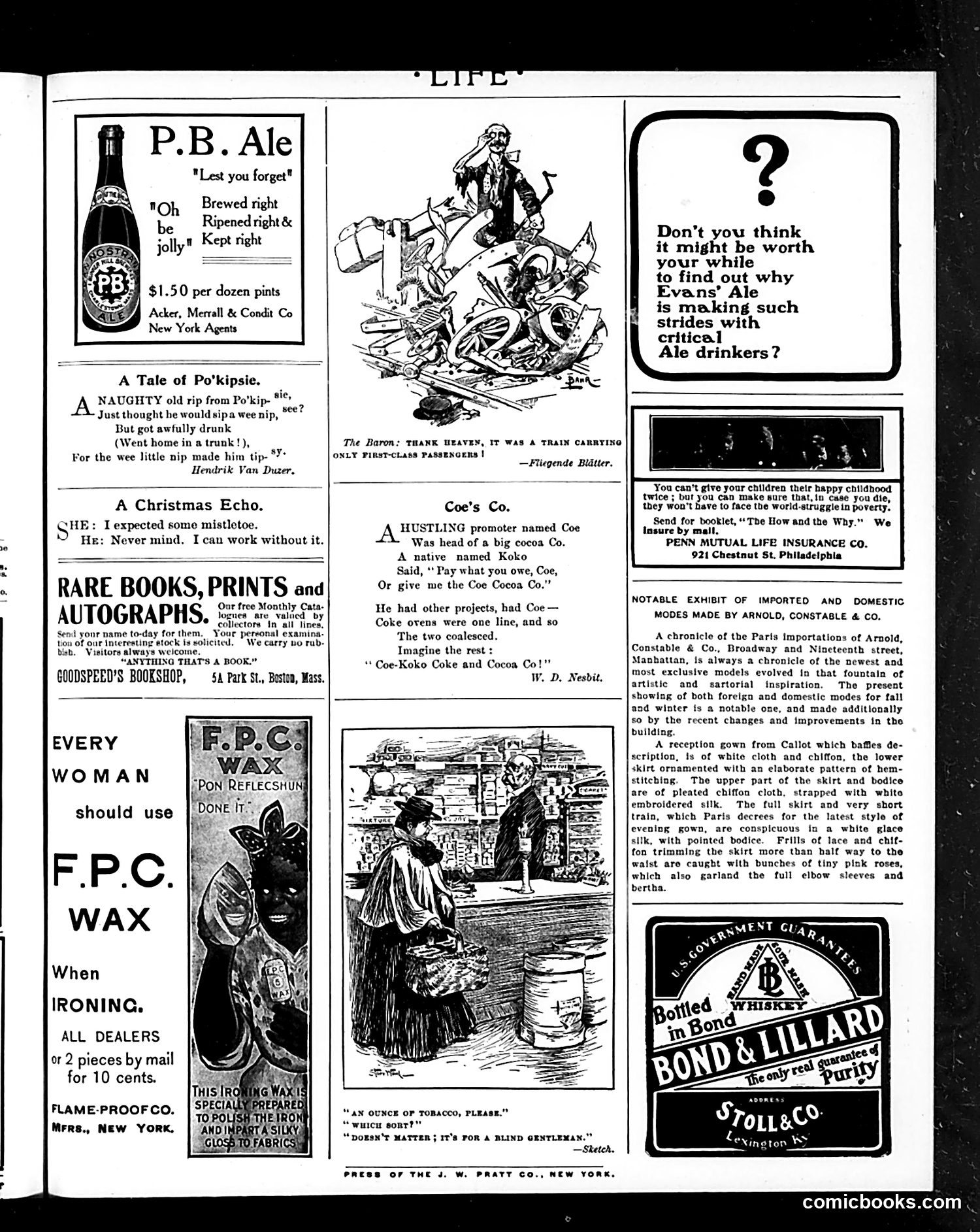
This is primarily a **commercial advertising page** from an early 20th-century *Life* magazine, with several small satirical cartoons and humorous poems interspersed. The cartoons employ period humor: - **"A Tale of Po'kipsie"**: A cautionary poem about a drunk man who tumbles from a train—standard Victorian morality humor about alcohol's dangers. - **"A Christmas Echo"**: A brief domestic joke about mistletoe and marriage. - **"Coe's Co."**: A punny narrative poem about a cocoa company owner named Coe whose ventures (including coke ovens) "coalesce"—wordplay humor. - **Tobacco shop cartoon**: Shows a customer buying tobacco "for a blind gentleman"—the implication being the excuse is dishonest, offering period social commentary on hypocrisy. The bulk of the page features advertisements for P.B. Ale, F.P.C. Wax, rare books, insurance, whiskey, and fashion—reflecting *Life*'s dual role as satirical magazine and advertising vehicle. The Evans' Ale ad uses questioning rhetoric to promote their product to "critical ale drinkers."
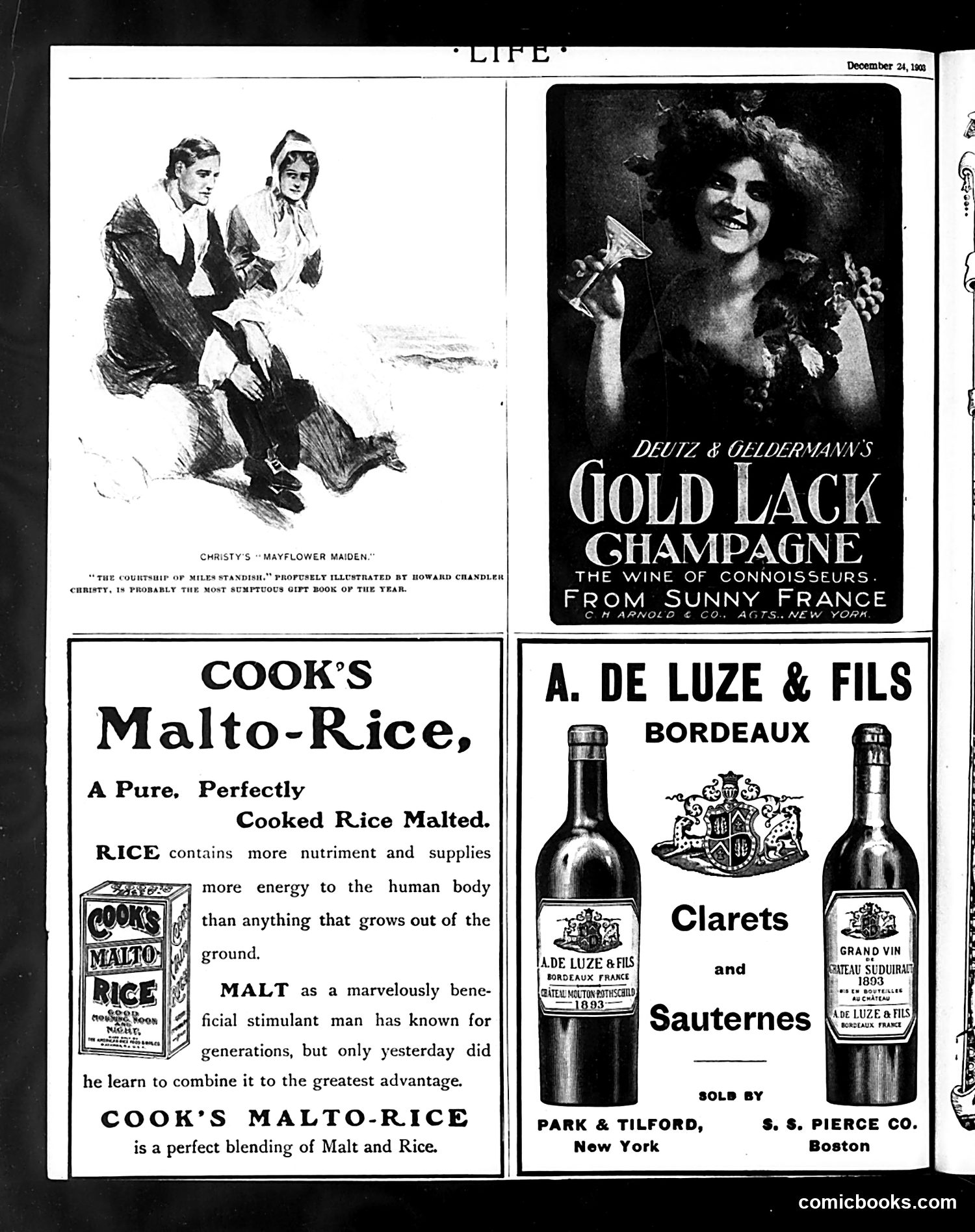
This is primarily a **advertisements and book promotion page** rather than political satire. The top features an illustration by Howard Chandler Christy promoting his gift book on "The Courtship of Miles Standish"—a reference to Longfellow's famous poem about Puritan colonial history. The sketch shows two figures in period dress, presented as the year's most luxurious gift book. Below are three product advertisements: **Cook's Malto-Rice** (a nutritional supplement combining malt and rice for energy), **Gold Lack Champagne** (imported French wine), and **A. De Luze & Fils** clarets and sauternes (also French wines, sold by upscale New York and Boston retailers Park & Tilford and S.S. Pierce). The page reflects early 1900s consumer culture—wealthy Americans purchasing refined European luxury goods and literary gifts. There is **no discernible political or satirical content**; this appears to be a standard advertising/editorial page from the holiday season edition.