
Life, 1903-12-24 · page 6 of 20
Life — December 24, 1903 — page 6: what you’re looking at
What you’re looking at
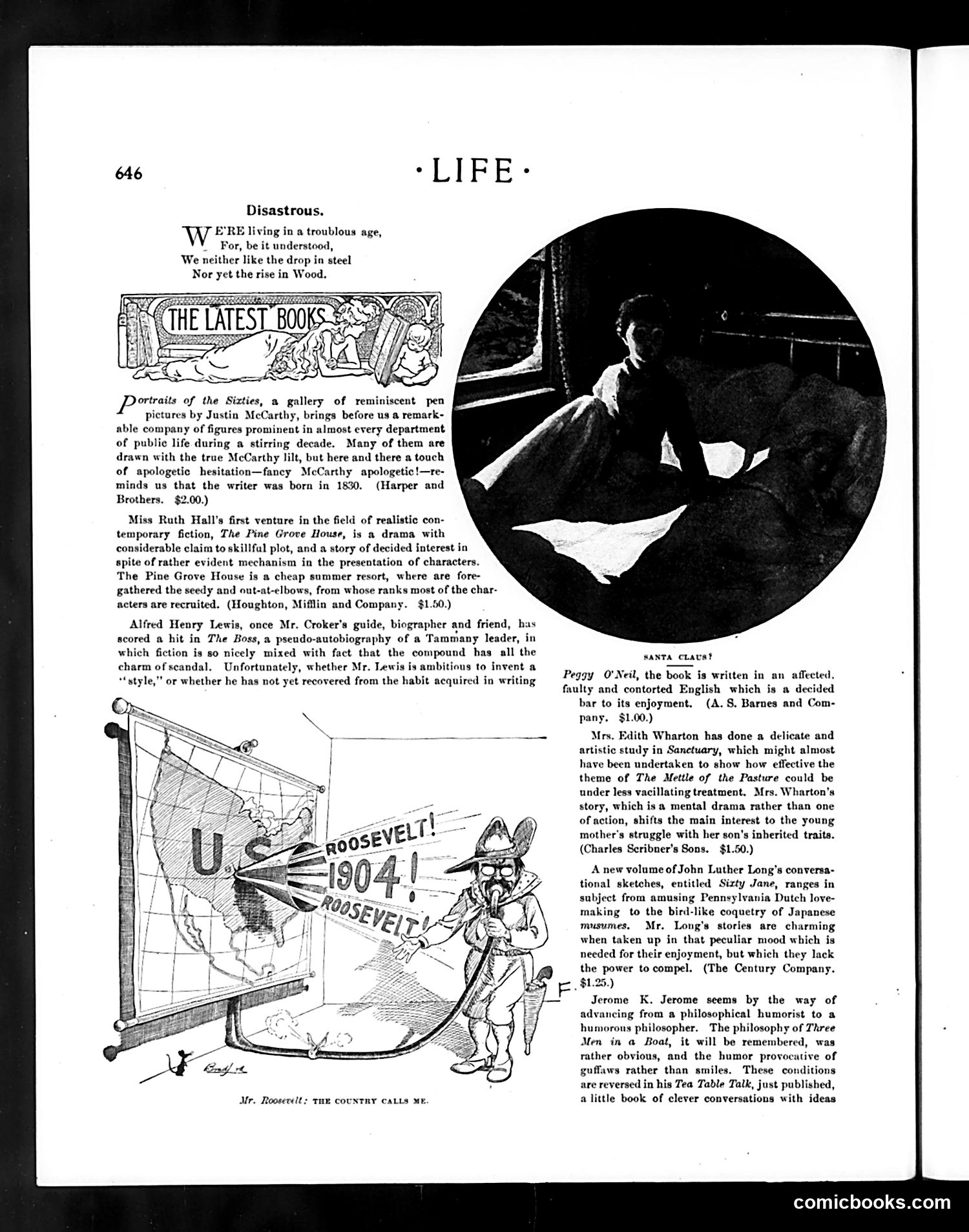
The cartoon labeled "Mr. Roosevelt: The Country Calls Me" depicts Theodore Roosevelt as a figure being pulled or called into action by the country, represented as a large mechanical device or contraption labeled "Roosevelt 1904." The caricature shows Roosevelt in characteristic pose, responding to what appears to be a draft or call for the 1904 presidential election. This satirizes Roosevelt's political position in 1904—whether he would seek another term after ascending to the presidency following McKinley's assassination in 1901. The "country calls" framing is ironic commentary on Roosevelt's own ambitions versus public demand. The mechanical imagery suggests the machinery of politics and electoral campaigns pulling him forward into the race.
📄 Transcribed text from this page (OCR, searchable)
Machine-transcribed from the original scan — historical spelling and the odd misread are preserved.
Disastrous. ERE living in a troublous age, For, be it understood, We neither like the drop in steel Nor yet the rise in Wood. ortraits of the Sixties, a gallery of reminiscent pen pictures by Justin McCarthy, brings before us a remark- able company of figures prominent in almost every department of public life during a stirring decade. Many of them are drawn with the trae McCarthy lilt, but here and there a touch of apologetic hesitation—fancy McCarthy apologetic !—re- minds us that the writer was born in 1830. (Harper and Brothers. $2.00.) Miss Ruth Hall's first venture in the field of realistic con- temporary fiction, The Pine Grove House, is a drama with considerable claim to skillful plot, and a story of decided interest in spite of rather evident mechanism in the presentation of characters. The Pine Grove House is a cheap summer resort, where are fore- gathered the seedy and out-at-elbows, from whose ranks most of the char- acters are recruited. (Houghton, Mifflin and Company. $1.50.) Alfred Henry Lewis, once Mr. Croker'’s guide, biographer and friend, has scored a hit in The Boss, a pseudo-autobiography of a Tammany leader, in which fiction is so nicely mixed with fact that the compound has all the charm of scandal. Unfortunately, whether Mr. Lewis is ambitious to invent a “style,” or whether he has not yet recovered from the habit acquired in writing SANTA CLaUs? Peggy O'Neil, the book is written in an affected, faulty and contorted English which is a decided bar to its enjoyment, (A.S. Barnes and Com- pany. $1.00.) Mrs. Edith Wharton has done a delicate and artistic study in Sanctuary, which might almost have been undertaken to show how effective the theme of The Mettle of the Pasture could be under less vacillating treatment. Mrs. Wharton's story, which isa mental drama rather than one of action, shifts the main interest to the young mother's struggle with her son's inherited traits. (Charles Scribner's Sons. $1.50.) A new volume of John Luther Long's conversa- tional sketches, entitled Sizty Jane, ranges in subject from amusing Pennsylvania Dutch love- musumes. Mr. Long's stories are charming when taken up in that peculiar mood which is needed for their enjoyment, but which they lack the power tocompel. (The Century Company. _ $1.25.) Jerome K. Jerome seems by the way of advancing from a philosophical humorist to a humorous philosopher. The philosophy of Three Men in a Boat, it will be remembered, was rather obvious, and the humor provocative of guffaws rather than smiles. These conditions are reversed in his Tea Table Tatk, just published, Mr. Roosevelt: THe COUNTRY CALLS ME. alittle book of clever conversations with ideas comicbooks.com