
Life, 1903-12-24 · page 12 of 20
Life — December 24, 1903 — page 12: what you’re looking at
What you’re looking at
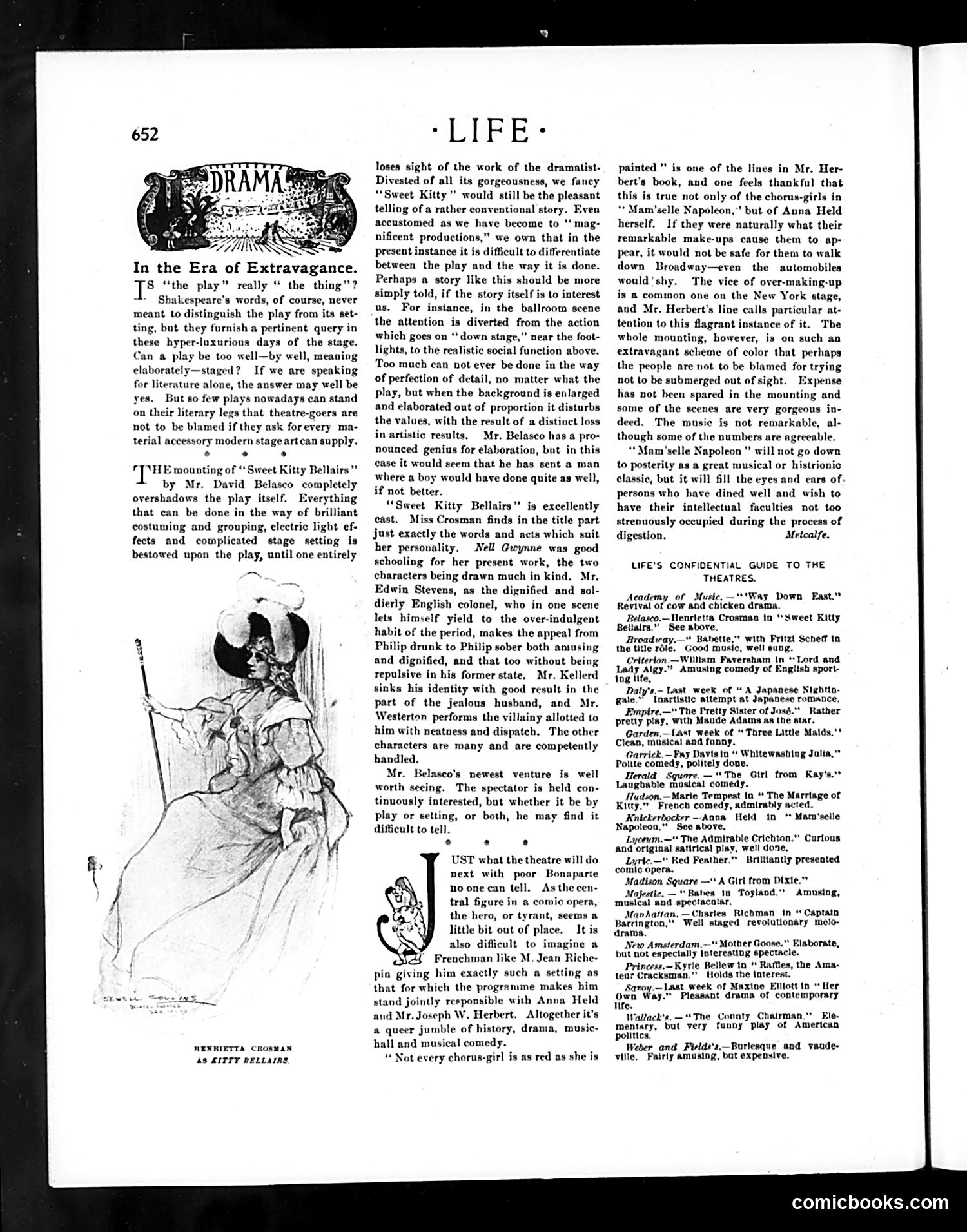
This page is primarily a **theater review column** titled "In the Era of Extravagance," not a political cartoon. The main illustration shows a sketch labeled "Henrietta Crosman as Kitty Bellairs"—an actress in costume for the play "Sweet Kitty Bellairs." The review discusses how modern theatrical productions prioritize elaborate staging and spectacle over storytelling clarity. The critic argues that while "Sweet Kitty Bellairs" is well-executed, audiences struggle to follow the plot because the ornate sets and over-scaled backgrounds distract from the action. The piece then lists current theatrical productions with brief reviews. This reflects **early 1900s theater criticism**, where the tension between artistic ambition and audience comprehension was a live debate.
📄 Transcribed text from this page (OCR, searchable)
Machine-transcribed from the original scan — historical spelling and the odd misread are preserved.
In the Era of Extravagance. TS cithe play” really the thing"? - Shakespeare’s words, of course, never meant to distinguish the play from its set- ting, but they furnish a pertinent query in these hyper-luxurious days of the stage. Can a play be too well—by well, meaning claborately—staged? If we are speaking for literature alone, the answer may well be yes. But so few plays nowadays can stand on their literary legs that theatre-goers are not to be blamed if they ask forevery ma- terial accessory modern stage artcan supply. ° ° ° FL HE mounting of “Sweet Kitty Bellairs"”” by Mr. David Belasco completely overshadows the play itself. Everything that can be done in the way of brilliant costuming and grouping, electric light ef- fects and complicated stage setting is bestowed upon the play, until one entirely WENKIETTA CROSMAN a8 KITTY BELLAIRS, “LIFE* loses sight of the work of the dramatist. Divested of all its gorgeousness, we fancy “Sweet Kitty’ would still be the pleasant telling of a rather conventional story. Even accustomed as we have become to ‘‘ mag- nificent productions,” we own that in the present instance it is difficult to differentiate between the play and the way it is done. Perhaps a story like this should be more simply told, if the story itself is to interest us. For instance, in the ballroom scene the attention is diverted from the action which goes on ‘down stage,” near the foot- lights, to the realistic social function above. Too much can not ever be done in the way of perfection of detail, no matter what the play, but when the background is enlarged and elaborated out of proportion it disturbs 8, with the result of a distinct loss ic results, Mr. Belasco has a pro- nounced genius for elaboration, but in this case it would seem that he has sent a man where a boy would have done quite as well, if not better. “Sweet Kitty Bellairs” is excellently east. Miss Crosman finds in the title part just exactly the words and acts which suit her personality. Nell Greynne was good schooling for her present work, the two characters being drawn much in kind. Mr. Edwin Stevens, as the dignified and sol- dierly English colonel, who in one scene lets himself yield to the over-indulgent habit of the period, makes the appeal from Philip drunk to Philip sober both amusing and dignified, and that too without being repulsive in his former state. Mr. Kellerd sinks his identity with good result in the part of the jealous husband, and Mr. Westerton performs the villainy allotted to him with neatness and dispatch. The other characters are many and are competently handled. Mr. Belasco's newest venture is well worth seeing. The spectator is held con- tinuously interested, but whether it be by play or setting, or both, he may find it difficult to tell. ° . ® UST what the theatre will do next with poor Bonaparte 5 no one can tell, As the cen- UB, tral Ggure in a comic opera, 4. the hero, or tyrant, seems a GOVT little bit out of place. It is > also difficult to imagine a ic Frenchman like M. Jean Riche- pin giving him exactly such a setting as that for which the programme makes him stand jointly responsible with Anna Held and Mr. Joseph W. Herbert. Altogether it’s a queer jumble of history, drama, music- hall and musical comedy. “ Not every chorus-girl is as red as she is painted " is one of the lines in Mr. Her- bert’s book, and one feels thankful that this is true not only of the chorus-girls in ‘* Mam'selle Napoleon,” but of Anna Held herself. If they were naturally what their remarkable make-ups cause them to ap- pear, it would not be safe for them to walk down Broadway—even the automobiles would 'shy. The vice of over-making-up is a common one on the New York stage, and Mr. Herbert's line calls particular at- tention to this flagrant instance of it. The whole mounting, however, is on such an extravagant scheme of color that perhaps the people are not to be blamed for trying not to be submerged out of sight. Expense has not been spared in the mounting and some of the scenes are very gorgeous in- deed. The music is not remarkable, al- though some of the numbers are agreeable. “*Mam'selle Napoleon" will not go down to posterity as a great musical or histrionic classic, but it will fill the eyes and ears of. persons who have dined well and wish to have their intellectual faculties not too strenuously occupied during the process of digestion. Metcalfe. LIFE'S CONFIDENTIAL GUIDE TO THE THEATRES. Academy of Mustc,—“*Way Down East." Revival of cow and chicken drama. Belasco.—Henrlet'e Crosman in ‘Sweet Kitty Bellatra."” See above. Breadvray.—"* Babette,” with Pritzt Scheff ta the title réle. Good music, well sung. Criterion. —Willtam Faversham in ‘Lord and Lady Algy.” Amusing comedy of English sport- tng life, Daly's — Last week of “A Japanese Nightin- gale.” Inarttstic attempt at Japanese romance. Emptre.—“The Pretty Sister of José." Rather pretty play, with Maude Adams as the star. Garden.—Last week of “Three Little Malds."* Clean, musical and fanny. Garrick.—Fay Davisin * Whitewasbing Jalis,”* Poltte comedy, politely done. Square. — “The Girl from Kay's.’* Lasughabe masical comedy. Hudson.—Marie Tempest in “ The Marriage of Kitty.” French comedy, admirably acted. Knickerbocker —-Anna Held in ‘ Mam'selle Napoleon,” See above, Lyceum. The Admirable Crichton." Curtous and original satirical play, well done, Lyrie.—"* Red Feather.” Brilitantly presented comic opera. Madison Square — A Giri from Dixte."* Mojestic. — “Babes in Toyland.” Amusing, miustcal abd spectacolar, Manhattan, —Chartes Richman in “Captain Barrington,” Well staged revolutionary melo- drama. New Amsterdam,—* Mother Goose.” Elaborate, but not especially interesting spectacte. Princess.—Kyrie Bellew in “ Rafies, the Ams- teur Crackaman.” Holds the tnterest. ‘Saroy,—Last week of Maxine Elliott tn “Her Own Way.” Pleasant drama of contemporary life. Wallack's, — “The Connty Chairman.” Ele- mentary, but very fuuny play of Amertcan politics. Weber and Firtds's,—Burlesque and vaude- ville, Fairly amusing, bat expensive, comicbooks.com