
A complete issue · 20 pages · 1903
Life — October 29, 1903
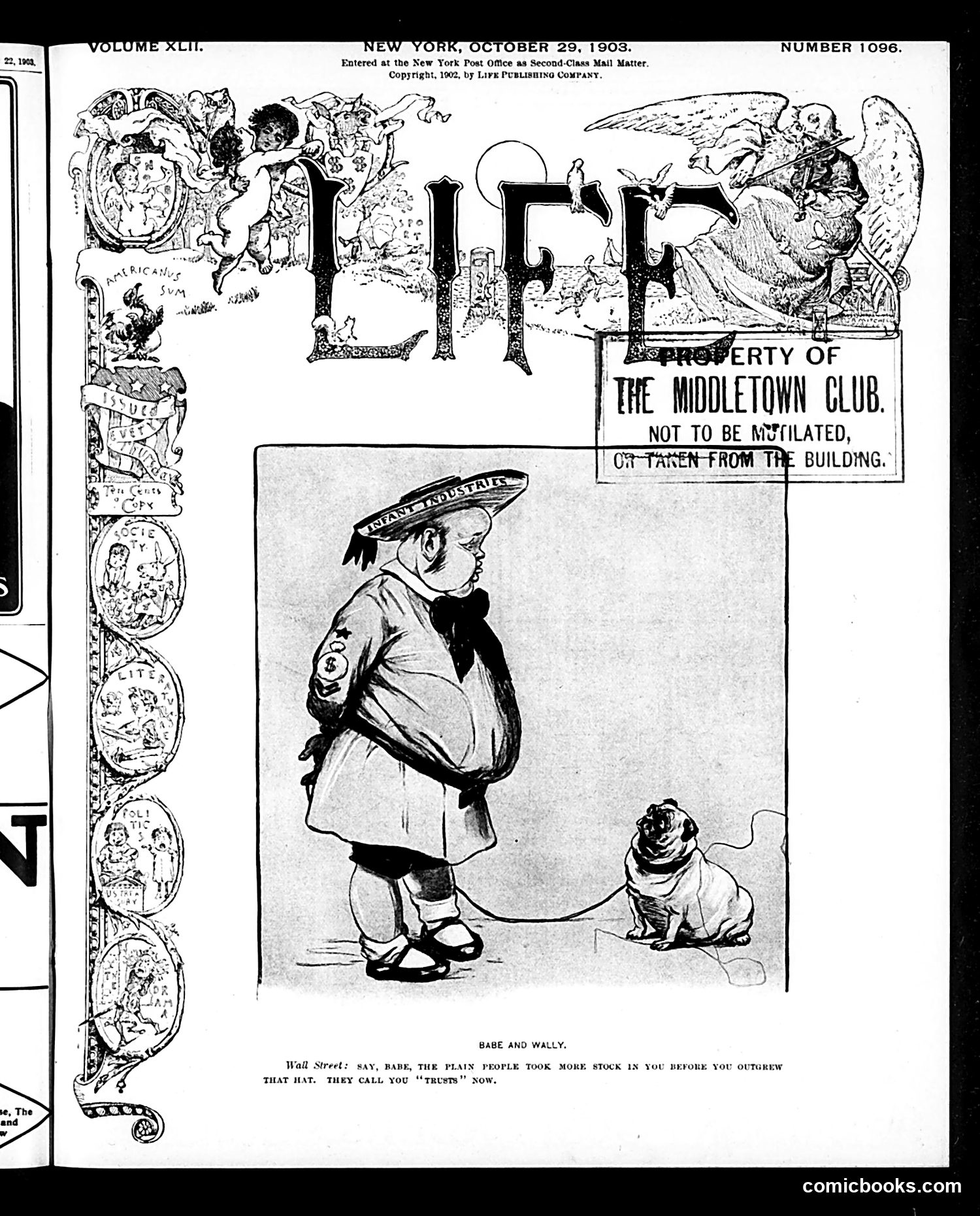
This cartoon satirizes Wall Street speculation and public trust during the early 1900s. The figure labeled "BABE" (wearing a straw hat marked "WALL STREET") represents a wealthy speculator or financier. He leads a small dog labeled "WALLY" on a leash—likely symbolizing ordinary citizens or the general public. The caption reads: "Wall Street: say, Babe, the plain people took more stock in you before you outgrew that hat. They call you 'Trusts' now." The satire criticizes how financial elites ("Babe") once enjoyed public confidence but have grown greedy, becoming associated with monopolistic trusts. The dog metaphor suggests the public blindly follows wealthy speculators, even as those figures become increasingly corrupt and untrustworthy.
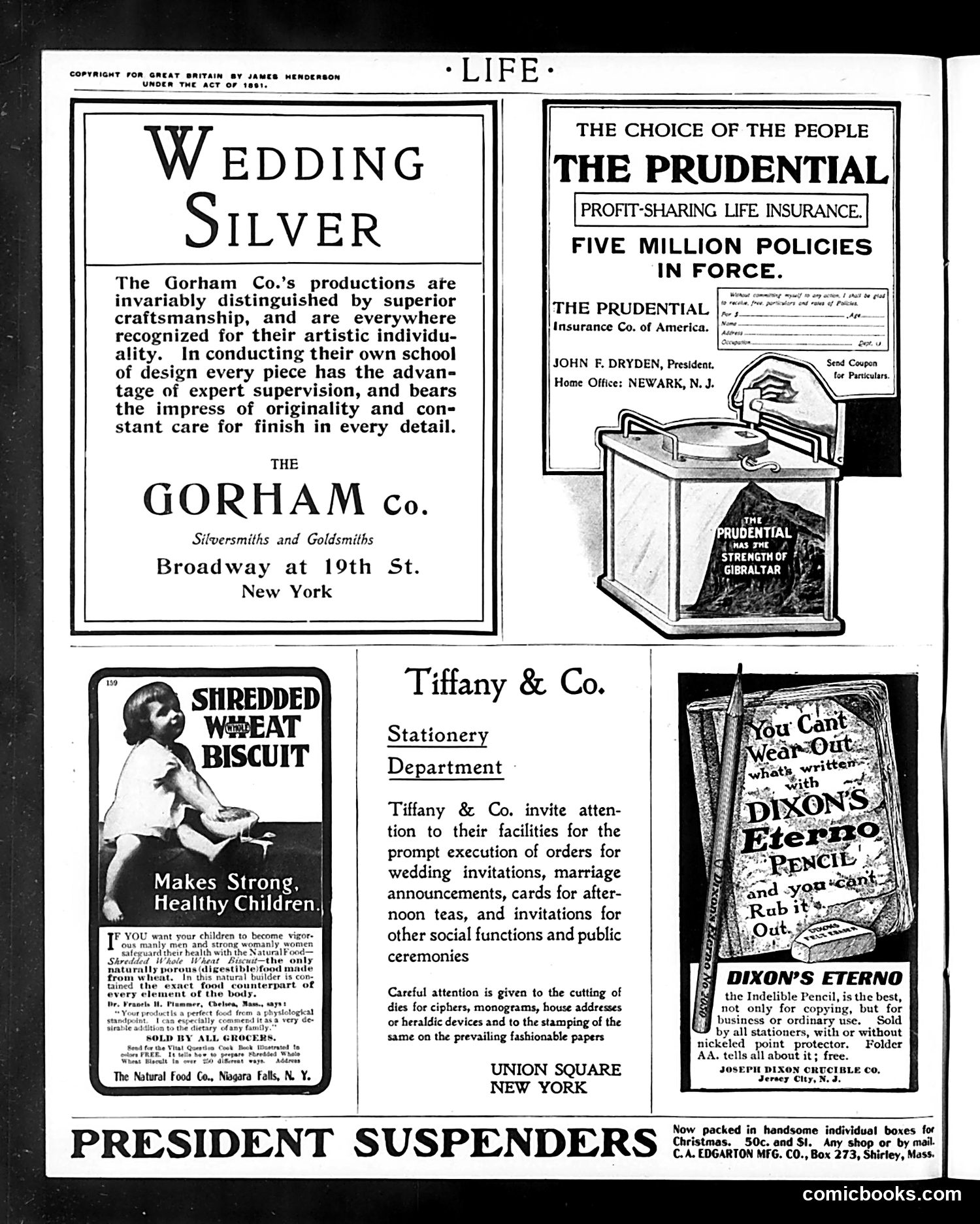
This page is **primarily advertising**, not political satire. It contains five commercial advertisements from what appears to be an early 20th-century publication: 1. **Gorham Co.** — wedding silver/jewelry 2. **The Prudential** — life insurance with 5 million policies 3. **Shredded Wheat Biscuit** — breakfast cereal marketed for children's health 4. **Tiffany & Co.** — stationery services for formal occasions 5. **Dixon's Eternо** — pencils There are no political cartoons or satirical commentary visible. The single illustration (a cherub eating biscuit) is product advertising, not social commentary. The page reflects consumer culture and luxury goods targeted at affluent Americans of the era.
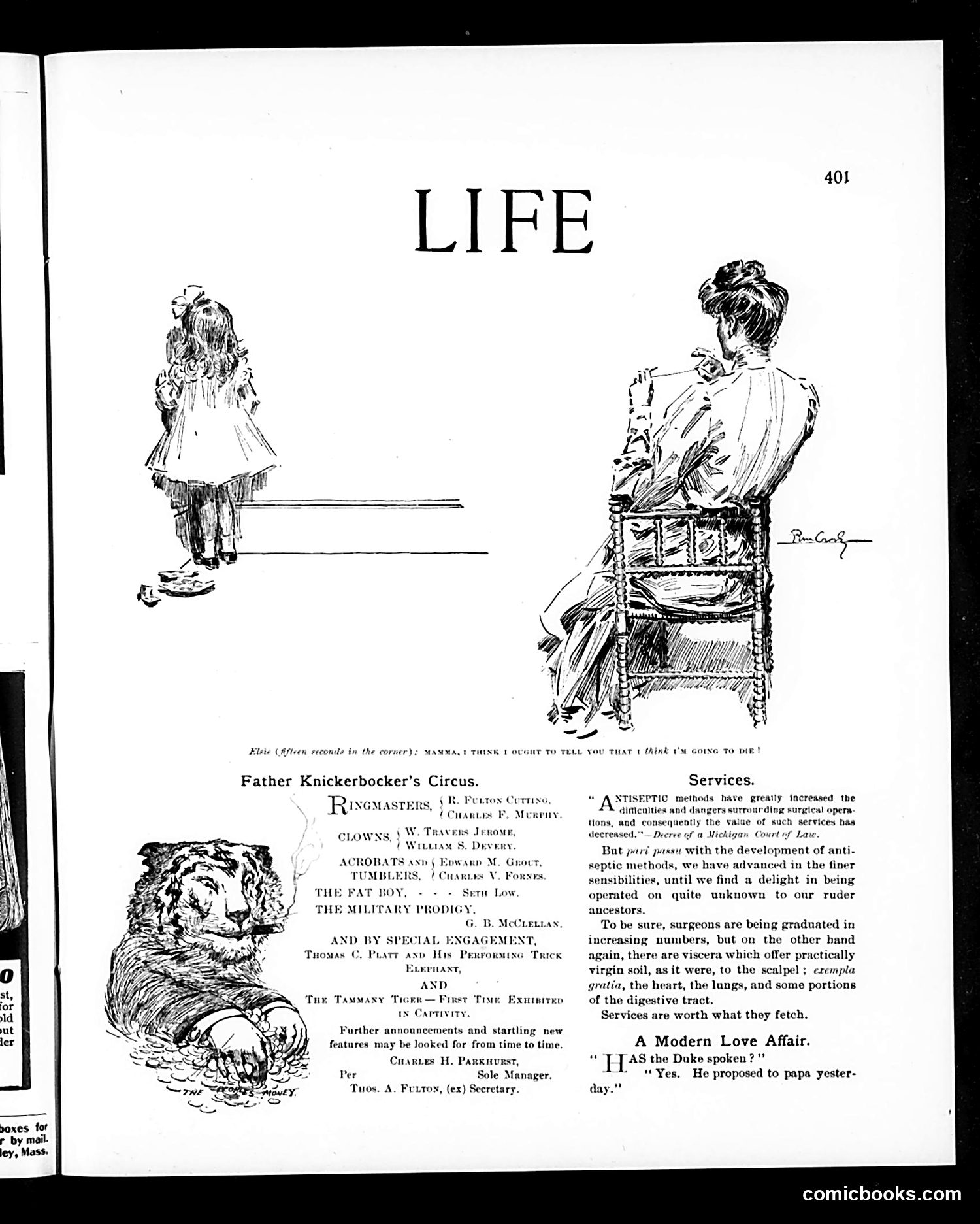
This page from *Life* magazine contains two main elements: **Top cartoon**: Shows a child telling an adult (sitting in a chair, viewed from behind) that she thinks she's going to die. The humor appears to rely on the child's dramatic overstatement—likely about some minor ailment or complaint—contrasting with the adult's casual indifference. **Bottom section**: Announces "Father Knickerbocker's Circus," featuring various performers and attractions including acrobats, a military prodigy, a Tammany Tiger, and other acts. This appears to be an advertisement or announcement for an actual circus event or theatrical production. The page also includes a brief article titled "Services" discussing antiseptic medical methods, and another item called "A Modern Love Affair" with minimal visible content.
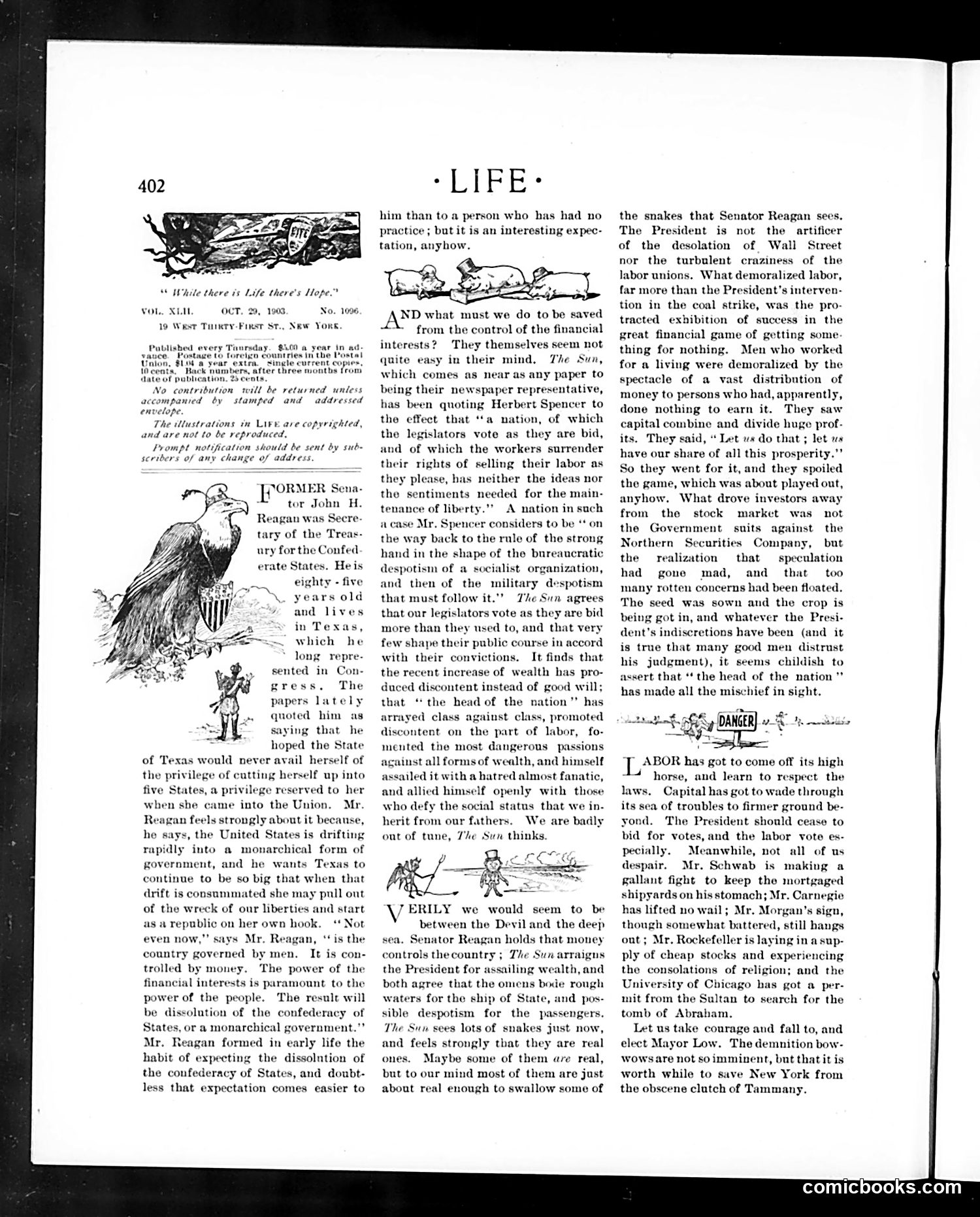
This page critiques **Senator John H. Reagan's** defense of financial interests and wealth concentration. The text attacks Reagan's assertion that the nation needs strong leadership by the wealthy to prevent socialist disorder. The **eagle illustration** (top left) symbolizes American authority and patriotism—imagery Reagan invoked. The article's satire targets Reagan's claim that labor unrest stems from agitators rather than legitimate grievances. Life argues Reagan ignores actual causes: demoralizing wealth inequality, speculation-driven financial crashes, and the government's bias toward capital over workers' rights. The cartoons depict everyday Americans caught between dangerous forces (labeled "Devil" and "deep sea"), suggesting workers face impossible choices—precisely the instability Reagan blamed on labor rather than systemic inequality.
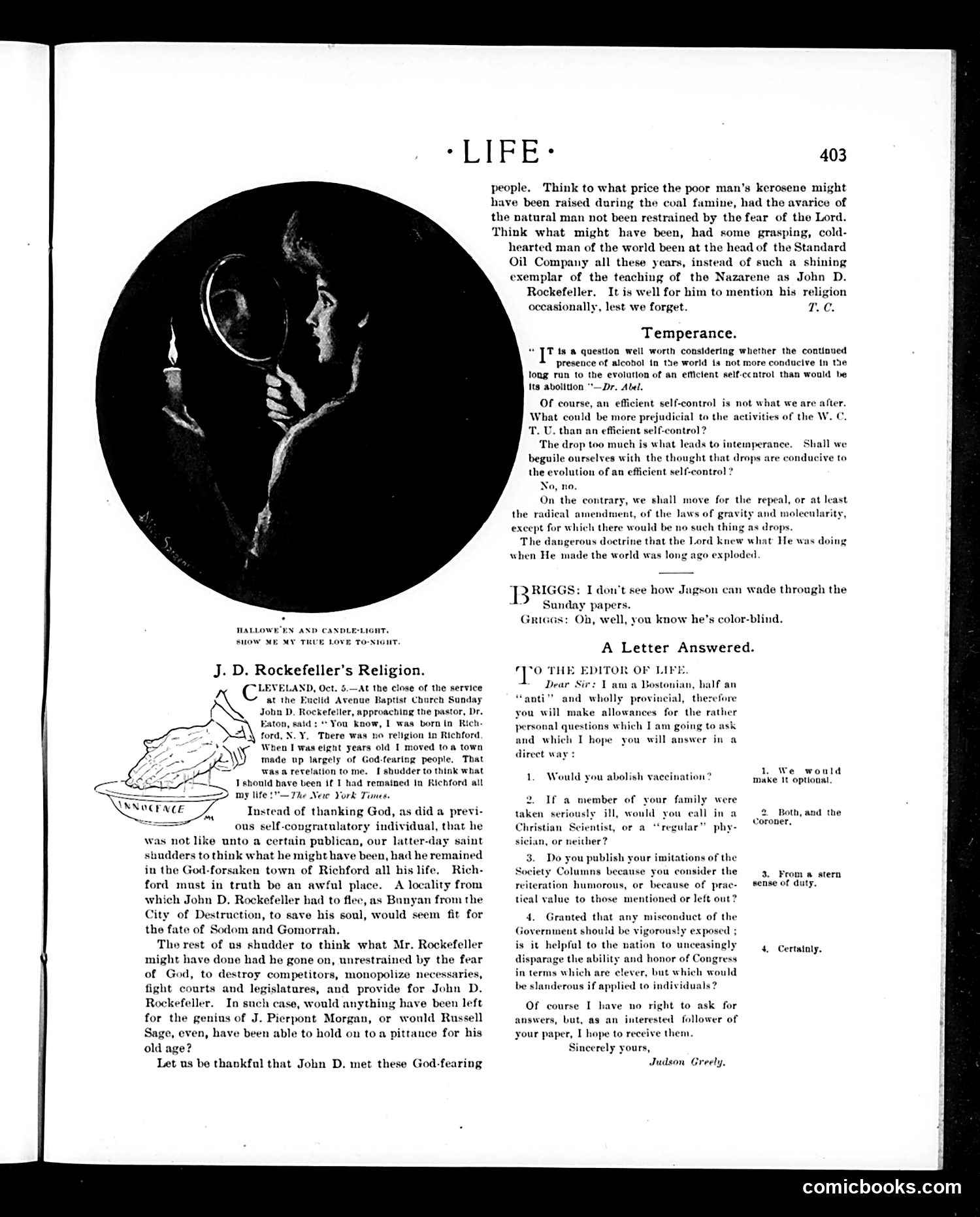
The page features a circular illustration titled "Hallow'e'en and Candle-Light: Show Me My True Love To-night," depicting a figure gazing into what appears to be a mirror or reflective surface by candlelight—a reference to folk divination practices associated with Halloween. The main article discusses **J.D. Rockefeller's Religion**, critiquing the wealthy industrialist's claim to piety. The satire suggests that Rockefeller's religious devotion is hypocritical, contrasting his ruthless business practices with his public religiosity. The author argues that a truly moral Rockefeller would have behaved differently, implying his wealth was accumulated through morally questionable means that genuine faith should have prevented. The page also contains reader letters addressing topics like temperance and vivisection.
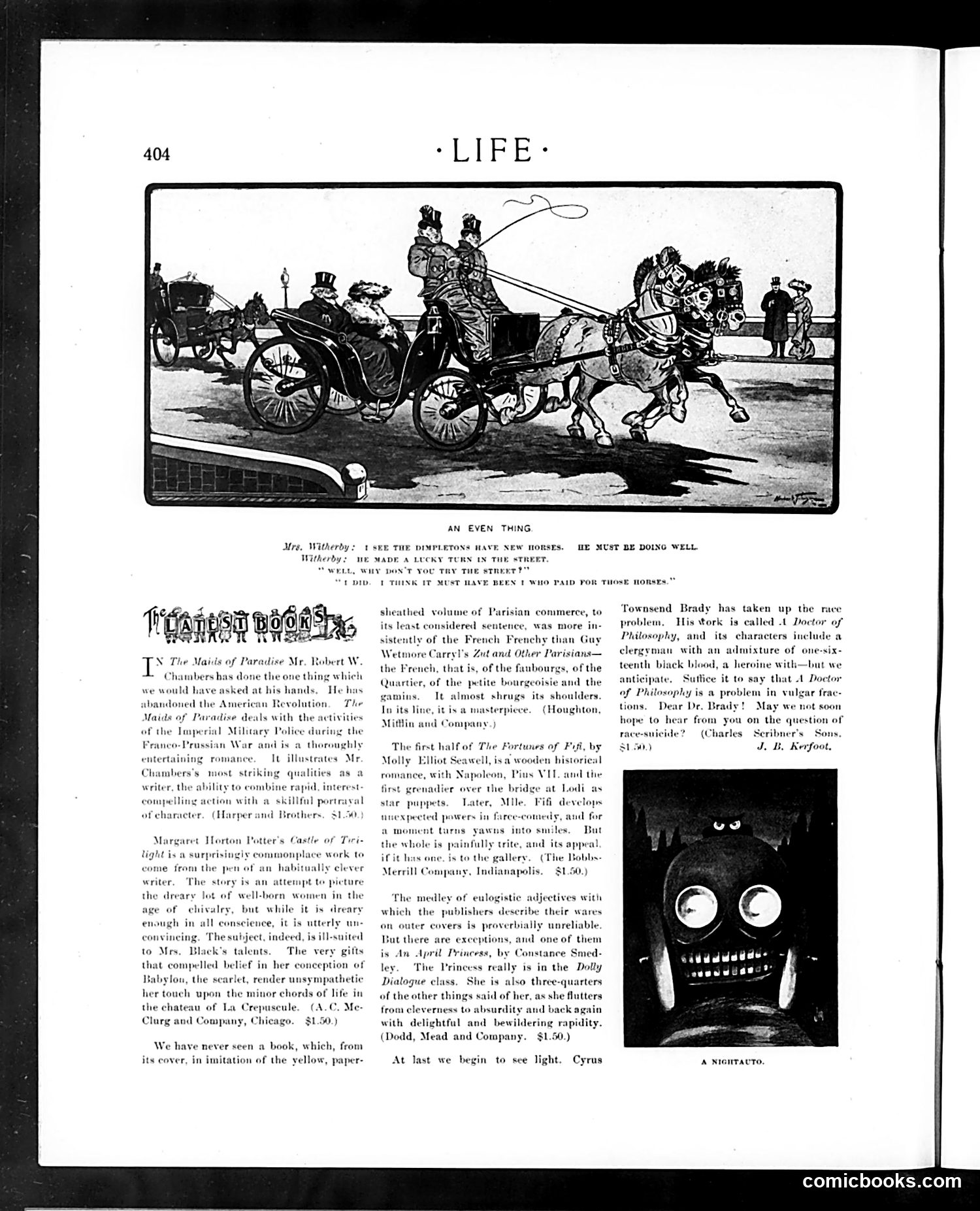
The top illustration shows an elegant horse-drawn carriage procession, captioned "An Even Thing." The dialogue between Mrs. Winterby and Winterby jokes about new horses: she notes they're performing well, while he suggests they must be doing better than their previous pair—implying the old horses were purchased from someone who "paid for those horses," likely a reference to being swindled. This appears to be social satire about the upper class and conspicuous consumption. The humor targets wealthy individuals' anxieties about being cheated in expensive purchases and the social one-upmanship involved in displaying fine horses and carriages. The page also contains book reviews, including discussion of historical and literary works. The small illustration on the right is labeled "A Nightclub."
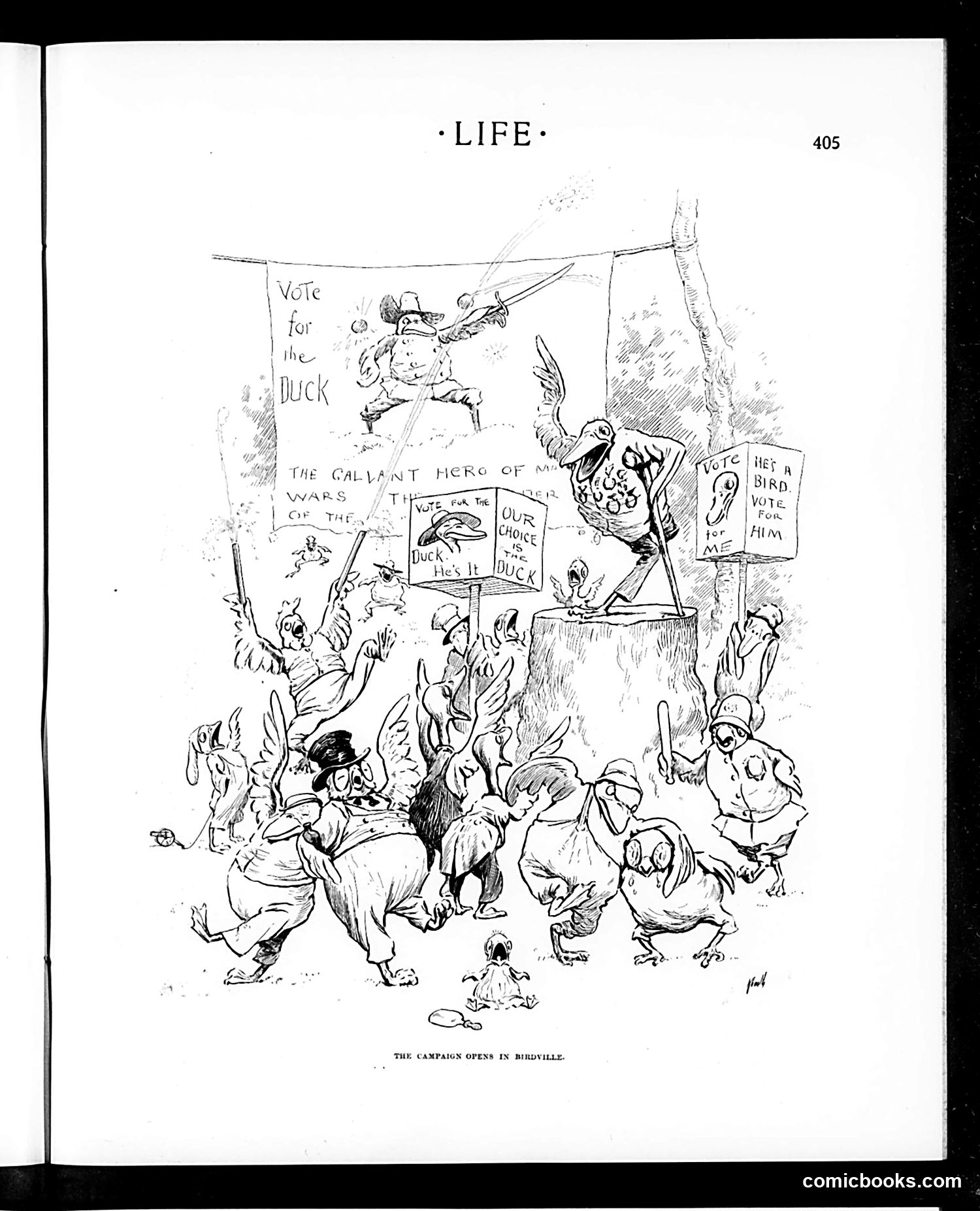
This satirical cartoon depicts an election campaign in a fictional bird society. Various anthropomorphized birds hold campaign signs advocating for different candidates: "Vote for the Duck," "Our Choice is Duck," "Vote for a Bird," and "Vote for Him." The satire appears to mock absurd or circular political campaigns where voters are offered minimal meaningful choice—all candidates are essentially interchangeable (literally, they're all birds). The signs suggest campaigns based on species identity rather than substantive policy positions. The "Birdville" setting emphasizes the satirical nature, suggesting this is a commentary on real-world elections where candidates offer little differentiation and voters are asked to choose based on superficial characteristics rather than actual differences.
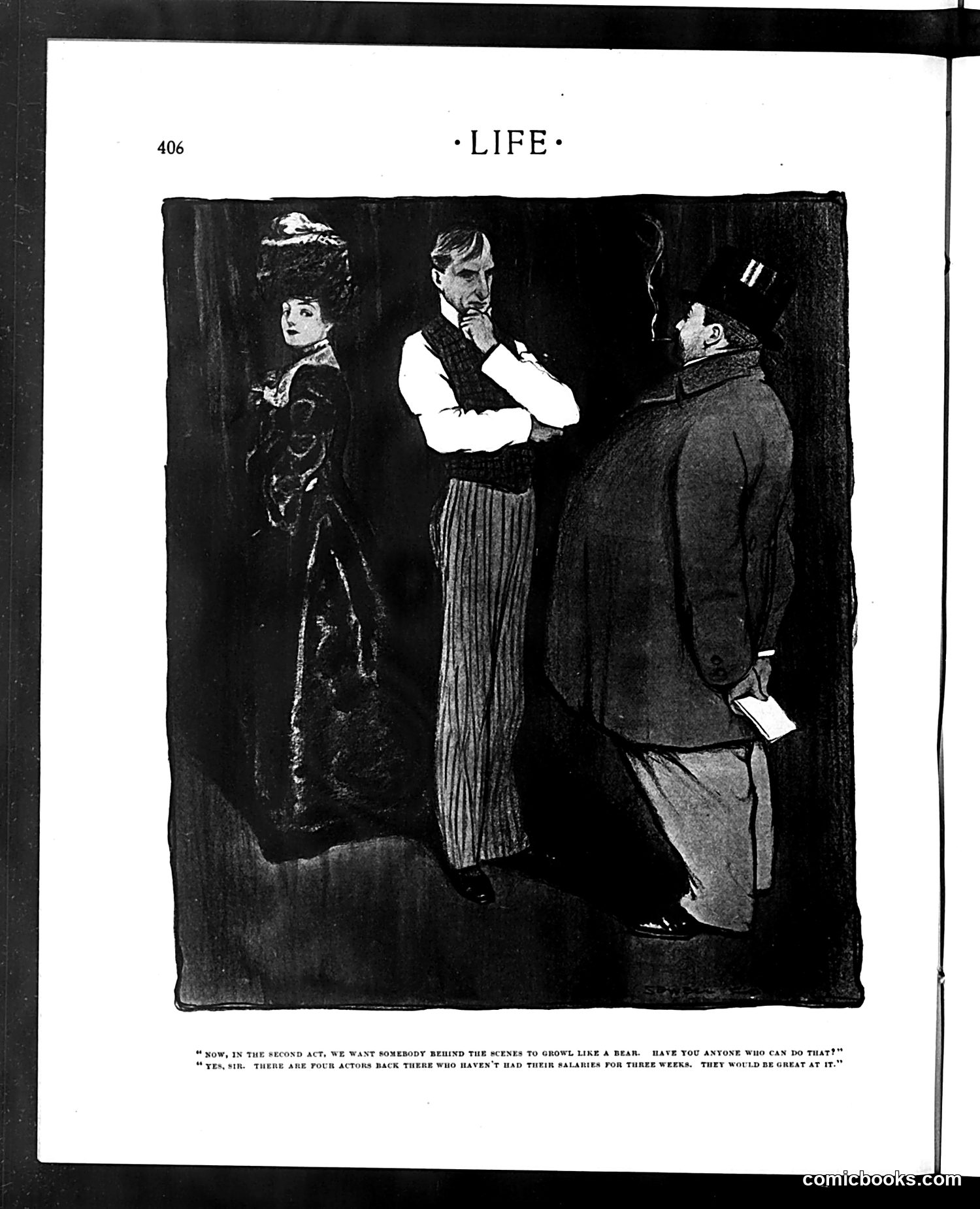
This is a theatrical satire from *Life* magazine. The scene depicts what appears to be a stage director or producer (center, in vest) speaking with a military officer (right, holding papers) while an actress waits (left, in ornate costume). The caption mocks theater economics during what appears to be wartime—the director proposes hiring unpaid actors "back there who haven't had their salaries for three weeks" to play bears in a second act scene. The humor targets: 1. **Theatrical desperation**: Productions struggling financially 2. **Labor exploitation**: Using desperate, unpaid performers 3. **Wartime conditions**: Suggests economic hardship affecting the entertainment industry The military figure's presence implies this occurs during wartime when resources were scarce and salaries went unpaid. The satire critiques both the theater's financial mismanagement and willingness to exploit vulnerable performers.
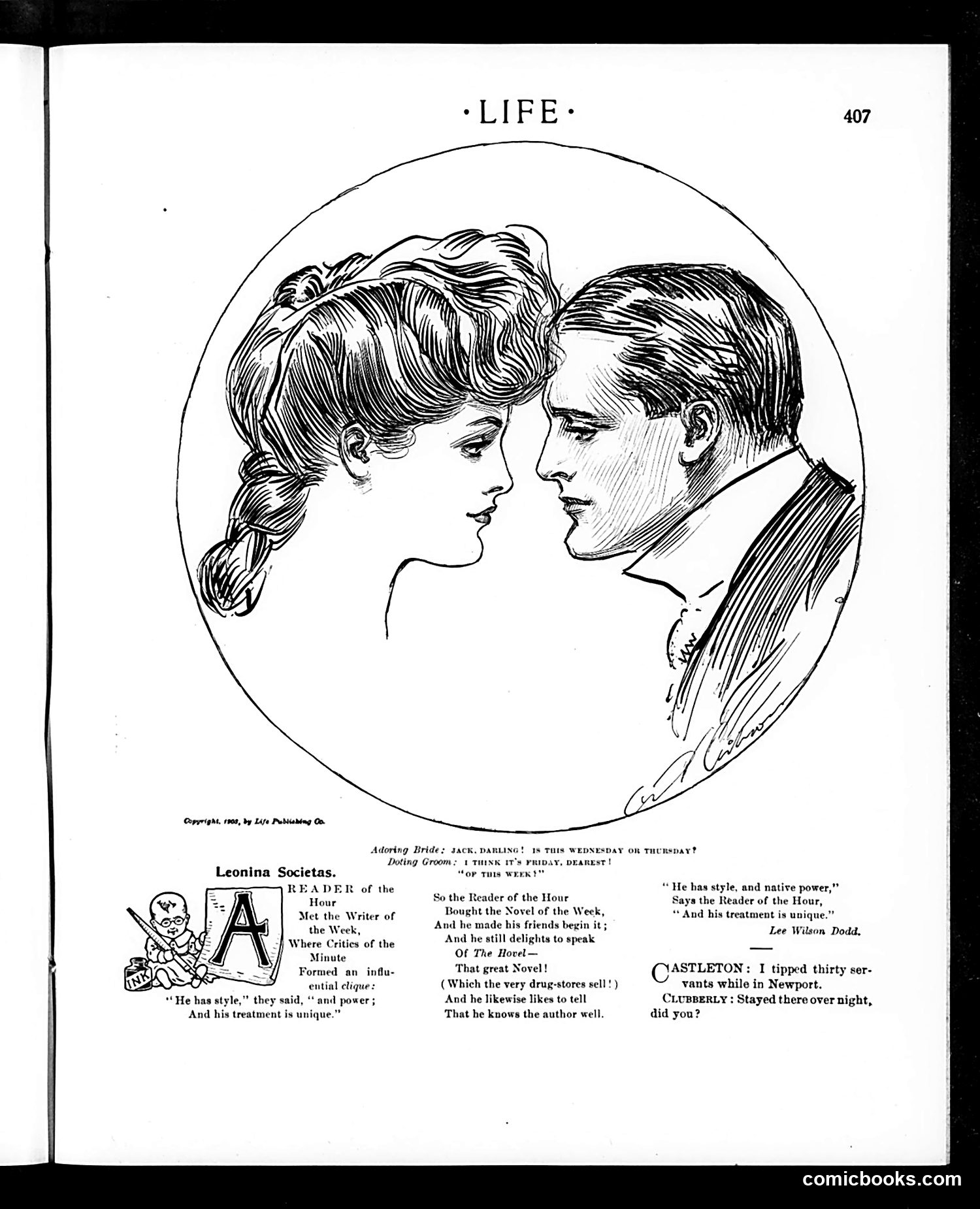
This page features a romantic illustration of a couple (a woman and man in profile) within a circular frame, accompanying text about "Leonina Societies" and literary discussion. The main satire appears to center on a novel called "The Hovel" and its popularity among readers. The dialogue mocks how drugstores are selling this book and how the "Leader of the Hour" has made it fashionable among friends. The bottom section contains a brief comedic exchange between characters named Castleton and Clabberly about servants and staying overnight in Newport—likely satirizing upper-class social pretensions and small talk. The page appears to be satirizing literary trends, consumerism around popular novels, and shallow society gossip of the era.
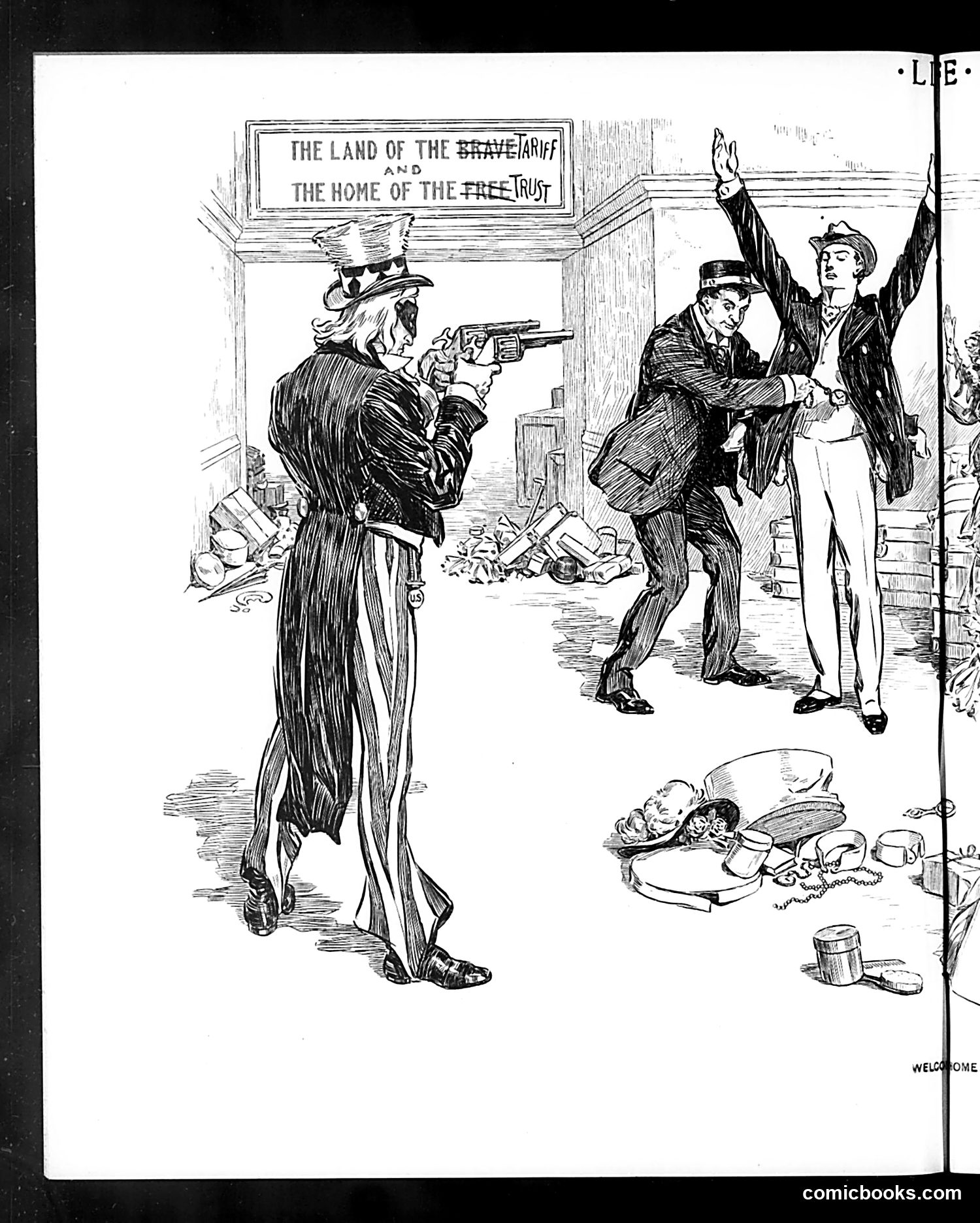
This cartoon satirizes American imperialism and military interventionism. The figure on the left—appearing to be Uncle Sam or a similar American authority figure—holds two guns and aims them at a building labeled "The Land of the Brave/Tariff and The Home of the Free/Trust." Two figures on the right, dressed as politicians or businessmen, surrender with raised hands, appearing frightened or defeated. The scattered debris and weapons at ground level suggest violence or conflict. The satire critiques the contradiction between American ideals ("land of the brave," "home of the free") and the actual use of military force and economic coercion (tariffs, trusts) to achieve political and commercial goals. The cartoon suggests American democracy is being threatened or corrupted from within by these aggressive policies.
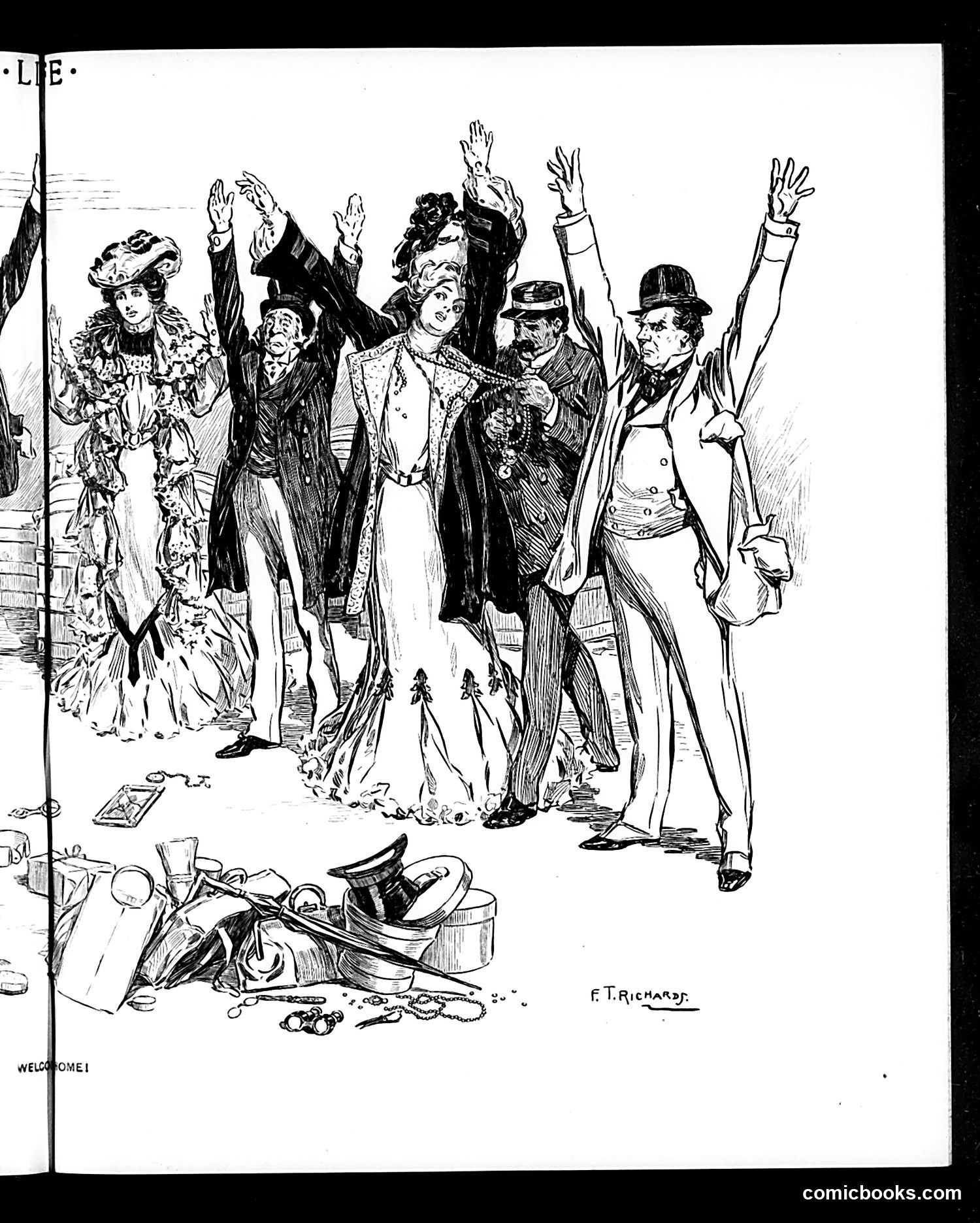
This appears to be an early 20th-century satirical cartoon by F.T. Richards showing a group of well-dressed figures in celebratory poses with raised arms. The scattered items at their feet—including what appear to be discarded hats, bottles, and other debris—suggest a celebration or revelry, possibly depicting politicians or public figures in a moment of triumph or excess. The "LIFE" masthead and "WELCOME!" text suggest this may commemorate a notable arrival or event. However, without clearer identifying labels or additional context, I cannot definitively identify which specific figures or historical event is being satirized. The style and composition suggest commentary on wealth, power, or political behavior during the Progressive Era, but the precise targets remain unclear from the image alone.
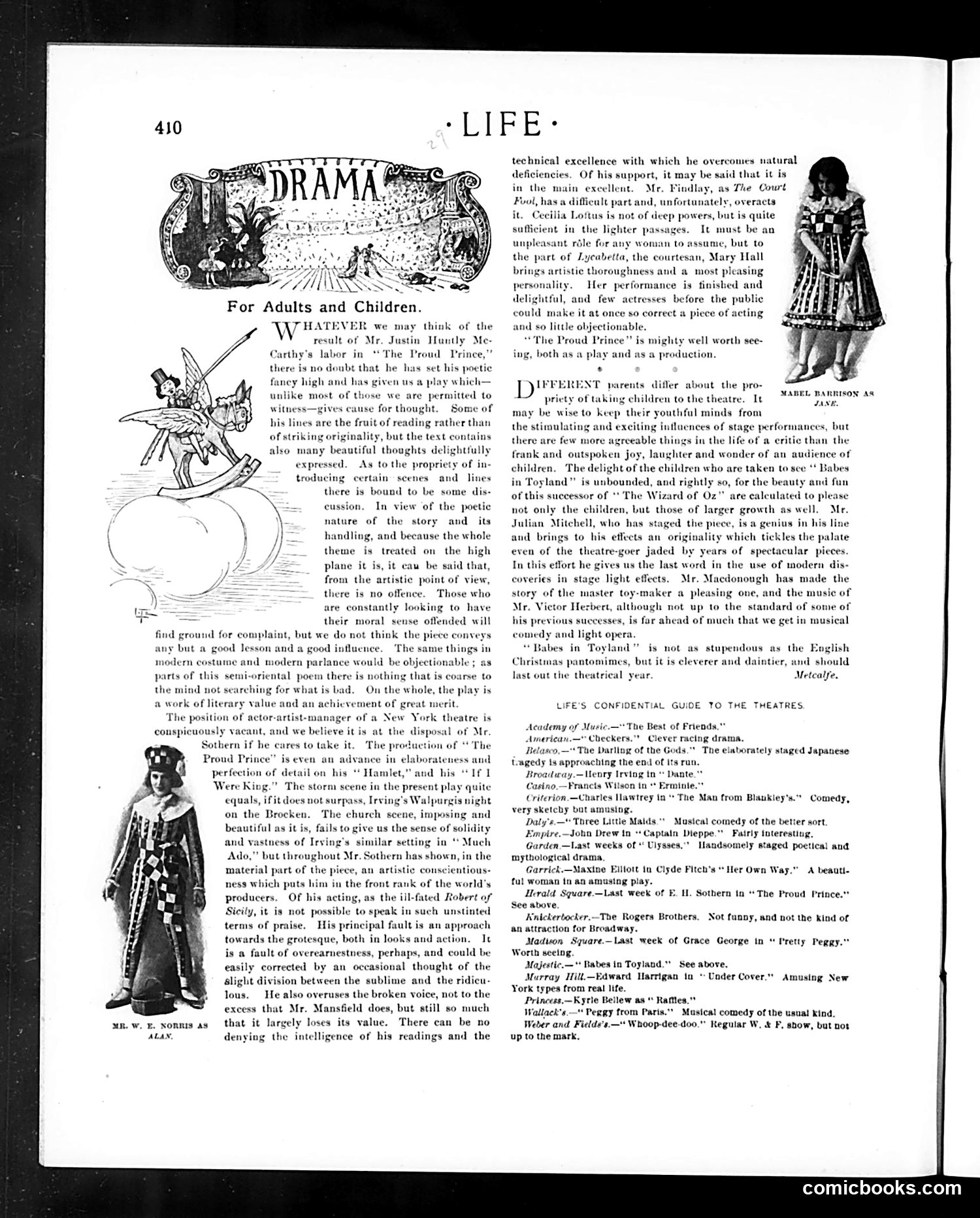
This page reviews theatrical productions, primarily "The Proud Prince," a play by Justin Huntly McCarthy. The illustrated figure in elaborate costume (labeled "MR. W. E. NORRIS AS ALAN") appears to be an actor in the production. The "DRAMA" section discusses the play's literary merit and stage production quality. The text praises the work's poetic language and moral lessons for both children and adults, noting it avoids the moral corruption sometimes associated with theatre. The review critiques various actors' performances and discusses the use of modern stage lighting effects. A secondary section lists current theatrical productions running in New York. This is primarily theatre criticism rather than political satire—a standard cultural feature in Life magazine from this era.
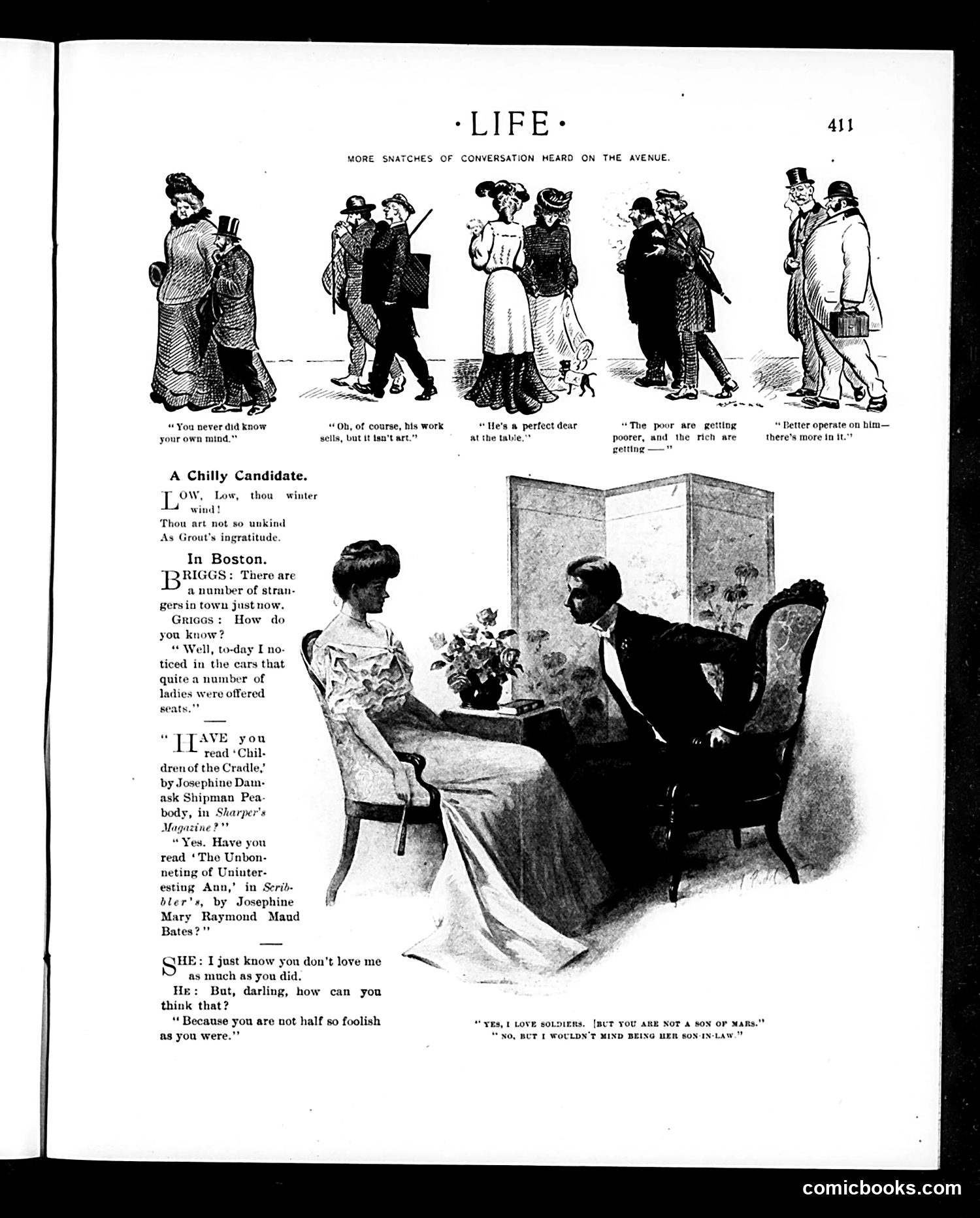
This page from *Life* magazine contains several short satirical sketches about contemporary social behavior: **Top strip**: Five vignettes mocking superficial Avenue (likely Fifth Avenue, NYC) conversation—about art criticism, poverty, and wealth inequality, presented as overheard snippets of snobbish or dismissive talk. **"A Chilly Candidate"**: A poem about winter wind and ingratitude, likely referencing a political candidate named Grout in Boston (unclear which figure without more context). **"In Boston" dialogue**: A joke about chivalry—strangers in town are identified by the fact that men *offer* seats to women on streetcars, implying this courtesy was becoming rare or noteworthy. **Literary references**: Satire mocking pretentious book titles with absurdly long author names (*Children of the Cradle*, *The Unbonneting of Uninteresting Ann*), suggesting over-earnest or forgettable contemporary literature. **Bottom illustration and dialogue**: A couple's conversation where the woman claims diminished affection; the final caption jokes about preferring to be the soldier's son-in-law rather than his actual son—wordplay on romantic versus filial relationships. Overall: gentle satire of urban manners, social pretension, and romantic conventions.
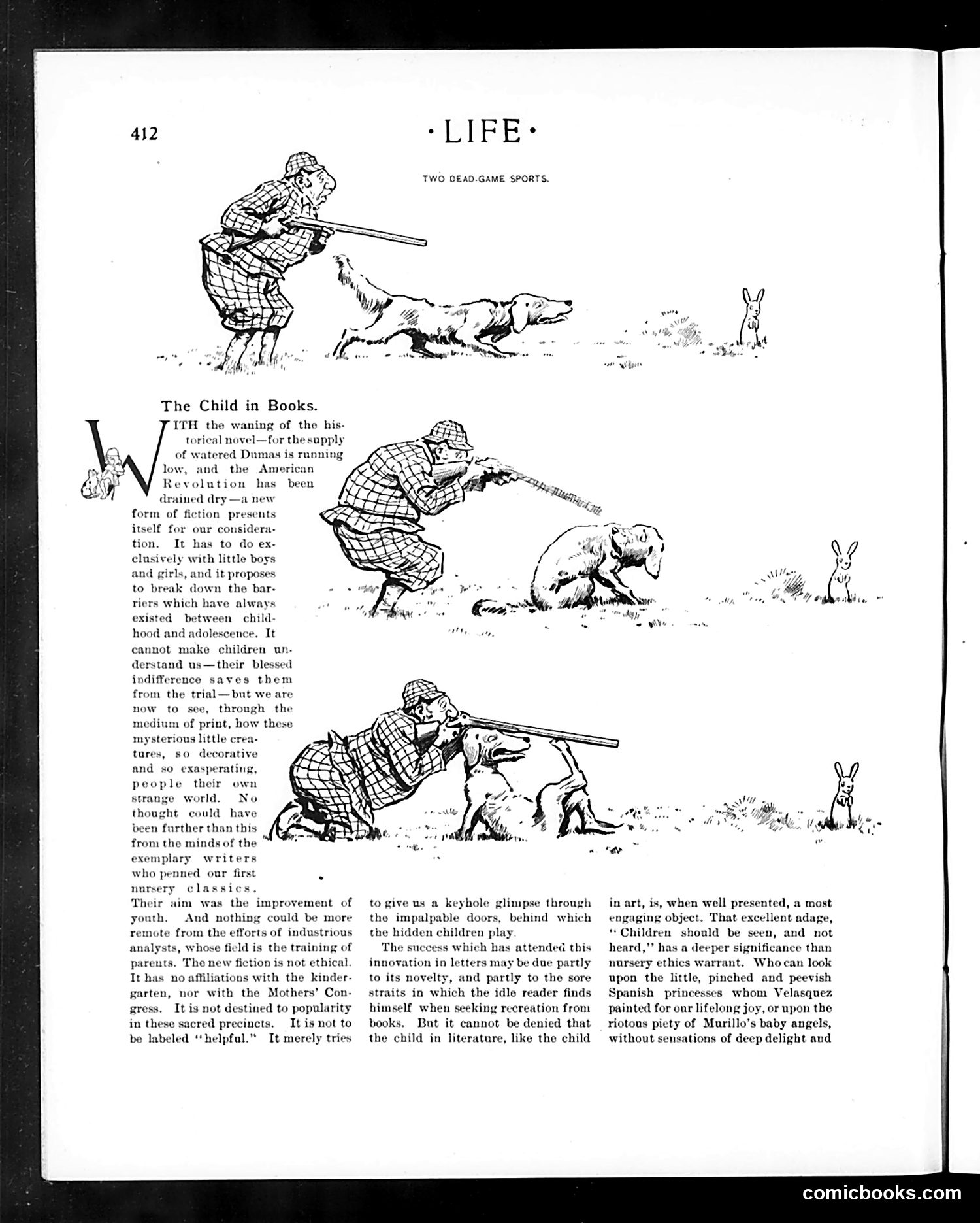
This article satirizes a new literary trend: fiction depicting children's inner lives and perspectives, rather than didactic stories aimed at moral improvement. The title "Two Dead Game Sports" refers ironically to hunting—the illustrations show a boy with a gun and hunting dog pursuing rabbits, while observing a child's "mysterious" world as adults would hunt game. The satire targets adult writers' newfound fascination with children as subjects. The text mocks how this represents a departure from traditional nursery literature's ethical mission, noting the trend arises partly from depleted historical novel supplies and readers seeking escapism. The author notes, with tongue-in-cheek approval, that depicting children authentically—whether "pinched and peevish" or angelic—creates engaging art, yet admits this new fiction "is not ethical" and won't appeal to mothers' organizations. The joke: adults are treating children as exotic curiosities to observe and exploit literarily, much like game to hunt.
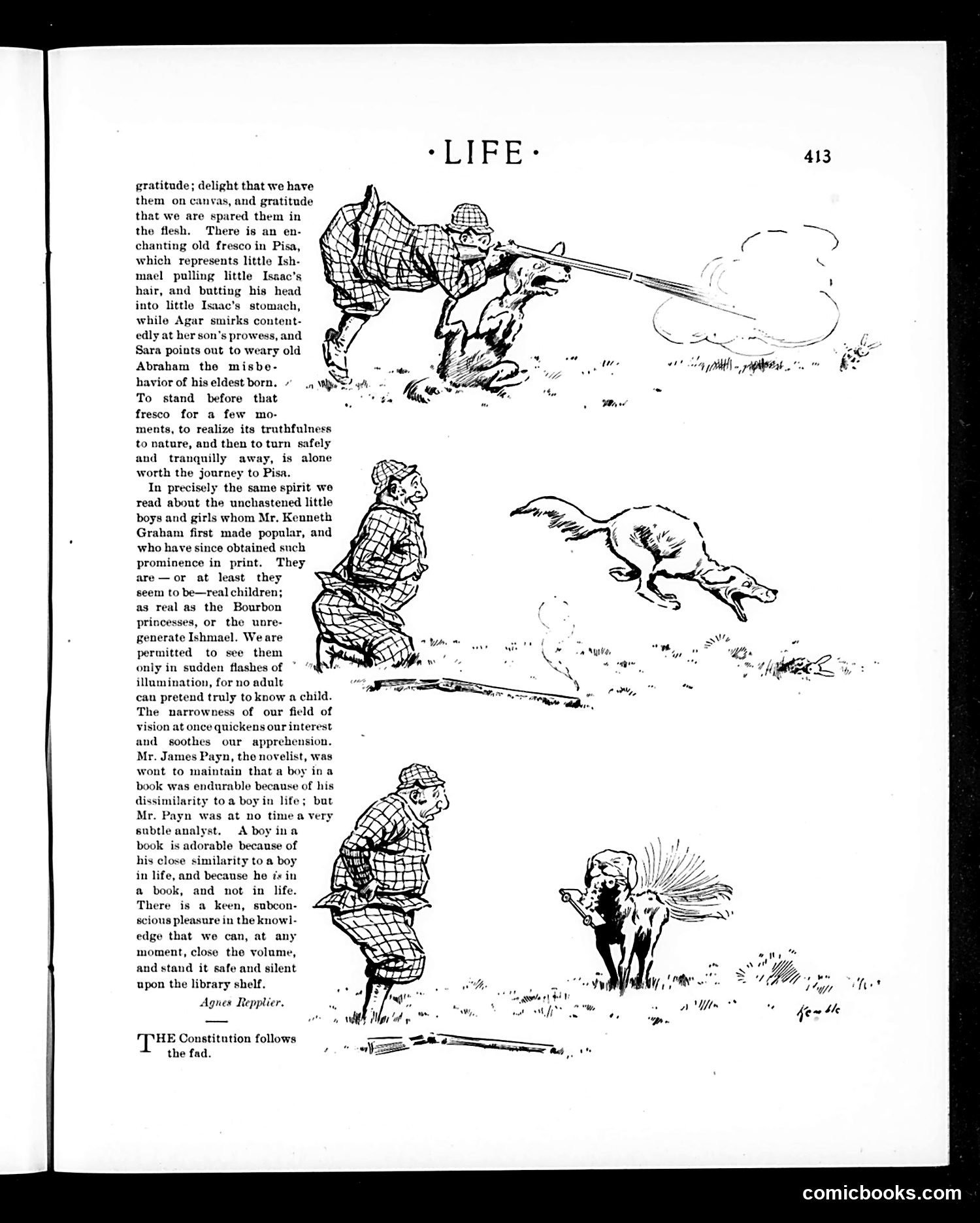
This page discusses children in literature and art, featuring illustrations of mischievous boys in plaid clothing engaged in hunting or outdoor pranks—likely referencing Kenneth Grahame's popular children's characters (author of *The Wind in the Willows*). The essay by Agnes Repplier argues that fictional children appeal because they mirror real children's behavior while remaining safely contained in books. She compares them to a fresco in Pisa depicting young Ishmael bullying Isaac—noting we can appreciate such "truthful" depictions of childish misbehavior in art without enduring them in actual life. The satire is gentle: Repplier celebrates how literature lets adults enjoy children's chaos and rudeness from a safe distance, closing the book when tired. The illustrations show these literary boys as energetic, unrefined, and somewhat wild—embodying the appealing "realness" Repplier praises. The final note "The Constitution follows the fad" appears to be an unrelated section header.
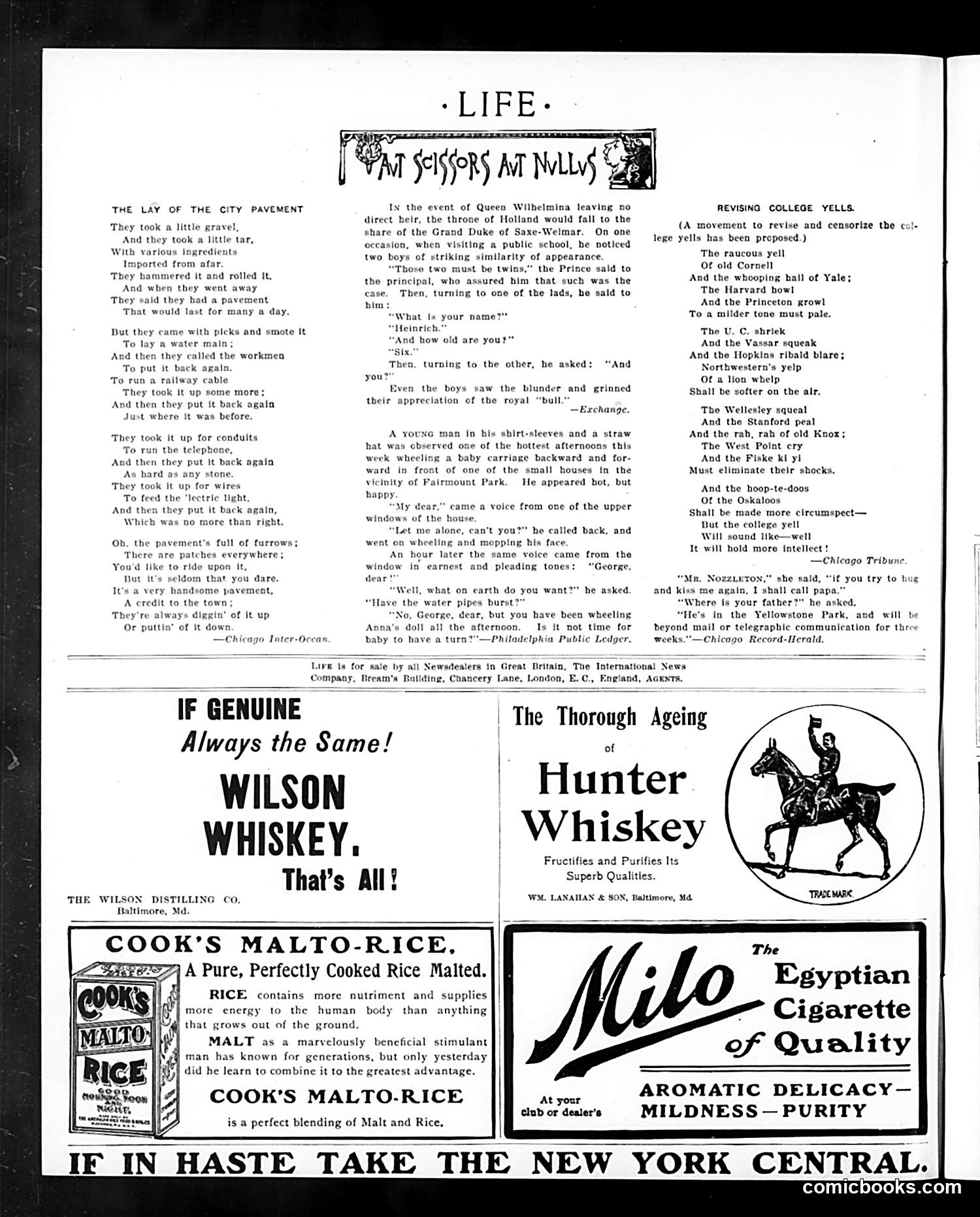
This *Life* magazine page contains humorous prose and verses mocking contemporary urban annoyances and social conventions. **"The Lay of the City Pavement"** satirizes Chicago street maintenance—workers constantly dig up pavements for utilities (water, sewers, electricity, telephone cables), then poorly repair them, leaving a patchwork of dangerous ruts. The joke: a city's "credit" is undermined by perpetual deterioration. **"Scissors at Nully"** collects three brief anecdotes: a royal visitor's accidental grammatical error ("which was the case"), a husband contentedly pushing his wife's doll carriage (mistaken for a baby), and a woman's threat to call her father—who happens to be unreachable in Yellowstone Park. **"Revising College Yells"** proposes sanitizing boisterous university chants into quieter, more "intellectual" versions—a humorous critique of prudish reformers seeking to eliminate exuberant tradition. The page is primarily content-driven advertising for whiskey, malt drinks, and cigarettes, typical of the era. The satire targets urban bureaucracy, domestic absurdity, and Victorian prudishness.
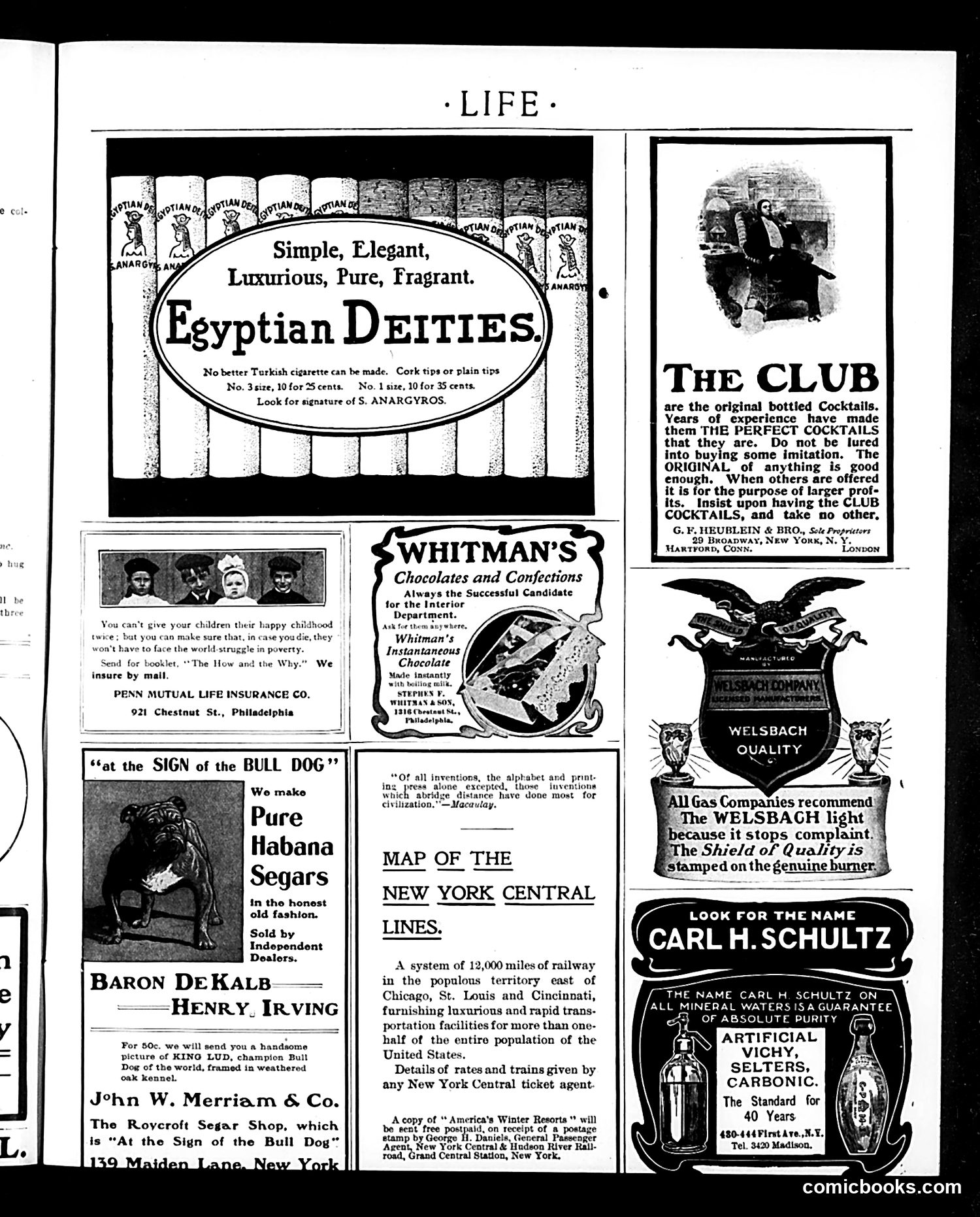
This is primarily a **commercial advertising page**, not a political cartoon. It contains various product advertisements from the early 20th century with minimal satirical content. The only potentially humorous reference is the **Whitman's Chocolates ad**, which jokes that their product is "Always the Successful Candidate for the Interior Department"—likely a gentle jab at political patronage or corruption, suggesting that quality chocolates are more reliably excellent than political appointees. Otherwise, the page features straightforward ads for luxury goods: Egyptian cigarettes, life insurance, Habana cigars (with an unrelated picture of a champion bulldog), Whitman's chocolates, Club cocktails, Welsbach gas lamps, Carl H. Schultz mineral waters, and New York Central Railways. These target affluent readers with disposable income for travel, spirits, and imported goods. The page reflects early 1900s consumer culture and advertising conventions—minimal critique, maximal product promotion.
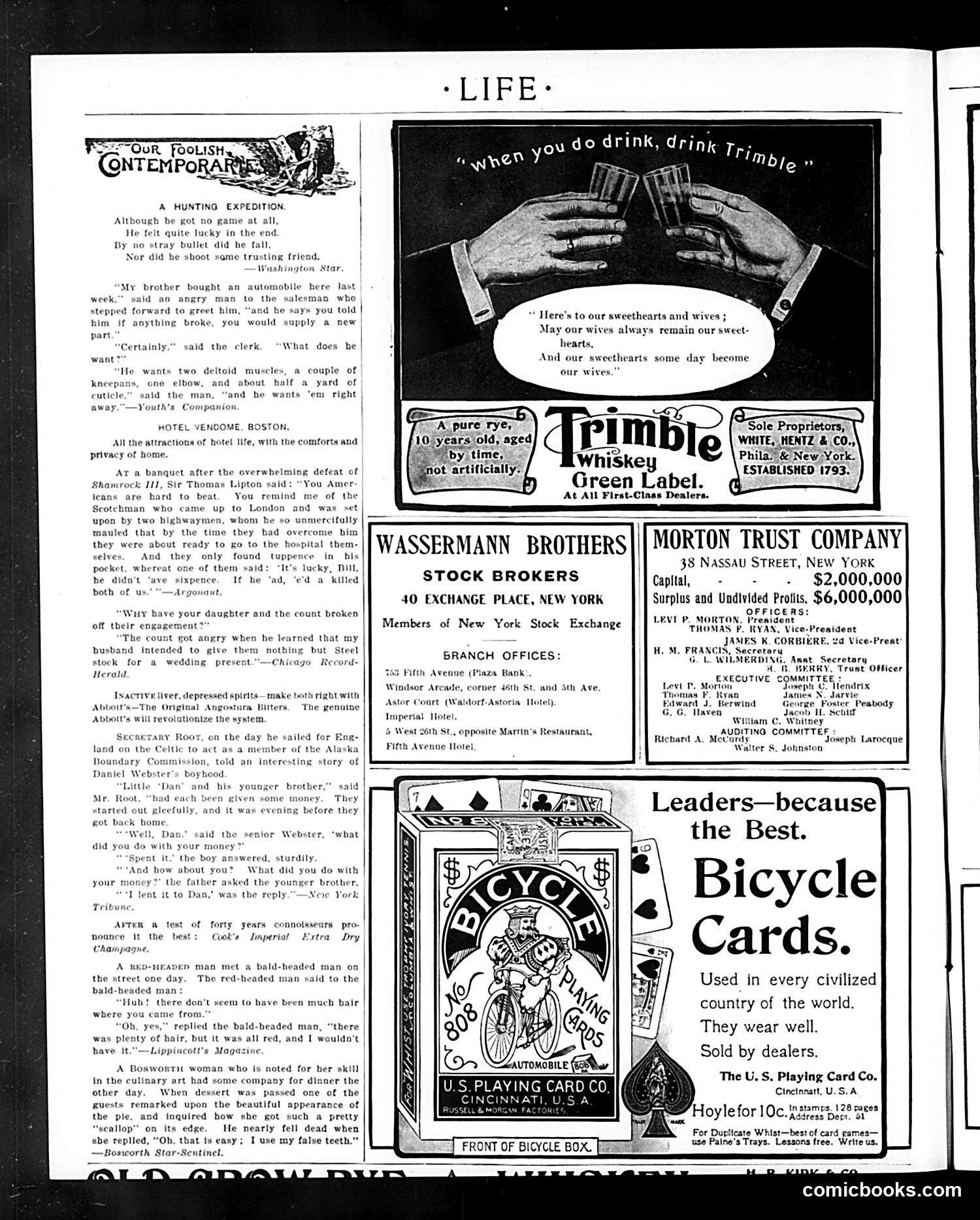
This is primarily an **advertising page** from Life magazine, interspersed with brief humor columns typical of the publication's satirical style. The main content consists of: **Humorous anecdotes** poking fun at American consumer culture and social pretension—a Scotsman robbery victim with no money, an angry automobile buyer demanding replacement parts, a father and son's financial misadventures. **Full-page advertisements** for: - **Trimble Whiskey** (featuring a toast to "sweethearts and wives") - **Wassermann Brothers** stock brokers - **Morton Trust Company** (financial services) - **Bicycle Cards** by U.S. Playing Card Co., marketed as the superior brand used globally The page reflects early 20th-century American consumer capitalism and leisure culture. The ads target wealthy readers (stock brokers, whiskey, playing cards), while the humor gently mocks middle-class aspirations—particularly regarding new automobiles, which were still luxury items. No specific political satire is evident; the humor is genteel and domesticated rather than pointed social critique.
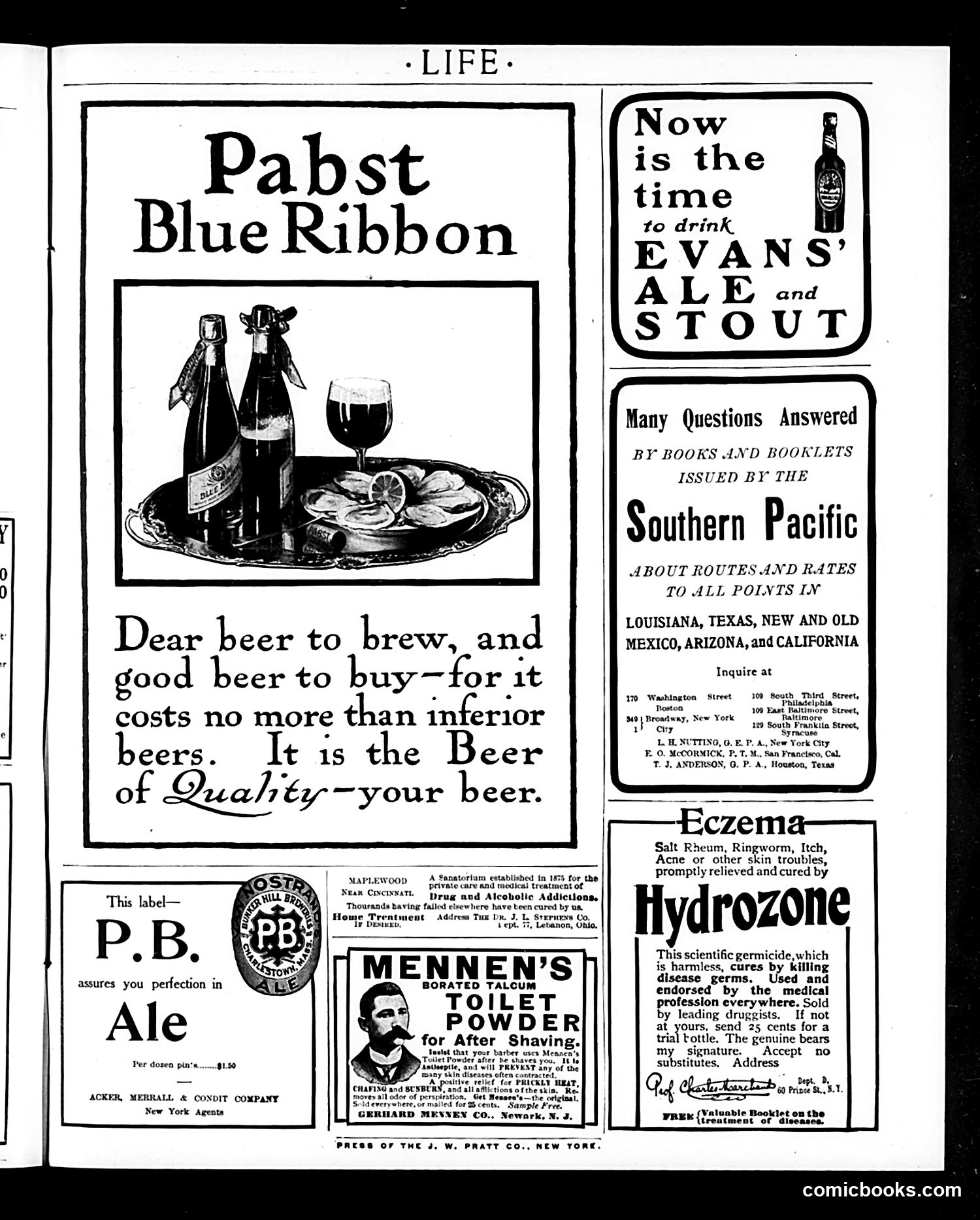
This is primarily an **advertising page**, not satirical content. It features multiple product advertisements typical of early 20th-century American magazines: **Main advertisements:** - **Pabst Blue Ribbon beer**: Emphasizes quality at competitive pricing - **Evans' Ale and Stout**: Seasonal promotion - **Southern Pacific Railway**: Travel information for southwestern destinations - **Mennen's Borated Talcum Powder**: After-shaving product - **Hydrozone**: Skin treatment germicide - **Maplewood Sanitarium**: Medical facility for treating alcoholism and drug addiction (notably ironic given the beer advertisements above it) **Historical context for modern readers:** The page reflects turn-of-century consumer culture, including patent medicines and aggressive marketing of alcohol before Prohibition. The sanitarium advertisement is particularly striking—it acknowledges widespread addiction problems while the same publication advertises the very products causing them, revealing the era's contradictory attitudes toward substance abuse and commercial interests. No political satire or caricature is present here.
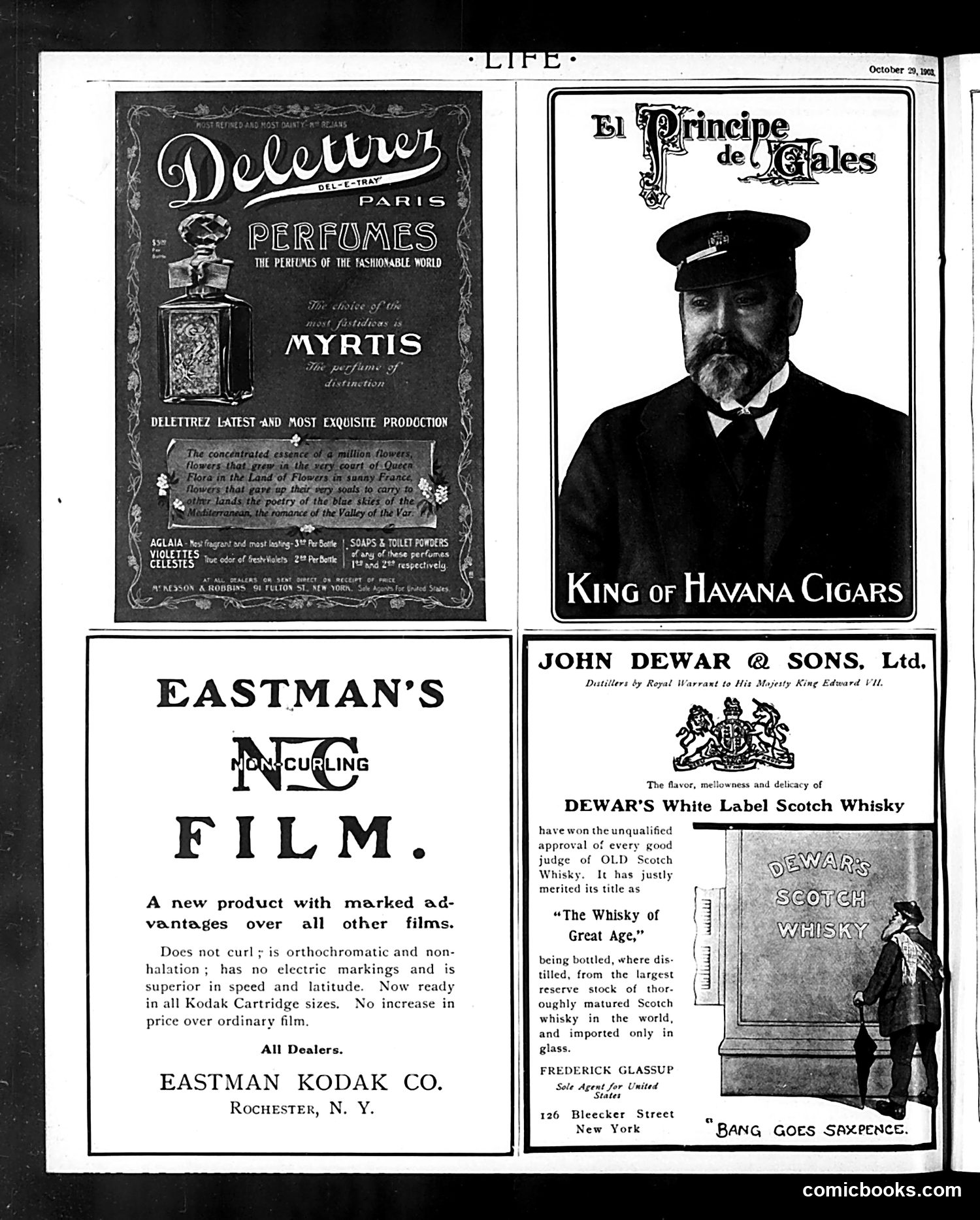
This is primarily an **advertising page**, not political satire. It contains four product advertisements: 1. **Deleuze Perfumes** (Paris): Luxury fragrance marketed to the fashionable set, highlighting the "Myrtis" scent. 2. **El Príncipe de Gales Cigars**: Features a bearded man in captain's hat—likely referencing the Prince of Wales (Edward VII, who became king in 1901), using his title/image to market "King of Havana Cigars." 3. **Eastman Kodak "NC Film"**: Promotes a new non-curling photographic film with technical specifications for professional photographers. 4. **Dewar's White Label Scotch Whisky**: Emphasizes Scottish heritage and age, with a illustration captioned "Bang Goes Sixpence"—a period phrase suggesting modest expense. The page reflects early 1900s consumer culture, targeting wealthy readers with luxury imports and new technology. There is no political cartoon or satirical commentary present.