
Life, 1903-10-29 · page 4 of 20
Life — October 29, 1903 — page 4: what you’re looking at
What you’re looking at
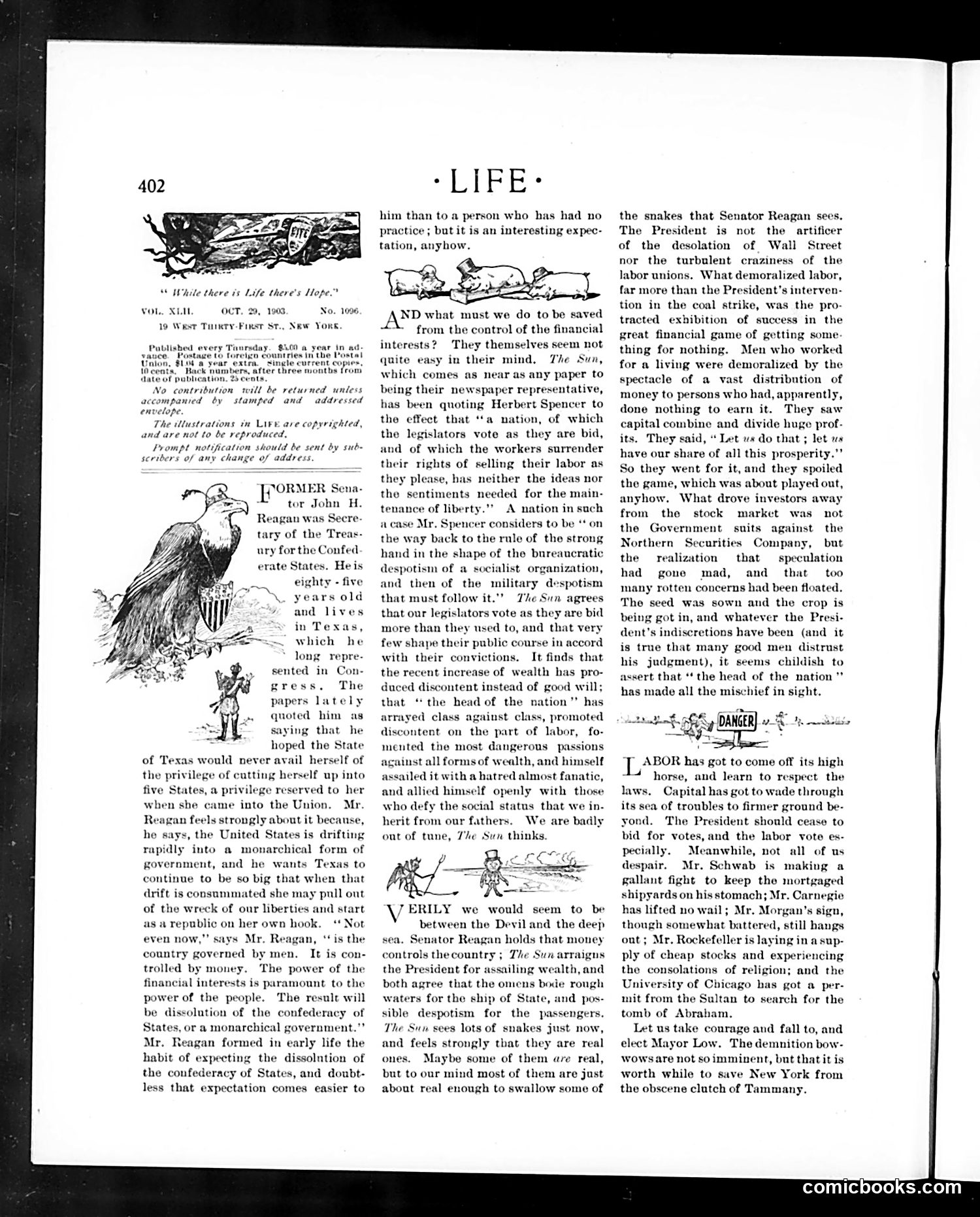
This page critiques **Senator John H. Reagan's** defense of financial interests and wealth concentration. The text attacks Reagan's assertion that the nation needs strong leadership by the wealthy to prevent socialist disorder. The **eagle illustration** (top left) symbolizes American authority and patriotism—imagery Reagan invoked. The article's satire targets Reagan's claim that labor unrest stems from agitators rather than legitimate grievances. Life argues Reagan ignores actual causes: demoralizing wealth inequality, speculation-driven financial crashes, and the government's bias toward capital over workers' rights. The cartoons depict everyday Americans caught between dangerous forces (labeled "Devil" and "deep sea"), suggesting workers face impossible choices—precisely the instability Reagan blamed on labor rather than systemic inequality.
📄 Transcribed text from this page (OCR, searchable)
Machine-transcribed from the original scan — historical spelling and the odd misread are preserved.
j XL OCT, 29, 1903. West Tunery-Finst St., New YORe S068 year k numbers, aft rill be returned unless stamped and addressed No contribution accompanied by envelope. The illustrations in Live ave copyrighted, and are not to be reproduced. Prompt notification should be sent by sub= scribers of any change of address, JPORMER Sena- tor John H. Reagan was Secre- tary of the Treas- ury forthe Confed ates. Heis eighty - five years old and in T which he long. repre- sented in Con- gress. The papers lately quoted him as saying that he hoped the St of Texas would never avail herself of the privilege of cutting herself up into a privilege reserved to her when she came into the Union. Mr. Reagan feels strongly about it because he says, the United States is drifting rapidly into a monarchical form of government, and he wants Texas to continue to be so big that when that drift is consummated she may pull ont of the wreck of our liberties and start as a republic on her own hook. ‘Not even now,” says Mr. Reagan, ‘is the country governed by men. It is con- trolled by money. The power of the financial interests is paramount to the power of the people. The result will be dissolution of the confederacy of States, or a monarchical government.”’ Mr. Reagan formed in early life the habit of expecting the dissolution of the confederacy of States, and doubt- less that expectation comes easier to lives LIPE him than to a person who has had no practice ; but it is an interesting expec- tation, anyhow. A ND what must we do to be saved from the control of the financial interests? They themselves seem not quite easy in their mind, The which comes as near as any paper to being their newspaper representative, has been quoting Herbert Spencer to the effect that ‘¢a nation, of which the legislators vote as they are bid, and of which the workers surrender their rights of selling their labor as they please, has neither the ideas nor the sentiments needed for the main- tenance of liberty."’. A nation in such a case Mr. Spencer considers to be “on the way back to the rule of the strong hand in the shape of the bureaucratic despotism of a socialist organization, and then of the military despotism that must follow it. The Sun agrees that our legislators vote as they are bid more than they used to, and that very few shape their public course in accord with their convictions. It finds that the recent increase of wealth has pro- duced discontent instead of good will; that ‘the head of the nation ’’ has arrayed class against class, promoted discontent on the part of labor, fo- mented the most dangerous pa: against all forms of wealth, and hims assailed it with a hatred almost fana and allied himself openly with thos who defy the social status that we herit from our fathers. We are badly ont of tune, 7/e Sun thinks. Sun, eS , would seem to be between the Devil and the deep 8e% nator Reagan holds that money V ERILY we controls thecountry ; The Sunarraigns the President for assailing wealth, and both agree that the omens bode rough waters for the ship of State, and pos- sible despotism for the passenger The Sun sees lots of snakes just now, and feels strongly that they are real ones. Maybe some of them are real, but to our mind most of them are just about real enough to swallow some of the snakes that Senator Reagan sees. The President is not the artificer of the desolation of Wall Street nor the turbulent craziness of the labor unions, What demoralized labor, far more than the President's interven- tion in the coal strike, was the pro- tracted exhibition of success in the great financial game of getting some- thing for nothing. Men who worked for a living were demoralized by the spectacle of a vast distribution of money to persons who had, apparently, done nothing to earn it. They saw capital combine and divide huge prof- its. They said, “* Let vs do that ; let us have our share of all this prosperity.”” So they went for it, and they spoiled the game, which was about played out, anyhow. What drove investors away from the stock market was not the Government suits against the Northern Securities Company, but the realization that — speculation had gone mad, and that too many rotten concerns had been floated. The seed was sown and the crop is being got in, and whatever the Presi- dent's indiscretions have been (and it is true that many good men distrust his judgment), it seems childish to assert that ‘* the head of the nation has made all the mischief in sight. L ABOR has got to come off its high + horse, and learn to respect the laws. Capital has got to wade through its sea of troubles to firmer ground be- yond. The President should cease to bid for votes,and the labor vote es- pecially. Meanwhile, not all of us despair. Mr, Schwab is making a gallant fight to keep the mortgaged shipyards on his stomach; Mr. Carnegie has lifted no wail; Mr. Morgan’s sign, though somewhat battered, still hangs out; Mr. Rockefeller is laying in a sup- ply of cheap stocks and experiencing the consolations of religion; and the University of Chicago has got a per- mit from the Sultan to search for the tomb of Abraham. Let us take courage and fall to, and Mayor Low. The demnition bow- ‘sare not soimminent, but that it is worth while to save New York from the obscene clutch of Tammany. comicbooks.com