
Life, 1903-10-29 · page 15 of 20
Life — October 29, 1903 — page 15: what you’re looking at
What you’re looking at
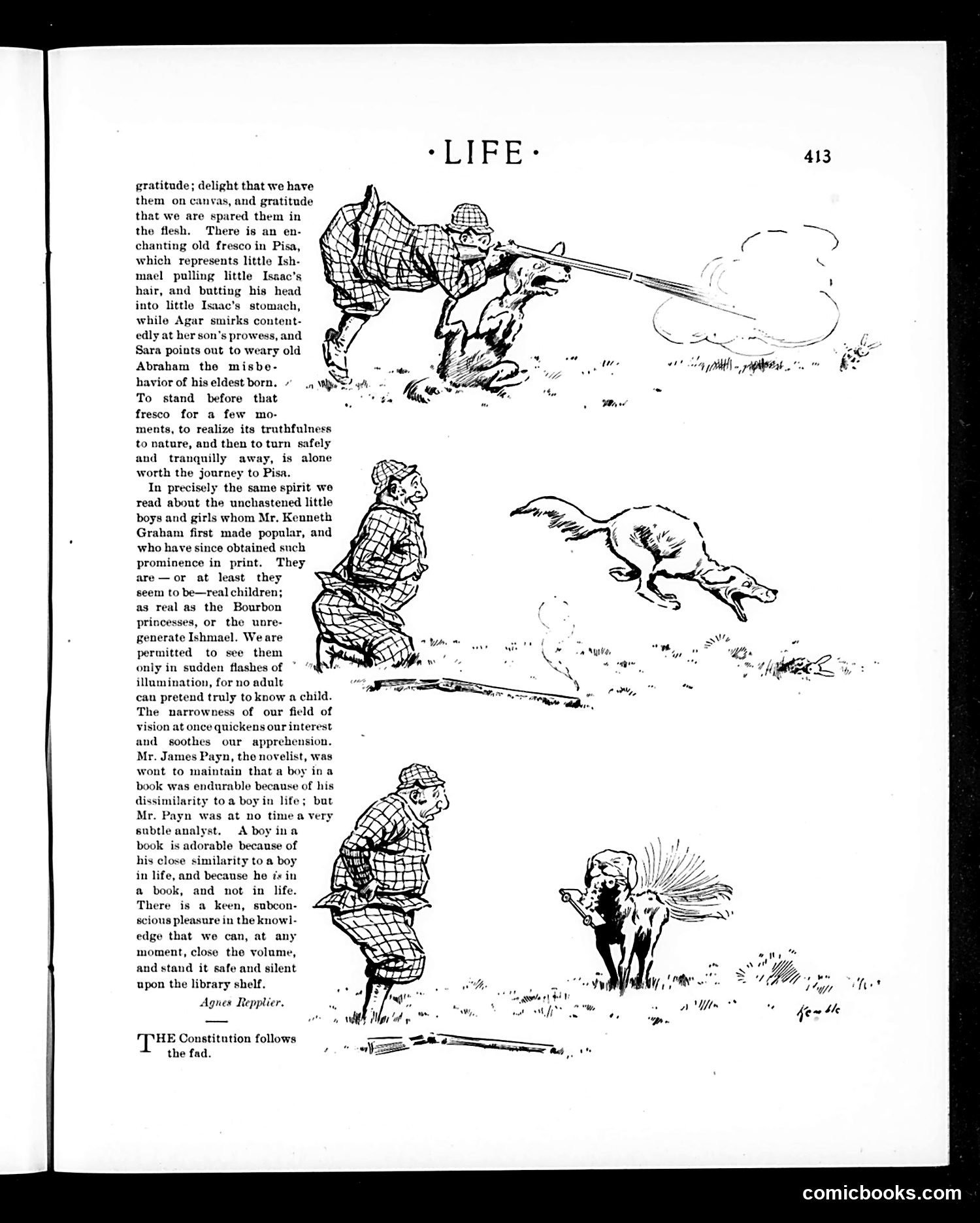
This page discusses children in literature and art, featuring illustrations of mischievous boys in plaid clothing engaged in hunting or outdoor pranks—likely referencing Kenneth Grahame's popular children's characters (author of *The Wind in the Willows*). The essay by Agnes Repplier argues that fictional children appeal because they mirror real children's behavior while remaining safely contained in books. She compares them to a fresco in Pisa depicting young Ishmael bullying Isaac—noting we can appreciate such "truthful" depictions of childish misbehavior in art without enduring them in actual life. The satire is gentle: Repplier celebrates how literature lets adults enjoy children's chaos and rudeness from a safe distance, closing the book when tired. The illustrations show these literary boys as energetic, unrefined, and somewhat wild—embodying the appealing "realness" Repplier praises. The final note "The Constitution follows the fad" appears to be an unrelated section header.
📄 Transcribed text from this page (OCR, searchable)
Machine-transcribed from the original scan — historical spelling and the odd misread are preserved.
gratitude; delight that we have them on canvas, and gratitude that we are spared them in the flesh. There is an en- chanting old fresco in Pisa, which represents little Ish- mael pulling little Isaac’s hair, and butting his head into little Isaac’s stomach, while Agar smirks content- edly at her son’s prowess, and Sara points out to weary old Abraham the misbe- havior of hiseldest born. ., Why To stand before that fresco for a few mo- ments, to realize its truthfulness to nature, and then to turn safely and tranquilly away, is alone worth the journey to Pisa. In precisely the same spirit we read about the unchastened little boys and girls whom Mr. Kenneth Graham first made popular, and who have since obtained such prominence in print. They are—or at least they seem to be—real children; as real as the Bourbon princesses, or the unre- generate Ishmael. We are permitted to see them only in sudden flashes of * illumination, for no adult can pretend truly to know a child. The narrowness of our field of vision at once quickens our interest and soothes our apprehension. Mr. James Payn, the novelist, was wont to maintain that a boy ina book was endurable because of his dissimilarity toa boy in life; bat Mr. Payn was at no time a very subtle anal: A boy ina book is adorable because of his close similarity to a boy in life, and because he ts in a book, and not in life. There is a keen, subcon- scious pleasure in the know]- edge that we can, at any moment, close the volume, and stand it safe and silent upon the library shelf. Agnes Repplier. HE Constitution follows the fad. = 20 phil «lO. oo witty ae ta te comicbooks.com