
Life, 1903-10-29 · page 14 of 20
Life — October 29, 1903 — page 14: what you’re looking at
What you’re looking at
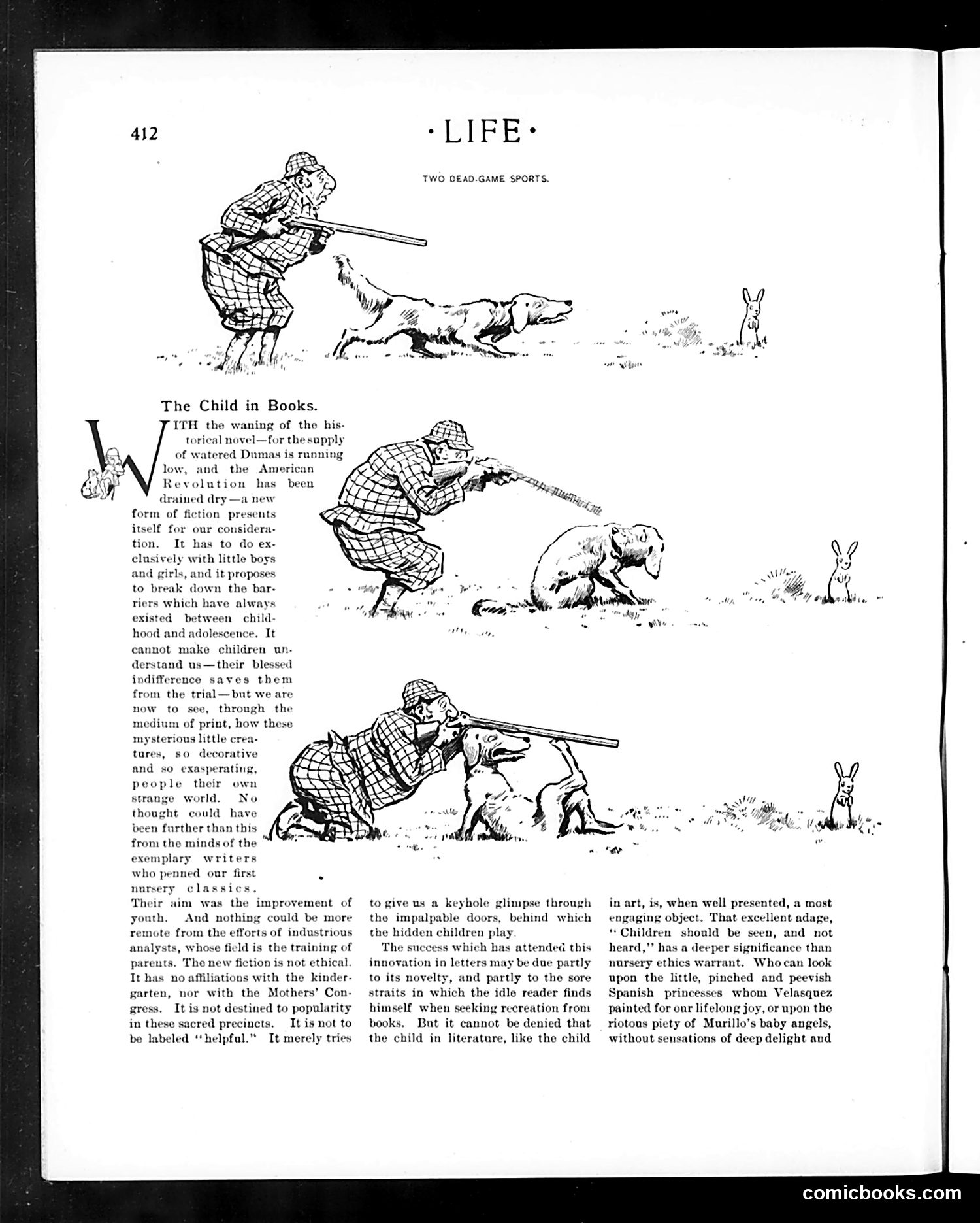
This article satirizes a new literary trend: fiction depicting children's inner lives and perspectives, rather than didactic stories aimed at moral improvement. The title "Two Dead Game Sports" refers ironically to hunting—the illustrations show a boy with a gun and hunting dog pursuing rabbits, while observing a child's "mysterious" world as adults would hunt game. The satire targets adult writers' newfound fascination with children as subjects. The text mocks how this represents a departure from traditional nursery literature's ethical mission, noting the trend arises partly from depleted historical novel supplies and readers seeking escapism. The author notes, with tongue-in-cheek approval, that depicting children authentically—whether "pinched and peevish" or angelic—creates engaging art, yet admits this new fiction "is not ethical" and won't appeal to mothers' organizations. The joke: adults are treating children as exotic curiosities to observe and exploit literarily, much like game to hunt.
📄 Transcribed text from this page (OCR, searchable)
Machine-transcribed from the original scan — historical spelling and the odd misread are preserved.
The Child in Books. ITH the waning of the his- torical novel—for the supply of watered Dumas is running low, and the American Revolution been drained dry —a new form of fiction presents itself for our considera- tion. It has to do ex- clusively with little boys has and girls, and it proposes to break down the bar- riers which have always existed child- hood and adolescence. It cannot make children un- derstand us—their blessed indifference saves them from the trial—but we are now to see, through the medium of print, how these mysterious little crea- so decorative between tures, and so exasperating, i ple their own strange world. No thought could have been further than this from the minds of the * exemplary writers who penned our first nursery classics. Their aim was the improvement of youth. And nothing could be more remote from the efforts of industrious ts, whose field is the training of parents. The new fiction is not ethical. It has no affiliations with the kinder- garten, nor with the Mothers’ Con- gress. It is not destined to popularity in these sacred precincts. It is not to be labeled “helpful.” It merely tries analy “EIPE* TWO DEAO.GAME SPORTS. to give us a keyhole glimpse through the impalpable doors, behind which the hidden children The suce ich has attended this innovation in letters may be due partly to its novelt nd partly to the sore straits in which the idle reader finds himself when seeking recreation from books. But it cannot be denied that the child in literature, like the child in art, is, when well presented, a most engaging object. That excellent adage, “Children should be seen, and not heard,’ has a deeper significance than nursery ethics warrant. Who can look upon the little, pinched and peevish Spanish princesses whom Velasquez painted for our lifelong joy, or upon the riotous piety of Murillo's baby angels, without sensations of deep delight and comicbooks.com