
A complete issue · 20 pages · 1903
Life — September 24, 1903
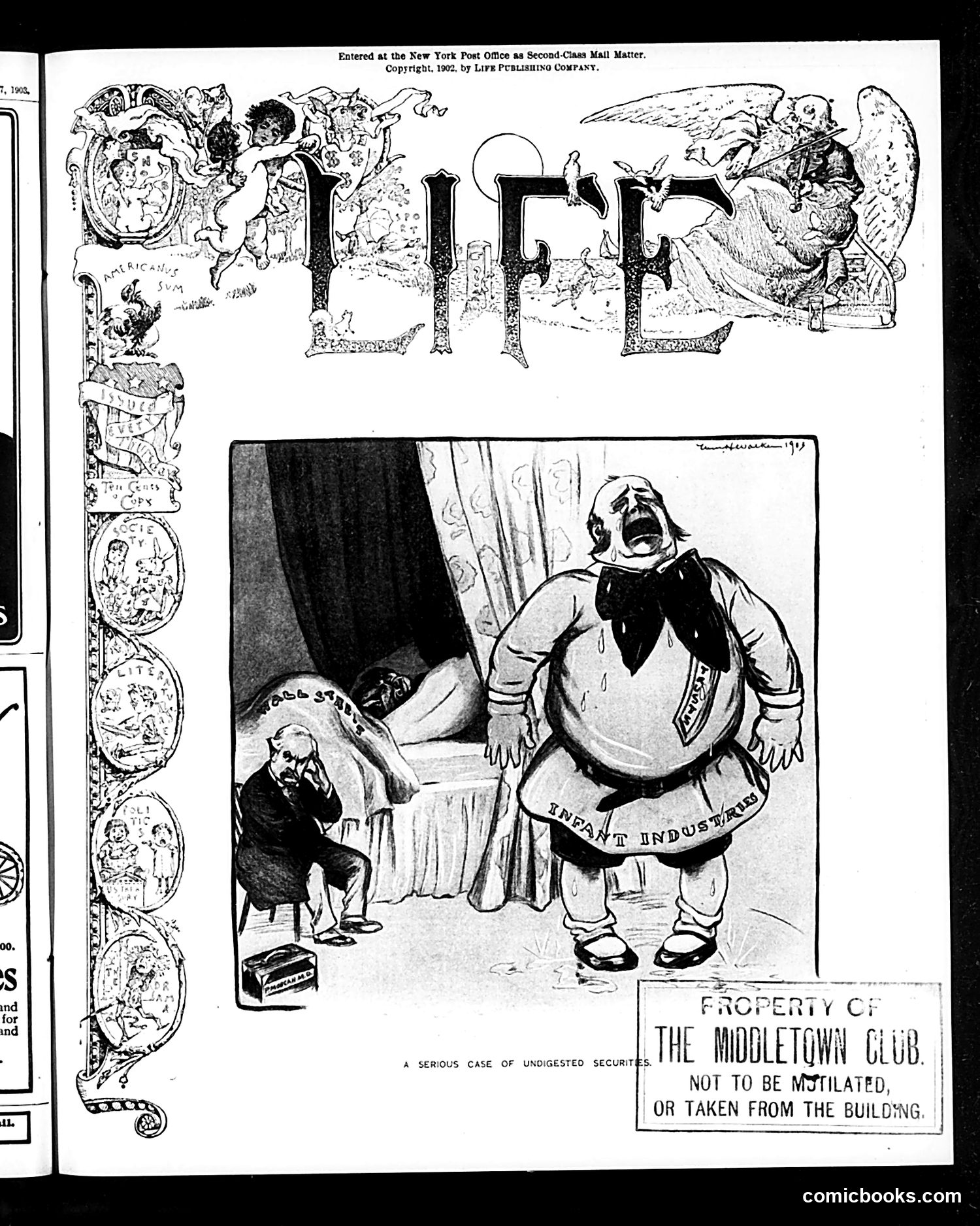
This page contains two distinct satirical works: **Top:** The decorative "LIFE" masthead features ornamental cherubs and classical imagery, standard for the magazine's header design. **Bottom:** A cartoon titled "A Serious Case of Undigested Securities" depicts a large, distressed figure labeled "Infant Industries" experiencing severe digestive distress. A small man sits nearby with a toolbox, appearing to be a doctor or specialist. The caption references "Property of The Middletown Club." **Meaning:** This appears to be financial satire about struggling American industries in the early 1900s, likely commenting on protectionist tariff policies or problematic industrial investments ("undigested securities"). The "infant industries" metaphor—common in economic debates about trade protection—suggests these businesses cannot digest their financial commitments, requiring intervention. The Middletown Club reference remains unclear without additional context.
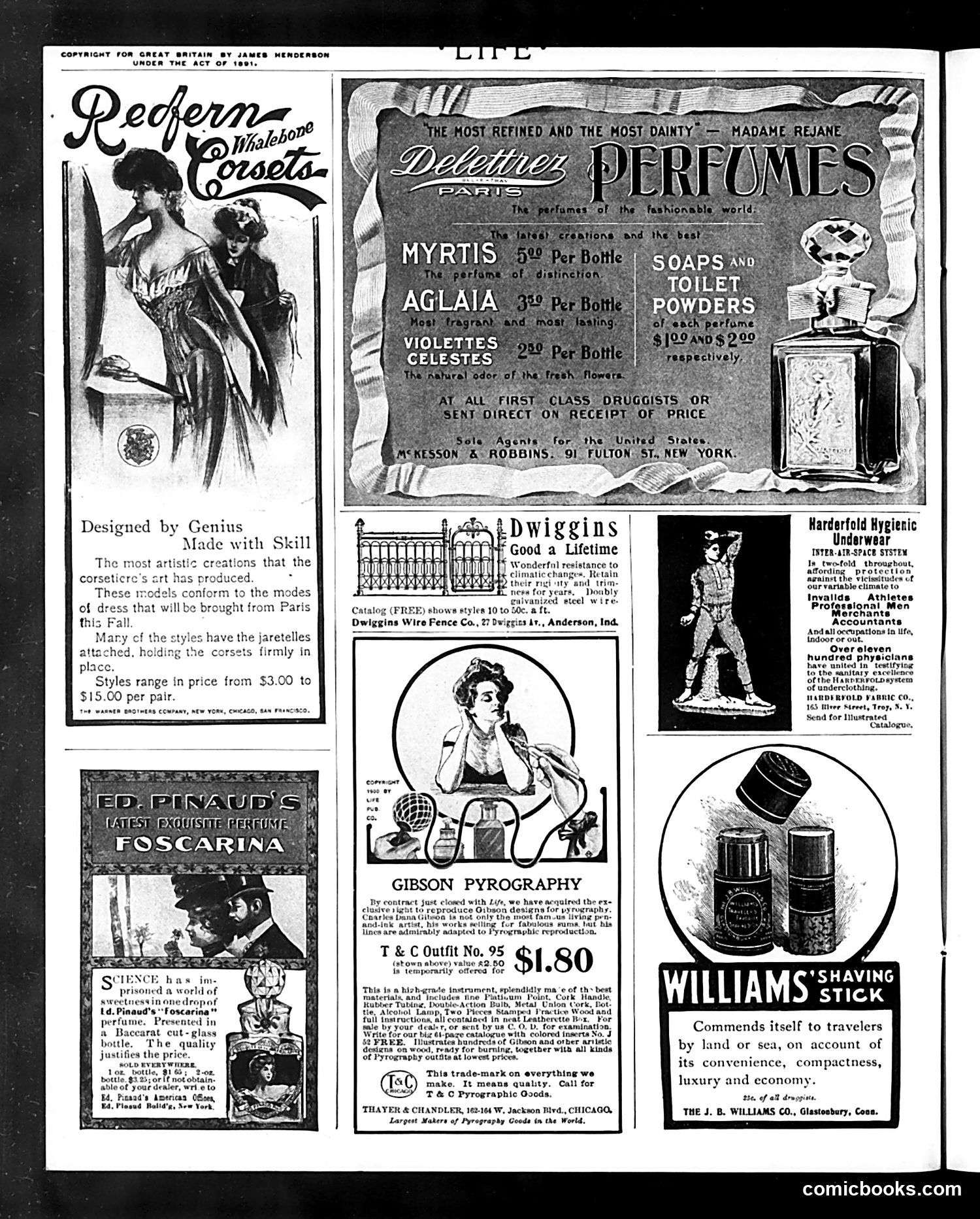
This page is primarily **advertising**, not political cartoons or satire. It contains six product advertisements from the early 20th century: 1. **Redfern Corsets** - fashion-focused, emphasizing Parisian designs 2. **Delettrez Perfumes** - luxury fragrances with multiple product lines 3. **Dwiggins Wire Fence** - fencing materials 4. **Gibson Pyrography** - a decorative burning/etching kit priced at $1.80 5. **Ed. Pinaud's Foscarina Perfume** - men's grooming product 6. **Williams Shaving Stick** - travel shaving product The advertisements target affluent consumers through imagery of fashionable women, refined products, and claims of quality and distinction. There is **no political satire or cartoon content** on this page—it represents typical *Life* magazine monetization through luxury goods advertising during this era.
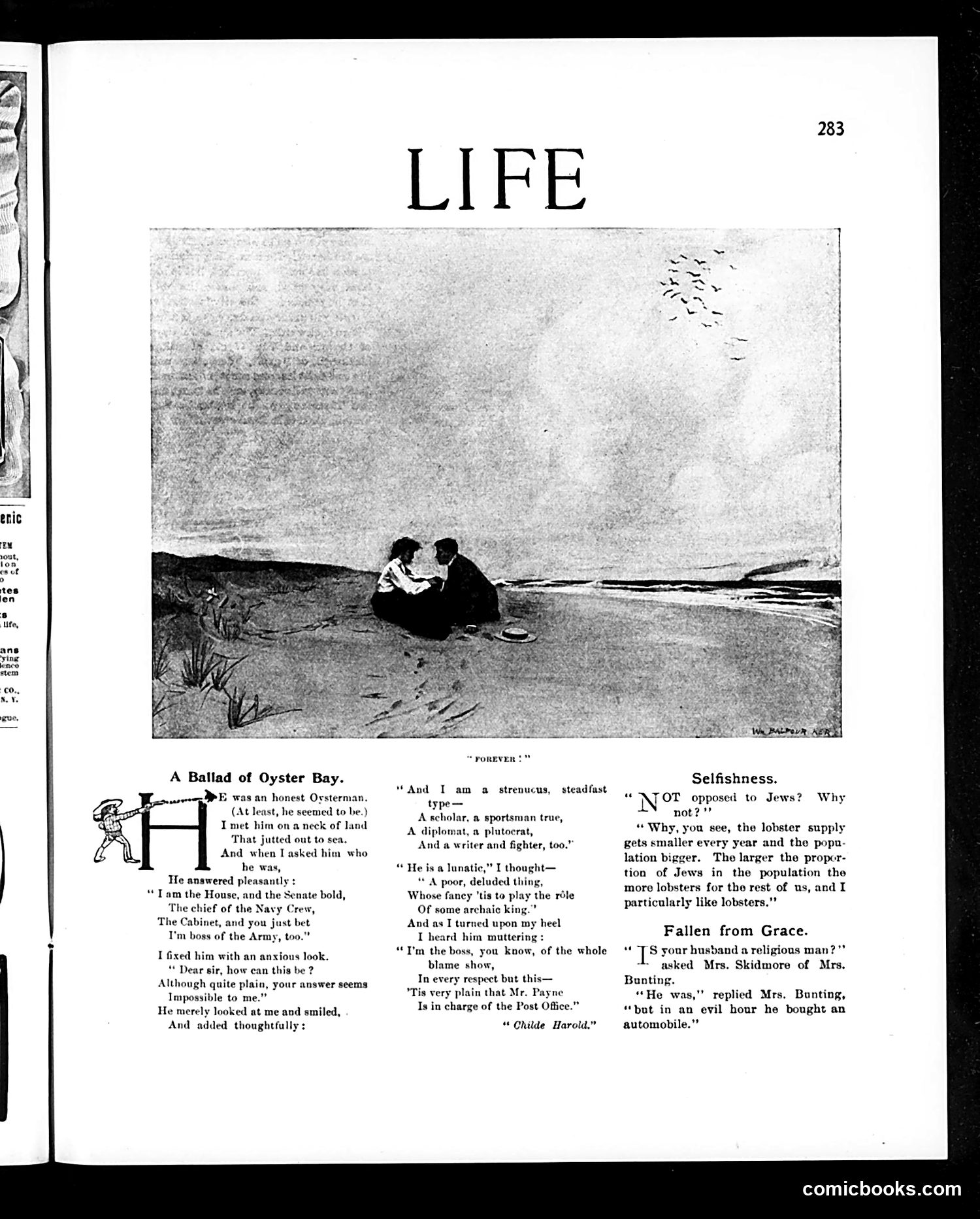
The main illustration, "Forever," depicts two figures sitting on a beach in an intimate moment, satirizing romantic idealism. Below are three brief humorous pieces: "A Ballad of Oyster Bay" references Theodore Roosevelt's home at Oyster Bay, New York. The poem mocks someone claiming simultaneous roles as an "honest Oysterman," House member, Senator, and Cabinet official—likely satirizing Roosevelt's expansive political ambitions or a politician's conflicting loyalties. "Selfishness" uses a joke about lobster population decline to mock Jewish people, reflecting unfortunate period antisemitism common in early 20th-century American humor magazines. "Fallen from Grace" presents a brief anecdote about a religious man purchasing an automobile, suggesting satire of hypocrisy or changing values in modern society.
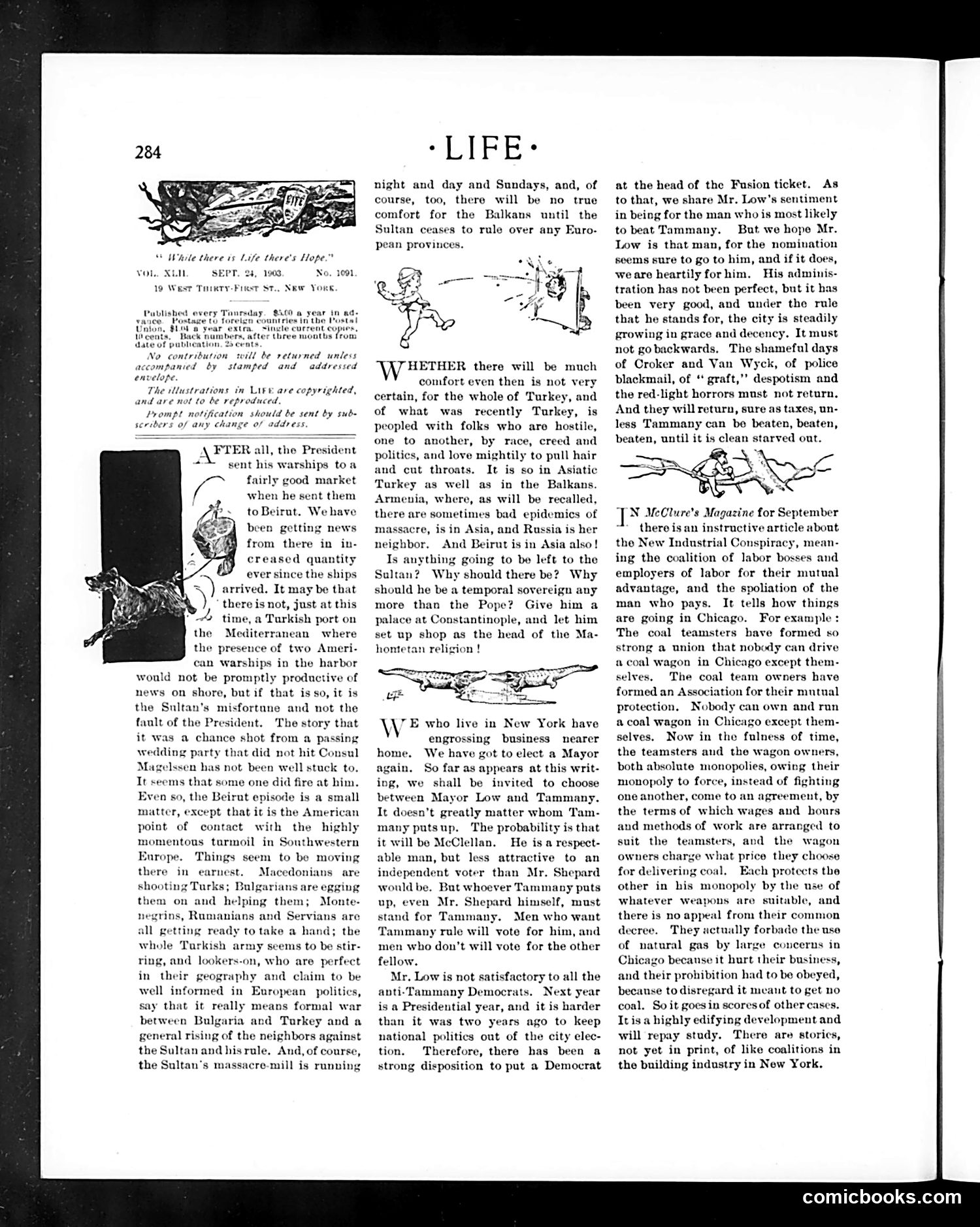
This page discusses New York City's mayoral election, presenting arguments for supporting a Democratic candidate (likely Mayor Low) over the Republican Tammany Hall-backed candidate Tammany. The text argues that Low's administration, though imperfect, has improved the city's governance and prevented corruption associated with Tammany's "red-light horrors." The cartoons appear to satirize political corruption and machine politics, with illustrated figures seemingly mocking either Tammany Hall operatives or dishonest politicians. The article also addresses labor disputes in Chicago—specifically coal wagon monopolies—framing this as a cautionary tale about unchecked corporate power. The overall tone warns against returning corrupt political machines to power while advocating for reform-minded leadership.
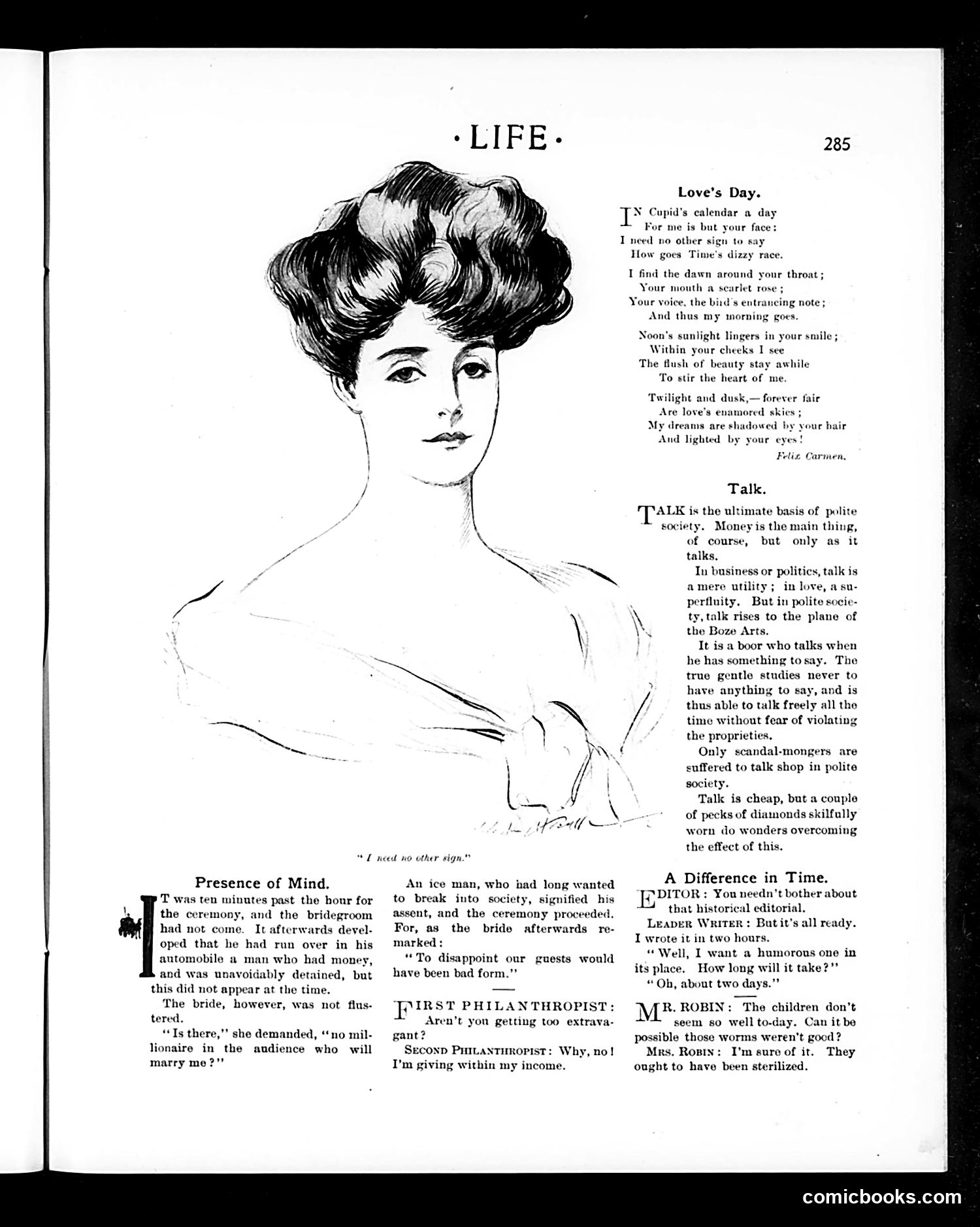
This page contains literary and social commentary rather than political cartoons. The main illustration depicts a fashionable woman in early 1900s style, accompanying a poem titled "Love's Day" by Felix Carmen celebrating romantic devotion. Below are three brief satirical pieces: **"Presence of Mind"** mocks an awkward wedding ceremony where the groom arrives late, and the bride demands a "honorable" suitor from the audience—a comedic jab at marriage customs. **"Talk"** is an essay arguing that conversation represents the highest form of polite society, distinguishing between "scandal-mongers" and refined discourse. **"A Difference in Time"** and the philanthropist dialogue are light social humor about everyday absurdities—worm sterilization and extravagant charitable giving. The page emphasizes social satire rather than political commentary.
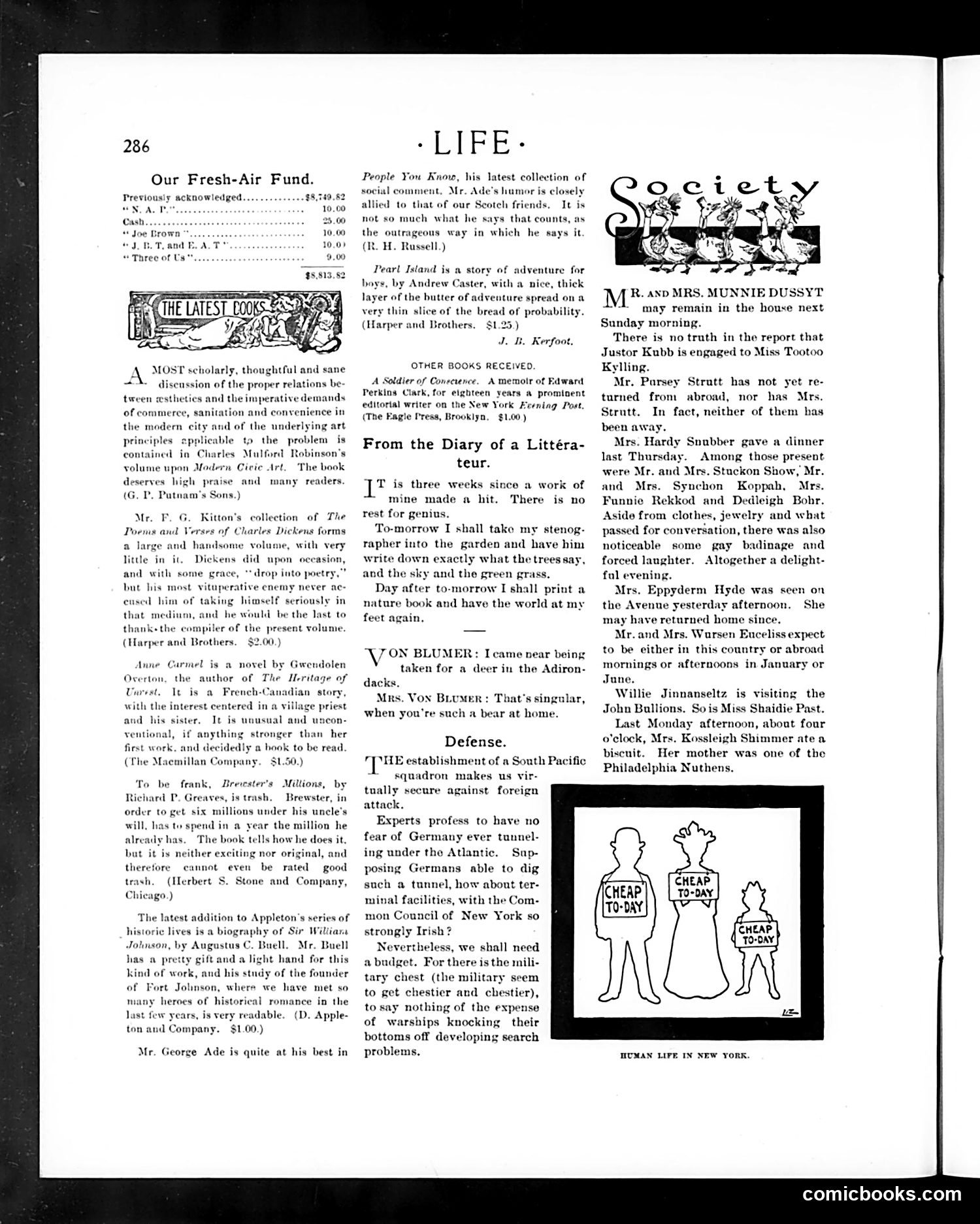
The cartoon depicts three figures wearing sandwich boards reading "CHEAP TO-DAY," illustrating economic hardship during what appears to be a period of inflation or economic crisis. The figures—two adults and a child—represent ordinary New Yorkers advertising themselves or goods as inexpensive, suggesting desperation in the marketplace. This satirizes the economic conditions where people and commodities have become devalued. The repetition of "CHEAP TO-DAY" emphasizes the temporary nature of bargains, implying prices constantly fluctuate. The inclusion of a child makes the social commentary sharper—economic distress affects entire families. The cartoon's title anchors it as commentary on urban working-class struggles, likely from the early 20th century when *Life* magazine focused on social satire and economic critique.
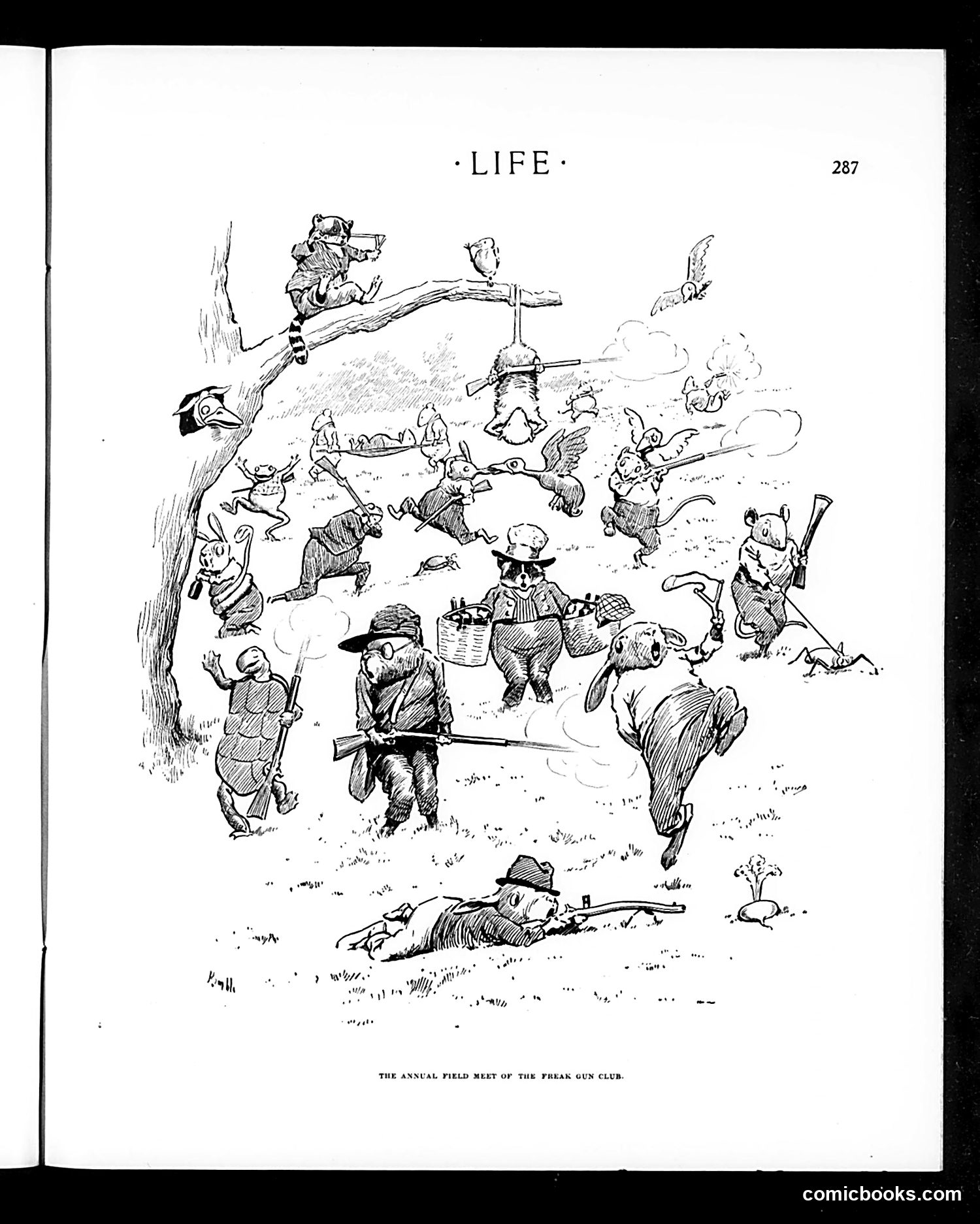
This satirical cartoon depicts what appears to be a shooting competition or gathering of eccentric marksmen. The title labels them as members of a "Freak Gun Club," suggesting they are amateur or incompetent shooters rather than skilled sportsmen. The figures are drawn as caricatured animals and exaggerated human forms engaging in chaotic marksmanship activities—some lying prone, others standing awkwardly with rifles, creating an impression of disorder and incompetence. A bird perches in a tree above, observing the mayhem. The satire mocks amateur gun clubs or shooting organizations of the era, portraying their members as ridiculous, uncoordinated, and bungling. It's unclear whether this references a specific club or represents a general criticism of civilian shooting enthusiasts circa early 1900s.
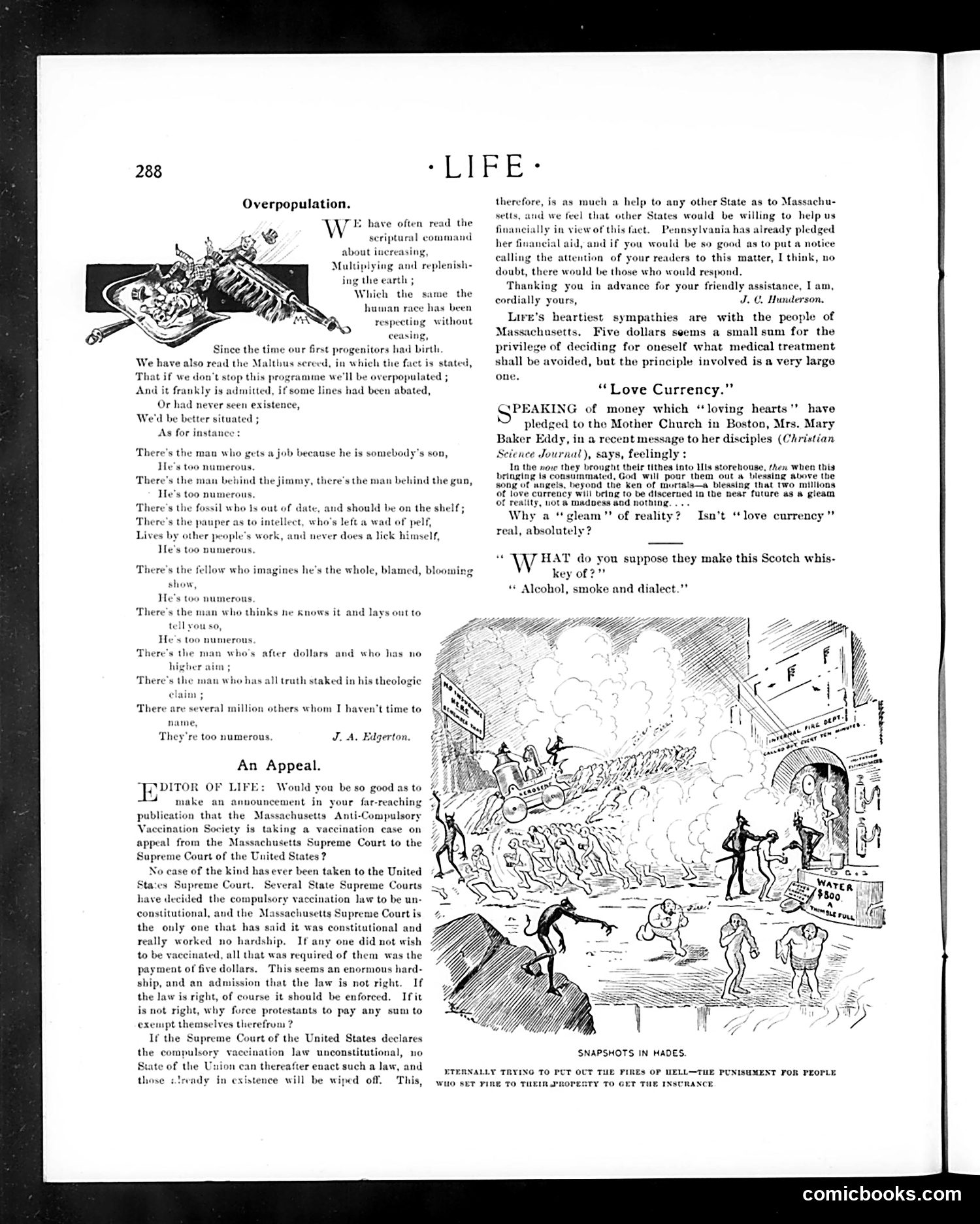
The large cartoon depicts Hell as a chaotic insurance office where people are frantically trying to obtain fire insurance. The caption reads: "ETERNALLY TRYING TO PUT OUT THE FIRES OF HELL—THE PUNISHMENT FOR PEOPLE WHO SET FIRE TO THEIR PROPERTY TO GET THE INSURANCE." This satirizes insurance fraud—specifically arson committed to collect insurance payouts. The figures shown are damned souls receiving eternal punishment fitting their crime: they're forced to endlessly attempt extinguishing hellfire while trapped in bureaucratic chaos, unable to escape their predicament. It's a moral commentary on dishonest businessmen and property owners who deliberately burned buildings for profit, a common crime of the era. The cartoon sarcastically suggests divine justice perfectly matches the punishment to the sin.
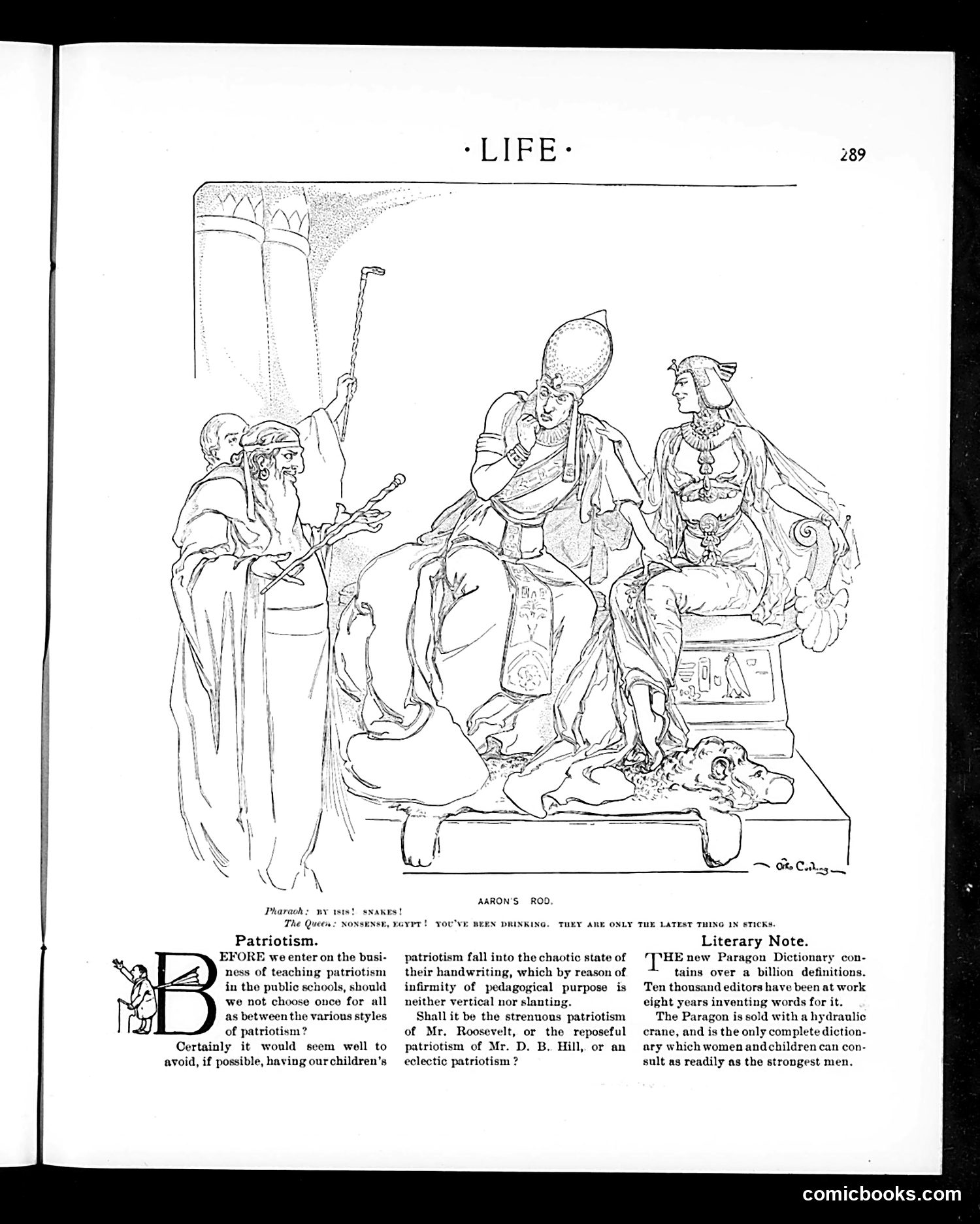
**The Cartoon "Aaron's Rod":** This depicts a biblical reference—Aaron's rod from Exodus, which miraculously produced serpents. The sketch shows two figures in Egyptian dress (representing Moses and Aaron from the biblical narrative) performing magic before what appears to be Egyptian royalty seated on a throne. **The Satirical Point:** The caption's crude dialogue ("By jigs! snakes! The Queen: Nonsense, Egypt! You've been drinking. They are only the latest thing in sticks") mocks Egyptian royalty as gullible or intoxicated, while the "latest thing" quip suggests contemporary fashion or fads. **Context:** This appears to be satirizing both biblical literalism and perhaps contemporary fascination with Egyptology or archaeological discoveries popular in early 20th-century America.
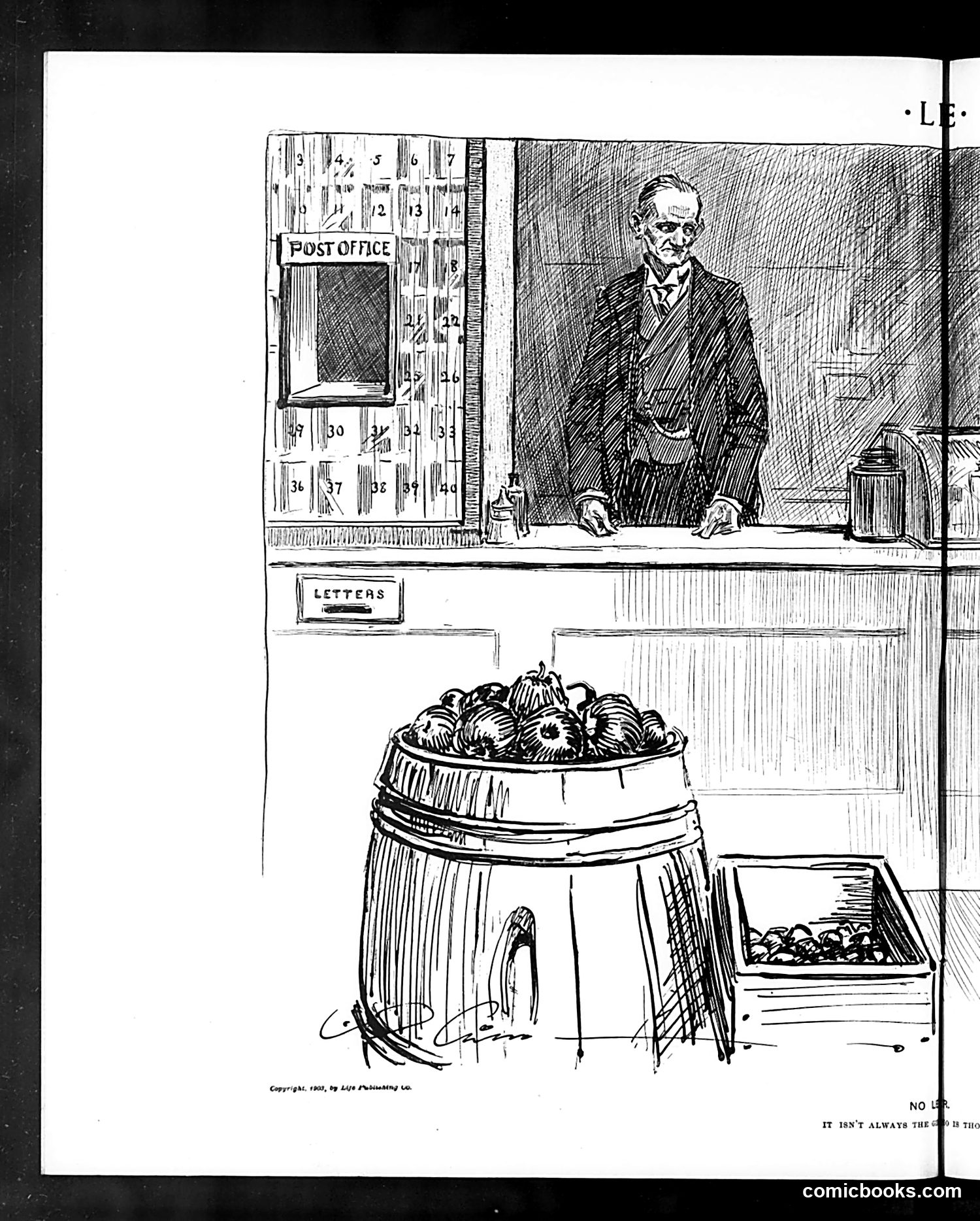
This appears to be a satirical cartoon from Life magazine depicting a post office scene. The upper panel shows a stern-faced postmaster at his window, with numbered mail slots visible on the building exterior. The lower panel prominently features a large barrel overflowing with apples, alongside a wooden crate also filled with produce. The cartoon likely satirizes government inefficiency or corruption—specifically, the practice of using government positions (like postmaster appointments) as political patronage rewards. The barrel of apples may reference the phrase "apple of discord" or represent gifts/bribes, suggesting postal officials receiving benefits beyond their salary. The "Letters" label indicates the contrast between the postmaster's official duties and questionable side activities. The exact political context remains unclear without additional caption text.
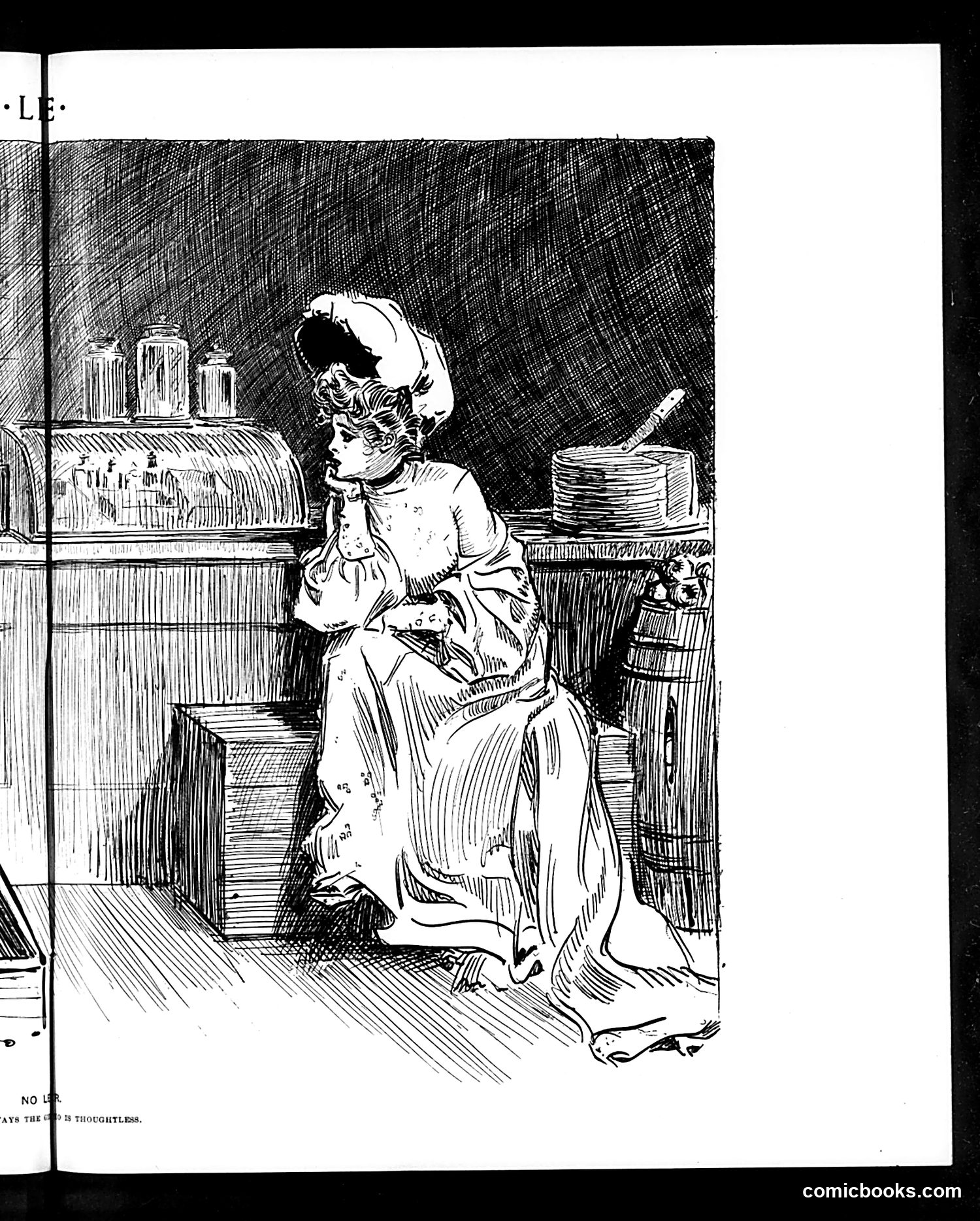
This appears to be a domestic scene from an early Life magazine satirical cartoon. The illustration shows a woman in Edwardian-era dress and elaborate hat, seated in what appears to be a kitchen or servant's quarters, surrounded by bottles and household items. The partially visible OCR text at bottom reads "SAYS THE SERVANT IS THOUGHTLESS," suggesting the cartoon satirizes the relationship between a lady of the house and her domestic help. The satire likely critiques either the employer's unrealistic expectations of servants or comments on class dynamics of the era. The woman's exaggerated hat and fashionable clothing contrast with her domestic surroundings, possibly mocking the pretensions or disconnect of upper-class women from practical household management. Without the complete caption, the precise satirical target remains unclear.
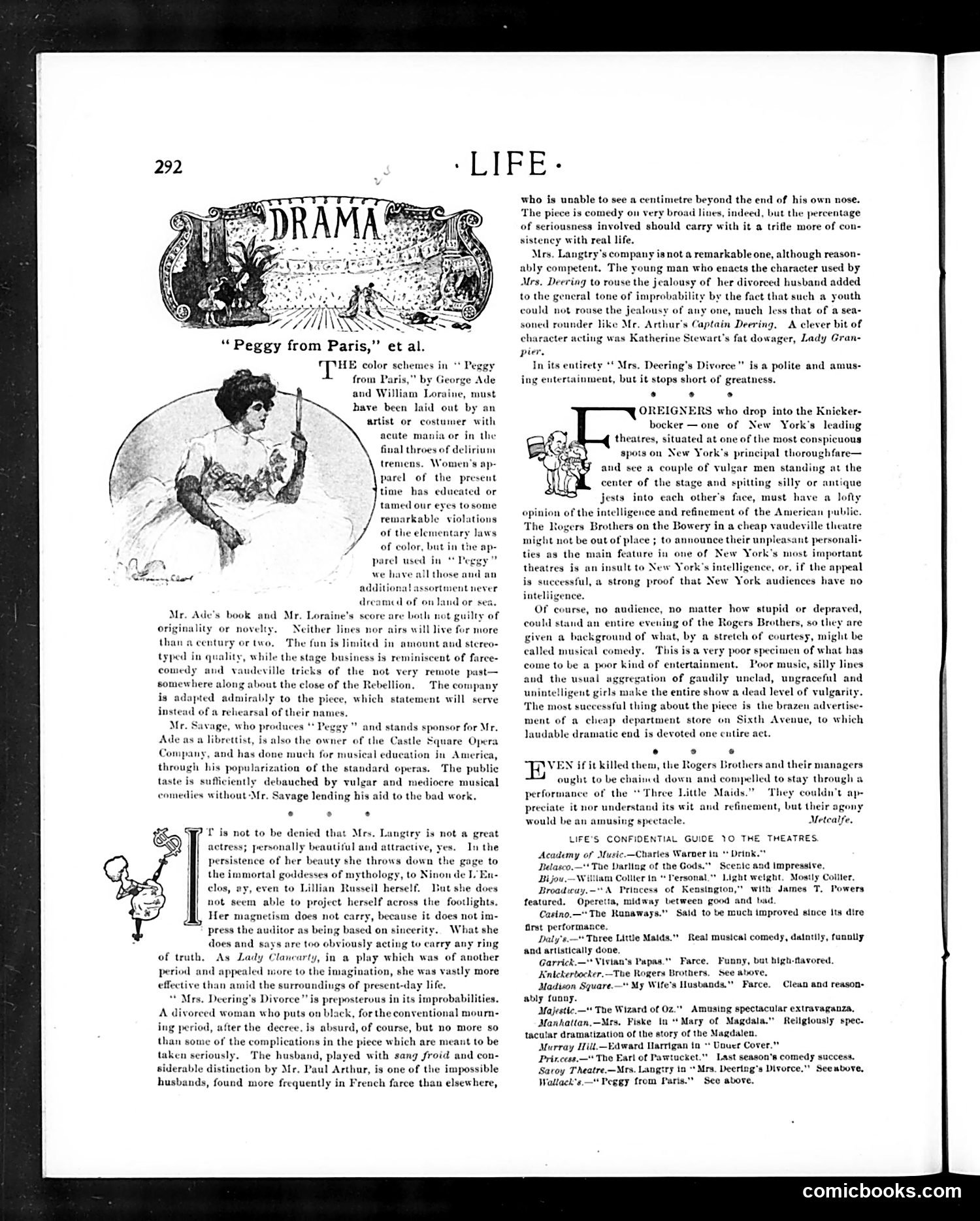
This page reviews theatrical productions, primarily critiquing "Peggy from Paris" and "Mrs. Deering's Divorce." The illustration shows a woman in an elegant dress, drawn in the Art Nouveau style typical of early 1900s theater reviews. The satire targets the quality of contemporary theater. The critic disparages "Mrs. Deering's Divorce" as shallow entertainment, and mocks the Rogers Brothers theater on Broadway for presenting crude, unsophisticated musical comedy ("Three Little Maids") to audiences the reviewer considers intellectually inferior. The reviews suggest a cultural divide between "high" drama and vulgar popular entertainment. The critic's tone is dismissive toward mass audiences and commercial theater aimed at them, reflecting early Progressive-era anxieties about taste and public intelligence in American culture.
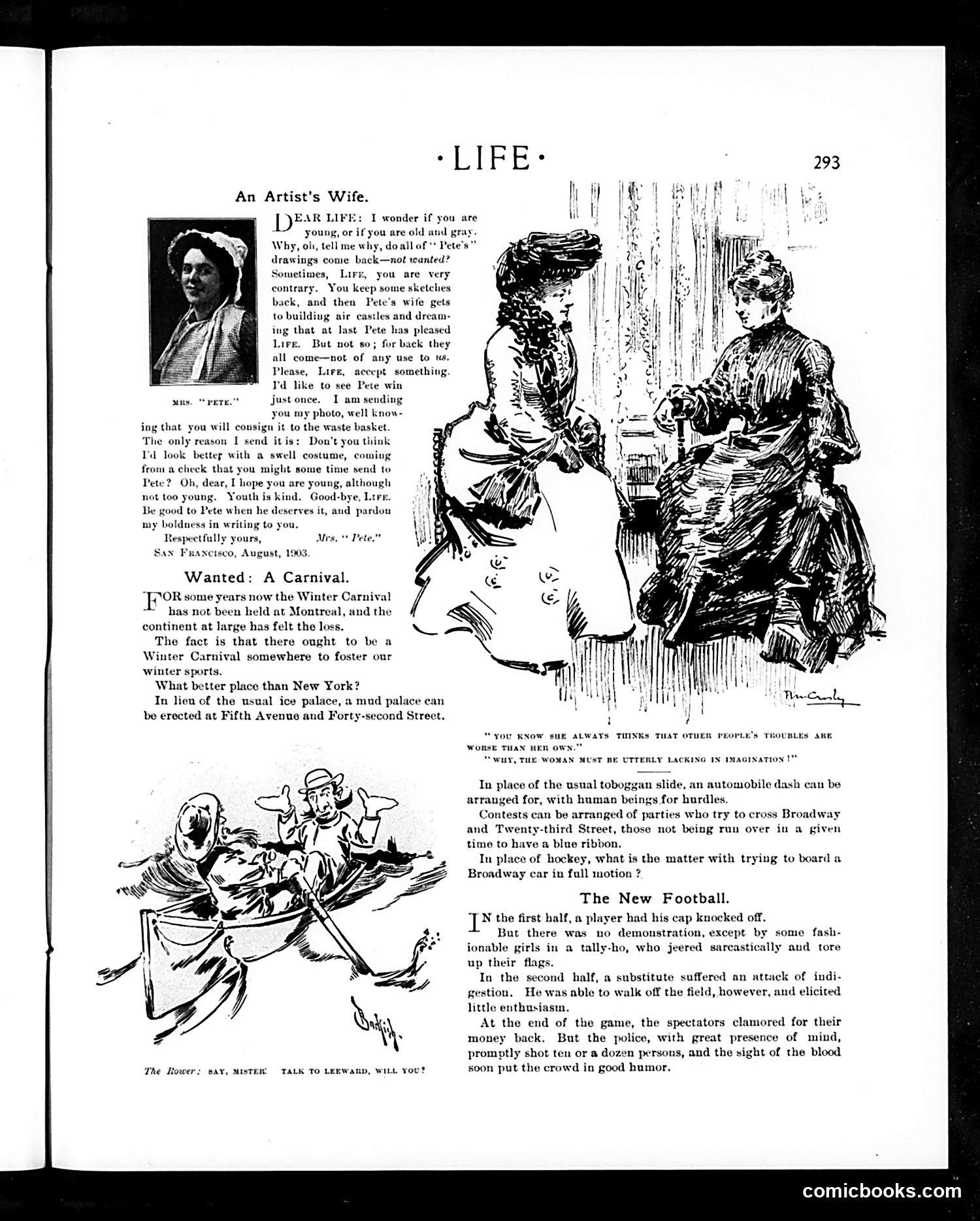
This page contains three separate satirical pieces mocking contemporary society: **"An Artist's Wife"** presents a letter from a struggling artist's wife to *Life* magazine, complaining that her husband "Pete's" drawings are repeatedly rejected. She's sending a photo, hoping *Life* will accept work if she appears in fashionable dress—satirizing both artistic rejection and women's perceived superficiality. **"Wanted: A Carnival"** mocks New York's lack of winter entertainment by suggesting absurd replacements for Montreal's Winter Carnival events: mud palaces, automobile "hurdles" with people, dangerous Broadway crossings, and boarding moving streetcars. The satire targets urban chaos and reckless city life. **"The New Football"** darkly jokes about an increasingly boring sport where spectators demand excitement—so police open fire on crowds, which finally entertains them. This satirizes both sports culture and casual violence in crowd control. The cartoons employ exaggerated scenarios to critique artistic failure, urban congestion, and public entertainment values of the era.
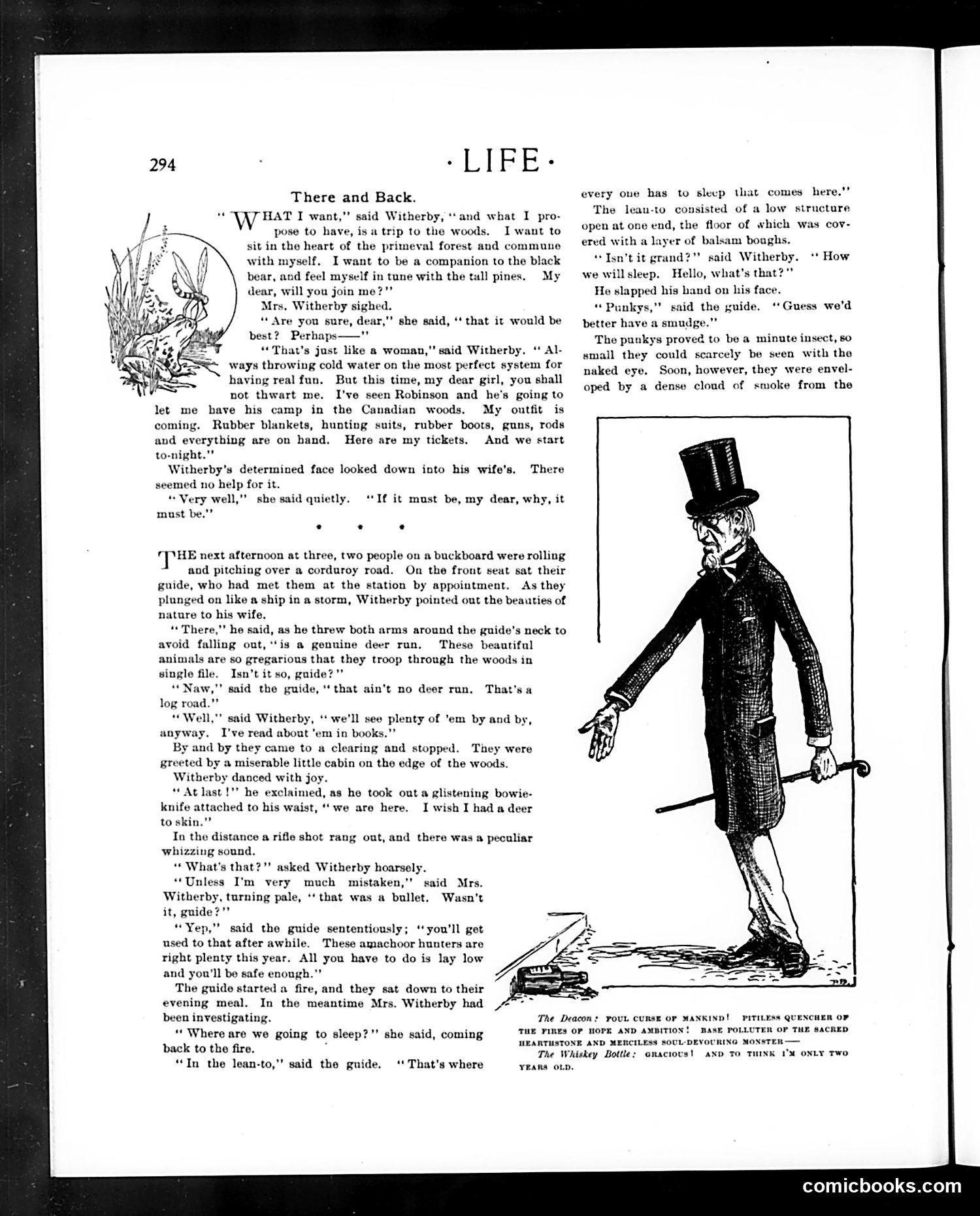
This satirical story mocks the romanticized ideal of "roughing it" in nature. The protagonist Witherby is a pompous, city-dwelling man who fancies himself a wilderness adventurer after reading about it in books. He drags his reluctant wife into the Canadian woods, enthusiastically misidentifying natural features (claiming a log road is a "deer run") while the practical guide corrects him. The humor escalates when reality intrudes: bullets from amateur hunters whiz past, tiny biting insects (punkys) swarm them, and they must sleep in a drafty, primitive lean-to. Witherby's romantic delusions clash violently with actual wilderness hardship. The accompanying illustration shows a foppish, overdressed gentleman—likely representing this type of pretentious amateur—embodying the contrast between affected civilization and genuine outdoor living. The satire targets upper-class affectation and the gap between literary fantasy and practical reality.
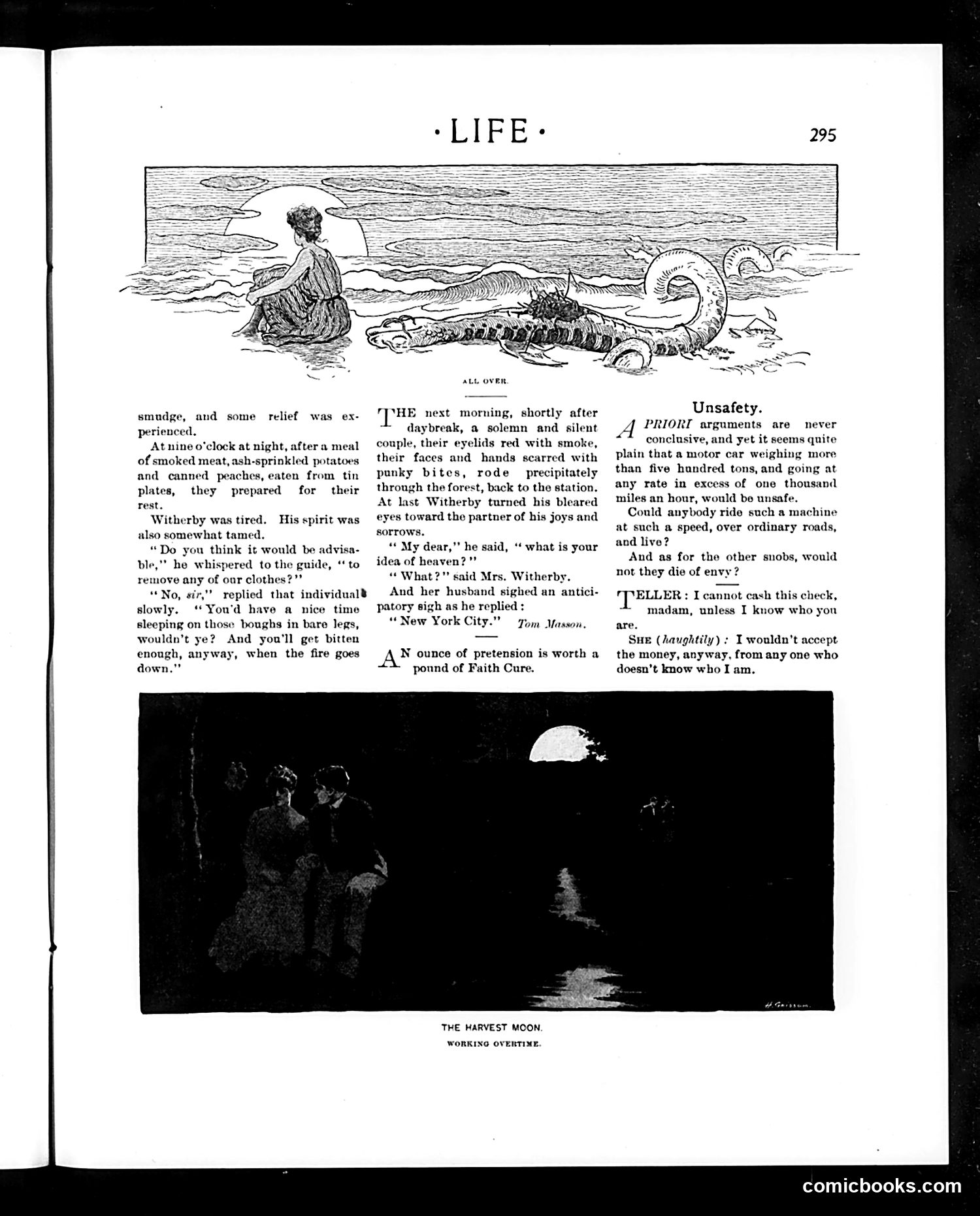
**Main Content:** This page contains a humorous short story about a couple named Witherby on a camping trip, illustrated with two images. The narrative mocks the romanticized notion of outdoor adventure—Witherby and his wife endure smoke, insect bites, uncomfortable sleeping conditions, and general misery before fleeing back to New York City, which Mrs. Witherby considers "heaven." The satire targets wealthy urbanites attempting rustic experiences they're entirely unprepared for. **Side Jokes:** - **"Unsafety"**: Satirizes proposed super-fast motor cars (weighing 500+ tons, traveling 1,000+ mph) as obviously dangerous—mocking both technological hubris and envious snobs who'd want them. - **"Eller" comic**: A brief exchange about a woman's social importance—she won't accept money from someone who doesn't know her, satirizing snobbish pretension about identity and class status. **Overall:** The page mocks early-1900s upper-class pretensions regarding both outdoor recreation and social standing.
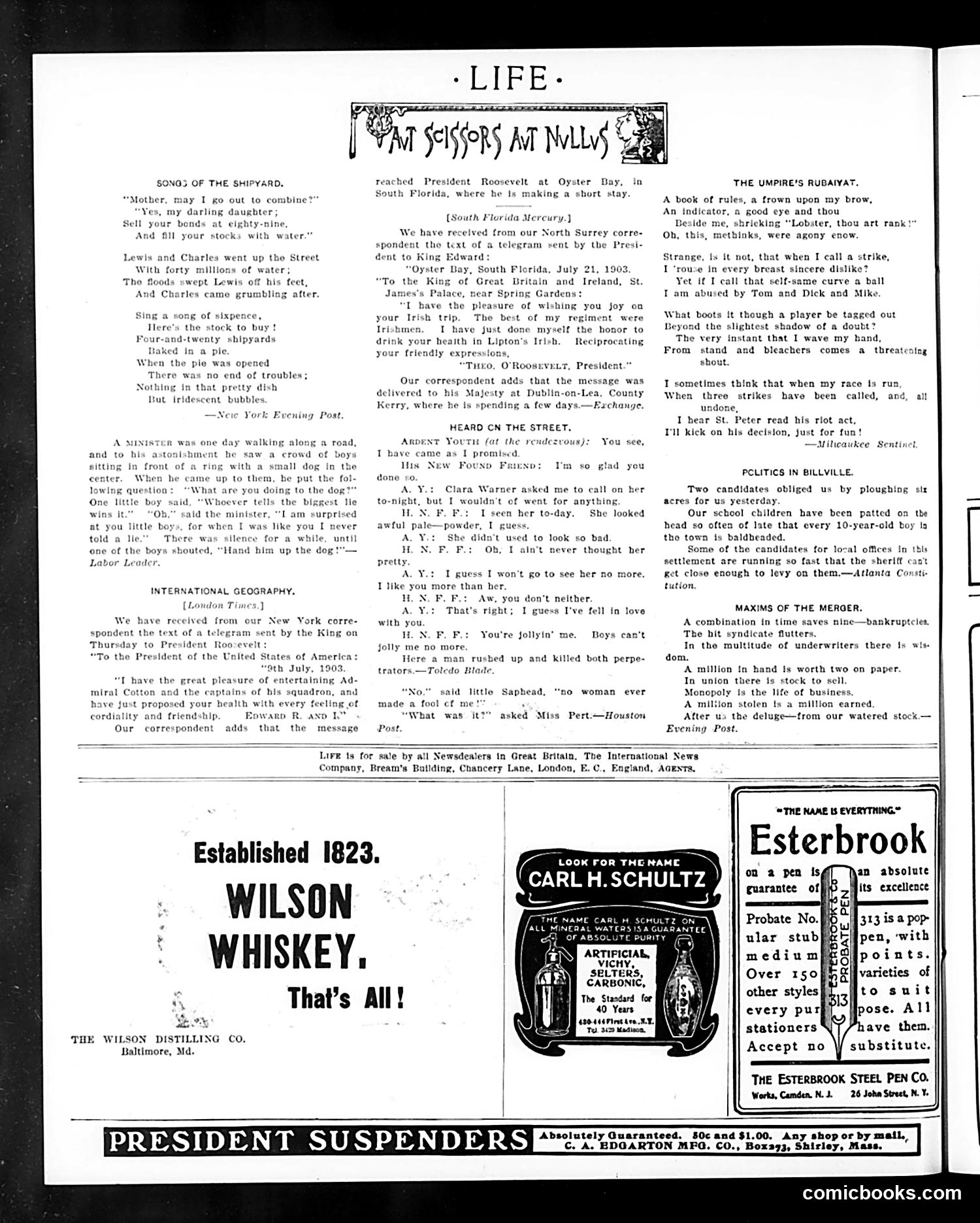
This page from Life magazine (circa 1903, based on datelines) is primarily **satirical verse and humor pieces** rather than political cartoons. Key content: **"Songs of the Shipyard"** mocks financial speculation and fraud. "Lewis and Charles" represent investors who manipulate stock prices ("fill your stocks with water"—a period term for inflated, worthless stock). The nursery rhyme parody references the 1903 shipyard bubble. **"International Geography"** satirizes absurd diplomatic confusion: President Roosevelt receives congratulations at "Oyster Bay, South Florida"—a geographical impossibility that jokes about his actual location. The mock-telegram response invokes "Lipton's Irish" (a drink, not serious diplomacy), mocking formal international protocol. **Other pieces** include jokes about courtship, religious hypocrisy, and baseball umpires. The page reflects Life's role as a **satirical weekly targeting financial fraud, political pretension, and social absurdity** in early 1900s America. The remaining space is advertising for whiskey and pens.
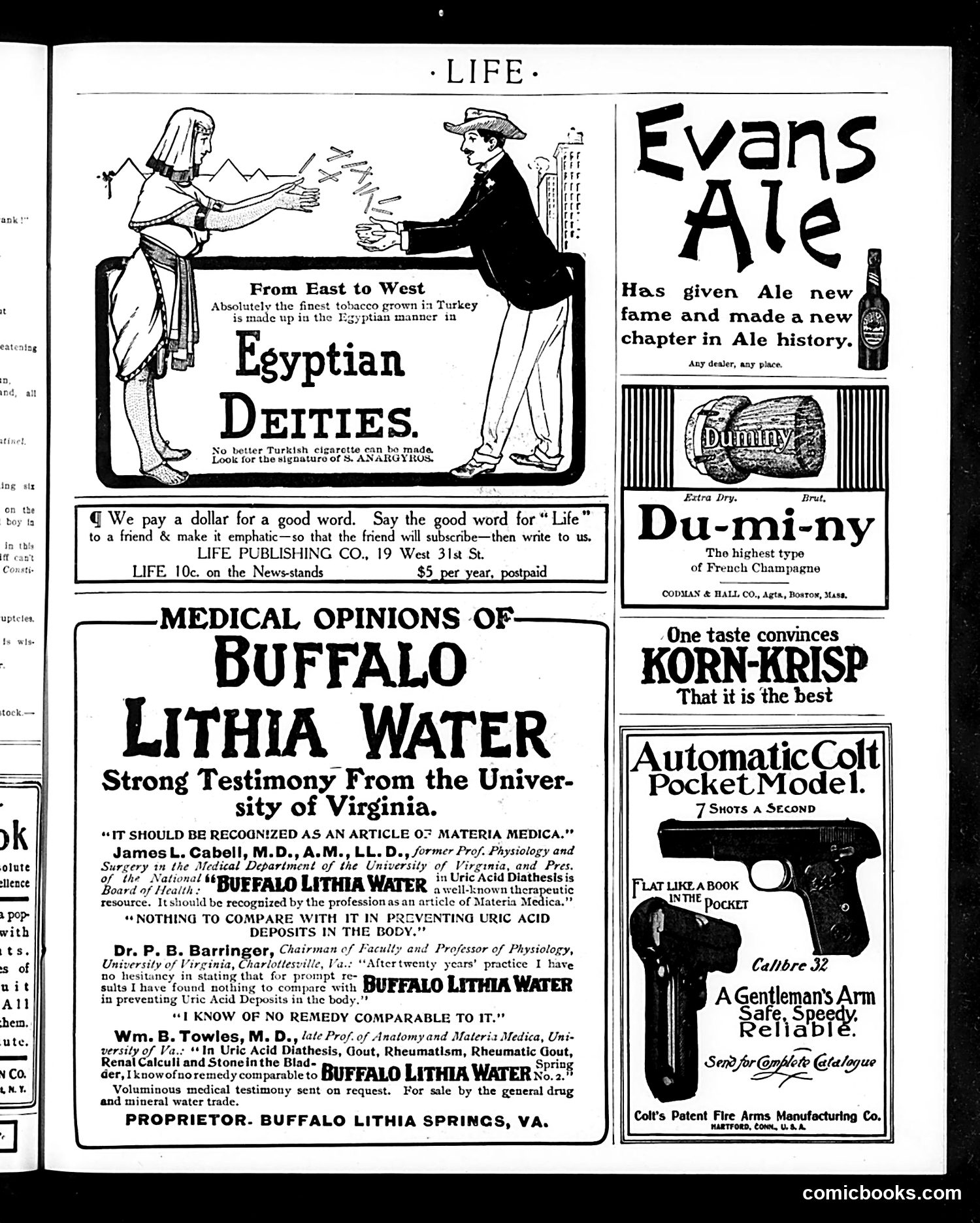
This page contains primarily **advertisements** rather than editorial cartoons, typical of early 20th-century magazines. The main cartoon depicts an **Egyptian figure offering tobacco to a Western businessman**, promoting "Egyptian Deities" cigarettes made with Turkish tobacco "in the Egyptian manner." The joke appears to be a play on "deities" (gods) versus the product itself—likely suggesting these cigarettes are divine/superior. The page is dominated by **patent medicine and luxury goods ads**: Buffalo Lithia Water claims medical endorsements from University of Virginia professors for treating gout and uric acid deposits (reflecting period anxieties about such ailments); Evans Ale and Du-mi-ny Champagne promote beverages; and a Colt Automatic Pocket Pistol advertises itself as "A Gentleman's Arm—Safe, Speedy, Reliable." The ads reflect **Gilded Age consumer culture**: medical testimonials (now recognized as dubious), imported luxury products, and firearms marketed as gentlemanly accessories. Life magazine's own ad solicits word-of-mouth subscriptions.
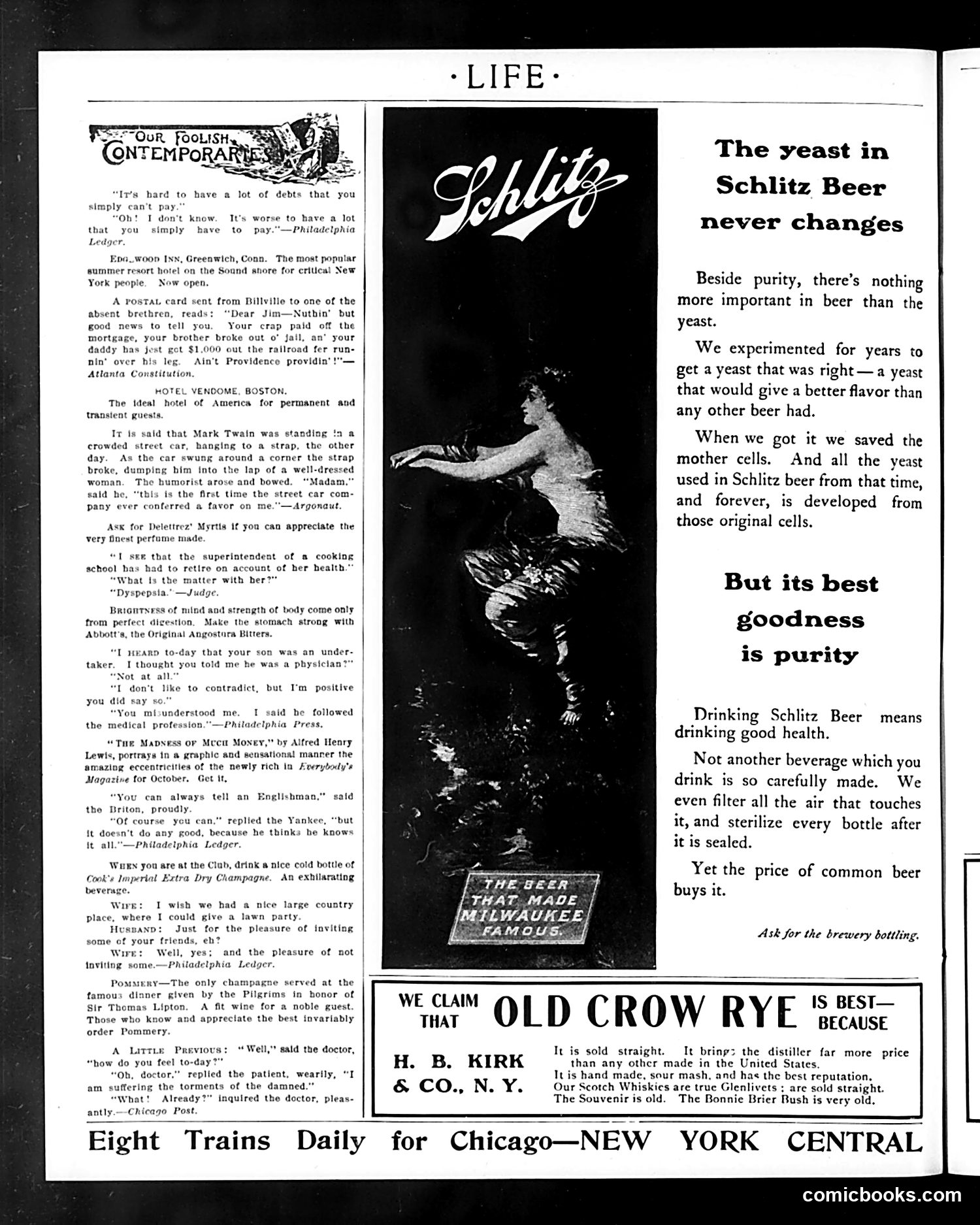
This page is primarily **advertising**, featuring beer and whiskey ads alongside humorous anecdotes typical of early 1900s Life magazine. The **Schlitz Beer advertisement** emphasizes "purity" and consistency of yeast strain—marketing beer as a health beverage. The accompanying image shows a classical female figure, appealing to aspirational, upper-class sensibilities. The **Old Crow Rye whiskey ad** claims superiority through traditional production methods ("hand made, sour mash"). The satirical content consists of short jokes mocking: - Financial irresponsibility and debt - Rural/Southern dialect humor ("Billville") - Class pretensions (the "newly rich" referenced in the Lewis article mention) - Gender and marital dynamics (the wife's lawn party joke) - British versus American cultural stereotypes The Mark Twain anecdote depicts American humor through a gentleman's mishap on public transit—reflecting era concerns about crowded urban life and class mixing. Overall, this represents **early 20th-century consumer culture**, where beer and whiskey companies leveraged health claims and social aspiration to market alcohol.
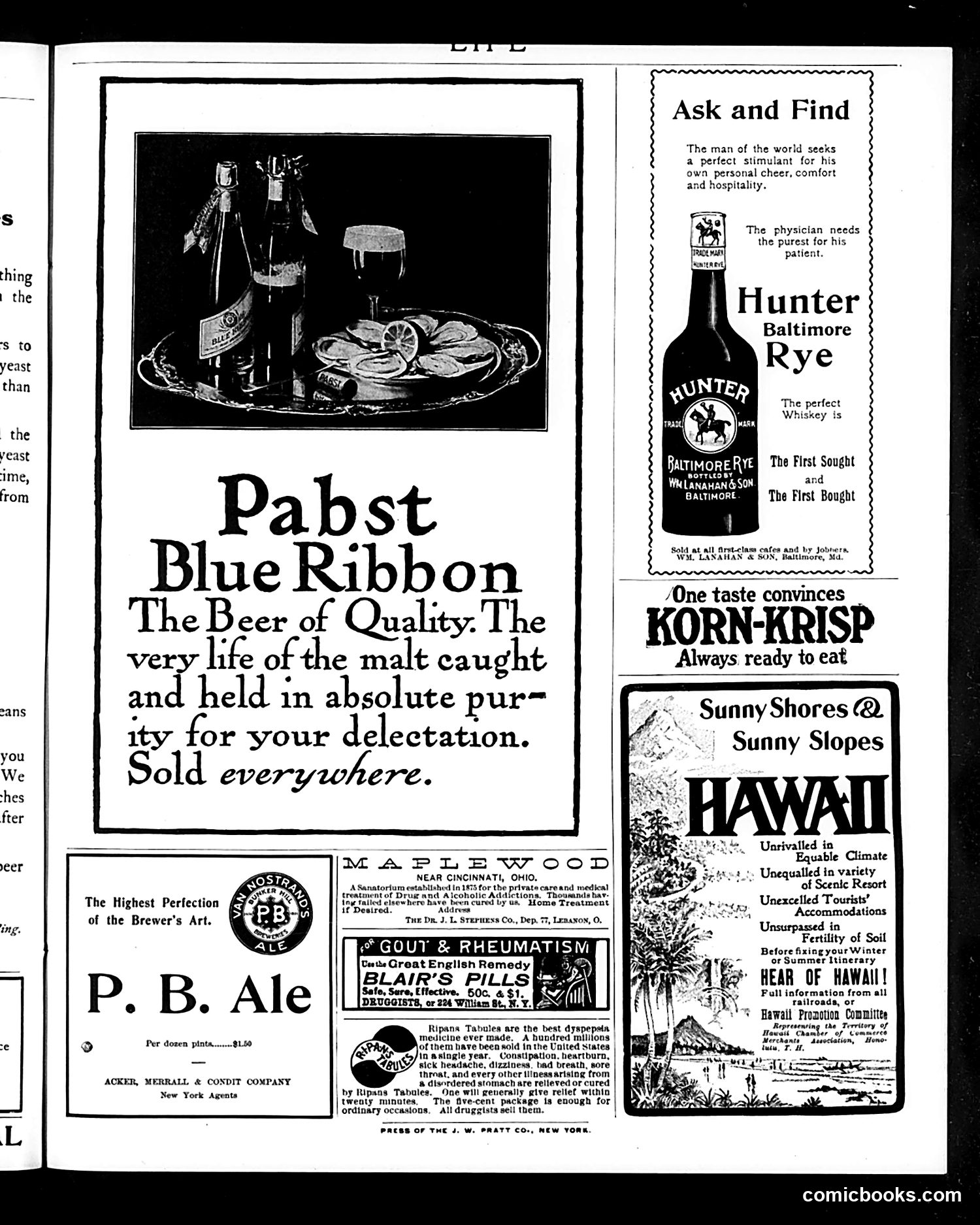
This page is primarily **advertising**, not political satire. It contains multiple product advertisements from the early 20th century, including: - **Pabst Blue Ribbon Beer** (large central ad) promoting beer as a quality product "sold everywhere" - **P.B. Ale** by Acker, Merrall & Condit Company - **Hunter Baltimore Rye whiskey**, marketed as "the perfect whiskey" - **Korn-Krisp** cereal ("always ready to eat") - **Hawaii tourism** promoting "Sunny Shores & Sunny Slopes" - Medical/patent remedy ads for alcoholism treatment, gout pills, and digestive tablets The irony a modern reader might notice: the page simultaneously advertises alcoholic beverages (beer and whiskey) alongside an alcoholism treatment facility—reflecting early-1900s attitudes where such contradictions were unremarkable. The ads emphasize quality, comfort, and hospitality rather than health concerns.
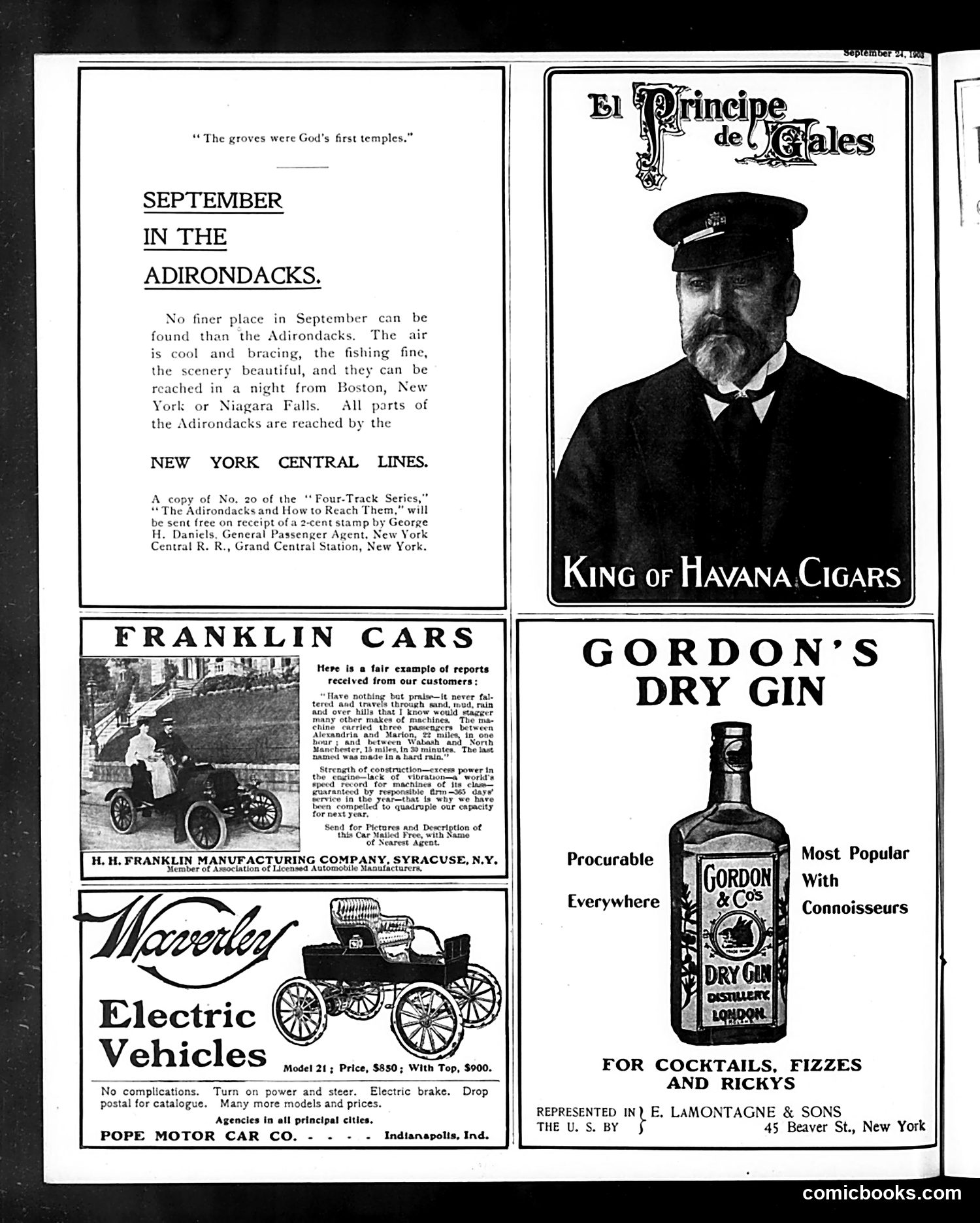
This is primarily an **advertising page**, not a satirical cartoon. It contains five distinct advertisements from circa early 1900s: 1. **New York Central Lines** - promotes Adirondack travel, framing nature ("groves were God's first temples") as a luxury destination accessible by rail. 2. **Franklin Cars** - highlights an electric vehicle's durability and reliability through customer testimonials. 3. **Waverley Electric Vehicles** - advertises electric cars, positioning them as simple and practical alternatives to combustion engines. 4. **El Príncipe de Gales Cigars** - features a bearded man in captain's hat, marketing Cuban cigars as premium products. 5. **Gordon's Dry Gin** - promotes gin for cocktails, emphasizing its status among "connoisseurs." The page reflects early 20th-century consumer culture: electric vehicles as emerging technology, rail travel as leisure, and imported luxury goods (cigars, gin) as markers of sophistication. No political satire is evident.