
Life, 1903-09-24 · page 12 of 20
Life — September 24, 1903 — page 12: what you’re looking at
What you’re looking at
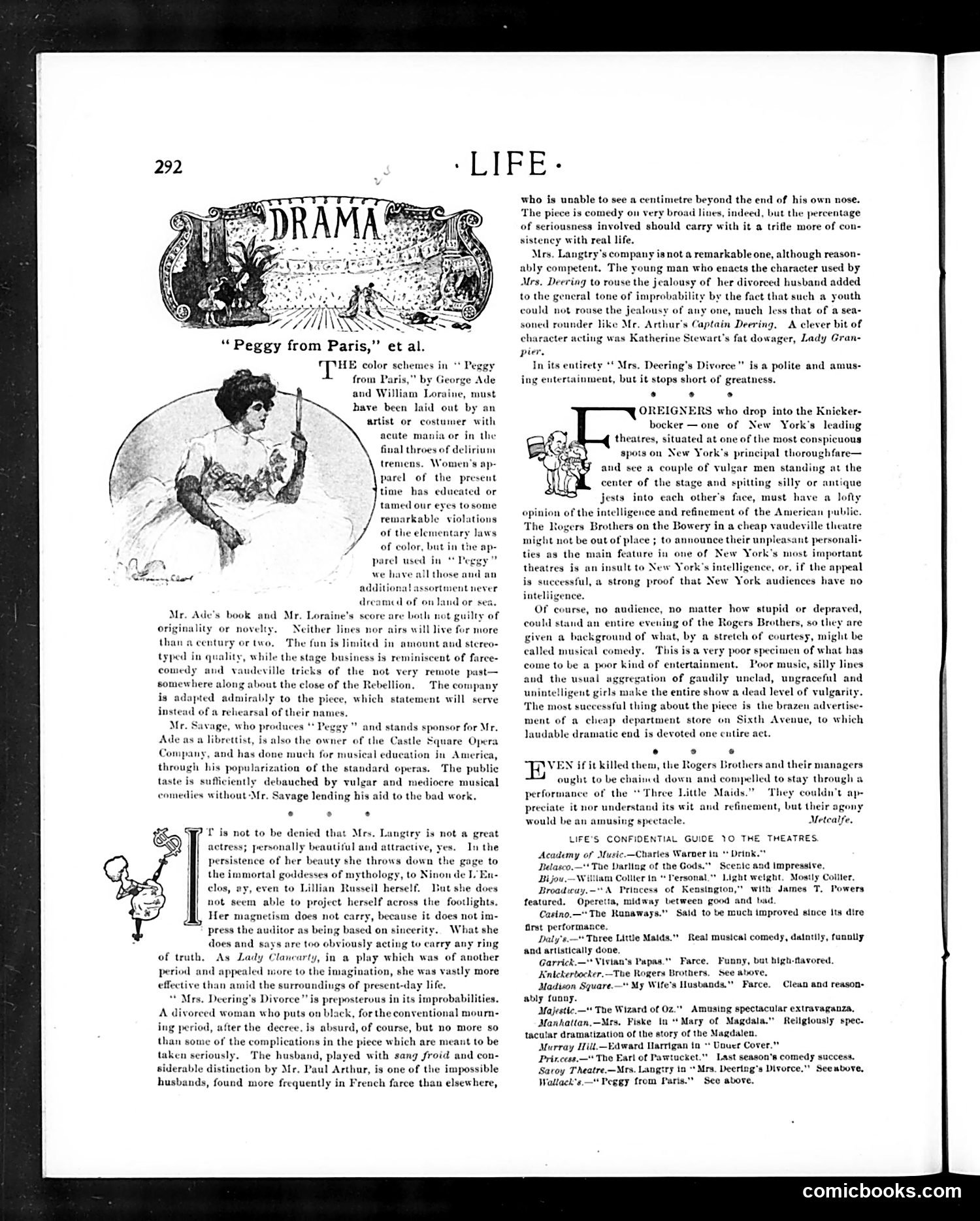
This page reviews theatrical productions, primarily critiquing "Peggy from Paris" and "Mrs. Deering's Divorce." The illustration shows a woman in an elegant dress, drawn in the Art Nouveau style typical of early 1900s theater reviews. The satire targets the quality of contemporary theater. The critic disparages "Mrs. Deering's Divorce" as shallow entertainment, and mocks the Rogers Brothers theater on Broadway for presenting crude, unsophisticated musical comedy ("Three Little Maids") to audiences the reviewer considers intellectually inferior. The reviews suggest a cultural divide between "high" drama and vulgar popular entertainment. The critic's tone is dismissive toward mass audiences and commercial theater aimed at them, reflecting early Progressive-era anxieties about taste and public intelligence in American culture.
📄 Transcribed text from this page (OCR, searchable)
Machine-transcribed from the original scan — historical spelling and the odd misread are preserved.
“LIFE “ Peggy from Paris,” et al. MPHE color schemes in “* Peggy from Paris, ge Ade and William Loraine, must have been Jaid out by an artist or costumer with acute vor in the by Ge final throes of delirium tremens. Women’s ap- parel of the present time has educated or tamed our eyes tosome remarkable violations of the elementary laws of color, but in the ap- parel used in we have all those and an additior cdl of on land of sea. Mr. Ade’s book and Mr. Loraine’s score are both not guilty of originality or novelty. Neither lines nor airs will live for more than a century or two. ‘The fun is limited in amount and stereo tssortment never typed in quality, while the stage business is reminiscent of farce- comedy and vaudeville tricks of the not very remote past— somewhere along about the close of the Rebellion, The company is adapted admirably to the piece, which statement will serve instead of a rehearsal of their names. Mr. Savage, who produces Peggy" and stands sponsor for Mr. Ade asa librettist, is also the owner of the Castle Square Opera tion in America, through his popularization of the standard operas. The public taste is sufliciently debauched by vulgar and mediocre musical ies without-Mr, Savage lending his aid to the bad work. , and has done much for musical edu f is not to be denied that Mes. Langtry is not a great actress; personally beautiful and attractive, yes. In the persistence of her beauty she throws down the gage to the immortal goddesses of mytholog inon de 1 Eu- ay, even to Lillian Russell herself. But she does not seem able to project herself across the footlights. Her magnetism does not carry, because it does not im- press the auditor as being based on sincerity. What she does and says are too obviously acting to carry any ring As Lady Clawarty, in a play which was of another appealed more to the imagination, she was vastly more effective than amid the surroundings of present-day life. “ Mrs. Deering’s Divorce” is preposterous in its improbabilities. A divorced woman who puts on black, for the conventional mourn- ing period, after the decree, is absurd, of course, but no more so than some of the complications in the piece which are meant to be taken seriously. The husband, played with sang froid and con- siderable distinction by Mr. Paul Arthur, is one of the impossible husbands, found more frequently in French farce than elsewhere, of truth, period and who is unable to see a centimetre beyond the end of his own nose. The piece is comedy on very broad lines, indeed, but the percentage of seriousness involved should carry with it a trifle more of cou- sistency with real life. Mrs. Langtry’s company isnot a remarkable one, although reason- ably competent. The young man who enacts the character used by Mrs. Deering to rouse the jealousy of her divorced husband added to the general tone of improbability by the fact that such a youth could not rouse the jealousy of any one, much less that of a sea- soned rounder like Mr. Arthur's Captain Deering, A clever bit of character acting was Katherine Stewart's fat dowager, Lady Gran- In its entirety ** Mrs. Deering’s Divorce” isa polite and amus- ing entertainment, but it stops short of greatness. . ° ° OREIGNERS who drop into the Knicker- bocker —one of New York's leading theatres, situated at one of the most conspicuous spots on New York's principal thoroughfare— and sce a couple of vulgar men standing at the center of the stage and spitting silly or antique jests into each other's face, must have a lofty The Rogers Brothers on the Bowery in a cheap vaudeville theatre might not be out of place ; to announce their unpleasant personali ties as the main feature in one of New York's most i theatres is an insult to New York's intelligence, or. if the appeal is successful, a strong proof that New York audiences have no intelligence. Of course, no audience, no matter how stupid or depraved, could stand an entire evening of the Rogers Brothers, so they are given a background of what, by a stretch of courtesy, might be called musical comedy. ‘This is a very poor specimen of what has come to be a poor kind of entertainment. Poor music, silly lines and the usual aggregation of gaudily unclad, ungraceful and unintelligent girls make the entire show a dead level of vulgarity. ‘The most successful thing about the pice ment of a cheap department store on Sixth Avenue, to which laudable dramatic end is devoted one cutire act. is the brazen adverti: . ° ° VEN if it killed them, the Rogers Brothers and their managers ought to be chaind down and compelled to stay through a performance of the “Three Little Maids.” ‘They couldn't ap- preciate it nor understand its wit and refinement, but their agony would be an amusing spectacle. Metcalfe. LIFE'S CONFIDENTIAL GUIDE 10 THE THEATRES. Academy of Music. —Chartes Warner in Drink.” Delasco.—" Tue Darling of the Gods.” Scenic and Impressive, Bijou,—Witllam Collter in Personal." Light weight, Mosily Coliler, Broadway.-" A Princess of Kensington,” with James T, Powers featured. Operetta, midway between good and bad. Casino.—*The Runaways.” Said to be much improved since Its dire first performance. Daly's.—" Taree Little Maids." Real musical comedy, datntily, funnily ‘and artistically done. Garrick.—"* Vivian's Papas." Farce. Funny, but high-flavored, Knickertocker.—The Rogers Brothers. See above, Madison Square.—* My Wife's Husbands.” Farce. ably funny. ‘Majestic. Tue Wizard of 02." Amusing spectacular extravaganza, Manhattan,—Mrs. Fiske in “Mary of Magdala.” Religiously spec. tacular dramatization of the story of the Magdalen. Murray Hilt,—Eaward Harrigan tn“ Uouer Cover.” Prir.cess.—" The Earl of Pawtucket.” Last season's comedy success. Saroy Theatre.—Mrs. Langtry 1 * Mra, Deering’s Divorce.” Seeubove, Wallack"s.— Peggy from Paris.” See above, Clean and reason- comicbooks.com