
A complete issue · 20 pages · 1903
Life — September 10, 1903
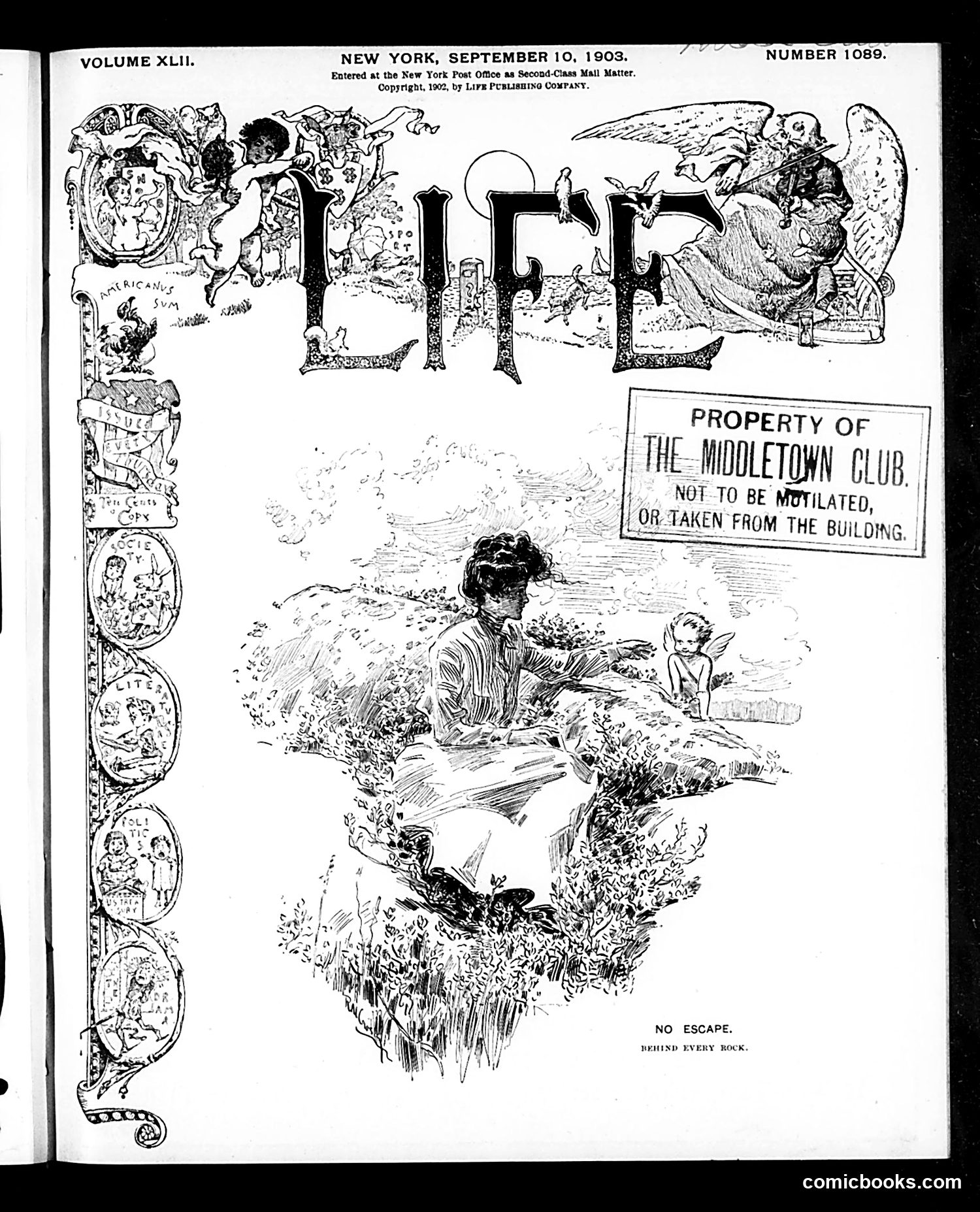
This is the cover of *Life* magazine's satirical section. The central illustration depicts a woman (likely representing literature or intellectual pursuits) sitting in nature with a cherub, painting or drawing. The composition emphasizes escape into idyllic, natural settings. The ownership stamp "Property of The Middletown Club" with the warning "Not to be mutilated, or taken from the building" indicates this was a library copy—a common practice for subscription magazines at gentlemen's clubs. The phrase "No escape. Behind every book" (bottom) suggests ironic commentary about how even in literature or nature, one cannot avoid some inescapable reality or social condition—likely referencing contemporary social issues the magazine regularly satirized.
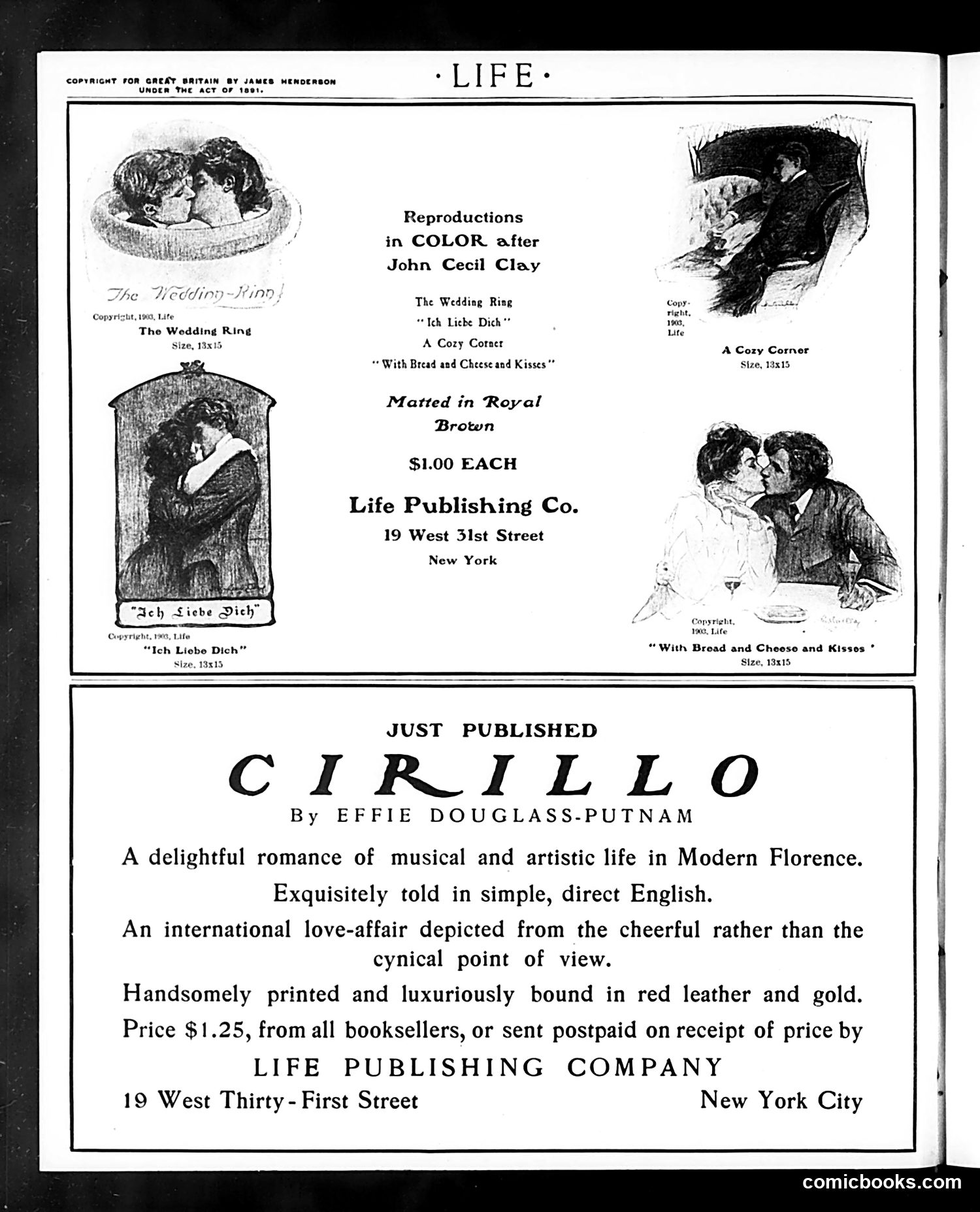
This page is primarily **advertising** rather than editorial content. It showcases reproductions of romantic artworks by John Cecil Clay from Life Publishing Company, priced at $1.00 each. The four illustrated pieces—"The Wedding Ring," "Ich Liebe Dich," "A Cozy Corner," and "With Bread and Cheese and Kisses"—depict intimate domestic scenes of couples in affectionate poses. Below this is an advertisement for a novel called *Cirillo* by Effie Douglass-Putnam, described as "a delightful romance of musical and artistic life in Modern Florence." The book costs $1.25 and is advertised as being "handsomely printed and luxuriously bound in red leather and gold." The page reflects early 20th-century commercial publishing, marketing sentimental romantic imagery and literature to readers.
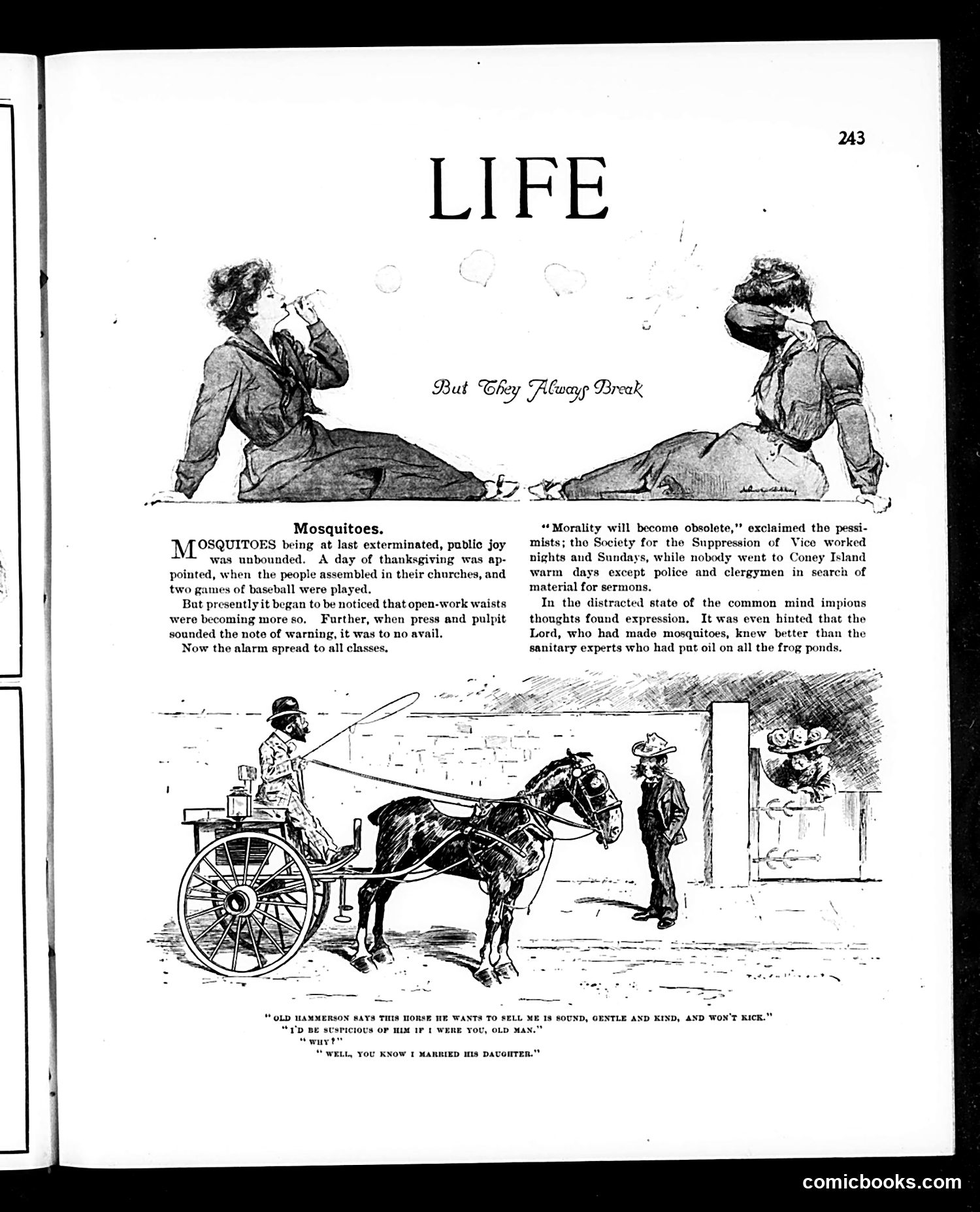
**Top Panel**: Two women lying down with the caption "But They Always Break" satirizes romantic relationships, suggesting men are unreliable partners. **"Mosquitoes" Section**: Celebrates the elimination of mosquitoes in what appears to be New York City—a genuine public health victory. The text notes thanksgiving celebrations, baseball games, and church attendance. However, it satirizes the era's optimistic belief that mortality would become "obsolete," mocking both public health advocates and moral reformers (the Society for the Suppression of Vice) who worked simultaneously. The joke: people celebrated mosquito elimination while ignoring other serious threats, and reformers' efforts proved similarly ineffective. **Bottom Cartoon**: Depicts a horse-trading scene with dialogue about selling a horse and marrying off a daughter—equating women to livestock in a satirical critique of marriage as transactional.
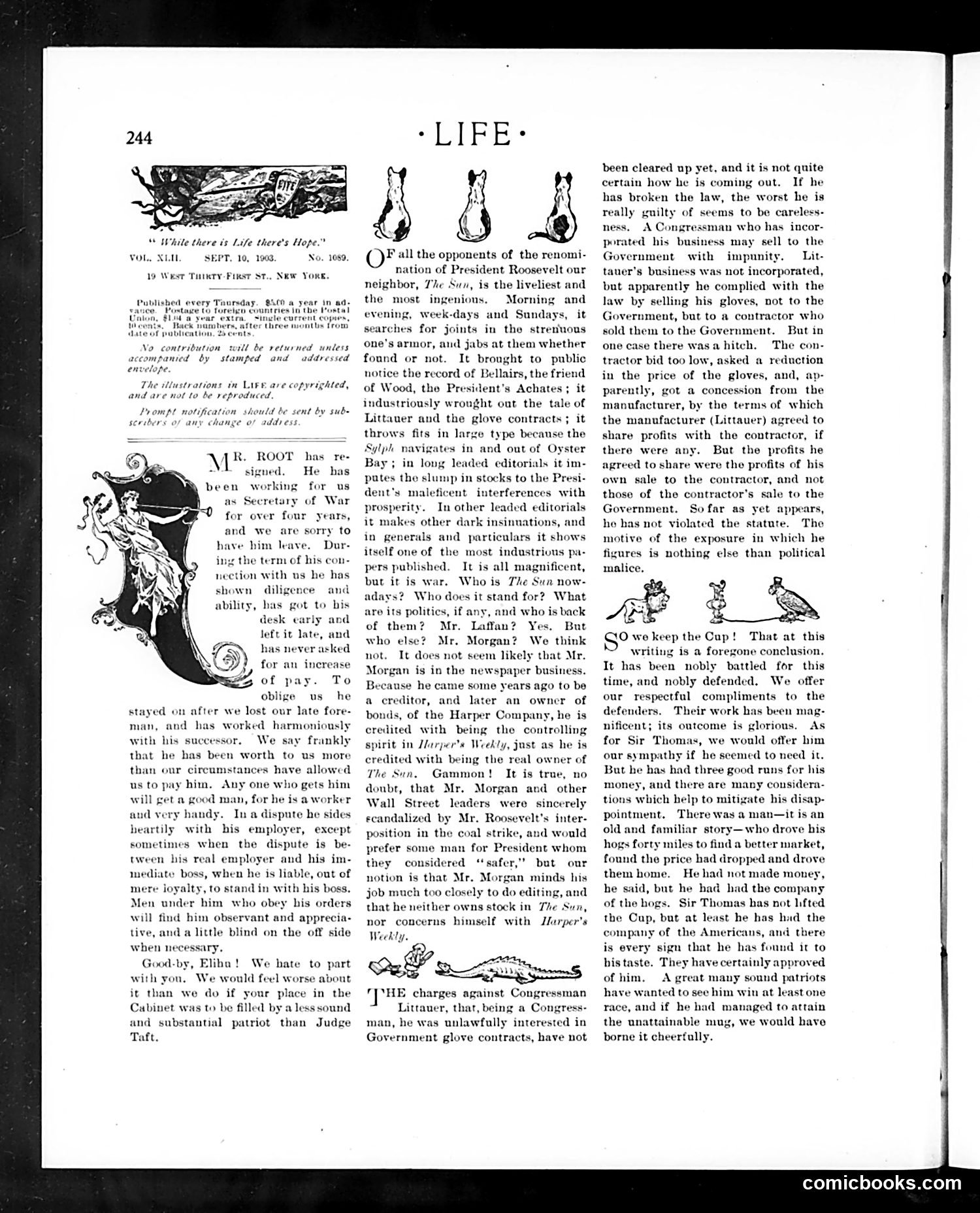
This page critiques **President Roosevelt's** renomination and his newspaper *The Sun*. The editorial attacks *The Sun* as "lively and ingenious" but fundamentally dishonest, comparing it unfavorably to *Harper's Weekly*. The main cartoon depicts **Mr. Root** (likely Elihu Root, Roosevelt associate), shown leaving his position after four years. The text suggests Root's departure reflects internal conflict within Roosevelt's circle regarding business practices—specifically involving government glove contracts where a contractor allegedly profited improperly. The piece sarcastically addresses charges against Congressman **Littauer** regarding unlawful interest in Government contracts, implying Roosevelt's inner circle engaged in questionable dealings despite anti-corruption rhetoric. The overall message: Roosevelt's administration, despite reformist claims, harbored corrupt practices among trusted associates.
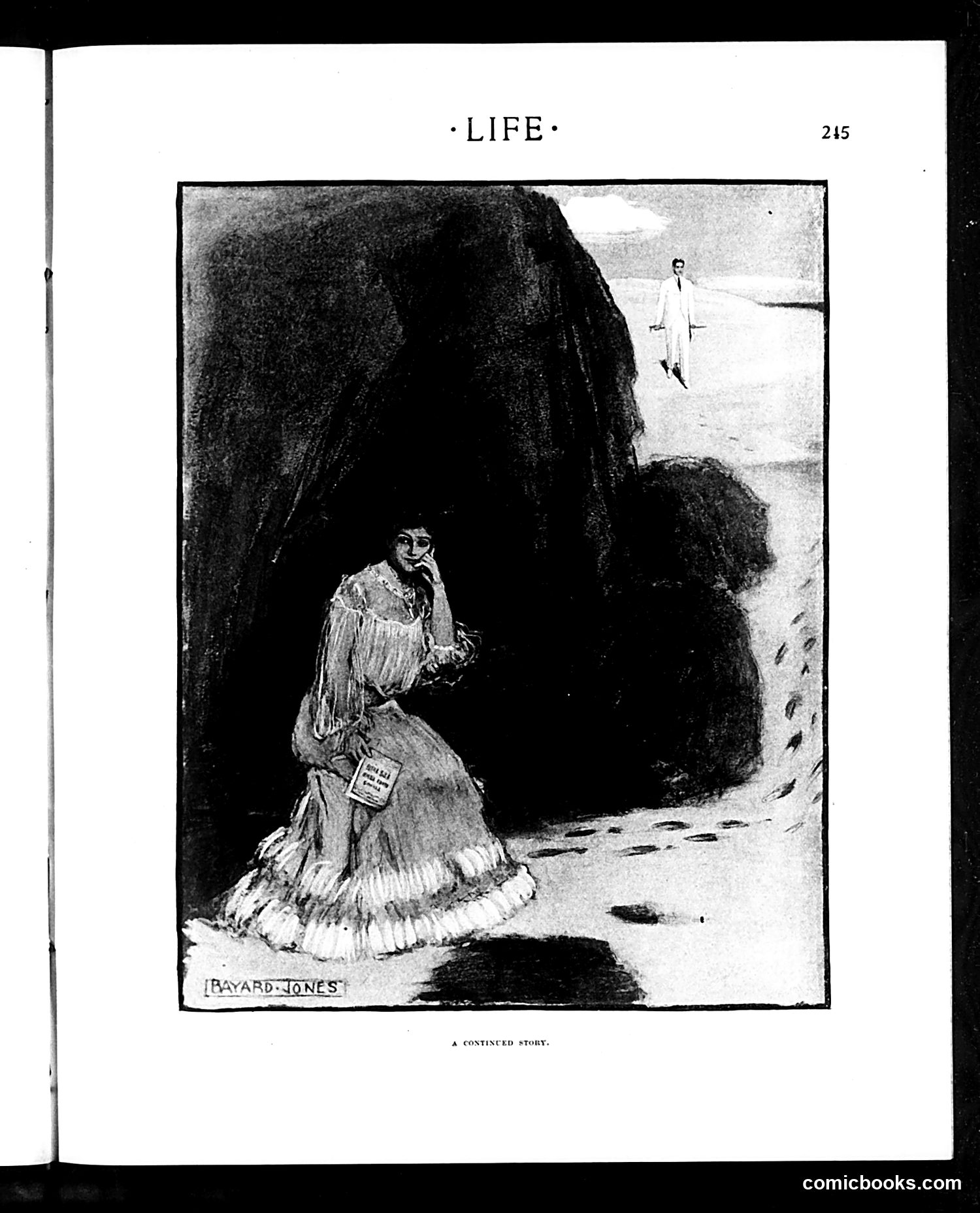
This illustration by Bayard Jones depicts "A Continued Story" and shows a woman in tattered clothing crouching in a cave or dark shelter, holding what appears to be a small sign. A figure in light clothing stands in the distance outside the shelter. The image likely satirizes poverty or homelessness, a common subject in early 20th-century American satire. The woman's disheveled appearance and makeshift shelter suggest economic hardship. The sign she holds—text unclear in this reproduction—likely contains social commentary, possibly about unemployment, begging, or welfare. Without clearer text on the sign or additional context, the specific satirical target remains unclear. The "continued story" framing suggests this was part of a serialized narrative. The contrast between the woman's dark confinement and the bright world outside emphasizes social inequality or exclusion.
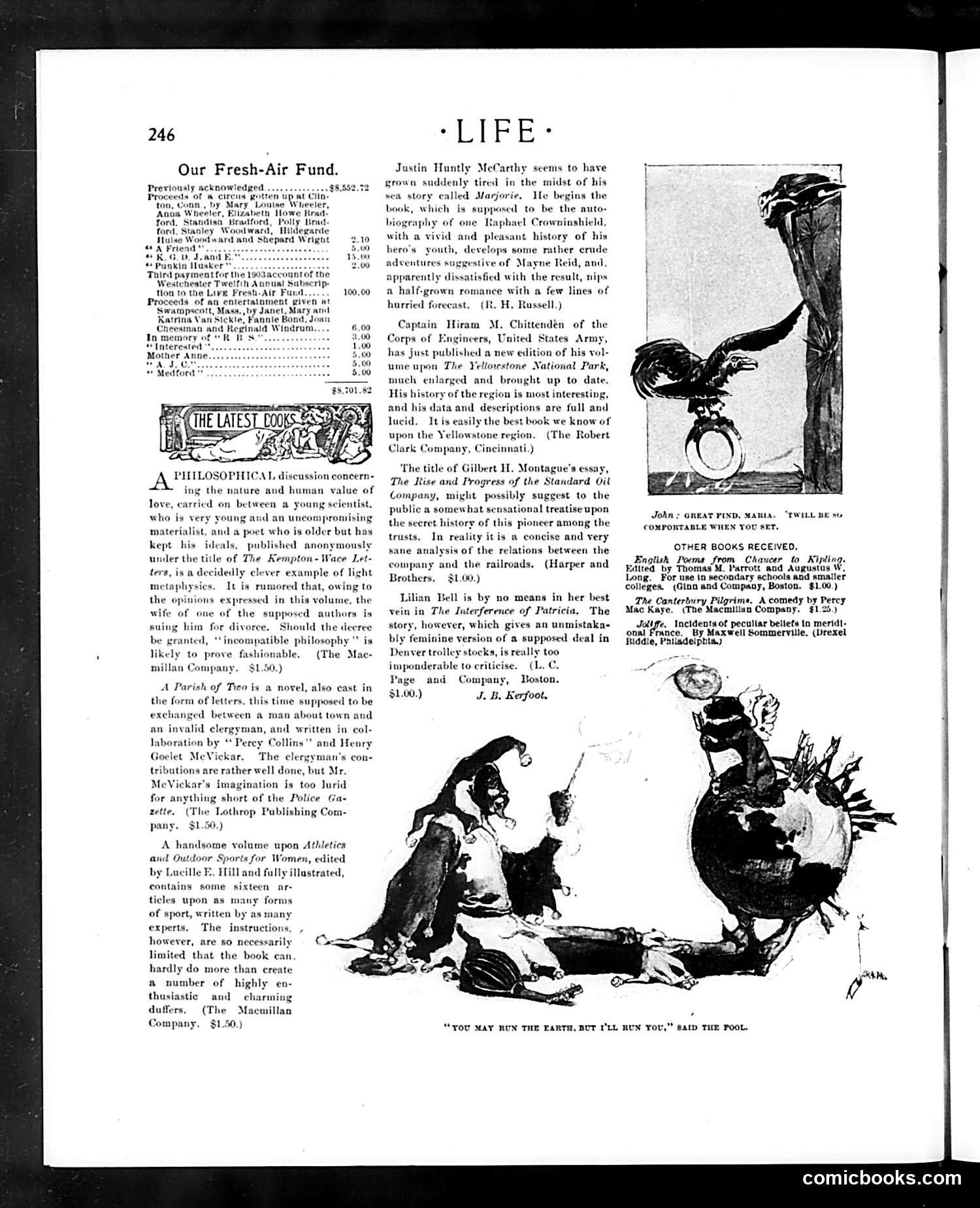
This page contains book reviews rather than political cartoons. The main illustration shows a figure in formal dress (top) and below it a scene (captioned "You may run the earth, but I'll run you," said the fool) depicting what appears to be a confrontation between a well-dressed man and a woman in an exaggerated pose. The reviews discuss literary works including discussions of philosophy, standard oil company history, and a novel in letter form. The cartoons seem to illustrate themes about power dynamics and social relationships—likely satirizing the tension between material success and domestic/romantic influence, a common early 20th-century satirical theme about gender relations. Without clearer context about publication date or specific literary references, precise interpretation remains limited.
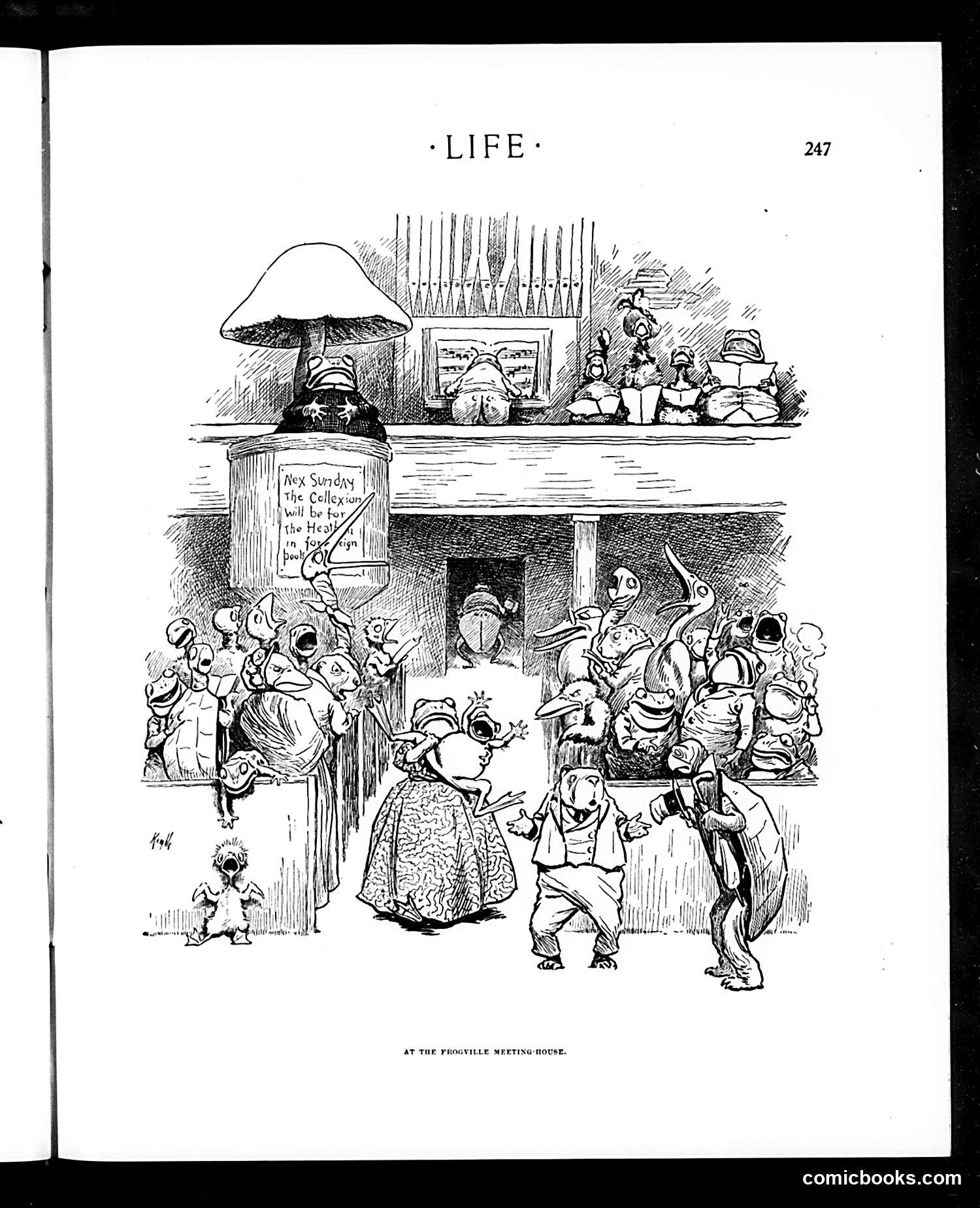
This satirical cartoon depicts anthropomorphic pigs gathered at a meeting house, with a sign reading "Rex Swinem the Celleywum will be for His Healt" (the OCR text is garbled, but the image shows a proclamation on a pole). The scene mocks a political or social gathering, likely targeting corrupt politicians or self-serving leaders. The pigs—a classic metaphor for greed, gluttony, and moral degradation—crowd around what appears to be a meeting or announcement about a leader's health or authority. The title suggests satire of rural or small-town political assemblies, with the porcine characters emphasizing the perceived stupidity or base nature of the participants. The overall tone ridicules naive followers gathering to hear pronouncements from their leaders.
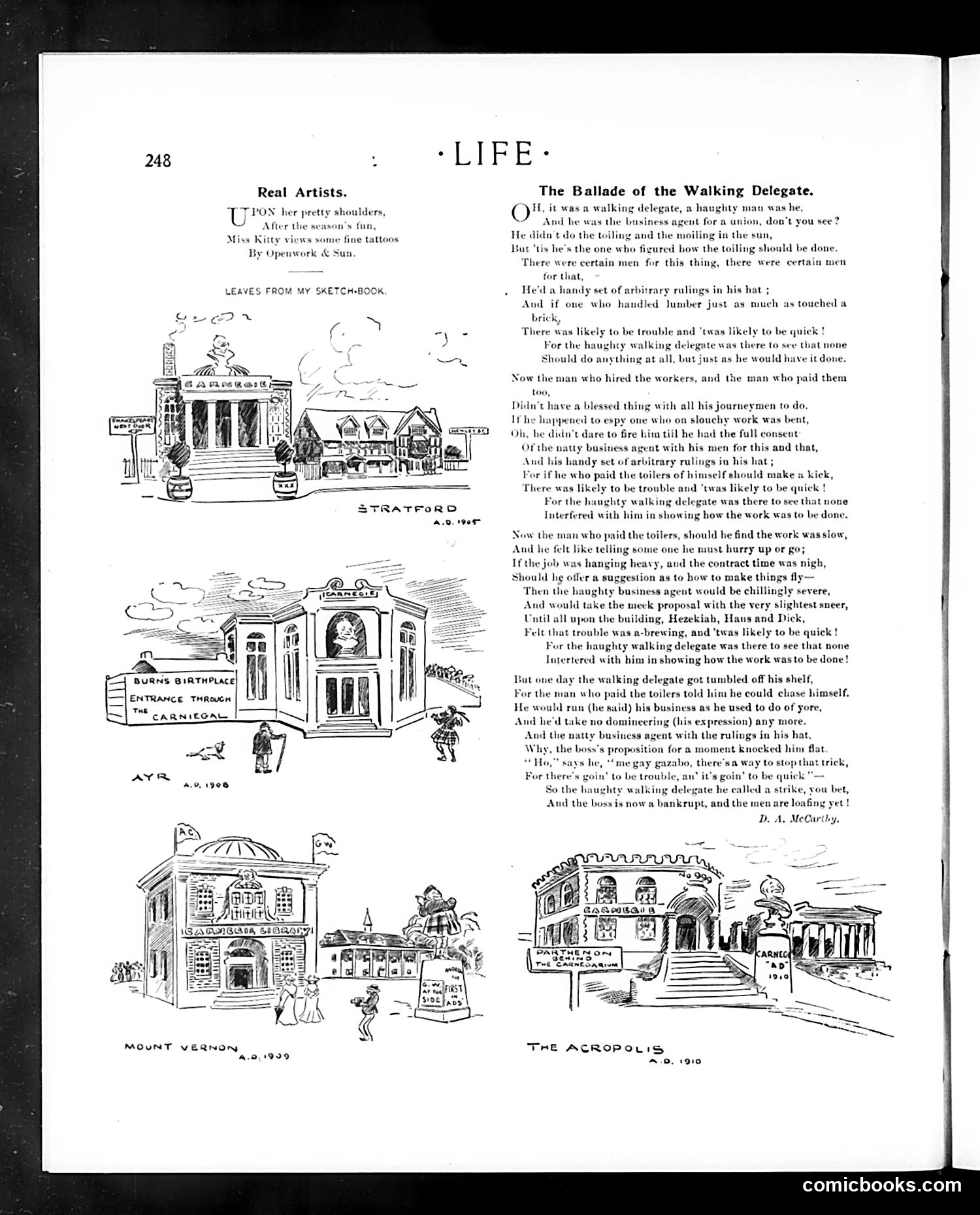
This page contains two sections: **Left side:** "Real Artists" sketches showing buildings from British locations (Stratford, Burns Birthplace, Mount Vernon, The Acropolis), labeled as "Leaves from my Sketchbook" with dates from 1908-1910. These appear to be architectural drawings by a contributor. **Right side:** "The Ballad of the Walking Delegate"—a satirical poem mocking labor disputes. The narrative describes a arrogant union official ("walking delegate") who makes unreasonable demands on employers and workers, ultimately causing a strike that bankrupts the business owner. The satire criticizes union corruption and overreach, suggesting that aggressive labor negotiation tactics backfire and harm everyone involved, reflecting early 20th-century anti-union sentiment common in mainstream American publications.
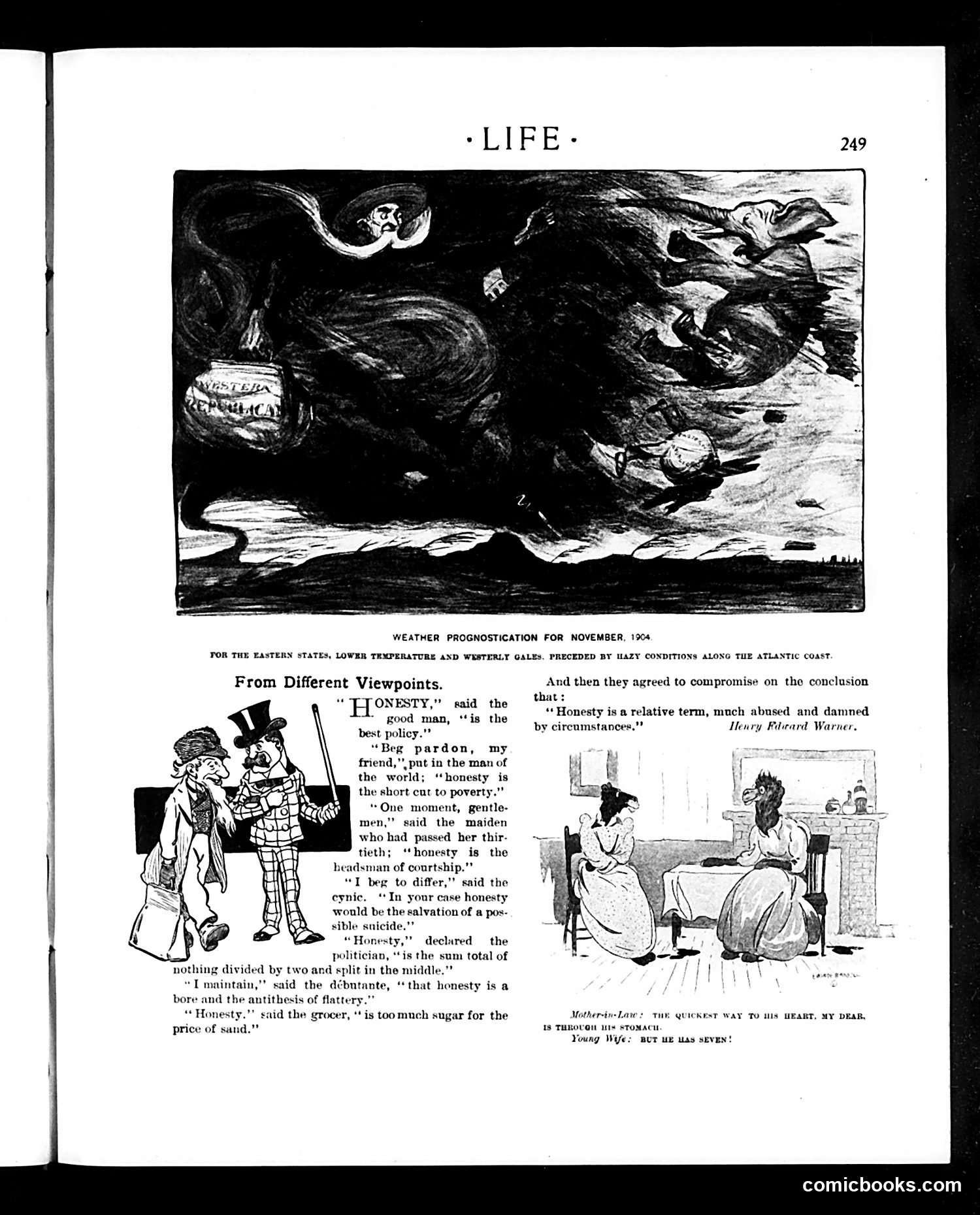
**Top Illustration:** A weather forecast cartoon for November 1904, depicting stormy conditions for the Eastern states with hazy Atlantic Coast weather—a literal, non-political weather joke. **Main Content - "From Different Viewpoints":** A satirical piece on the definition of "honesty" through dialogue between different social types: a good man, a poor man, a maiden, a cynic, a politician, a debutante, and a grocer. Each offers contradictory perspectives on honesty's meaning, suggesting the term is subjective and interpreted through self-interest. **Side Illustrations:** Two domestic scenes depicting marital advice, with captions about reaching a husband's heart through his stomach, and a joke about a wife and seven children. The satire mocks how different social classes rationalize ethics to suit their circumstances.
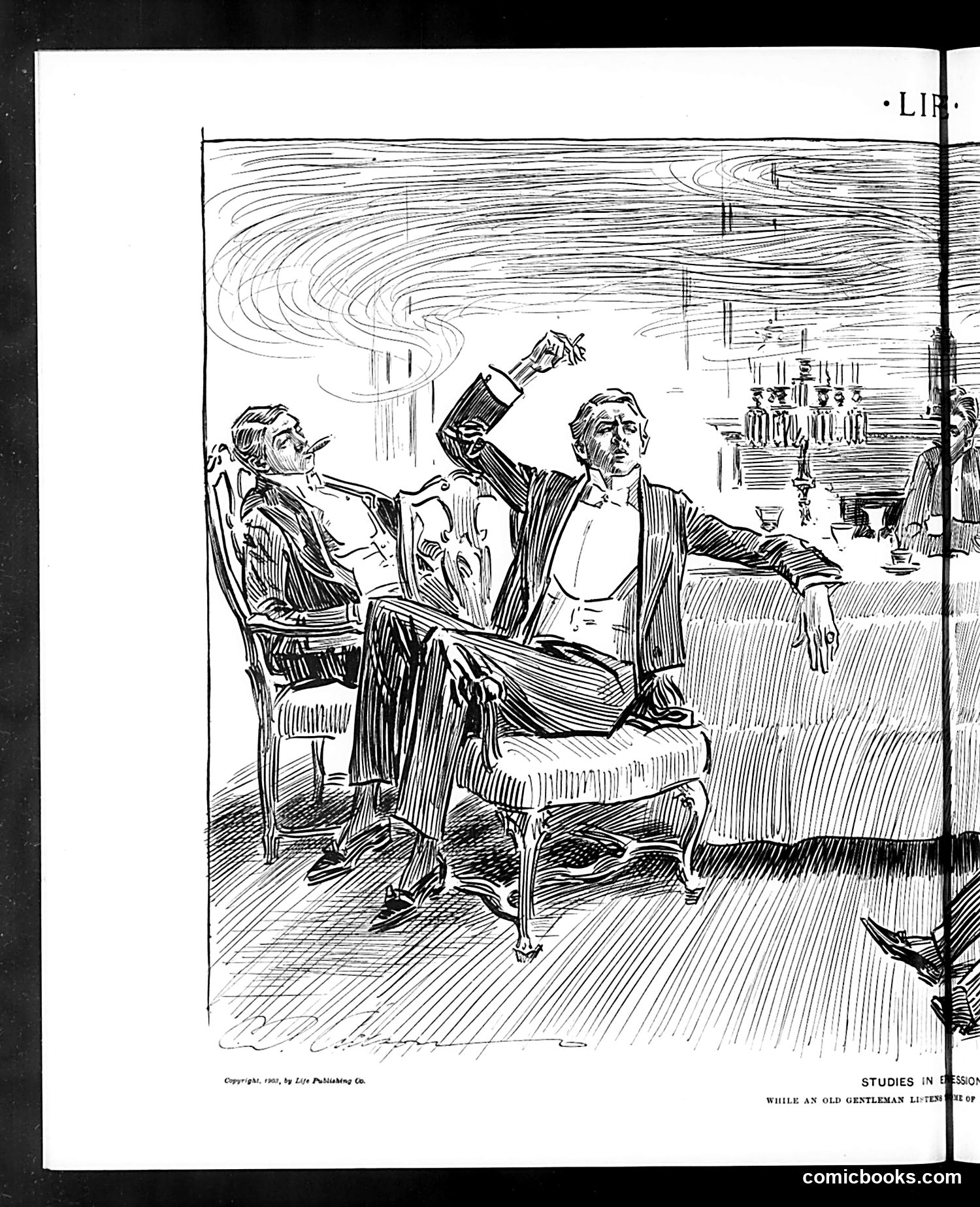
This is a satirical illustration titled "Studies in Desson While an Old Gentleman Listens" (OCR text partially unclear). The cartoon depicts two men in formal dress in what appears to be an elegant interior setting. The figure on the left gestures expressively while holding what looks like a bottle, while the man on the right sits listening. The swirling lines in the background suggest animated conversation or perhaps smoke. The satire appears to target social pretension or affected behavior—possibly mocking someone demonstrating or "posing" while another party observes. The "old gentleman" reference suggests generational contrast. Without clearer text or identifying captions, the specific political or social target remains uncertain, though the tone suggests mockery of affectation or performative sophistication among upper-class figures.
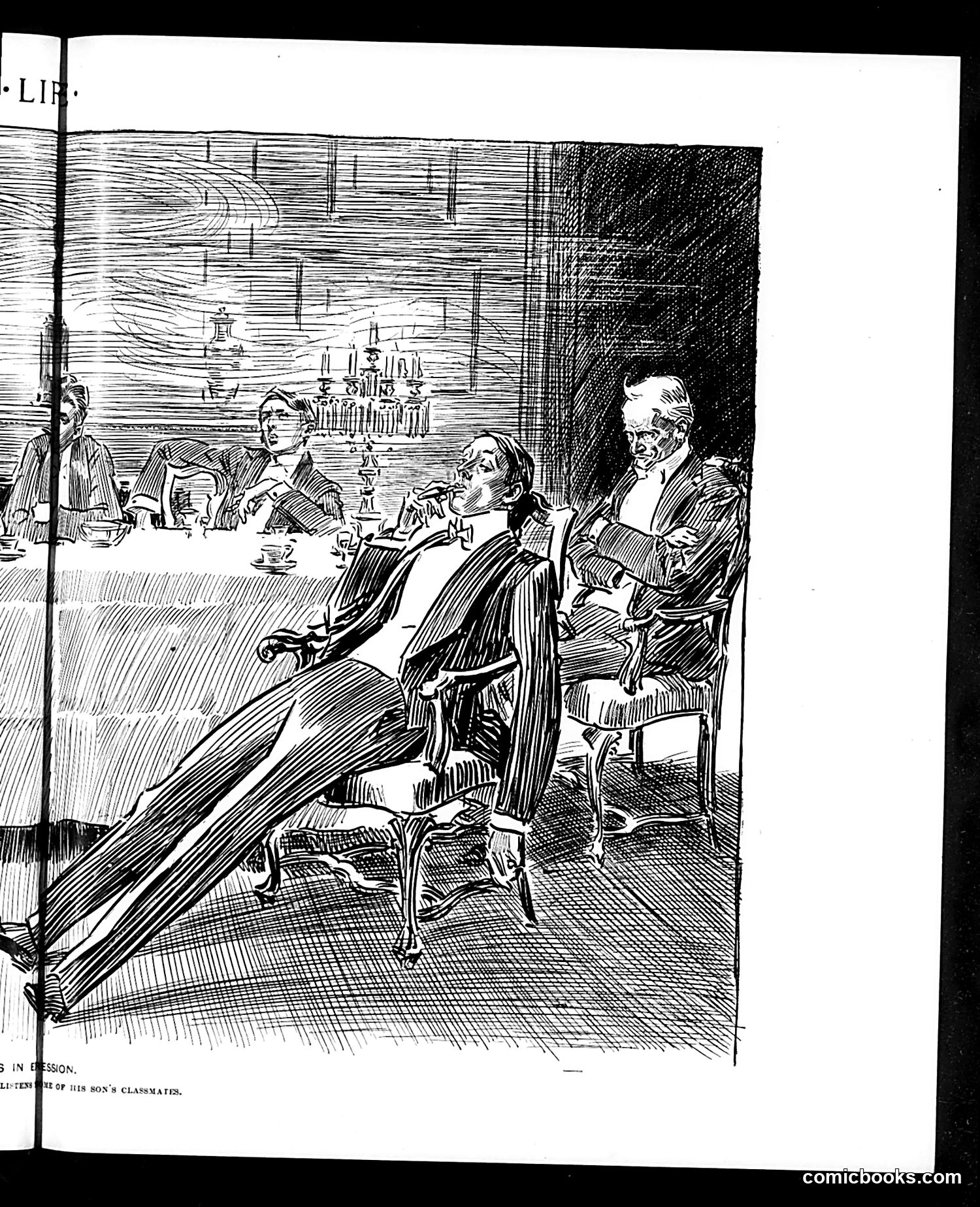
This is a satirical illustration from *Life* magazine depicting a formal dinner scene. The OCR text is fragmentary and unclear, but the image shows four well-dressed men in formal attire at what appears to be an elegant dining setting, with a chandelier visible in the background. The central figure reclines in an exaggerated pose in his chair while the others remain seated properly, suggesting mockery of pretension or affectation. The specific identities and political references are unclear from the visible text. The drawing style—detailed cross-hatching and line work—is typical of late 19th or early 20th-century satirical illustration. Without legible caption text or clearer historical context, the exact targets of this satire cannot be definitively determined from the image alone.
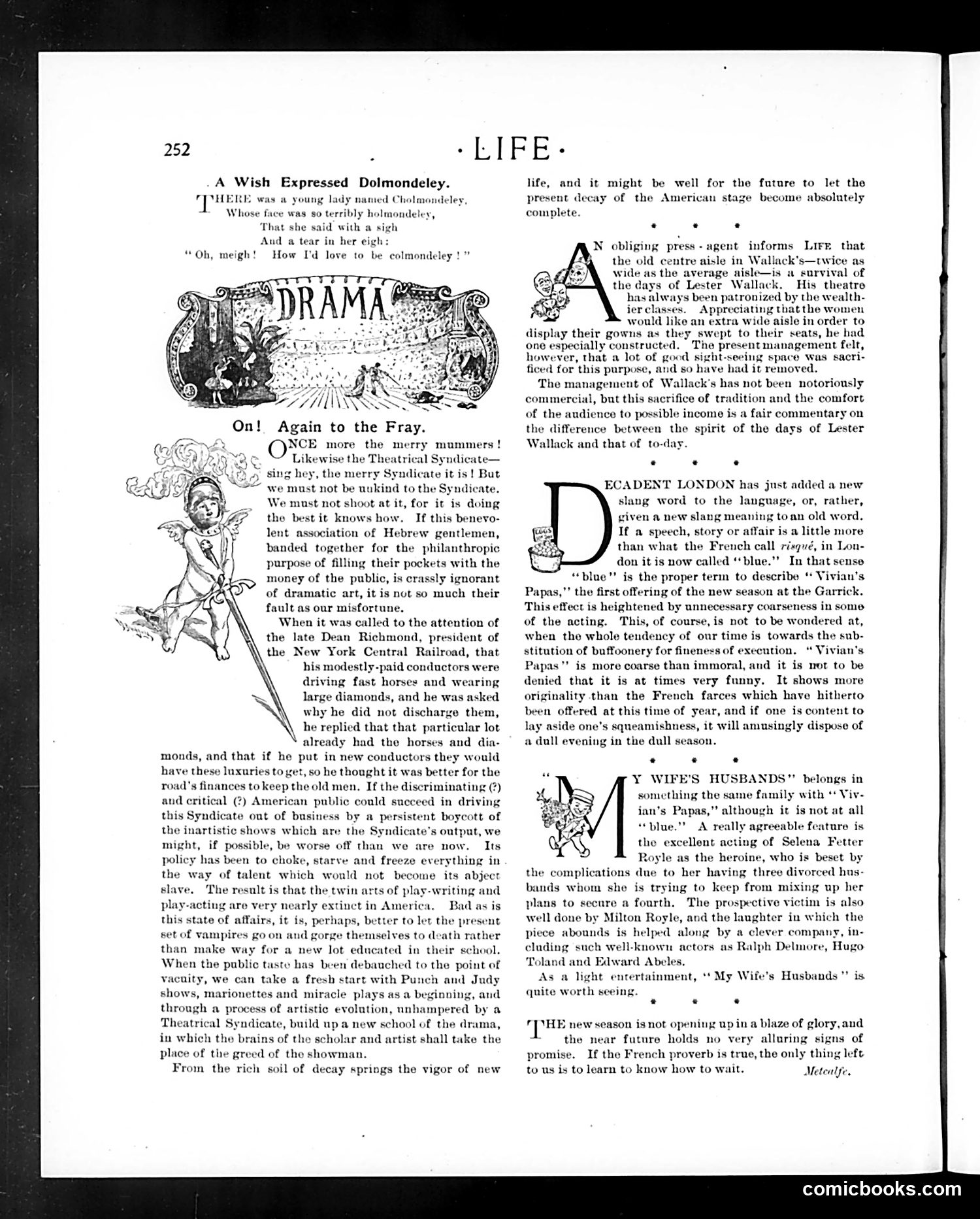
This page contains theater criticism and commentary rather than political cartoons. The main content discusses the theatrical world of the period. The section "A Wish Expressed Dolmondeley" is a brief poem about a young lady named Cholmondeley who wishes to be "colmondeley" (elegant/refined). The longer piece "On! Again to the Fray" critiques the Theatrical Syndicate's business practices, particularly regarding conductors on the New York Central Railroad who were allegedly pressured to stop patronizing syndicate theaters. The author argues this monopolistic control is damaging American theater and calls for reform through new dramatic schools and artistic evolution rather than "vampires" (exploitative producers) controlling the stage. The remaining sections review current theatrical productions including "Vivian's Papas," "My Wife's Husbands," and comment on the upcoming theater season.
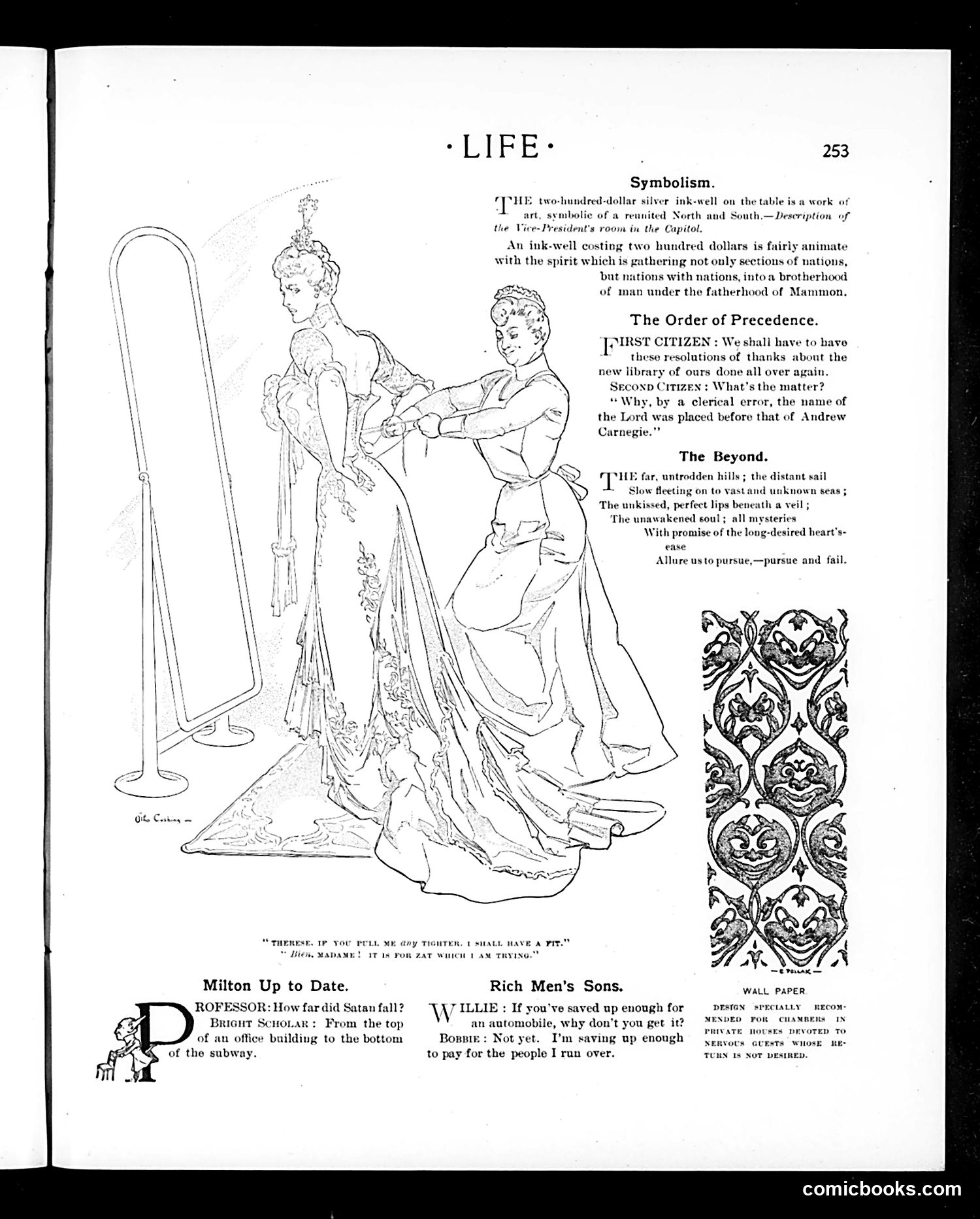
This page contains multiple satirical pieces mocking the era's obsession with money and status: **"Symbolism"** ridicules a $200 silver inkwell in the Vice-President's room as representing the "brotherhood of man under the fatherhood of Mammon"—sarcastically suggesting that wealth, not morality, unites the nation (likely post-Civil War reconciliation). **"The Order of Precedence"** jokes that Andrew Carnegie's name was mistakenly placed *before* the Lord's in library dedications—a sharp jab at how industrialists like Carnegie had become more important culturally than religious figures. **"Rich Men's Sons"** features a dialogue where a wealthy man says he's saving money not for an automobile, but "to pay for the people I run over"—dark humor about wealthy industrialists' indifference to those harmed by their businesses. **"Milton Up to Date"** updates Milton's *Paradise Lost*, replacing theological falls with modern urban humor (Satan falls from an office building to the subway). The overall message: American society worships wealth over morality, spirituality, or human welfare.
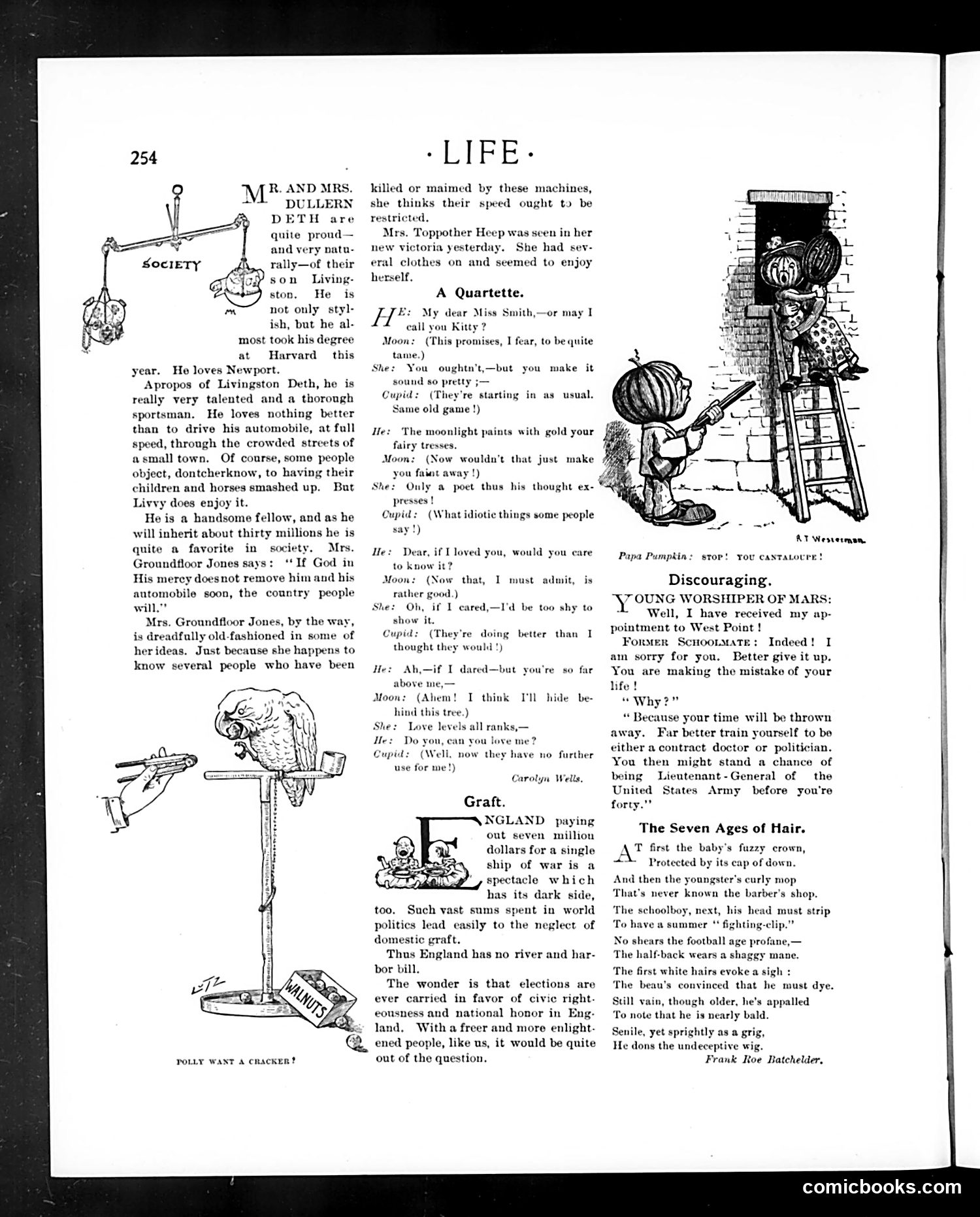
This page contains several satirical pieces mocking American society circa early 1900s: **"Mr. and Mrs. Dullern Deth"**: Satirizes wealthy, negligent parents proud of their son Livingston, who recklessly drives automobiles through crowded town streets at dangerous speeds, killing pedestrians and horses. The text mocks the upper class for dismissing safety concerns as "old-fashioned" (embodied by Mrs. Groundfloor Jones, who reasonably objects to preventable deaths). **"A Quartette"**: A witty poetic dialogue about courtship, where Moon and Cupid mock the predictable, hackneyed romantic lines exchanged between He and She—suggesting love poetry and seduction follow tiresome formulas. **"Graft"**: Compares England's massive naval spending ($7 million for a warship) unfavorably to American politics, sarcastically noting that Americans excel at domestic political corruption ("graft") while England neglects such opportunities. **"Young Worshipper of Mars"**: A brief joke warning a West Point appointee that military service is a poor career choice compared to becoming a corrupt doctor or politician—easier paths to becoming a general. **"The Seven Ages of Hair"**: A humorous poem tracking male hair loss through life stages.
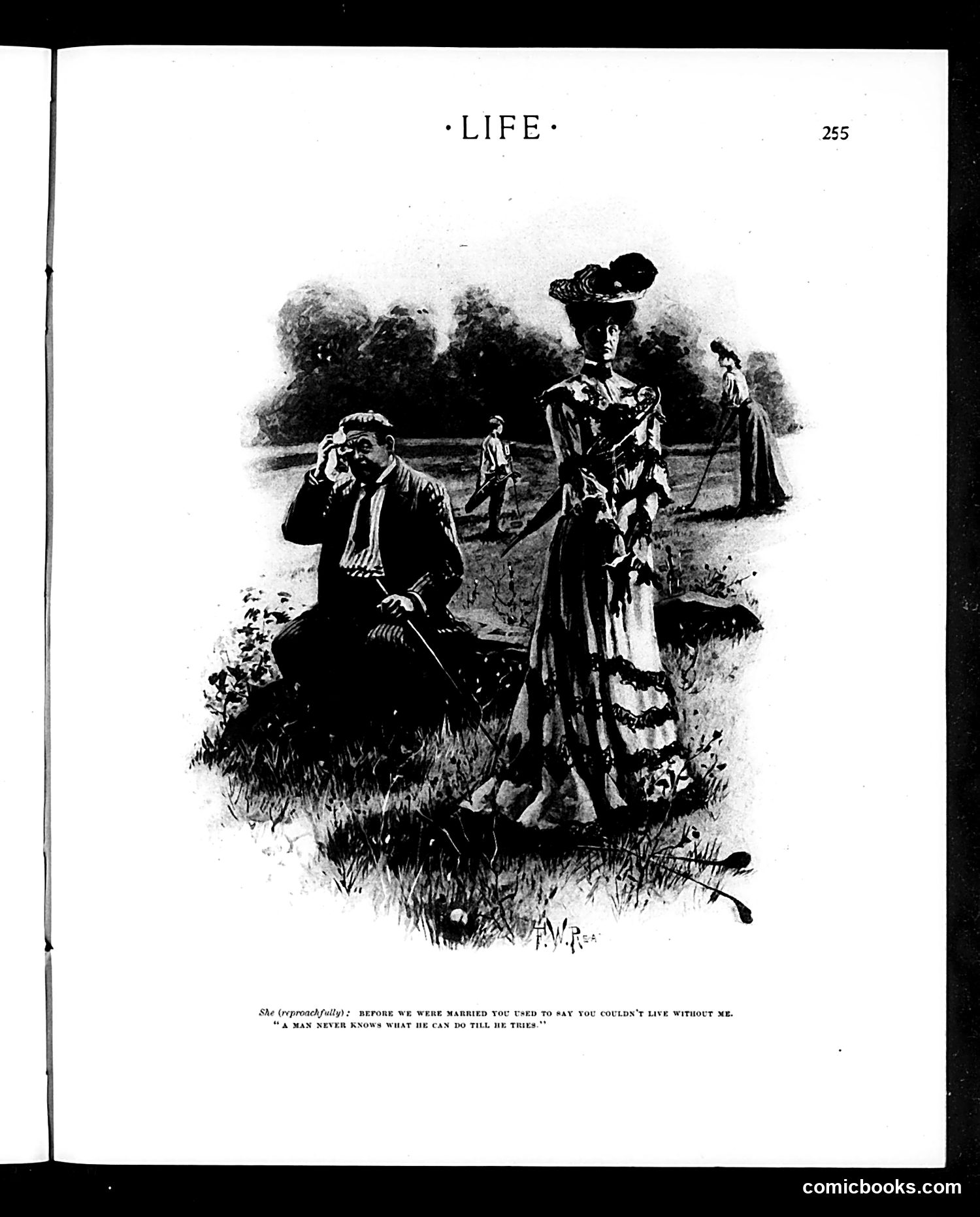
This is a romantic/domestic satire cartoon. A woman reproaches her husband in an outdoor setting, referencing his pre-marriage declarations that he "couldn't live without" her. His response—"A man never knows what he can do till he tries"—implies he's discovered he *can* live without her, contrary to his earlier professions. The joke targets the gap between courtship promises and post-marriage reality, a common satirical theme in early 20th-century Life magazine. The woman's formal dress and the pastoral setting suggest genteel middle-class domesticity. The cartoon mocks both masculine dishonesty in romance and the disillusionment that can follow marriage, resonating with readers of that era who recognized the cliché of fading marital devotion.
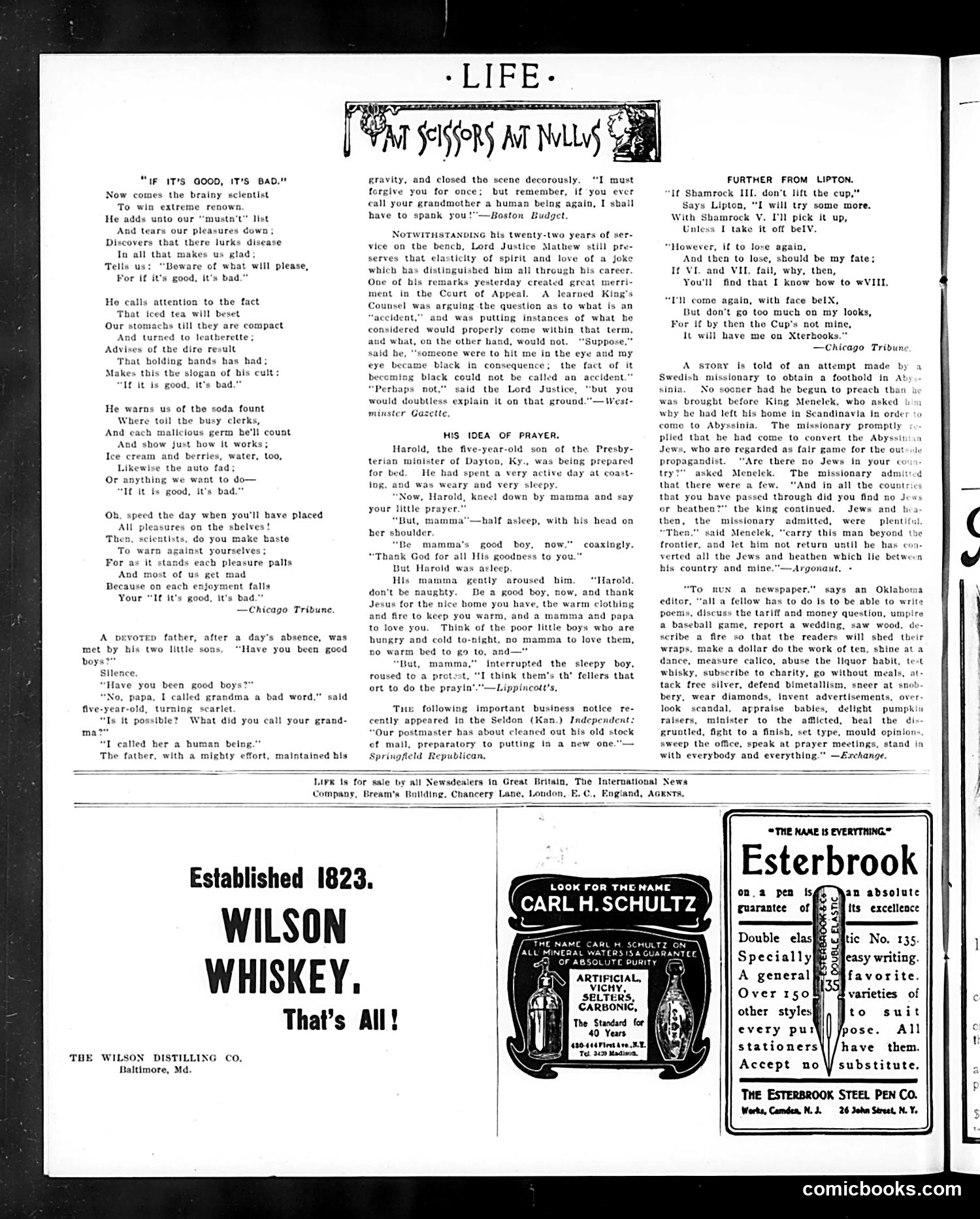
This page contains several humorous pieces satirizing early 20th-century social anxieties and authority figures. The main cartoon/poem mocks overzealous scientists and health experts who constantly warn the public that innocent pleasures—iced tea, ice cream, soda fountains, automobiles—cause disease or harm. The satire targets their contradictory messaging and the public's exasperation with constant warnings about "if it's good, it's bad." Supporting anecdotes include: - A child calling his grandmother a "human being" (dark humor about propriety) - A judge's witty remark about accidents in court - A sleepy child's logical objection to being told to pray for poor children instead of enjoying his own comforts The final piece references Sir Thomas Lipton's America's Cup yacht racing attempts, using his repeated vows to try again as running humor. The advertisements (Wilson Whiskey, Esterbrook pens) are period-appropriate filler.
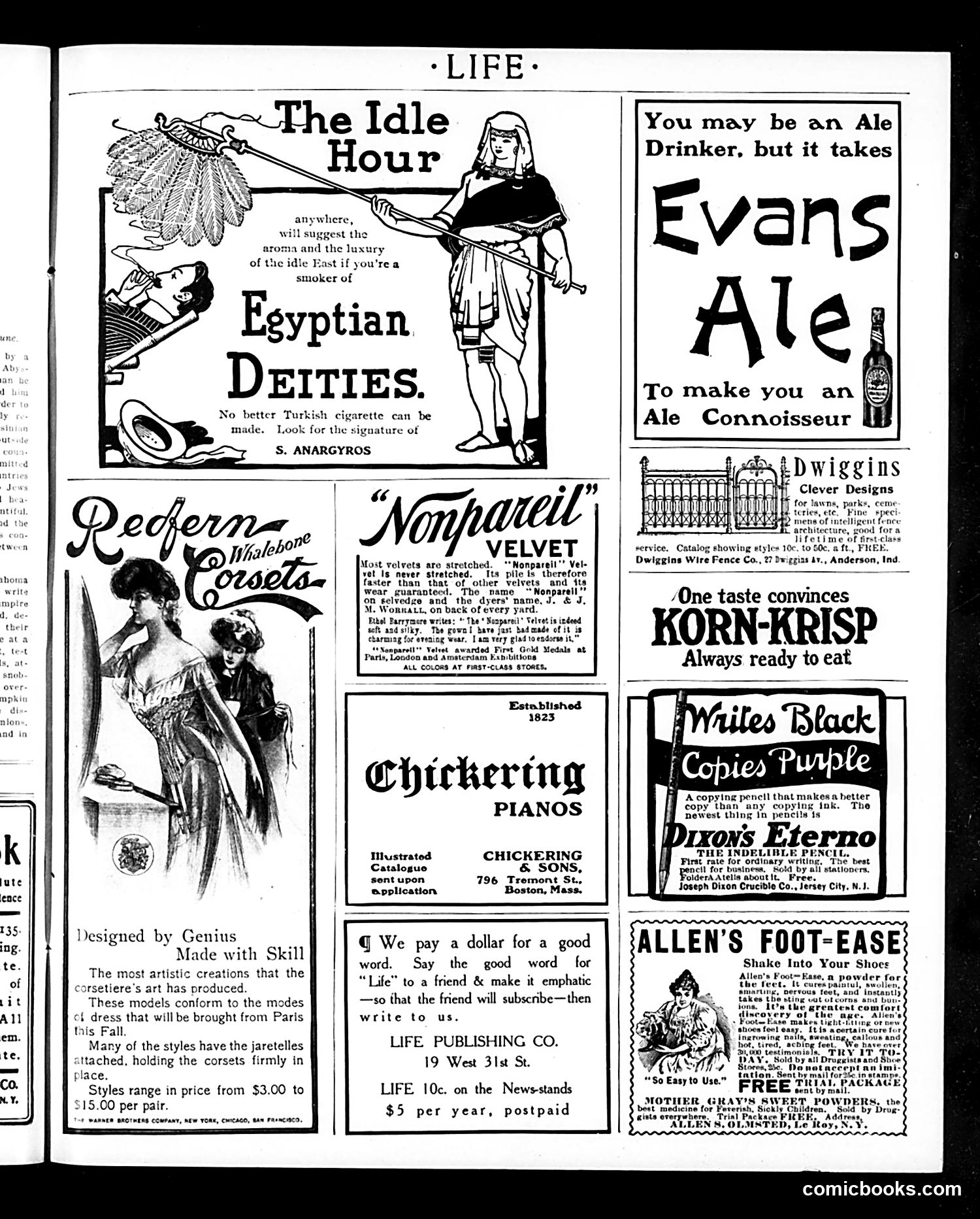
This is primarily an **advertising page** from Life magazine, not a political cartoon. The layout features various product advertisements typical of early 20th-century magazines. Notable ads include: - **Egyptian Deities cigarettes**: Turkish cigarettes marketed with Orientalist imagery - **Redfern corsets**: High-fashion corsetry designed for Paris fashion, priced $3–$15 - **Nonpareil Velvet**: Fabric endorsed by actress Ethel Barrymore - **Evans Ale**: Beer advertised as conferring sophistication ("connoisseur") - **Chickering Pianos**: Established 1823, a prestige instrument brand - **Korn-Krisp cereal**: Convenience food - **Allen's Foot-Ease powder**: Patent medicine for foot comfort The page also contains a **call for reader submissions**: Life offers payment for readers who recommend the magazine to friends, reflecting early subscription-building practices. The ads collectively reflect **consumer culture and aspirational marketing** of the era—luxury goods, fashion, and new convenience products targeting middle/upper-class readers.
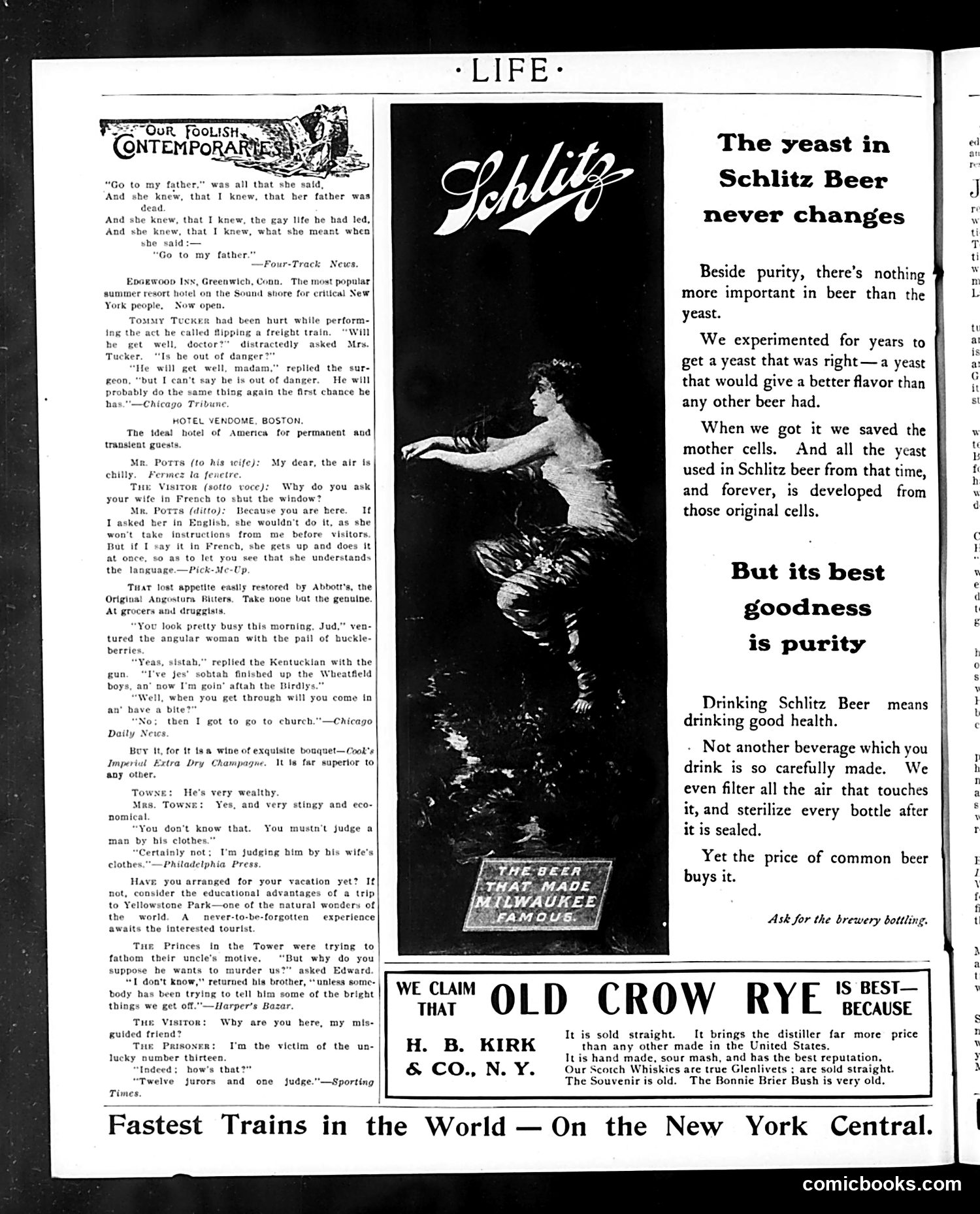
This page from *Life* magazine is primarily **advertising and humor shorts** rather than political satire. The content includes: **Humor Sections:** Brief comedic anecdotes about everyday social situations—a man injured by a train who'll "probably do the same thing again," a wife who only obeys French commands, a prisoner jailed because he was juror #13 (unlucky number). These mock human nature and social pretenses. **Main Advertisements:** - **Schlitz Beer** emphasizes purity and consistent yeast quality—a marketing appeal to health-conscious consumers - **Old Crow Rye** whiskey claims superiority as American-made - Various product endorsements (Angostura Bitters, champagne, hotels) The page reflects early 20th-century consumer culture, where *Life's* satirical humor accompanied luxury goods advertising. There is no identifiable political cartoon or caricature—rather, gentle social comedy targeting middle-class anxieties about propriety, health, and status.
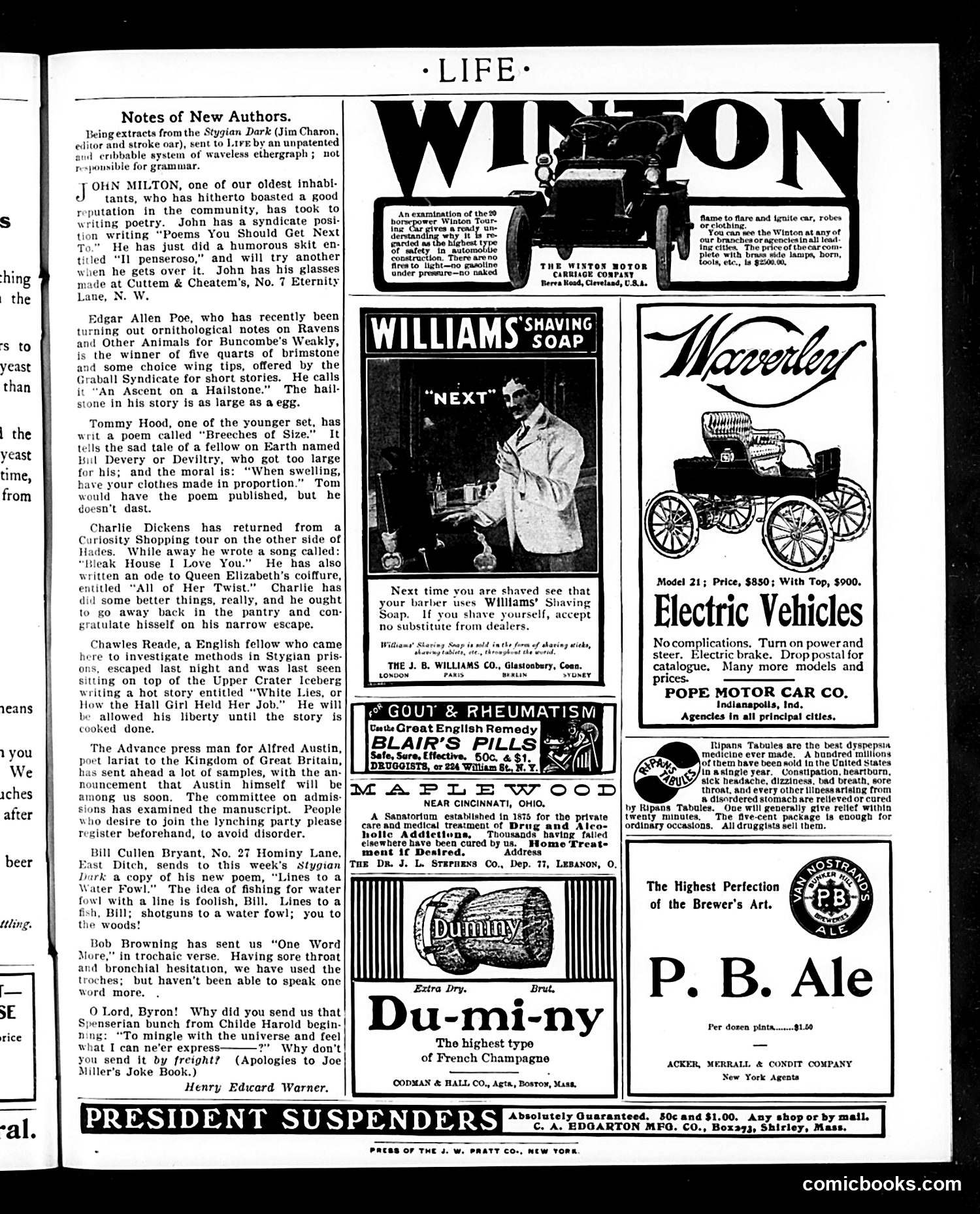
This page is primarily **advertisements and literary satire**, not political cartooning. The main content is "Notes of New Authors"—a humorous section where deceased famous writers (John Milton, Edgar Allan Poe, Charlie Dickens, Charles Reade, Alfred Austin) are satirized as if they're newly arrived in the afterlife and attempting modern writing. The jokes mock their work: Milton writes poetry badly, Poe submits ornithological notes, Dickens returns from touring Hell's curiosity shops. The satire works through **absurdist anachronism**—treating long-dead classic authors as contemporary hacks trying to break into contemporary publication markets, complete with syndicates and editors. It's gentle mockery of both the famous writers and the modern publishing industry. The remainder is period advertising for motor cars, shaving soap, patent medicines, and ale—typical early 20th-century magazine filler with no satirical content.
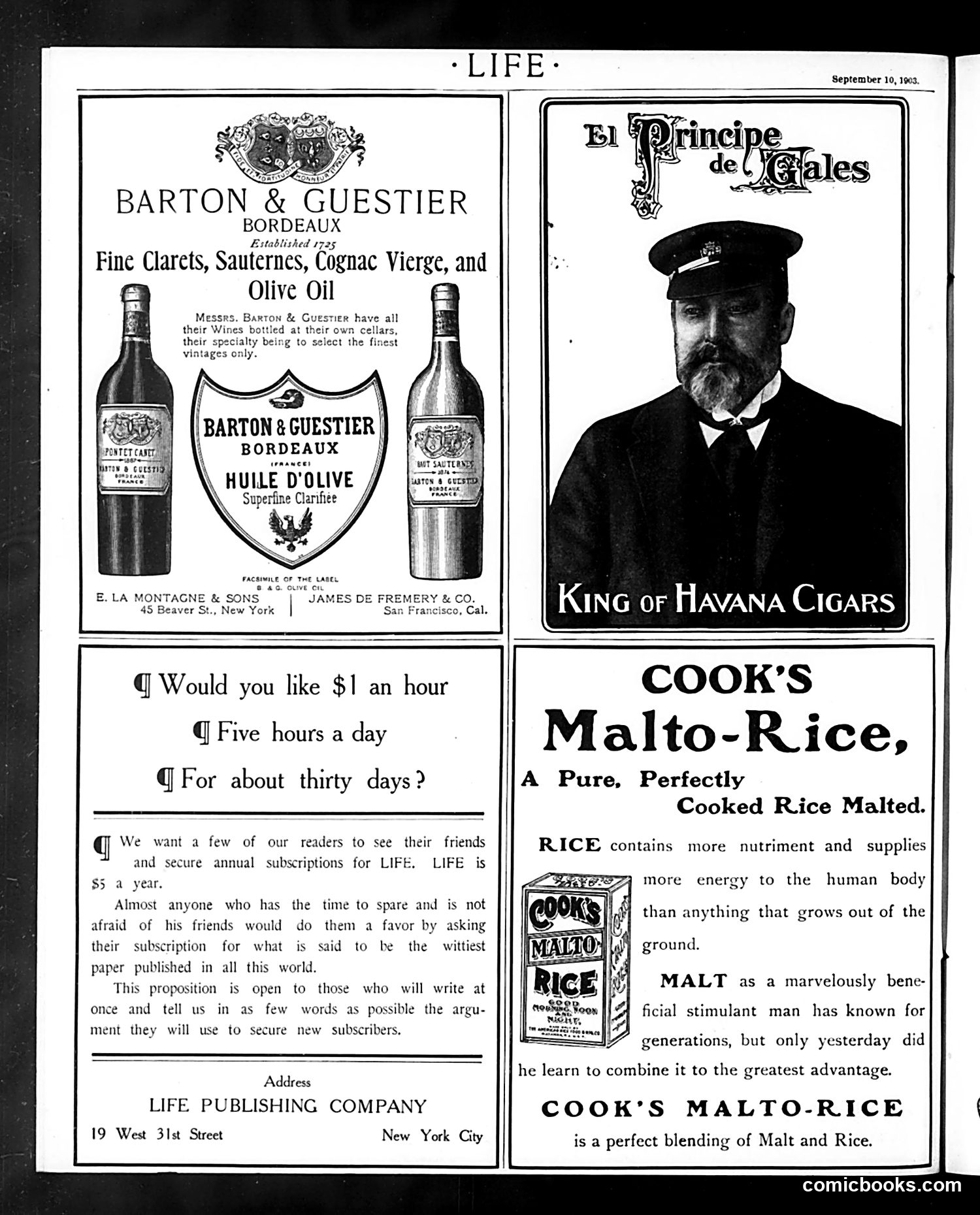
This page is primarily **advertisements**, not political satire. The ads include: 1. **Barton & Guestier** (Bordeaux wines and olive oil) — a luxury French import advertisement 2. **El Príncipe de Gales** cigars — featuring a bearded man labeled "King of Havana Cigars" 3. **Life Publishing Company subscription pitch** — offering readers $1/hour to recruit new subscribers by persuading friends the magazine is "the wittiest paper published in all this world" 4. **Cook's Malto-Rice** — a health food product claiming rice and malt provide superior nutrition and energy The subscription recruitment ad is the most noteworthy editorial content, essentially asking readers to become salesmen for a $5 annual subscription. No political figures or events are referenced; this is a commercial page typical of early 20th-century magazine publishing.