
Life, 1903-09-10 · page 12 of 20
Life — September 10, 1903 — page 12: what you’re looking at
What you’re looking at
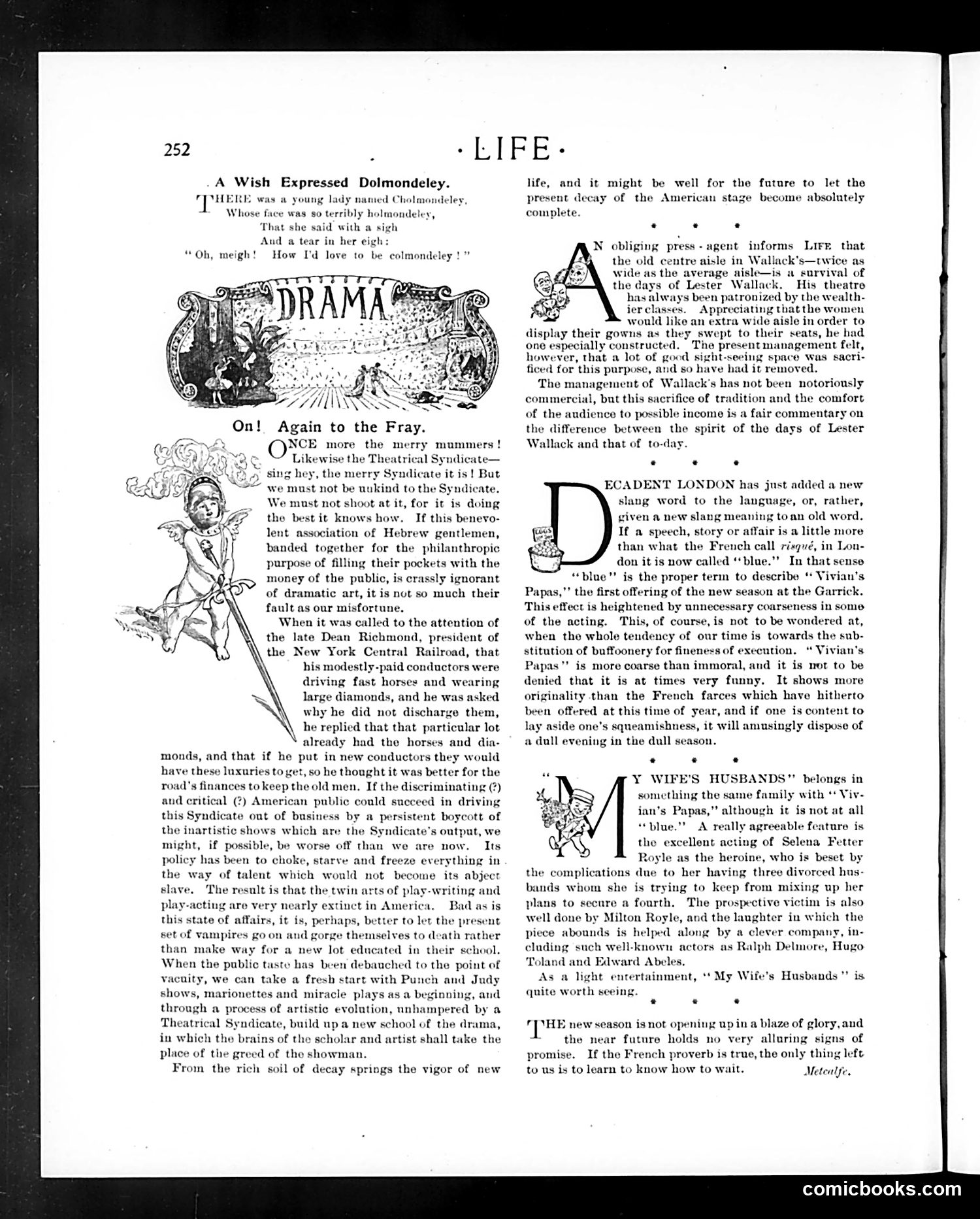
This page contains theater criticism and commentary rather than political cartoons. The main content discusses the theatrical world of the period. The section "A Wish Expressed Dolmondeley" is a brief poem about a young lady named Cholmondeley who wishes to be "colmondeley" (elegant/refined). The longer piece "On! Again to the Fray" critiques the Theatrical Syndicate's business practices, particularly regarding conductors on the New York Central Railroad who were allegedly pressured to stop patronizing syndicate theaters. The author argues this monopolistic control is damaging American theater and calls for reform through new dramatic schools and artistic evolution rather than "vampires" (exploitative producers) controlling the stage. The remaining sections review current theatrical productions including "Vivian's Papas," "My Wife's Husbands," and comment on the upcoming theater season.
📄 Transcribed text from this page (OCR, searchable)
Machine-transcribed from the original scan — historical spelling and the odd misread are preserved.
: “LIFE: A Wish Expressed Dolmondeley. TPHERE was a young lady named Cholmondeley, was so terribly holmondeley she said with a sigh Aud a tear in her eigh: “Oh, meigh! How I'd love to be colmondeley !” Again to the Fray. NCE more the merry mummers! Likewise the Theatrical Syndicate— ) sing hey, the merry Syndicate it is! But we must not be uukind to the Syndicate. We must not shoot at it, for it is doing the best it knows how. If this benevo- lent association of Hebrew gentlemen, banded together for the philanthropic purpose of filling their pockets with the money of the public crassly ignorant of dramatic art, it is not so much their fault as our misfortune, When it was called to the attention of the late Dean Richmond, president of the New York Central Railroad, that his modestly-paid conductors were driving fast horses and wi large diamonds, and he was why he did not discharge them, he replied that that particular lot already had the horses and dia- monds, and that if he put in new conductors they would have these luxuries to get, so he thought it was better for the road's fil ces tokeep the old men. If the discriminating (?) and critic: American public could succeed in driving this Syndicate out of business by a persistent boycott of the inartistic shows which are the Syndicate’s output, we might, if possible, be worse off than we are now. Its policy has been to choke, starve and freeze everything in the way of talent which would not become its abject slave, The result is that the twin arts of play-writing and play-acting are very nearly extinct in America. Bad as is this state of affairs, it is, perhaps, better to let the present set of vampires go on and gorge themselves to death rather than make way for a new lot educated in their school. When the public taste has been debauched to the point of vacuity, we can take a fresh start with Punch and Judy shows, marionettes and miracle plays as a beginnir through a process of artistic evolution, unnhampered by a Theatrical S$ , build up a new school of the drama, in which the brains of the scholar and artist shall take the place of the greed of the showman. From the rich soil of decay springs the vigor of new life, and it might be well for the future to let the present decay of the American stage become absolutely complete. . . . N obliging press-agent informs Lire that the old centre aisle in Wallack'’s—uwice as wide the average aisle—is a survival of the days of Lester Wallack. His theatre has always been patronized by the wealth- ierclasses. Appreciating thatthe women would like an extra wide aisle in order to display their gowns as they swept to their seats, he had one especially constructed. The present management felt, however, that a lot of good sight-seeing space Was sacri- 1 for this purpose, and so have had it removed. The management of Wallack’s has not been notoriously commercial, but this sacrifice of tradition and the comfort of the audience to possible income is a fair commentary on the difference between the spirit of the days of Lester Wallack and that of to-day. * . . ECADENT LONDON has just added a new slang word to the language, or, rather, given a new slang meaning toan old word. If a speech, story or affair is a little more than what the French call risqué, in Lon- don it is now called “blue.” In that sense “blue” is the proper term to describe “ Vivian's Papas,”’ the first offering of the new season at the Garrick. This effect is heightened by unnecessary coarseness in some of the acting. This, of course, is not to be wondered at, when the whole tendency of our time is towards the sub- stitution of buffoonery for fineness of execution. “ Vivian's Papas ”' is more coarse than immoral, and it is not to be denied that it is at times very funny. It shows more originality than the French farces which have hitherto been offered at this time of year, and if one is content to lay aside one's squeamishness, it will amusingly dispose of a dull evening in the dull season. Y WIFE'S HUSBANDS” belon; something the same family with * Viv- ian’s Papas,” although it is not at all ‘blue.’ A really agreeable feature is the excellent acting of Selena Fetter Royle as the heroine, who is beset by the complications due to her having three divorced hu: bands whom she is trying to keep from mixing up her plans to secure a fourth, The prospective victim is also well done by Milton Royle, and the laughter in which the piece abounds is helped along by a clever company, in- cluding such well-known actors as Ralph Delmore, Hugo Toland and Edward Abel As a light entertainment, ‘* My Wife’s Hus quite worth seeing. * . 1 [HE new season isnot opening up in a blaze of glory, and the near future holds no very alluring signs of promise. If the French proverb is true, the only thing left to us is to learn to know how to wait. Metcalfe. comicbooks.com