
A complete issue · 20 pages · 1903
Life — August 27, 1903
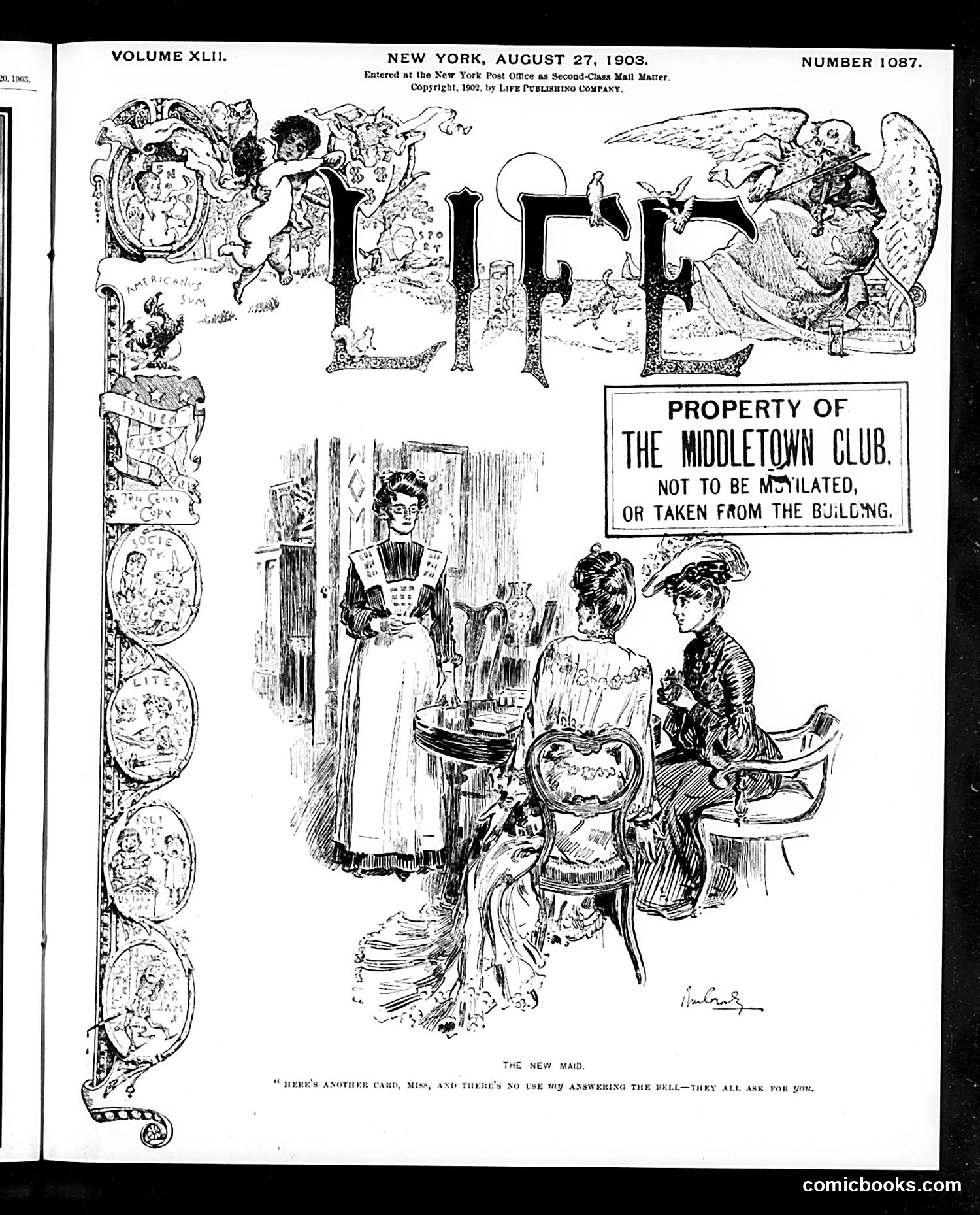
This satirical cartoon depicts a domestic scene where a new maid presents herself to her employers. The caption reads: "Here's another card, Miss, and there's no use my answering the bell—they all ask for you." The joke targets the era's common problem of maids receiving male callers or suitors. The humor lies in the maid's popularity—so many men request her by name that answering the door has become pointless. This satirizes both the maid's social freedom (surprising for the period) and the household disruption caused by domestic servants entertaining gentleman callers, a social concern of early 1900s middle-class life. The cartoon mocks both servant behavior and the implicit anxieties it provoked in employers.
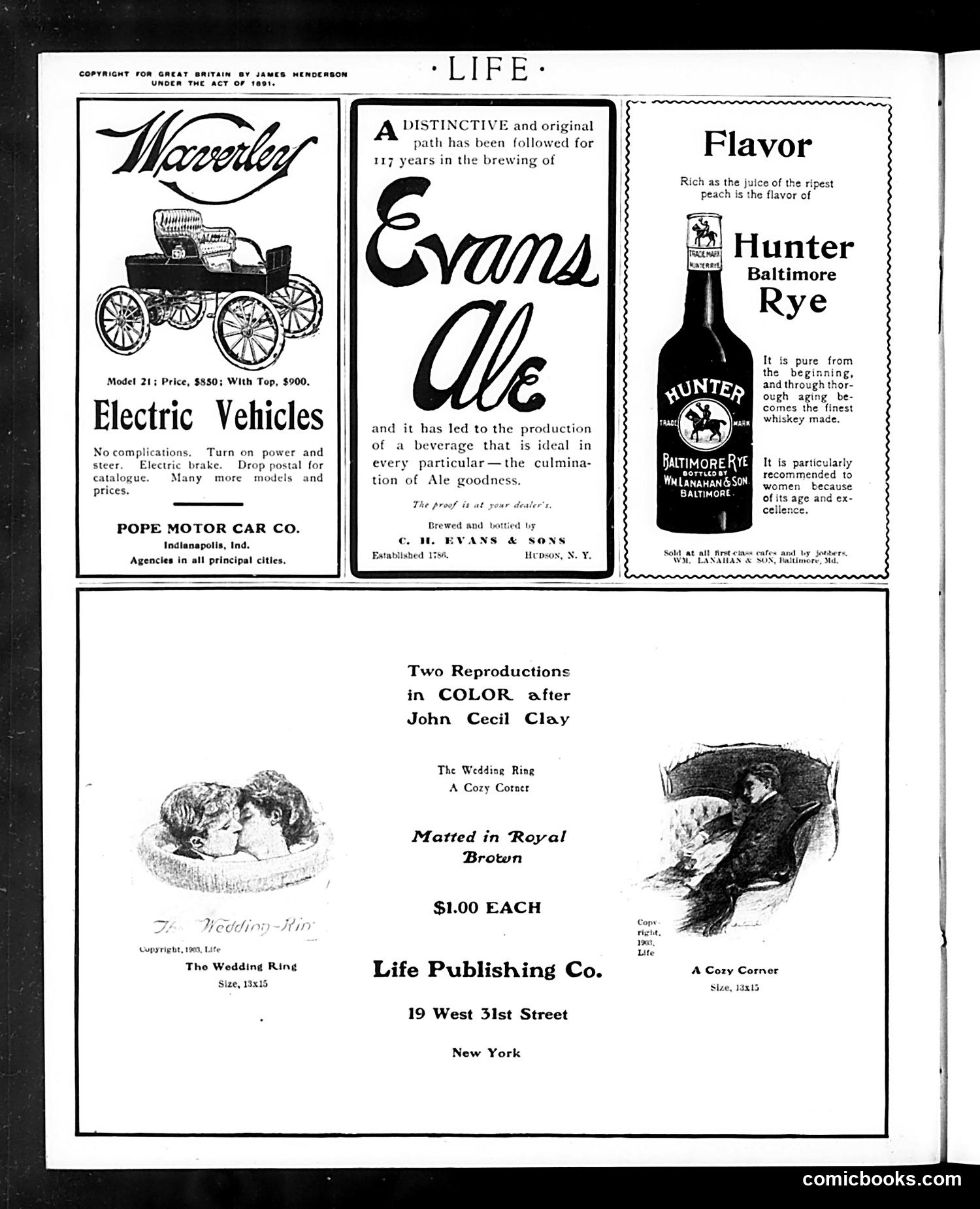
This page is **primarily advertising**, not satire or political commentary. It contains three distinct ads: 1. **Pope Motor Car Company** (top left): Advertises electric vehicles, Model 21, priced at $350 with top, $900. Emphasizes simplicity: "Turn on power and steer." 2. **Evans Ale** (top center): Promotes this beverage as an ideal drink, brewed by C.H. Evans & Sons in Hudson, New York since 1264. 3. **Hunter Baltimore Rye** (top right): Whiskey advertisement highlighting purity and aging, marketed to women for its "age and excellence." The lower section advertises **John Cecil Clay reproductions**: two color prints titled "The Wedding Ring" and "A Cozy Corner" (size 13x15), sold by Life Publishing Co. for $1 each. No political cartoons or satire appears on this page.
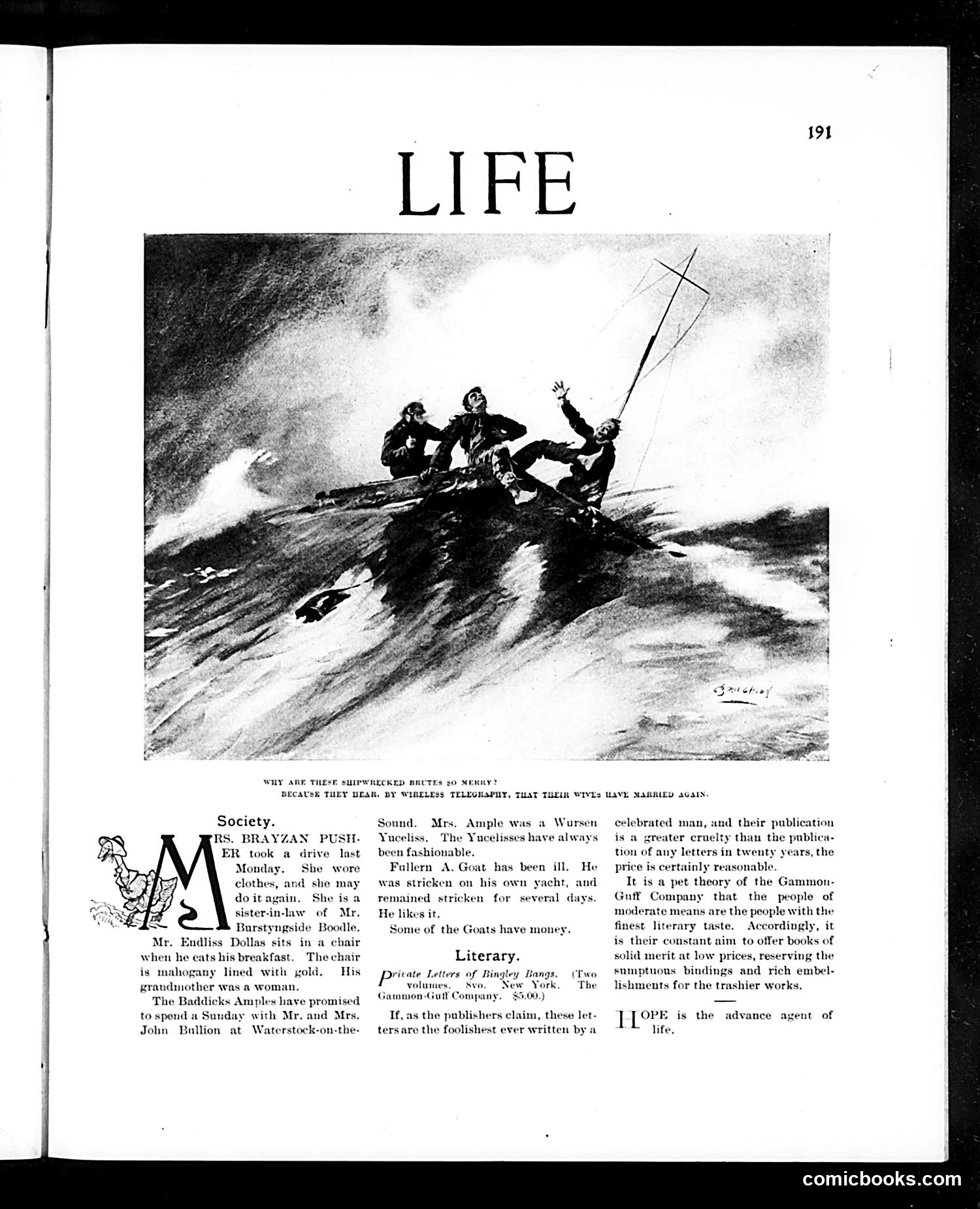
The main illustration depicts three men on what appears to be a wrecked ship or vessel during rough seas, with a cross visible. The caption reads: "WHY ARE THESE SHIPWRECKED BRUTES SO MERRY? BECAUSE THEY HEAR, BY WIRELESS TELEGRAPH, THAT THEIR WIVES HAVE MARRIED AGAIN." This is a dark humor joke about shipwrecked sailors receiving news via wireless telegraph (a novel technology at the time) that their wives have remarried, which the cartoon suggests makes them happy. The satire likely mocks both marital unhappiness and the absurdity of receiving such personal news through new technology during a disaster. The page also contains society gossip and a literary review section below, typical of Life magazine's satirical content.
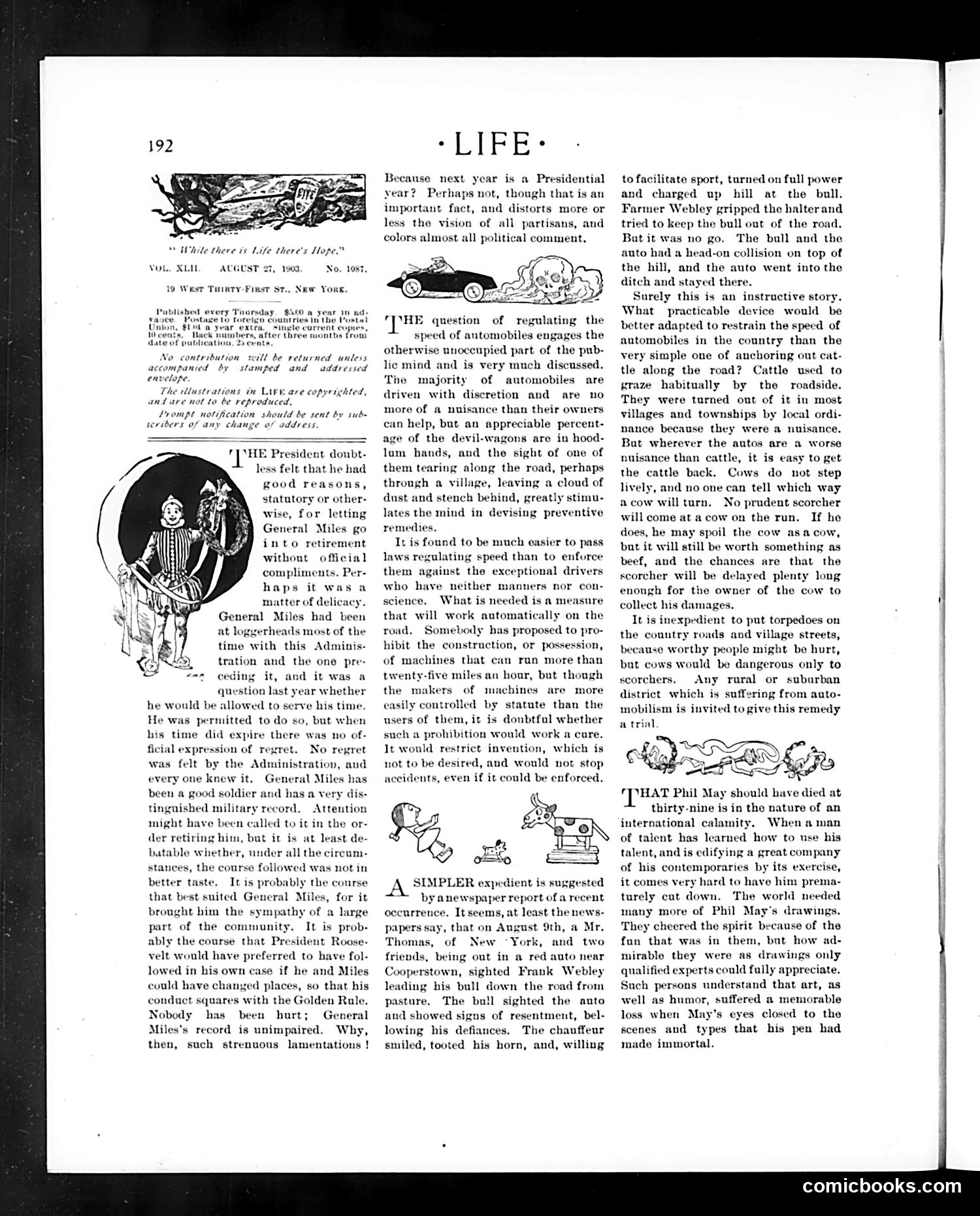
The page contains editorial commentary rather than a political cartoon. The main illustration shows a figure in formal dress (circular inset, left side), likely a government official, though the OCR'd text doesn't identify them clearly. The text discusses automobile speed regulation—a contemporary public safety concern. It references General Miles' retirement and mentions an August 9th incident involving a man named Thomas, two friends, a red auto, and a bull near Georgetown. The auto allegedly struck the bull, which then collided with a ditch. The satire criticizes both reckless drivers and impractical speed-limit solutions. It argues that restricting automobiles to 25 mph wouldn't prevent accidents or change driver behavior—restriction would fail where enforcement does. The piece reflects early 1900s anxieties about automobiles as public hazards.
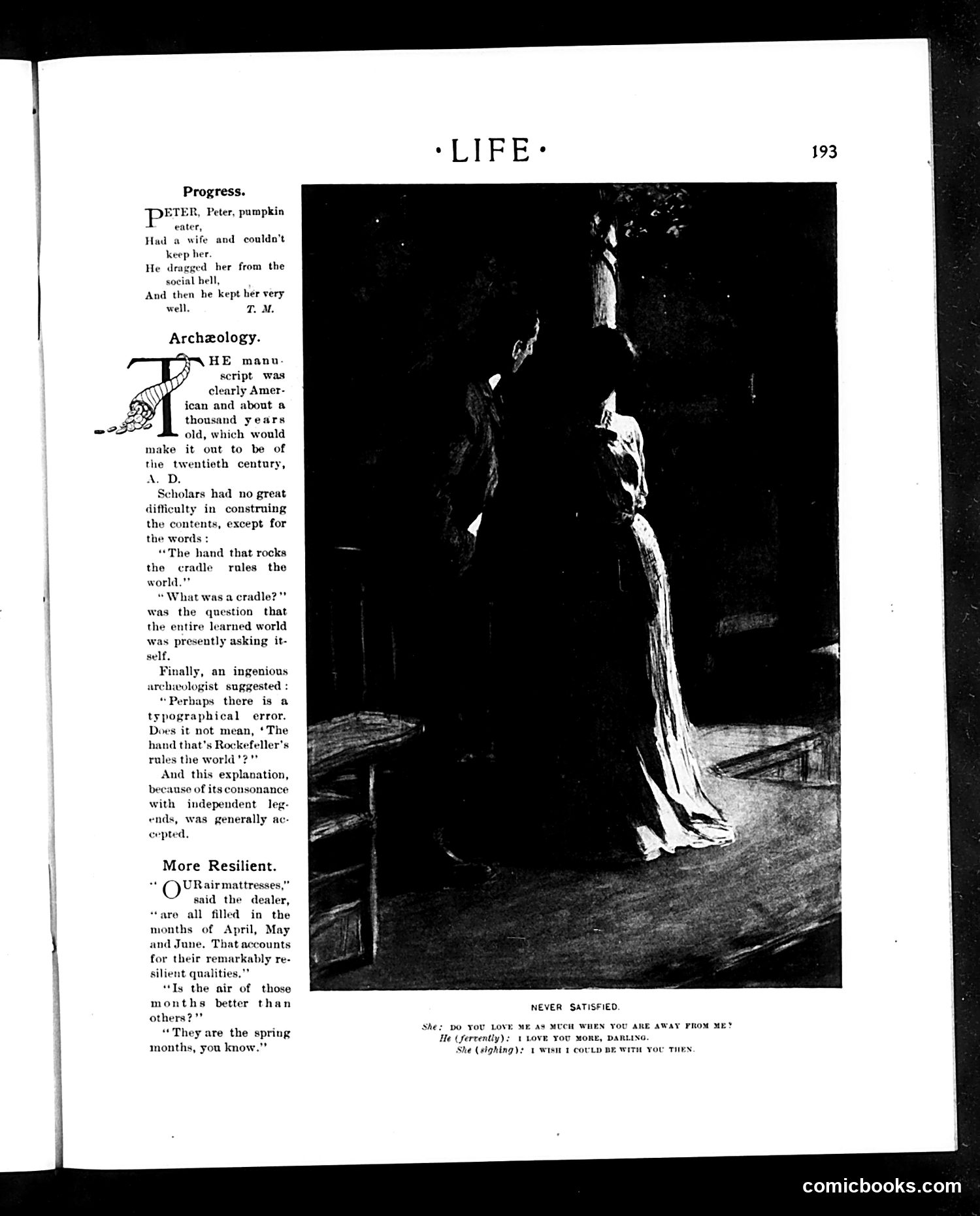
This page contains three unrelated satirical pieces: **"Progress"** jokes about Peter, a pumpkin-eater who couldn't keep his wife and dragged her from social events—then kept her "very well" (suggesting imprisonment). **"Archaeology"** mocks scholarly debate over an ancient American manuscript dated to 1000 A.D. The learned world argued about "what was a cradle?" until an archaeologist suggested a typographical error: "The hand that *rockefeller's* rules the world" (not "rocks the cradle"). This satirizes both academic pedantry and the Rockefeller family's enormous wealth and influence in early 20th-century America. **"More Resilient"** discusses air-filled mattresses' seasonal resilience, comparing spring months' superior air quality—light satirical commentary on product marketing. The page's dominant image shows a dramatic scene with emotional dialogue about love and separation, though context is unclear.
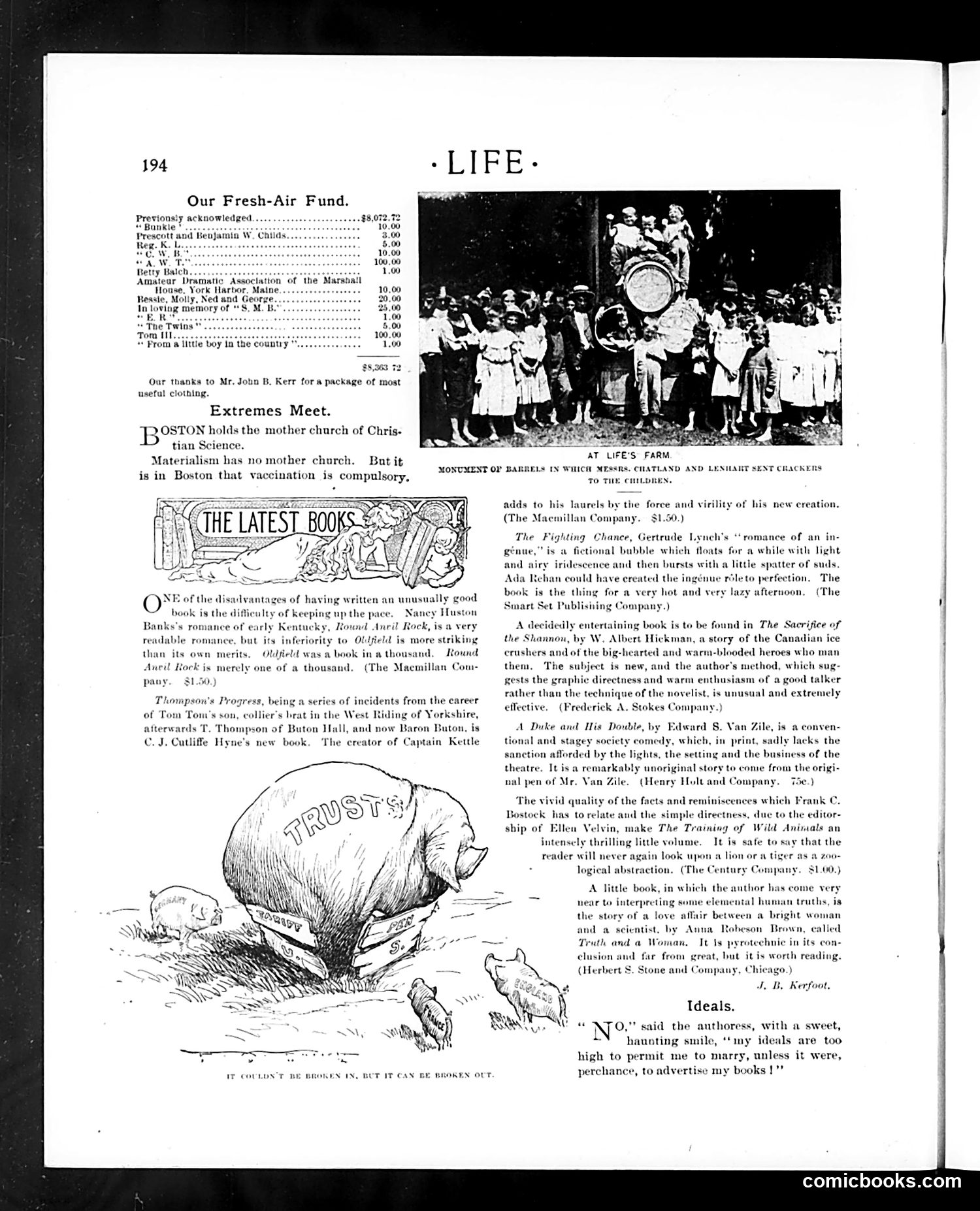
The main cartoon on this page shows a large bag labeled "TRUST" surrounded by smaller bags labeled "GRAFT" and "BOODLE." The caption reads: "IT COULDN'T BE BROKEN IN, BUT IT CAN BE BROKEN OUT." This is **anti-monopoly/anti-corruption satire** targeting the large industrial trusts that dominated early 20th-century American business. The imagery suggests that while these corrupt financial structures ("trusts") cannot be trained or reformed through regulation ("broken in"), they *can* be broken apart through legal action or public pressure ("broken out"). This reflects the Progressive Era's major political concern: breaking up monopolies and eliminating corporate corruption. The anthropomorphized bags personify abstract financial wrongdoing, making the complex issue of industrial monopolies accessible through visual humor.
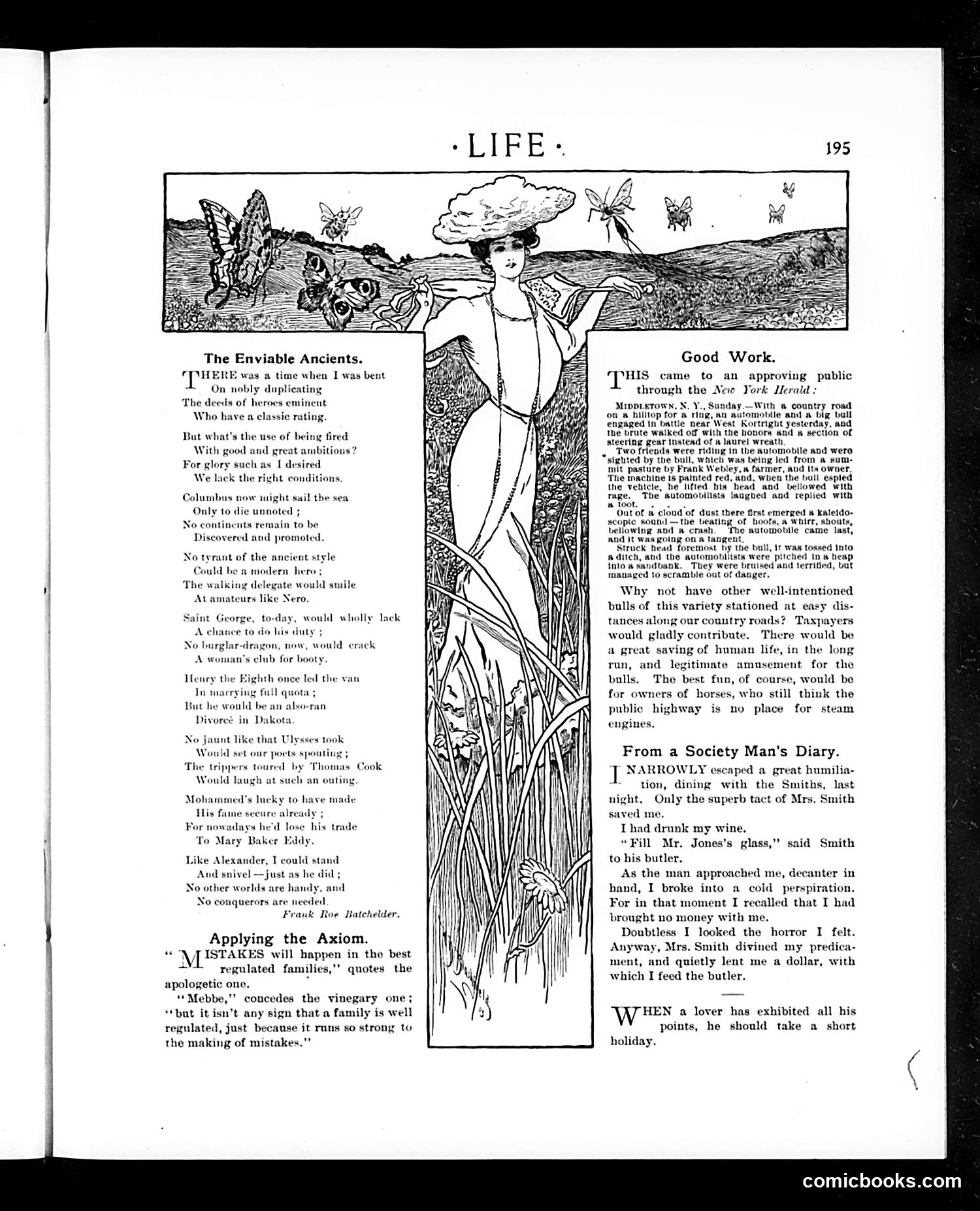
This page contains three separate satirical pieces: 1. **"The Enviable Ancients"** (left): A poem mocking nostalgia for classical heroism. It argues that ancient heroes like Ulysses and Saint George achieved fame through dangerous deeds, while modern achievements lack such glory. The satire suggests contemporary society lacks the conditions for true heroism. 2. **"Good Work"** (right): A humorous anecdote about an automobile accident on a country road involving a bull. The piece mocks the suggestion that steam-powered "safety bulls" be stationed along roads—satirizing impractical technological solutions and liability concerns. 3. **"From a Society Man's Diary"** and **"Applying the Axiom"**: Brief satirical observations about social embarrassment and family regulation, typical of Life's commentary on upper-class manners. The central illustration depicts a fashionable woman surrounded by nature and insects.
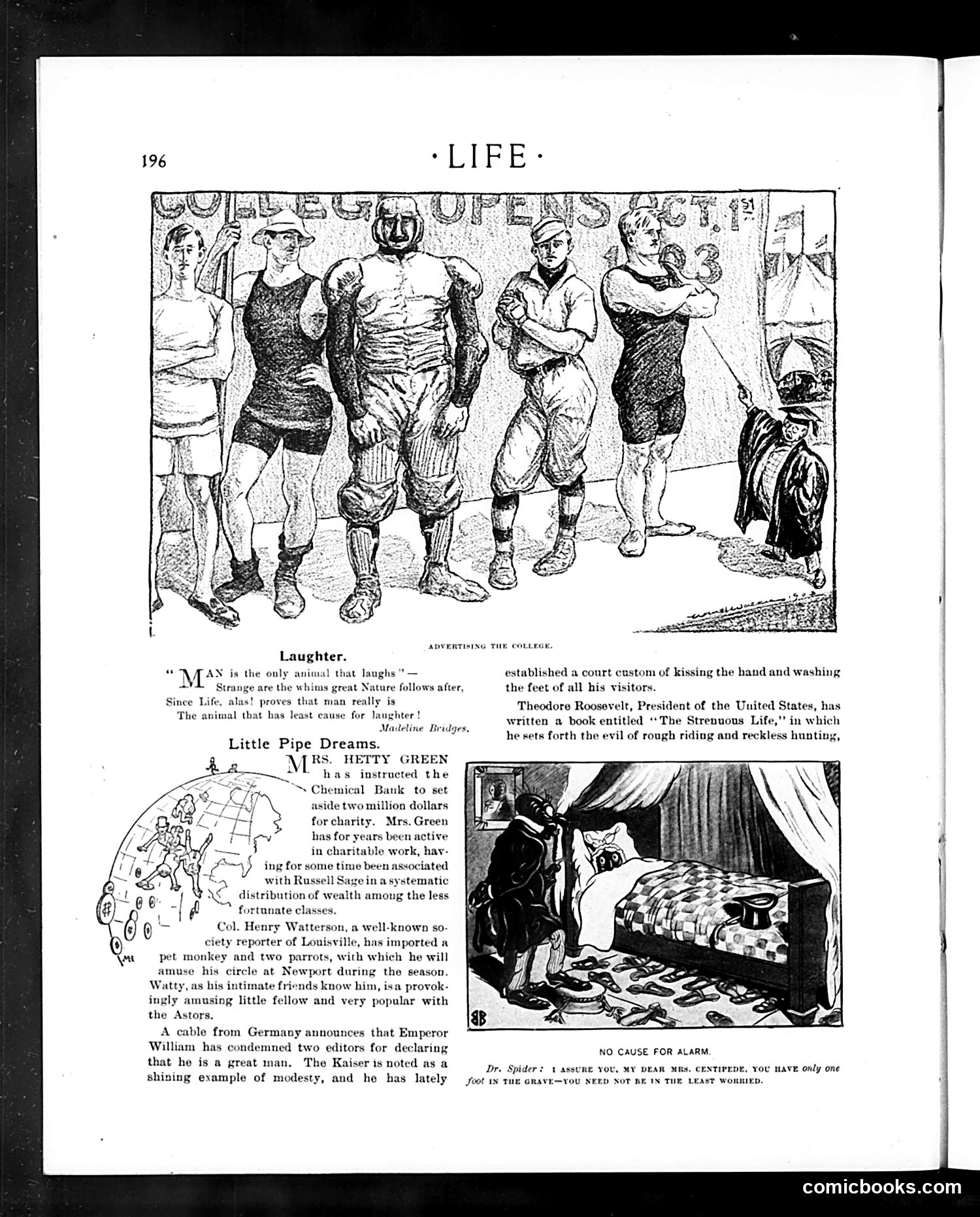
**Top Cartoon ("Advertising the College"):** Depicts various athletes in different sports uniforms standing together. The satire appears to target college athletics recruitment and commercialization—suggesting colleges "advertise" themselves through sports programs rather than academics. **"Laughter" Section:** Opens with a quote attributing laughter uniquely to humans, then discusses Theodore Roosevelt's book on hunting. The humor seems to critique Roosevelt's promotion of "rough riding" and hunting as manly pursuits. **"Little Pipe Dreams":** Features a globe illustration with Mrs. Hetty Green, a wealthy philanthropist, planning charitable distribution of two million dollars—satirizing wealth concentration and token charitable gestures. **"No Cause for Alarm":** A doctor reassures a worried patient about being buried, making dark humor about mortality.
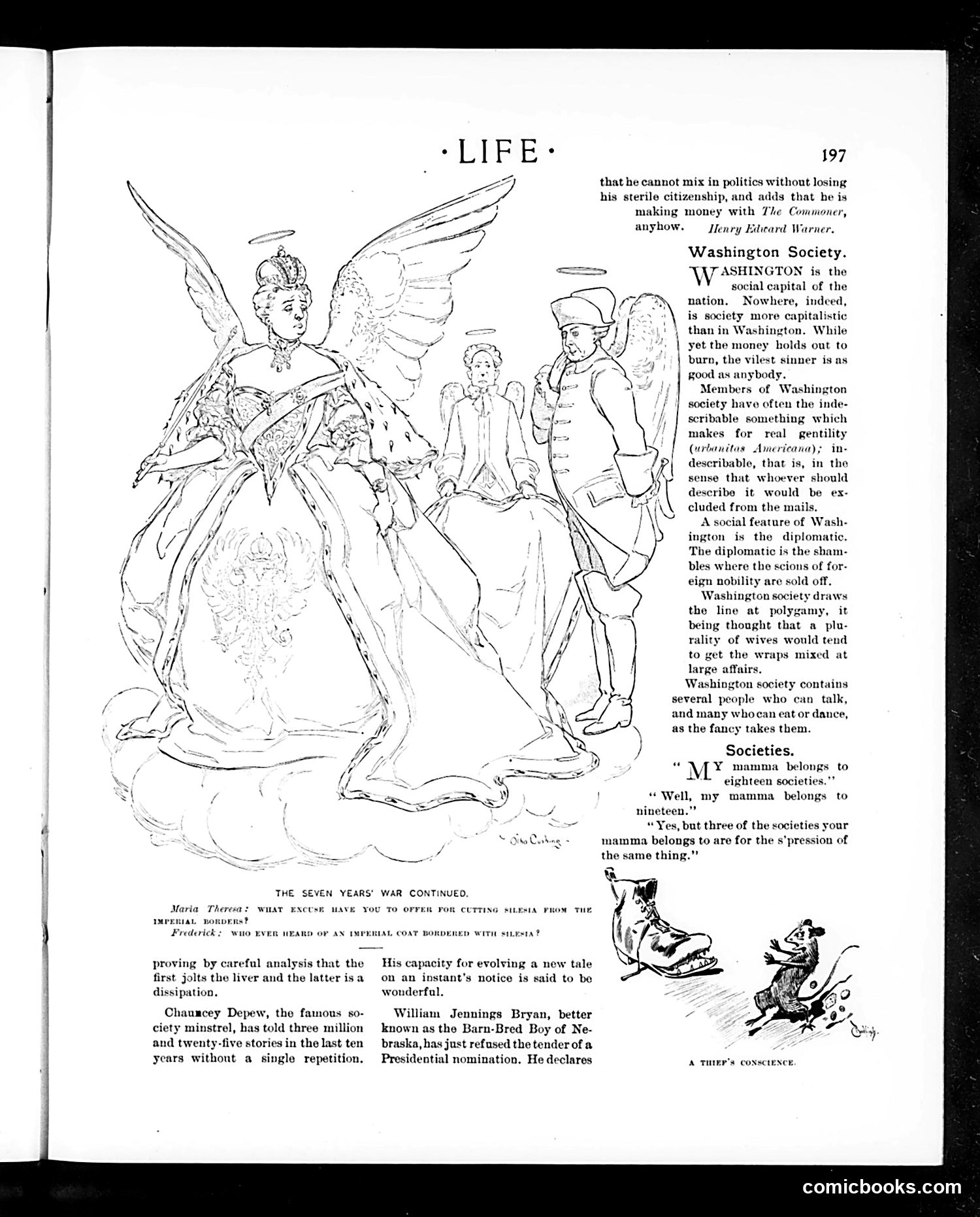
The main illustration depicts an angel (representing American virtue or patriotism) surrounded by smaller figures, titled "THE SEVEN YEARS' WAR CONTINUED." The dialogue references a dispute over silesia—a historical European territory—suggesting this satirizes ongoing American political conflicts being compared to prolonged international wars. The text section "Washington Society" mocks the capital's elite social circles, describing their insularity and pretension. It notes their polygamous social mixing and ridicules the diplomatic corps as a venue where foreign nobility "sell themselves off." The "Societies" dialogue jokes about mothers belonging to numerous social organizations, implying either excessive club membership or satirizing women's social climbing. The small cartoon captioned "A THIEF'S CONSCIENCE" shows an animal, likely symbolizing dishonesty or crime.
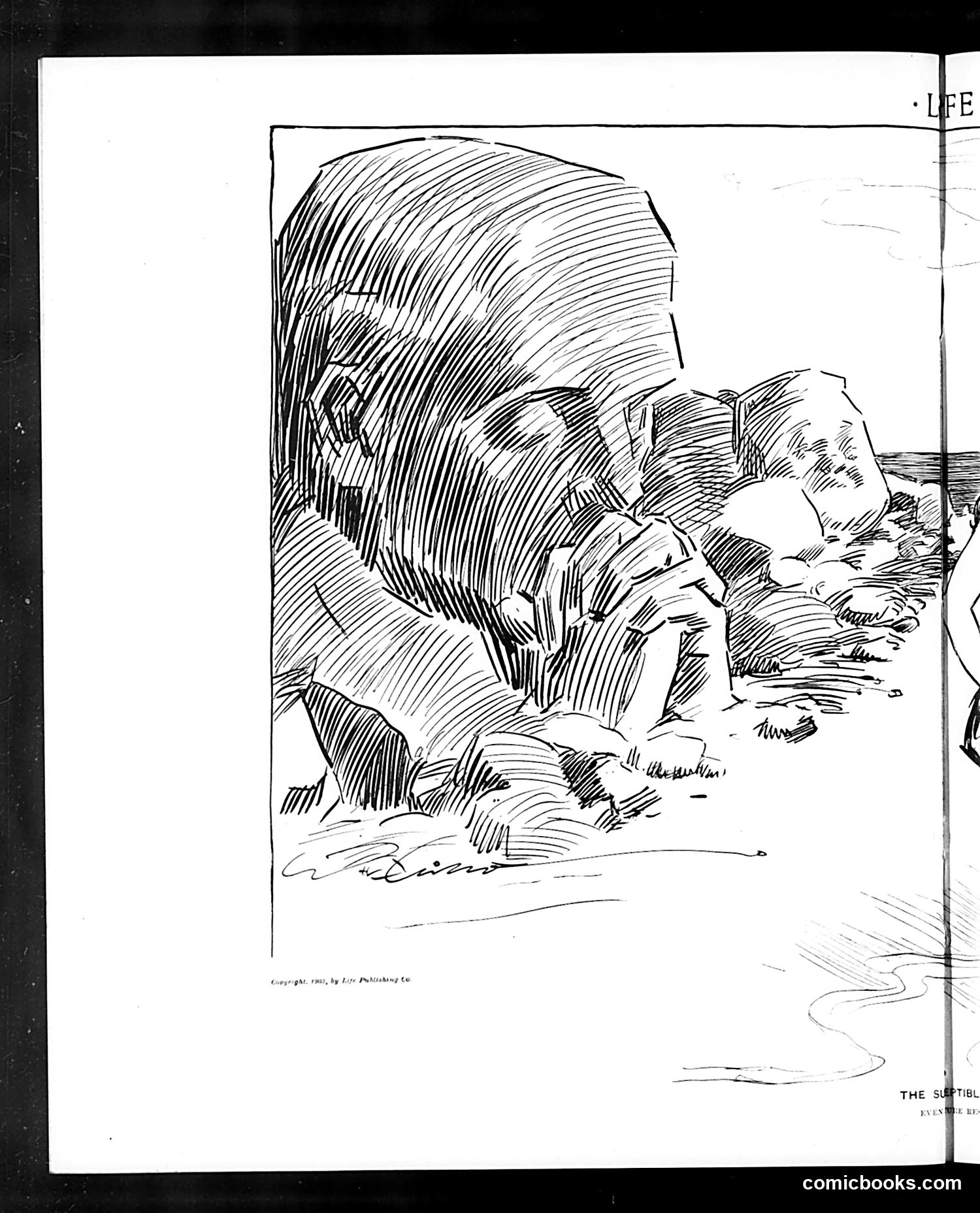
This page appears to be from *Life* magazine and shows a sketch of what looks like a large, rounded figure hunched over or bent down among rocks or boulders. The drawing style uses heavy cross-hatching and linear marks typical of early-to-mid 20th century satirical illustration. However, without legible text identifying the subject, the specific political or social reference is unclear from this image alone. The OCR text provided doesn't contain readable caption or explanatory material that would clarify who is being caricatured or what event or issue the cartoon addresses. To accurately explain this cartoon's meaning to a modern reader, I would need either: clearer visible text on the page itself, or confirmation of the publication date and issue, which would provide necessary historical context.
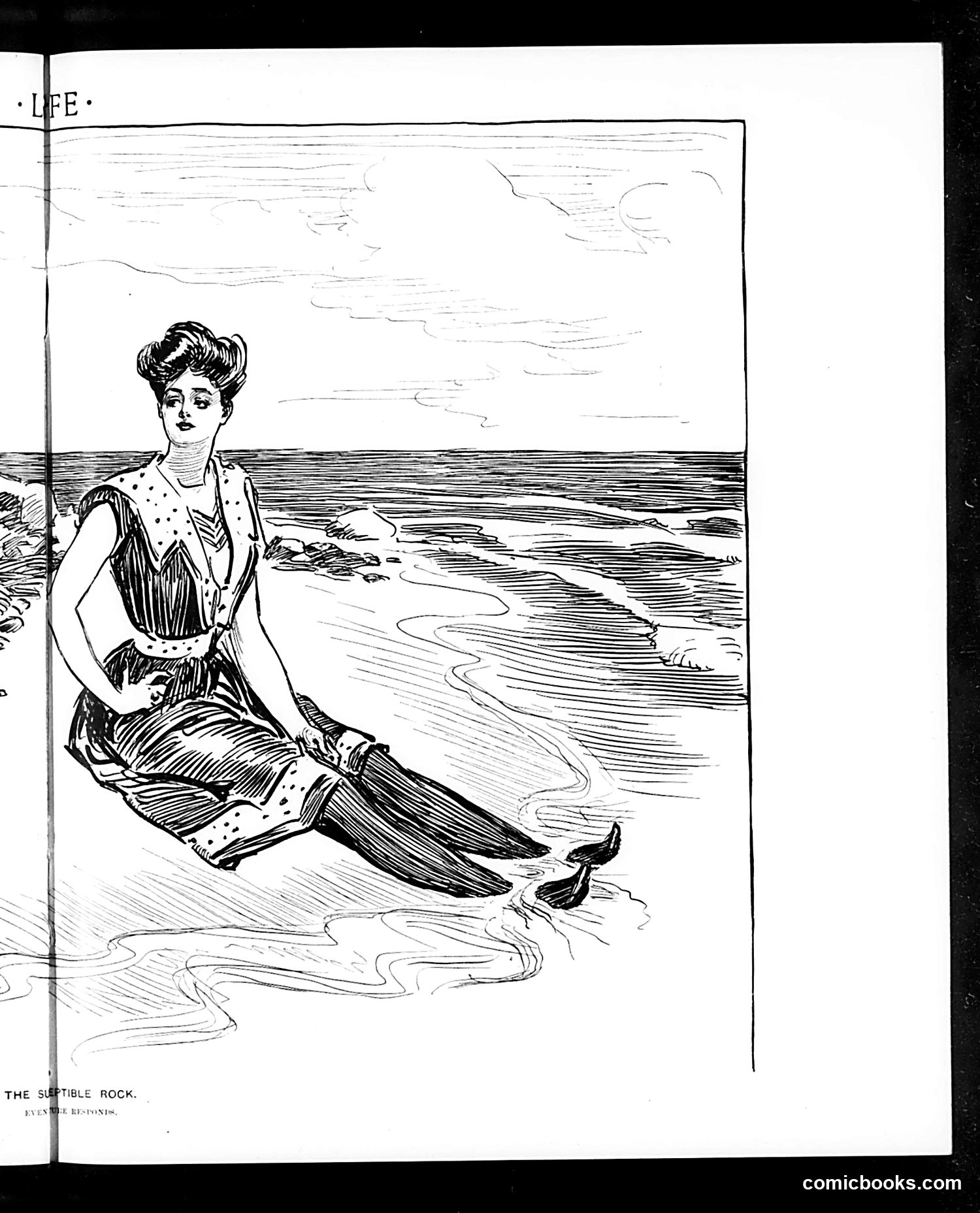
This illustration from *Life* magazine depicts a fashionably dressed Edwardian-era woman in an elaborate dress and upswept hairstyle, sitting on rocks by the seashore. The title "The Susceptible Rock" appears to be a humorous double entendre—playing on the word "susceptible" to suggest both geological softness and romantic vulnerability. The cartoon likely satirizes either romantic sentimentality, the vulnerability of women, or perhaps the erosive effects of feminine attention on masculine resolve (the "rock" representing a man's emotional fortitude). The beach setting and woman's relaxed, contemplative pose emphasize themes of leisure and romance typical of early-20th-century satirical humor targeting upper-class social dynamics and courtship rituals.
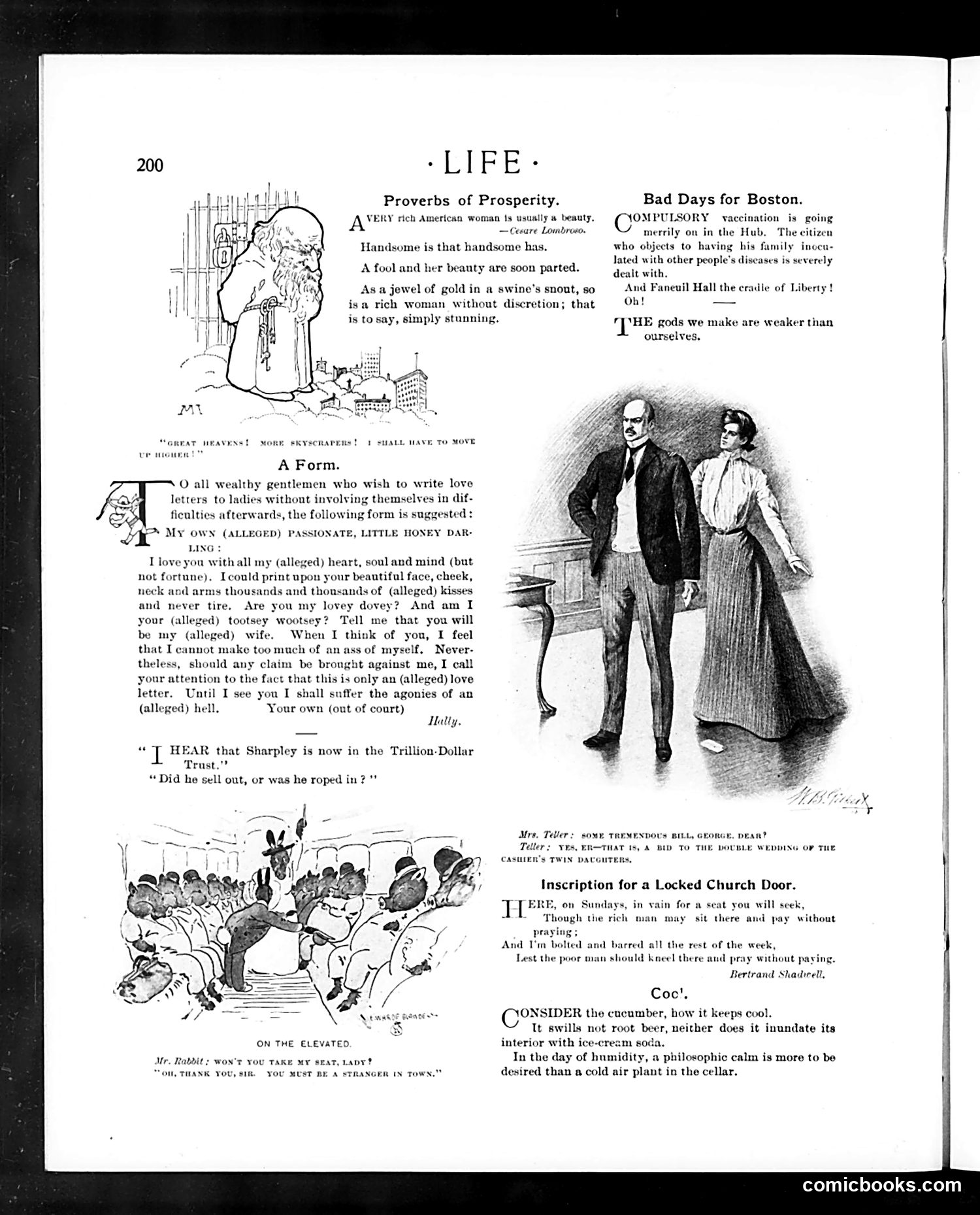
This page contains several satirical pieces typical of early Life magazine: **"Proverbs of Prosperity"** mocks wealthy women's vanity with cynical observations about beauty and status. **"A Form"** parodies overwrought romantic love letters from wealthy gentlemen, using excessive "(alleged)" qualifiers to suggest insincere flattery—satire on hypocritical courtship among the rich. **"Bad Days for Boston"** appears to criticize Boston's moral standards, likely referencing social disease and family shame. **"On the Elevated"** cartoon jokes about crowded subway conditions and class interactions. **"Inscription for a Locked Church Door"** sarcastically critiques wealthy churchgoers who pay for pews while excluding the poor from worship. **"Coc'"** humorously compares cucumbers' cooling properties to air conditioning—seemingly light domestic humor. The overall tone targets wealthy hypocrisy, class inequality, and urban social problems of the era.
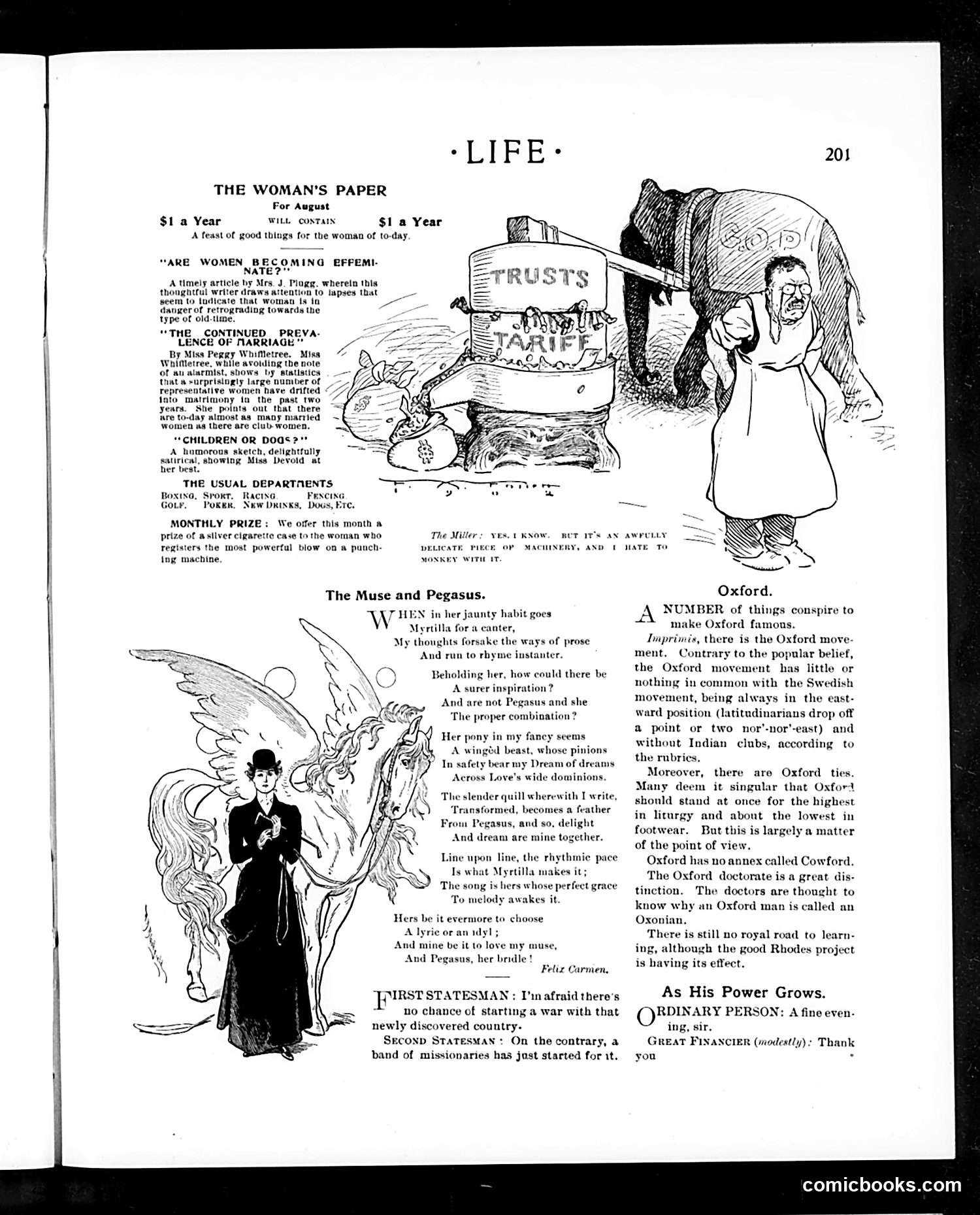
This page from *Life* magazine combines satirical commentary with humor typical of early 20th-century American journalism. **"The Woman's Paper"** section advertises a fictional women's magazine, satirizing contemporary feminist debates. Articles mock concerns about "women becoming effeminate" and document "the continued prevalence of marriage"—suggesting irony about women's changing social roles. The monthly prize (powerful punch on a machine) mocks both women's physical capabilities and commercialized femininity. **"The Muse and Pegasus"** is romantic poetry celebrating a woman named Myrtilla, presented in conventional sentimental style. **The statesman cartoon** satirizes colonial imperialism: two politicians discuss war prospects with an undiscovered country, then realize missionaries will solve the problem (implying missionaries create conflict justifying military intervention). **"Oxford"** pokes fun at Oxford University's pretensions—its liturgical importance contrasted with poor footwear standards, and the newly prestigious Rhodes Scholarship project. **"As His Power Grows"** suggests a wealthy financier's growing arrogance through casual rudeness to ordinary people.
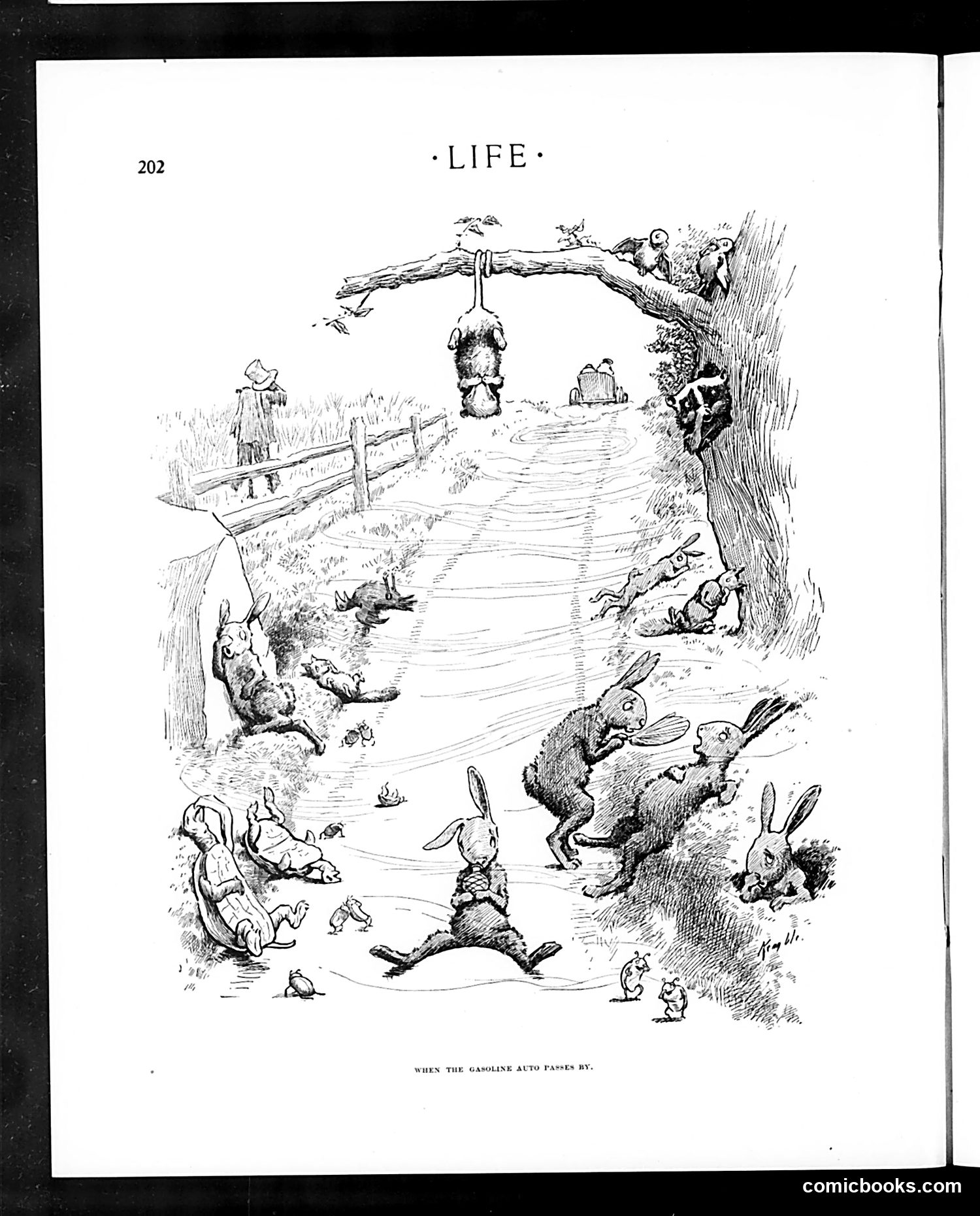
This is a satirical cartoon from *Life* magazine (page 202) titled "When the Gasoline Auto Passes By." The image depicts anthropomorphized rabbits and other animals scattering in panic along a rural road as an automobile approaches. A figure hangs from a tree branch above, and various creatures flee in disarray. The satire targets early automobile culture and its disruptive impact on rural life. The gasoline-powered car—a relatively new technology at the time—is portrayed as a chaotic threat to pastoral tranquility, causing widespread alarm among innocent creatures and country folk. The cartoon likely mocks both the automobile's environmental and social disruption and the exaggerated fears some held about this emerging transportation technology invading traditional countryside existence.
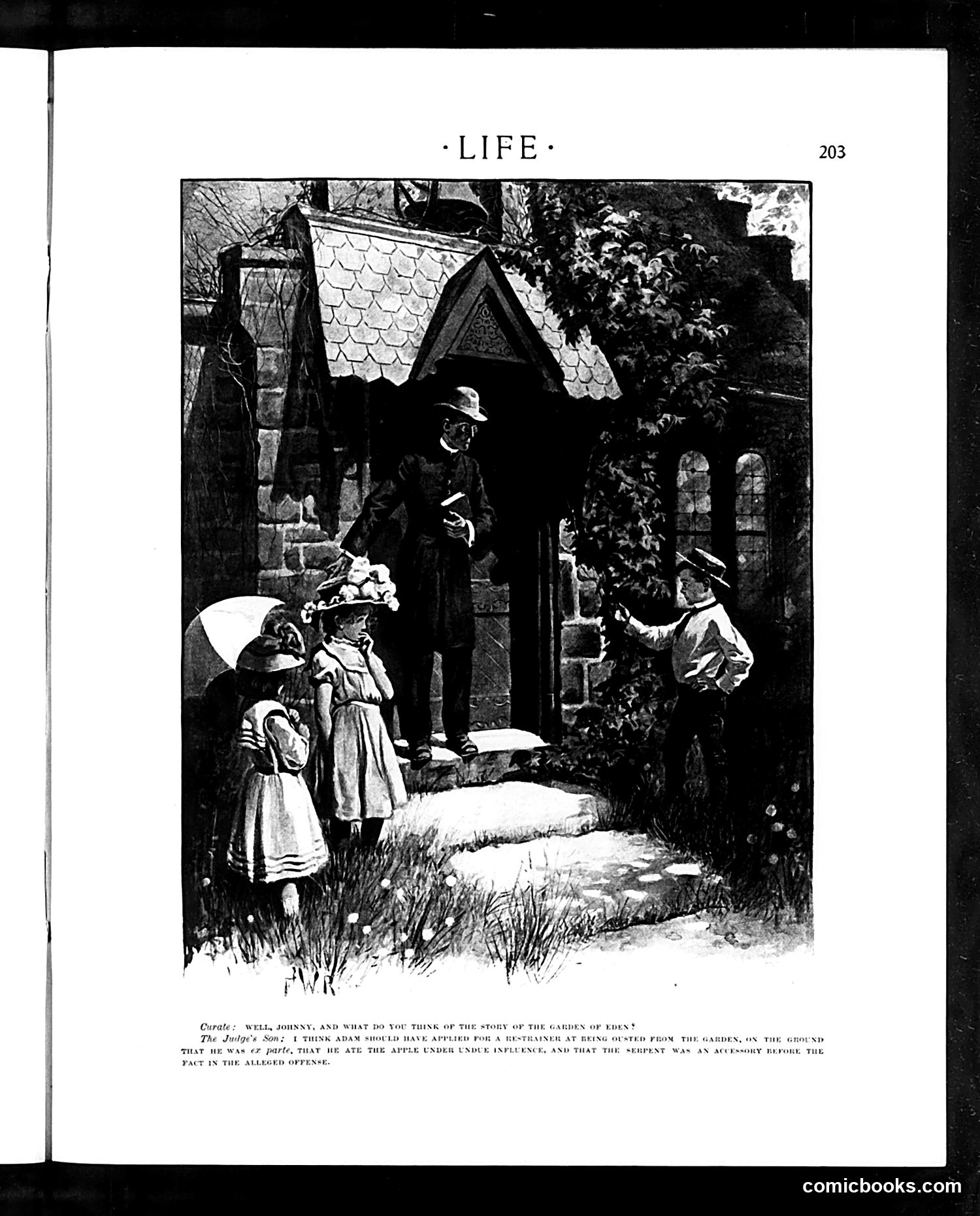
This illustration depicts a courtroom scene reimagining the Biblical Garden of Eden story as a legal proceeding. A judge presides over what appears to be a trial concerning Adam eating the forbidden apple. The satirical premise—indicated by the caption mentioning "The Judge's Son"—suggests that a judge's son is defending himself by claiming Adam should have been "sustained" (legally protected) from being "ousted from the garden" because he ate the apple "under undue influence," with the serpent as an "accomplice before the fact." The cartoon mocks the legal system's tendency to use technical legal arguments and loopholes to excuse moral wrongdoing. By applying modern courtroom procedure to humanity's original sin, Life ridicules how elaborate legal defenses can obscure simple guilt, particularly when powerful or connected people are involved (hence "the Judge's Son").
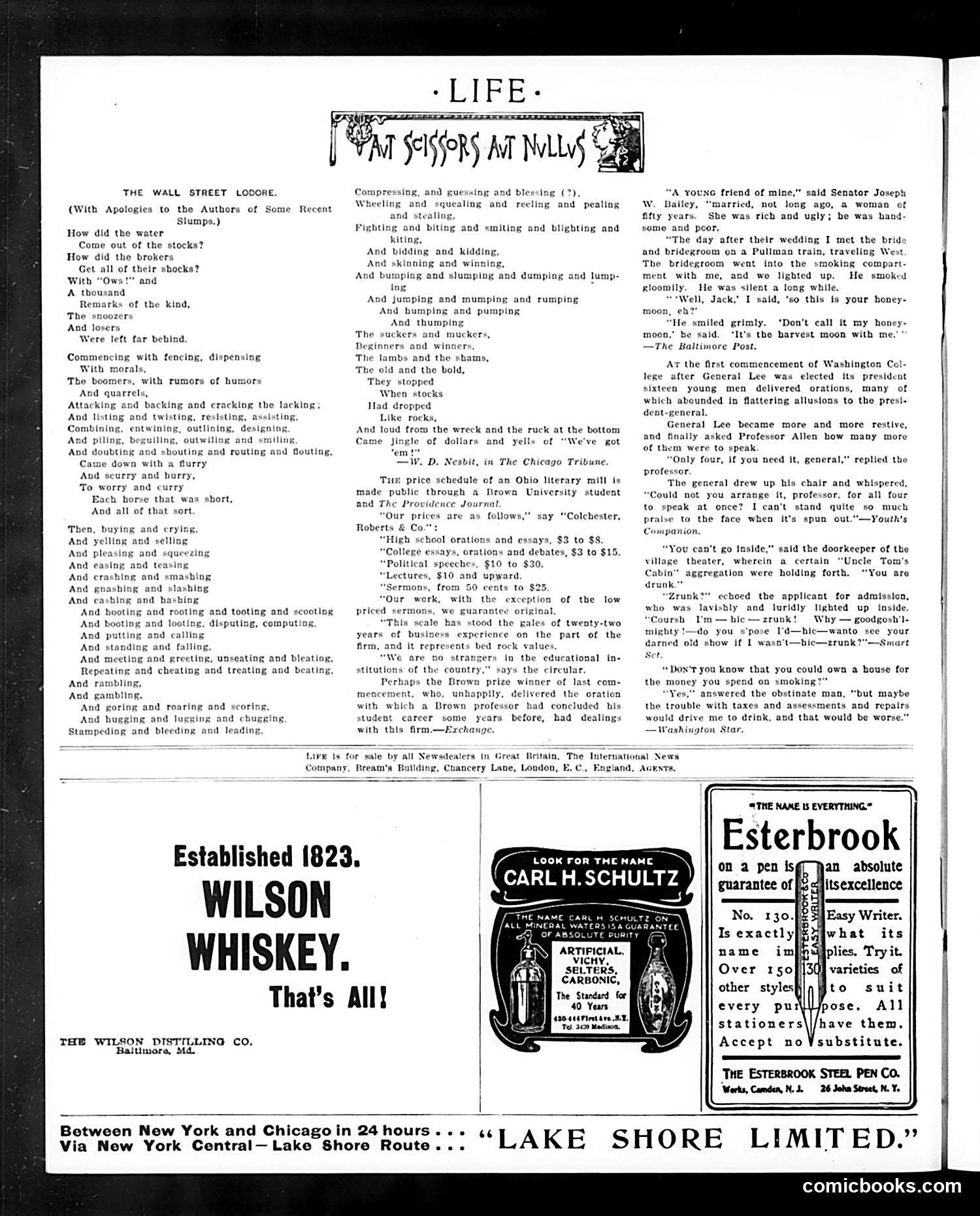
This page from *Life* magazine contains satirical content mocking Wall Street speculation and academic dishonesty. **The Main Cartoon:** "The Wall Street Lodore" (a parody of Longfellow's "The Charge of the Light Brigade") depicts the chaotic frenzy of stock market trading through rapid-fire, rhyming action verbs—"buying and crying," "crashing and smashing," etc. The satire captures the frenzied, almost mindless activity of brokers and speculators during market fluctuations, suggesting the financial world operates on emotion rather than reason. **The Short Story:** Senator Joseph W. Bailey tells of a young man who married a wealthy 50-year-old woman for her money despite being handsome and poor himself—satirizing mercenary marriages and class hypocrisy. **Secondary Content:** An article exposes an Ohio literary mill selling custom essays, orations, and speeches to students—mocking academic fraud and the commodification of education. The page reflects Progressive Era concerns about financial speculation, social climbing, and institutional corruption.
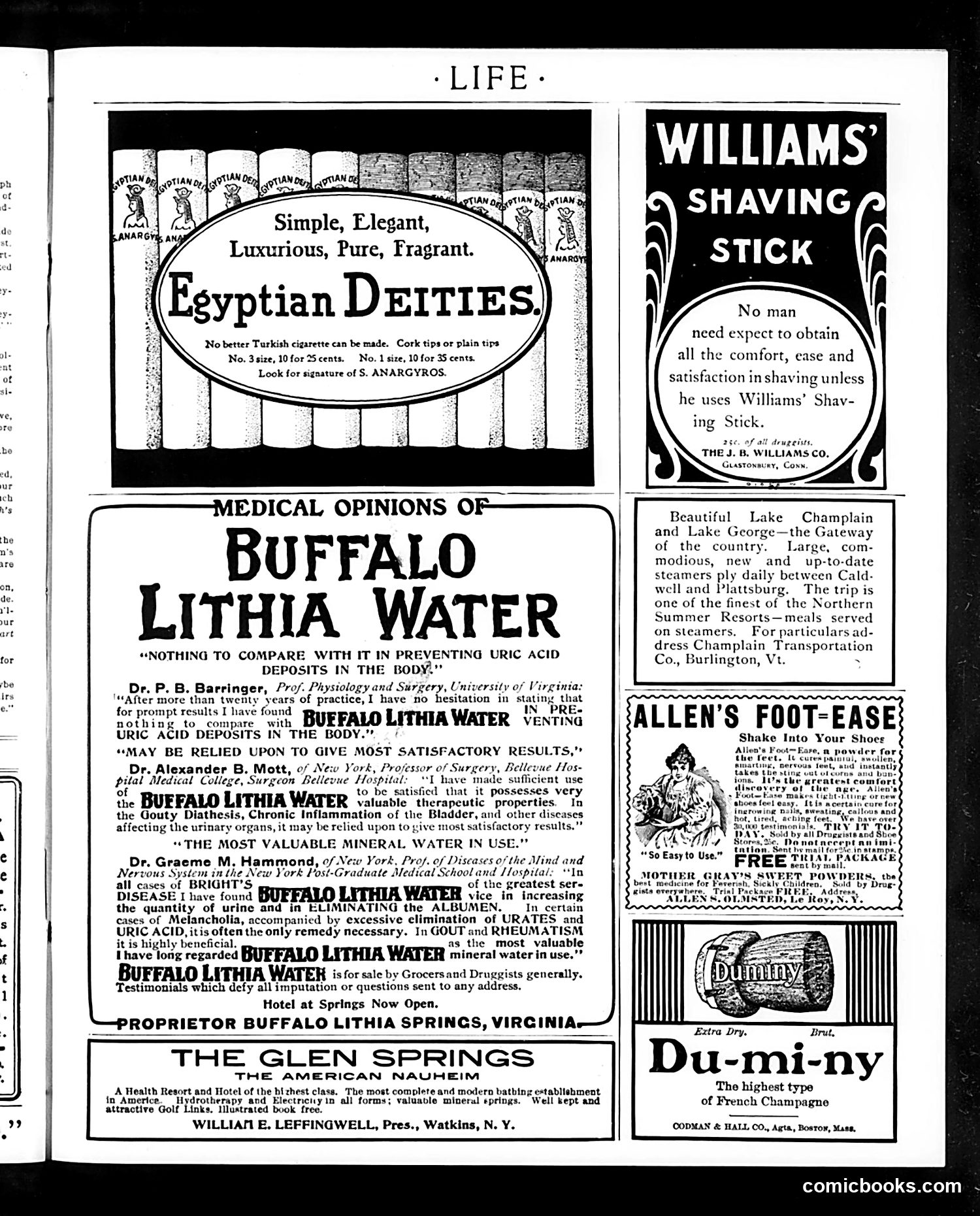
This is primarily a **pharmaceutical and consumer product advertisement page**, not a political cartoon. It contains no satire or caricature requiring historical context. The page features period medical advertisements typical of early 20th-century American magazines: **Major ads include:** - **Egyptian Deities cigarettes** – Turkish cigarettes with cork or plain tips - **Williams' Shaving Stick** – hygiene product - **Buffalo Lithia Water** – mineral water advertised with endorsements from prominent physicians (Dr. P.B. Barringer, Dr. Alexander B. Mott, Dr. Graeme M. Hammond) claiming therapeutic benefits for gout, rheumatism, kidney disease, and other ailments - **Allen's Foot-Ease** – foot powder - **Du-mi-ny champagne** – French wine - **Glen Springs resort** – health spa with mineral springs The Buffalo Lithia Water ad is the most extensive, relying on medical authority and testimonials—a common marketing strategy before FDA regulations restricted health claims. No satire is evident; these are straightforward product promotions targeting affluent readers.
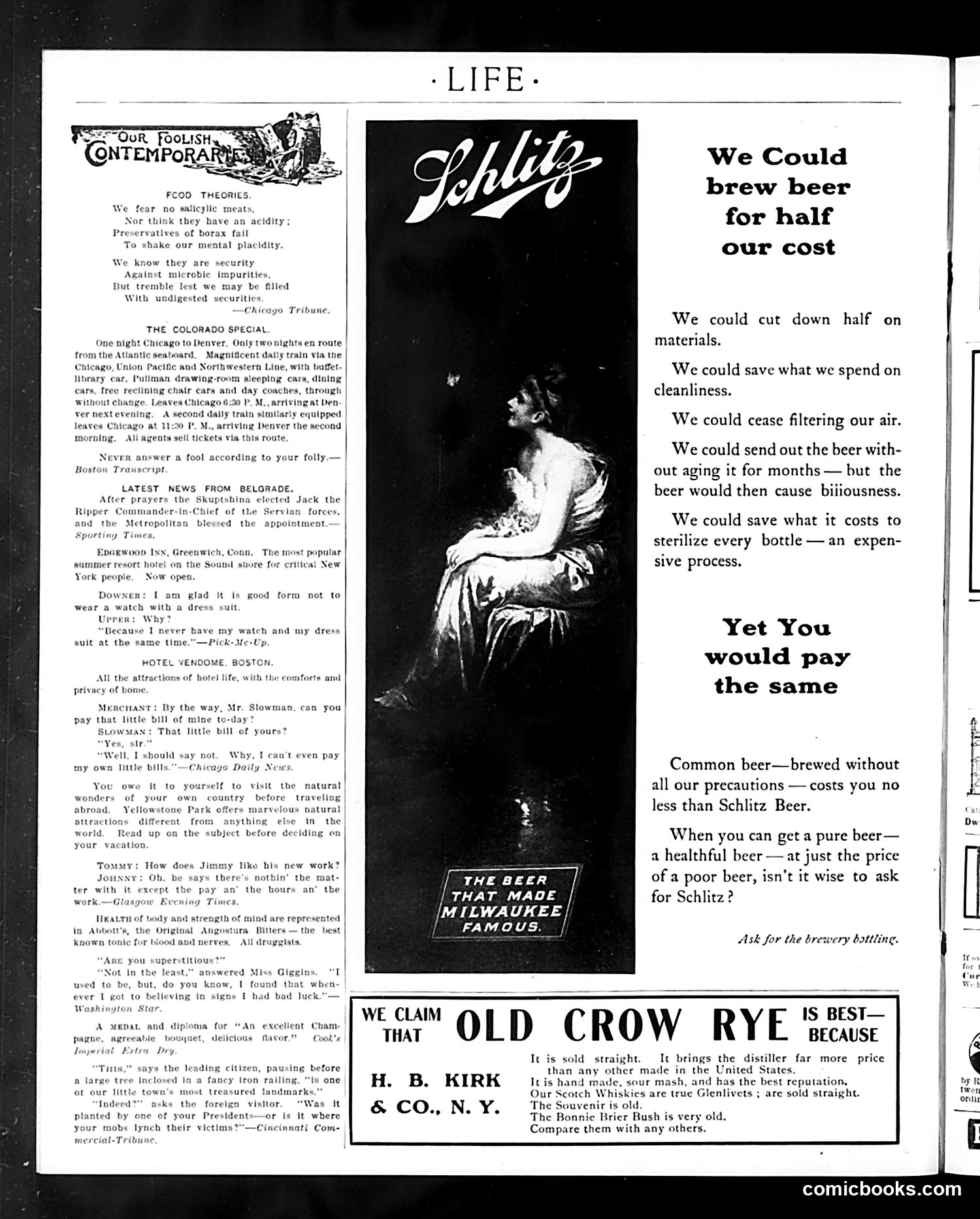
This page mixes satirical commentary with period advertising. The left side contains brief humorous anecdotes mocking contemporary concerns—food safety anxieties, hotel etiquette, and financial pretension—typical of Life's "Our Foolish Contemporaries" section, which satirized everyday social absurdities. The right side features a **Schlitz beer advertisement** cleverly structured as social commentary. It argues that Schlitz *could* cut production costs dramatically (cheaper materials, less filtering, skipping sterilization) yet charges standard prices anyway. The implication: Schlitz maintains premium quality and safety standards competitors might skip, justifying the price. This was likely responding to competition from cheaper beers. Below are advertisements for **Old Crow Rye whiskey** and **H.B. Kirk whiskeys**, emphasizing handmade quality and aged superiority. The humor works on two levels: genuine satire of contemporary foolishness plus sophisticated advertising that *uses* satire to position Schlitz as the ethical choice in an era of food-safety scandals.
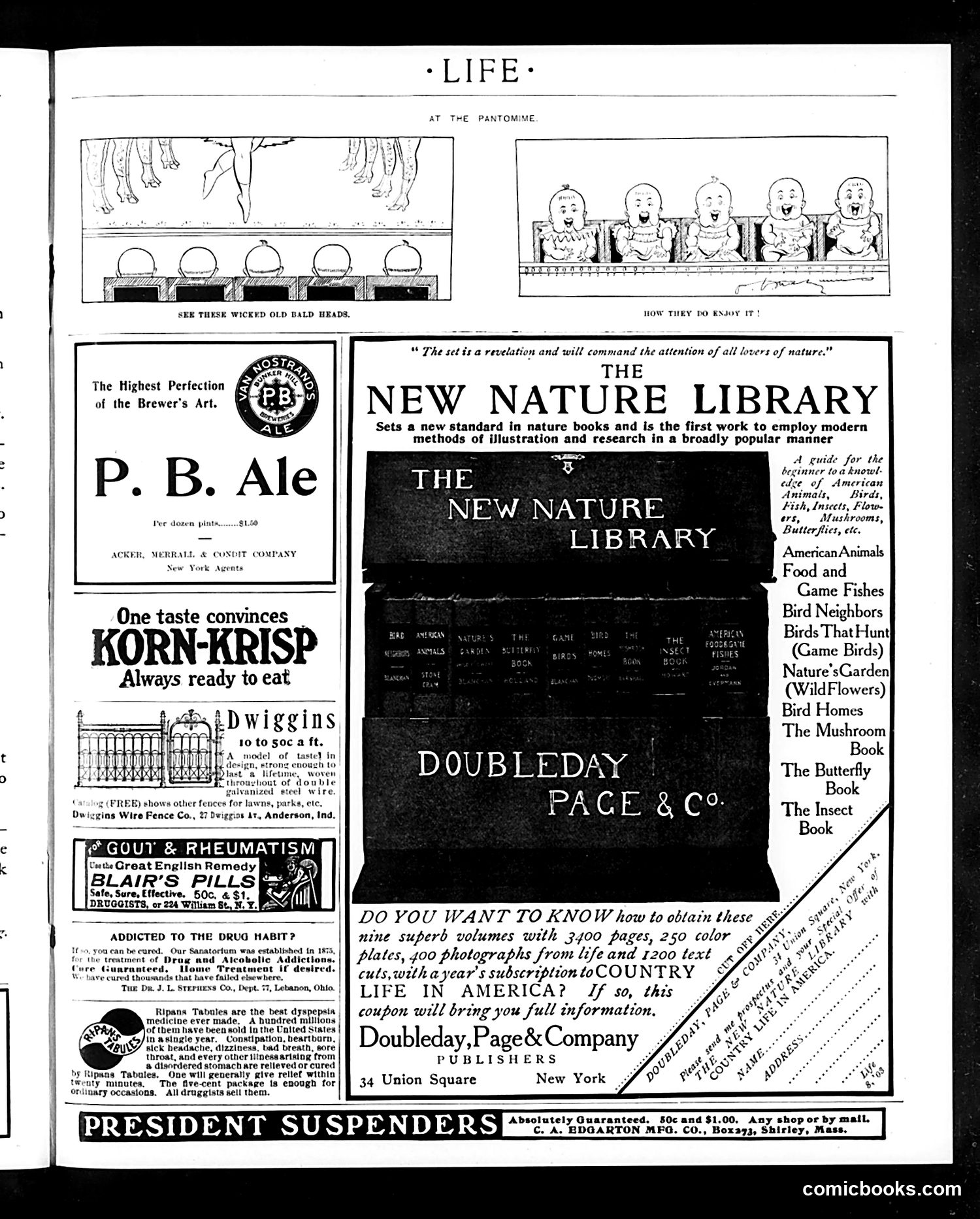
This page is primarily **advertising**, not editorial satire. The top cartoons labeled "At the Pantomime" show two scenes: spectators watching a stage performance (heads visible from behind) and children reacting with delight—a lighthearted joke about audience enjoyment at theatrical entertainment. The page's main content features advertisements for period products: P.B. Ale (beer), Korn-Krisp cereal, Dwiggins wire fencing, medical remedies (Blair's Pills for gout, Ripans Tablets for dyspepsia, drug addiction treatment), and suspenders. The dominant advertisement promotes *The New Nature Library*, a nine-volume nature encyclopedia by Doubleday, Page & Company, emphasizing its modern illustration methods and broad appeal. There is **no political satire** visible here—the page reflects early 20th-century consumer culture and advertising conventions typical of Life magazine during this era.
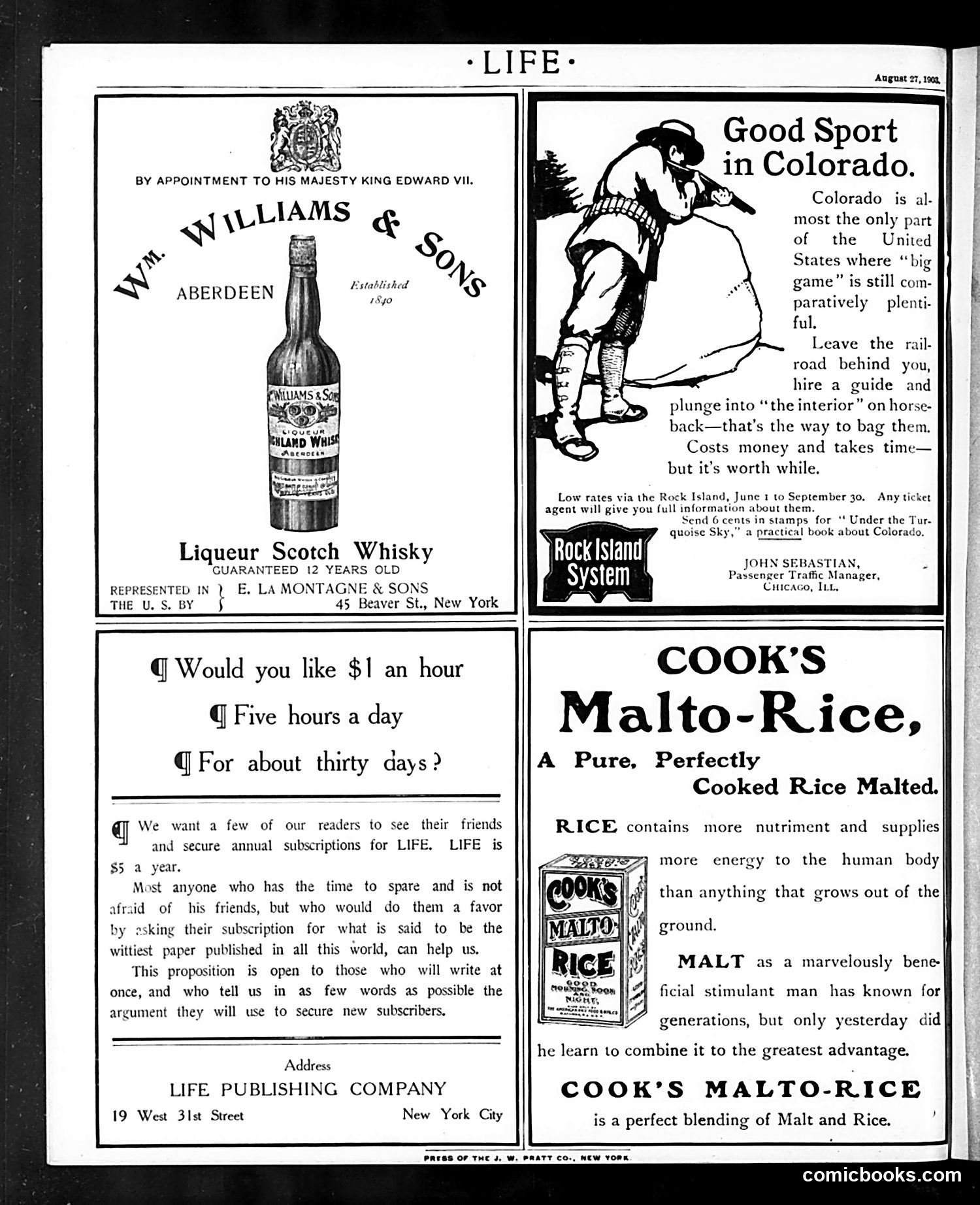
This page is primarily **advertising**, not satire or political commentary. It contains four distinct commercial advertisements: 1. **Williams & Sons Scotch Whisky** (top left): A luxury liquor ad emphasizing the product's age and prestige, with royal appointment credentials. 2. **Rock Island Railroad/Colorado Tourism** (top right): A illustrated ad promoting big-game hunting in Colorado, depicting a cowboy or hunter. It encourages wealthy readers to leave civilization and hunt wildlife via the railroad's low summer rates. 3. **Life Magazine Subscription Drive** (bottom left): The magazine solicits readers to recruit new subscribers for $5/year, offering $1/hour compensation for securing subscriptions—essentially crowdsourcing marketing. 4. **Cook's Malto-Rice** (bottom right): A health food product advertisement claiming rice provides superior nutrition and energy, marketed as a "stimulant" when combined with malt. The page reflects **early 1900s consumer culture**: luxury goods, adventure tourism for the wealthy, and patent medicines/health products with broad health claims.