
Life, 1903-08-27 · page 4 of 20
Life — August 27, 1903 — page 4: what you’re looking at
What you’re looking at
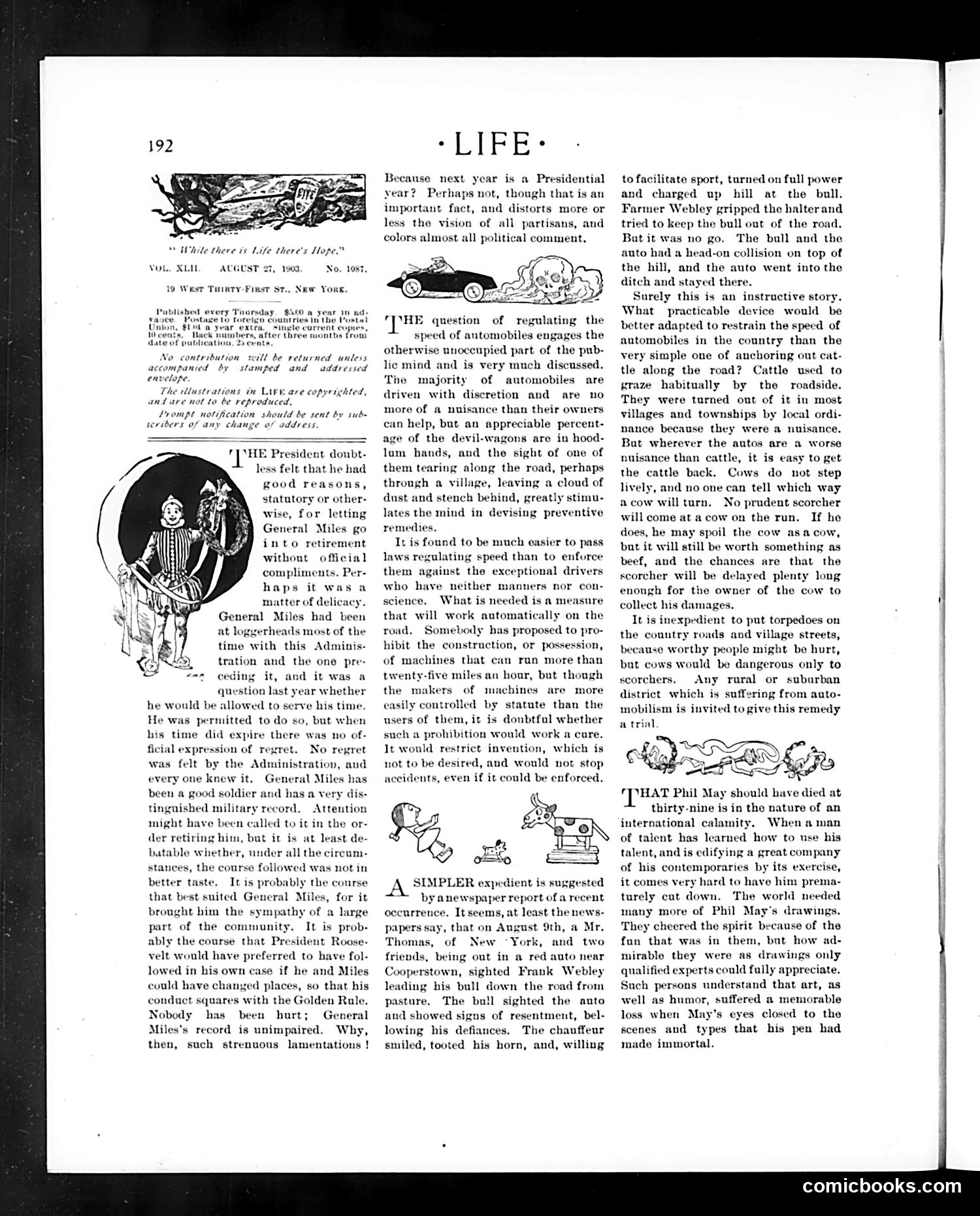
The page contains editorial commentary rather than a political cartoon. The main illustration shows a figure in formal dress (circular inset, left side), likely a government official, though the OCR'd text doesn't identify them clearly. The text discusses automobile speed regulation—a contemporary public safety concern. It references General Miles' retirement and mentions an August 9th incident involving a man named Thomas, two friends, a red auto, and a bull near Georgetown. The auto allegedly struck the bull, which then collided with a ditch. The satire criticizes both reckless drivers and impractical speed-limit solutions. It argues that restricting automobiles to 25 mph wouldn't prevent accidents or change driver behavior—restriction would fail where enforcement does. The piece reflects early 1900s anxieties about automobiles as public hazards.
📄 Transcribed text from this page (OCR, searchable)
Machine-transcribed from the original scan — historical spelling and the odd misread are preserved.
“While there is Life there's Hope.” VOL. XLIL AUGUST 27, 1963 No. 1087. 19 West Turety-Finst St.. New Yors. lay $200 a y ‘countries In Vo contribution rill be returned unless accompanied by stamped and addressed envelope. The illustrations in Lire are copyrighted, ant are not to be reproduced, Prompt notification should be sent by sub= seribers of any change of address. ve 2 President doubt- ss felt that he had good reasons statutory or othe: wise, for letting General Miles go into retirement without official compliments. Per- haps it was a matter of delicacy. General Miles had been erheads most of the time with this Adminis- tration and the one pre- it, and it was a ion last year whether he would be allowed to serve his time. He was permitted to do so, but when his time did expire there was no of- ficial expression of regret. No regret was felt by the Administration, and every one knew it. General Miles been a good soldier and has a very dis- tinguished military record, Attention might have been called to it in the or- der retiring him, but it is at least de- batable whether, under all the circum- stances, the course followed was not in better taste, It is probably the course that best suited General Miles rit brought him the sympathy of a large part of the communit, It is prob- ably the course that President Roose- velt would have preferred to have fol- lowed in his own case if he and Miles could have changed places, so that his conduct squares with the Golden Rule. Nobody has been hurt; General Miles's record is unimpaired. Why, then, such strenuous lamentations ! SLE * Because next year is a Presidential year?) Perhaps not, though that is an important fact, and distorts more or less the vision of all partisans, and colors almost all political comment. "pHE question of regulating the speed of automobiles engages the otherwise unoccupied part of the pub- lic mind and is very much discussed. The majority of automobiles are retion and are no more of a nuisance than their owners can help, but an appreciable percent- age of the devil-wagons are in hood- lum hands, and the sight of one of them tearing along the road, perhaps through a village, leaving a cloud of dust and stench behind, greatly sti lates the mind in devising pr remedies. It is found to be much easier to pass laws regulating speed than to enforce them against the exceptional drivers who have neither manners nor con- science. What is needed is a measure that will work automatically on the road. Somebody has proposed to pro- hibit the construction, or possession, of machines t can run more than twenty-five miles an hour, but though the makers of machines are more easily controlled by statute than the users of them, it is donbtfal whether such a prohibition would work a care. It would restrict invention, which is not to be desired, and would not stop accidents, even if it could be enforced. driven with dis EO A SIMPLER expedient is suggested ~~ by anewspaper report of a recent occurrence. It seems, at least the news- papers say, that on August 9th, a Mr, Thomas, of New “York, and two friends, being out in a red auto near Cooperstown, sighted Frank Webley leading his bull down the road from pasture. The bull sighted the auto and showed signs of resentment, bel- lowing his defiances. The chauffeur smiled, tooted his horn, and, willing to facilitate sport, turned on full power and charged up hill at the bull. Farmer Webley gripped the halterand tried to keep the bull out of the road. But it was no go. The bull and the auto had a head-on collision on top of the hill, and the auto went into the ditch and stayed there. Surely this is an instructive story What practicable device would be better adapted to restrain the speed of automobiles in the country than the very simple one of anchoring out cat- tle along the road? Cattle used to graze habitually by the roadside. They were turned out of it in most villages and townships by local ordi- nance because they were a nuisance. Bat wherever the autos are a worse nuisance than cattle, it is easy to get the cattle back. Cows do not step lively, and no one can tell which way a cow will turn. No prudent scorcher will come at a cow on the run. If he does, he may spoil the cow asacow, but it will still be worth something as beef, and the chances are that the scorcher will be delayed plenty long enongh for the owner of the cow to collect his damages. It is inexpedient to put torpedoes on the country roads and village streets, because worthy people might be hurt, bat cows would be dangerous only to scorchers. Any rural or suburban district which is suffering from auto- mobilism is invited to give this remedy atrial PHAT Phil May should have died at thirty-nine is in the nature of an international calamity, When aman of talent has learned how to use his talent, and is edifying a great company of his contemporaries by its exercise, it comes very hard to have him prema- turely cut down. The world needed many more of Phil May’s drawings. ‘They cheered the spirit because of the fan that was in them, but how ad- mirablo they were as drawings only qualified experts could fully appreciate. Such persons understand that art, as well as humor, suffered a memorable loss when May’s eyes closed to the scenes and types that his pen had made immortal. comicbooks.com