
A complete issue · 24 pages · 1903
Life — July 30, 1903
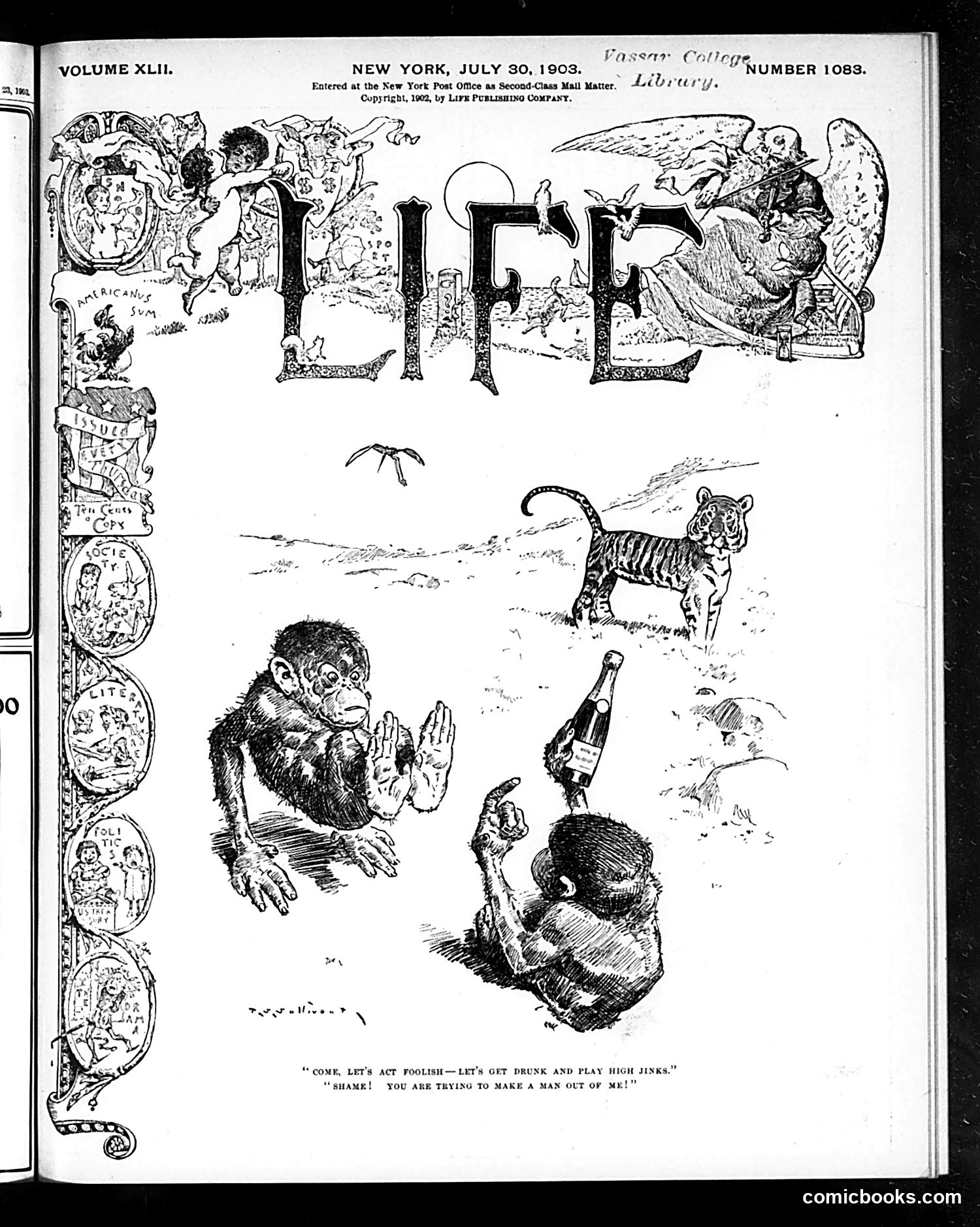
This page features satirical illustrations of primates engaged in human vices. The main cartoon shows two monkeys—one offering a champagne bottle to another with the caption "Come, let's act foolish—let's get drunk and play high jinks" and "Shame! You are trying to make a man out of me!" The satire works through **inversion**: rather than depicting humans behaving like animals, it shows animals rejecting human behavior as degrading. This appears to mock excessive drinking and rowdy entertainment among the upper classes, suggesting that such conduct is beneath even animals—that civilized humans mimicking drunken foolishness are actually devolving morally. The decorative border and accompanying tiger illustration suggest this is part of a larger satirical feature. The humor relies on contemporary anxieties about social propriety and moral decline.
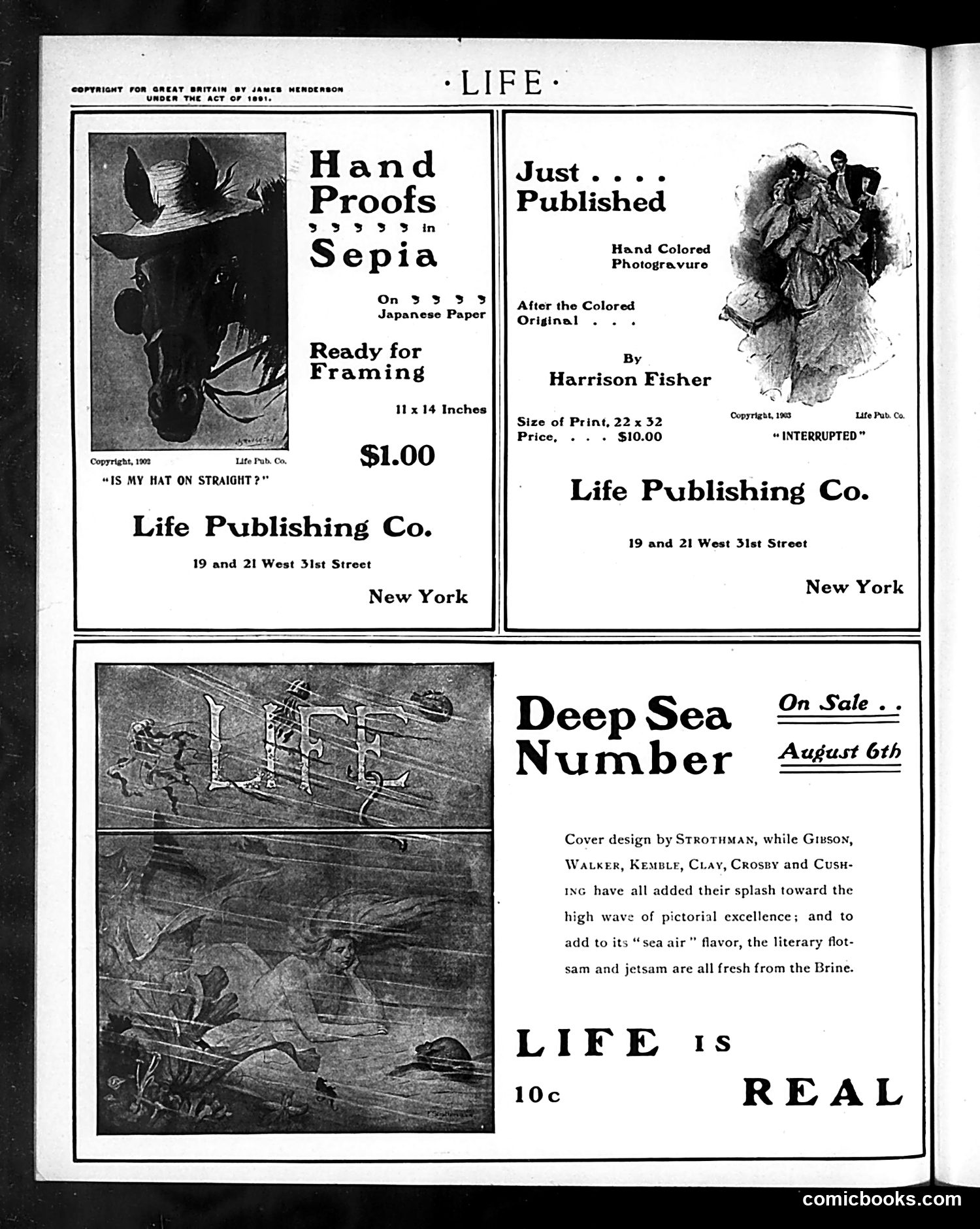
This page is primarily **advertising** for Life Publishing Co.'s products rather than satirical content. The top-left advertisement features a hand-colored sepia photogravure titled "Is My Hat on Straight?" depicting a horse's head—priced at $1.00, sized 11x14 inches, ready for framing. The top-right announces a newly published hand-colored photogravure by Harrison Fisher titled "Interrupted," priced at $10.00 for a 22x32 print. The bottom advertisement promotes Life magazine's "Deep Sea Number" issue, on sale August 6th for 10 cents. It credits cover designer Strothman and contributors (Gibson, Walker, Kemple, Clay, Crosby, and Cushing) for adding "pictorial excellence" and "sea air" flavor through literary and visual content. The page serves as a merchandising vehicle for Life's publications and magazine issues.
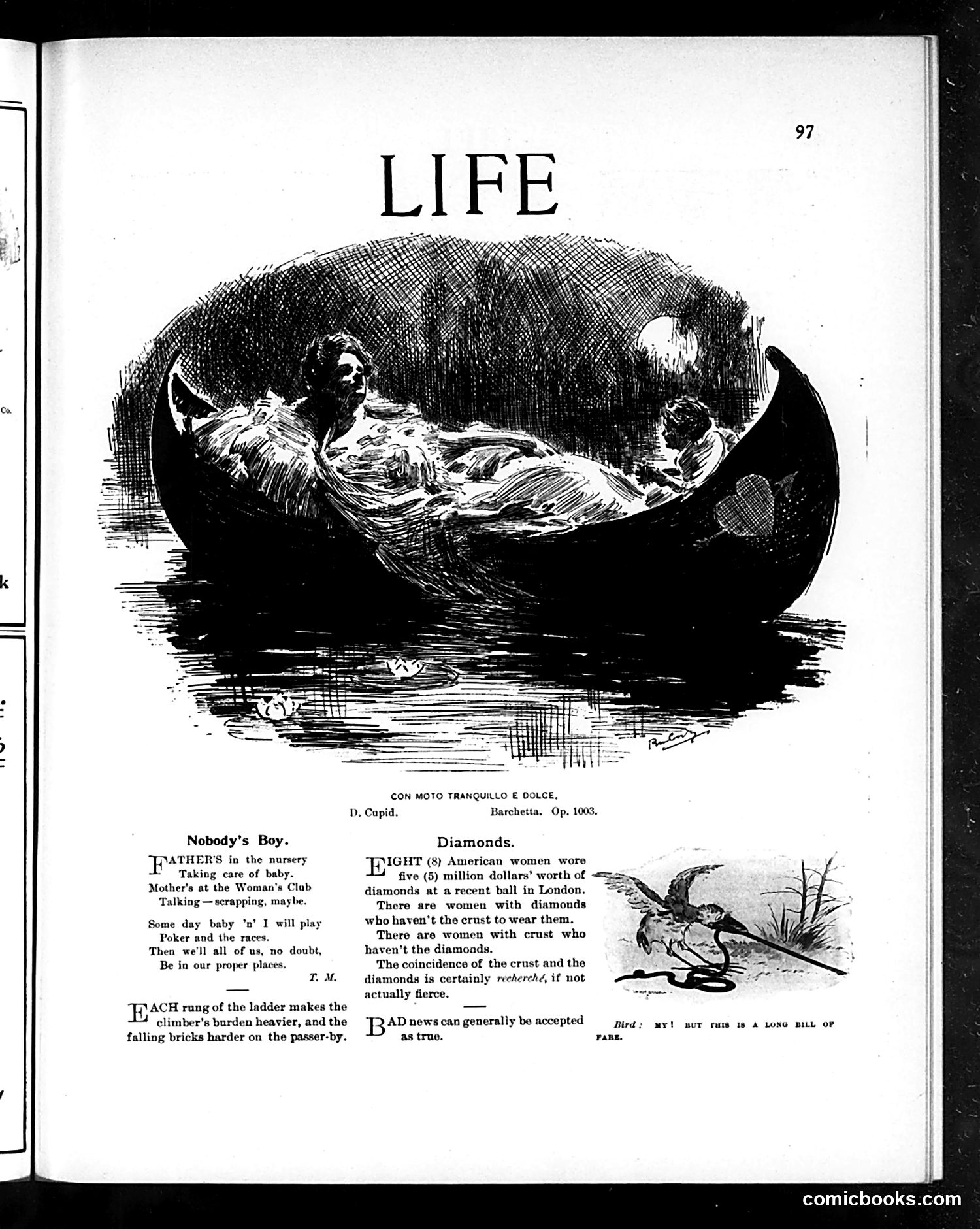
The main illustration shows a woman reclining in a gondola under moonlight—a romantic scene accompanying the musical notation "Con moto tranquillo e dolce" (gently and sweetly). Below are three satirical pieces: **"Nobody's Boy"** mocks working-class ambition, suggesting a nursery child will eventually find "proper places" in society's hierarchy. **"Diamonds"** satirizes wealth inequality: Eight American women owned five million dollars' worth of diamonds at a recent London ball, yet many women lack even the "crust" (basic means) to wear them. The satire questions whether such luxury is genuinely "recherché" (refined) or merely fierce. **"Bad news"** offers a cynical observation that bad news is generally accepted as true—a comment on public credulity. The small bird illustration's caption remains unclear from the OCR.
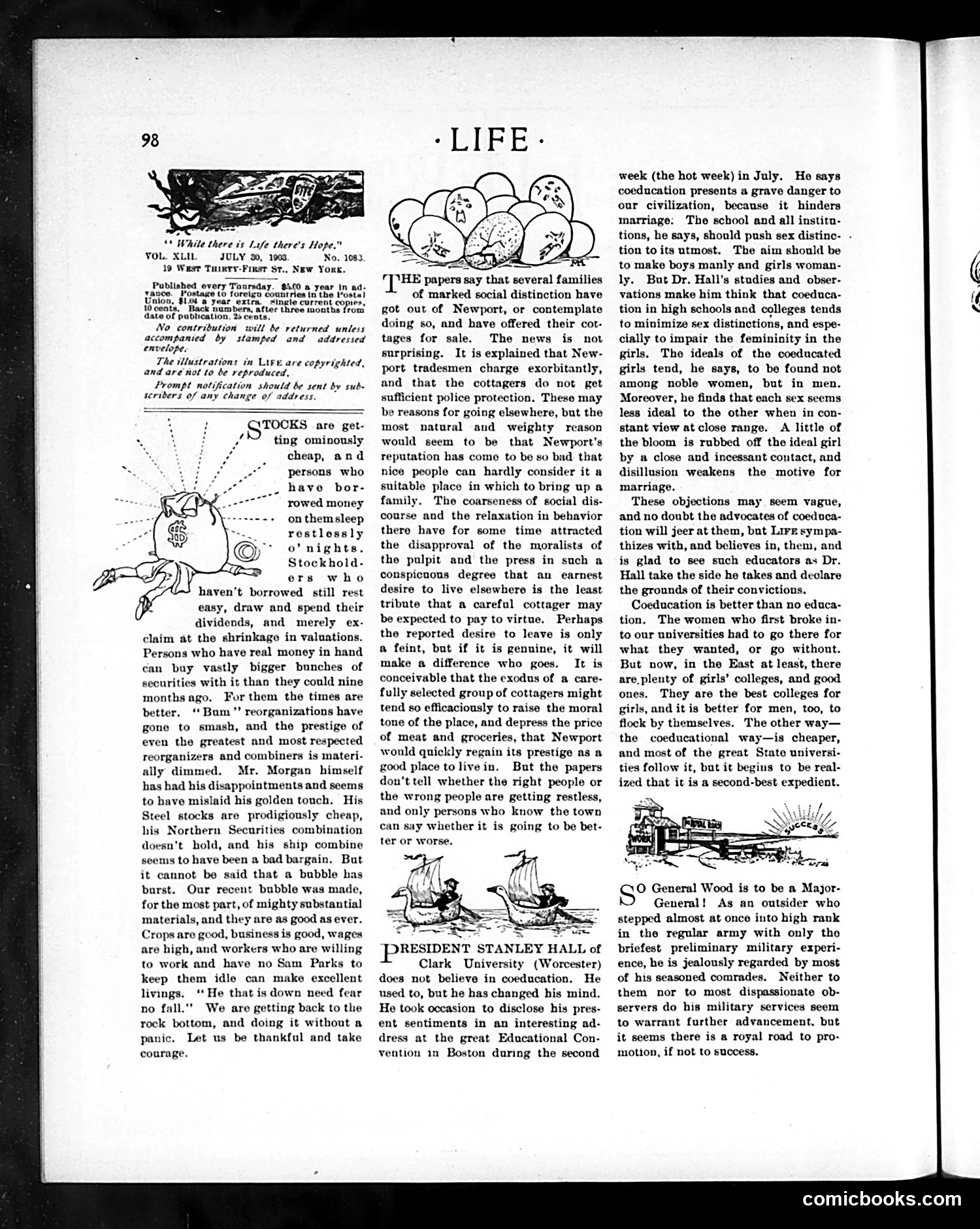
**The Main Cartoon:** The left illustration shows a figure labeled "STOCKS" as a large, inflated balloon being held down by multiple ropes. The satire depicts stock market speculation as dangerously unstable—kept aloft only by continuous effort and restraint. The visual metaphor suggests that if people stopped "borrowing money on bloomingly restlessly of nights," the bubble would burst catastrophically. **The Text's Context:** The article discusses Newport's reputation decline as wealthy families relocate. It critiques how Newport's social prestige has suffered, with even the "moralists of the pulpit and press" expressing disapproval. The piece argues that careful social management might restore the town's standing. **The Political Point:** This reflects early 1900s anxiety about speculative finance and wealth concentration, alongside concerns about America's established elite retreating from traditional centers of influence.
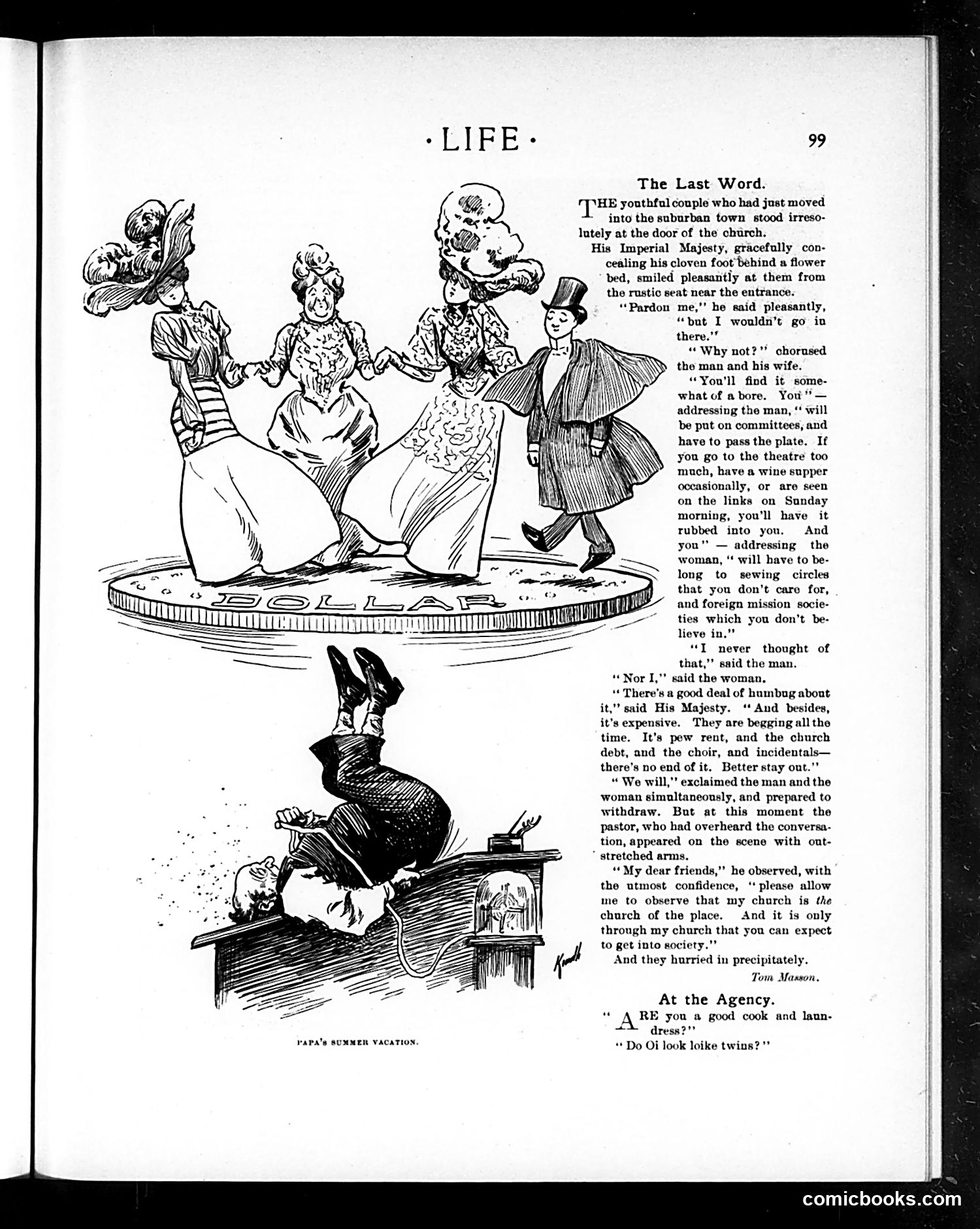
**"The Last Word"** (top cartoon): A newly married couple at church is intercepted by the pastor, who insists his church is "the church of the place" for gaining entry to society. He lectures them that rejecting his church means committees, theater obligations, and sewing circles—all tedious social duties. The satire targets Victorian-era class pretension: the clergy's gatekeeping role in respectability and the exhausting social obligations marriage demands, particularly for women. The joke is that avoiding church doesn't escape society's demands; it simply redirects them elsewhere. **"Papa's Summer Vacation"** (bottom cartoon): Shows a man doing a headstand, apparently during leisure time. The caption suggests domestic chaos or indignity during vacation—likely mocking how men's supposed leisure becomes undignified or comedic. Both pieces satirize social conventions and marital/domestic life in Victorian America.
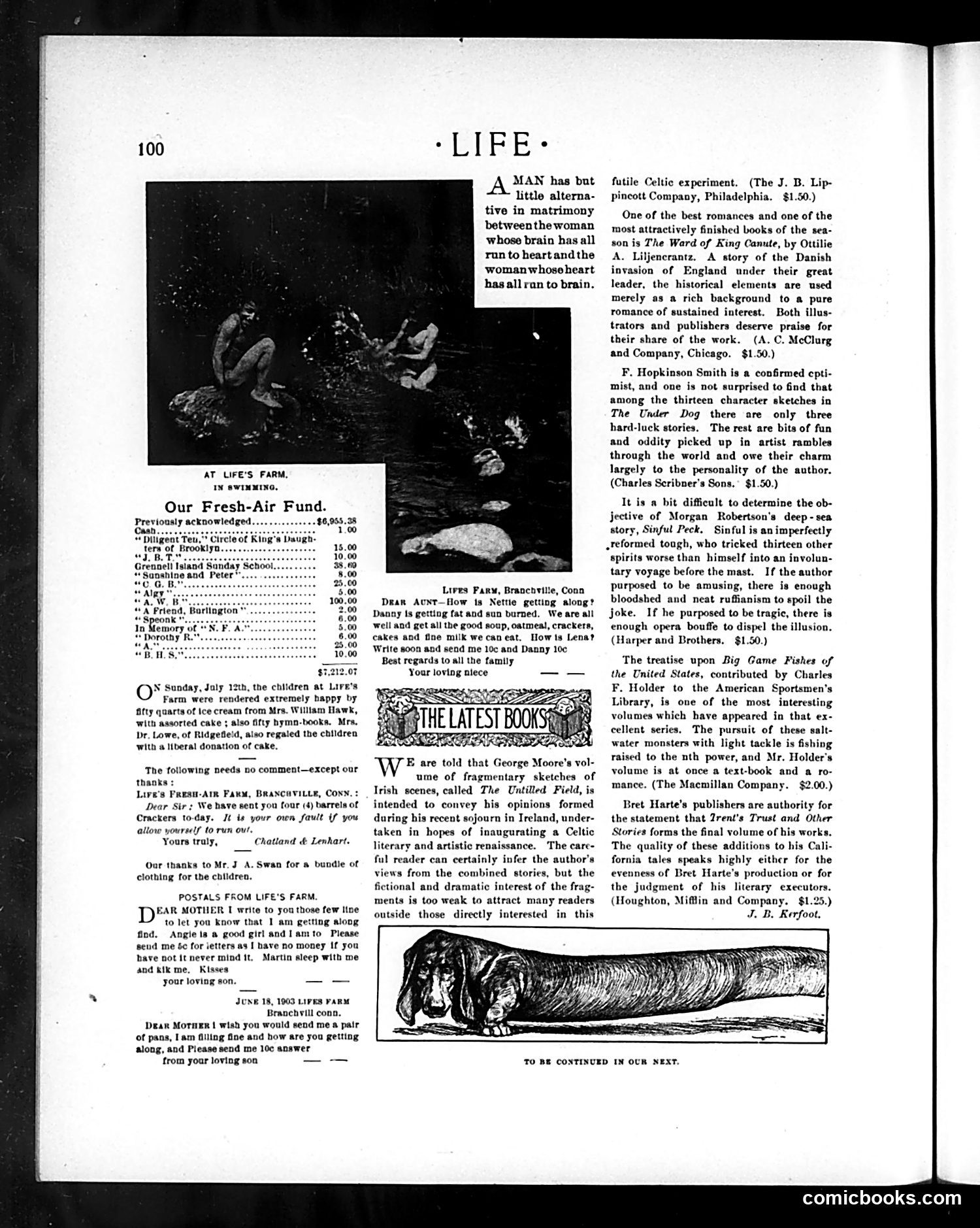
This page contains two main photograph illustrations labeled "AT LIFE'S FARM" and "LIFE'S FARM, Braceville, Conn" showing children swimming and playing. These appear to be documentary photographs of a children's recreational facility rather than political cartoons. The page is primarily devoted to: 1. **"Our Fresh-Air Fund"** — a fundraising appeal listing donors and amounts contributed to send poor children to a farm for summer recreation 2. **Book reviews** discussing recent publications 3. **"Postals from Life's Farm"** — letters from grateful families whose children benefited from the fund This represents Life magazine's social reform journalism, promoting charitable assistance for underprivileged urban children through outdoor recreation programs—a Progressive Era concern. The content emphasizes philanthropy and child welfare rather than political satire.
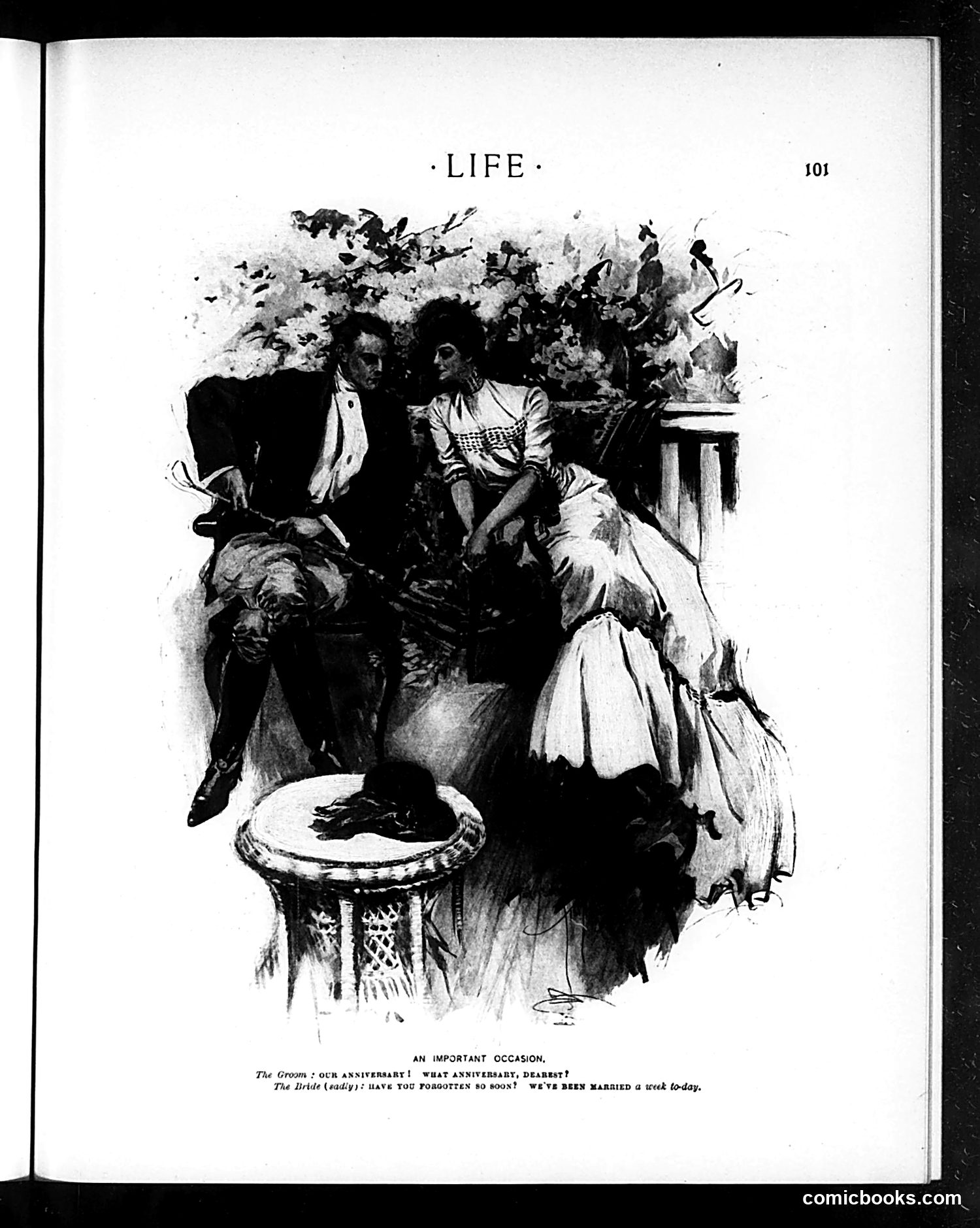
This satirical cartoon depicts a wedding anniversary celebration. The caption reads: "The Groom: 'OUR ANNIVERSARY! WHAT ANNIVERSARY, DEAREST?' The Bride (acidly): 'HAVE YOU FORGOTTEN SO SOON? WE'VE BEEN MARRIED A WEEK TODAY.'" The humor targets newlywed husbands who forget anniversaries—even one occurring just seven days after marriage. The wife's acidic tone and the groom's apparent confusion suggest a common marital dynamic: the husband's forgetfulness versus the wife's expectation that he remember romantic milestones. The elaborate party setting with flowers and decorative elements emphasizes the absurdity of the situation—she's gone to significant effort celebrating something he's already forgotten. This reflects early-20th-century satirical commentary on gender roles and marriage expectations.
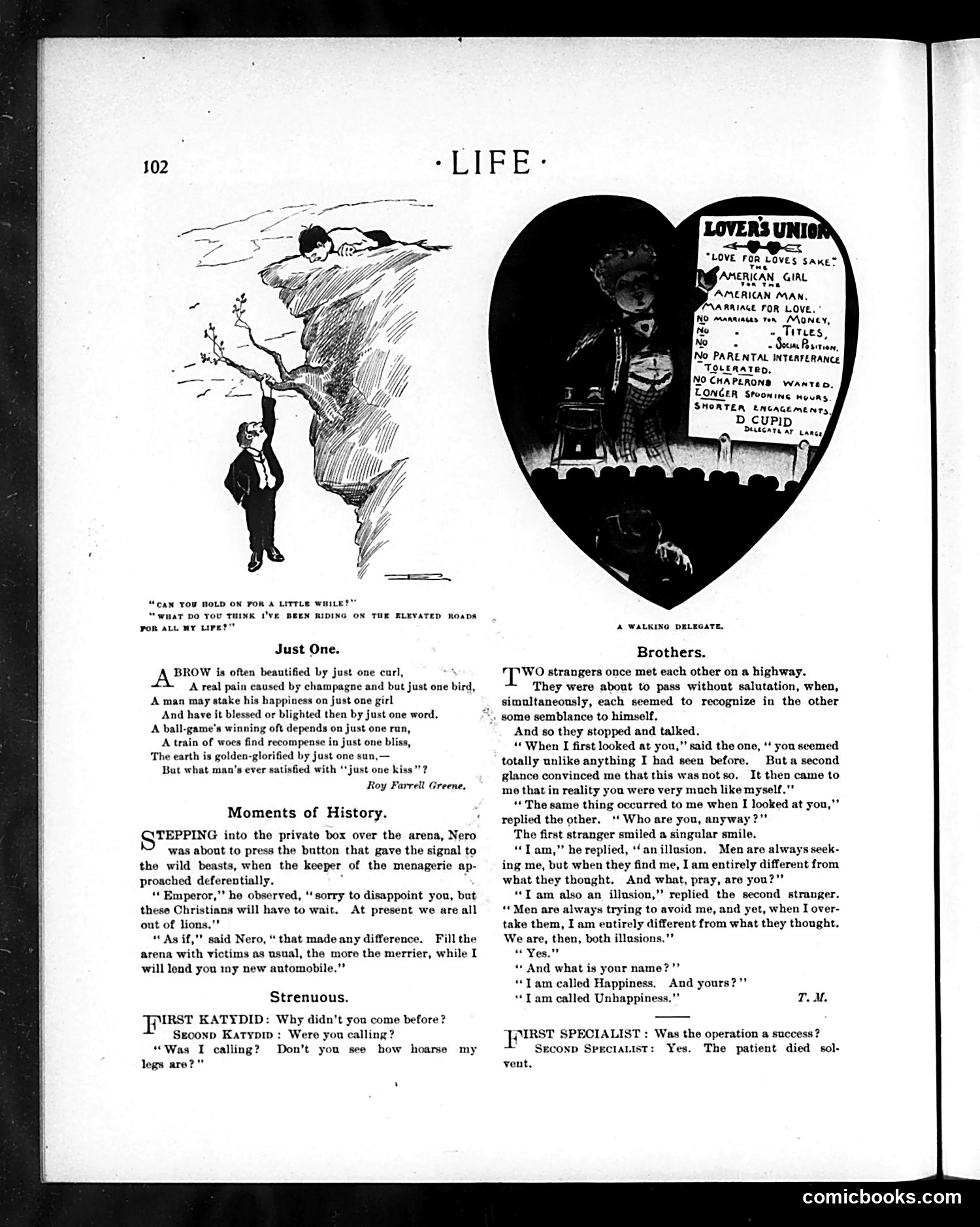
This page contains three separate humorous pieces: **"Just One"** (left): A sketch showing a man on an elevated road asking a woman below if she can "hold on for a little while," referencing "elevated roads" he's been riding "all my life." The satire appears to mock romantic persistence or unrealistic male expectations in courtship. **"Lovers Union"** (center): A heart-shaped advertisement parodies personal ads, listing humorous dating requirements like "Love for Love's Sake," "American Girl," "No Marriage for Love," and specifications about parental non-interference. This satirizes the commercialization of romance and the absurdity of reducing relationships to transactional checklists. **"Brothers," "Moments of History," and brief jokes** (right): Various short satirical pieces about coincidence, misunderstanding, and professional incompetence, typical of Life's miscellaneous humor format.
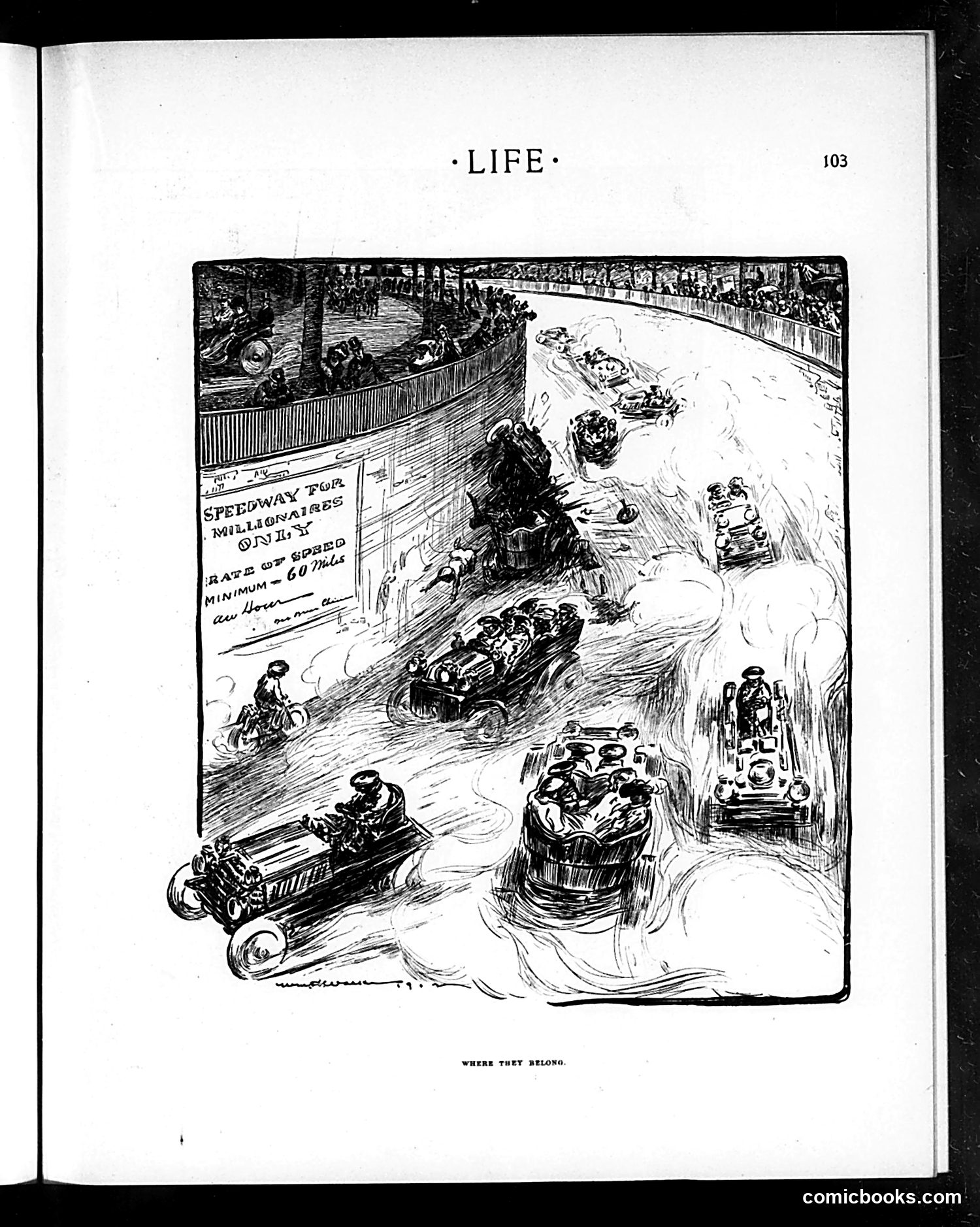
This is a satirical cartoon about early automobile racing at a speedway. The sign visible in the image reads "SPEEDWAY FOR MILLIONAIRES ONLY" with "RATE 60 MILES" (minimum speed requirement). The cartoon satirizes wealth inequality and exclusivity in early motor racing. Only wealthy individuals could afford both the expensive automobiles and the entry fees to this exclusive speedway. The multiple racing vehicles shown represent the elite participating in this high-speed sport while crowds watch from bleachers. The caption "WHERE THEY BELONG" suggests the cartoonist's commentary—that this dangerous activity is appropriately restricted to the wealthy, implying either that the rich deserve such risks or that they should stay separated from ordinary people. The satire critiques both the elitism of early motorsport and the dangerous nature of racing.
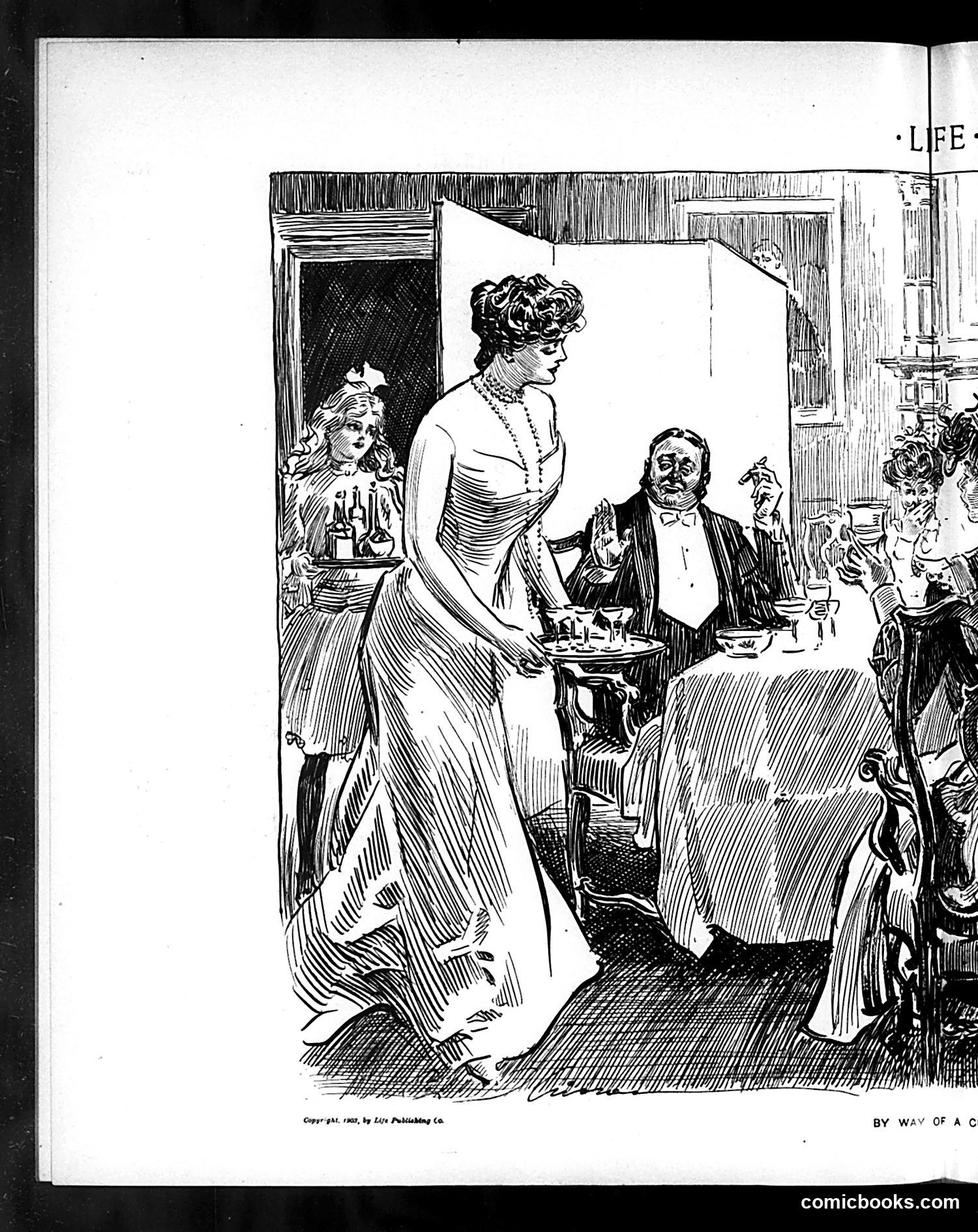
This is a satirical illustration from *Life* magazine depicting a formal dinner party scene. A fashionably dressed woman in an elegant gown stands prominently, serving or attending to a seated gentleman in formal attire (tuxedo). Other well-dressed figures are visible in the background at the dining table. The satire appears to comment on **gender roles and social class dynamics** of the early 20th century. The woman's graceful posture and servant-like positioning, despite her fine dress, suggests commentary on how even "upper-class" women were expected to serve male guests at social gatherings. The gentleman's somewhat self-satisfied expression reinforces this critique of patriarchal social conventions. The specific title or caption needed to fully explain the satirical point is not legible in this image.
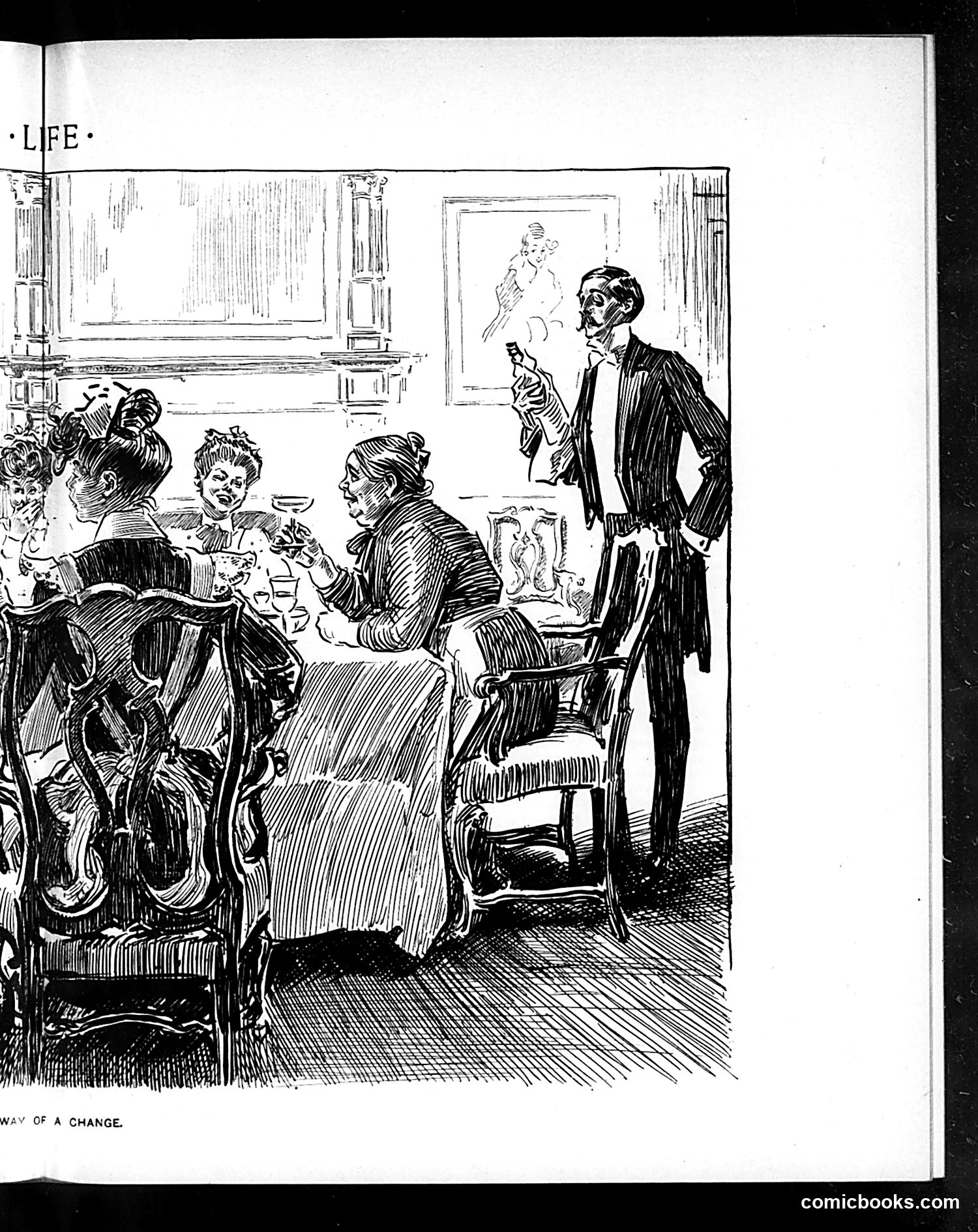
This page from *Life* magazine shows a social satire cartoon depicting what appears to be an upper-class drawing room scene. A well-dressed man in a suit stands prominently on the right, holding what looks like a small object (possibly a cigar or similar item), addressing seated women in elegant dress. The title fragment visible reads "WAY OF A CHANGE," suggesting this depicts some kind of social or behavioral transformation. The cartoon likely satirizes changing social customs or manners among the wealthy classes—possibly commenting on shifting attitudes toward smoking, drinking, or other social conventions of the era. The caricatured expressions and exaggerated postures emphasize the satirical intent, though without the complete caption or publication date, the specific social critique remains unclear.
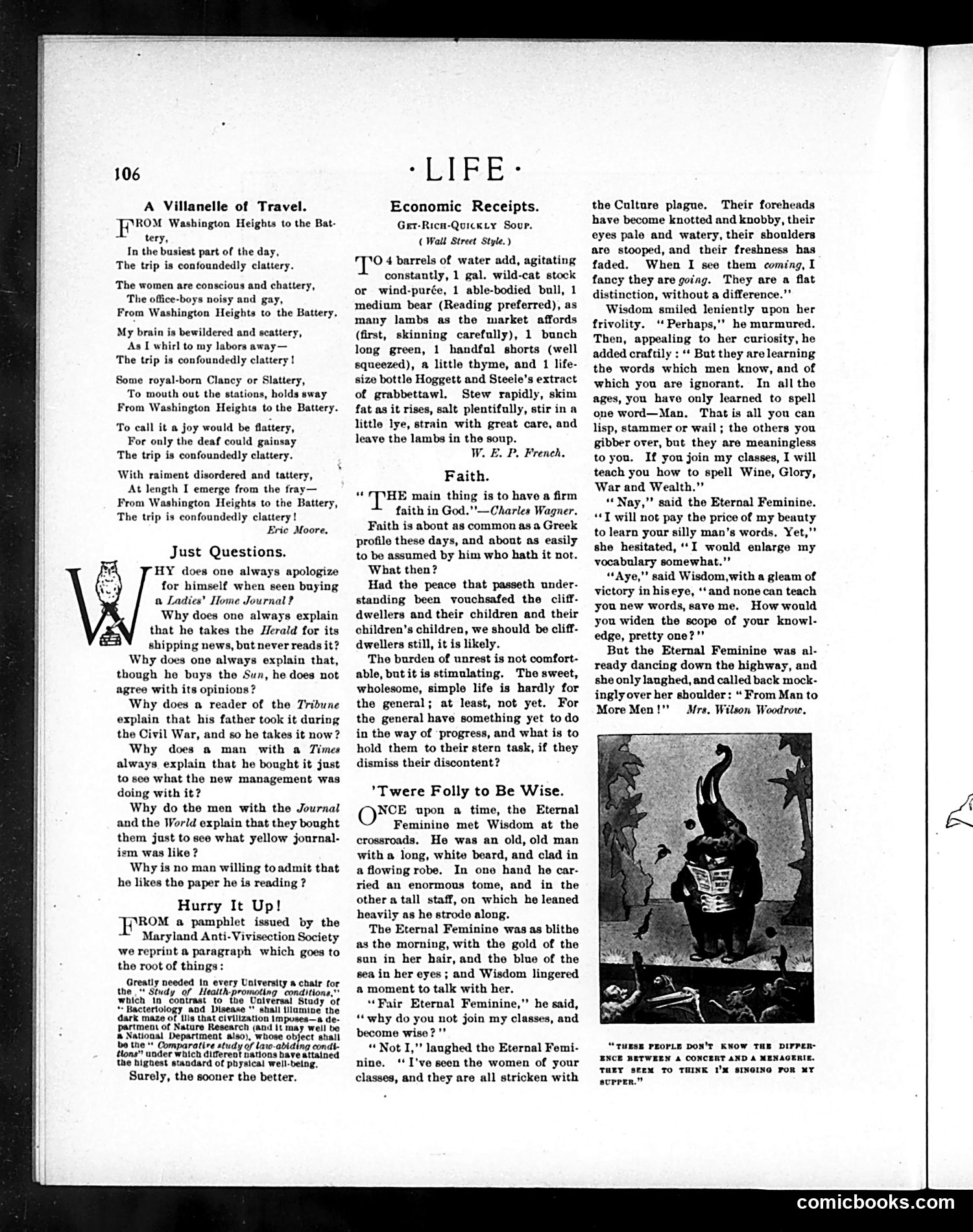
This page from Life magazine contains primarily literary content—poems and essays—rather than political cartoons. The visible illustration shows two figures in what appears to be a casual or comedic scene, with a caption reading "THESE PEOPLE DON'T KNOW THE DIFFERENCE BETWEEN A CONCERT AND A MENAGERIE. THEY SEEM TO THINK I'M SINGING FOR MY SUPPER." The cartoon's humor appears to derive from a performer (likely a musician) frustrated with an inattentive or disruptive audience treating a concert like casual entertainment rather than serious art. Without additional context about the specific performer or event referenced, the joke seems to be about the gap between artistic pretension and public indifference—a recurring satirical theme in early 20th-century Life magazine.
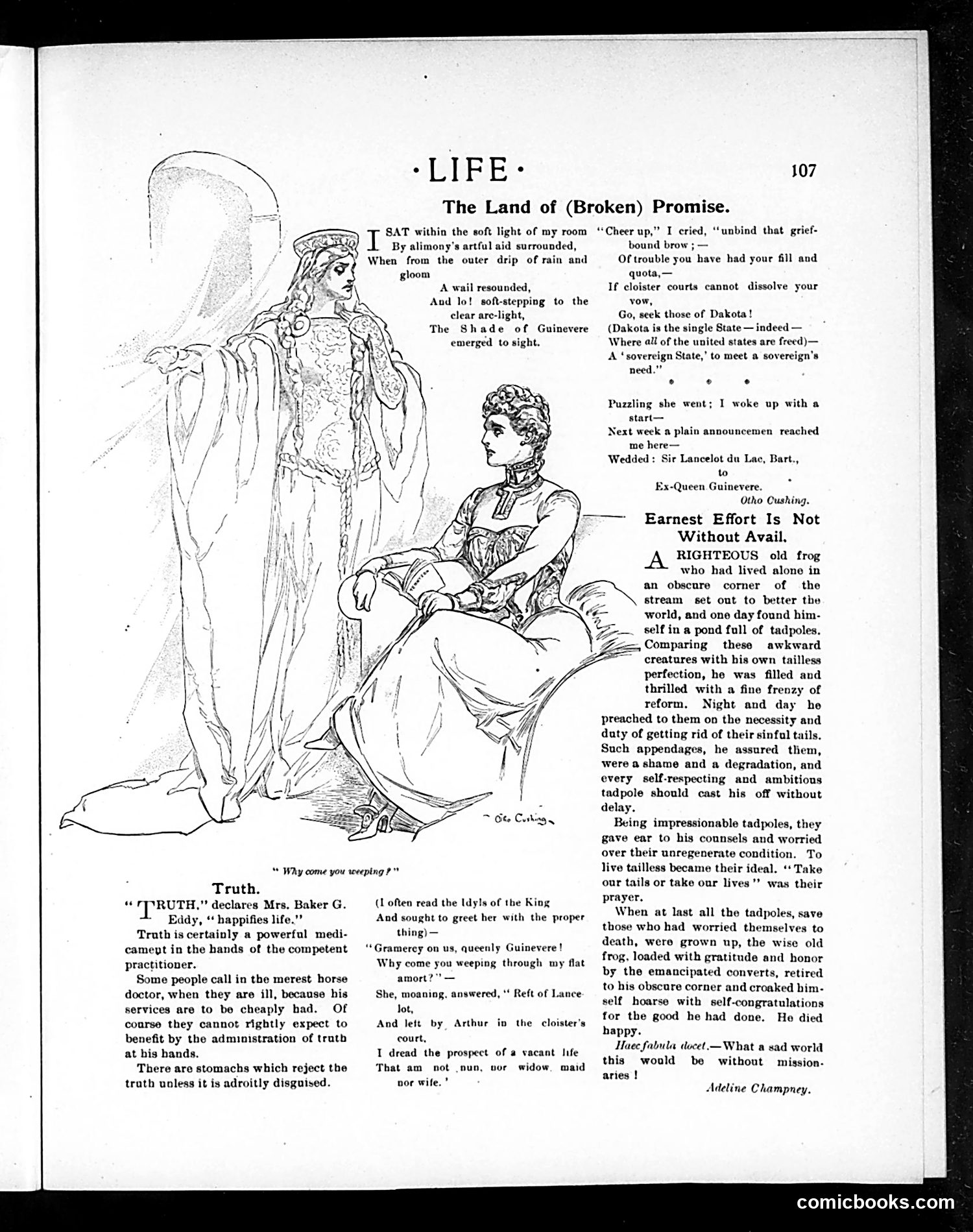
The main cartoon depicts the ghost of **Queen Guinevere** (from Arthurian legend) visiting the narrator, weeping over her abandonment by Lancelot. The satire targets **divorce law**: she's trapped in her marriage vow with no escape—until the narrator suggests **Dakota**, which the text notes is "the single State...where all of the united states are freed." This is a jab at Dakota's notoriously lax divorce laws, which made it a destination for wealthy Americans seeking easy separations. The punchline: Guinevere marries Sir Lancelot there the next week. The secondary story, "Earnest Effort Is Not Without Avail," is a fable about a self-righteous frog reforming tadpoles to shed their "sinful tails"—clearly satirizing zealous moral reformers (possibly Christian Scientists, given the Mrs. Baker G. Eddy reference in the "Truth" essay) who impose their values on others, often with dubious results. Both pieces mock earnest self-improvement movements and legal/social hypocrisy.
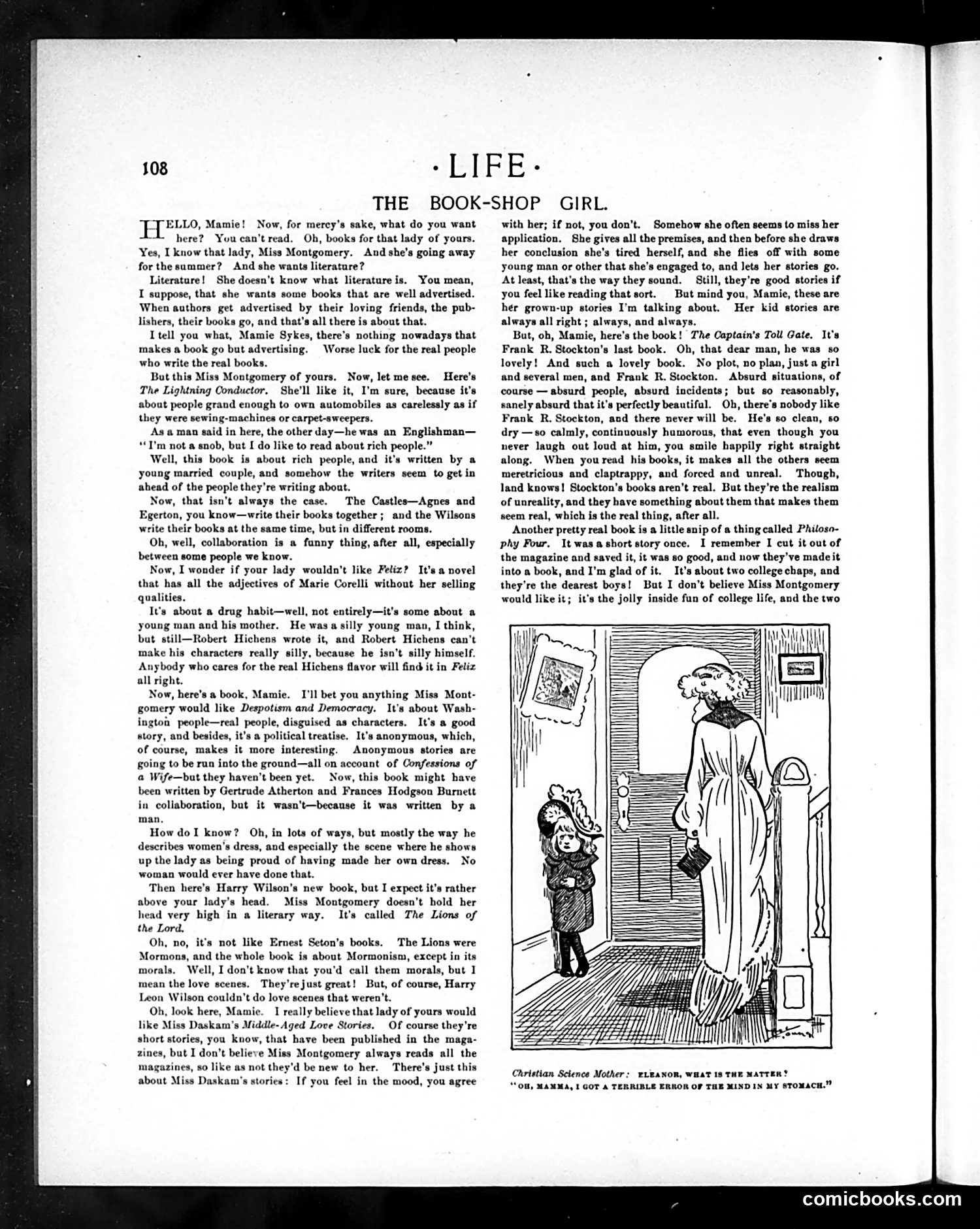
This is a satirical dialogue between a cynical bookshop clerk and a customer named Mamie, discussing what novels to recommend to "Miss Montgomery," a wealthy but intellectually unambitious woman. The satire targets: 1. **Publishing industry fakery**: The clerk openly mocks how books succeed through advertising rather than merit—"nothing nowadays that makes a book go but advertising. Worse luck for the real people who write the real books." 2. **Wealthy readers' shallow tastes**: Montgomery is presented as someone who reads books about rich people living luxuriously (automobiles, fine dress) rather than serious literature. 3. **Author recognition**: References to contemporary bestselling authors (Marie Corelli, Robert Hichens, Gertrude Atherton, Ernest Seton, Harry Leon Wilson) whose popularity the clerk dismisses as marketing-driven. 4. **Gender stereotyping**: The clerk deduces an anonymous book was written by a man because no woman would boast of making her own dress—a joke about feminine vanity and class pretension. The cartoon illustration shows a woman selecting books while a child peers at the shelves, visualizing the scene being discussed.
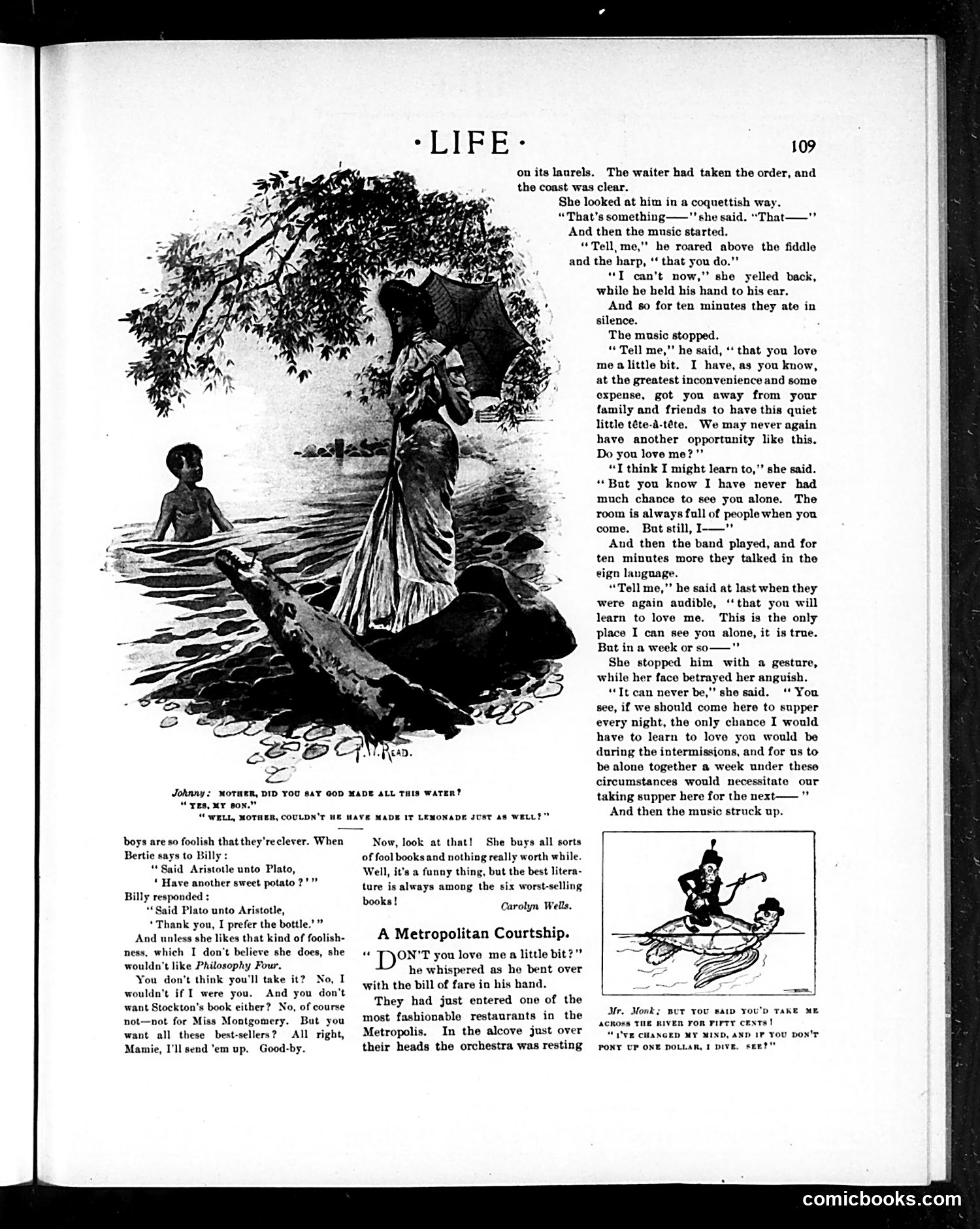
This page contains two satirical pieces about courtship and literature preferences. **Top section:** A humorous dialogue mocking boys' pretentious philosophical references. Two characters (Bertie and Billy) exchange silly pseudo-intellectual banter quoting "Aristotle and Plato" with absurd punchlines about potatoes and bottles. The satire targets young men who think they're clever by affecting learned conversation. A female character dismisses this as foolish behavior. **"A Metropolitan Courtship":** A romantic sketch satirizing urban dining culture and the difficulties of intimate conversation in fashionable restaurants. A couple tries to have a romantic conversation in a fancy restaurant alcove, but the orchestra's music repeatedly drowns them out. The irony is that their private romantic moment is constantly interrupted—they can only talk during musical intermissions. The satire mocks both the pretentiousness of fashionable restaurants and the impracticality of conducting secret romance in public spaces. **Lower cartoon:** Appears to be an unrelated comic about someone (Monk) renegotiating a river crossing fee from fifty cents to one dollar. The humor targets urban social pretension and the gap between romantic ideals and practical reality.
**"King Pete"** is a satirical poem addressing Peter Karageorgevitch, who appears to have recently ascended to the Serbian throne. The jokes mock the instability and danger of Balkan monarchy by offering darkly humorous "advice": sleep in a safe, check under beds for bombs, wear mail, look for explosives under royal seats, and stay away from public places. The satire reflects real historical violence—Serbian rulers faced frequent assassination attempts and coups during this period (this appears early 1900s based on context). Rather than congratulating the new king, *Life* humorously highlights how precarious his position is, with the repeated refrain "King Pete" emphasizing the grim jesting. The accompanying anecdotes are lighter humor about country doctors, senators, and travelers—standard magazine filler—but the "King Pete" poem is pointed political commentary on Balkan political instability disguised as friendly counsel.
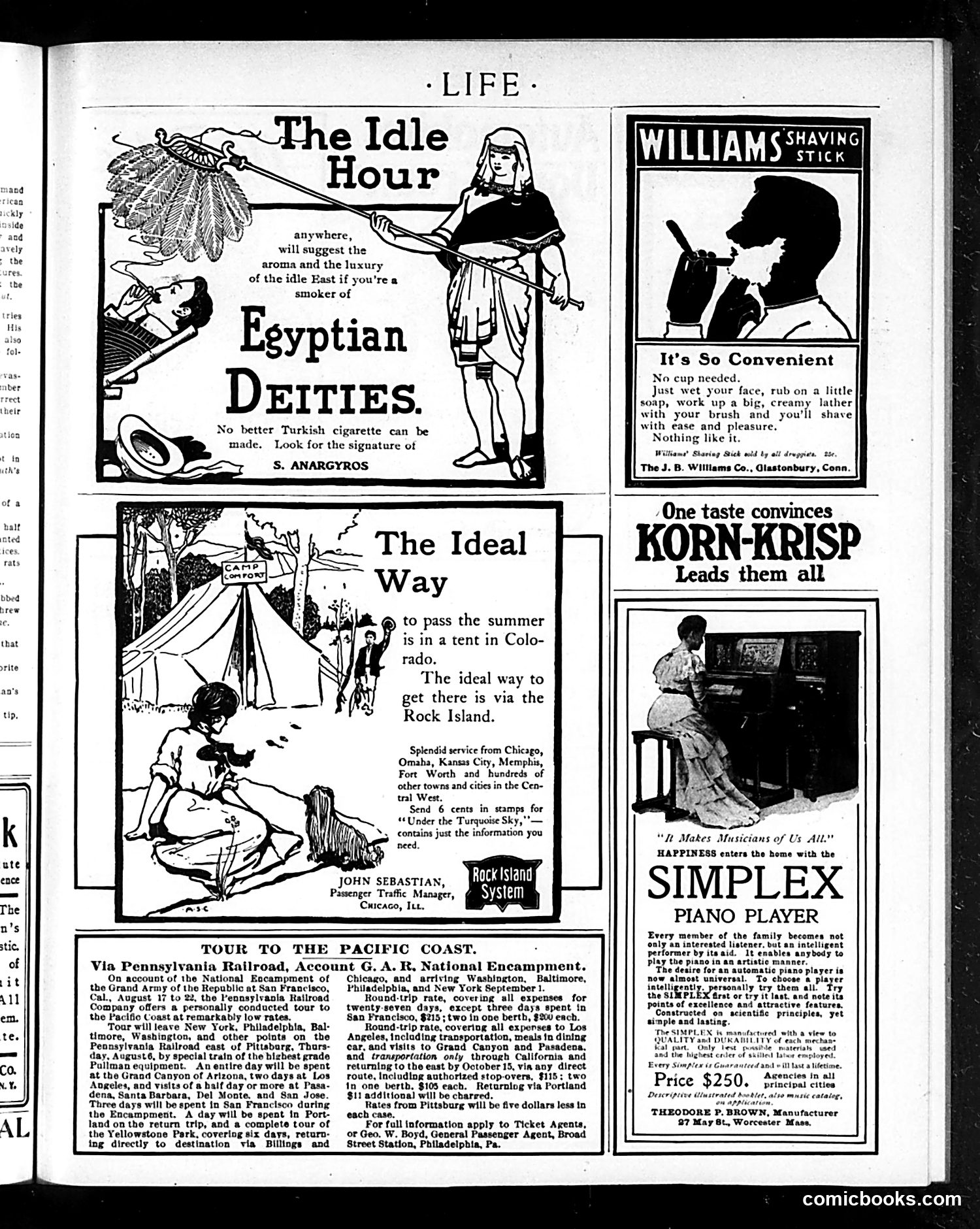
This page is primarily **advertising** from an early 20th-century American magazine. The content consists of five product advertisements with minimal editorial content. The ads promote: 1. **Egyptian Deities cigarettes** — Turkish cigarettes marketed with orientalist imagery (a woman in Egyptian-style dress), appealing to notions of exotic luxury 2. **Williams Shaving Stick** — a grooming product emphasizing convenience 3. **Rock Island Railroad** — promoting scenic travel to Colorado 4. **Korn-Krisp cereal** — with an image of a woman at a piano 5. **Pennsylvania Railroad's Pacific Coast tour** — a detailed travel package to the 1908 G.A.R. (Grand Army of the Republic) National Encampment in San Francisco, with pricing and itinerary 6. **Simplex Piano Player** — an automated piano device marketed as democratizing music-making for families The page reflects period advertising conventions: orientalism, gender stereotypes, and emphasis on leisure and consumer goods for middle-class Americans. There is no identifiable satire or political cartoon content visible.
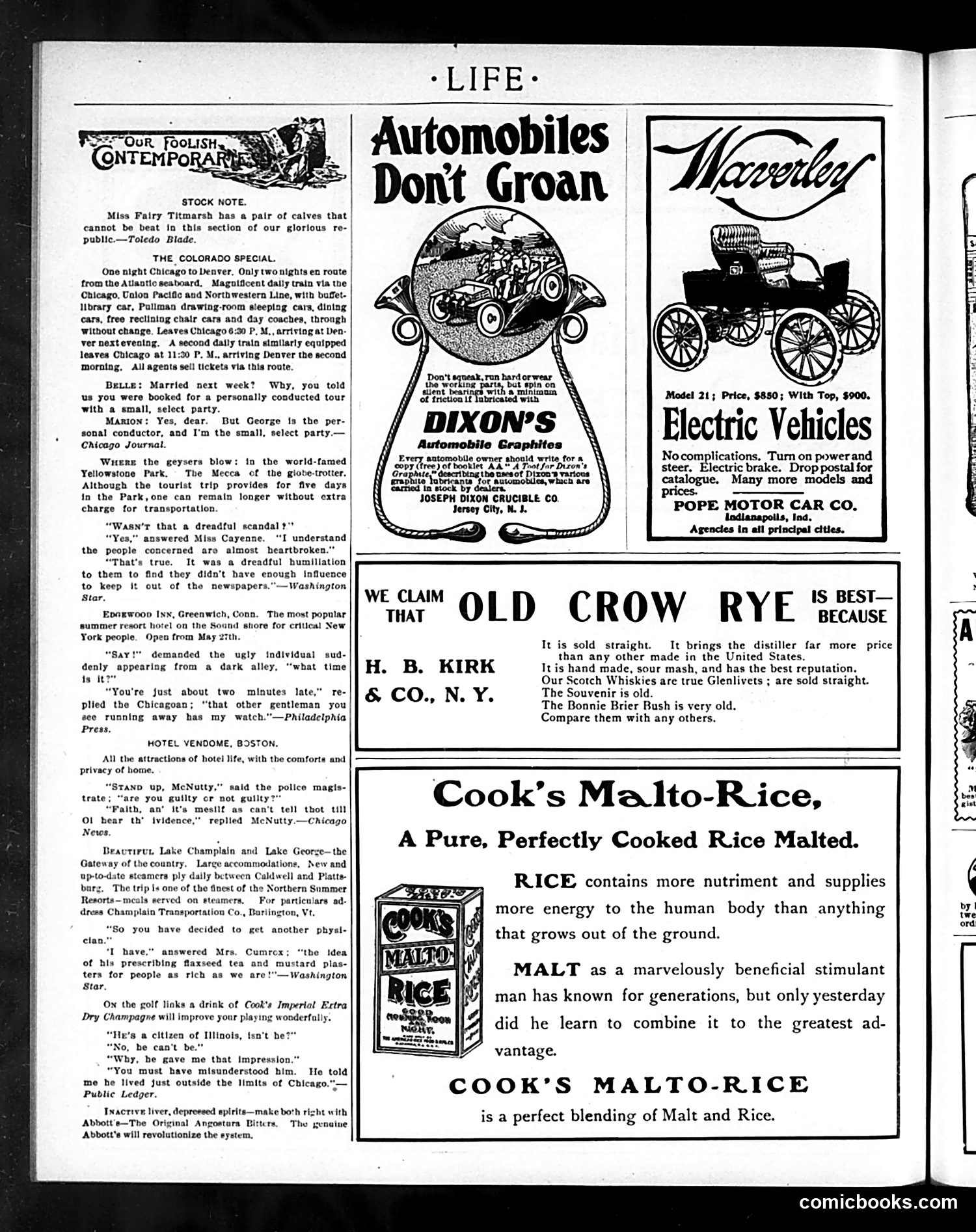
This page combines satirical humor with period advertising, typical of early 1900s Life magazine. **The Satire:** The left column contains brief humorous anecdotes mocking social pretension and human folly—a wealthy woman's cattle, tourists seeking exclusivity, someone using connections to suppress scandal, and a man robbed by a tardy mugger. These reflect Life's signature style: poking fun at middle and upper-class vanities. **The Advertisements:** The page is dominated by commercial pitches for automobiles (Dixon's, Pope Motor Car), spirits (Old Crow Rye whiskey), and Cook's Malto-Rice cereal. The "Automobiles Don't Groan" ad humorously suggests cars are superior to horses. These ads are unremarkable by modern standards but reveal what early 20th-century consumers valued: emerging automobile technology, whiskey quality claims, and health-focused grain products. The overall tone reflects Life's dual purpose: satirizing contemporary society while supporting itself through luxury-goods advertising targeted at affluent readers.
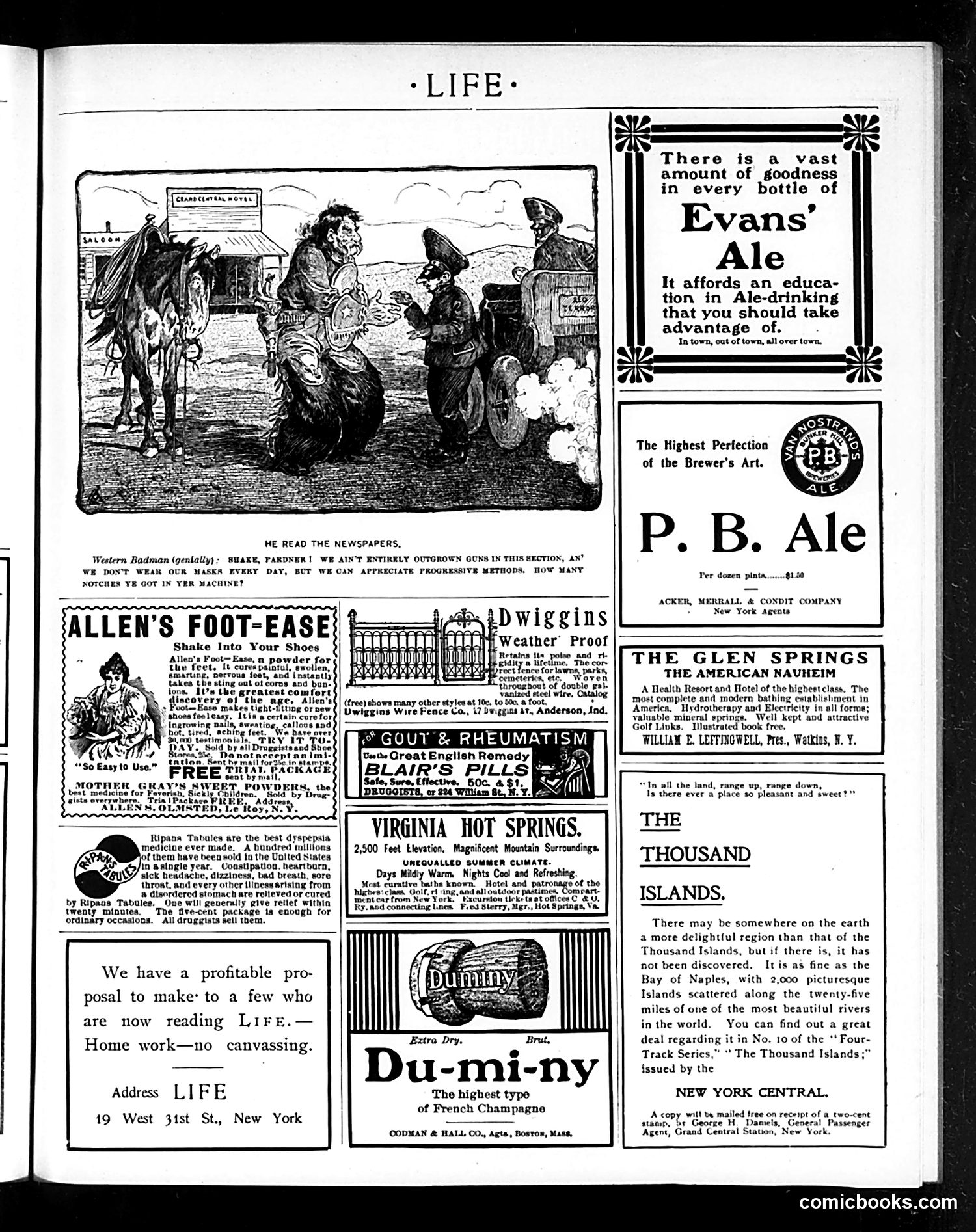
This single-panel cartoon depicts a **Western gunslinger confronting a "Badman"** about reading newspapers. The dialogue reveals the satire's point: the Western figure claims that despite being "old-fashioned" (they still carry guns), they've learned to appreciate "progressive methods" from newspapers. The joke targets **urban progressivism versus frontier tradition**. The cartoonist satirizes how even rough, gun-toting Westerners are adopting modern, civilized approaches after reading about them—suggesting newspapers spread progressive ideas across America's regional divides. The exaggerated dialect and stereotypical Western setting emphasize the contrast between backwards frontier culture and forward-thinking modern society. The caption's emphasis on "progressive methods" indicates this reflects early 1900s debates about modernization and civilization spreading to remote areas.
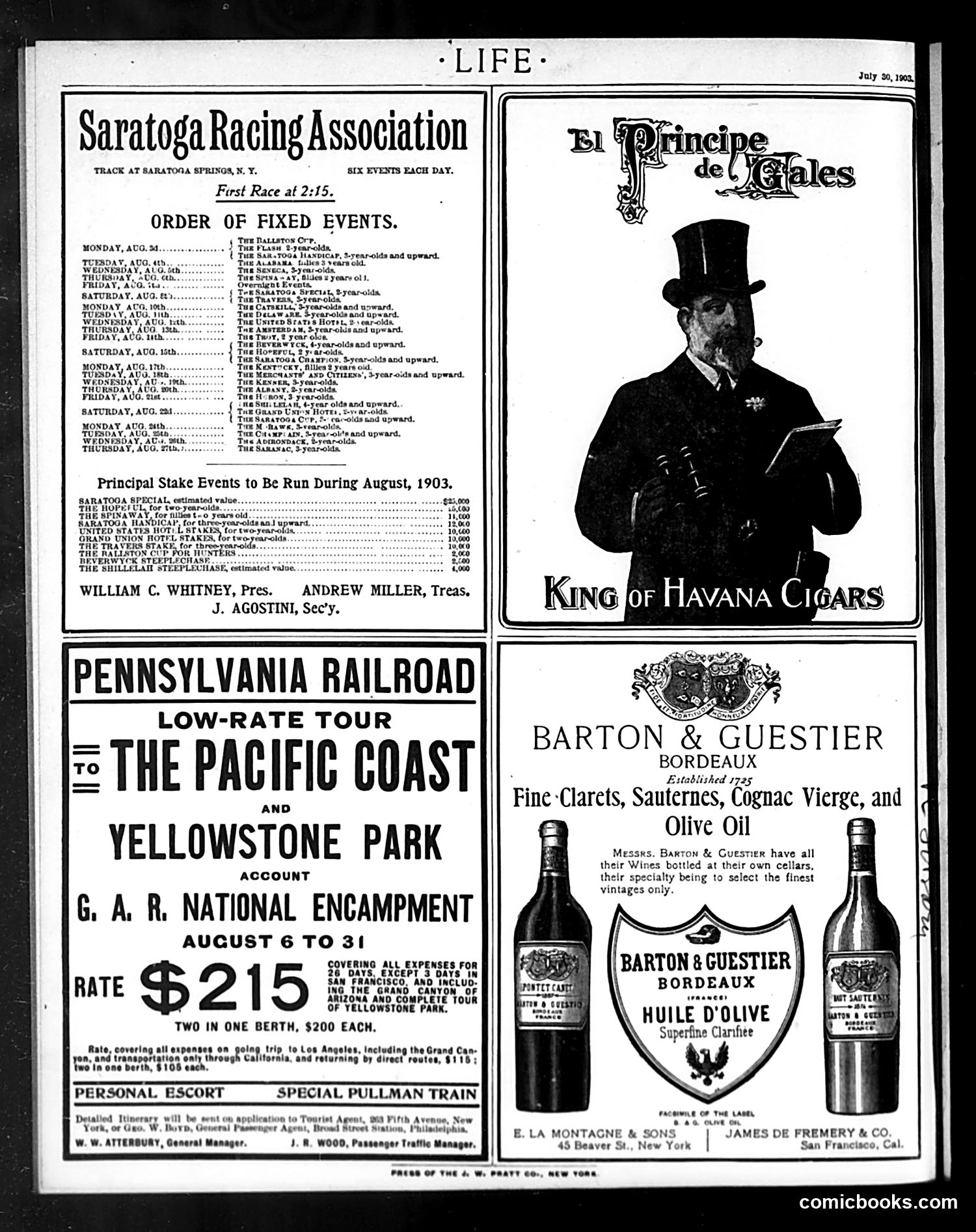
This is primarily an **advertising page** rather than satirical content. It contains four distinct advertisements: 1. **Saratoga Racing Association** — announces horse racing events at Saratoga Springs, New York for August 1903, listing daily races and stakes events with prize money. 2. **"El Príncipe de Gales" (The Prince of Wales)** — a cigar advertisement featuring a well-dressed man in a top hat. The imagery capitalizes on prestige associated with British royalty. 3. **Pennsylvania Railroad** — promotes low-cost tours to the Pacific Coast and Yellowstone Park (August 6-31), framed as part of a "G.A.R. National Encampment" (Grand Army of the Republic—Civil War veterans' organization). 4. **Barton & Guestier** — Bordeaux wine merchant advertising fine clarets, cognac, and olive oil from their French cellars. The page reflects 1903 leisure culture: gambling, travel, imported luxuries, and nostalgic veteran tourism. No political satire is evident—this is straightforward commercial content aimed at affluent readers.

I cannot reliably interpret this page. The image is almost entirely black or severely underexposed, making any cartoon illustrations, captions, or text content essentially invisible. While there is a visible white border/margin on the left side and the "comicbooks.com" watermark at bottom right, the actual content—whether cartoons, illustrations, text, or advertisements—cannot be discerned clearly enough to identify figures, understand references, or explain satirical intent. A higher-contrast or better-quality scan would be needed to provide meaningful analysis of this Life magazine page.
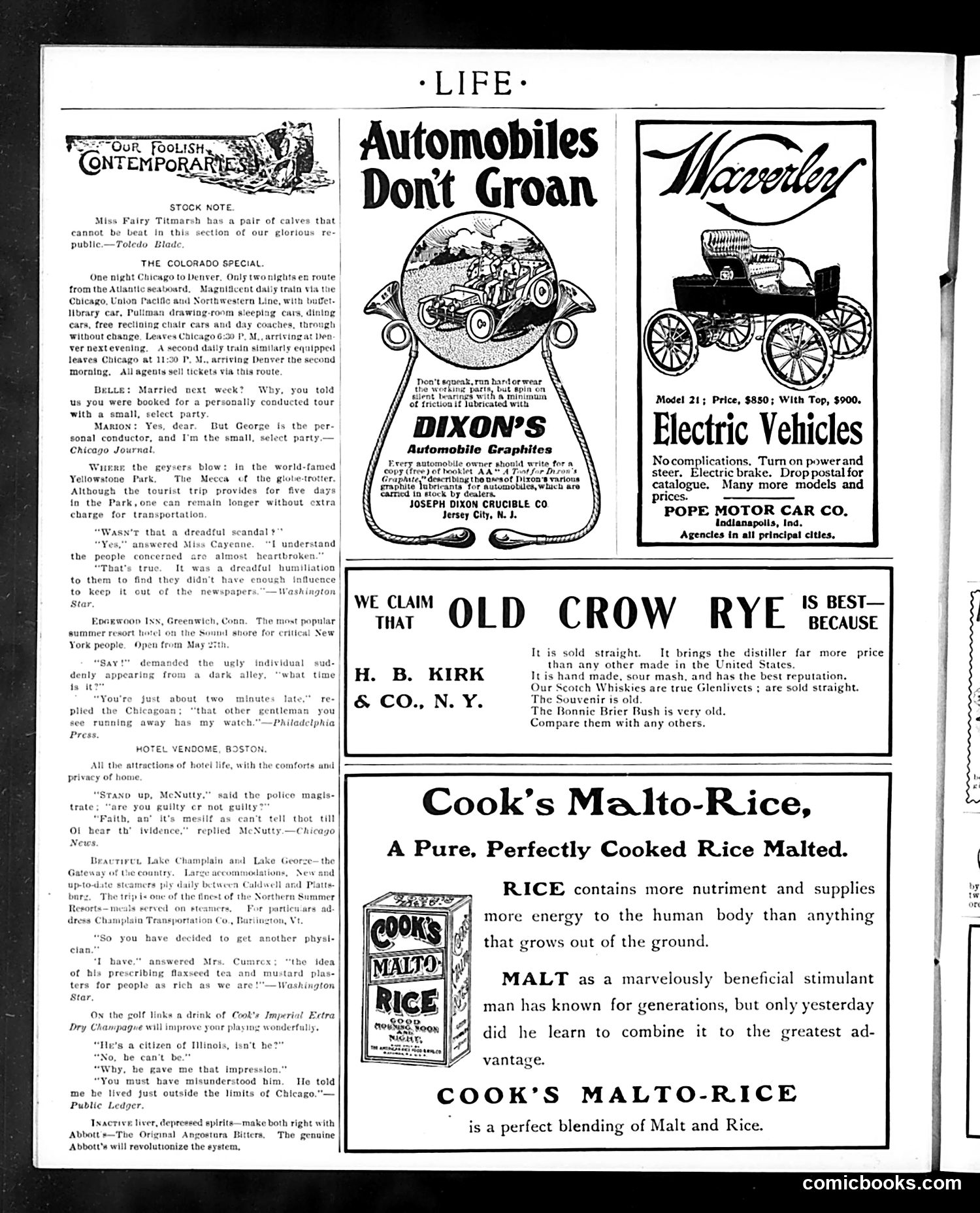
This page from *Life* magazine consists primarily of **advertisements and humorous short anecdotes** rather than political satire. The main content includes: **The Cartoons/Jokes:** The central cartoon, "Automobiles Don't Groan," depicts a personified automobile with a human face, advertising Dixon's Automobile Graphites. It's a lighthearted pun—the car won't "groan" (complain) if properly lubricated. Below is a brief dialogue joke about a woman named Marion who was "booked for a personally conducted tour" but clarifies her husband George is the conductor and she's the "select party"—a play on words about marriage. **The Advertisements:** The page showcases early 1900s products: Marvelday Electric Vehicles, Old Crow Rye whiskey, Cook's Malto-Rice (a health food), and various travel promotions. **Historical Context:** The humor reflects pre-WWI American life, with casual attitudes toward marriage, early automobile culture, and patent medicines marketed as health solutions. The page demonstrates *Life*'s mix of satirical commentary with commercial advertising.
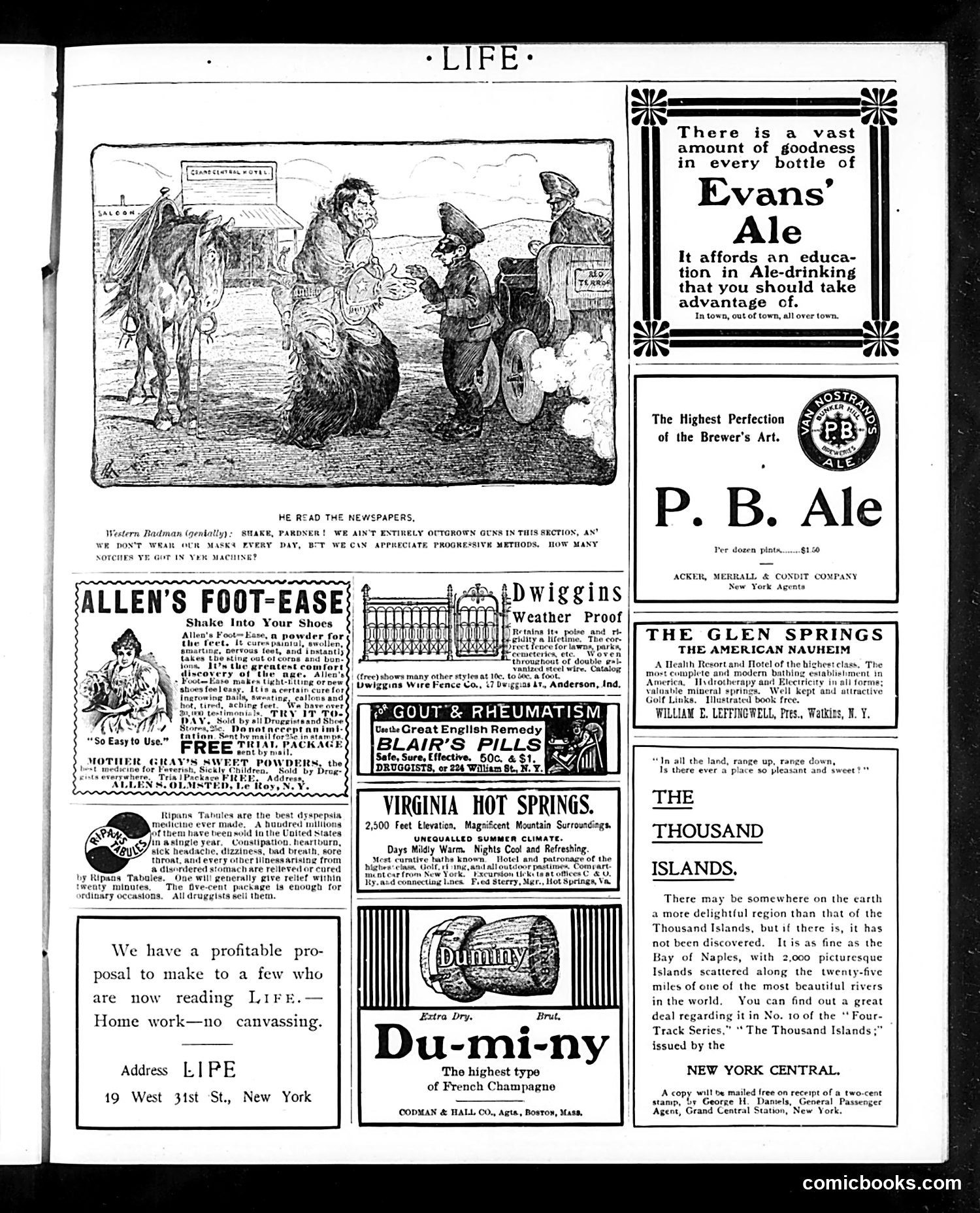
This single-panel cartoon satirizes the contrast between Western frontier violence and progressive modern society. Two "Western Badmen" encounter each other; one asks the other how many "notches" are in his gun—a reference to the frontier practice of marking kills on one's weapon. The joke's point: the questioner acknowledges that despite reading newspapers about "progressive methods," the West hasn't entirely abandoned guns and frontier violence. There's ironic tension between claims of civilizational progress (represented by newspaper access) and persistent violent traditions. The cartoon critiques either frontier nostalgia or skepticism about whether modernity truly transforms regional cultures. The rest of the page consists entirely of period advertisements (foot powder, champagne, spa resorts, etc.), making this the magazine's sole editorial content.
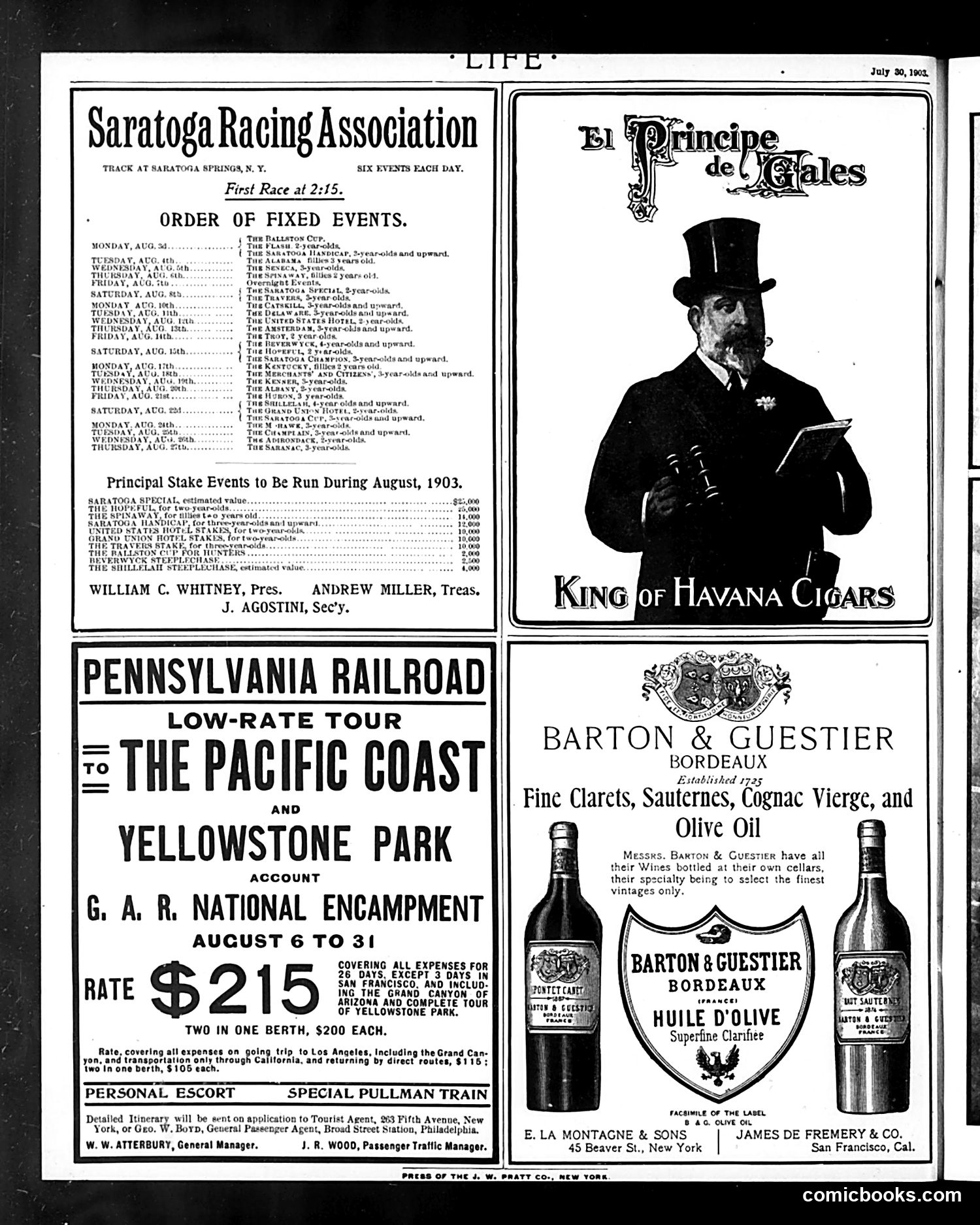
This page is primarily **advertising**, not satire or political commentary. It contains four distinct advertisements: 1. **Saratoga Racing Association**: Announces horse racing events at Saratoga Springs, New York in August 1903, listing stake races and prize amounts. 2. **El Príncipe de Gales Cigars**: Features an illustration of a distinguished gentleman in formal attire (top hat, reading material) advertising Havana cigars—a luxury product appeal to affluent readers. 3. **Pennsylvania Railroad Tour**: Promotes discounted excursion packages to the Pacific Coast and Yellowstone Park (August 6-31, 1903) at $215 per person, marketed as all-inclusive travel. 4. **Barton & Guestier**: A French wine and olive oil merchant (established 1725) advertising Bordeaux wines and specialty products. The page reflects **Gilded Age consumer culture**—targeting wealthy readers with leisure travel, fine wines, and luxury goods. There is no political satire present.