
Life, 1903-07-30 · page 14 of 24
Life — July 30, 1903 — page 14: what you’re looking at
What you’re looking at
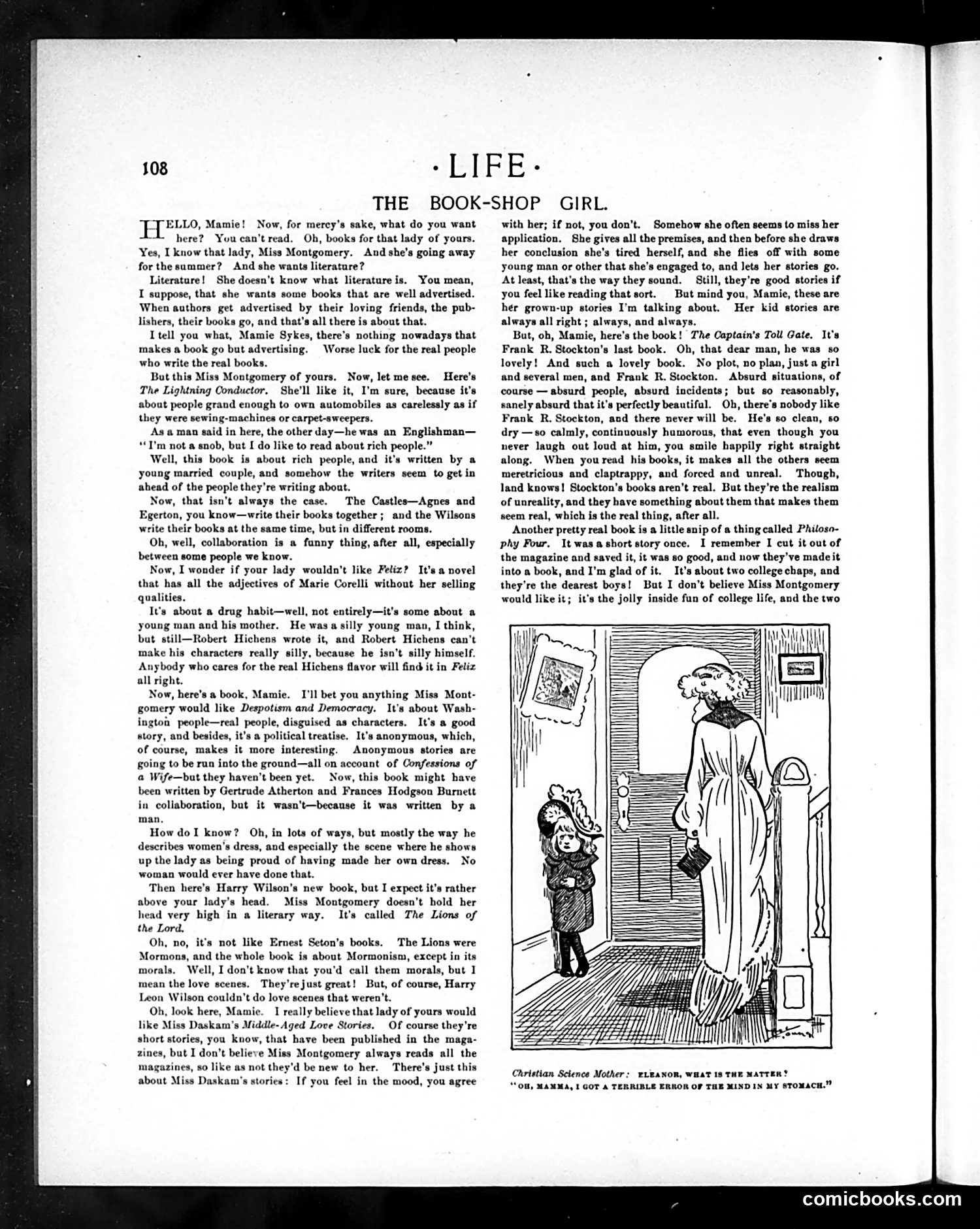
This is a satirical dialogue between a cynical bookshop clerk and a customer named Mamie, discussing what novels to recommend to "Miss Montgomery," a wealthy but intellectually unambitious woman. The satire targets: 1. **Publishing industry fakery**: The clerk openly mocks how books succeed through advertising rather than merit—"nothing nowadays that makes a book go but advertising. Worse luck for the real people who write the real books." 2. **Wealthy readers' shallow tastes**: Montgomery is presented as someone who reads books about rich people living luxuriously (automobiles, fine dress) rather than serious literature. 3. **Author recognition**: References to contemporary bestselling authors (Marie Corelli, Robert Hichens, Gertrude Atherton, Ernest Seton, Harry Leon Wilson) whose popularity the clerk dismisses as marketing-driven. 4. **Gender stereotyping**: The clerk deduces an anonymous book was written by a man because no woman would boast of making her own dress—a joke about feminine vanity and class pretension. The cartoon illustration shows a woman selecting books while a child peers at the shelves, visualizing the scene being discussed.
📄 Transcribed text from this page (OCR, searchable)
Machine-transcribed from the original scan — historical spelling and the odd misread are preserved.
108 SIBLE: THE BOOK-SHOP GIRL. y ELLO, Mamie! Now, for mercy’s sake, what do you want here? You can’t read. Oh, books for that lady of yoars. Yes, I know that lady, Miss Montgomery, And she’s going away forthe summer? And she wants literature? Literature! She doesn't know what literature is. You mean, I suppose, that she wants some books that are well advertised. When authors get advertised by their loving friends, the pub- lishers, their books go, and that's all there is about that. I tell you what, Mamie Sykes, there's nothing nowadays that makes a book go but advertising. Worse luck for the real people who write the real books, But this Miss Montgomery of yours. Now, let me see. Here's The Lightning Conductor, She'll like it, I’m sure, because it’ about people grand enough to own automobiles as carelessly as if they were sewing-machines or carpet-sweepers. As a man said in here, the other day—he was an Englishman— “I'm not a snob, but I do like to read about rich people.” Well, this book is about rich people, and it's written by a young married couple, and somehow the writers seem to get in ahead of the people they're writing about. Now, that isn’t always the case. The Castles—Agnes and Egerton, you know—write their books together ; and the Wilsons write their books at the same time, but in different rooms. Oh, well, collaboration is a fanny thing, after all, especially between some people we know. Now, I wonder if your lady wouldn't like Feliz? It's a novel that has all the adjectives of Marie Corelli without her selling qualities. It’s about a drug habit—well, not entirely—it's some about a young man and his mother. He wasa silly young man, I think, but still—Robert Hichens wrote it, and Robert Hichens can't make his characters really silly, because he isn’t silly himself. Anybody who cares for the real Hichens flavor will find it in Feliz all right. Now, here's a book, Mamie. I'll bet you anything Miss Mont- gomery would like Despotism and Democracy. It's about Wash- ington people—real people, disguised as characters. It's a good story, and besides, it's a political treatise, It’s anonymous, which, of course, makes it more interesting. Anonymous stories are going to be run into the ground—all on account of Confessions of a Wife—but they haven't been yet. Now, this book might have been written by Gertrude Atherton and Frances Hodgson Burnett in collaboration, but it wasn't—because it was written by a man, How doI know? Oh, in lots of ways, but mostly the way he describes women's dress, and especially the scene where he shows up the lady as being proud of having made her own dress. No woman would ever have done that. Then here’s Harry Wilson's new book, but I expect it’s rather above your lady’s head. Miss Montgomery doesn't hold her head very high in a literary way. It’s called The Lions of the Lord, Oh, no, it’s not like Ernest Seton’s books. The Lions were Mormons, and the whole book is about Mormonism, except in its morals. Well, I don't know that you'd call them morals, but I mean the love scenes, They’rejust great! But, of course, Harry Leon Wilson couldn't do love scenes that weren't. Oh, look here, Mamie. I really believe that lady of yours would like Miss Daskam's Middle- Aged Love Stories. Of course they're short stories, you know, that have been published in the maga- zines, but I don’t believe Miss Montgomery always reads all the magazines, so like as not they'd be new to her. There's just this about Miss Daskam's stories: If you feel in the mood, you agree with her; if not, you don’t. Somehow she often seems to miss her application. She gives all the premises, and then before she draws her conclusion she's tired herself, and she flies off with some young man or other that she’s engaged to, and lets her stories go. At least, that's the way they sound. Still, they're good stories if you feel like reading that sort. But mind you, Mamie, these are her grown-up stories I’m talking about. Her kid stories are always all right ; always, and always. But, oh, Mamie, here’s the book! The Captain's Toll Gate, It's Frank R. Stockton’s last book. Ob, that dear man, he was so lovely! And such a lovely book. No plot, no plan, just a girl and several men, and Frank R. Stockton. Absurd situations, of course —absurd people, absurd incidents; but so reasonably, sanely absurd that it’s perfectly beautiful. Ob, there's nobody like Frank R. Stockton, and there never will be. He's so clean, so dry —so calmly, continuously humorous, that even though you never laugh out loud at him, you smile happily right straight along. When you read his books, it makes all the others seem meretricious and claptrappy, and forced and unreal. Though, land knows! Stockton’s books aren’t real. But they're the realism of unreality, and they have something about them that makes them seem real, which is the real thing, after all. Another pretty real book is a little snip of a thing called Philoso- phy Four. It wasashort story once. I remember I cut it out of the magazine and saved it, it was 80 good, and now they've madeit into a book, and I'm glad of it. It’s about two college chaps, and they're the dearest boys! But I don’t believe Miss Montgomery would like it; it’s the jolly inside fun of college life, and the two Hh Wy} Christian Science Mother: ELBaNoR, WHAT 18 THE MATTER! “OM, MAMMA, 1 GOT A TERRIBLE ERROR OF THE MIND IN MY STOMACH.” comicbooks.com