
Life, 1903-07-30 · page 4 of 24
Life — July 30, 1903 — page 4: what you’re looking at
What you’re looking at
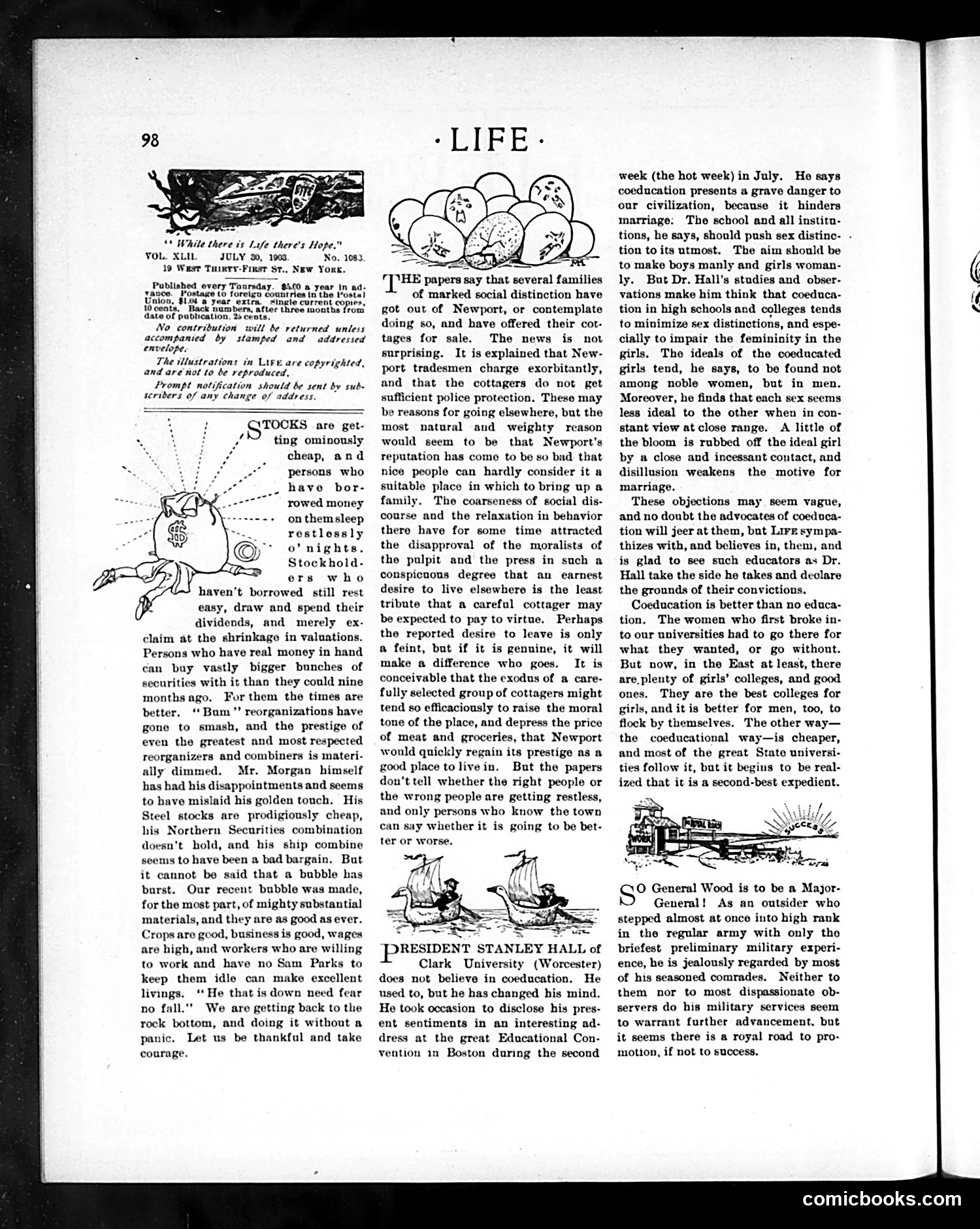
**The Main Cartoon:** The left illustration shows a figure labeled "STOCKS" as a large, inflated balloon being held down by multiple ropes. The satire depicts stock market speculation as dangerously unstable—kept aloft only by continuous effort and restraint. The visual metaphor suggests that if people stopped "borrowing money on bloomingly restlessly of nights," the bubble would burst catastrophically. **The Text's Context:** The article discusses Newport's reputation decline as wealthy families relocate. It critiques how Newport's social prestige has suffered, with even the "moralists of the pulpit and press" expressing disapproval. The piece argues that careful social management might restore the town's standing. **The Political Point:** This reflects early 1900s anxiety about speculative finance and wealth concentration, alongside concerns about America's established elite retreating from traditional centers of influence.
📄 Transcribed text from this page (OCR, searchable)
Machine-transcribed from the original scan — historical spelling and the odd misread are preserved.
‘* While there is Life there's Hope.” VOL. XLIL JULY 20, 1903. ‘No. 1083. 19 West Taxrt Published overy Tooreday. $400 a year in ad- raves. Postage (0 foreigo countries in the Posts Union, #110 a year exten, single current copies, Weeats. bumbers, after three months from date of publication. 25 ccats- No contribution will be returned unless accompanied by stamped and addressed envelope. The illustrations in Live are copyrighted, and are not to be reproduced, Prompt notification should be sent bv sub- seribers of any change of address. GTOCKs are get- ting ominously cheap, and persons who have bor- rowed money onthemsleep restlessly o’ nights. Stockhold- ers who haven't borrowed still rest easy, draw and spend their dividends, and merely ex- claim at the shrinkage in valuations. Persons who have real money in hand can buy vastly bigger bunches of securities with it than they could nine months ago. For them the times are better. ‘‘ Bum” reorganizations have gone to smash, and the prestige of even the greatest and most respected reorganizers and combiners is materi- ally dimmed. Mr. Morgan himself has had his disappointments and seems to have mislaid his golden touch. His Steel stocks are prodigiously cheap, his Northern Securities combination doesn’t hold, and his ship combine seems to have been a bad bargain. But it cannot be said that a bubble has burst. Our recent bubble was made, for the most part, of mighty substantial materials, and they are as good as ever. Crops are good, business is good, wages are high, and workers who are willing to work and have no Sam Parks to keep them idle can make excellent livings. ‘He that is down need fear no fall." We are getting back to the rock bottom, and doing it without a panic. Let us be thankful and take courage. RSS : TRE papers say that several families of marked social distinction have got out of Newport, or contemplate doing so, and have offered their cot- tages for sale. The news is nov surprising. It is explained that New- port tradesmen charge exorbitantly, and that the cottagers do not get sufficient police protection, These may be reasons for going elsewhere, but the most natural and weighty reason would seem to be that Newport's reputation has como to be so bad. that nice people can hardly consider it a suitable place in which to bring up a family. The coarseness of social dis- course and the relaxation in behavior there have for some time attracted the disapproval of the moralists of the pulpit and the press in such a conspicuous degree that an earnest desire to live elsewhere is the least tribute that a careful cottager may be expected to pay to virtue. Perhaps the reported desire to leave is only a feint, but if it is genuine, it will make a difference who goes. It is conceivable that the exodus of a care- fully selected group of cottagers might tend so efficaciously to raise the moral tone of the place, and depress the price of meat and groceries, that Newport would quickly regain its prestige as a good place tolivein. But the papers don't tell whether the right people or the wrong people are getting restless, and only persons who know the town can say whether it is going to be bet- ter or worse. RESIDENT STANLEY HALL of Clark University (Worcester) does not believe in coeducation. He used to, but he has changed his mind. He took occasion to disclose his pres- ent sentiments in an interesting ad- dress at the great Educational Con- vention in Boston during the second week (the hot week) in July. Ho says coeducation presents a grave danger to our civilization, because it hinders marriage: The school and all instita- tions, he says, should push sex distine- - tion to its utmost. The aim should be to make boys manly and girls woman- ly. But Dr. Hall's studies and obser- vations make him think that coeduca- tion in high schools and colleges tends to minimize sex distinctions, and espe- cially to impair the femininity in the girls. The ideals of the coeducated girls tend, he says, to be found not among noble women, but in men. Moreover, he finds that each sex seems less ideal to the other when in con- stant view at close range. A little of the bloom is rubbed off the ideal girl by a close and incessant contact, and disillusion weakens the motive for marriage. These objections may seem vague, and no doubt the advocates of coeduca- tion will jeer at them, but Lirz sympa- thizes with, and believes in, them, and is glad to see such educators as Dr. Hall take the sido he takes and deolare the grounds of their convictions. Coeducation is better than no educa- tion. The women who first broke in- to our universities had to go there for what they wanted, or go without. But now, in the East at least, there are.plenty of girls’ colleges, and good ones. They are the best colleges for girls, and it is better for men, too, to flock by themselves. The other way— the coeducational way—is cheaper, and most of the great State universi- ties follow it, but it begins to be real- ized that it is a second-best expedient. S° General Wood is to be a Major- KR General! As an outsider who stepped almost at once into high rank in the regular army with only tho briefest preliminary military experi- ence, he is jealously regarded by most of his seasoned comrades. Neither to them nor to most dispassionate ob- servers do his military services seem to warrant further advancement, but it seems there is a royal road to pro- motion, if not to success. comicbooks.com