
A complete issue · 20 pages · 1903
Life — June 11, 1903
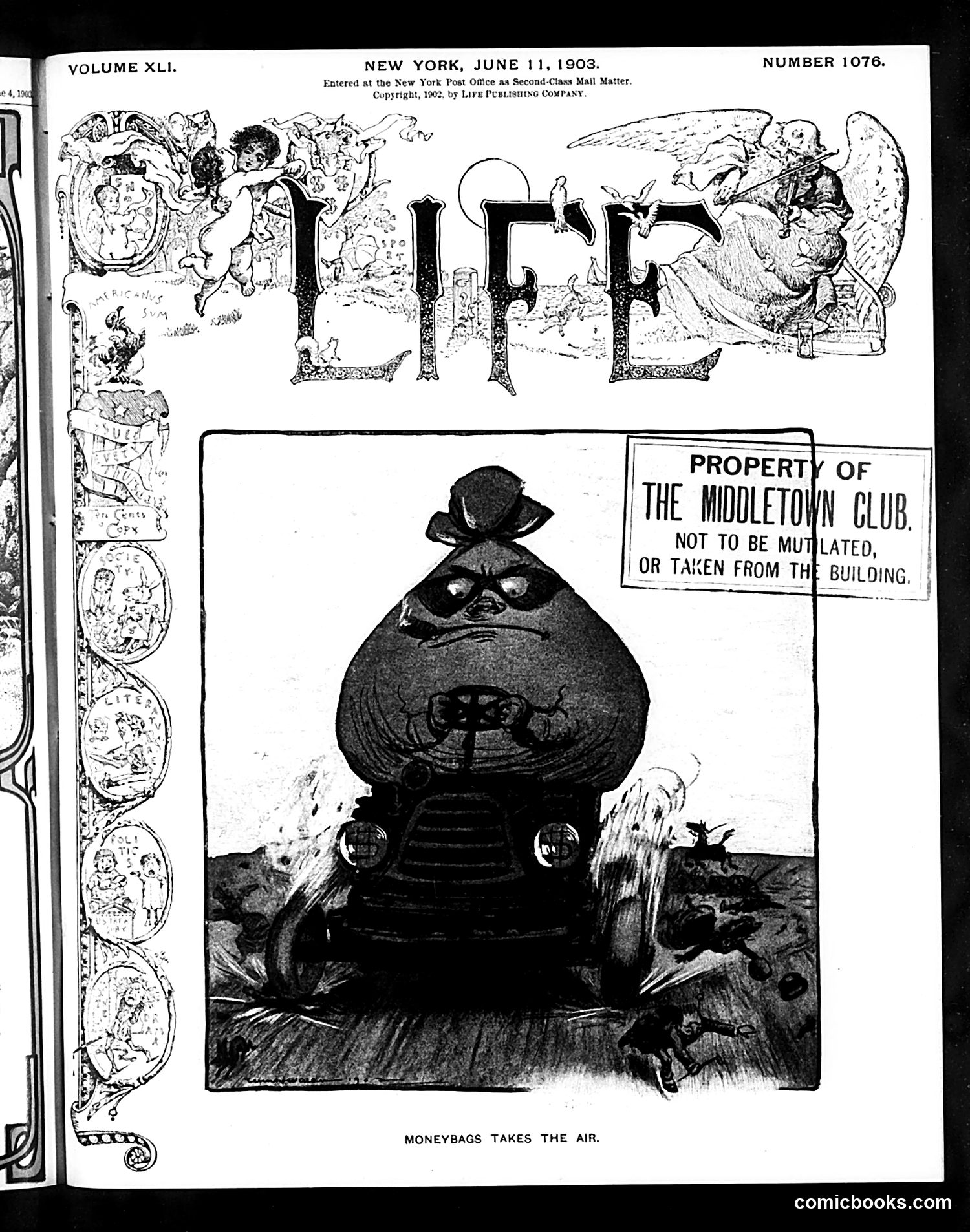
This satirical cover depicts "Moneybags Takes the Air"—a rotund, wealthy figure wearing a top hat and monocle, portrayed as a bloated money-bag with a smug expression. The character is airborne, suggesting the wealthy are becoming increasingly removed from ordinary society. The accompanying property notice from "The Middletown Club" warns the figure not to be "mutilated, or taken from the building," treating the wealthy patron as a possession—satirizing how exclusive clubs protected their elite members. The ornate decorative border with classical scenes suggests contrast between refined tradition and modern greed. The satire critiques how the wealthy literally and figuratively elevated themselves above common people during the Gilded Age's economic inequality.
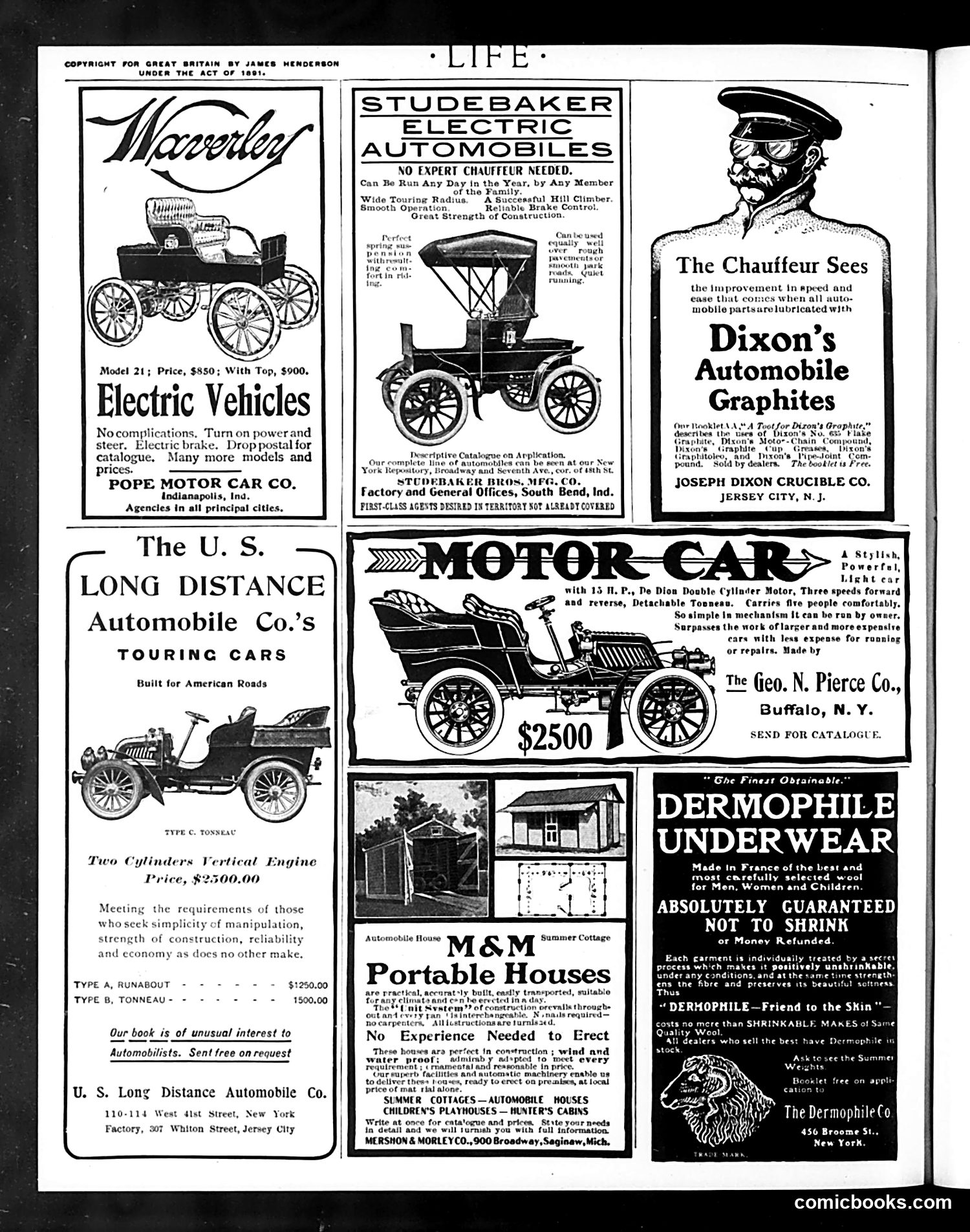
This page consists **primarily of advertisements** for early automobiles and related products, dating to the early 1900s based on vehicle styles and technology mentioned. Notable ads include: - **Waverley Electric Vehicles** ($850-$900): Early electric cars marketed as simple, no-chauffeur-needed transportation - **Studebaker Electric Automobiles**: Similar pitch emphasizing ease of operation - **Geo. N. Pierce Co. Motor Car** ($2500): A more expensive, powerful gasoline vehicle - **U.S. Long Distance Automobile Co.**: Touring cars at $2,250 The ads reflect the era's **transition between electric and gasoline automobiles**, with electric vehicles marketed to affluent buyers wanting convenient, uncomplicated transportation. Additional ads promote automobile accessories, portable houses, and undergarments—typical magazine revenue sources. **There is no political cartoon visible** on this page; it is a commercial advertising section.
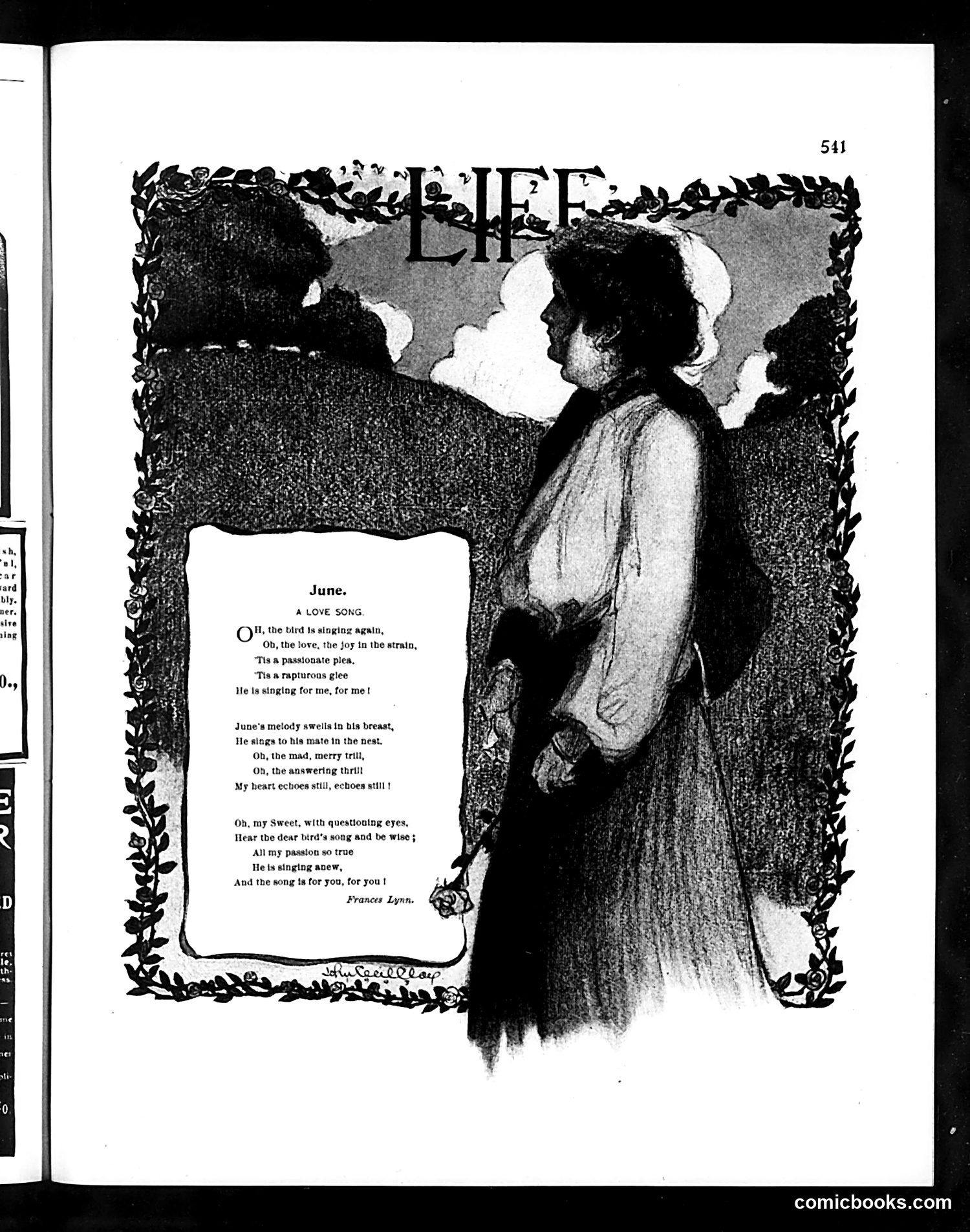
This page features "A Love Song" by Frances Lynn, illustrated with an Art Nouveau-style drawing of a woman in profile. The poem describes a bird singing of love and passion, with romantic imagery ("rapturous glee," "answering thrill"). The illustration shows a fashionably dressed woman from the early 1900s listening to or observing birds, rendered in the decorative style characteristic of Life magazine's aesthetic during this period. The ornamental border and soft-focus artistic treatment suggest this is a serious romantic or sentimental contribution rather than satire. Without identifying specific political references or caricatures, this appears to be a straightforward literary and artistic piece celebrating romantic love through nature imagery—typical of Life's cultural content in the early twentieth century.
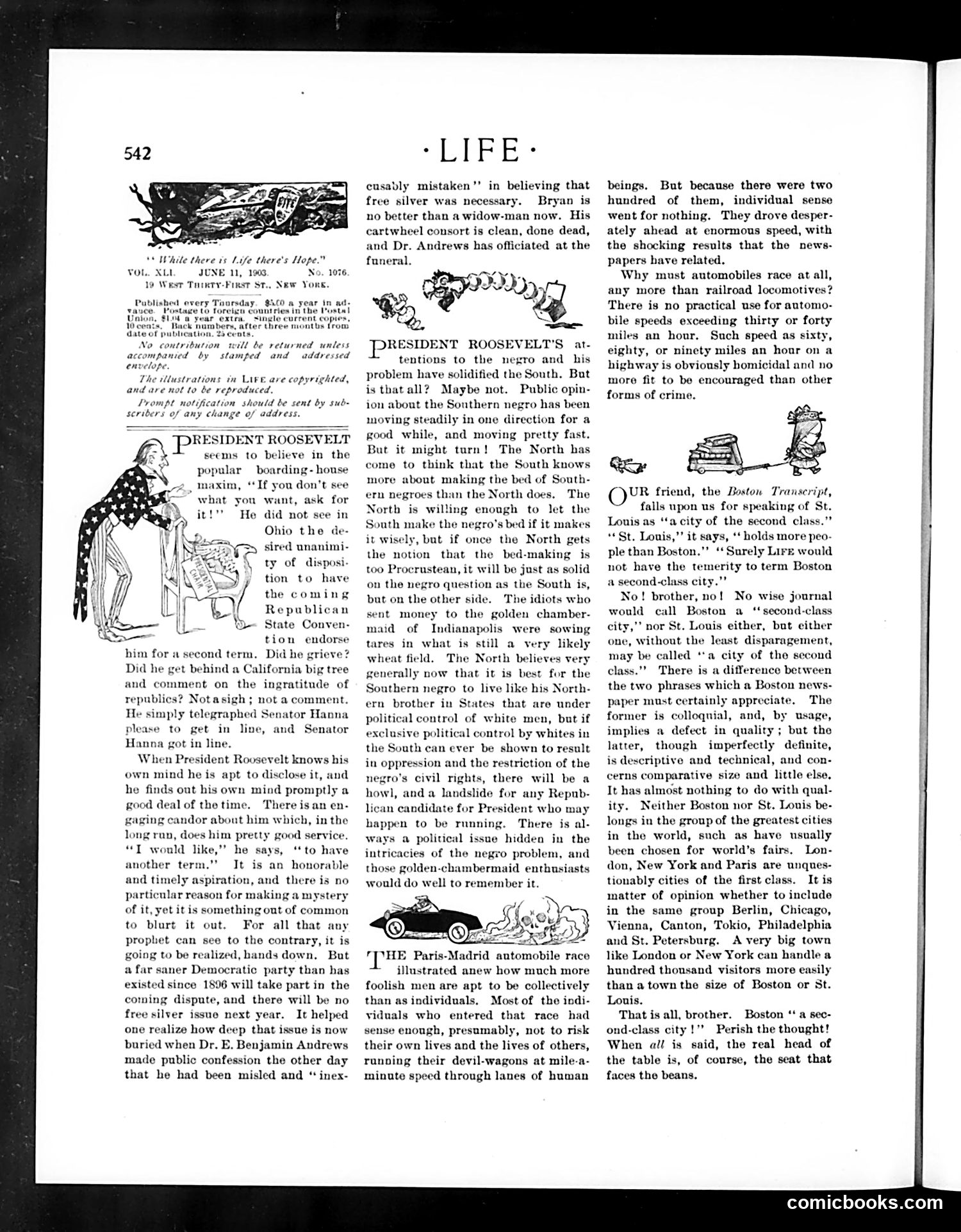
This page from *Life* magazine contains editorial commentary on President Roosevelt's views regarding the American South and race relations. The text critiques Roosevelt's optimistic belief that the South is improving its treatment of African Americans, suggesting this assessment may be mistaken. The accompanying cartoon depicts Roosevelt in conversation, likely illustrating his confidence about Southern progress. The editorial argues that the North shouldn't assume the South has reformed, warning that Northern interference in "bed-making" could backfire politically. The piece also includes commentary on automobiles and a separate discussion comparing Boston to St. Louis as major American cities. The overall tone is satirical, questioning Roosevelt's optimism about racial progress in the post-Reconstruction South.
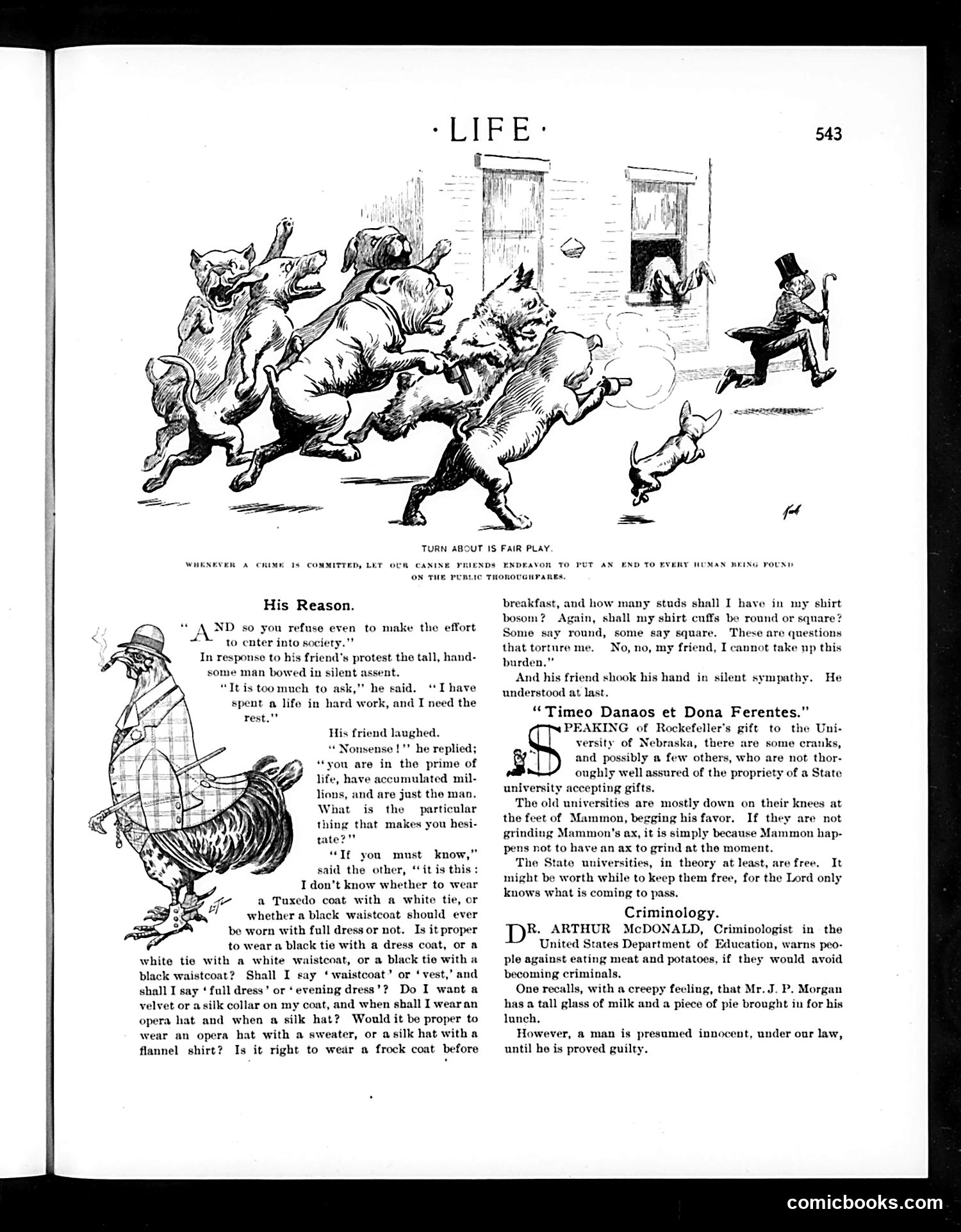
This cartoon satirizes wealthy industrialists being chased by dogs—likely representing consequences for their crimes against the public. The caption reads: "Whenever a crime is committed, let our canine friends endeavor to put an end to every human being found on the public thoroughfares." The satire inverts normal power dynamics: rich men who typically evade justice through wealth and connections now face pursuit like common criminals. The well-dressed gentleman fleeing on the right (possibly a caricatured industrialist or robber baron) experiences the street-level harassment ordinary people endured. The accompanying text "His Reason" discusses a man refusing to enter society, citing lifelong hard work and fatigue—likely critiquing upper-class pretense and the exploitation underlying industrial fortunes. This reflects Gilded Age tensions between labor and capital.
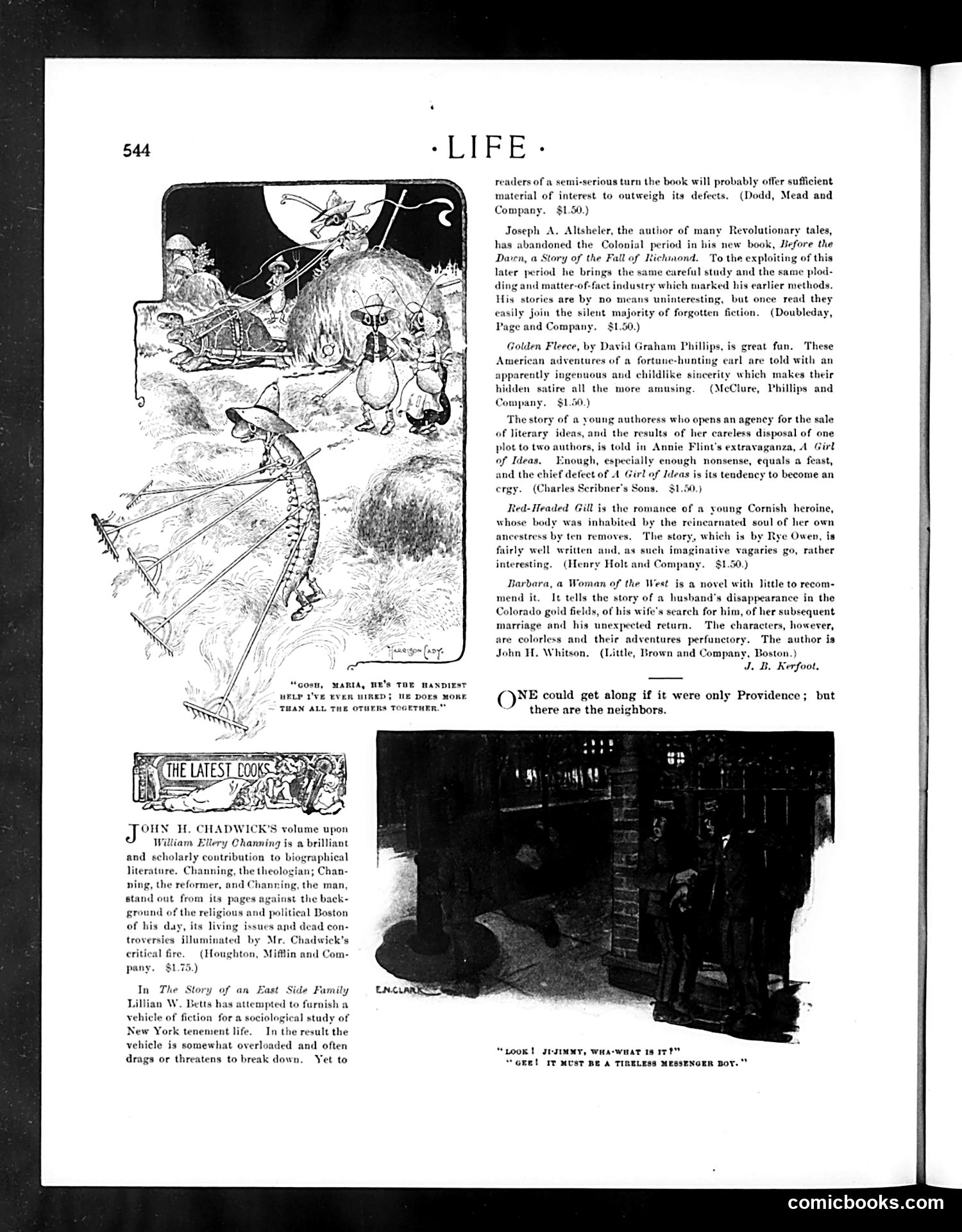
This page from *Life* magazine contains book reviews rather than political cartoons. The upper illustration depicts a whimsical scene with animals and figures in a naturalistic setting, likely accompanying a review of children's or adventure literature. The reviews discuss several novels including works by Joseph A. Alsheler (Revolutionary War tales), David Graham Phillips (*Golden Fleece*), and others. The text emphasizes storytelling quality and literary merit across various genres—from Colonial adventure to sociological fiction about New York tenement life. The lower photograph shows an indoor scene with figures, captioned with dialogue about a "timeless messenger boy." This appears to be a literary criticism section rather than satirical political commentary, focusing on evaluating contemporary American fiction and its merit.
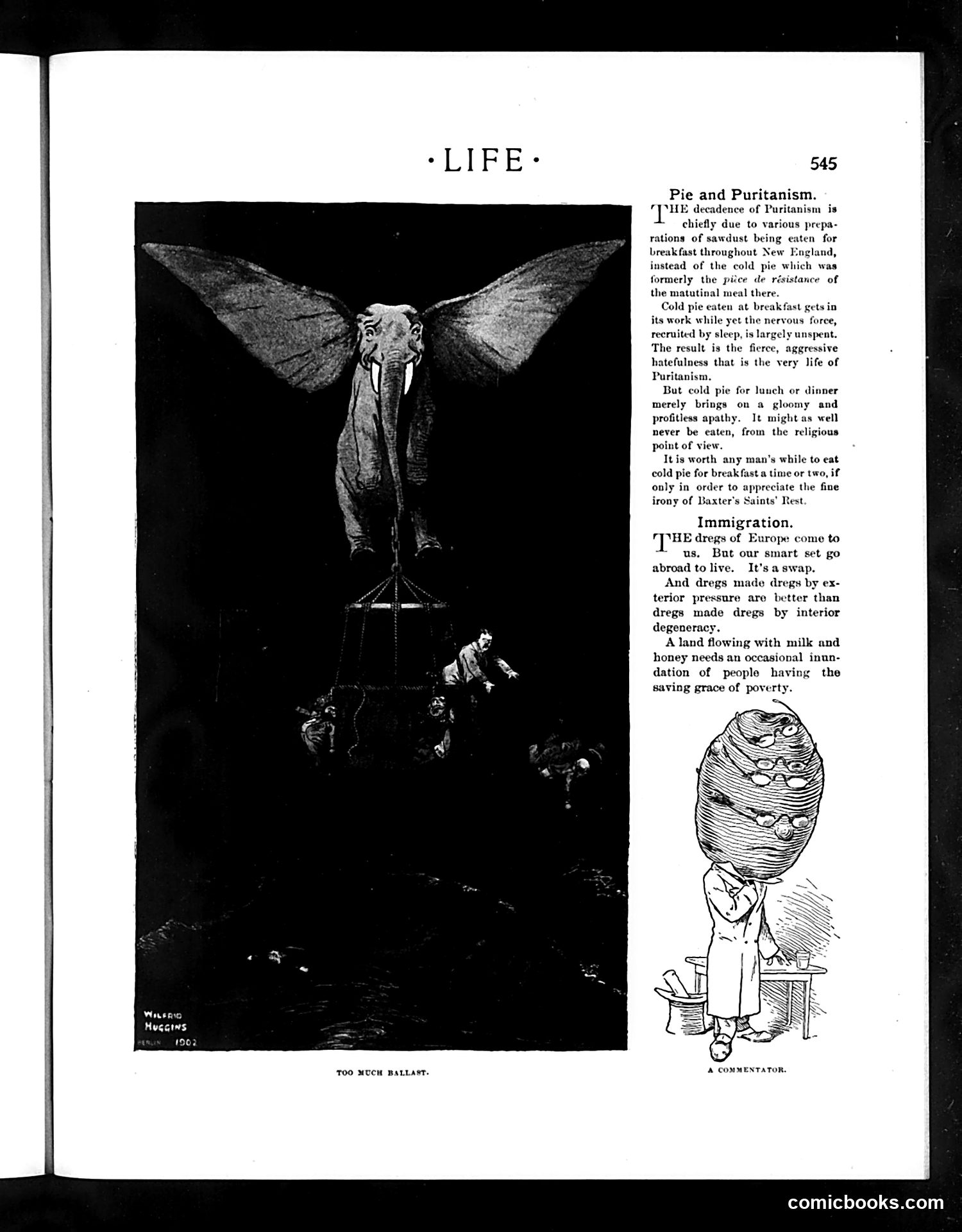
**Main Cartoon ("Too Much Ballast"):** A large stork carries multiple human figures in a bundle beneath its wings. The stork appears to be straining under the weight. This illustrates the "Immigration" article below it, which criticizes European immigrants entering America. The cartoon suggests immigrants are excessive "ballast" (dead weight) burdening the nation. **Secondary Cartoon ("A Commiserator"):** A figure with a wrapped head (appearing ill or injured) sits hunched, illustrating America's social problems. **Text Topics:** - "Pie and Puritanism" critiques New England food traditions and religious hypocrisy - "Immigration" argues that poor European immigrants lack the "saving grace of poverty" and drain resources The page reflects early 20th-century anti-immigration sentiment, sarcastically dismissing European newcomers as burdensome.
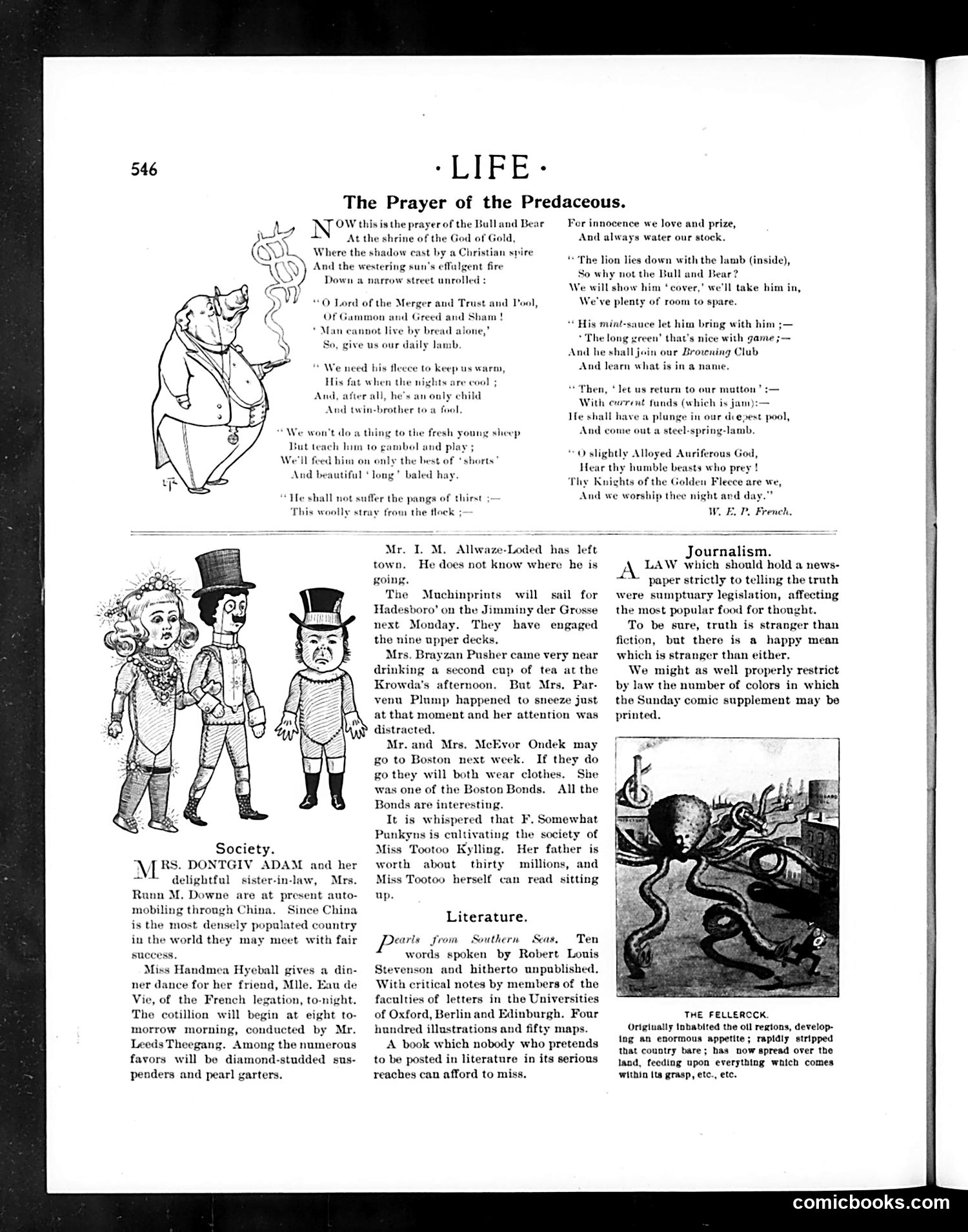
The page contains three distinct sections: **"The Prayer of the Predaceous"** (top): A satirical poem with an illustration of a bull and bear in formal dress. The poem mocks predatory financial speculation, with the animals personifying market forces. They pray to "Lord of the Merger and Trust and Pool" and plan to teach young sheep (investors) to "gamble and play," using deceptive practices. The satire targets Wall Street manipulation and exploitation of ordinary investors. **"Society"** (bottom left): Social gossip items about wealthy individuals and their activities, illustrated with caricatured figures in formal attire. **"Journalism" and "Literature"** (right): Brief commentary sections discussing newspaper regulation and a literary work about Southern life. The overall page reflects *Life's* consistent satirizing of wealthy elites, financial corruption, and social pretension.
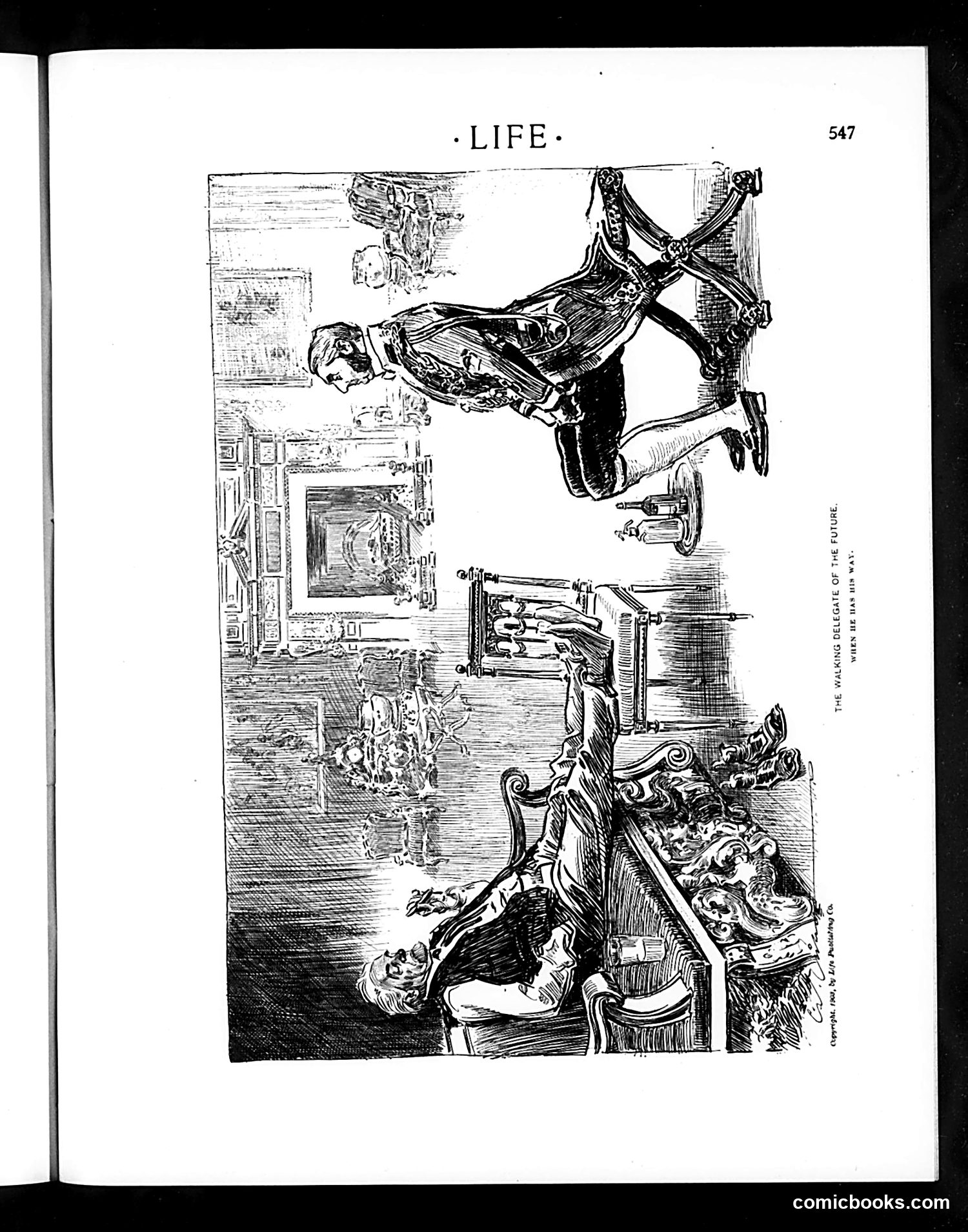
This page from *Life* magazine contains a single illustration oriented sideways (rotated 90 degrees). The sketch depicts an interior domestic scene with multiple figures in what appears to be a Victorian-era drawing room or parlor. The image shows elaborately dressed figures in period clothing interacting in an ornate interior setting with detailed furnishings and architectural elements. The style is characteristic of *Life*'s satirical social commentary, likely satirizing upper-class social customs or manners of the era. However, without legible caption text or clearer detail of specific figures' identities, I cannot definitively identify which particular social situation, political figure, or contemporary scandal this cartoon satirizes. The ornate furnishings and formal dress suggest commentary on wealthy society, but the specific satirical target remains unclear from the image alone.
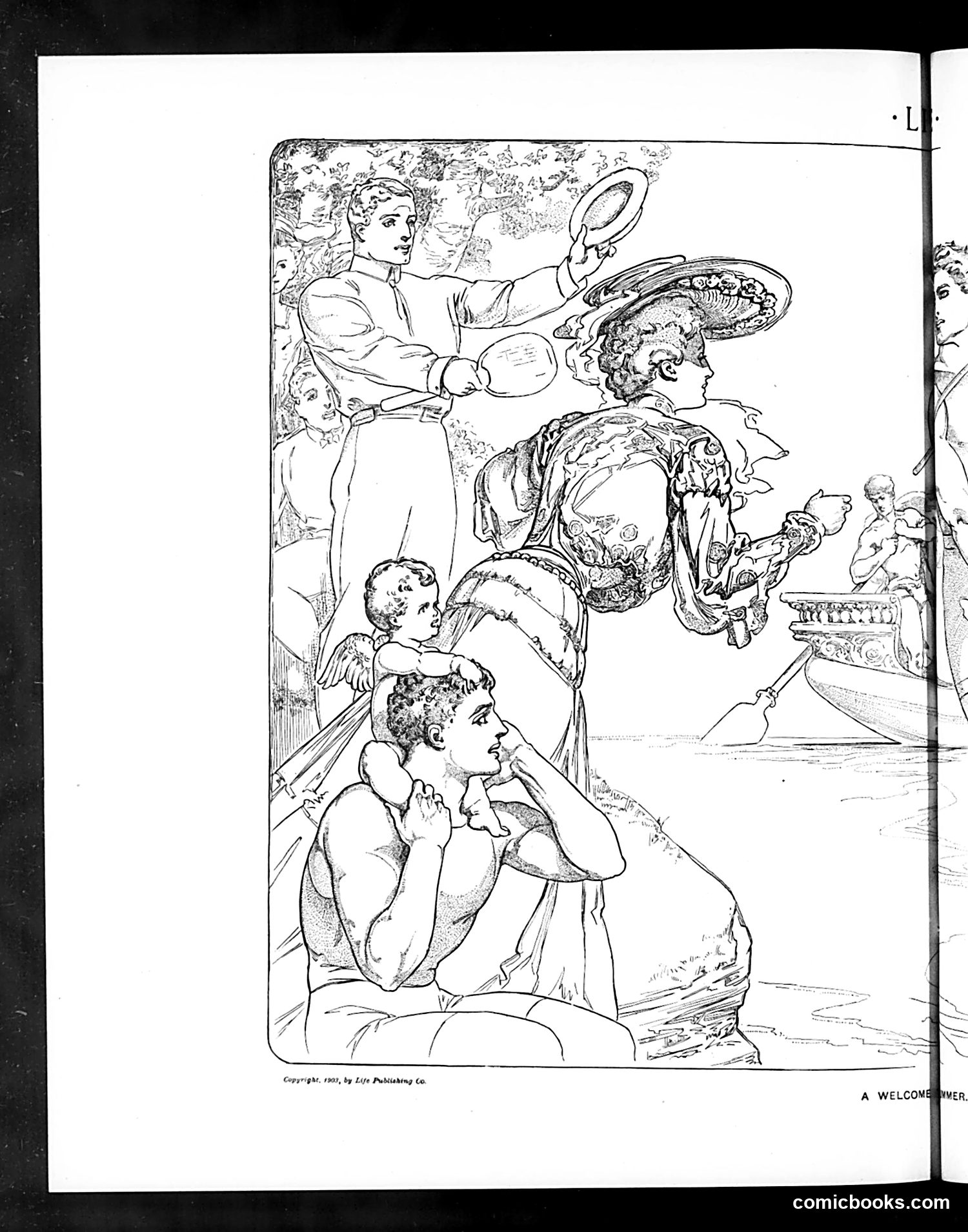
This appears to be a satirical illustration titled "A Welcome River" (visible at bottom right). The image depicts several allegorical figures in a classical style around water. The central figures appear to represent prosperity or abundance (suggested by the cornucopia-like imagery and festive gathering), while the seated figure in the foreground seems positioned as a recipient or observer of this bounty. The classical artistic style and multiple figures suggest this may be satirizing American attitudes toward immigration, commerce, or national prosperity during the early 1900s period. However, **without clearer text or additional context**, I cannot definitively identify which specific political event, policy, or public figure this cartoon references. The "welcome" title suggests positive sentiment toward something—possibly immigration or foreign trade—but the specific satirical target remains unclear from the visible information alone.
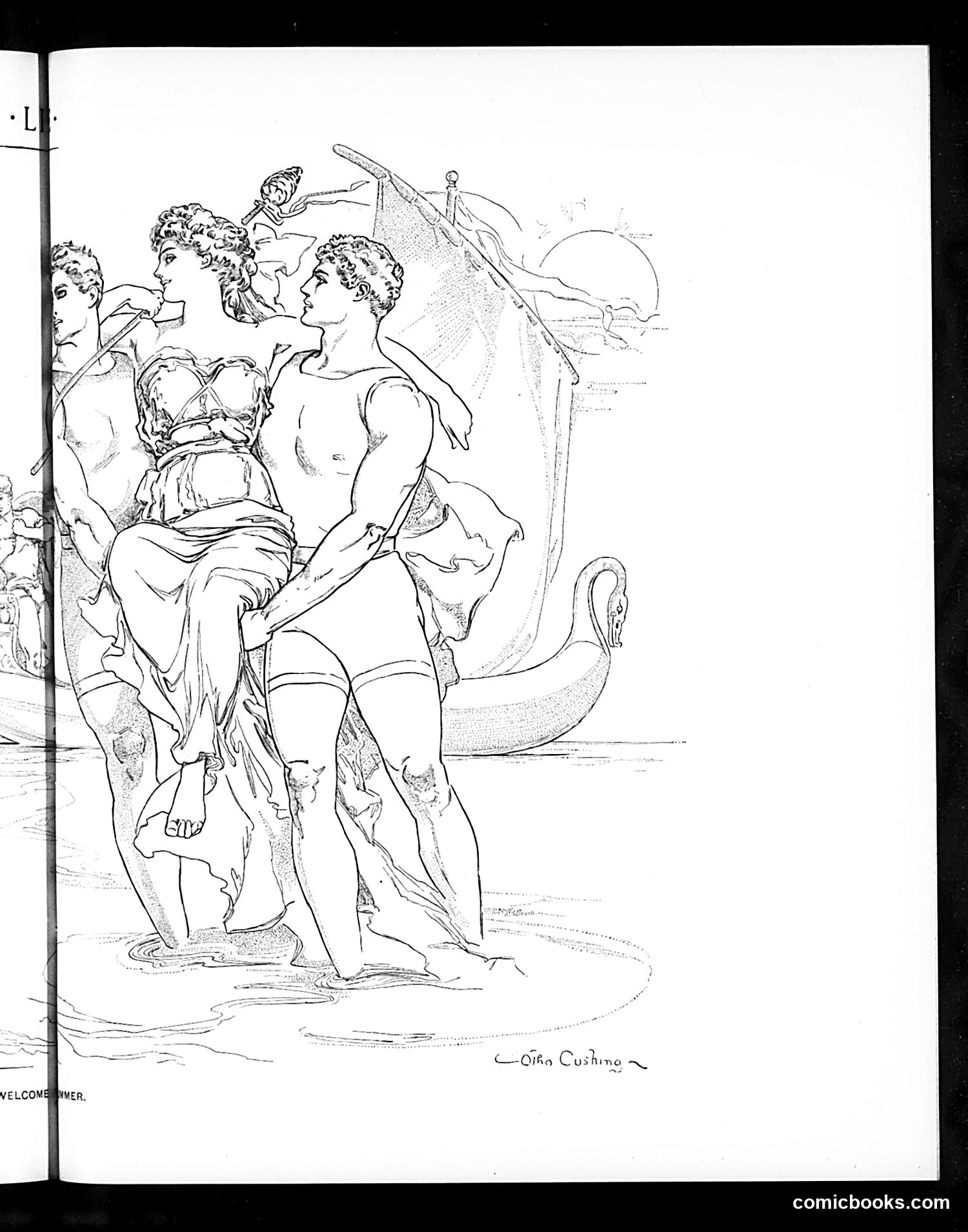
This sketch by Celia Cushing depicts classical allegorical female figures (likely representing abstract concepts or nations) in a nautical scene. One figure operates a sail while others observe, with a boat and sun visible in the background. Without additional context from the magazine's date or surrounding articles, the specific political reference is unclear. However, the maritime imagery and multiple female personifications suggest commentary on a contemporary political or international situation—possibly related to navigation of policy, diplomacy, or national direction. The style is typical of *Life* magazine's satirical approach, using classical female figures as traditional symbols for abstract ideas. The exact meaning requires knowing when this was published and what events it addresses.
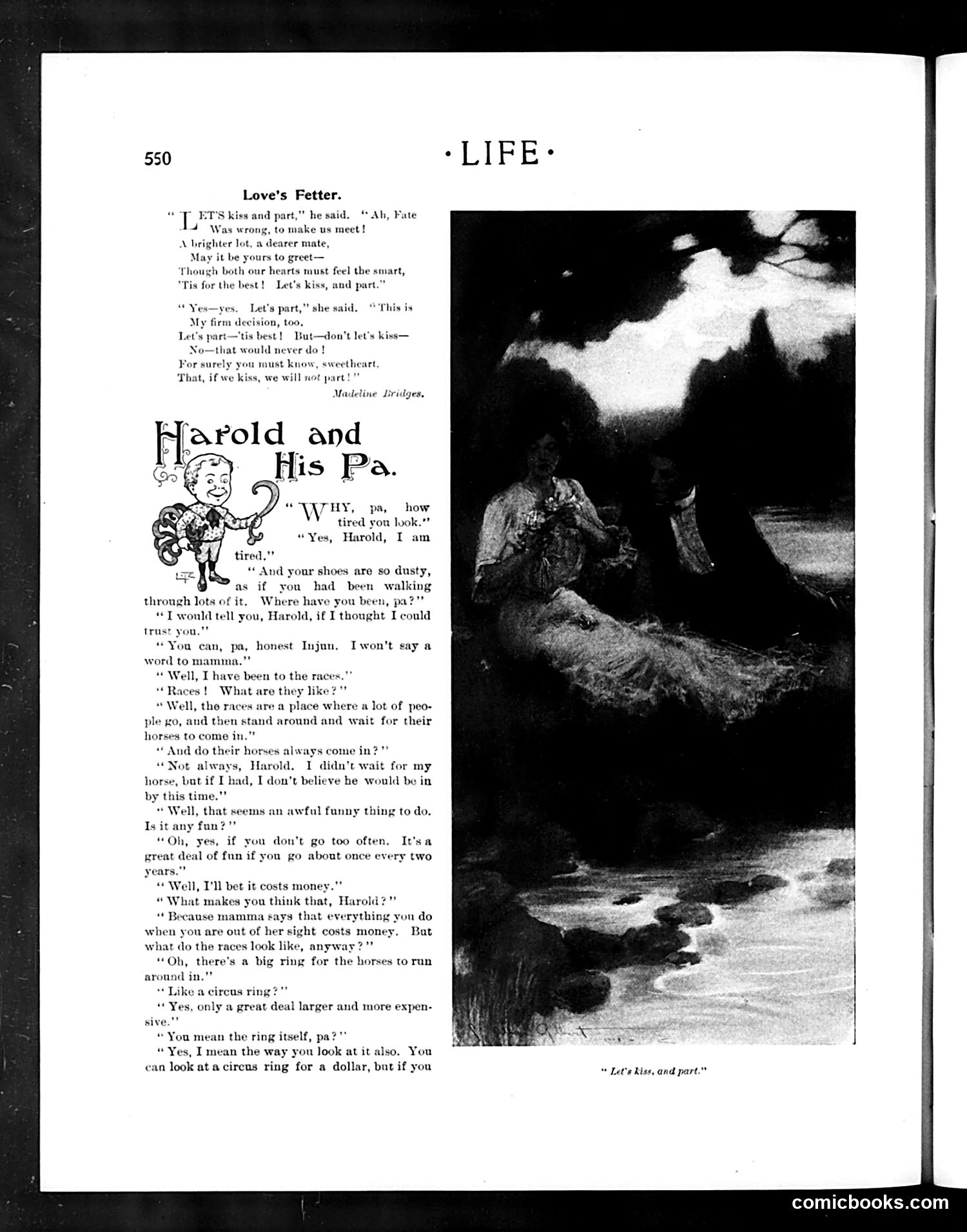
This page contains two unrelated pieces: 1. **"Love's Fetter"** — A poem by Madeline Bridges about romantic hesitation, using the metaphor of kissing and parting in relationships. 2. **"Harold and His Pa"** — A comic dialogue between a young boy (Harold) and his father. The father, exhausted, questions where Harold has been. Harold explains he went to the races—a place where people gather to watch horses compete in a large ring. The father expresses surprise that Harold would frequent such an expensive activity, leading to a discussion about the costs of gambling and entertainment. The humor derives from Harold's innocent, matter-of-fact explanations of the races as he understands them, contrasting with his father's concerns about money being wasted on frivolous pursuits. The cartoon satirizes parental worry about children's expenses and leisure activities.
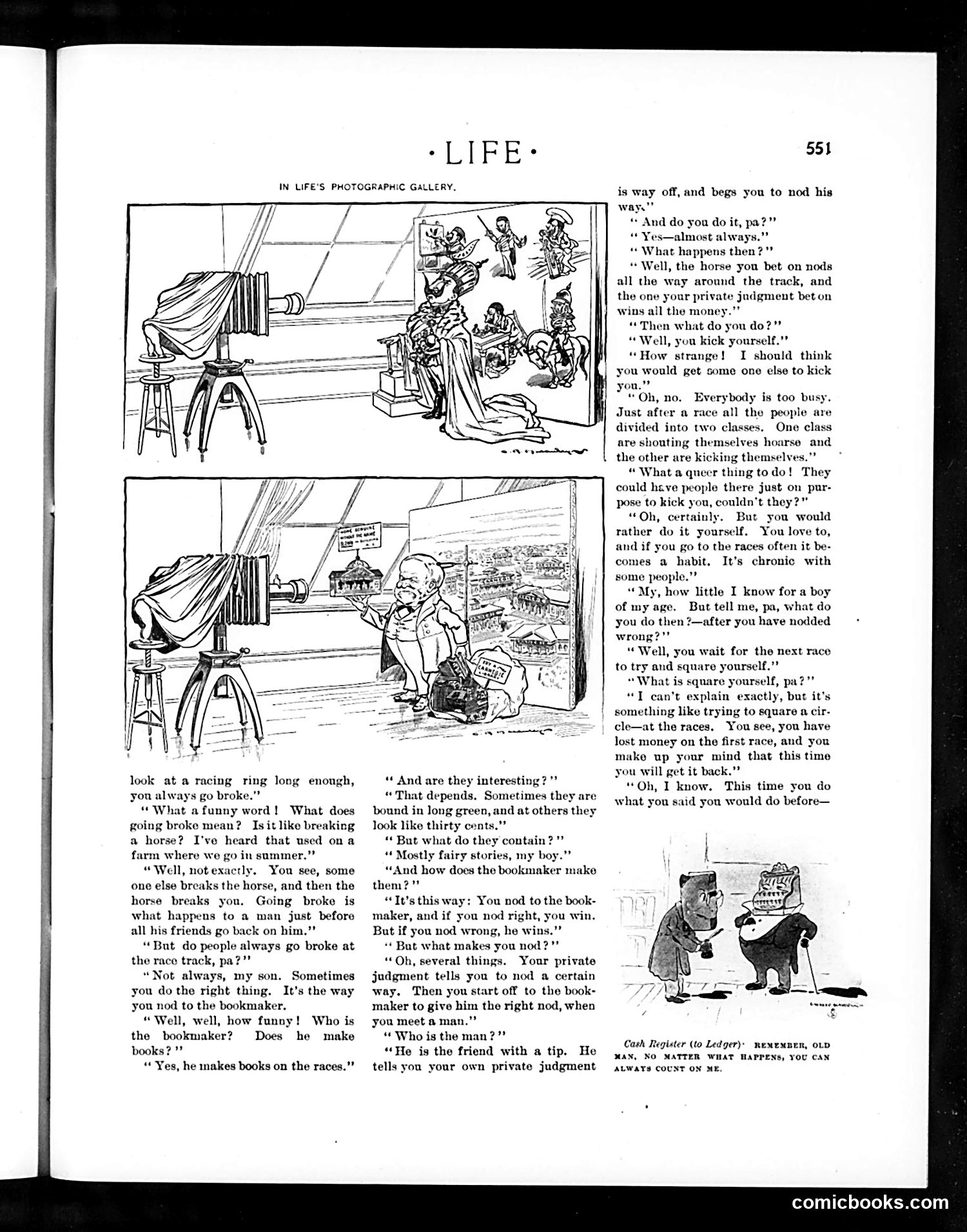
This page satirizes horse-racing gambling culture, popular in early 20th-century America. A father explains to his naive son how the racetrack operates through a dialogue format. **The satire targets:** - Bookmakers (illegal gambling operators who take bets), portrayed as con artists selling "fairy stories" bound in worthless paper ("thirty cents") - The betting system's absurdity: success depends on nodding "correctly" to the bookmaker, a euphemism for making the right bet - Chronic gambling addiction: losing money on one race, then immediately betting again to "square yourself" (recover losses)—an impossible cycle like "trying to square a circle" - Male social pressure: friends constantly offer "tips" that override rational judgment **The joke's darkness:** The father admits he *always* follows bad advice, loses money, then compulsively repeats the cycle. The small cartoon at bottom shows a cash register telling a ledger it can always be counted on—implying bookmakers reliably profit from suckers. The piece critiques gambling's mathematical certainty: the house always wins.
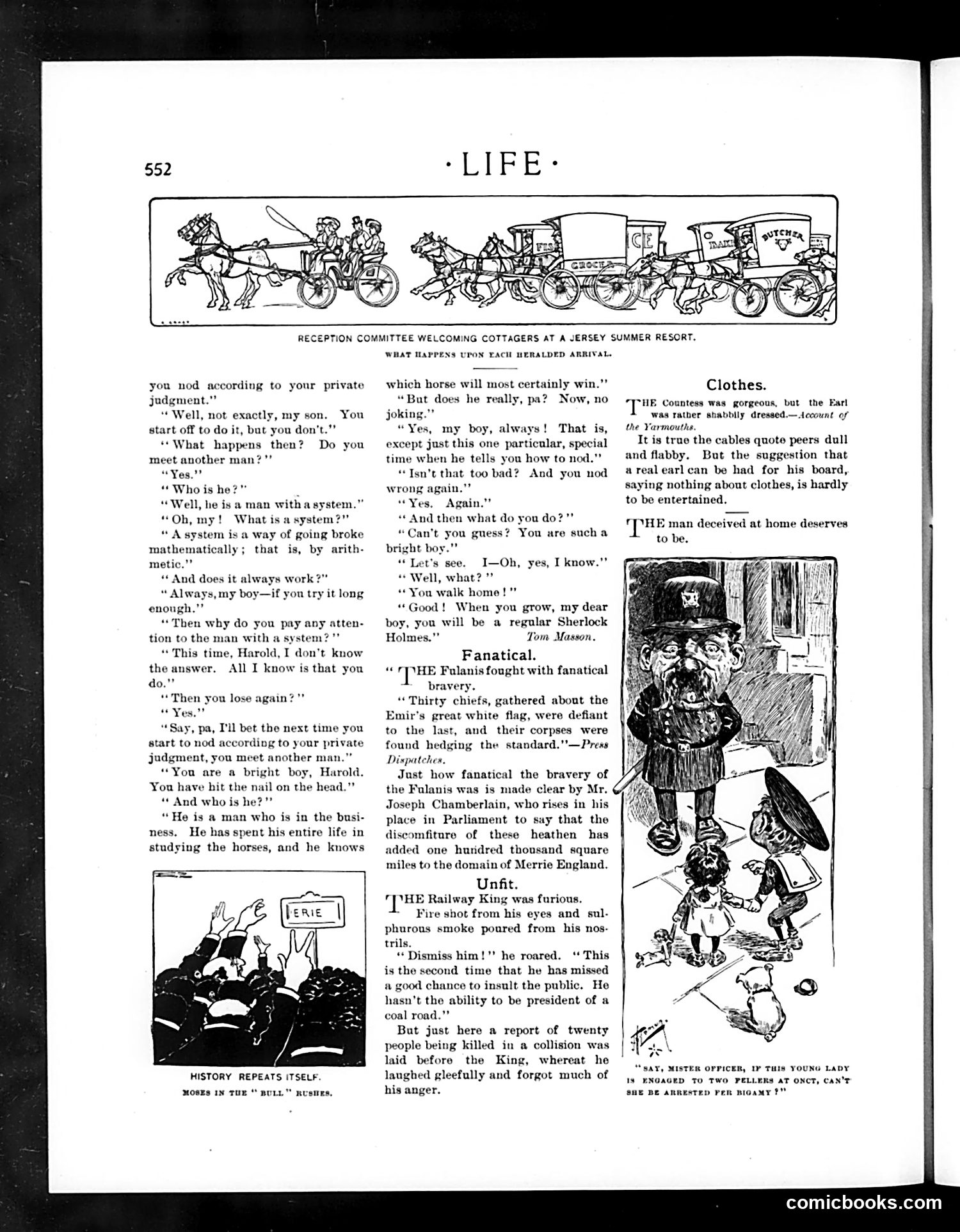
This page contains multiple satirical pieces typical of early Life magazine's humor: **Top cartoon** shows a dialogue between father and son about horse racing and gambling systems. The satire mocks men who follow "systems" for betting on horses, only to lose money repeatedly. The joke: despite knowing better, they keep consulting "experts" and inevitably "walk home" broke. **"Fanatical"** section sarcastically critiques British colonial expansion. It notes that Joseph Chamberlain celebrated the deaths of Fulani warriors (killed in battle) primarily because their defeat added territory to the British Empire—suggesting the real motivation wasn't moral righteousness but imperial acquisition. **"Unfit"** mocks a railroad executive ("Railway King") who is furious about an employee missing a chance to insult the public, but then laughs when hearing twenty people died in a collision. The satire exposes corporate indifference to public safety. **"Clothes"** and **"The man deceived"** appear to be brief humorous observations about social pretense and infidelity. The bottom cartoon's caption suggests confusion about bigamy laws.
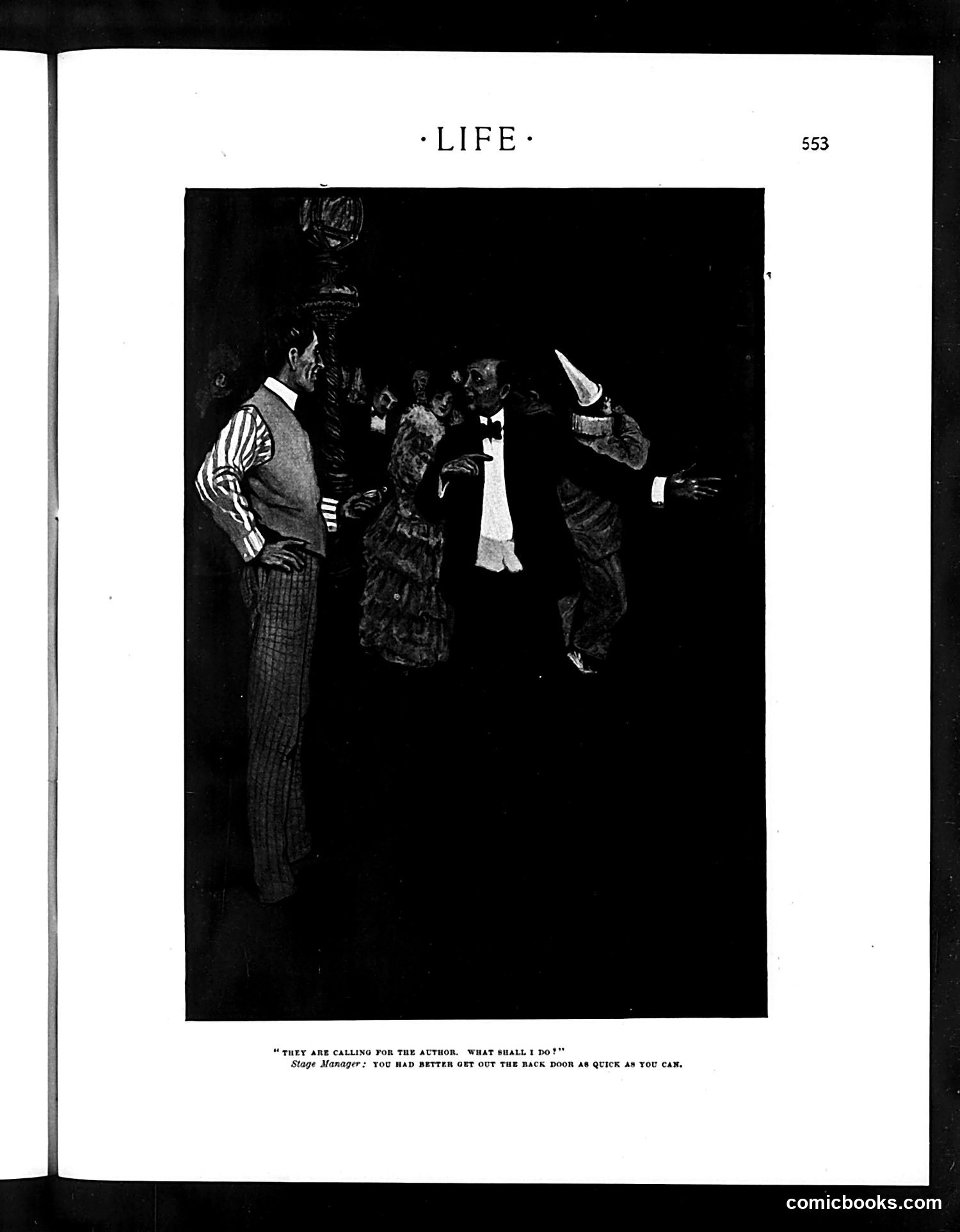
This is a theatrical backstage scene satirizing a play's poor reception. A nervous author (left, in striped shirt and vest) asks the Stage Manager what to do when the audience calls for him. The Stage Manager's blunt advice—to flee out the back door "as quick as you can"—suggests the play is a disaster and the author should escape before facing an angry or disappointed audience. The humor lies in the frank acknowledgment that calling for "the author" traditionally signals either triumph or, as implied here, catastrophic failure. Rather than take a bow, the author should literally run away. This reflects the unpredictable and sometimes brutal nature of theater criticism and audience reception in the early 20th century.
This page from *Life* magazine contains three separate humorous pieces: 1. **"More Omar for Ladies"** (poem): A light satire on health-reform movements, mocking Victorian-era crusades against tight corsets and high heels. The joke is that despite reformers' efforts, society will continue ignoring health advice. 2. **Mark Twain anecdote**: A courtship story where young Samuel Clemens boldly tells Miss Olivia Langdon's father he'll "keep a sharp lookout"—implying he'll pursue her despite parental disapproval. The humor lies in the audacious, indirect proposal. 3. **Italian citizenship satire**: Commissioner Shields tricks an Italian immigrant seeking naturalization by asking absurd questions ("Will you burn Washington?") that the candidate answers "Sure" to—having been coached to say yes to everything. The satire mocks both the immigrants' mechanical approach to citizenship and their inadequate English comprehension, while suggesting their instructors are cynically gaming the naturalization process. The advertisements below promote whiskey brands.
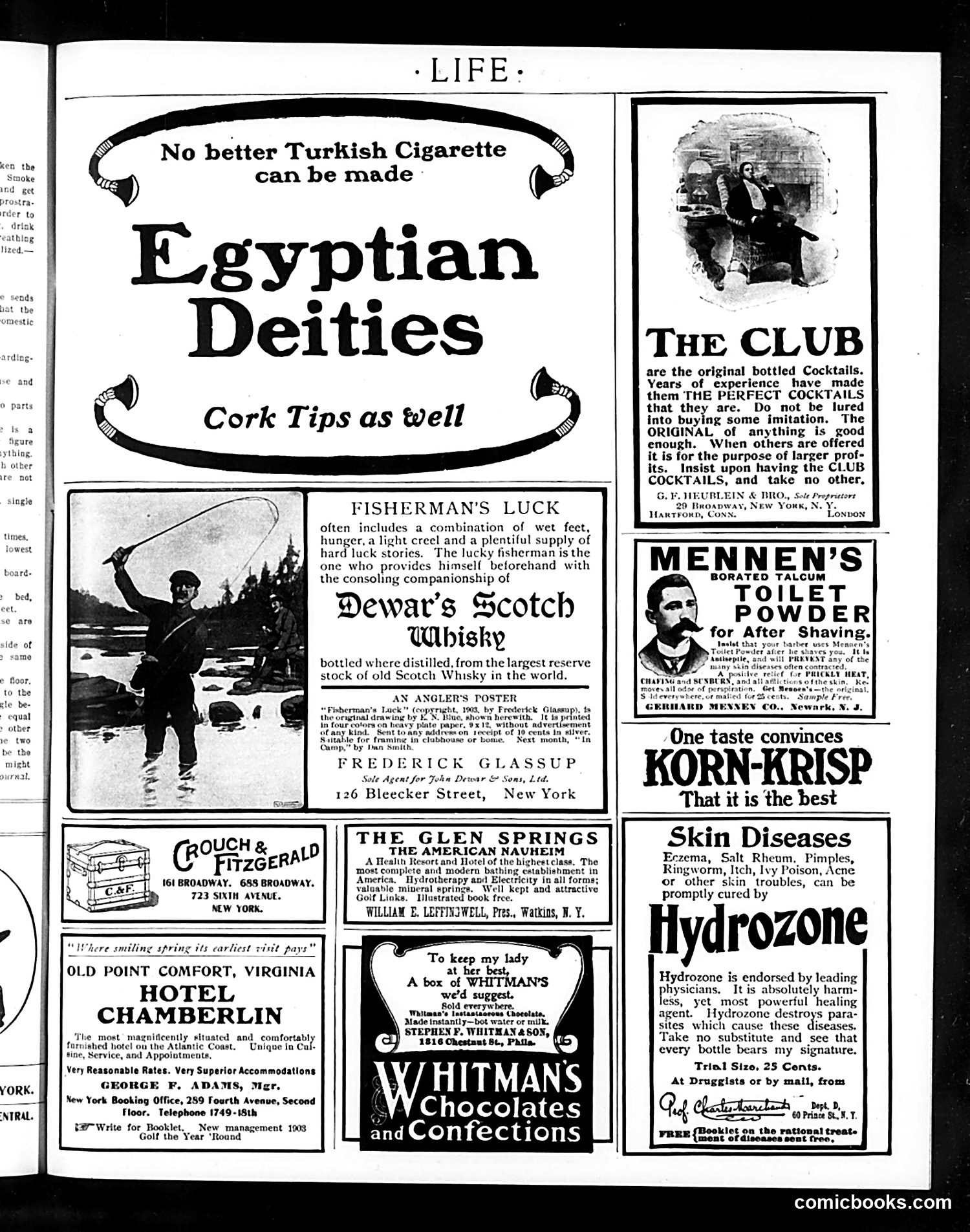
This page is **primarily advertising**, not satire or political commentary. It contains roughly a dozen product advertisements typical of early 1900s American commerce. Notable ads include: - **Egyptian Deities cigarettes** and **Dewar's Scotch Whisky**—luxury imports marketed to affluent readers - **The Club cocktails**—claiming to be "original bottled cocktails," warning against imitations - **Hotel advertisements** (Old Point Comfort, Glen Springs)—leisure destinations for the wealthy - **Patent medicines** (Hydrozone for skin diseases, Mennen's toilet powder)—typical of an era before FDA regulation, making broad health claims The only illustration with narrative content is **"Fisherman's Luck,"** depicting a fisherman with a small catch, humorously suggesting that whisky compensates for poor fishing results. The page reflects **Gilded Age consumer culture**: luxury goods, dubious medical products, and leisure activities marketed to Life's affluent readership. No political figures or satirical commentary are present.
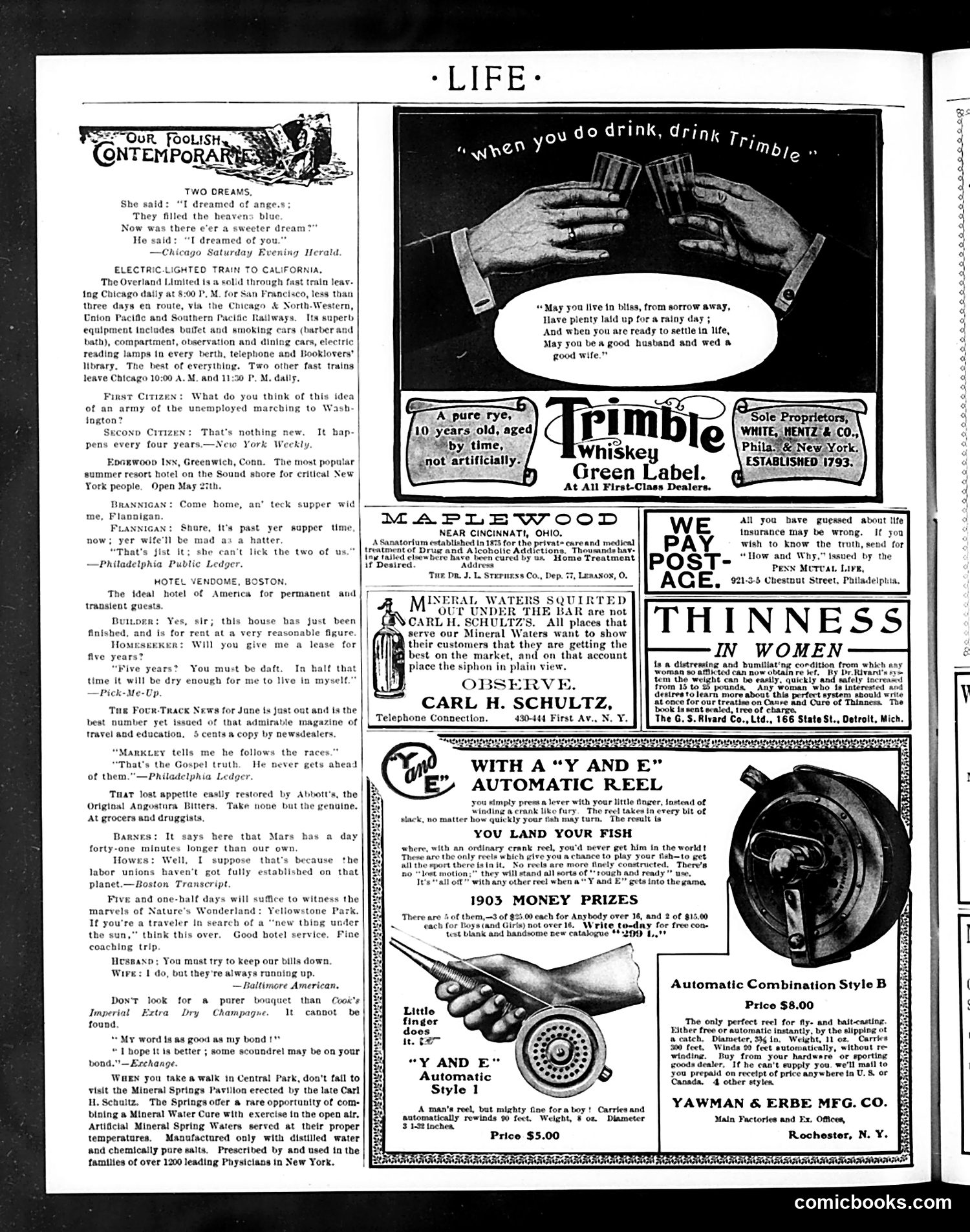
This page combines satirical commentary with period advertisements typical of early 1900s American magazines. **The cartoons** mock contemporary social issues through brief dialogues. One exchanges romantic platitudes between a couple. Another satirizes political predictability—a "Second Citizen" dismisses an "army of unemployed marching to Washington" as routine, occurring "every four years," critiquing both cyclical political theater and chronic joblessness. Other jokes target domestic life and labor relations. **The advertisements** reveal period concerns: Trimble Whiskey promotes drinking culture with marriage blessing sentiments; a "Y and E" fishing reel emphasizes leisure technology; railroad and hotel ads cater to wealthy travelers; mineral water springs claim medical authority (naming the late Carl H. Schultz). **The satire's target** is genteel American society—its pretensions, hypocrisies, and acceptance of systemic problems as inevitable. The juxtaposition of romantic poetry with unemployment commentary underscores class divisions and social complacency characteristic of Gilded Age *Life* magazine humor.
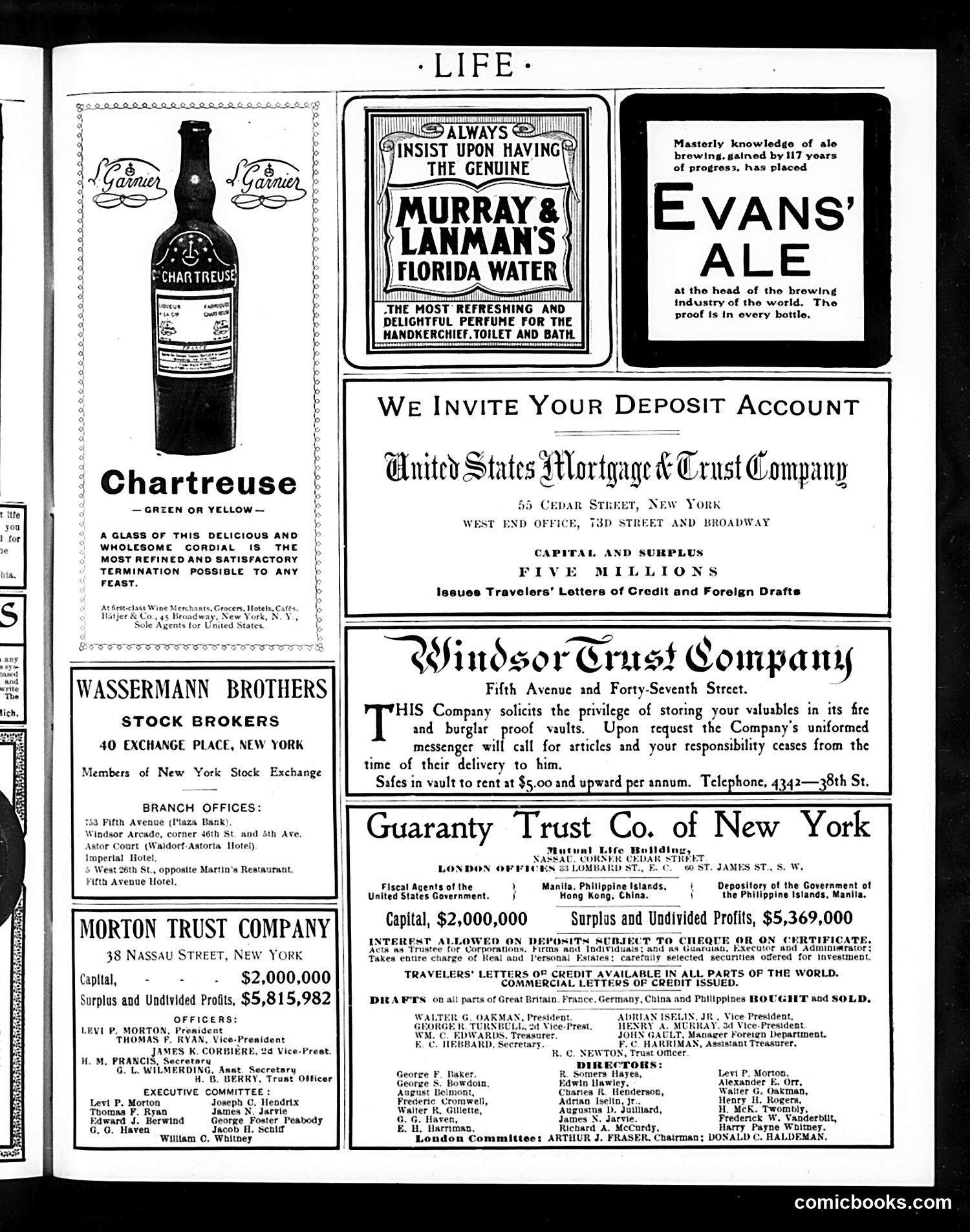
This page is primarily **advertising**, not satire or political commentary. It's a collection of financial institution and luxury product advertisements from an early 20th-century *Life* magazine. The ads feature: - **Chartreuse liqueur** and **Evans' Ale** — premium alcoholic beverages marketed to wealthy consumers - **Murray & Lanman's Florida Water** — a cologne/toilet product - **Stock brokerages and trust companies** (Wassermann Brothers, Morton Trust Company, Windsor Trust Company, Guaranty Trust Co.) — financial services targeting the affluent The only visual element is a **bottle of Chartreuse** in decorative packaging at top left. **Context for modern readers**: These ads reflect the *Life* magazine's original audience — wealthy New Yorkers and society figures. The emphasis on "genuine" products and established institutions (note Evans' Ale's claim of "117 years of progress") suggests concerns about counterfeiting and market confidence during an era of rapid industrialization and growing consumer culture. This is essentially a **financial/luxury services directory**, not editorial content.
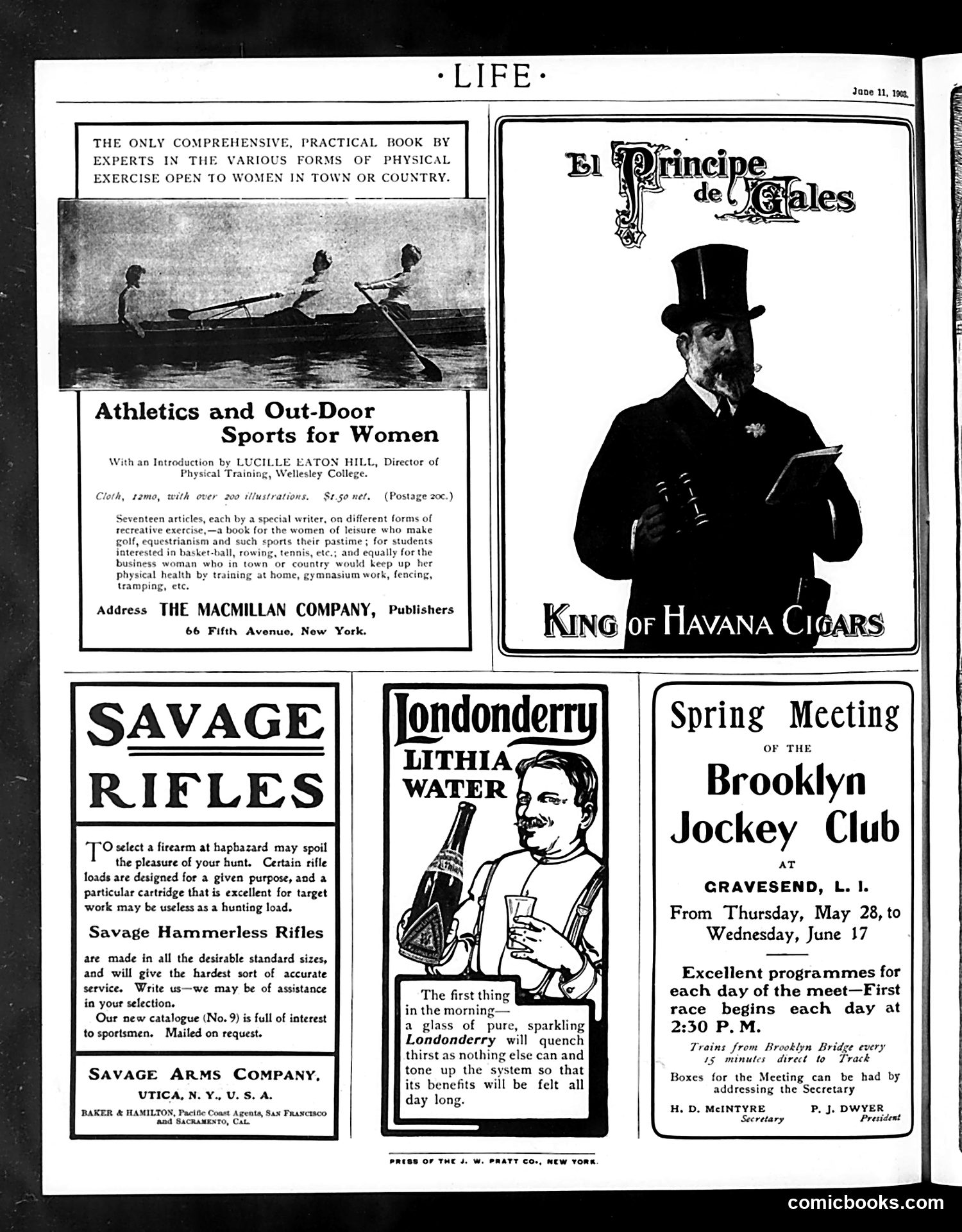
This page is primarily **advertising and book announcements** rather than satirical cartoons. It contains: 1. **Book advertisement** (top left): A practical guide on women's athletics and outdoor sports, featuring rowing, introducing physical training for women—reflecting early 1900s expanding female participation in exercise. 2. **"El Príncipe de Gales"** (top right): A cigar advertisement featuring a gentleman in formal dress (top hat, monocle), marketing Havana cigars with aspirational imagery of upper-class refinement. 3. **Remaining ads**: Savage rifles (hunting equipment), Londonderry lithia water (a health tonic), and a Brooklyn Jockey Club spring racing announcement. The page reflects 1903 consumer culture and emerging social trends—women's emancipation through sports, luxury goods marketing, and leisure activities for the wealthy. No political satire is evident; this is straightforward commercial content.