
Life, 1903-06-11 · page 4 of 20
Life — June 11, 1903 — page 4: what you’re looking at
What you’re looking at
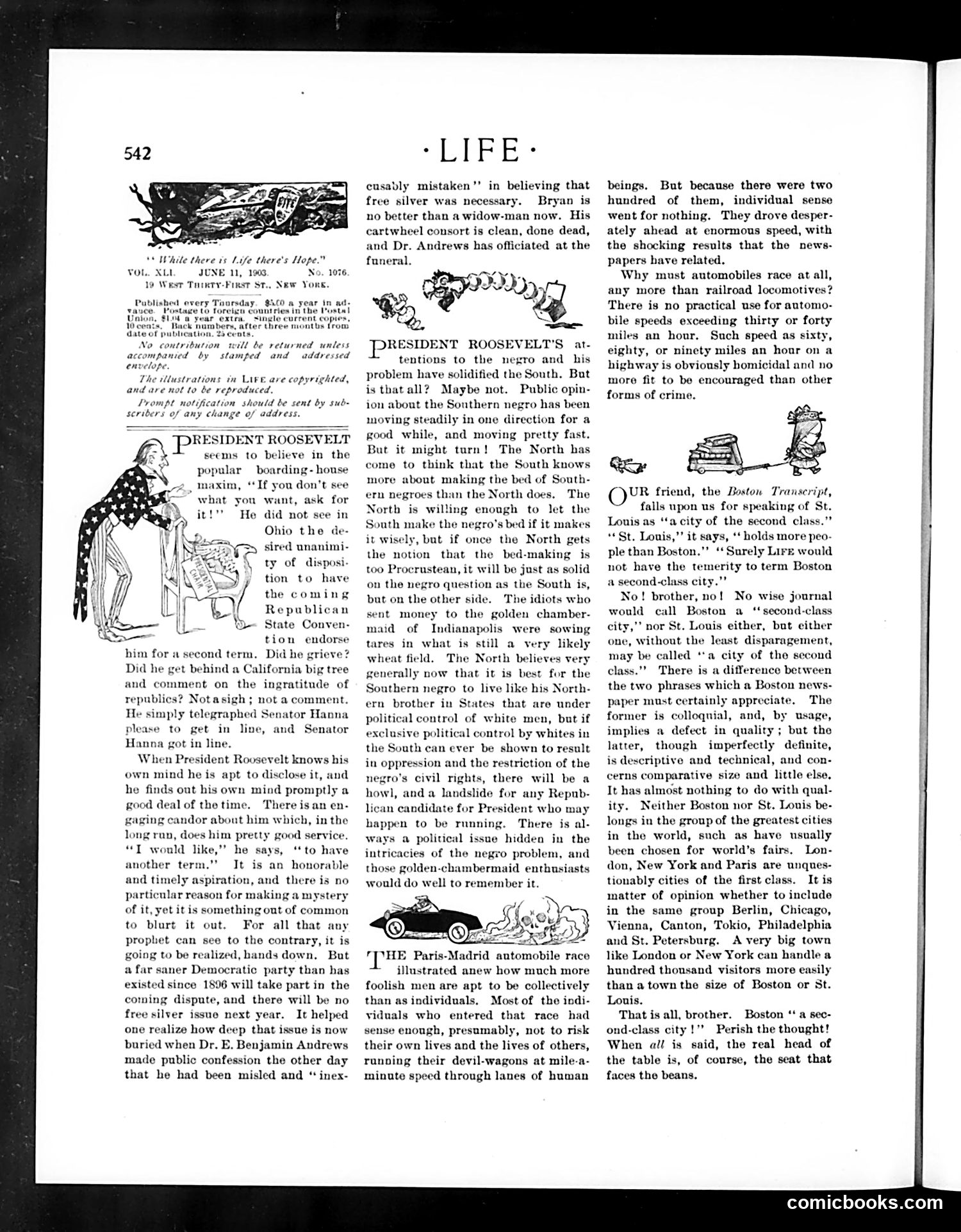
This page from *Life* magazine contains editorial commentary on President Roosevelt's views regarding the American South and race relations. The text critiques Roosevelt's optimistic belief that the South is improving its treatment of African Americans, suggesting this assessment may be mistaken. The accompanying cartoon depicts Roosevelt in conversation, likely illustrating his confidence about Southern progress. The editorial argues that the North shouldn't assume the South has reformed, warning that Northern interference in "bed-making" could backfire politically. The piece also includes commentary on automobiles and a separate discussion comparing Boston to St. Louis as major American cities. The overall tone is satirical, questioning Roosevelt's optimism about racial progress in the post-Reconstruction South.
📄 Transcribed text from this page (OCR, searchable)
Machine-transcribed from the original scan — historical spelling and the odd misread are preserved.
‘+ While there is Life there's Hope.” VOL. XL JUNE 11, 1903. N 19 West Totety-First St.. New Yous. will be returned unless stamped and addressed No contribution ympanied by The illustrations in Lite ave copyrighted, and are not to be reproduced. Prompt notification should be sent by sub- scribers of any change of address. X, ‘PRESIDENT ROOSEVELT : seems to believe in the popular boarding- house _ maxim, “If you don’t see what you want, ask for He did not see in Ohio the de- sired unanimi- ty of disposi- tion to have the coming Republican Si State Conven- tion him for a second term, Did he grieve? Did he get behind a California big tree and comment on the ingratitude of republics? Notasigh ; not a comment. He simply telegraphed Senator Hanna please to get in line, and Senator Hanna got in line. When President Roosevelt knows his own mind he is apt to disclose it, and he finds out his own mind promptly a good deal of the time. There isan en- gaging candor about him which, in the long ran, does him pretty good service. “T would like,” he say “to have another term.’’ It is an honorable and timely aspiration, and there is no particular reason for making a mystery of it, yet itis something out of common to blurt it out. For all that any prophet can see to the contrary, it is going to be realized, hands down, But afar saner Democratic party than h existed since 1896 will take part in the coming dispute, and there will be no free silver issue next year. It helped one realize how deep that issue is now buried when Dr. E. Benjamin Andrews made public confession the other day that he had been misled and “ inex- endorse * LIFE + cusably mistaken’’ in believing that free silver was necessary. Bryan is no better than a widow-man now. His cartwheel consort is clean, done dead, and Dr. Andrews has officiated at the funeral. eg RESIDENT ROOSEVELT’S at- tentions to the negro and his problem have solidified the South. But is thatall? Maybe not. Public opin- ion about the Southern negro has been moving steadily in one direction for a good while, and moving pretty fast. But it might turn! The North has come to think that the South knows more about making the bed of South- ern negroes than the North does. The North is willing enough to let the South make the negro’s bed if it makes it wisely, but if once the North gets the notion that the bed-making is too Procrustean, it will be just as solid on the negro question as the South is, but on the other side. The idiots who sent money to the golden chamber- maid of Indianapolis were sowing tares in what is still a very likely wheat field. The North believes very generally now that it is best for the Southern negro to live like his North- ern brother in States that are under political control of white men, but if lusive political control by whites in the South can ever be shown to result in oppression and the restriction of the negro’s civil rights, there will be a howl, and a landslide for any Repub- lican candidate for President who may happen to be running. There is al- vs a political issue hidden in the es of the negro problem, and those golden-chambermaid enthusiasts would do well to remember it. THE Paris-Madrid automobile race illustrated anew how much more foolish men are apt to be collectively than as individuals, Most of the indi- viduals who entered that race had enough, presumably, not to risk their own lives and the lives of others, running their devil-wagons at mile-a- minute speed through lanes of human sens beings. But because there were two hundred of them, individual sense went for nothing. They drove desper- ately ahead at enormous speed, with the shocking results that the news- papers have related. Why must automobiles race at all, any more than railroad locomotives? There is no practical use for automo- bile speeds exceeding thirty or forty miles an hour, Such speed as sixty, eighty, or ninety miles an hour on a highway is obviously homicidal and no more fit to be encouraged than other forms of crime. UR friend, the Boston Transcript, falls upon us for speaking of St. Louis as ‘‘acity of the second class.” “St. Louis,” it says, ‘holds more peo- ple than Boston.”’ ‘* Surely Lire would not have the temerity to term Boston a second-class city.’ No! brother, no! No wise journal would call Boston a ‘second-class city,’ nor St. Louis either, but either one, Without the least disparagement, may be called “a city of the second class.””. There is a difference between the two phrases which a Boston news- paper must certainly appreciate. The former is colloquial, and, by usage, implies a defect in quality ; but the latter, though imperfectly definite, is descriptive and technical, and con- cerns comparative size and little else, It has almost nothing to do with qual- ity. Neither Boston nor St. Louis be- longs in the group of the greatest cities in the world, such as have usually been chosen for world’s fairs, Lon- don, New York and Paris are unques- tionably cities of the first class. It is matter of opinion whether to include in the same group Berlin, Chicago, Vienna, Canton, Tokio, Philadelphia and St. Petersburg. A very big town like London or New York can handle a hundred thousand visitors more easily than a town the size of Boston or St. Louis. That is all, brother. Boston ‘‘ a sec- ond-class city!" Perish the thought! When all is said, the real head of the table is, of course, the seat that faces the beans. comicbooks.com