
Life, 1903-06-11 · page 13 of 20
Life — June 11, 1903 — page 13: what you’re looking at
What you’re looking at
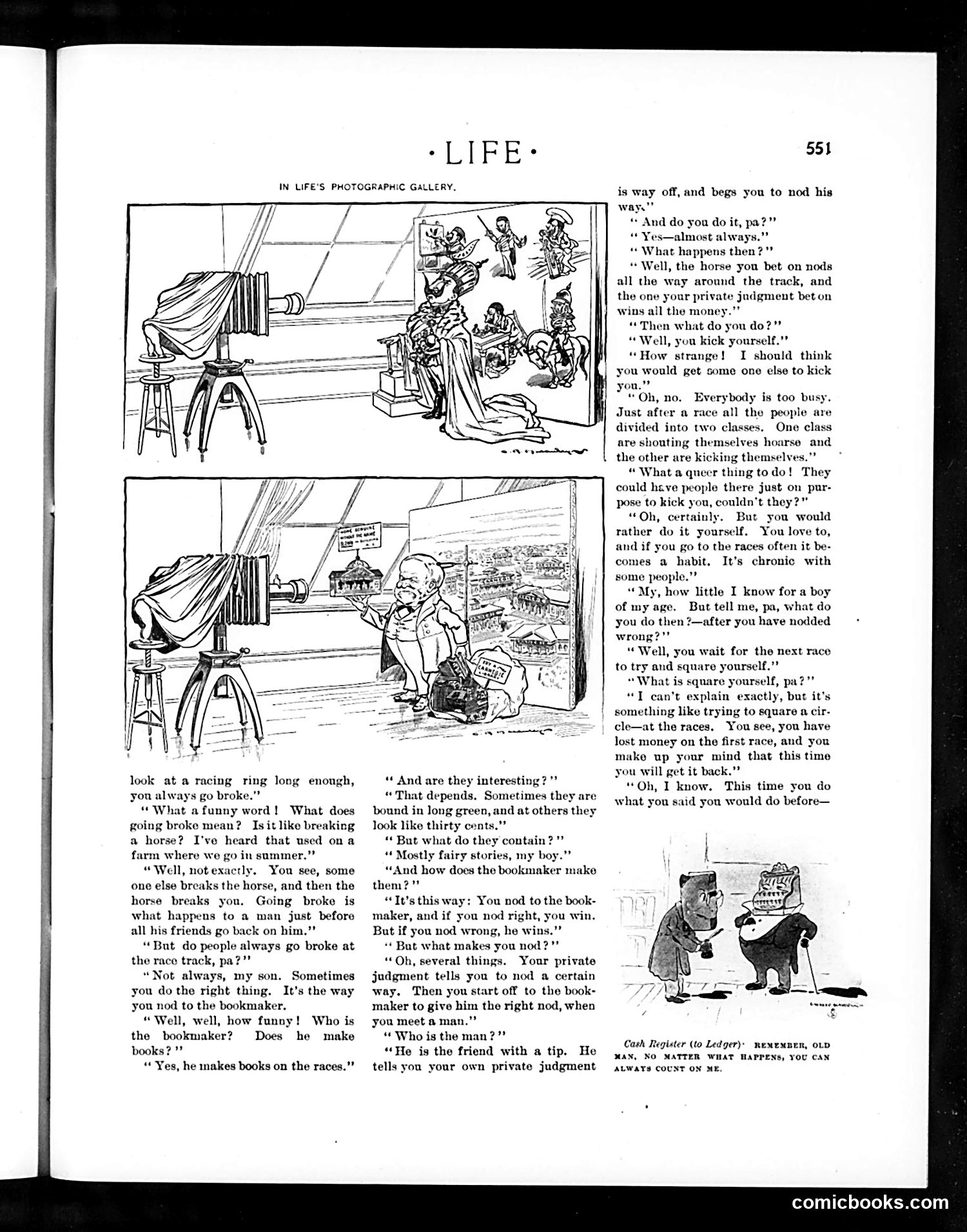
This page satirizes horse-racing gambling culture, popular in early 20th-century America. A father explains to his naive son how the racetrack operates through a dialogue format. **The satire targets:** - Bookmakers (illegal gambling operators who take bets), portrayed as con artists selling "fairy stories" bound in worthless paper ("thirty cents") - The betting system's absurdity: success depends on nodding "correctly" to the bookmaker, a euphemism for making the right bet - Chronic gambling addiction: losing money on one race, then immediately betting again to "square yourself" (recover losses)—an impossible cycle like "trying to square a circle" - Male social pressure: friends constantly offer "tips" that override rational judgment **The joke's darkness:** The father admits he *always* follows bad advice, loses money, then compulsively repeats the cycle. The small cartoon at bottom shows a cash register telling a ledger it can always be counted on—implying bookmakers reliably profit from suckers. The piece critiques gambling's mathematical certainty: the house always wins.
📄 Transcribed text from this page (OCR, searchable)
Machine-transcribed from the original scan — historical spelling and the odd misread are preserved.
© LIFE* IN LIFE'S PHOTOGRAPHIC GALLERY, look at a racing ring long enough, yon always go broke."” “What afunny word! What does going broke mean? Isit like breaking a horse? I've heard that used ona farm where we go in sammer.”* “Well, not exactly. You see, some one else breaks the horse, and then the horse breaks you. Going broke is what happens to a man just before all his friends go back on him,” “But do people always go broke at the race track, pa?’’ “Not always, my son. Sometimes you do the right thing. It’s the way you nod to the bookmaker. “Well, well, how funny! the bookmaker? Does he books? ’* “Yes, he makes books on the races.”” Who is make * And are they interesting ?"’ “That depends, Sometimes they are bound in long green, and at others they look like thirty cents.” «But what do they contain?” “ Mostly fairy stories, my boy.” “And how does the bookmaker make them?’” “It’s this way: You nod to the book- maker, and if you nod right, you win. But if you nod wrong, he wins.” “But what makes you nod?” “Oh, several things. Your private judgment tells you to nod a certain way. Then you start off to the book- maker to give him the right nod, when you meet a man.”” “ Who is the man?” “He is the friend with a tip. He tells you your own private judgment 553 is way off, and begs you to nod his way.” “ And do yon do it, pa?” “ Yes—almost always.” “What happens then?"” “Well, the horse you bet on nods all the way around the track, and the one your private judgment bet on wins all the money.” “Then what do you do?” “Well, you kick yourself.”” “How strange! I should think | you would get some one else to kick you.” “Oh, no. Everybody is too busy. Just after a race all the people are divided into two classes. One class are shouting themselves hoarse and the other are kicking themselves."’ “ What a queer thing todo! They could heve people there just on pur- pose to kick you, couldn't they?” “Oh, certainly. But you would rather do it yourself. You love to, and if you go to the races often it be- comes a habit, It’s chronic with some people.” “My, how little I know for a boy of my age. But tell me, pa, what do you do then ?—after you have nodded wrong?’" “Well, you wait for the next race to try and square yourself.” “What is square yourself, pa?” “TI can't explain exactly, but it's something like trying to square a cir- cle—at the races, You see, you have lost money on the first race, and you make up your mind that this time you will get it back.”” “Oh, I know. This time you do what you said you would do before— Cash Register (to Ledger)’ newexnen, od MAN, NO MATTER WHAT HAPPENS, YOU CAN ALWAYS COUNT ON ME. comicbooks.com