
A complete issue · 22 pages · 1903
Life — April 16, 1903
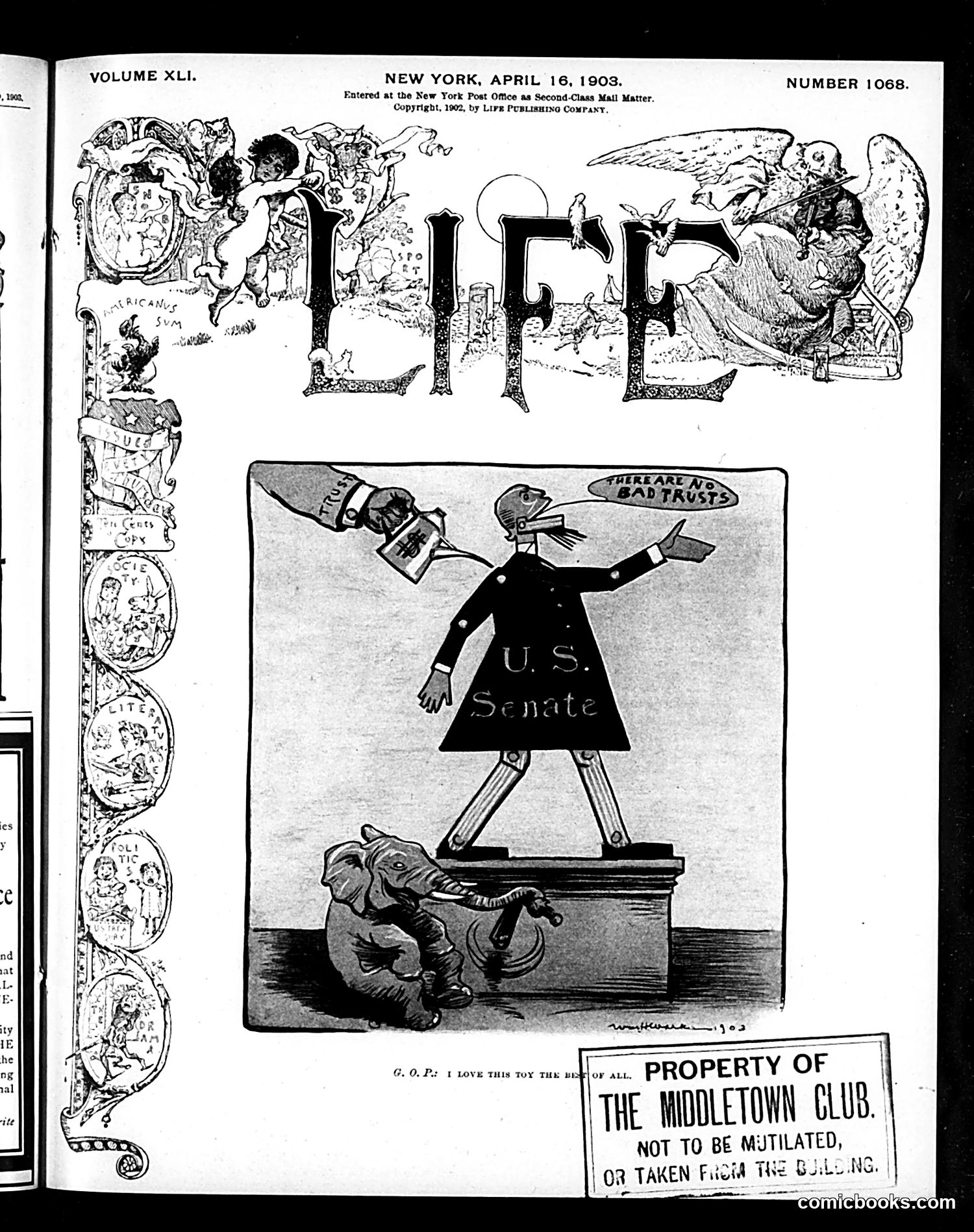
The main cartoon depicts the U.S. Senate as a figure juggling what appears to be a soap bubble or inflated object labeled "THERE ARE NO BAD TRUSTS," while an elephant (Republican symbol) crouches beneath. The Senate figure says "I LOVE THIS TOY THE BEST OF ALL." This satirizes the Senate's apparent complicity or naiveté regarding corporate monopolies ("trusts")—a major political issue of the early 1900s Progressive Era. The cartoon suggests the Senate is distracted by or endorsing a false claim that trusts aren't harmful, while ignoring the reality. The elephant symbolizes Republican control of the Senate, implying party responsibility for failing to regulate big business effectively. The decorative border contains various satirical vignettes typical of Life magazine's style.
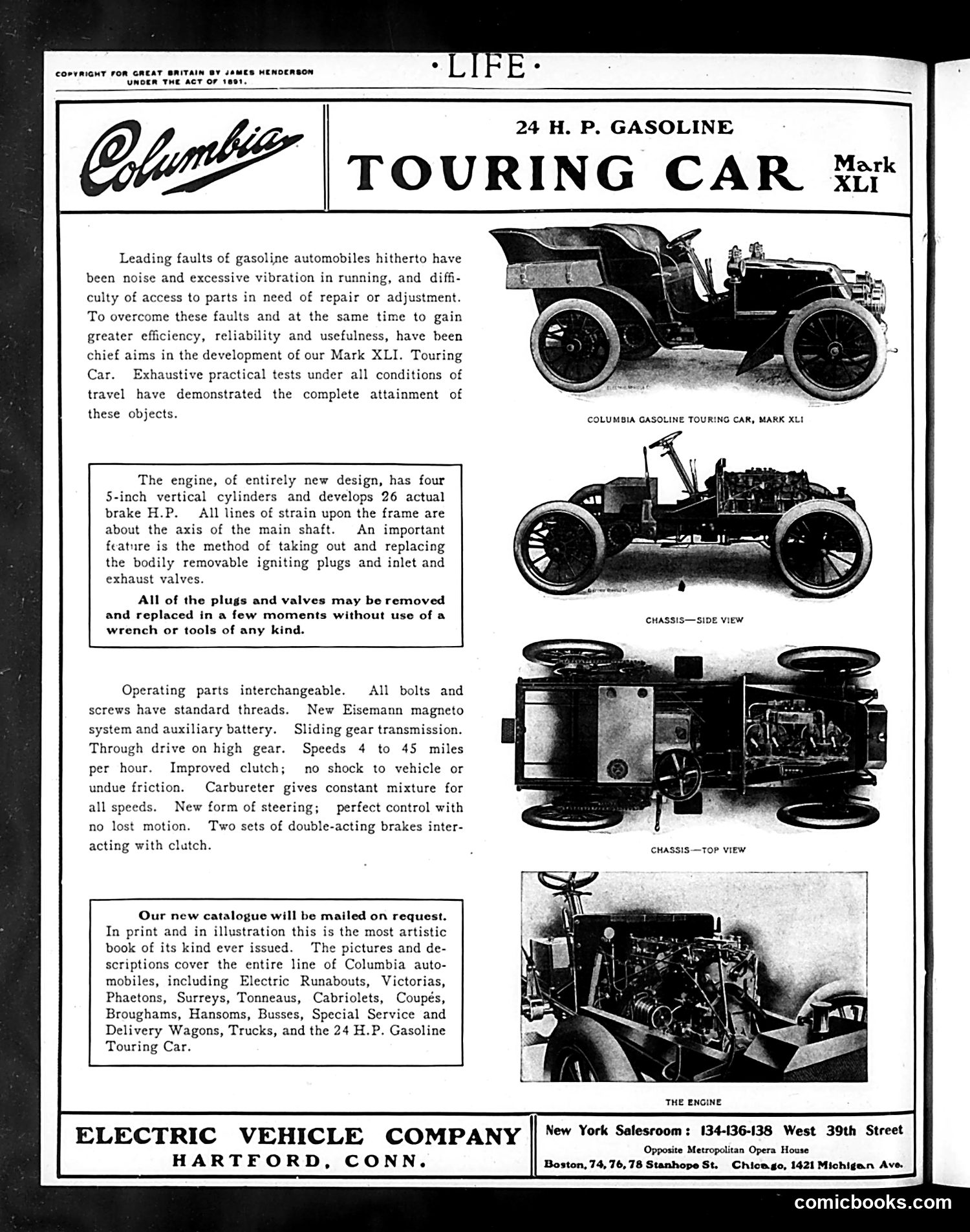
This is **not a cartoon or satire page**—it's a straightforward advertisement for the Columbia Mark XLI, a 24 horsepower gasoline touring car manufactured by the Electric Vehicle Company of Hartford, Connecticut. The page features technical specifications and mechanical diagrams highlighting the car's innovations: a new four-cylinder engine, removable ignition plugs, interchangeable parts, and improved braking and steering systems. Multiple photographs show the vehicle from different angles and detail internal components. The text emphasizes practical advantages—ease of maintenance, efficiency, and reliability—designed to appeal to early automotive buyers circa 1910s. This represents period marketing rather than political or social satire. The page is purely promotional material advertising automobile technology to potential customers.
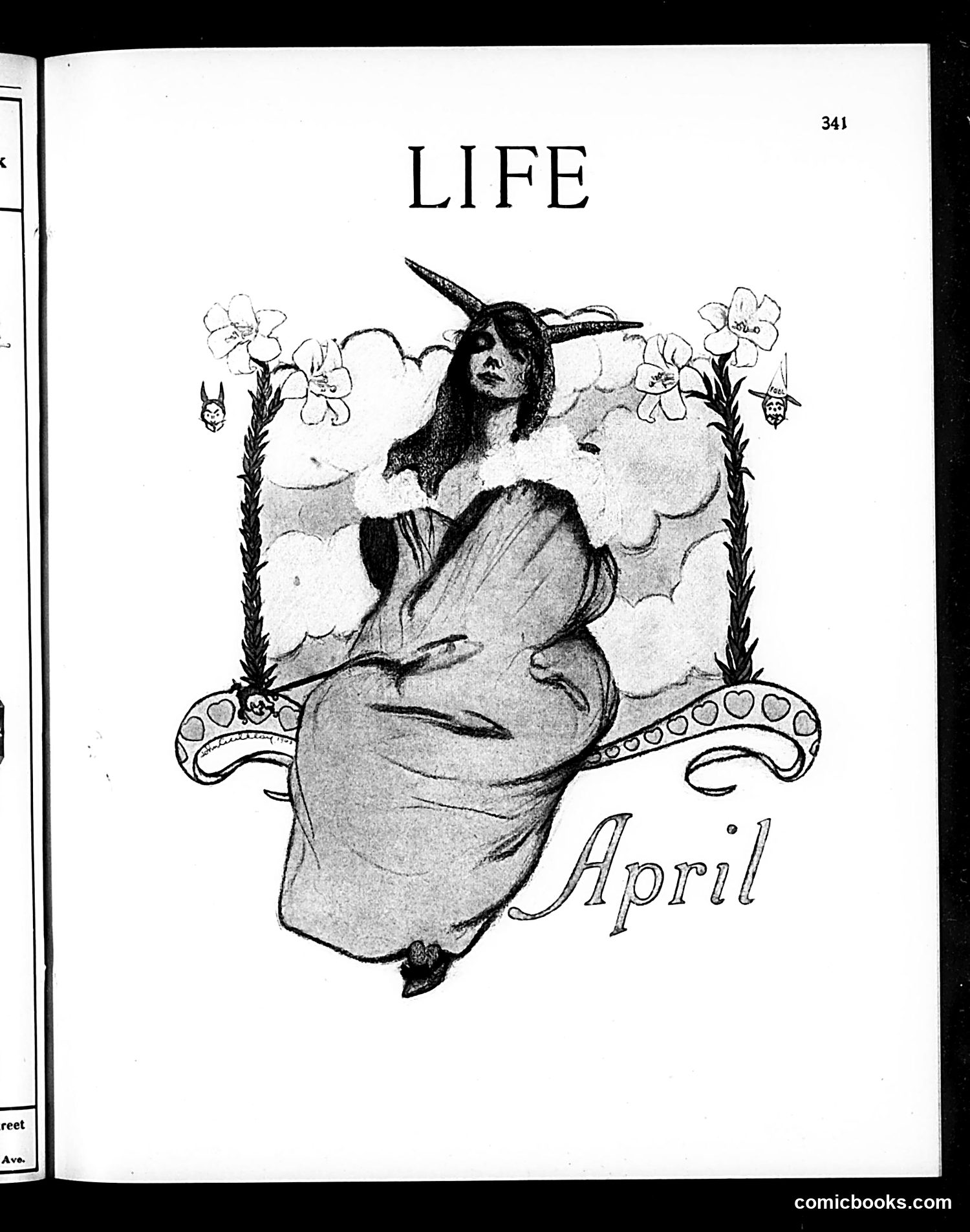
This is a decorative title page for Life magazine's April issue. The illustration depicts a classical female figure (likely representing Spring or April) with an upturned face and flowing robes. She wears a unicorn horn—a fantastical, whimsical touch typical of Art Nouveau styling popular in early 20th-century magazine design. The figure is framed by decorative floral elements: flowering plants with delicate blooms flank both sides, and an ornamental banner with circular dot patterns runs horizontally below. Small insects (possibly bees) are scattered among the flowers. Rather than political satire, this appears to be purely aesthetic cover art—establishing a springtime, fantastical mood for the monthly issue. The unicorn horn adds playful absurdity characteristic of Life's humorous aesthetic during this period.
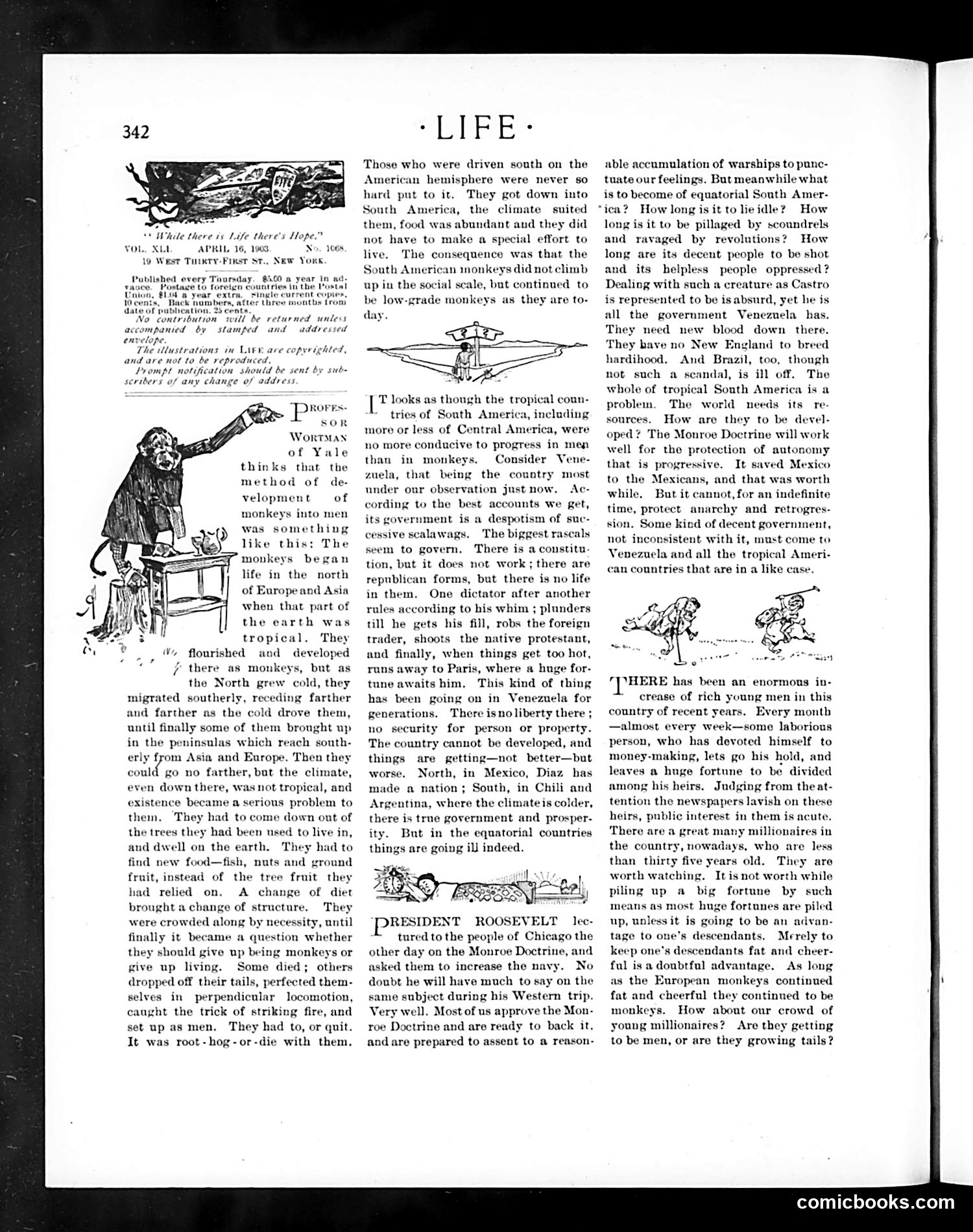
This LIFE magazine page contains editorial commentary on South American politics and society, illustrated with several cartoon vignettes. The main illustrations depict **monkeys in human situations** — a Professor of Yale observing monkeys "thinking" about development methods, and monkeys engaged in various human activities. This is satirical commentary: the cartoonist uses monkey caricatures to mock South American governance, suggesting that tropical countries' political systems are primitive or chaotic. The text discusses Venezuela's instability, lack of secure government, and succession of dictatorships — comparing it unfavorably to Mexico's progress under Díaz. The article also references **President Roosevelt's Monroe Doctrine** stance and approval of naval expansion. The satire conflates South American political disorder with animal behavior, reflecting the condescending, imperialist attitudes common in early 20th-century American journalism.
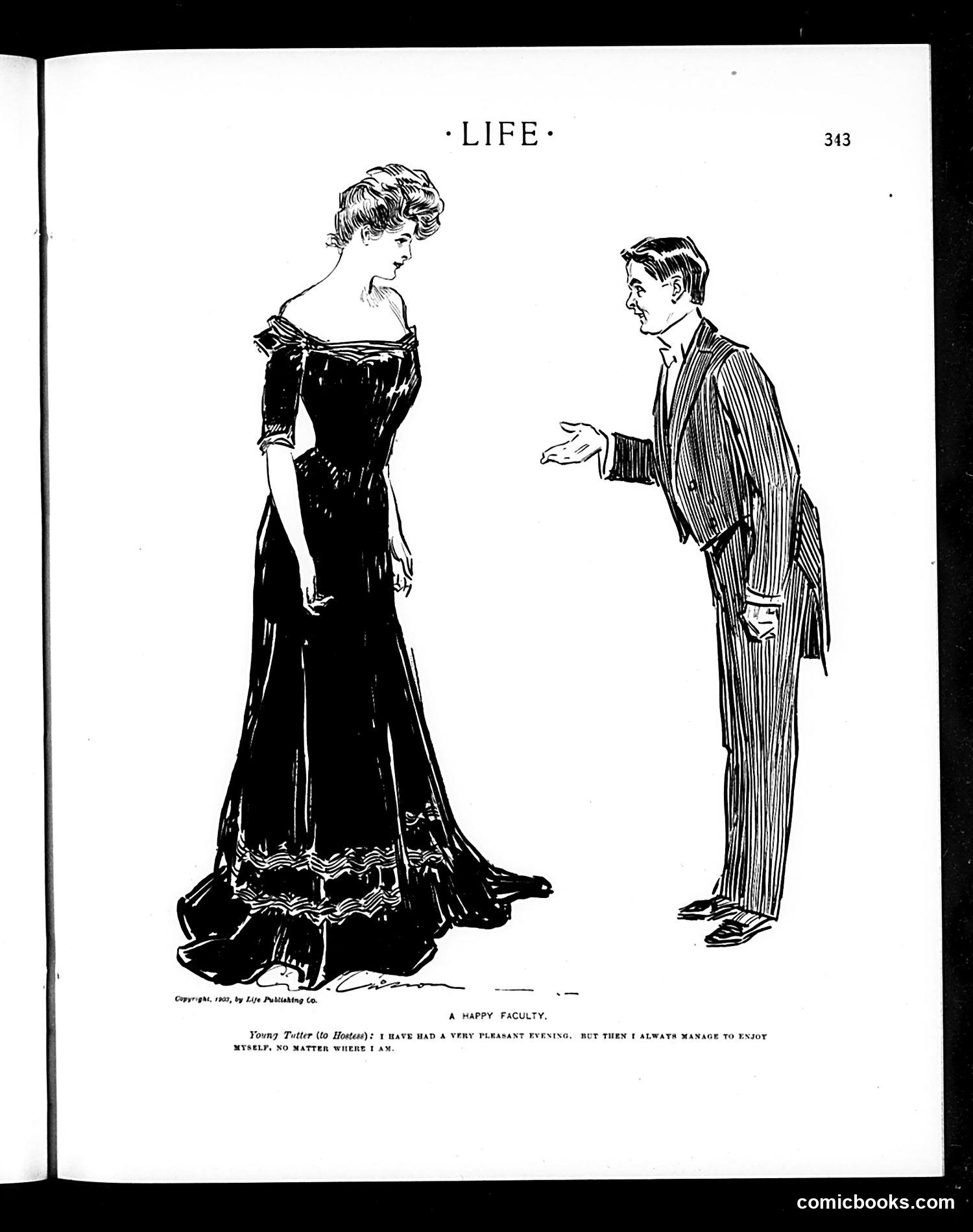
This cartoon depicts a social interaction between a well-dressed woman and man from the early 1900s. The caption attributes the quote to "Young Fuller (to Boston)" and reads: "I have had a very pleasant evening, but then I always manage to enjoy myself, no matter where I am." The satire targets the man's self-satisfied smugness—his ability to enjoy himself anywhere, regardless of company or circumstances. This appears to be social commentary on male vanity and self-absorption. The woman's composed but slightly detached posture suggests subtle disapproval of his obliviousness or self-centeredness. The "happy faculty" referenced in the title is his convenient talent for self-enjoyment, presented mockingly as a character flaw rather than virtue. The joke plays on early 1900s social conventions and masculine pretension.
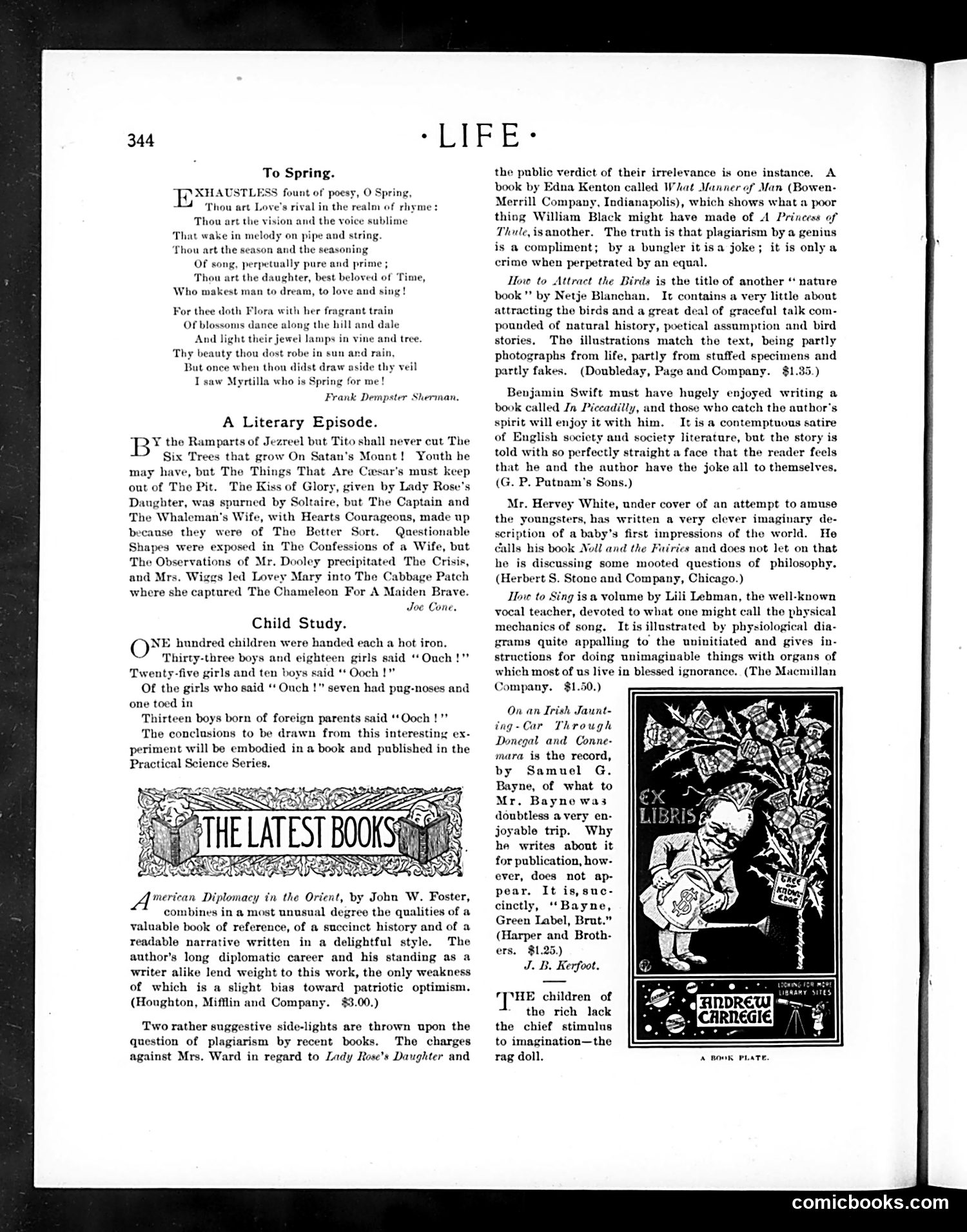
This page contains literary reviews and book advertisements rather than political cartoons. The main content includes: **"To Spring"** - a poem by Frank Dempster Sherman celebrating springtime imagery. **"A Literary Episode"** - a humorous piece by Joe Cone critiquing literary works, appearing to mock overwrought or derivative titles in contemporary publishing. **"Child Study"** - a brief experiment describing children's reactions to a hot iron, likely illustrating early psychological or educational research methods. The page includes two book advertisements with illustrations: one showing a figure in nature (possibly related to "On an Irish Jaunting-Car"), and another for "Andrew Carnegie" publications. Overall, this is a literary/cultural commentary page with no significant political satire or recognizable caricatures of public figures.
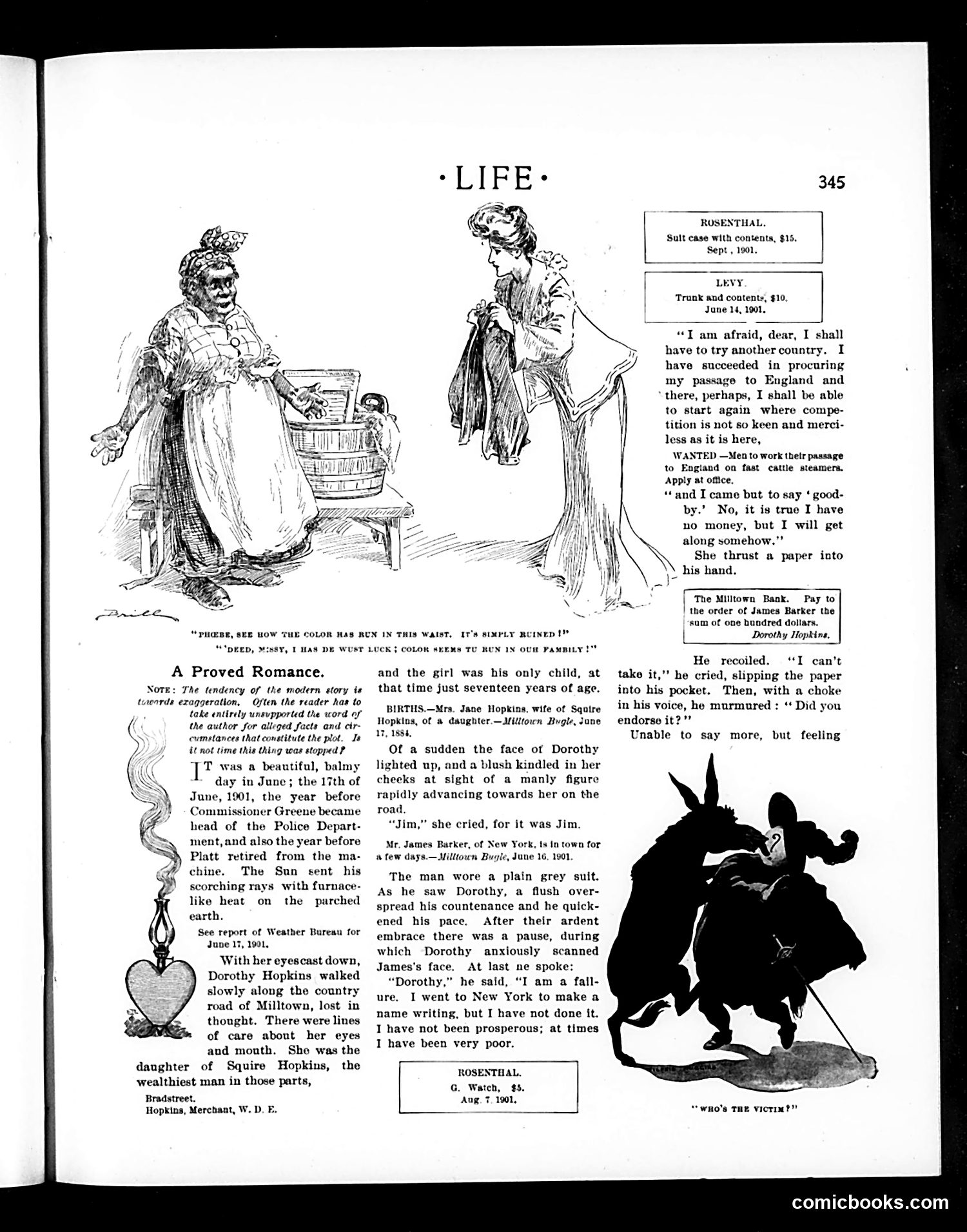
This page presents a serialized romantic story titled "A Proved Romance" with accompanying illustrations. The main narrative concerns Dorothy Hopkins, daughter of a wealthy squire, who encounters a man named Jim on a country road near Milltown. Jim reveals he's a failure—went to New York to become a writer but struggled financially and never succeeded. The satirical elements target **romantic melodrama conventions** of the era. The story's sentimental tone ("It was a beautiful, balmy day in June") and plot devices (chance encounter, confession of poverty, emotional reunion) parody popular serialized romance fiction that Life magazine's readers would recognize and mock. The various boxed advertisements and society notices interspersed throughout mock the magazine's own commercial interests in promoting consumer goods and social announcements.
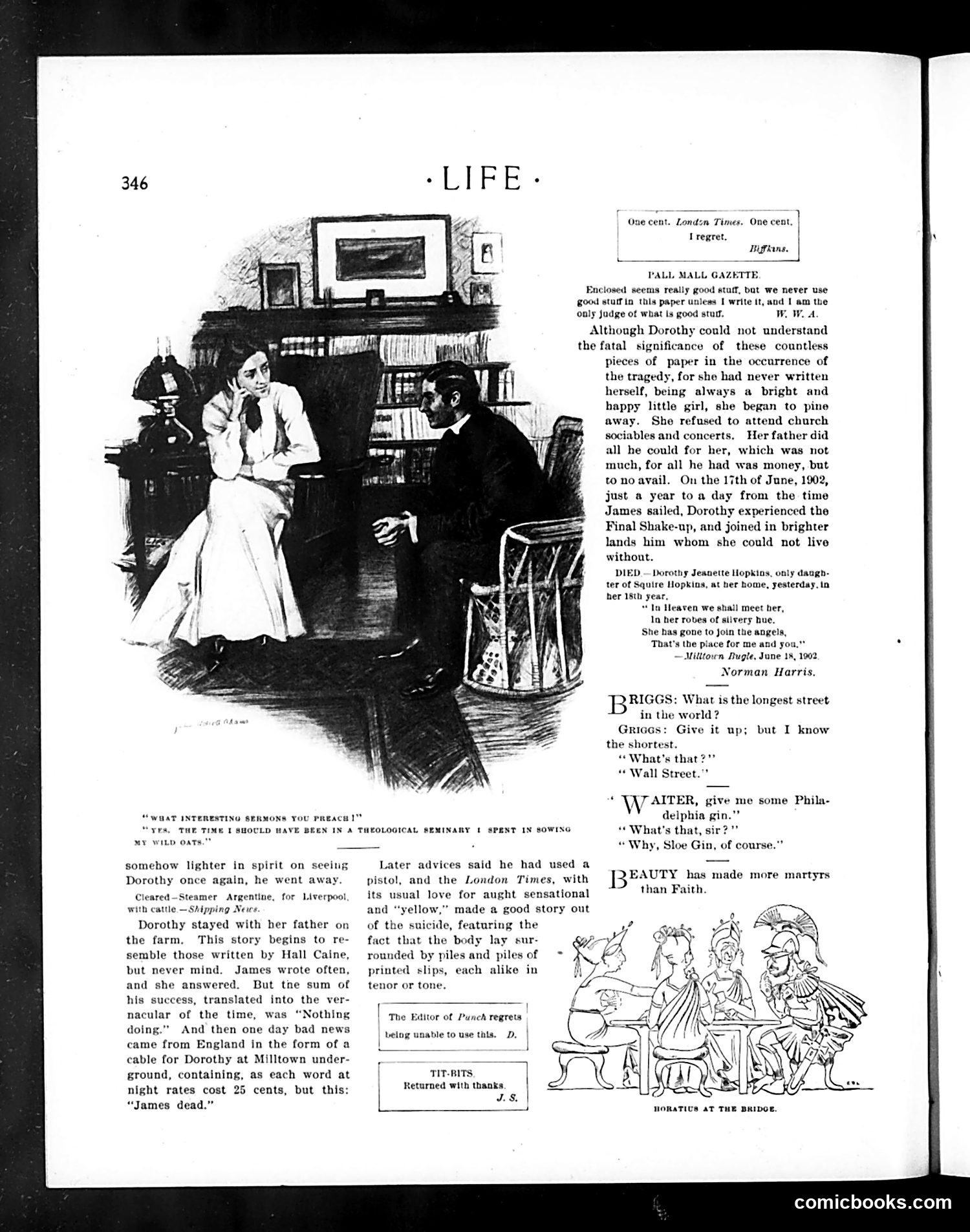
This page contains a memorial notice and satirical humor pieces from 1902. The main content mourns Dorothy Jeanette Hopkins, daughter of Squire Hopkins, who died at 18. The accompanying illustration shows a domestic scene, likely depicting a moment from her brief life. The page includes "Pall Mall Gazette" humor items—short jokes about everyday absurdities. Notable examples: Briggs asking about the longest street, answered with "Wall Street" (a joke about financial greed); a waiter misunderstanding "Philadelphia gin" as "Sloe Gin"; and a quip that "Beauty has made more martyrs than Faith." The bottom cartoon, "Horatios at the Bridge," appears to be classical satire (unclear of specific reference). Overall, the page juxtaposes genuine mourning with the magazine's typical light social commentary.
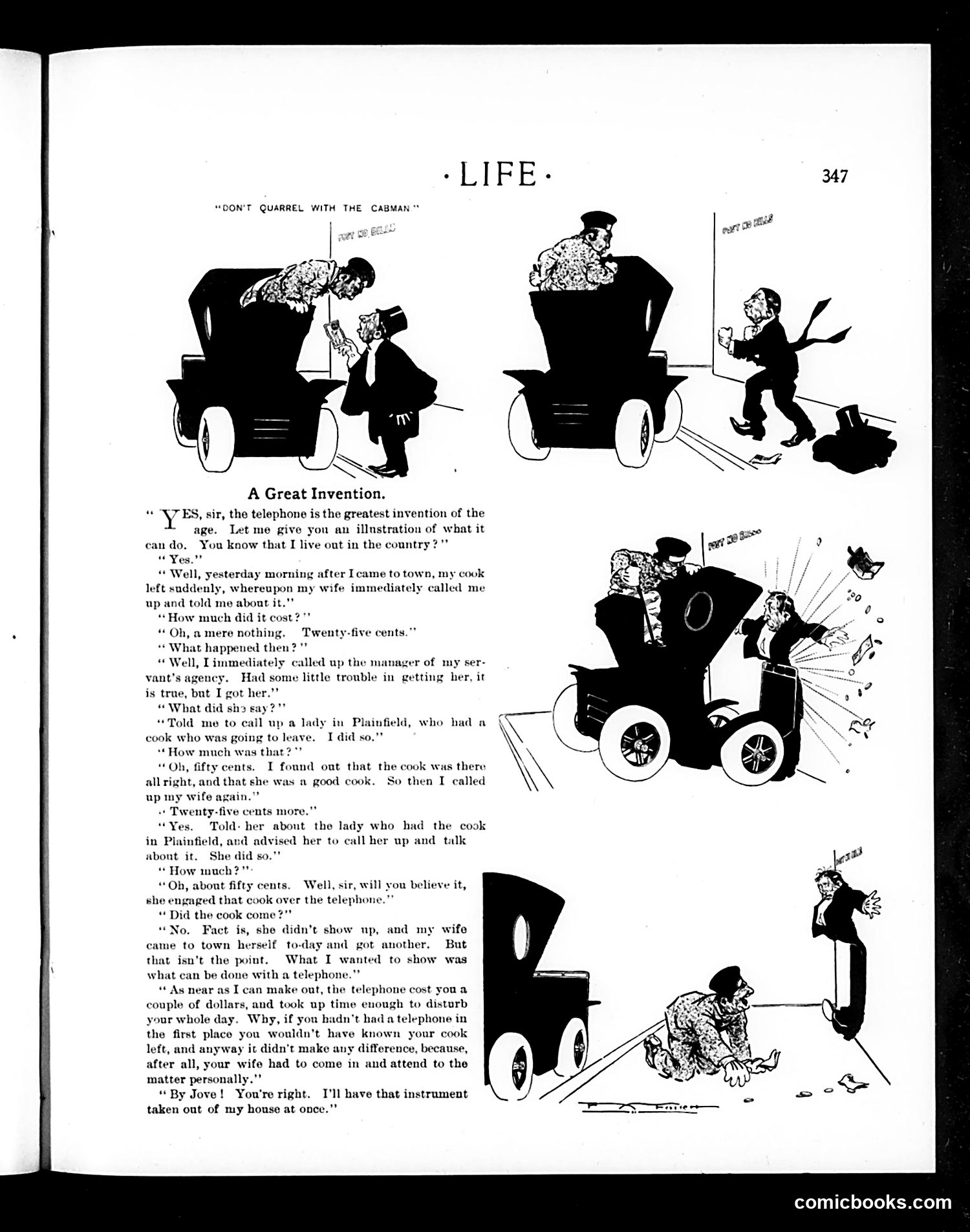
This page satirizes the telephone's disruptive impact on domestic life. The headline story presents a humorous anecdote: a man's cook suddenly quit, forcing his wife to phone him at work. Through multiple phone calls, they accidentally hired the cook back at inflated cost—demonstrating how the telephone enables wasteful miscommunication and extends workplace problems into home life. The cartoon illustrations show a cabman repeatedly transporting a woman and her belongings around town due to telephone-enabled confusion. The satire mocks the telephone as a "great invention" that paradoxically creates chaos: it allows constant communication but facilitates misunderstandings, wastes money, and intrudes upon domestic peace. The cabman becomes collateral damage in this technological disruption.
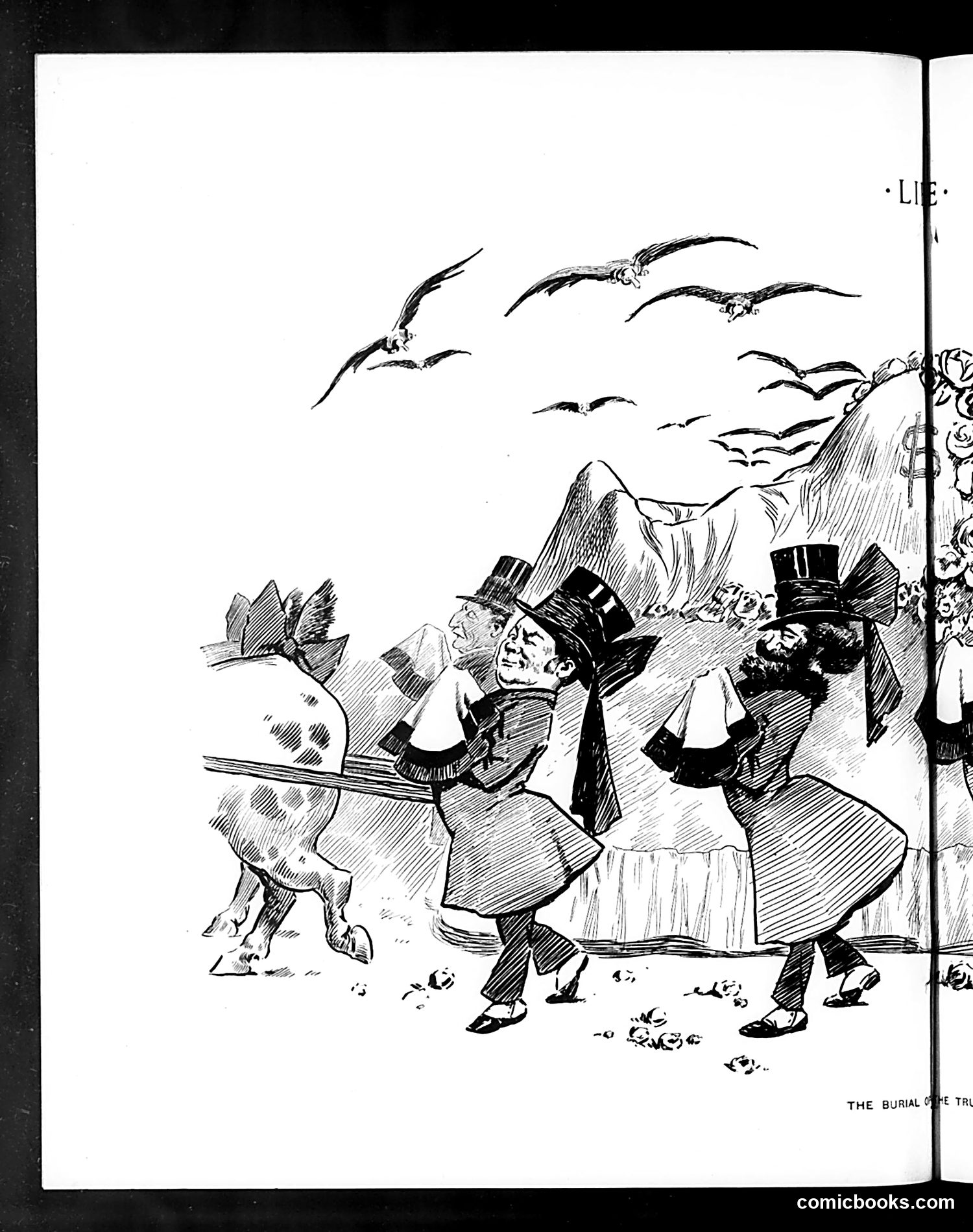
This political cartoon depicts two figures in formal dress (top hats and coats) appearing to conduct a funeral service for a pig. Birds fly overhead, and mountains appear in the background. The caption references "THE BURIAL OF THE TRUST." This is likely anti-trust satire from the Progressive Era (early 1900s), when monopolistic business "trusts" were major political targets. The pig likely represents corporate greed or corrupt business practices. The formal "burial" suggests either: 1. Celebration that trusts are finally being eliminated through government action, or 2. Satirical mockery that despite claims of reform, trusts continue thriving The specific figures are unclear from the image alone, though they appear to be political or business leaders. The cartoon critiques the era's major political debate over whether trust-busting efforts were genuine or merely performative.
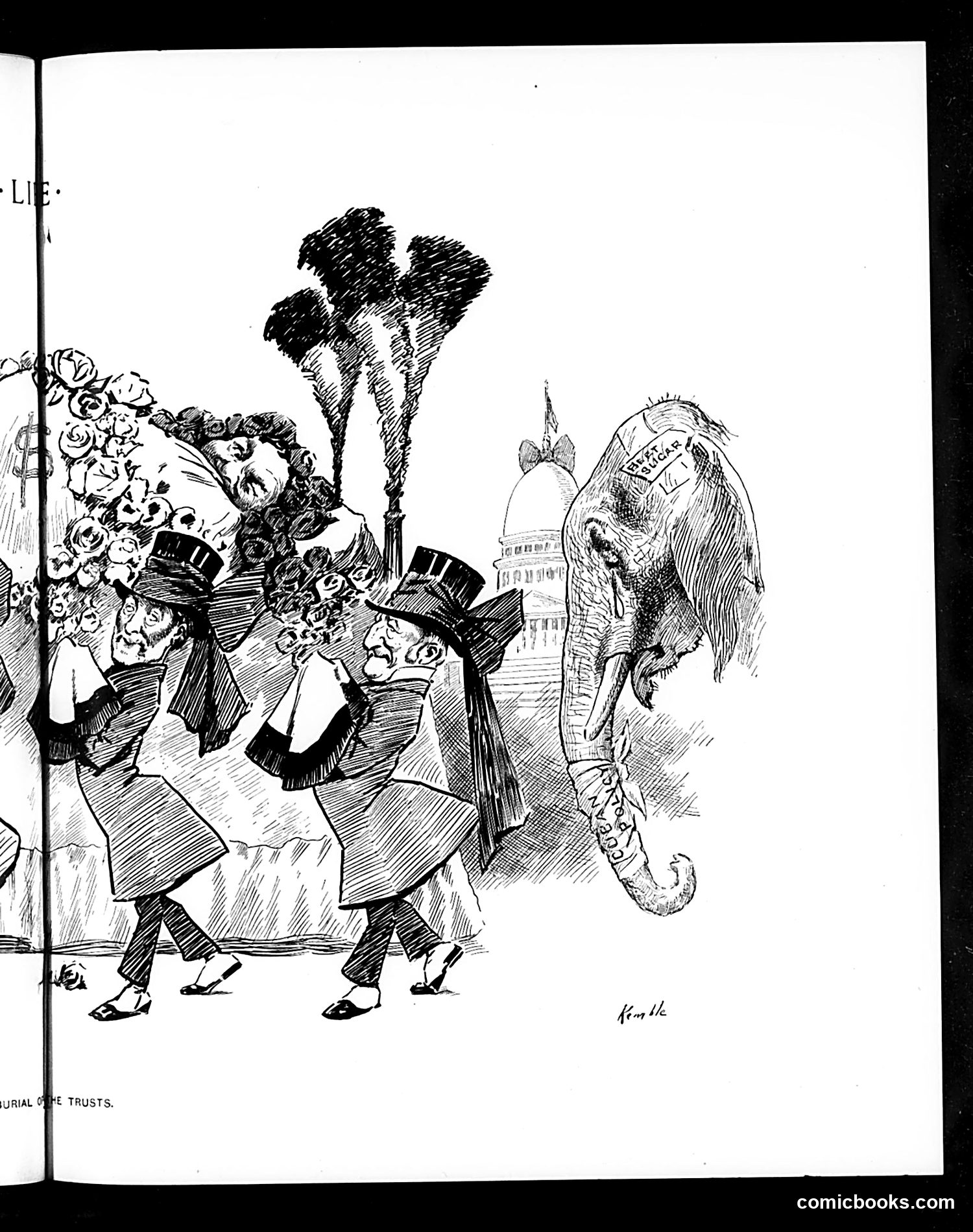
This is a satirical cartoon depicting an elephant (the Republican Party symbol) being led by figures in formal dress wearing top hats and carrying large floral arrangements. The Capitol building is visible in the background. The cartoon appears to criticize how Republican politicians or wealthy interests are "controlling" or "leading around" the Republican Party itself. The elaborate flowers suggest either celebration, funeral imagery, or lavish spending—possibly mocking extravagance or corruption. The partial text visible mentions "TRUSTS," suggesting this cartoon critiques the influence of corporate trusts on Republican politics—a major Progressive Era concern about monopolies controlling government policy. Without the full caption or publication date, the specific political moment remains unclear, though the style and themes suggest early 20th-century American political satire.
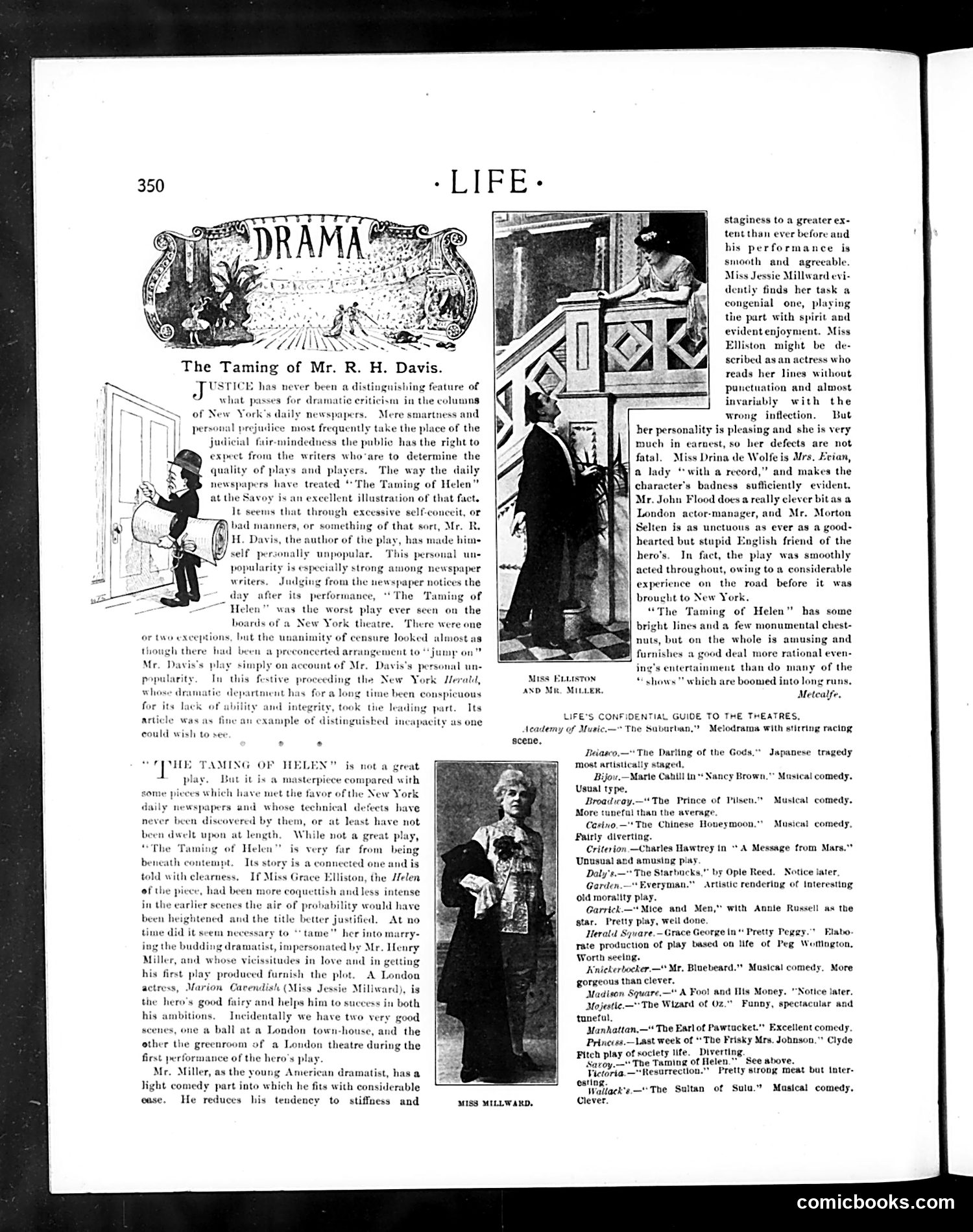
This page reviews a theatrical adaptation of Shakespeare's "The Taming of the Shrew," rewritten by American dramatist R. H. Davis. The left column criticizes the play's poor reception by New York newspaper critics, noting the "excessive self-conceit" of its author. The cartoon depicts a small man (Davis) being figuratively "tamed" or humbled—shown standing before a larger, authoritative figure. The satire mocks Davis's inflated ego and the gap between his confidence in his work and critics' harsh judgment. The page also includes theater reviews and photographs of cast members like Miss Elliston and Miss Willard, listing other contemporary productions at various theaters.
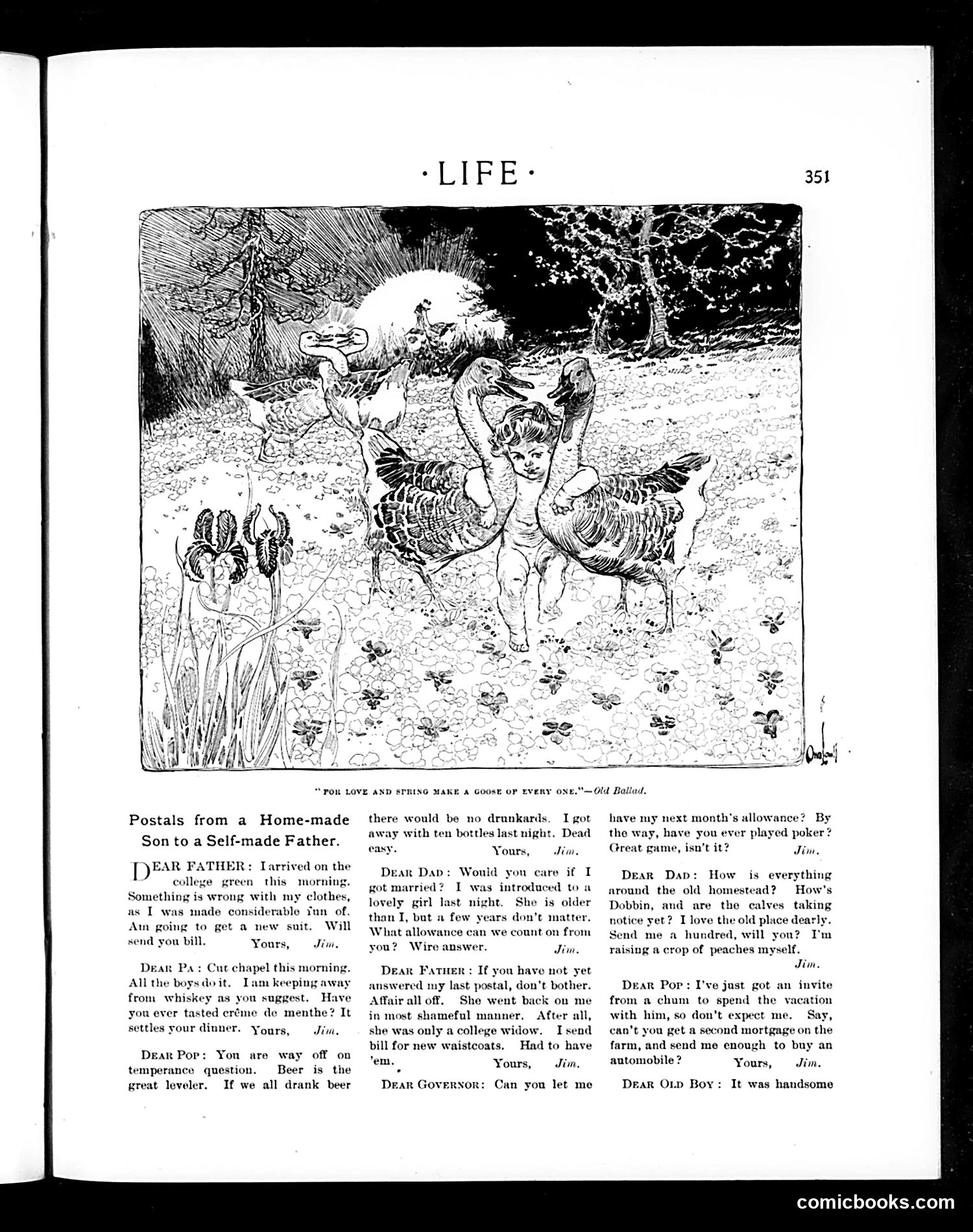
This is a satirical humor piece critiquing the behavior of a college-age son and his financially-struggling self-made father. The cartoon (showing cherubs/putti with geese) illustrates the epigraph about spring and love. The "postals" format presents a one-sided correspondence where the son repeatedly asks for money while describing irresponsible behavior: buying new clothes, cutting classes, drinking heavily (beer and crème de menthe), a failed engagement requiring new waistcoats, and wanting funds for an automobile. Each request is framed casually or with feigned innocence ("raising a crop of peaches"). The satire targets: - **Generational entitlement**: The son's constant demands despite his father's modest means - **College excess**: drinking, gambling (poker), and moral laxity - **Consumer culture**: perpetual need for new goods and luxuries The title's contrast—"home-made son to self-made father"—suggests the father built his wealth through hard work, while his son squanders it through frivolity. The implied frustration (the father's unshown responses) makes the son's obliviousness the joke.
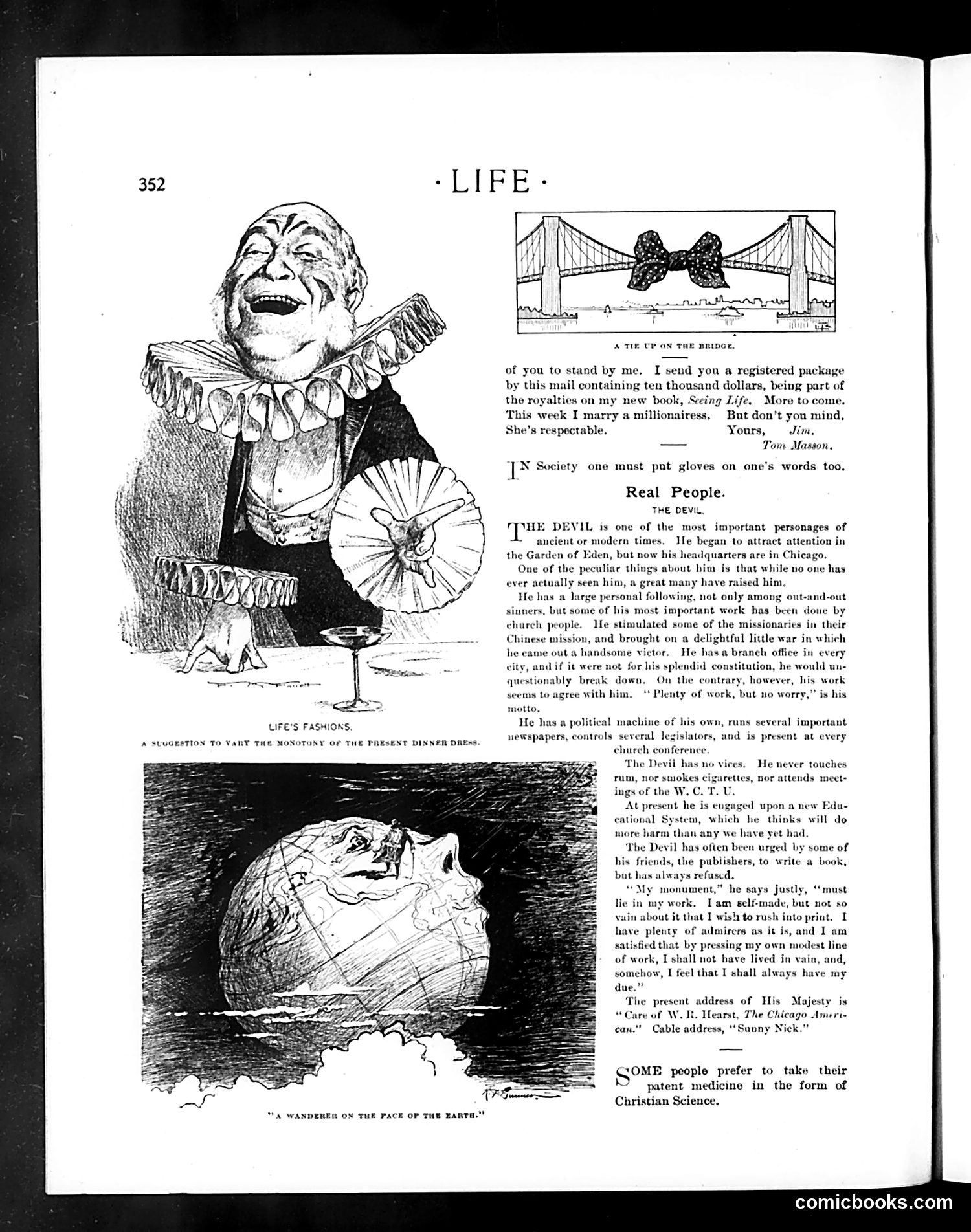
This page contains three distinct satirical pieces targeting American society circa early 1900s: **"A Tie Up on the Bridge"**: A humorous letter from "Jim" to a friend, boasting about marrying a millionairess while sending money from his book royalties. The satire mocks social-climbing and mercenary marriages among the wealthy. **"Life's Fashions"**: The top cartoon ridicules formal dinner dress codes by suggesting absurdly exaggerated alternatives—the figure wears an enormous Elizabethan-style ruff and holds a wine glass, satirizing the pretension and discomfort of high-society dress conventions. **"Real People: The Devil"**: The main article uses personification to satirize American corruption and vice. It cleverly suggests the Devil has relocated his "headquarters" to Chicago and now runs newspapers, controls legislators, and operates a political machine—implying that contemporary American institutions (media, politics, religion) are inherently corrupt or controlled by corrupt forces. The final jab at Christian Science and patent medicine suggests gullible Americans accept fraudulent "cures." All three pieces mock American materialism, hypocrisy, and social pretension.
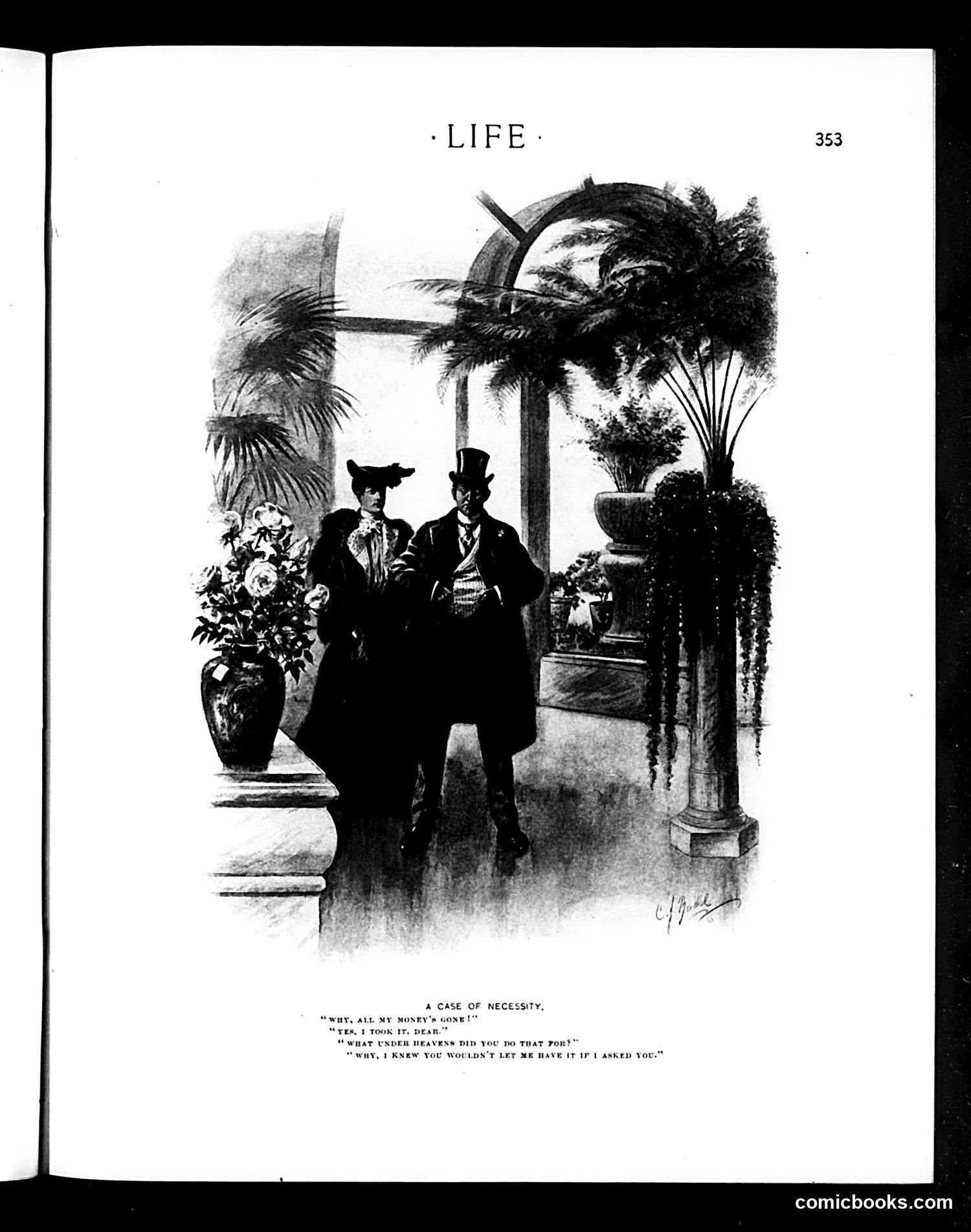
This is a domestic humor cartoon satirizing marriage dynamics and women's financial dependence. A well-dressed couple stands in an elegant conservatory; the woman has taken her husband's money without permission. The joke hinges on her justification: she stole from him because she knew he'd refuse if asked directly. The cartoon mocks both spouses—his stinginess and her manipulation—but the underlying satire targets the legal reality that married women had limited independent access to money and property. The title "A Case of Necessity" frames theft as justified by circumstances, suggesting that wives were forced into deception by their lack of financial autonomy. For a modern reader, this reveals how the era's marriage laws left women economically powerless, making this supposedly humorous domestic squabble actually a commentary on women's legal subordination.
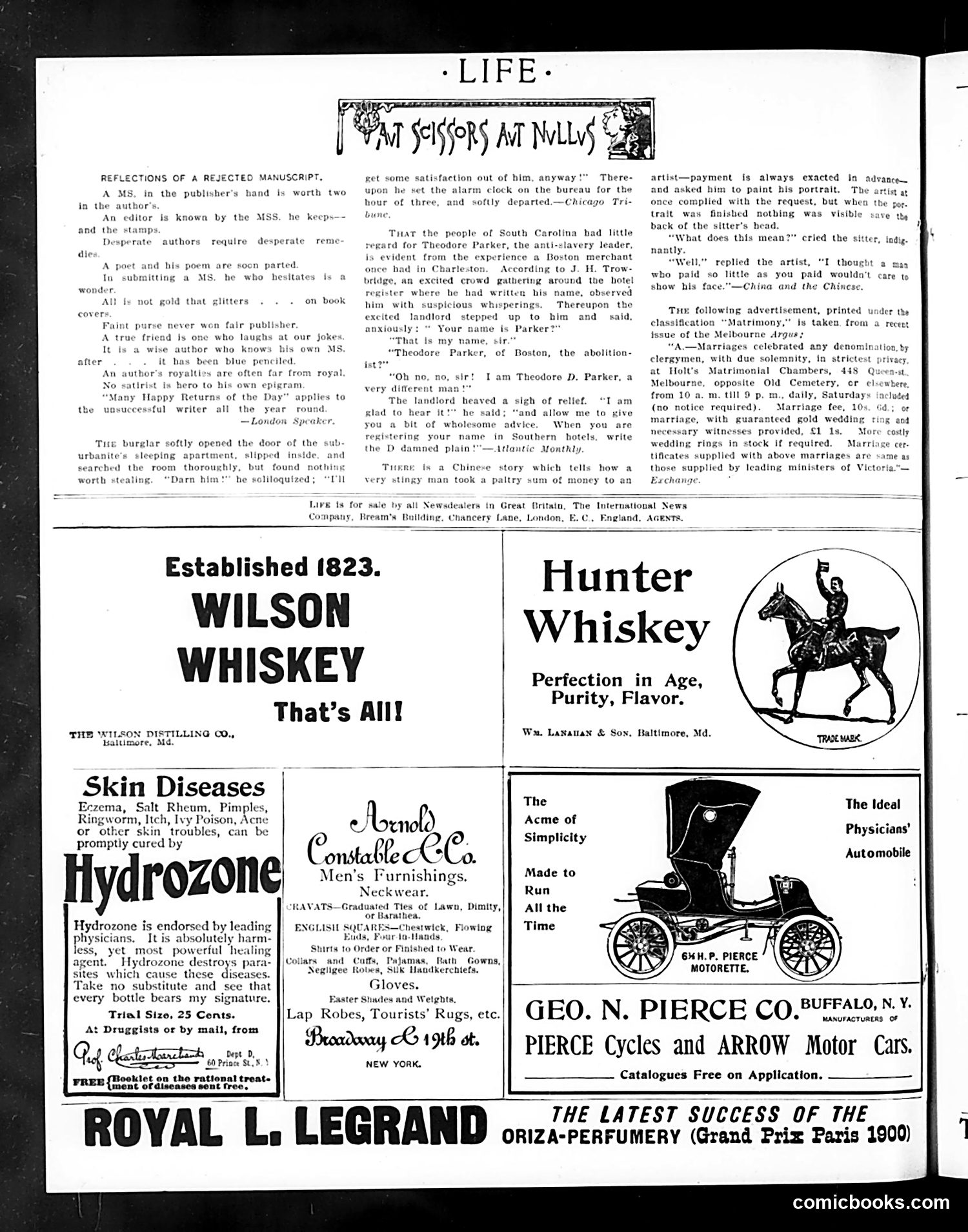
This page is primarily **advertisements and filler content**, not editorial cartoons. The main article discusses the frustrations of manuscript submission and literary rejection, using anecdotes about Theodore Parker and other writers to satirize the publishing industry's treatment of authors. The opening piece, "Reflections of a Rejected Manuscript," jokes about editors, rejected submissions, and the low royalties authors receive. It includes a story about a burglar disappointed to find "nothing worth stealing" in a writer's home—implying writers are perpetually broke. The other notable item is a marriage advertisement from a Melbourne newspaper, humorously presented as classified matrimony services with precise pricing (£1 for ceremonies, etc.), suggesting commercialized marriage arrangements. The remainder consists of period product advertisements: Wilson Whiskey, Hunter Whiskey, Hydrozone (a patent medicine for skin conditions), men's furnishings, an early automobile, and beauty products.
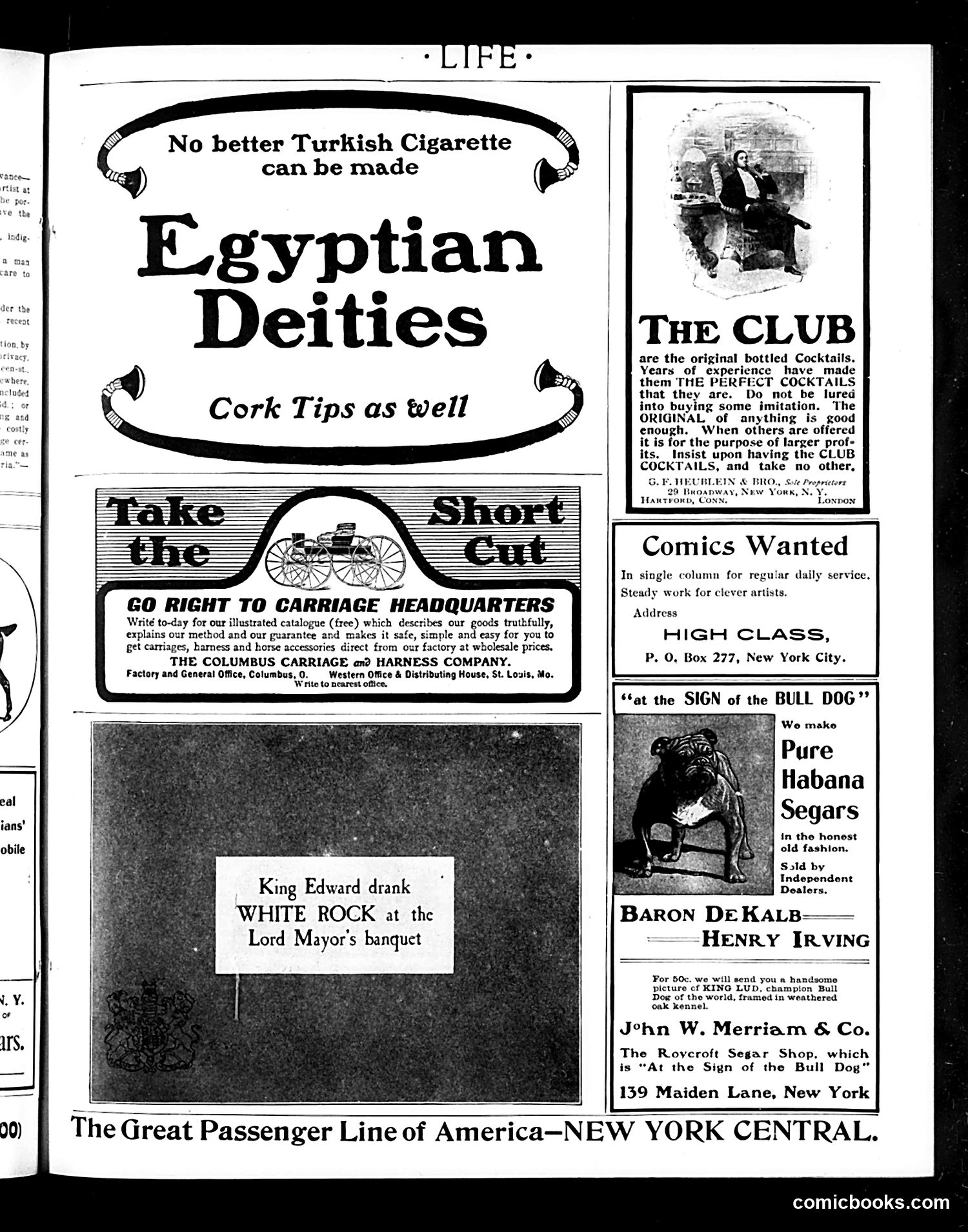
This is primarily an **advertising page** from Life magazine, not a political cartoon. The page contains multiple commercial advertisements for consumer products popular in the early 1900s. The main advertisements include: - **Egyptian Deities** cigarettes (Turkish tobacco) - **The Club** cocktails, marketed as "original bottled cocktails" - **Columbus Carriage and Harness Company** (carriages and horse accessories) - **White Rock** beverages (referenced in an image caption about King Edward drinking it at the Lord Mayor's banquet) - **Baron DeKalb Henry Irving** cigars - **Roycroft Segar Shop** cigars There's also a **"Comics Wanted"** notice seeking cartoonists for daily newspaper work. The page reflects Edwardian-era consumer culture, with brands emphasizing quality, tradition, and endorsements by prestigious figures (King Edward). The reference to King Edward's consumption of White Rock serves as a celebrity endorsement typical of early 20th-century marketing.
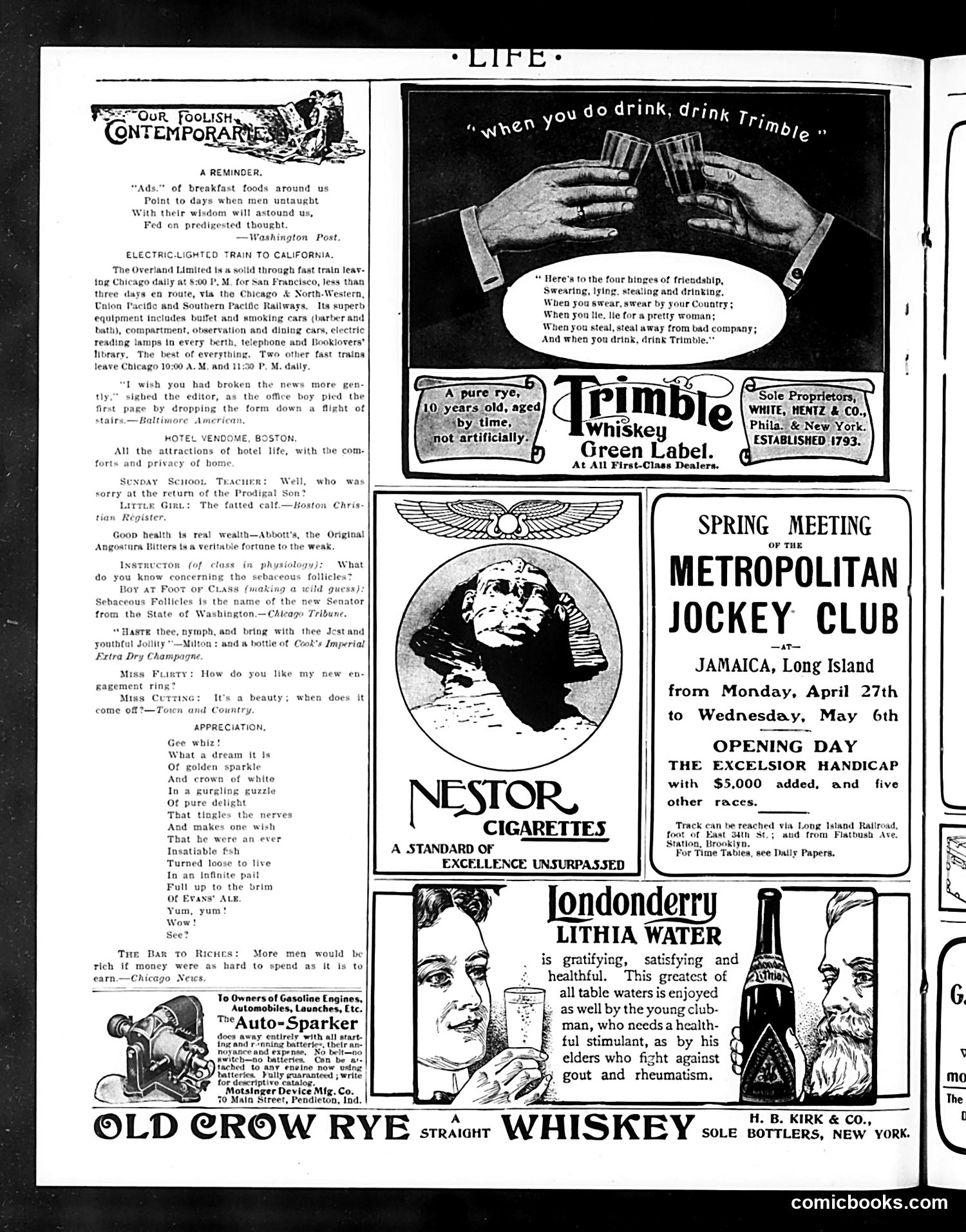
This page is primarily **advertising**, typical of early 1900s magazines. The satirical content is minimal. The notable cartoon element is **"Nestor Cigarettes"** featuring a classical male bust, marketing cigarettes as a "standard of excellence unsurpassed"—typical period advertising with no specific political reference. The left column contains **"Our Foolish Contemporary"**—Life's recurring feature mocking other publications' ads and editorial choices. It critiques breakfast cereal advertising that promises wisdom while promoting "predigested thought," satirizing how ads exploit consumer gullibility. The **Trimble Whiskey ad** uses crude humor about "friendship" tied to vices (swearing, lying, stealing, drinking)—period advertising that would be considered offensive today, reflecting casual attitudes toward alcohol and moral failings. The remaining content includes **racing results, hotel advertisements, and miscellaneous jokes**—standard magazine filler. No specific political figures or events are caricatured. This page reflects turn-of-the-century consumer culture more than satirical commentary.
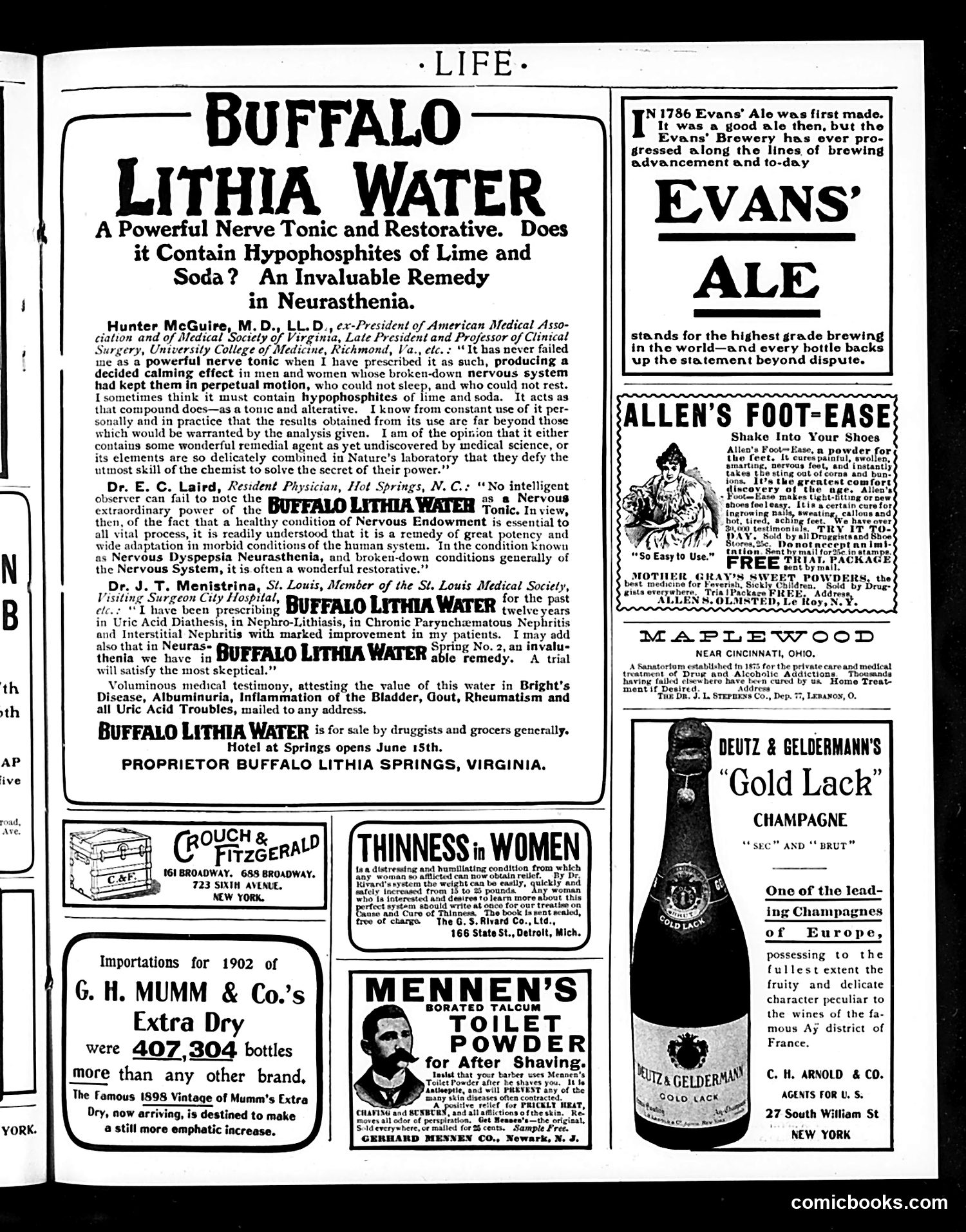
This page is primarily **advertisements**, not satire or political commentary. It showcases patent medicines and luxury goods common to early 1900s Life magazine. The main content advertises **Buffalo Lithia Water**, a purported cure-all featuring endorsements from physicians claiming it treats "neurasthenia" (nervous exhaustion—a diagnosis now considered obsolete). Doctors testify it helps various ailments: kidney disease, gout, rheumatism, and general nerve problems. The appeals to medical authority and vague scientific claims ("hypophosphites of lime and soda") typify the era's unregulated medical advertising before the FDA. Surrounding ads include **Evans' Ale** (established 1786), **Allen's Foot-Ease** powder, **Mennen's Talcum Powder**, champagne, and remedies for female "thinness." The humor for modern readers lies in recognizing these as **quack products**—especially the water advertised as a universal tonic with no proven ingredients. The page reflects pre-regulation marketing where manufacturers made sweeping health claims without evidence, exploiting popular anxieties about nervous disorders.
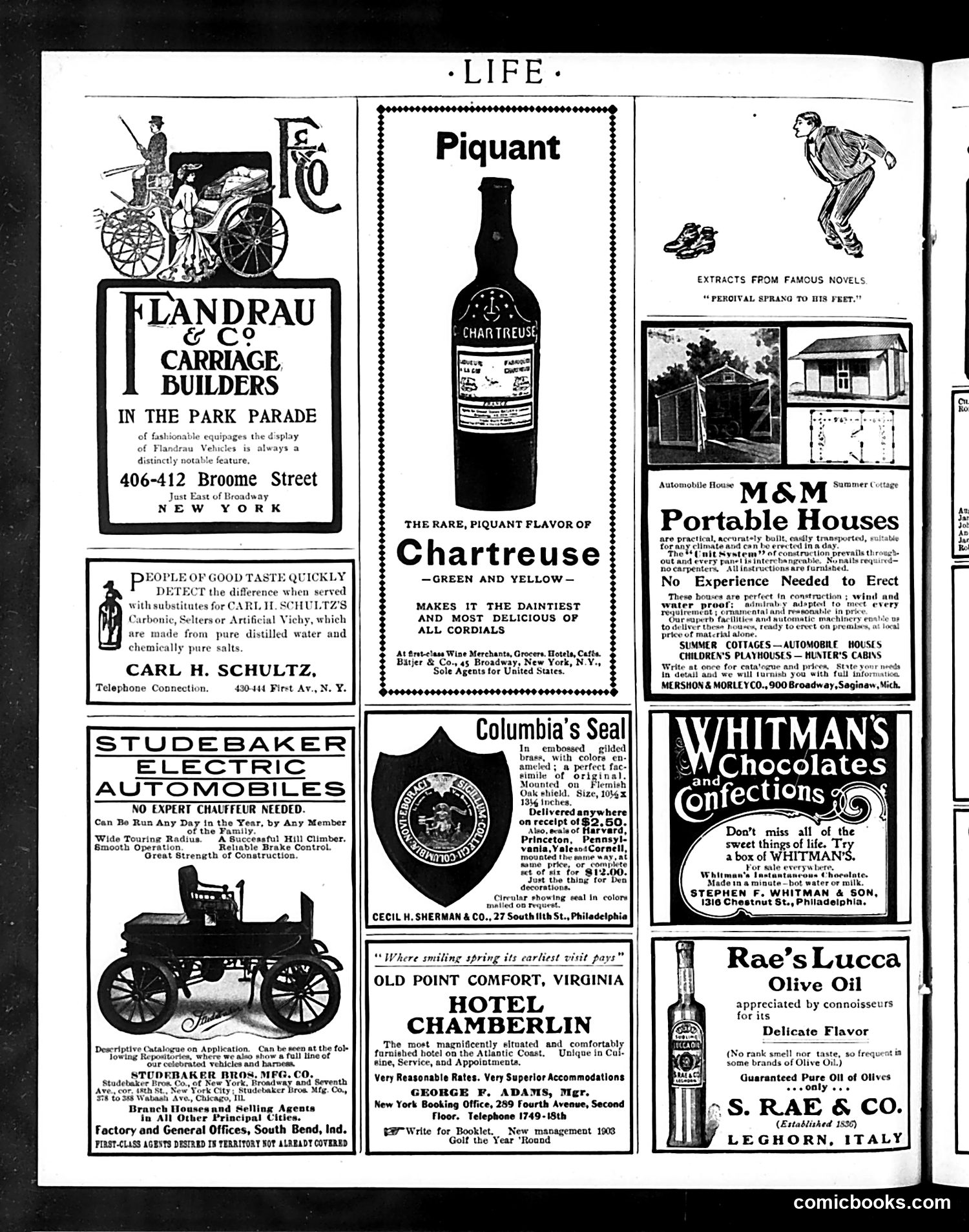
This is primarily an **advertising page**, not satirical content. It showcases early 1900s consumer products and services targeting affluent readers. Key advertisements include: - **Studebaker Electric Automobiles**: Marketed as requiring "no expert chauffeur," appealing to wealthy families seeking modern convenience - **Chartreuse liqueur**: Positioned as a luxury cordial for discriminating tastes - **M&M Portable Houses**: Prefabricated homes marketed as easily assembled—reflecting early 20th-century optimism about industrial solutions - **Luxury goods**: Hotel Chamberlin (Virginia resort), Whitman's Chocolates, Rae's Lucca Olive Oil, and Columbia's Seal (collegiate merchandise) The page reflects **Gilded Age consumer culture**—targeting the affluent with European imports, new technologies, and leisure pursuits. The small illustration labeled "Extracts from Famous Novels: Percival Sprang to His Feet" appears decorative rather than satirical. No political cartoons or social satire are evident; this is straightforward period advertising showcasing what wealthy Americans purchased circa 1903.
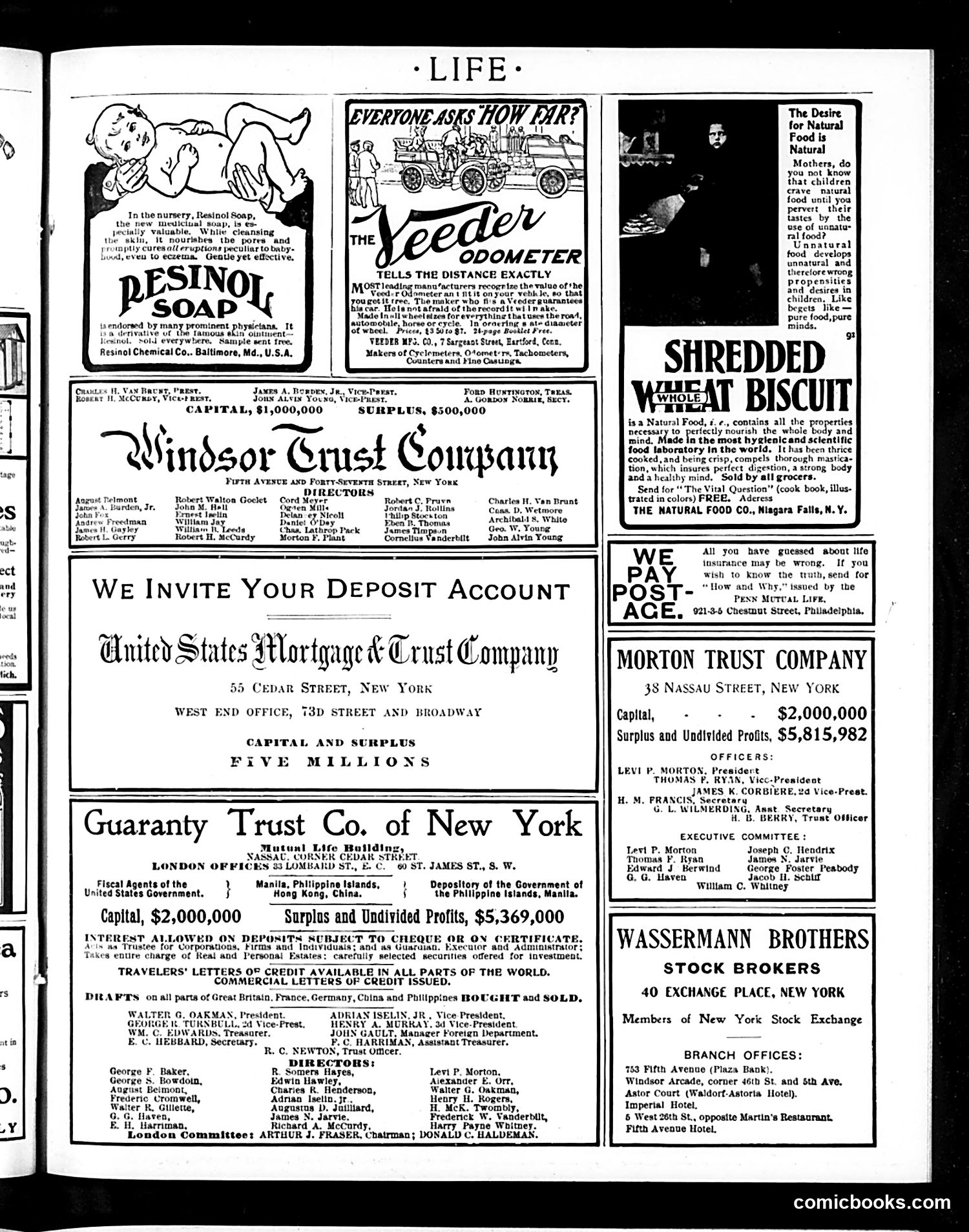
This is primarily an **advertising page** from Life magazine, not a satirical cartoon page. It contains multiple financial institution and consumer product advertisements. The notable content includes ads for **Resinol Soap** and **Shredded Wheat**, both making health claims—particularly targeting mothers concerned with children's "natural food." This reflects early-20th-century marketing around "natural" products and dietary purity, concerns that were genuinely serious given era hygiene problems. The page is dominated by financial institution advertisements (banks, trust companies, brokers) featuring wealthy New York establishments and prominent businessmen of the period. These ads emphasize capital and surplus figures. The Veeder Odometer advertisement shows an early automobile, reflecting the novelty of motorized vehicles at this time. The layout and typography are typical of Life's advertising-heavy pages from this era, mixing consumer and financial services ads with minimal editorial content.
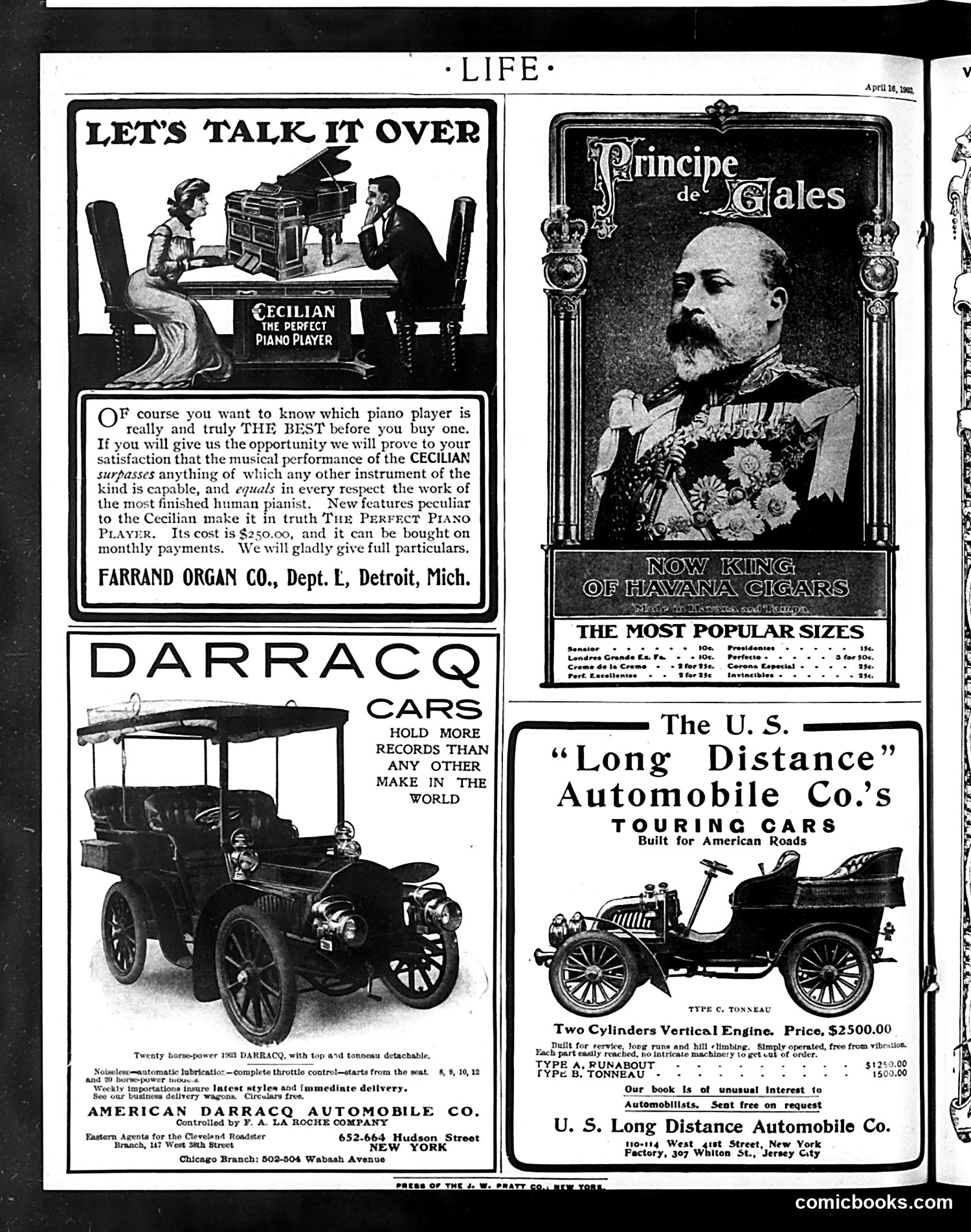
This page is primarily **advertising**, not satire or political commentary. It contains four product advertisements typical of the early automotive and mechanical era: 1. **Cecilian Piano Player** — An automated player piano marketed as superior to human pianists, promising mechanical perfection at $250. 2. **Darracq Cars** — French-manufactured automobiles claiming superior racing records, emphasizing automatic features and ease of operation. 3. **Principe de Gales Cigars** — Features a portrait labeled "Now King of Havana Cigars" (likely referencing a popular cigar brand name rather than actual royalty). 4. **U.S. Long Distance Automobile Co.** — American-made touring cars positioned as practical for American roads, priced $1,250-$2,500. The implicit satire in the Cecilian ad's opening ("Let's Talk It Over") mocks the marketing language of the era—the idea that a machine could genuinely replicate human artistry. Otherwise, this reflects early 1900s consumer culture celebrating technological innovation and American industrial competition with European manufacturers.