
Life, 1903-04-16 · page 6 of 22
Life — April 16, 1903 — page 6: what you’re looking at
What you’re looking at
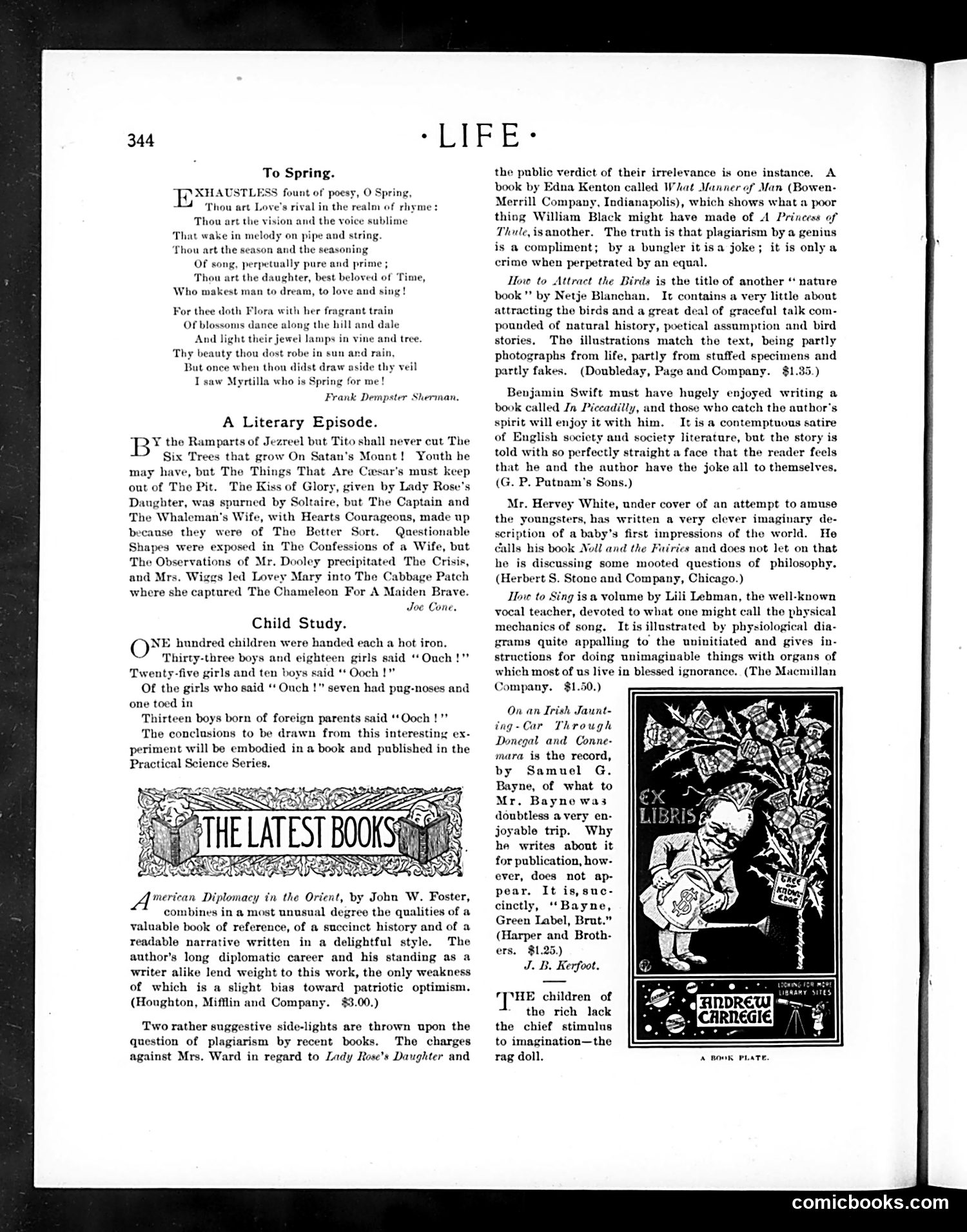
This page contains literary reviews and book advertisements rather than political cartoons. The main content includes: **"To Spring"** - a poem by Frank Dempster Sherman celebrating springtime imagery. **"A Literary Episode"** - a humorous piece by Joe Cone critiquing literary works, appearing to mock overwrought or derivative titles in contemporary publishing. **"Child Study"** - a brief experiment describing children's reactions to a hot iron, likely illustrating early psychological or educational research methods. The page includes two book advertisements with illustrations: one showing a figure in nature (possibly related to "On an Irish Jaunting-Car"), and another for "Andrew Carnegie" publications. Overall, this is a literary/cultural commentary page with no significant political satire or recognizable caricatures of public figures.
📄 Transcribed text from this page (OCR, searchable)
Machine-transcribed from the original scan — historical spelling and the odd misread are preserved.
“LUPE * To Spring. XHAUSTLESS fount of poesy, O Spring, ‘Thou art Love's rival in the realm of rhyme: Thou art the vision and the voice sublime ‘That wake in melody on pipe and string. ‘Thou art the season and the seasoning Of song, perpetually pure and prime ; Thou art the daughter, best beloved of Time, Who makest man to dream, to love and sing! For thee doth Flora with her fragrant train Of blo: long the hill and dale And light their jewel lamps in vine and tree. Thy beauty thou dost robe in sun and rain, But once when thou didst draw aside thy veil I saw Myrtilla who is Spring for me! Frank Dempster Sherman, A Literary Episode. “PRY the Ramparts of Jezreel but Tito shall never cut The Six Trees that grow On Satan's Mount! Youth he may have, but The Things That Are Ciesar's must keep out of The Pit. The Kiss of Glory, given by Lady Rose's Daughter, was spurned by Soltaire, but The Captain and The Whaleman’s Wife, with Hearts Courageous, made up because they were of The Better Sort. Questionable Shapes were exposed in The Confessions of a Wife, but The Observations of Mr. Dooley precipitated The Crisis, and Mrs. Wiggs led Lovey Mary into The Cabbage Patch where she captured The Chameleon For A Maiden Brave. Joe Cone. Child Study. ( NE hundred children were handed each a hot iron, Thirty-three boys and eighteen girls said “Ouch !"” Twenty-five girls and ten boys said ‘* Ooch !” Of the girls who said ‘‘ Ouch !" seven had pug-noses and one toed in Thirteen boys born of foreign parents said ‘*Ooch !"" The conclusions to be drawn from this interesting ex- periment will be embodied in a book and published in the Practical Science Series. Arerican Diplomacy in the Orient, by John W. Foster, combines in a most unusual degree the qualities of a valuable book of reference, of a succinct history and of a readable narrative written in a delightful style. The author’s long diplomatic career and his standing as a writer alike lend weight to this work, the only weakness of which is a slight bias toward patriotic optimism. (Houghton, Mifflin and Company. $3.00.) Two rather suggestive side-lights are thrown upon the question of plagiarism by recent books. The charges against Mrs. Ward in regard to Lady Rose's Daughter and the public verdict of their irrelevance is one instance, A book by Edna Kenton called What Manner of Man (Bowen- Merrill Company, Indianapolis), which shows what a poor thing William Black might have made of A Princess of Thule,isanother. The truth is that plagiarism by a genius is a compliment; by a bungler it isa joke; it is only a crime when perpetrated by an equal. How to Attract the Birds is the title of another “ nature book’? by Netje Blanchan. It contains a very little about attracting the birds and a great deal of graceful talk com- pounded of natural history, poetical assumption and bird stories, Tho illustrations match the text, being partly photographs from life, partly from stuffed specimens and partly fakes. (Doubleday, Page and Company. $1.35.) Benjamin Swift must have hugely enjoyed writing a book called In Piccadilly, and those who catch the author's spirit will enjoy it with him. It is a contemptuous satire of English society and society literature, but the story is told with so perfectly straight a face that the reader feels that he and the author have the joke all to themselves, (G. P. Putnam's Sons.) Mr. Hervey White, under cover of an attempt to amuse the youngsters, has written a very clever imaginary de- scription of a baby’s first impressions of the world. He calls his book Noll and the Fairies and does not let on that. he is discussing some mooted questions of philosophy. (Herbert S. Stone and Company, Chicago.) Tlie to Sing is a volume by Lili Lehman, the well-known vocal teacher, devoted to what one might call the physical mechanics of song. It is illustrated by physiological dia- grams quite appalling to the uninitiated and gives in- structions for doing unimaginable things with organs of which most of us live in blessed ignorance. (The Macmillan Company. $1.50.) On an Irish Jaunt- ing-Car Through Donegal and Conne- mara is the record, by Samuel G. Bayne, of what to Mr. Bayno was doubtless avery en- joyable trip. Why he writes about it for publication, how- ever, does not ap- pear. It is,suc- cinctly, ‘‘Bayne, Green Label, Brut.” (Harper and Broth- ers. $1.25.) J. B. Kerfoot. ip se children of the rich lack the chief stimulus to imagination—the rag doll. comicbooks.com