
Life, 1903-04-16 · page 12 of 22
Life — April 16, 1903 — page 12: what you’re looking at
What you’re looking at
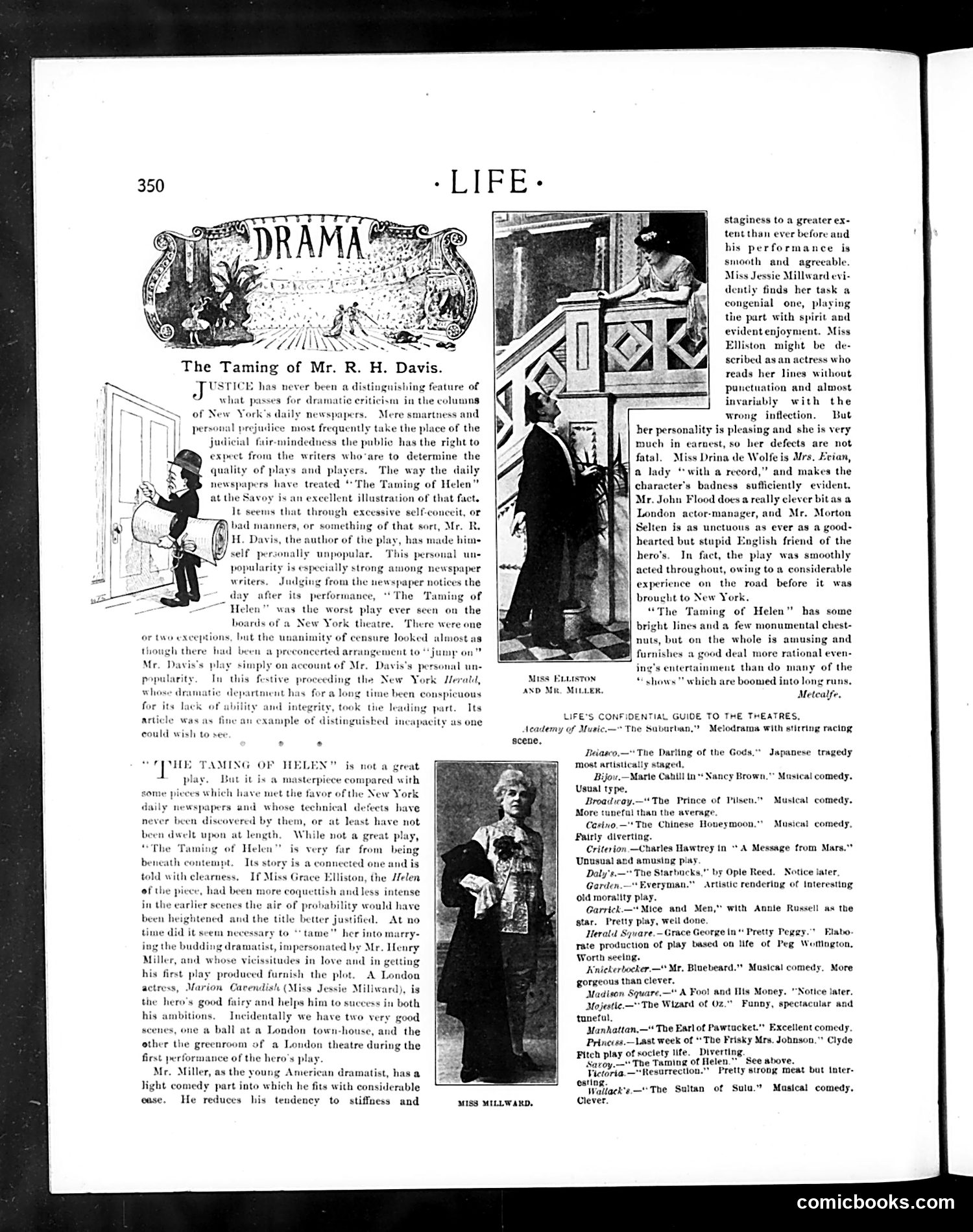
This page reviews a theatrical adaptation of Shakespeare's "The Taming of the Shrew," rewritten by American dramatist R. H. Davis. The left column criticizes the play's poor reception by New York newspaper critics, noting the "excessive self-conceit" of its author. The cartoon depicts a small man (Davis) being figuratively "tamed" or humbled—shown standing before a larger, authoritative figure. The satire mocks Davis's inflated ego and the gap between his confidence in his work and critics' harsh judgment. The page also includes theater reviews and photographs of cast members like Miss Elliston and Miss Willard, listing other contemporary productions at various theaters.
📄 Transcribed text from this page (OCR, searchable)
Machine-transcribed from the original scan — historical spelling and the odd misread are preserved.
The Taming of Mr. R. H. Davis. Justic ng feature of YF what passes for dramatic criticism in the columns Mere smartness and niost frequently take the place of the judicial fair-mindedness the public has the right to expect from the writers whovare to determine the quality of plays and players. The way the daily newspapers have treated “The Taming of Helen” at the Savoy is an excellent illustration of that fact. It seems that through excessive self-conceit, or bad manners, or something of that sort, Mr. Re sat Davis, the author of the play, has made hime has never been a distings of New York's daily newspapers personal preju P/ self personally unpopular. This personal une ng newspaper ulging from the newspaper notices the popularity is especially strong writers. day “The Taming of ~ Hele y ever seen on the boards of a New York theatre, ‘There were one r its performance was the worst p or two exceptions, but the unanimity of censure looked almost as though there had been a preconcerted arrangement to “jump on Mr. Davis's play simply on account of Mr. Davis's personal un- popularity, In this festive proceeding the New York Meratd, whose dramatic department has for a long time been conspicuous for its lack of ability and integrity, took the leading part. Its article was as fine an example of distinguisked incapacity as one could wish to sec “PME TAMING OF HELEN” is not a great 4 play, But it is a masterpiece compared with me pivees which have met the favor of the New York daily newspapers and whose technical never been discovered by them, of at Teast have not been dwelt upon at length “The Taming of Helen” ts have While not a great play, is very far from being is a connected one and is told with clearness, If Miss Grace Elliston, the Helen ef the piece, had been beneath contempt, Its stor less intense would have been heightened and the title better justified. At no id it seem necessary to * ore coquettish the earlier scenes the air of probabili tame” her into marry- ing the budding dramatist, impersonated by Mr. Henry Miller, and wh v his first p ssitudes in love and in getting produced furnish the plot. A London actress, Marion Cavendish (Miss Jessie Millward), is the hero's good fairy and helps him to success in both his ambitions. Incidental! ly we have two very good enes, one a ball at a London town-house, and the other the greenroom of a London theatre during the first performance of the hero's play. Mr. Miller, as the young American dramatist, has a light comedy part into which he fits with considerable ease. He reduces his tendency to stiffness and MISS MILLWARD. staginess to a greater ex- tent than ever before aud his performance is smooth and agreeable. Millward evi- finds her task a congenial one, playing the part with spirit and evident enjoyment. Miss Elliston might be de- scribed as an actress who reads her lines without punctuation and almost invariably with the wrong inflection. But her personality is pleasing and she is very much in earnest, so her defects are not fatal. Miss Drina de Wolfe is Mrs. Evian, a lady “with a record,” and makes the character's badness sufficiently evident. Mr. John Flood does a really clever bitas a London actor-manager, and Mr. Morton Selten is as unctuous as ever as a good- hearted but stupid English friend of the hero's. In fact, the play was smoothly acted throughout, owing to a considerable experience on the road before it was brought to New York. “The Taming of Helen” has some bright lines and a few monumental chest- nuts, but on the whole is amusing and furnishes a good deal more rational even “s entertainment than do m f the © shows’ which are boomed into long rans. Metcalfe, AND MR. MILLER. LIFE'S CONFIDENTIAL GUIDE TO THE THEATRES, teademy of Music.—* The Suburban,” Melodrama with stirring ractog scene. Peiasco.—* The Darling of the Gods.” most artistically staged. Bijou,—Marte Catil in“ Nancy Brown,” Musical comedy. Usual type. Broaiway.—“The Prince of Pilsen.” Mustcat comedy. More tunefal than the averag Cesino.—*Tue Chinese Hoveymoon."’ Musical comedy, Fairly diverting. Criterion —Charles Hawtrey in “A Message from Mars. Unusual and amusing play Daty's.—* The Starbucks," by Ople Reed. Notice later. Garden.—" Everyman.” Artistic rendering of Interesting old morality play. Garrick.— Mice and Men," with Annle Russell as the star. Pretty play, weil done. Herald Syuare,— Grace George In“ Pretty Peggy." Flabo rate production of play based on life of Peg Wortington. Worth seeing. Knickertocker.—" Mr, Bluebeard.” Musical comedy. More gorgeous than clever. Madison Square,—" A Foo! and Hts Money. "Notice later. Mojestiec —"The Wizard of Oz." Funny, spectacular and tuneful. Manhattan,—“ The Earl of Pawtucket.” Excellent comedy. Princiss.—Last week of “The Frisky Mrs, Johnson.” Clyde ch play of soctety life. Diverting. nae ‘The Taming of Helen." See above. Victoria. —“ Resurrection.” Pretty strong meat but tnter- es Nitiack's—*The Sultan of Sulu.” Masical comedy, Clever. Japanese tragedy comicbooks.com