
Life, 1903-04-16 · page 4 of 22
Life — April 16, 1903 — page 4: what you’re looking at
What you’re looking at
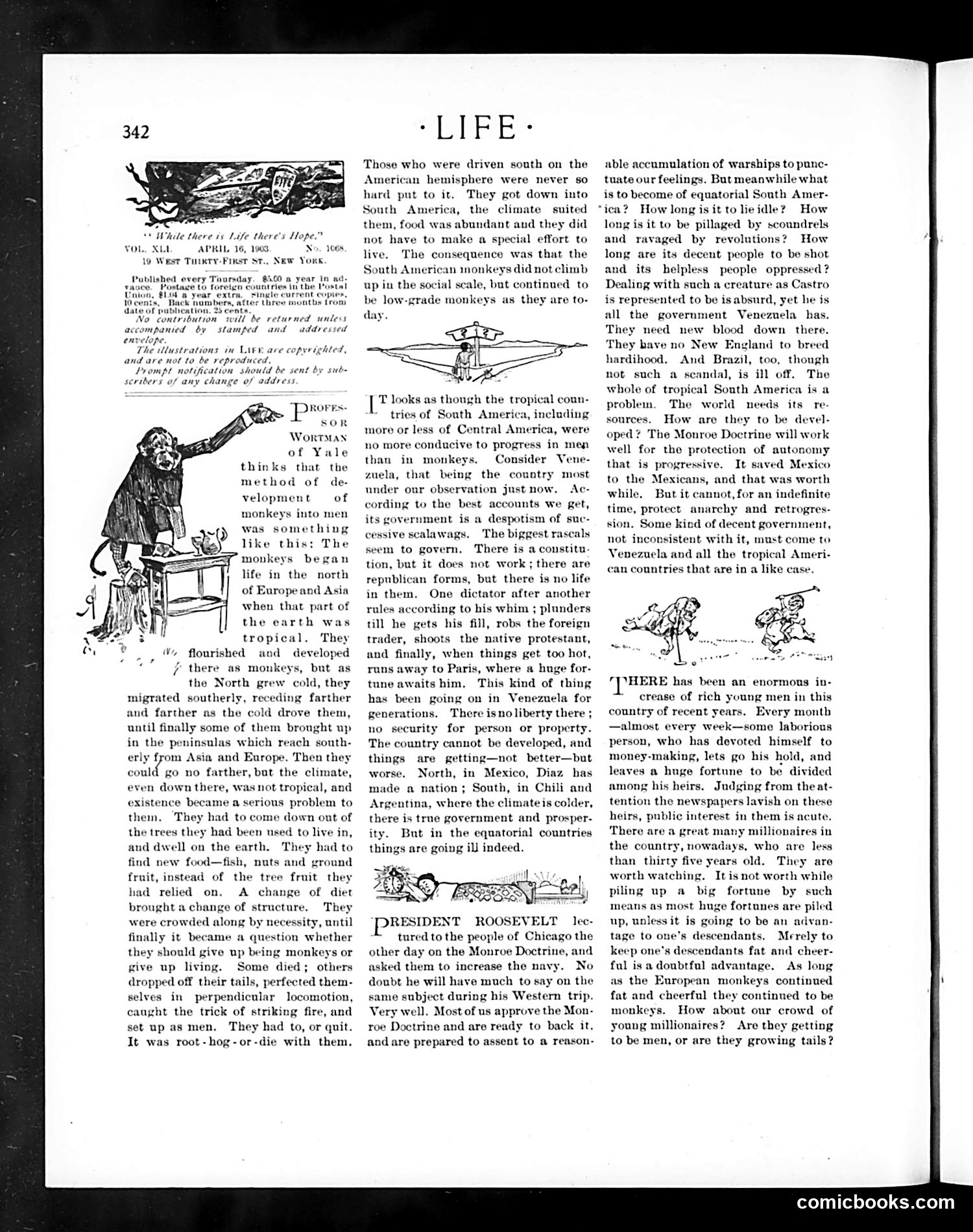
This LIFE magazine page contains editorial commentary on South American politics and society, illustrated with several cartoon vignettes. The main illustrations depict **monkeys in human situations** — a Professor of Yale observing monkeys "thinking" about development methods, and monkeys engaged in various human activities. This is satirical commentary: the cartoonist uses monkey caricatures to mock South American governance, suggesting that tropical countries' political systems are primitive or chaotic. The text discusses Venezuela's instability, lack of secure government, and succession of dictatorships — comparing it unfavorably to Mexico's progress under Díaz. The article also references **President Roosevelt's Monroe Doctrine** stance and approval of naval expansion. The satire conflates South American political disorder with animal behavior, reflecting the condescending, imperialist attitudes common in early 20th-century American journalism.
📄 Transcribed text from this page (OCR, searchable)
Machine-transcribed from the original scan — historical spelling and the odd misread are preserved.
White there ts Life there's Hope.” A APRIL 16, 1903. x West Tutnty-Finst St., NEW YORK 08s. Published every ace. Postage to Ma year exten Back humbers, at date of pubheatte No contribution accompanied by The illustrations in LiFe are copyrighted, and are not to be reproduced. Prompt notification should be sent by sub= scribers of any change of address ‘pre ES- SOR WortMan of Yale thinks that the method of de- velopment of monkey v something like this: The monkeys began life in the north will be returned unless stamped and addressed nto men of Europe and Asia when that part of the earth was tropical. They flourished and developed there as monkeys, but as the North grew cold, they migrated southerly, receding farther and farther as the cold drove them, until finally some of them brought up in the peninsulas whi reach south- erly from Asia and Europe. Then they soul no farther, but the climate, even down there, was not tropical, and existence became a serious problem to them. They had to come down out of the trees they had been used to live in, and dwell on the earth, They had to find new food—fish, nuts and ground fruit, instead of the tree fruit they had relied on. A change of diet brought a change of structure. They were crowded along by necessity, until finally it became a question whether they should give up being monkeys or give up living. Some died; others dropped off their tails, perfected them- selves in perpendicular locomotion, caught the trick of striking fire, and set up as men. They had to, or quit. It was root-hog-or-die with them. “EEE Those who were driven south on the American hemisphere were never 80 d put to it, They got down into South America, the climate suited them, food was abundant and they did not have to make a special effort to live. The consequence was that the South American monkeys did not climb up in the social scale, but continued to be low-grade monkeys as they are to- day. T looks as though the tropi tries of South America, including more or less of Central America, were no more conducive to progress in mea than in monkeys. Consider Vene- zuela, that being the country most under our observation just now. cording to the best accounts we get, its government is a despotism of suc cessive scal The biggest rascal: seem to govern. There is a constitu- tion, but it does not work; there are republican forms, but there is no life in them. One dictator after another rules according to his whim ; plunders till he gets his fill, robs the foreign trader, shoots the native protestant, and finally, when things get too hot, runs away to Paris, where a huge for- tune awaits him, This kind of thing has been going on in Venezuela for generations. There isno liberty there ; no security for person or property. The country cannot be developed, and things are getting—not better—but worse. North, in Mexico, Diaz has made a nation; South, in Chili and Argentina, where the climate is colder, there is trne government and prosper- ity. But in the equatorial countries things are going ill indeed. ea 3 RESIDENT ROOSEVELT _ lec- tured tothe people of Chicago the other day on the Monroe Doctrine, and asked them to increase the navy. No doubt he will have much to say on the same subject during his Western trip. Very well. Most of us approve the Mon- roe Doctrine and are ready to back it, and are prepared to assent to a reason- “ica? able accumulation of warships to panc- tuate our feelings. But meanwhile what is to become of equatorial South Amer- How long is it to lieidle? How long is it to be pillaged by scoundrels and ravaged by revolutions? How long are its decent people to be shot and its helpless people oppressed? Dealing with such a creature as Castro. is represented to be is absurd, yet he is all the government Venezuela has, They need new blood down there. They have no New England to breed hardihood. And Brazil, too, though not such a scandal, is ill off. The whole of tropical South America is a problem. The world needs its re- sources. How are they to be devel- oped ? The Monroe Doctrine will work well for the protection of autonomy that is progressive. It saved Mexico to the Mexicans, and that was worth while. But it cannot, for an indefinite time, protect anarchy and retrogres- sion. Some kind of decent government, not inconsistent with it, must come to Venezuela and all the tropical Ameri- can countries that are in a like case. WP BSRE has been an enormous in- crease of rich young men in this country of recent years. Every month —almost every week—some laborious person, who has devoted himself to money-making, lets go his hold, and leaves a huge fortune to be divided among his heirs. Judging from the at- tention the newspapers lavish on these heirs, public interest in them is ‘There are a great many millionaires in the country, nowa than thirty fi 8, Who are less years old. They are worth watching. Itis not worth while piling up a big fortune by such means as most huge fortunes are piled up, unless it is going to be an advan- tage to one’s descendants. Merely to keep one’s descendants fat and cheer- ful is a doubtful advantage. As long as the European monkeys continued fat and cheerful they continued to be monkeys. How about our crowd of young millionaires? Are they getting to be men, or are they growing tails? comicbooks.com