
A complete issue · 24 pages · 1903
Life — February 26, 1903
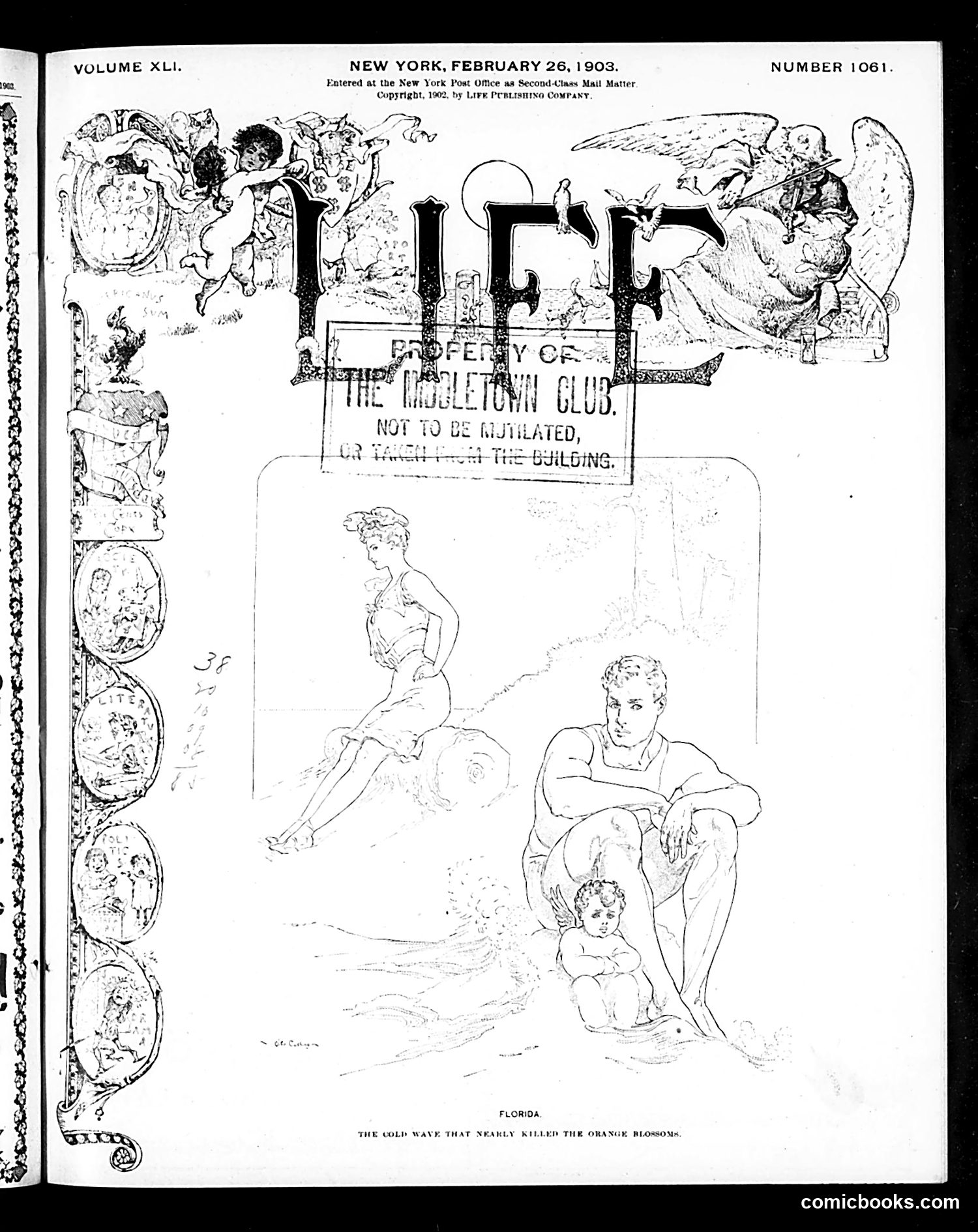
This page shows the cover/title section for "Life" magazine's satirical content. The header features decorative cherubs and classical figures surrounding the title. Below is a cartoon labeled "FLORIDA: THE COLD WAVE THAT NEARLY KILLED THE ORANGE BLOSSOMS." It depicts female and cherub figures in a scene suggesting frost damage to Florida's citrus crops. The image references an actual agricultural crisis—a severe cold snap that threatened Florida's valuable orange industry, a major economic concern for the state at that time. The ornamental border on the left side contains repeated circular medallion illustrations, typical of Life's decorative style. A stamp indicating "Property of the Middletown Club" suggests this was a library or institutional copy.
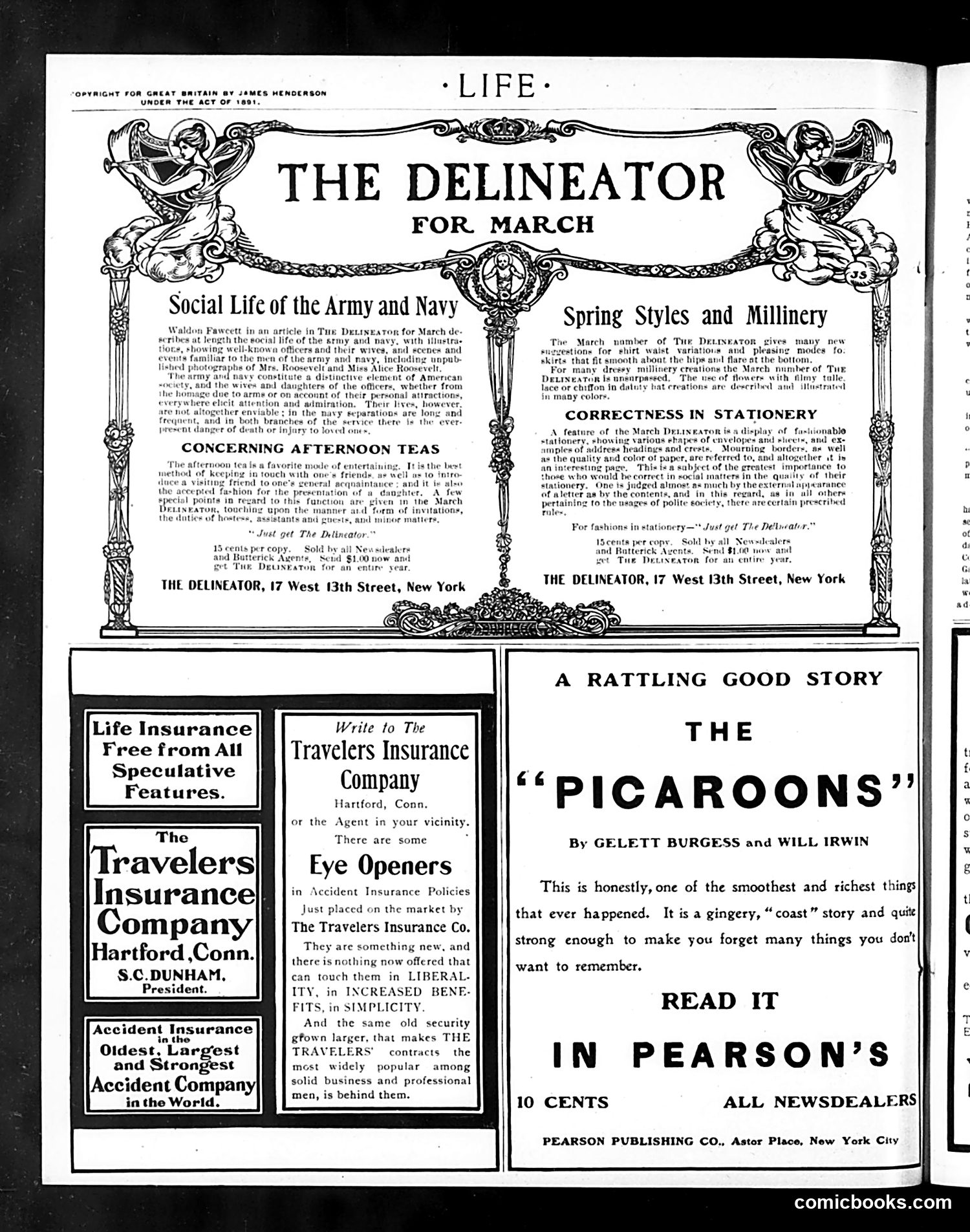
This page is primarily **advertising and editorial content** rather than political satire. The top section features "The Delineator for March," a women's fashion and lifestyle magazine, advertising spring styles, millinery, and stationery. Below that are ads for Travelers Insurance Company and a book advertisement for "The Picaroons" by Gelett Burgess and Will Irwin. The decorative header with cherubs and ornamental borders is typical of early 20th-century magazine design but doesn't convey specific political content. No identifiable political figures or satirical cartoons appear on this page. The content reflects period consumer culture—insurance products, fashion, and popular literature—rather than social or political commentary.
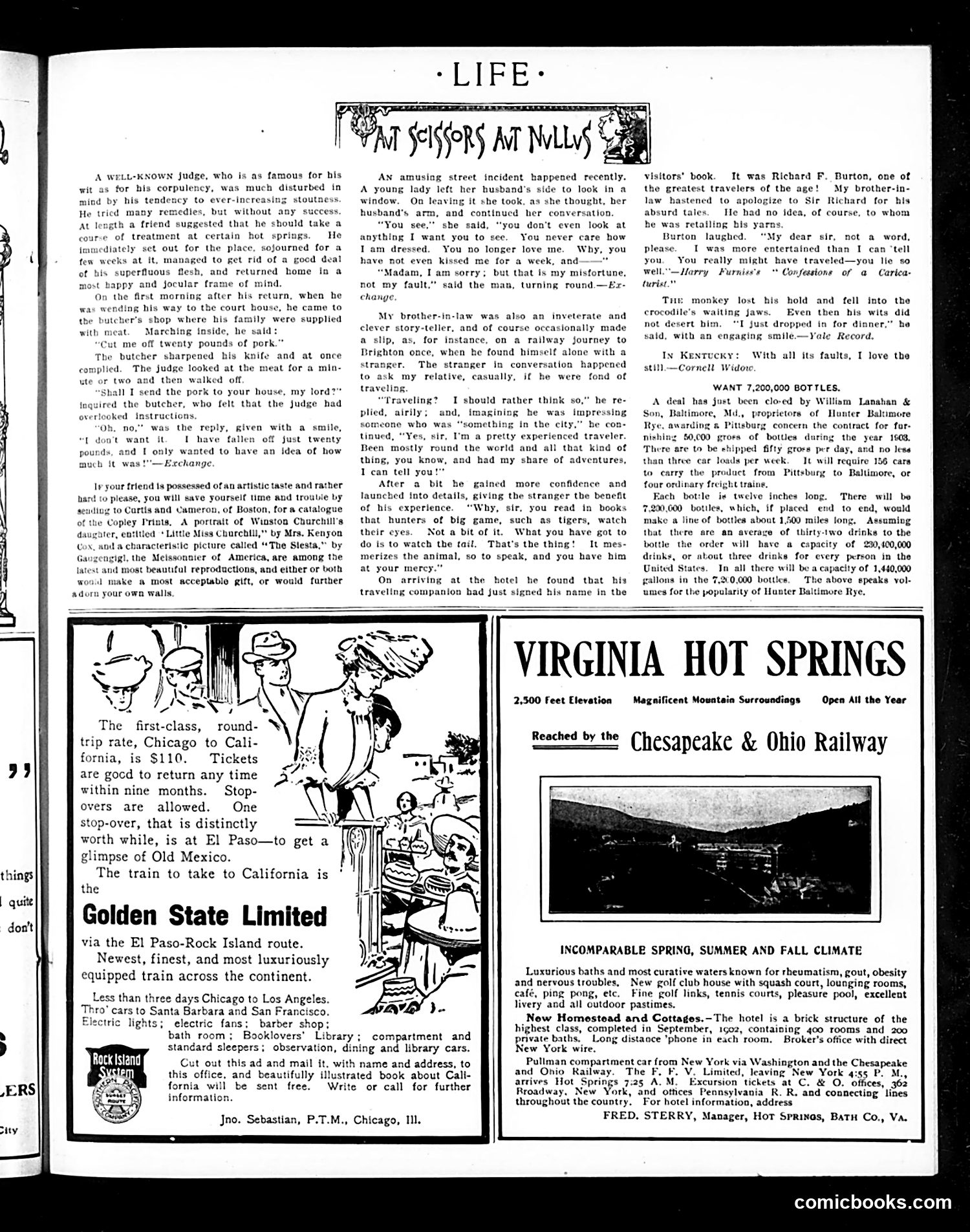
This page contains two main elements: a satirical article with accompanying cartoon, and travel advertisements. The cartoon depicts a judge who habitually over-sentences criminals, then befriends one of his defendants outside court. The satirical point critiques judicial inconsistency and hypocrisy—a judge who is "famous for his wit as for his strictness" yet prone to "ever-increasing sternness" contradicts himself by socializing with those he's condemned. The accompanying text tells anecdotes about the judge's unreasonable behavior and the awkward social encounter, mocking the absurdity of such judicial conduct. The page also advertises the "Golden State Limited" train and Virginia Hot Springs resort—typical early 20th-century leisure travel promotions. The satire targets judicial temperament and the disconnect between official severity and private sociability.
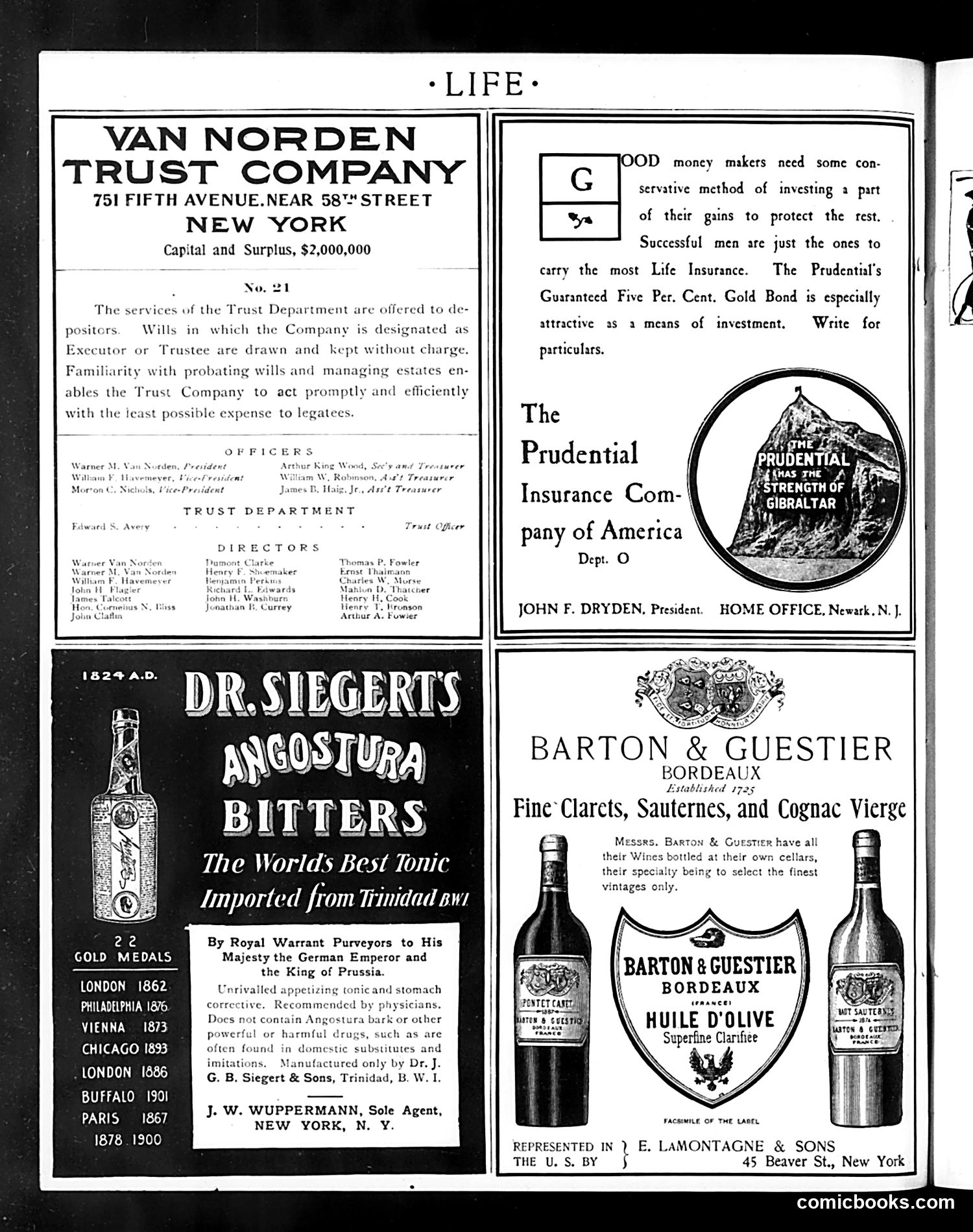
This page contains **no political cartoons or satirical content**—it consists entirely of period advertisements from approximately 1900-1910s. The ads promote: - **Van Norden Trust Company** (New York banking/estate services) - **The Prudential Insurance Company** (life insurance with their iconic Rock of Gibraltar logo) - **Dr. Siegert's Angostura Bitters** (imported tonic from Trinidad, claiming 22 gold medals) - **Barton & Guestier** (French wines and cognac from Bordeaux) These are straightforward commercial advertisements typical of *Life* magazine's revenue model. There is no satire, no cartoon figures, and no political commentary visible. The page simply represents how premium publications funded themselves through high-end product advertising targeting wealthy readers.
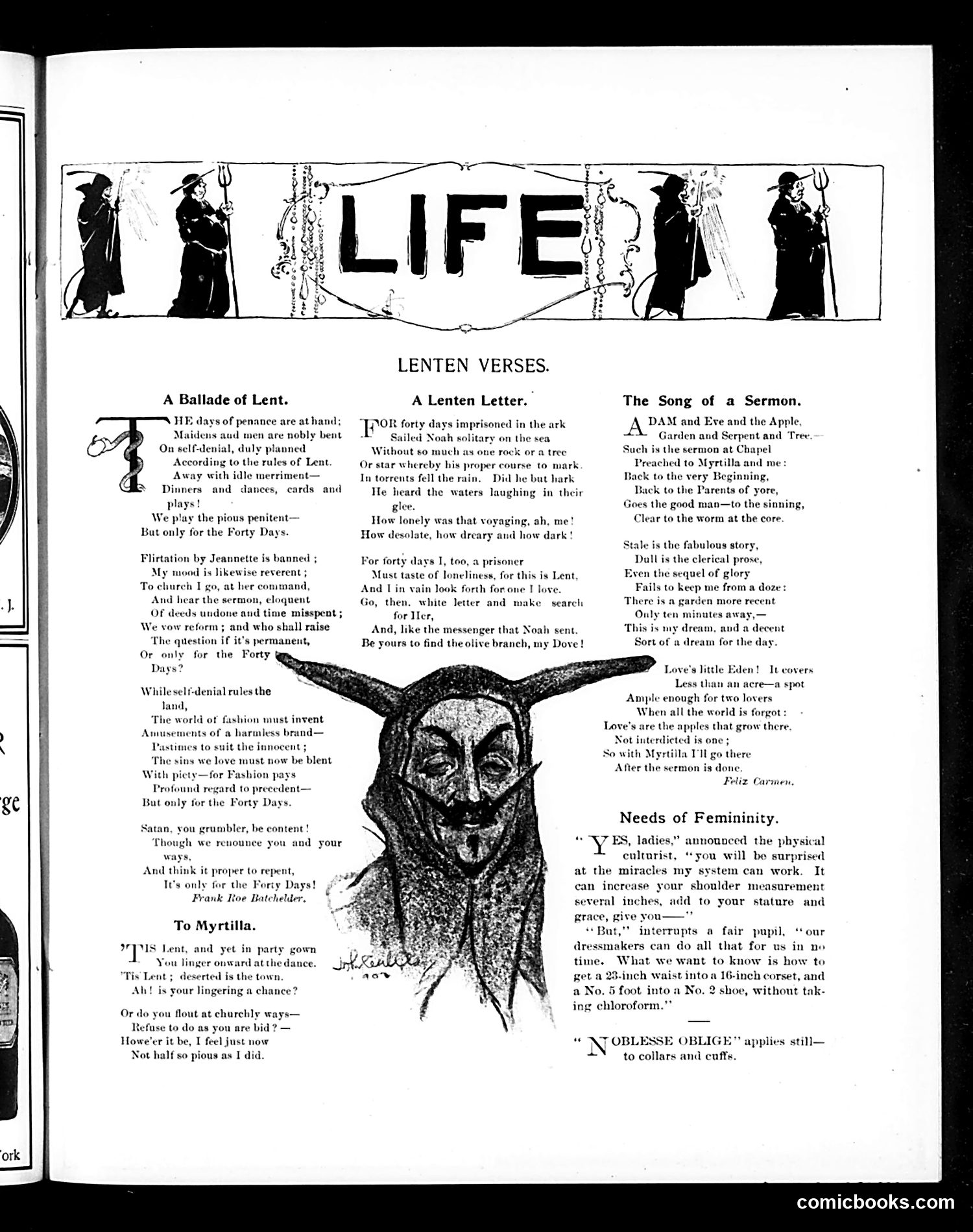
This page collects humorous poetry about Lenten observance (the 40-day Christian period of penance before Easter). The content satirizes both religious hypocrisy and secular attitudes toward Lenten restrictions. **Key elements:** - **"A Ballad of Lent"** mocks those who claim piety during Lent while maintaining worldly pleasures—particularly flirtation and fashion - **"A Lenten Letter"** presents a prisoner's lament, using Noah's ark as metaphor for Lenten confinement - **"Song of a Sermon"** parodies theological language - **Central illustration**: A demonic/satanic figure, likely representing temptation or sin that believers struggle against during Lent The satire targets the disconnect between professed religious devotion and actual behavior—a recurring theme in satirical magazines. Additional content addresses fashion and women's concerns.
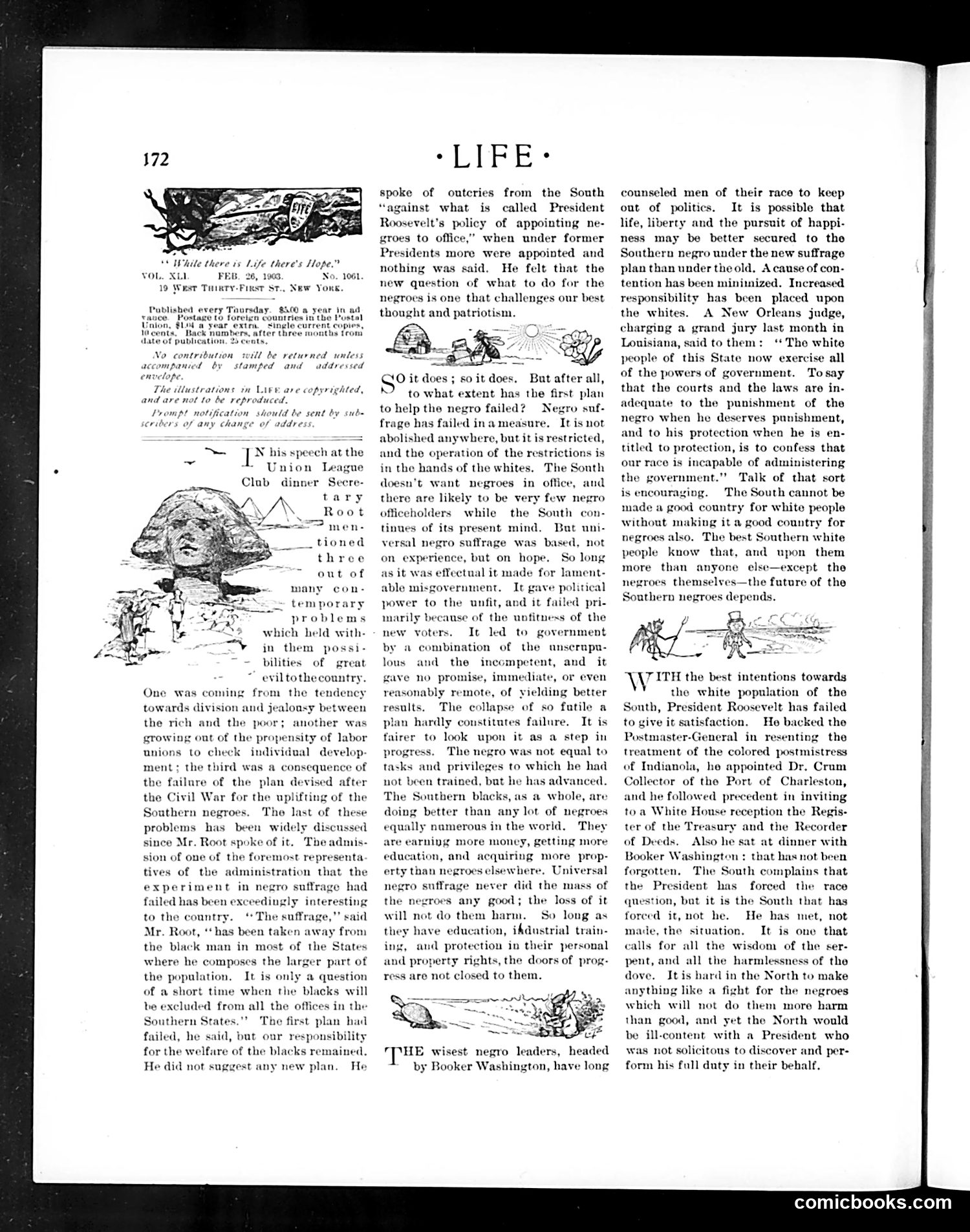
This page discusses President Roosevelt's policies toward African Americans, particularly regarding federal appointments and suffrage rights. The text criticizes the failure of universal negro suffrage and debates whether Southern states should retain political power despite their treatment of Black citizens. The small illustrations appear to be decorative vignettes typical of Life's satirical style, though specific figures are difficult to identify clearly in this reproduction. The substantive content addresses tensions between Northern and Southern approaches to Black political participation, with the author arguing that Roosevelt's approach has been inadequate. The page reflects early-20th-century debates about federal versus states' rights regarding Black voting and political power—issues that would dominate American politics for decades. The tone is critical of both Southern resistance to Black suffrage and what the author sees as insufficient federal intervention.
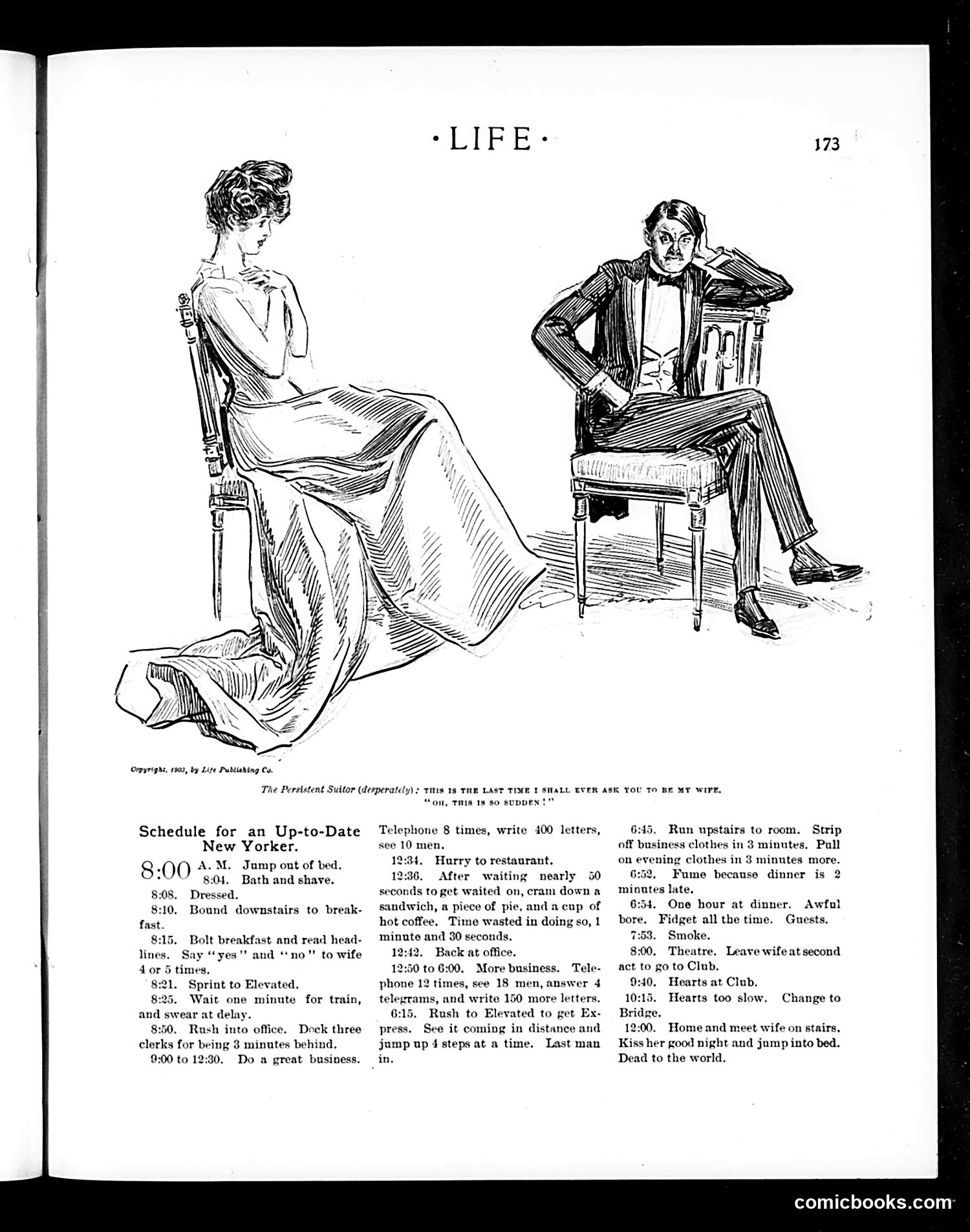
This page from *Life* magazine (copyright 1903) contains a satirical cartoon titled "The President's Suitor (desperately)" showing a man proposing to a woman with the caption: "THIS IS THE LAST TIME I SHALL EVER ASK YOU TO BE MY WIFE. OH, THIS IS SO SUDDEN!" The joke plays on the man's desperation—he's declaring this is his final proposal attempt, yet simultaneously calls the proposal "sudden," suggesting he's made this same plea repeatedly before. The satire mocks persistent, unwanted romantic pursuit and male desperation in courtship. Below is a humorous daily schedule for a busy New York businessman, detailing his rushed, fragmented day from 8:00 AM to midnight, emphasizing the frenetic pace of early 1900s urban professional life.
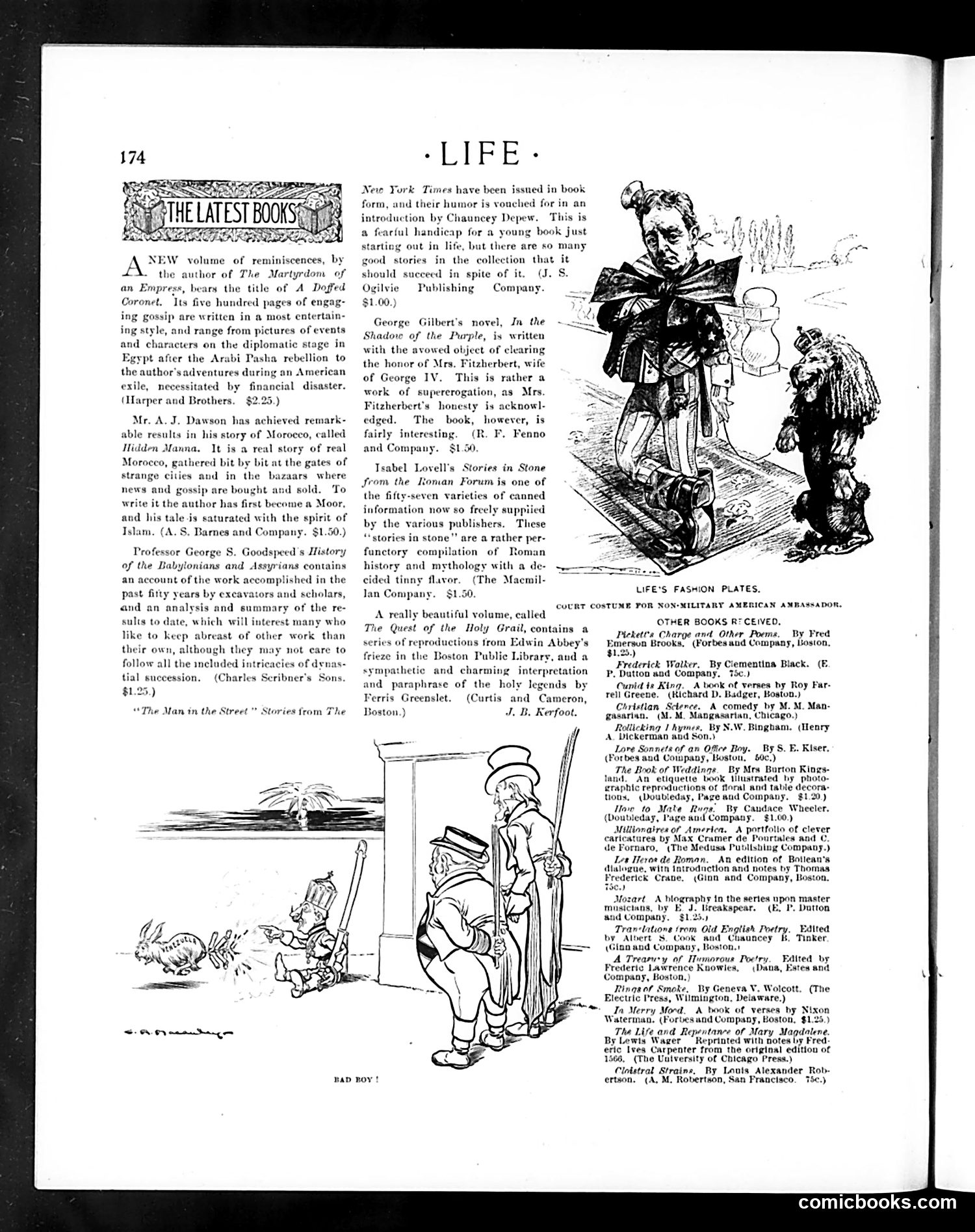
This page features book reviews and two satirical illustrations. The upper cartoon, titled "Life's Fashion Plates: Court Costume for Non-Military American Ambassador," depicts a portly gentleman in elaborate formal dress with a large bow tie, appearing to mock diplomatic fashion standards—likely critiquing overdressed American officials abroad. The lower illustration, captioned "Bad Boy," shows a mischievous child in period clothing causing minor havoc (appears to involve overturned objects), a common satirical theme in *Life* magazine about childhood mischief and parental exasperation. The surrounding text reviews contemporary books, including works about Morocco, Egypt, and various literary collections. The cartoons employ *Life*'s typical approach: visual humor about social pretension and everyday domestic scenarios that would resonate with educated American readers of the era.
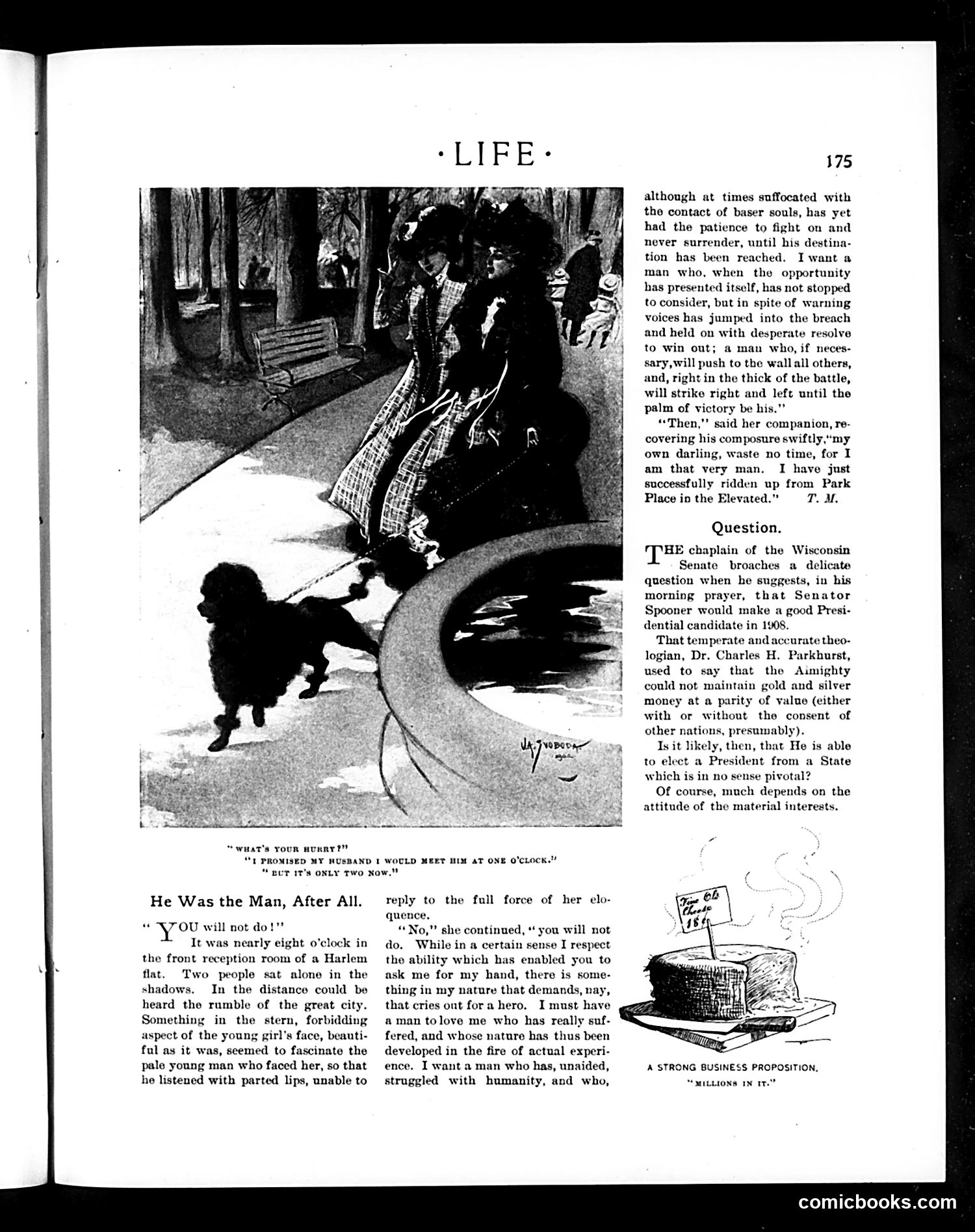
**Main Cartoon Caption:** "What's your hurry?" / "I promised to meet him at one o'clock." / "But it's only two now." This appears to be a commentary on **Senator Spooner** of Wisconsin, referenced in the adjacent text. The Wisconsin Senate chaplain supposedly suggested Spooner would make a good Presidential candidate in 1908. The text questions whether someone from a non-pivotal state could realistically become President, and expresses doubt about the proposal's viability. The cartoon itself depicts a domestic scene with figures and a dog—likely illustrating romantic or social discord. The illustration's timing joke (confusion about clock times) may be visual wordplay, though the exact satirical target requires additional historical context about Spooner and 1908 political dynamics.
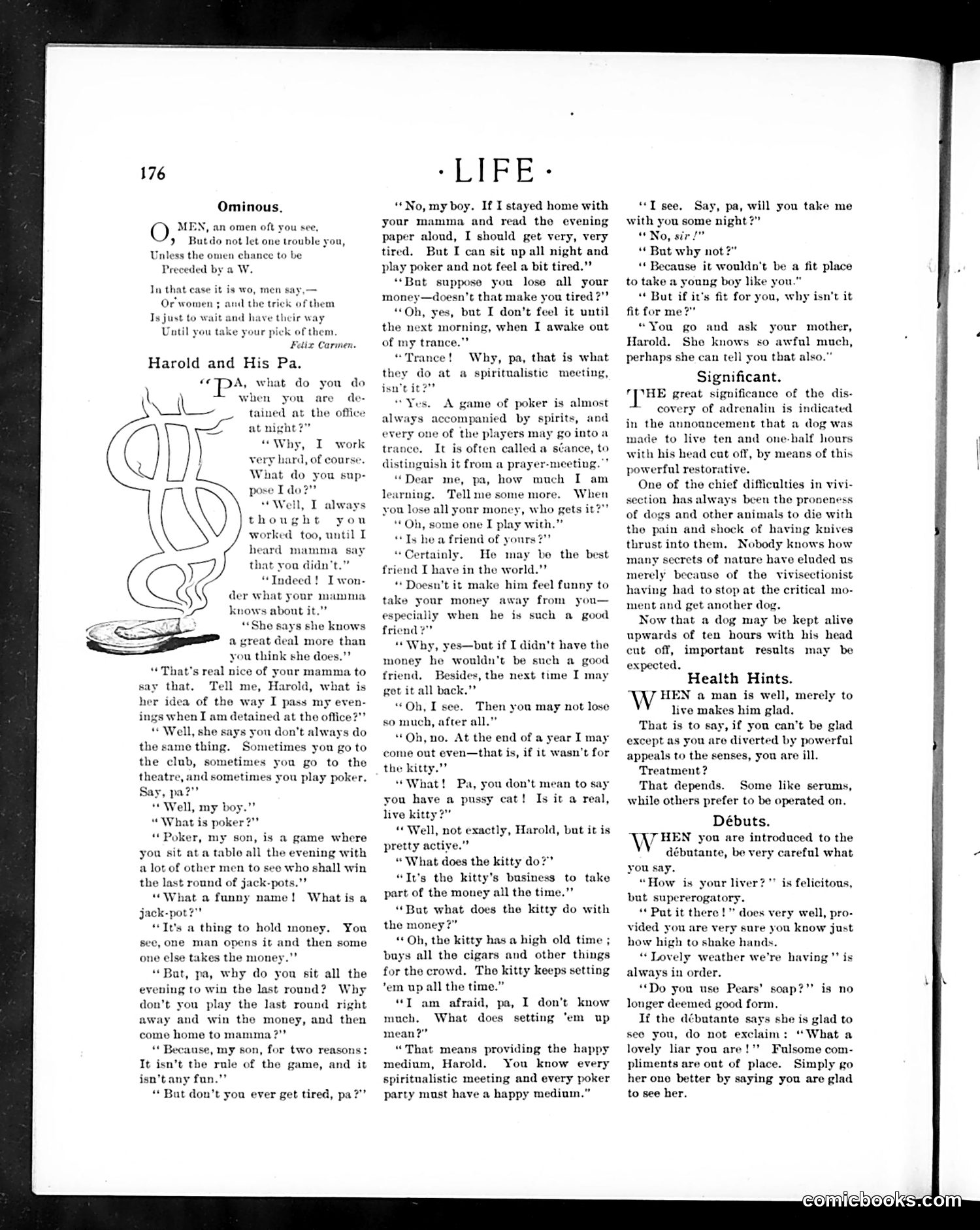
This page contains three separate pieces: 1. **"Harold and His Pa"** - A dialogue cartoon between a father and son about poker. The boy asks what poker is; the father explains it's a gambling game where players risk money. The satire targets wealthy fathers who gamble away fortunes while lecturing their sons about financial responsibility. The humor lies in the father's hypocrisy—he admits losing money at poker yet questions why his son would want to play. 2. **"Ominous"** - A brief dialogue suggesting that spiritualistic séances involve gambling, mocking both practices as frivolous pastimes. 3. **"Significant," "Health Hints," and "Debuts"** - Short advice columns about vivification (keeping dogs alive after decapitation), maintaining health through positive thinking, and proper etiquette for social introductions. The page satirizes upper-class vices and social pretensions.
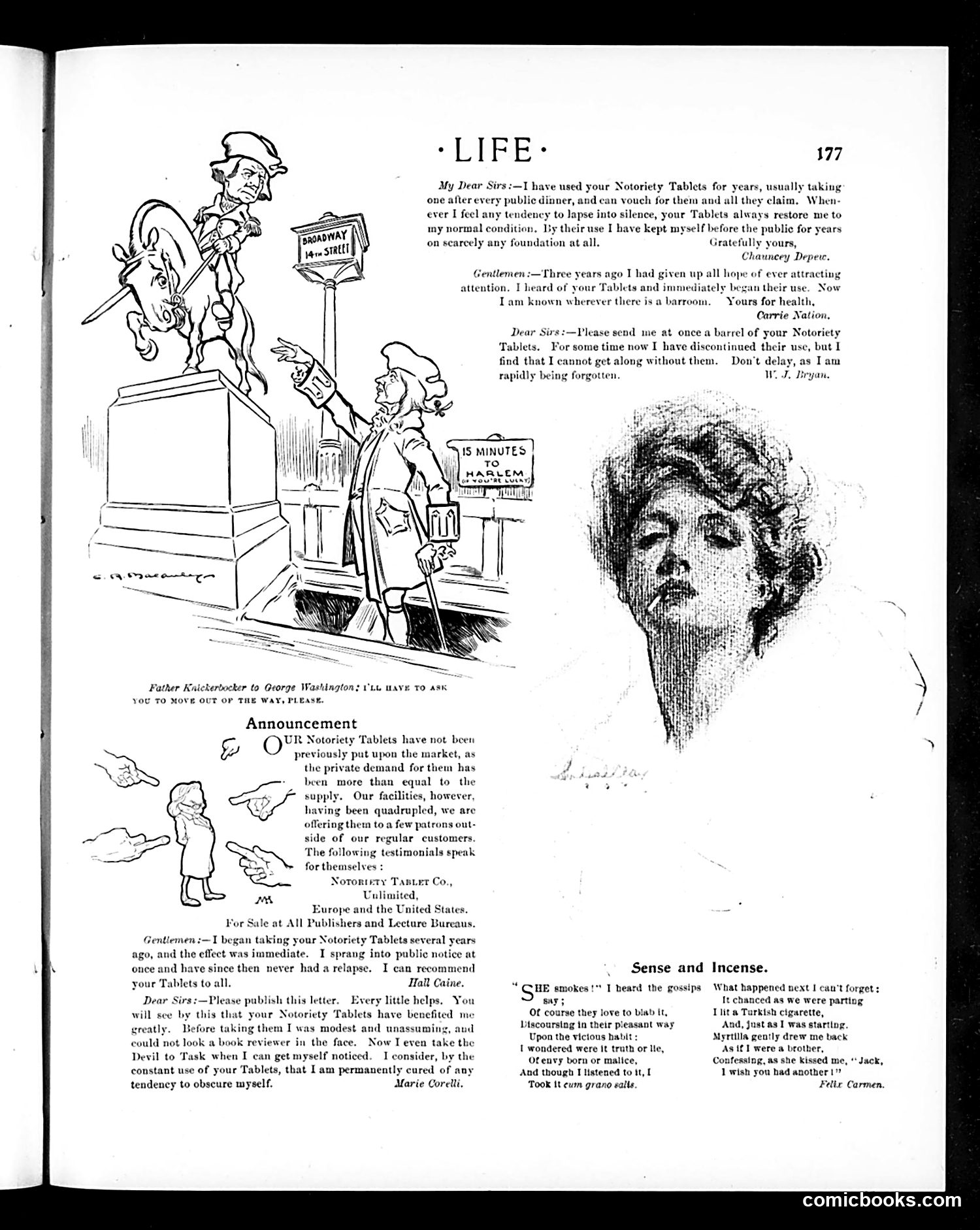
This page consists primarily of **testimonial advertisements** for "Notoriety Tablets," a patent medicine product. The main cartoon depicts Father Knickerbocker (personification of New York City) asking a figure on a statue to move, satirizing how the product's popularity has created public congestion. The testimonials are from named individuals praising the tablets for curing various ailments—a common advertising format of the era. The "Sense and Incense" section at bottom appears to be a humor column with brief comic exchanges about social behavior (smoking cigarettes). This is primarily **advertising content disguised as editorial matter**, reflecting early 20th-century magazine practices where paid endorsements blended seamlessly with regular content—now recognized as deceptive marketing.
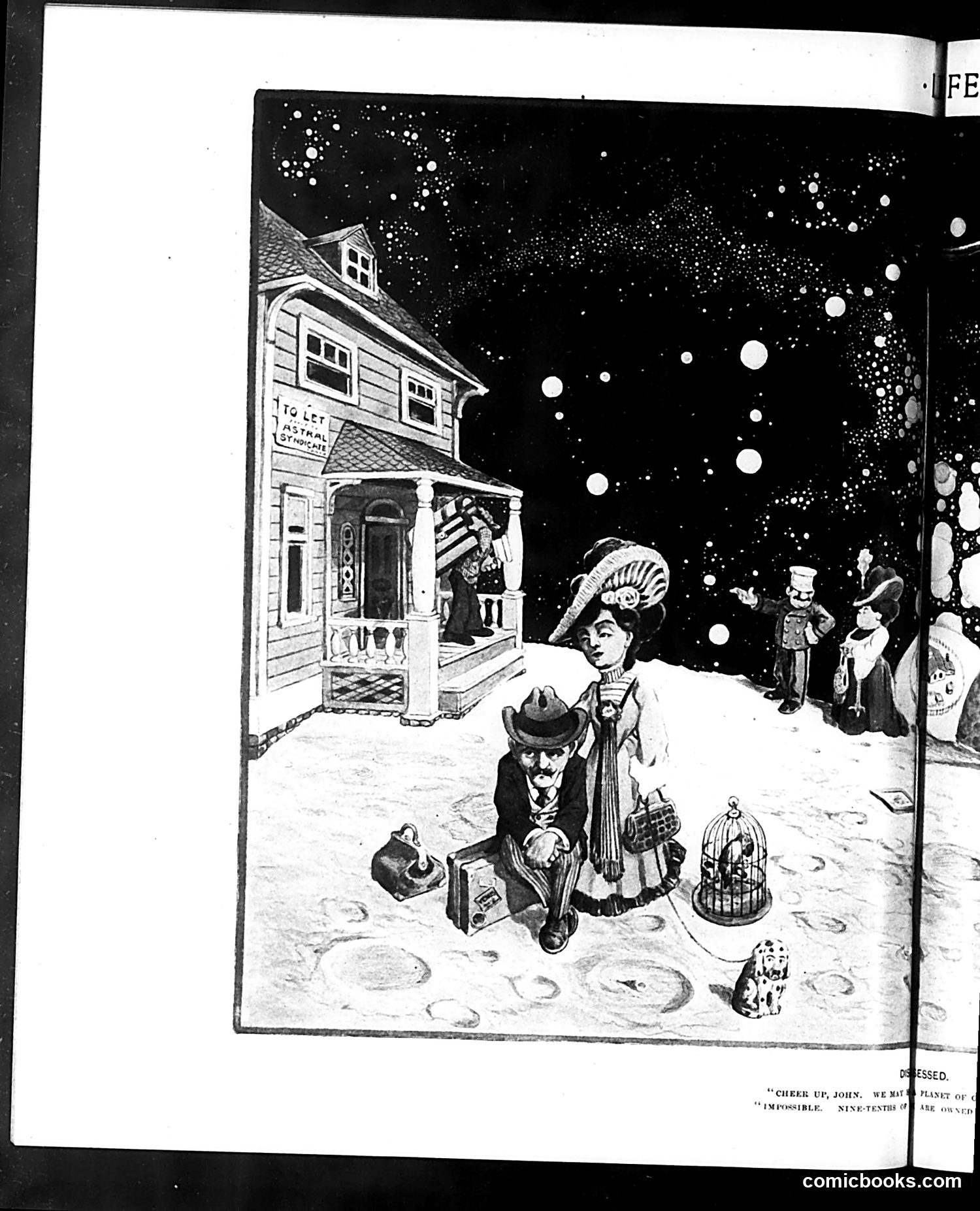
This appears to be a satirical illustration from Life magazine depicting a winter scene on what looks like another planet or fantastical location. The image shows elegantly dressed figures—a man in a top hat and formal wear alongside a woman in elaborate winter clothing with an elaborate headdress—standing in snow beneath a starry black sky. The partially visible caption at bottom reads "CHEER UP, JOHN. WE MAY PLANET OF..." with additional text cut off, suggesting wordplay about being on a "planet" versus "plane it." The illustration satirizes either: (1) space travel fantasies popular in early-to-mid 20th century popular culture, or (2) the absurdity of maintaining formal Victorian social conventions in impossible/ridiculous situations. The juxtaposition of high society dress codes against an alien landscape suggests gentle mockery of upper-class pretension and rigid social expectations.
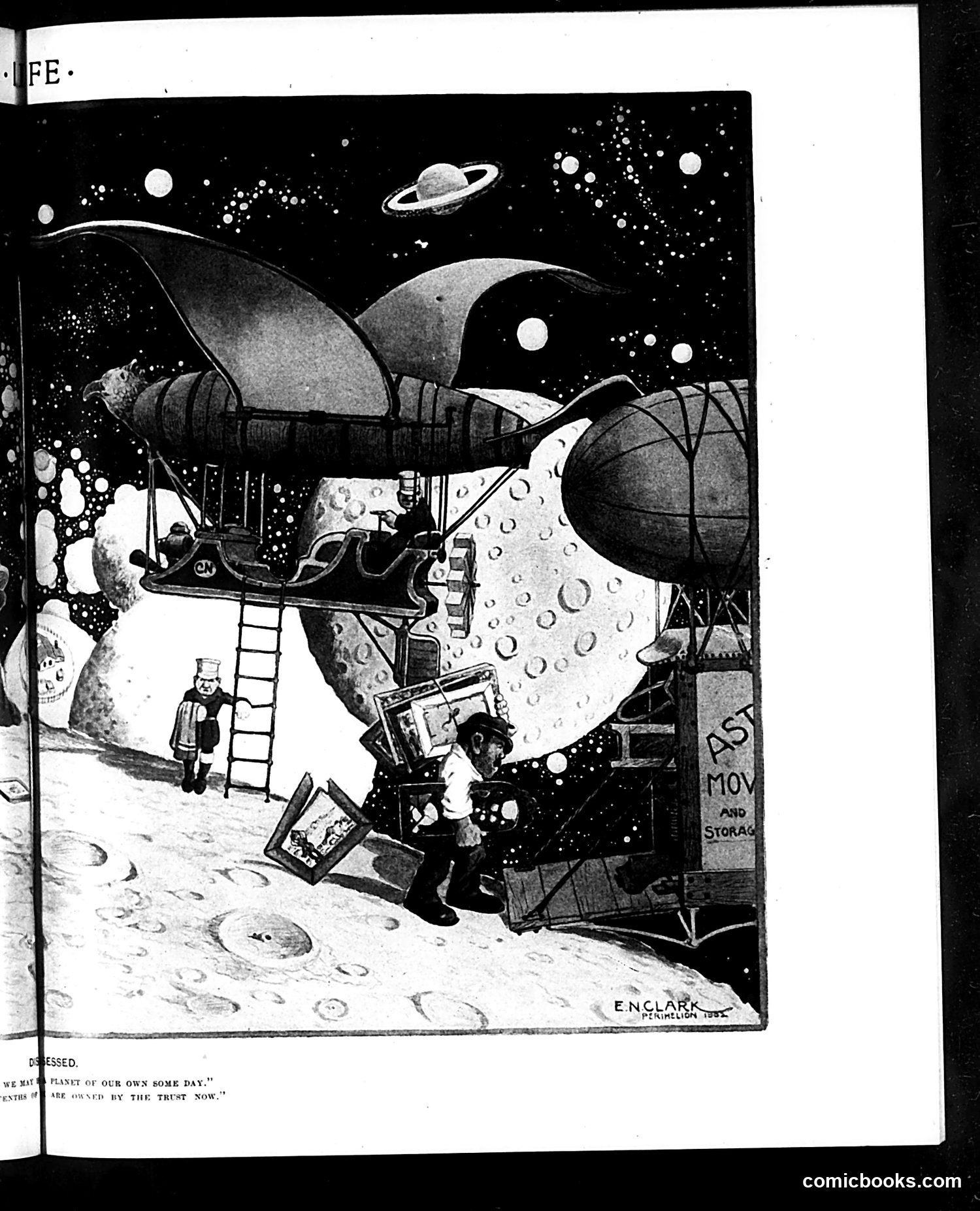
This illustration depicts a futuristic spacecraft landing on a celestial body, with figures in period dress exploring the alien landscape. The visible text references "a planet of our own some day" and mentions being "owned by the trust now," suggesting **anti-monopoly satire**. The cartoon likely critiques **industrial trusts**—massive corporate monopolies that dominated early 20th-century America. The joke appears to be that even if humanity colonizes other planets, the same corrupt trusts will follow and own those worlds too. The elaborate spacecraft and alien setting contrast darkly with the mundane reality of corporate control persisting everywhere. This reflects contemporaneous Progressive Era concerns about unchecked corporate power extending beyond earthly bounds.
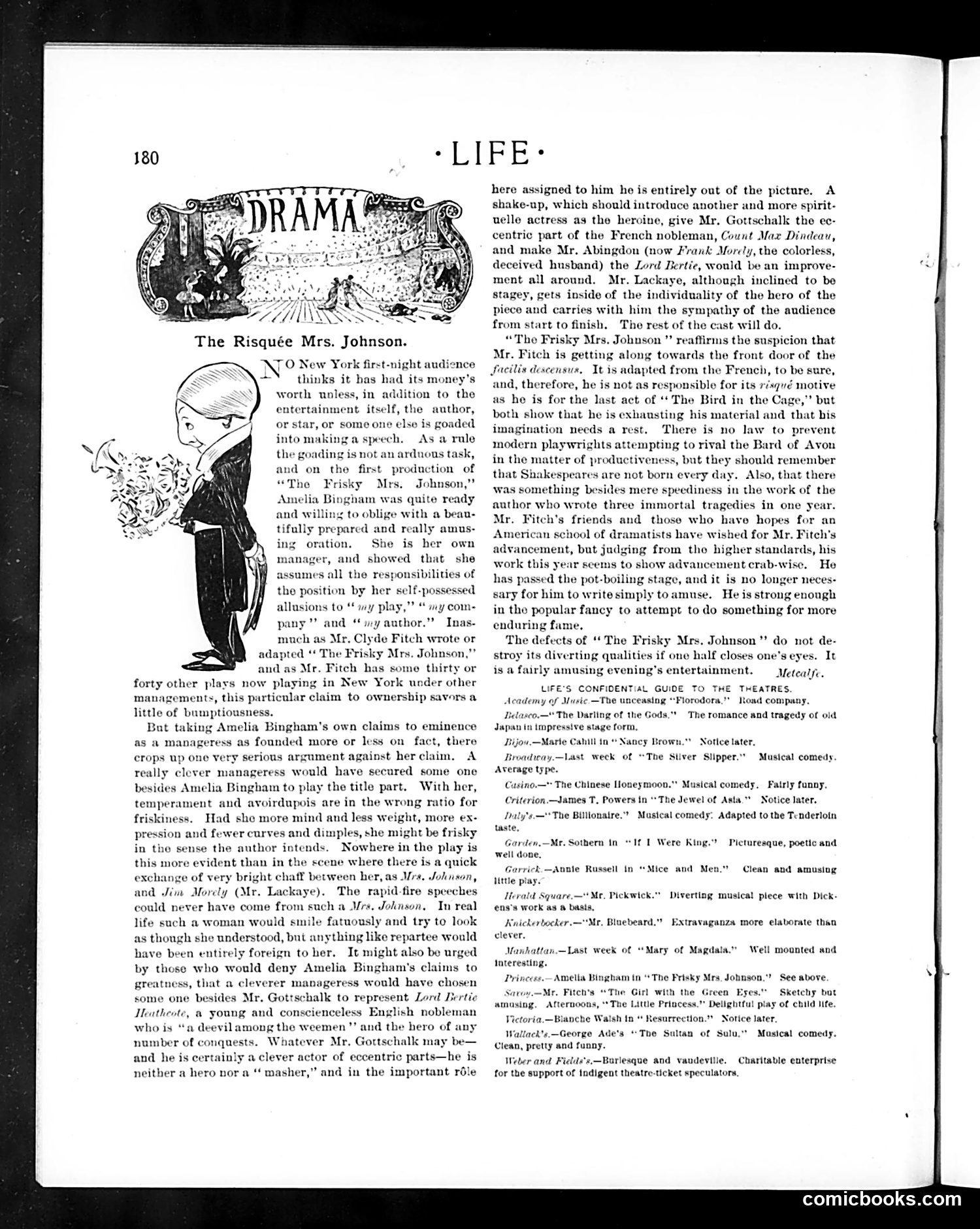
This page reviews a Broadway play starring actress Amelia Bingham. The cartoon depicts Bingham herself—the illustration shows a woman in theatrical dress, likely emphasizing her physical appearance as relevant to the critique. **The Satire:** Life's drama critic mocks Bingham's pretensions as both star and manager. While she claims ownership of the production ("my play," "my company"), the play was actually written by prolific playwright Clyde Fitch. The core criticism: Bingham is miscast as the "frisky" (lively, flirtatious) title character. She's portrayed as too heavy and lacks the wit needed for the role's quick repartee—"friskiness" requires both mind and grace, not "curves and dimples." **The Broader Point:** The review also critiques Fitch himself, suggesting his productivity is exhausting his talent. Life implies playwrights shouldn't attempt Shakespeare's output without Shakespeare's genius.
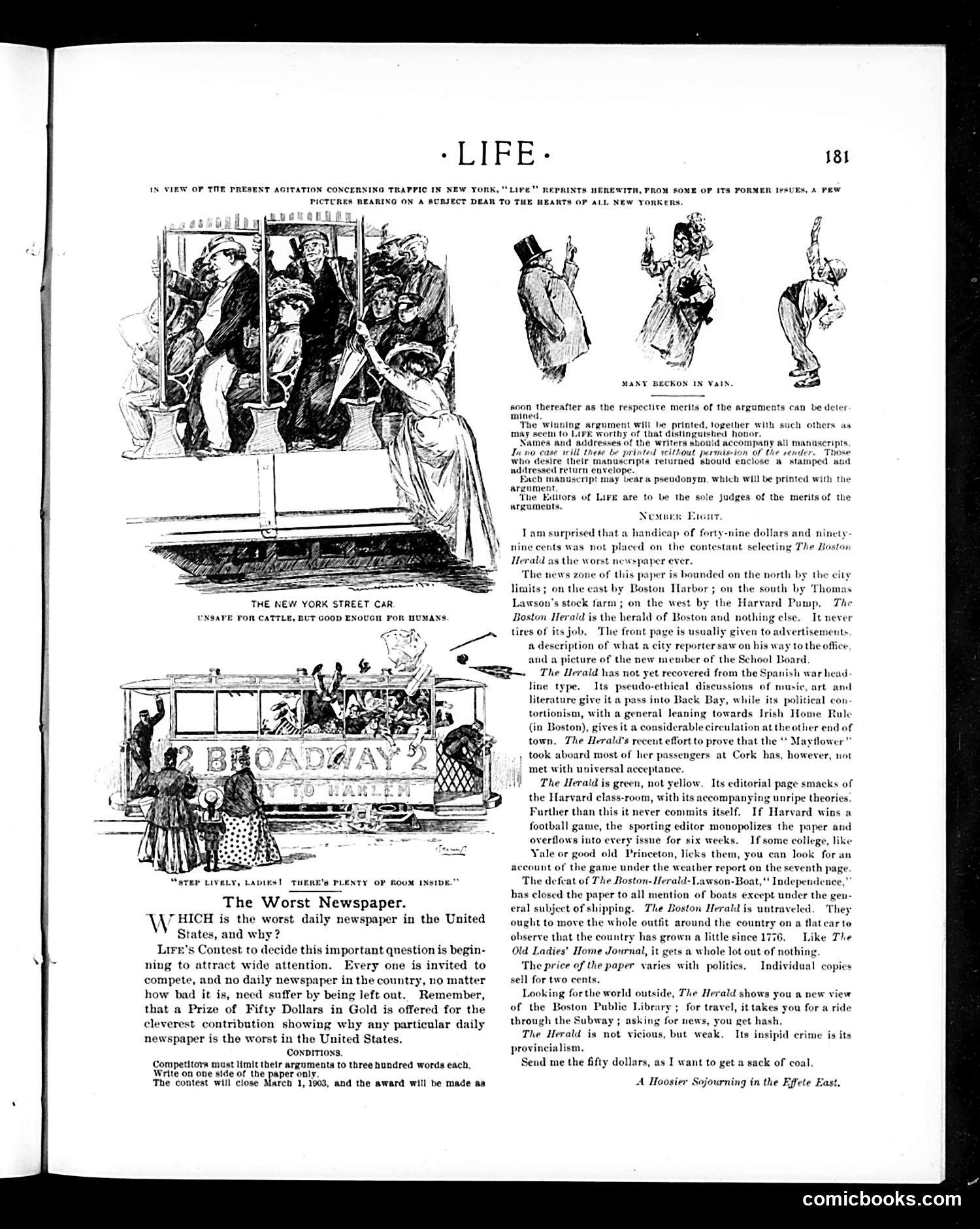
This 1903 *Life* magazine page announces a satirical contest inviting readers to argue which American newspaper is worst, offering $50 in gold for the cleverest submission (deadline March 1, 1903). The page includes one submitted entry attacking the **Boston Herald**—criticized as parochial, Harvard-influenced, and obsessed with local Boston topics (Irish politics, Harvard football, the failed "Lawson Boat"). The Herald is mocked as "green, not yellow" (provincial rather than sensationalist), intellectually pretentious yet vapid, and hopelessly outdated. The cartoons above depict **crowded NYC street cars** labeled "unsafe for cattle, but good enough for humans"—satirizing New York's transit system as inhumanely overcrowded. This reflects contemporary urban complaints about public transportation conditions. Together, the content targets both journalistic mediocrity and NYC's infrastructure failures as subjects "dear to the hearts of all New Yorkers."
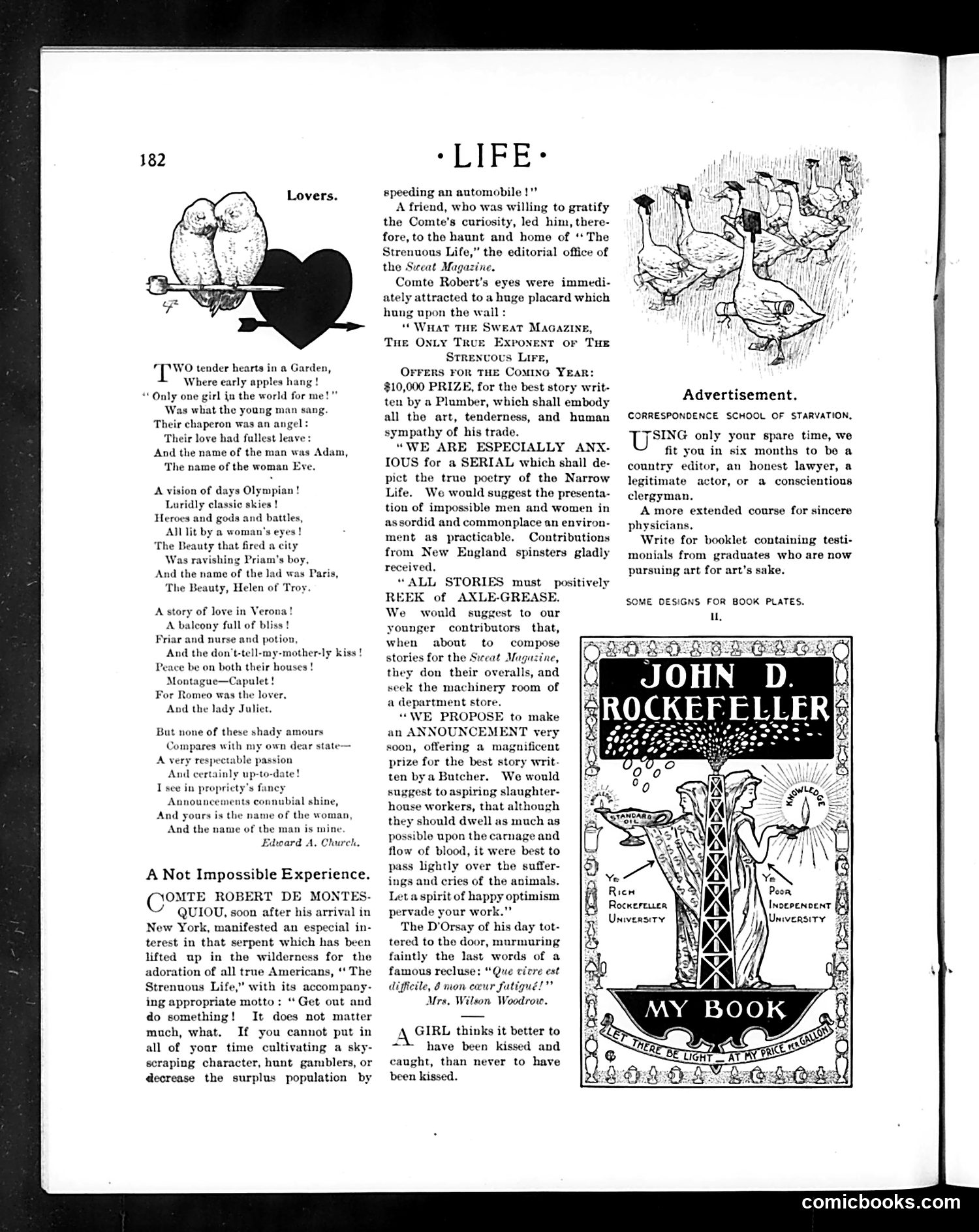
This page satirizes the American "Strenuous Life" movement—Theodore Roosevelt's philosophy promoting vigor, hard work, and action over leisure. **The main satire:** A French aesthete, Comte Robert de Montesquiou (a real decadent artist known for refined taste), visits *The Strenuous Life* magazine's offices and encounters absurd prize announcements. The magazine offers $10,000 for the best story "written by a Plumber" that "reeks of axle-grease" and depicts "impossible men and women in sordid...environment." They're planning similar prizes for butchers' stories emphasizing "carnage and flow of blood." **The joke:** Life magazine mocks how *The Strenuous Life* romanticizes manual labor and working-class grimness while paradoxically treating them as literary subjects. The contrast between the refined Montesquiou and these crude editorial mandates highlights the pretentiousness of celebrating "honest work" through commercial prize-seeking. The page also includes love poetry and period advertisements parodying correspondence schools promising poverty for idealistic pursuits ("country editor," "honest lawyer").
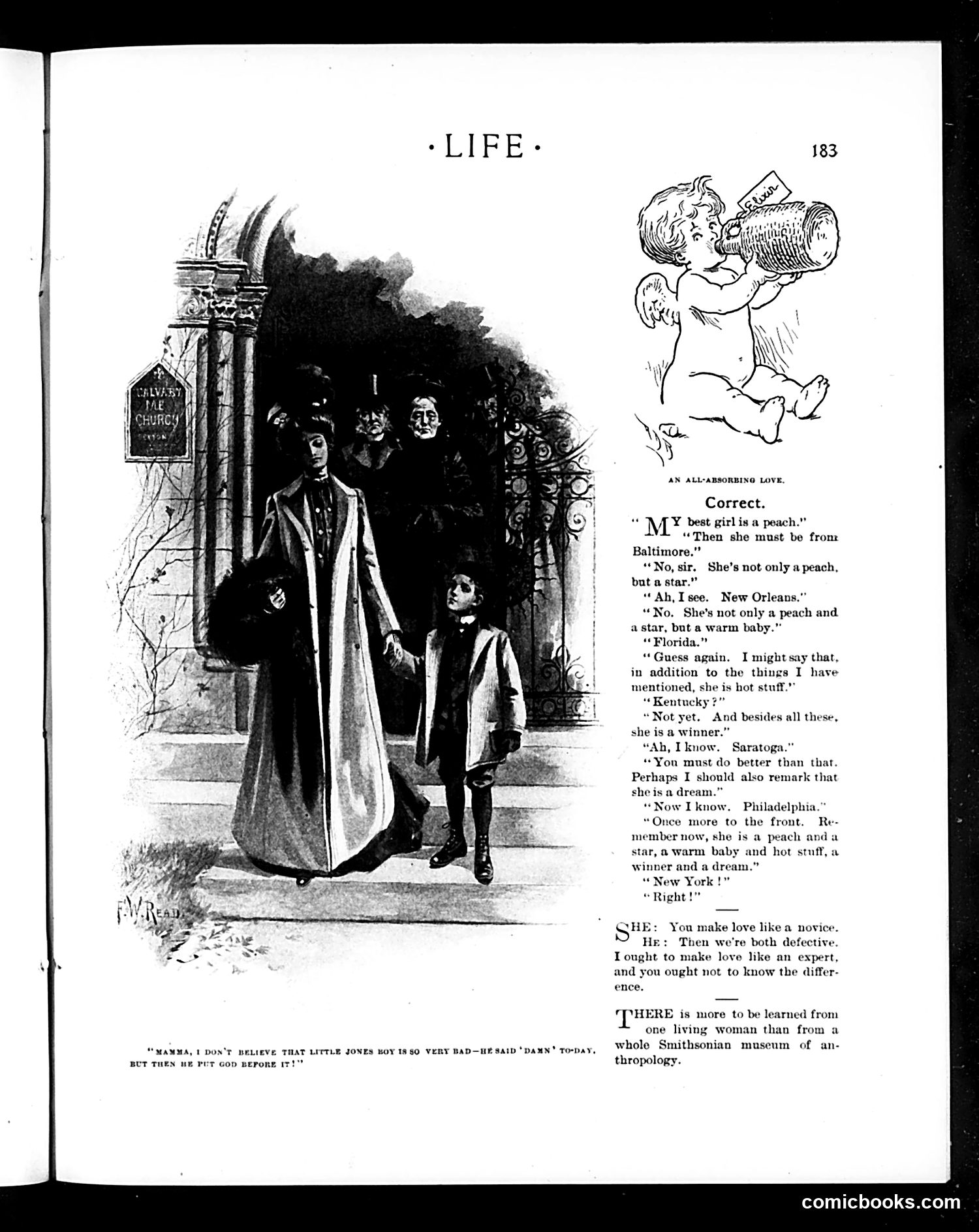
This page contains two distinct pieces of humor satirizing American regional stereotypes. **"Correct"** (main text): A dialogue where a man describes his girlfriend using slang terms—"peach," "star," "warm baby," "hot stuff," "winner," "dream"—and his companion guesses her origin city based on these descriptors. The joke relies on each American city having an associated reputation: Baltimore for peaches, New Orleans for stars, Florida for warmth, Kentucky for heat, Saratoga for winners, Philadelphia for dreaminess, and finally New York as the catch-all for a woman possessing *all* desirable qualities. The satire mocks how Americans stereotyped different cities' "types" of attractive women. **Lower cartoon and dialogue**: A brief exchange about incompetence in courtship, where both parties admit to being defective lovers—mild satire on romance and gender relations. **Bottom caption**: References "little Jones boy" and prayer, likely alluding to a contemporary scandal or social commentary (context unclear from image alone). The overall tone targets American urban stereotyping and romantic pretension.
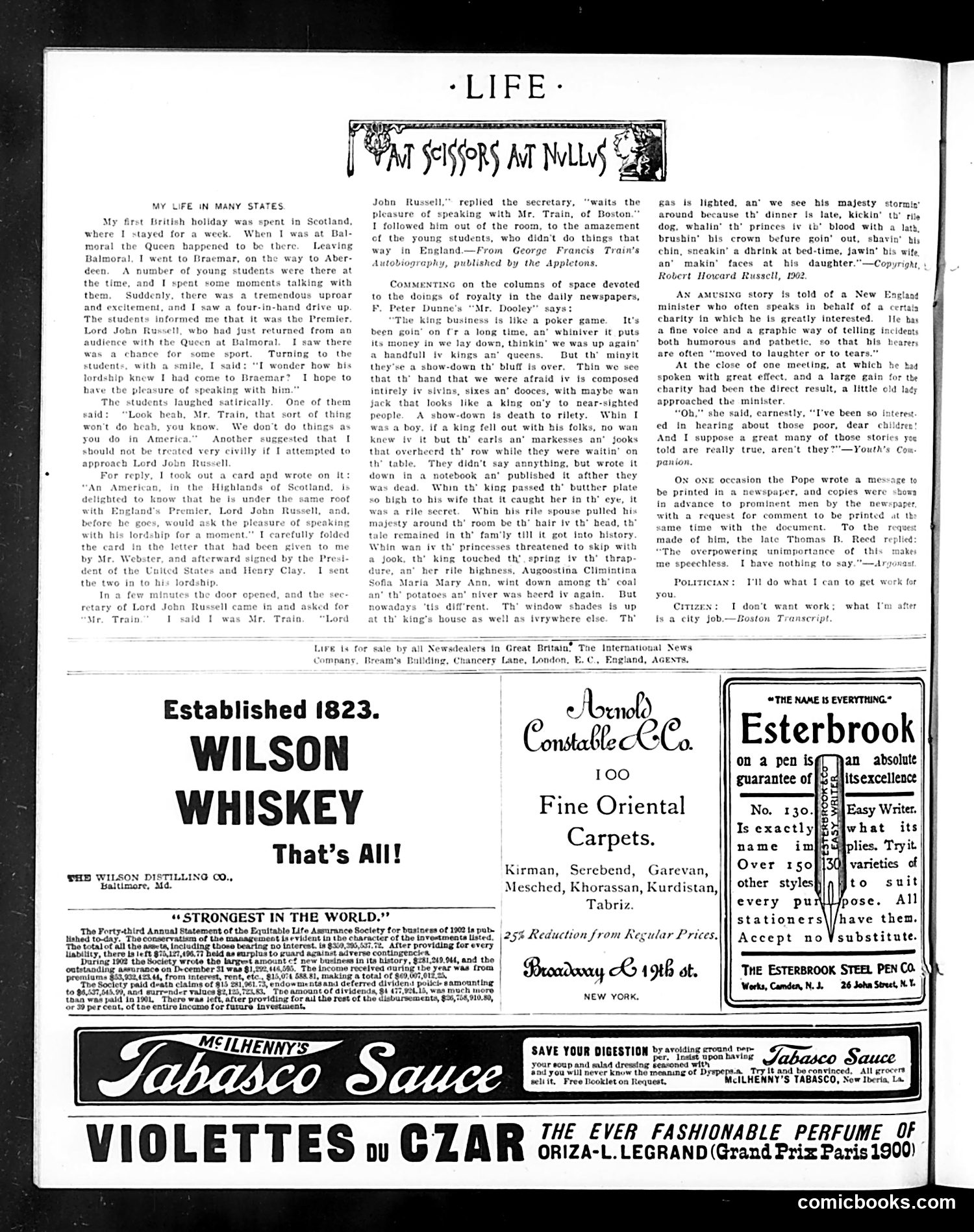
This page contains two distinct pieces of content: **Main Article: "My Life in Many States"** The featured article recounts anecdotes by George Francis Train, an American traveler and eccentric figure of the 19th century. The narrative includes his encounters with British nobility (Lord John Russell, the Queen at Balmoral) and Scottish students. Train's stories satirize both American brashness abroad and British class consciousness—particularly the humorous moment when Scottish students reject his casual familiarity with Lord Russell as inappropriate behavior. **"Mr. Dooley" Commentary** Peter Finley Dunne's popular Irish-American character "Mr. Dooley" offers satirical social commentary, here using poker as a metaphor for monarchy and dynastic power. The piece mocks both the theatrical nature of kingship and the class system's pretense. **Supporting Anecdotes** Two humorous stories follow: one mocking the messy reality behind royal dignity, another about a naive charity worker. The page is primarily textual—no political cartoons appear. The satire targets class pretension, American naïveté abroad, and the gap between royal mythology and actual behavior.
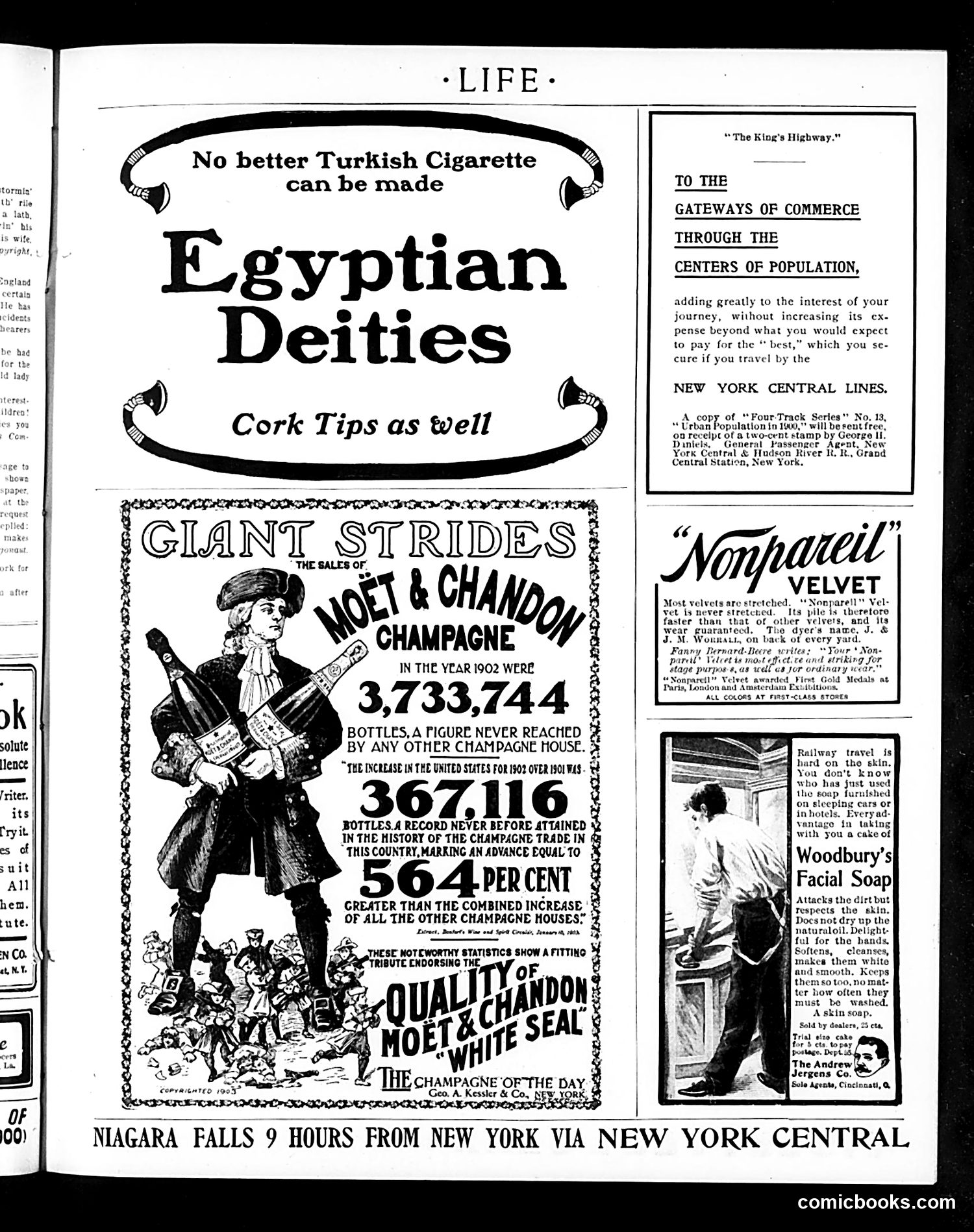
This page is primarily **advertising**, not political satire. It contains four commercial advertisements from circa 1902: 1. **Egyptian Deities cigarettes** - promoting Turkish cigarettes with cork tips 2. **Moët & Chandon champagne** - boasting sales figures (3.7+ million bottles in 1902, with U.S. sales up 367,116 bottles) 3. **"The King's Highway"** - New York Central railway promotion 4. **Nonpareil velvet** and **Woodbury's Facial Soap** - personal care products The only potentially satirical element is the champagne ad's excessive use of statistics to emphasize market dominance, which could be mocking commercial hyperbole. The figure depicted appears to be a generic wealthy gentleman in period dress, not a specific caricature. The page reflects early 20th-century consumer culture and advertising conventions rather than political commentary.
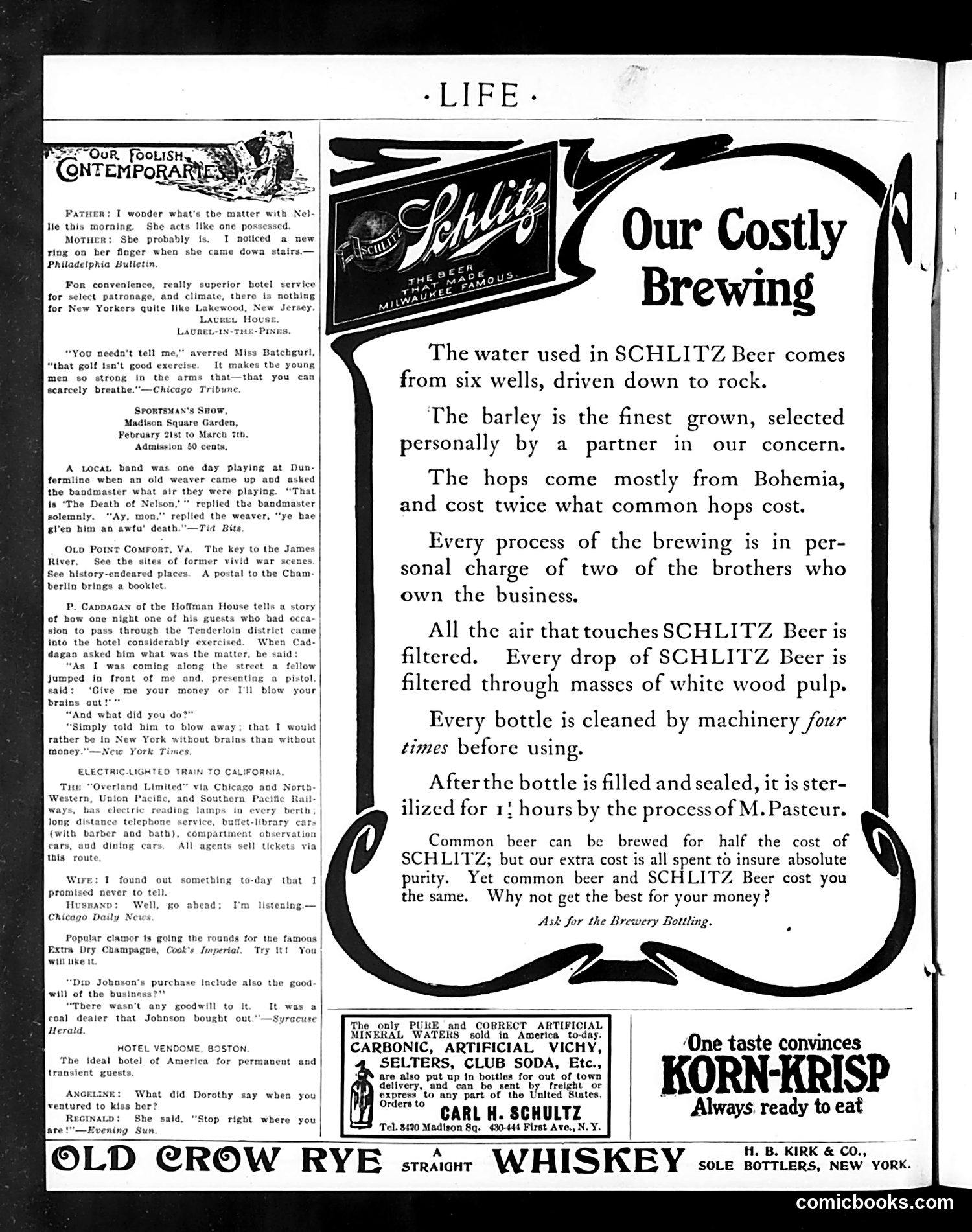
This page from *Life* magazine consists primarily of **advertisements and short humor pieces** rather than political cartoons. The content includes: **Humor Section ("Our Foolish Contemporaries"):** Brief satirical anecdotes mocking social pretension and foolishness—a woman acting "possessed" over a new ring, a golf enthusiast struggling to breathe from exertion, a Scottish weaver's dark humor about Nelson's death. **Primary Content:** A large **Schlitz Beer advertisement** dominating the right side, emphasizing the brewery's costly quality control: purified water from deep wells, hand-selected barley, expensive Bohemian hops, personal oversight by owner-brothers, filtration through wood pulp, quadruple bottle-cleaning, and Pasteur sterilization. The ad argues consumers get equal quality to cheaper beers, so "why not get the best for your money?" **Additional Ads:** Notices for Korn-Krisp cereal, Old Crow whiskey, artificial mineral waters, and various hotels. There is **no significant political satire** on this page—it's primarily commercial advertising with light social humor typical of early-1900s American magazines.
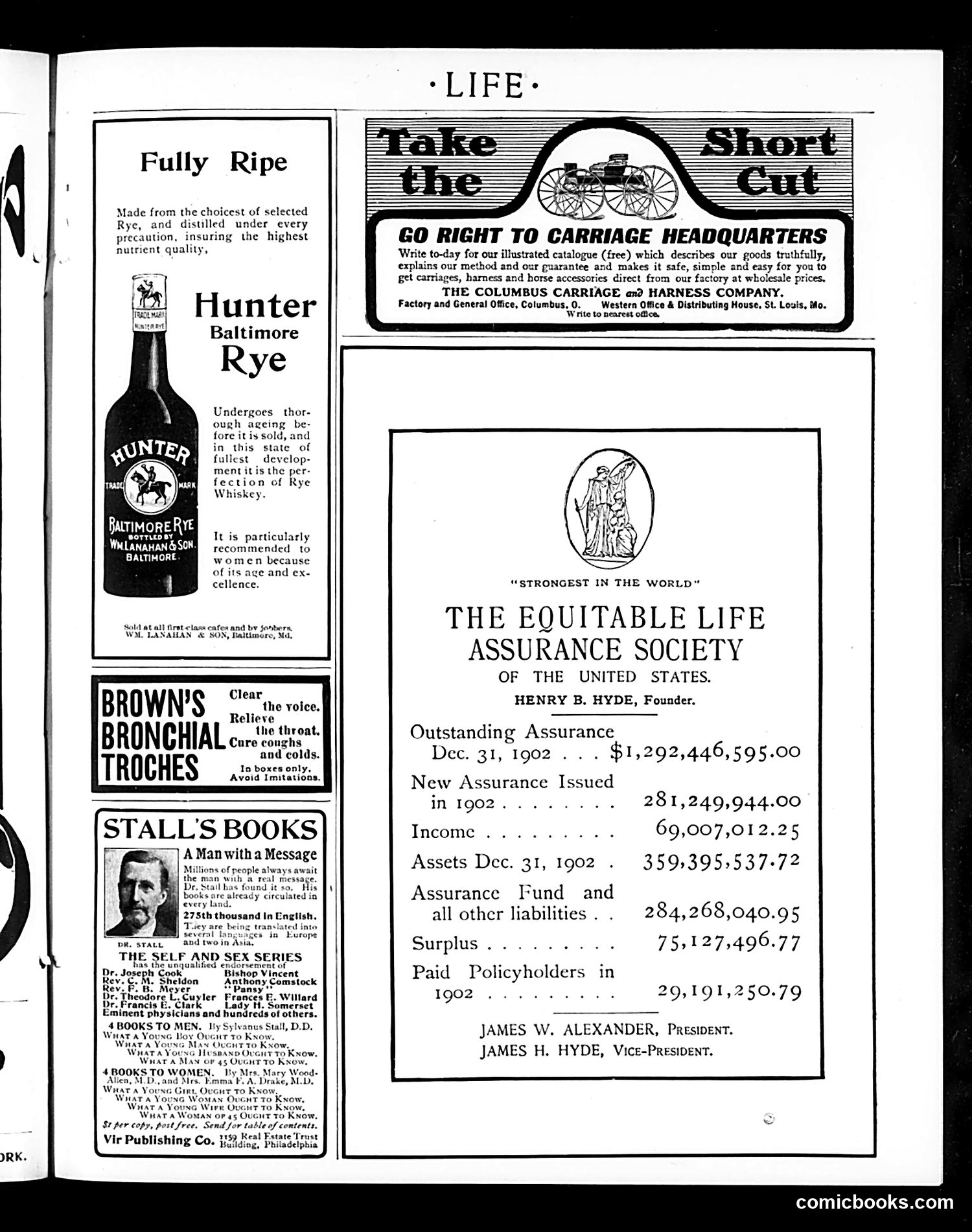
This page is primarily **advertising**, not satire or political commentary. It features four commercial advertisements from early 1900s: 1. **Hunter Baltimore Rye** — whiskey marketed as fully aged and "particularly recommended to women" for its quality 2. **Brown's Bronchial Troches** — throat lozenges 3. **Stall's Books** — self-help/medical texts by Dr. Stall on personal topics, endorsed by clergy and physicians 4. **The Equitable Life Assurance Society** — insurance company displaying impressive financial statistics (assets, surplus, payouts to policyholders in 1902) The Columbus Carriage advertisement promotes direct factory sales to consumers. There is **no visible cartoon** on this page. The content reflects early-20th-century consumer culture and marketing approaches—note the gendered marketing (whiskey "for women"), medical self-help industry, and life insurance as a growing financial institution. The layout and typography are typical of Life's advertising pages from this era.
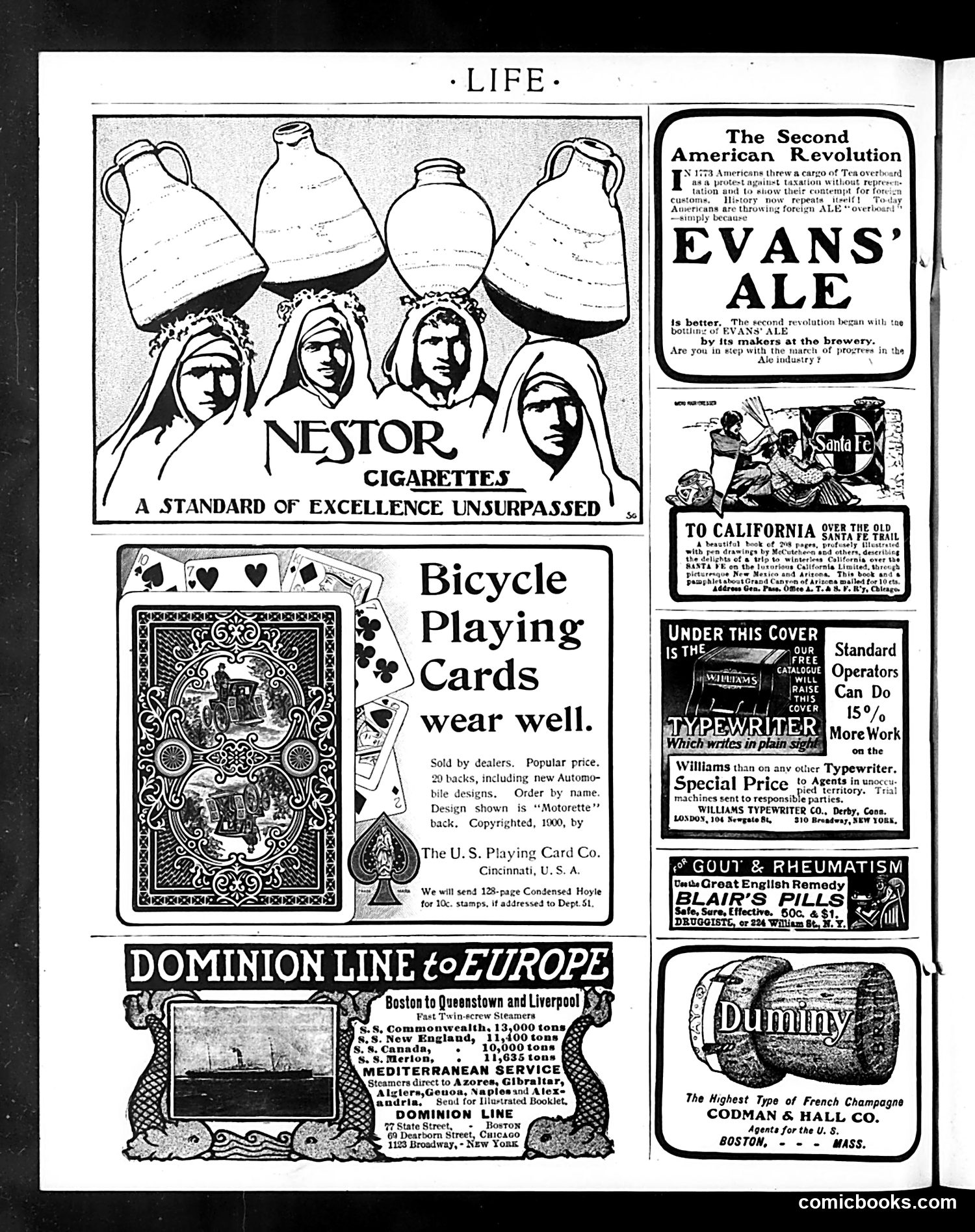
This page is primarily **advertising**, not political satire. The main content consists of product advertisements from circa 1900, including Nestor Cigarettes, Bicycle Playing Cards, Evans' Ale, typewriters, and shipping lines. The only cartoon element is the **Nestor Cigarettes ad** (top left), which features four classical female figures beneath hanging tobacco leaves. The ad claims cigarettes are "A Standard of Excellence Unsurpassed"—standard advertising hyperbole of the era. The **Evans' Ale advertisement** makes a joking reference to "The Second American Revolution," suggesting that progress in ale-brewing represents a kind of modern advancement. This is **light commercial humor**, not political commentary. The remaining space contains straightforward product advertisements and travel notices with no satirical intent. This appears to be a typical advertising-heavy page from Life magazine's commercial section rather than its editorial/satirical content.
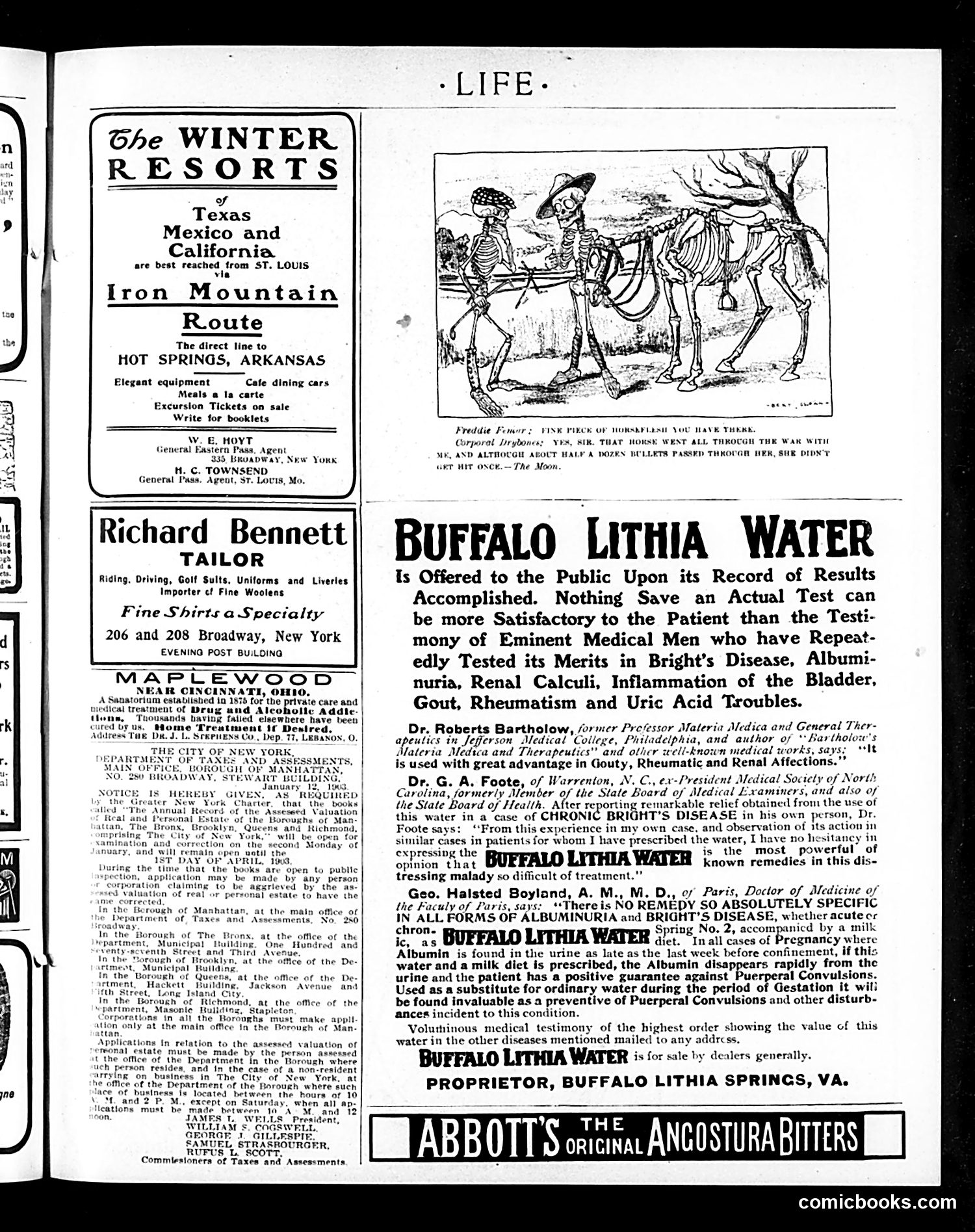
This page is primarily **advertisements and filler content** rather than editorial material. The main cartoon depicts a military scene: a soldier (Corporal Drybones) recounts to another soldier (Freddie Fenvir) how a horse survived being shot multiple times during war, yet the horse wasn't fatally hit—a darkly humorous anecdote credited to "The Moon." The cartoon's joke relies on absurdist war humor: the mundane survival of an animal amid combat violence, treated as a curiosity rather than tragedy. This reflects early-1900s attitudes toward war as material for light satire. The page is otherwise dominated by **patent medicine advertisements**, particularly Buffalo Lithia Water, claiming miraculous cures for kidney disease, gout, and rheumatism—typical of the era's largely unregulated medical advertising. Also featured are ads for a tailor, sanatorium for addiction treatment, and railroad services to winter resorts.
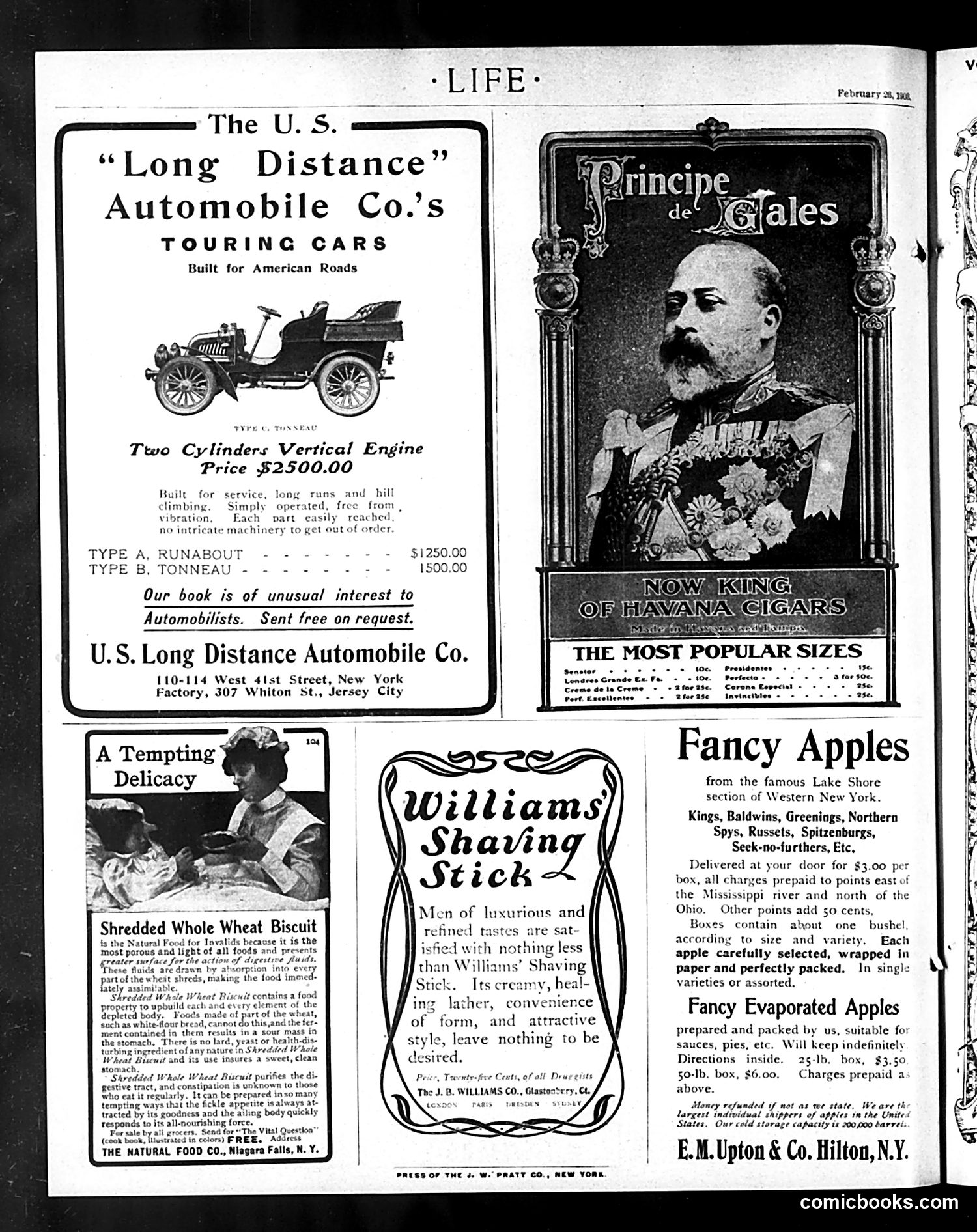
This is primarily an **advertising page** rather than political satire. It contains four product advertisements typical of early 1900s Life magazine: 1. **U.S. Long Distance Automobile Co.** – Promotes touring cars ($1,250–$2,500), emphasizing their suitability for American roads and hill-climbing. 2. **Principe de Gales Cigars** – Features what appears to be a European royal or aristocratic figure in formal military dress, likely referencing prestige and imported luxury goods. 3. **Williams Shaving Stick** – Markets grooming products to "men of luxurious and refined tastes." 4. **Food products** – Including Shredded Wheat Biscuit and Fancy Apples from upstate New York, emphasizing natural ingredients and health benefits. The page reflects **Edwardian consumer culture**: automobiles were novel luxuries, imported cigars signified sophistication, and health-conscious food marketing was emerging. No political satire is evident—this is straightforward commercial advertising.