
Life, 1903-02-26 · page 6 of 24
Life — February 26, 1903 — page 6: what you’re looking at
What you’re looking at
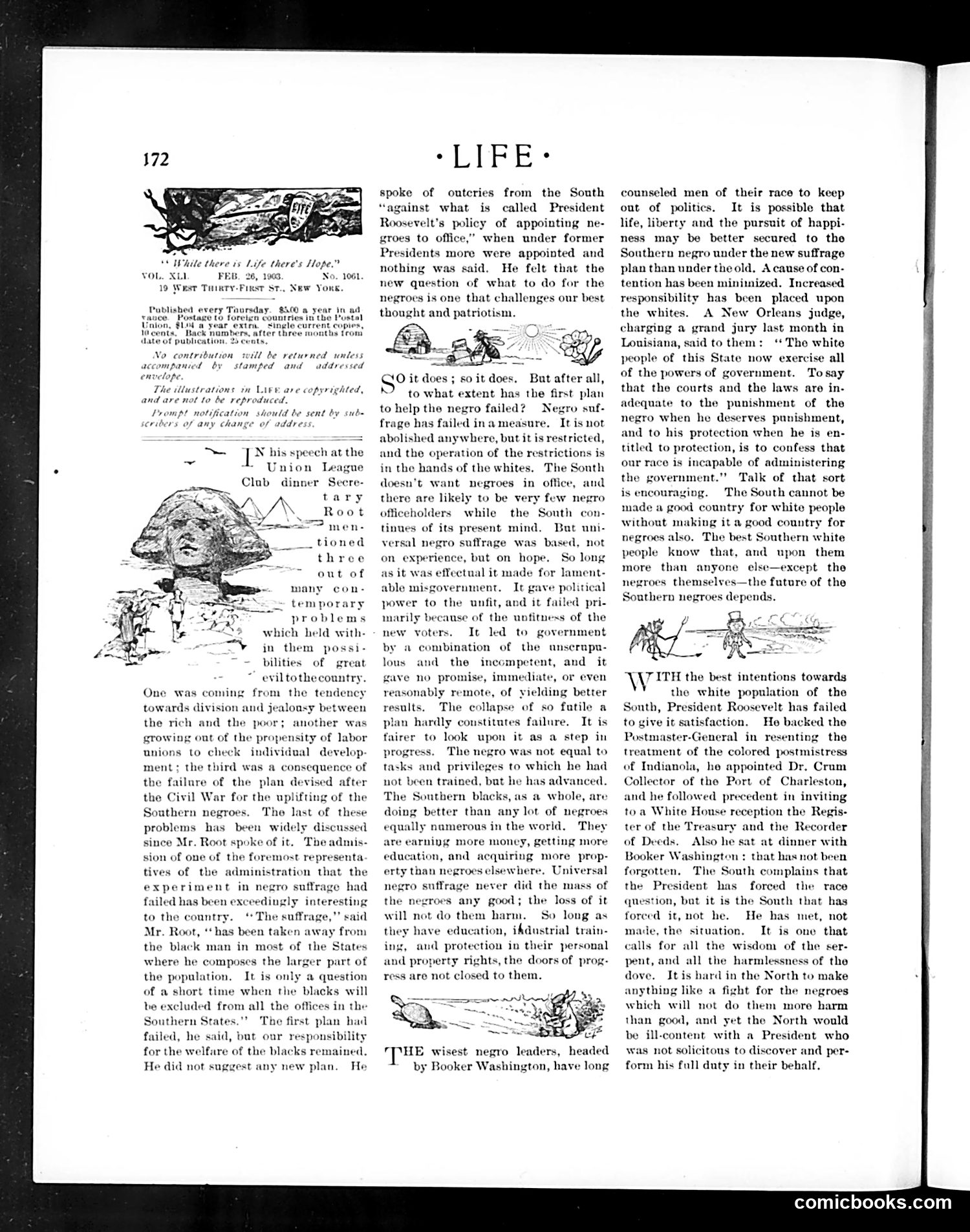
This page discusses President Roosevelt's policies toward African Americans, particularly regarding federal appointments and suffrage rights. The text criticizes the failure of universal negro suffrage and debates whether Southern states should retain political power despite their treatment of Black citizens. The small illustrations appear to be decorative vignettes typical of Life's satirical style, though specific figures are difficult to identify clearly in this reproduction. The substantive content addresses tensions between Northern and Southern approaches to Black political participation, with the author arguing that Roosevelt's approach has been inadequate. The page reflects early-20th-century debates about federal versus states' rights regarding Black voting and political power—issues that would dominate American politics for decades. The tone is critical of both Southern resistance to Black suffrage and what the author sees as insufficient federal intervention.
📄 Transcribed text from this page (OCR, searchable)
Machine-transcribed from the original scan — historical spelling and the odd misread are preserved.
4 . after three 1c date of publicatic ats. Vo contribution accompanied by ll be returned unless stamped and addressed The illustrations m Lite ave copyrighted, and are not to be reproduced. id be sent by sub= of any change of addre Prompt notification si ~ | N his speech at the Union Le Clab dinner Seer tary Root __ tioned three out of many con- temporary problems which held with- in them possi- - bilities of great eviltothecountry. from the tendency towards division and jealousy by the rich and the poor; another was growing out of the propensity of unions to check individual develop- ment; the third was a consequence of the failure of the plan devised after the Civil War for the uplifting of the Southern negroes. Tho last of these problems has been widely discussed since Mr. Root spoke of it. Tbe admis- sion of one of the foremost representa tives of the administration that the experiment in negro suffrage had failed has been e lingly interesting to the country. ©The suffrage,” said Mr. Root, ‘has been taken away from the black man in most of the States: where he composes the larger part of the population, It is only a question of a short time when the blacks will be excluded from all the offices in the Southern The first plan had failed, he said, but our responsibility for the welfare of the blacks remained. He did not suggest any new plan. He One was coming ween ates.’ “LIFE * spoke of outcries from the South “against what is called President Roosevelt's policy of appointing ne- groes to office,” when under former Presidents more were appointed and nothing was said. He felt that the new question of what to do for the negroes is one that challenges our best thought and patriotism. Se it does ; soit does, But after all, \* to what extent has the first plan to help the negro failed? Negro suf- frage has failed ina measure, It is not abolished anywhere, but it is restricted, and the operation of the restrictions is in the hands of the whites, The South doesn’t want negroes in office, and there are likely to be very few negro officeholders while the South con- tinues of its present mind, But uni- versal negro suffrage was based, not on experience, but on hope. So long s it was effectual it made for able misgovernment. It ga power to the unfit, and it failed pri- marily because of the unfitness of the new voters. It led to government by a combination of the ansernpu- and the incompetent, and it gave no promise, immediate, or even reasonably remote, of yielding better results. The collapse of so fatile a plan hardly constitutes failure. It is fairer to look upon it as a step in progress. The negro was not equal to tasks and privileges to which he had not been trained, but he has adv: The Southern blacks, : whole, doing better than y lot of negroes equally namerous in the world. They are earning more money, getting more ‘ducation, and acquiring more prop- erty than negroes elsewhere, Universal negro suffrage never did the mass of the negroes any good; the loss of it will not do them harm. So long as they have education, ikdustrial train- ing, and protection in their personal and property rights, the doors of prog- ress are not closed to them, lous st negro leaders, by Booker Washington, have long counseled men of their race to keep out of politics. It is possible that life, liberty and the pursuit of happi- ness may be better secured to the Southern negro under the new suffrage plan than under the old, A cause of con- tention has been mini:mized. Increased responsibility has been placed upon the white: A New Orleans judge, charging a grand jury last month in Louisiana, said to them: ‘ The white people of this State now exercise all of the powers of government. Tosay that the courts and the laws are in- adequate to the punishment of the negro when he deserves punishment, and to his protection when he is en- titled to protection, is to confess that our race is incapable of administering the government.” Talk of that sort is encouraging. The South cannot be made a good country for white people without making it a good country for negroes also. The best Southern white people know that, and upon them more than anyone else—except the negroes themselves—the future of the Southern negroes depends. \ 7 ITH the best intentions towards the white population of the South, President Roosevelt has failed to give it sa ction, He backed the Postmaster-General in resenting the treatment of the colored postmistress of Indianola, he appointed Dr, Crum Collector of the Port of Charleston, and he followed precedent in inviting toa White House reception the Regis- ter of the Treasury and the Recorder of Deeds. Also he sat at dinner with Booker Washington : that has not been forgotten. The South complains that the President has forced the race question, bat it is the South that has forced it, not he. He has met, not mare, the situation, It is one that calls for all the wisdom of the ser- pent, and all the harmlessness of the dove. It is hard in the North to make anything like a fight for the negroes which will not do them more harm than good, and yet the North would be ill-content with a President who was not solicitous to discover and per- form his full duty in their behalf, comicbooks.com