
A complete issue · 20 pages · 1903
Life — January 8, 1903
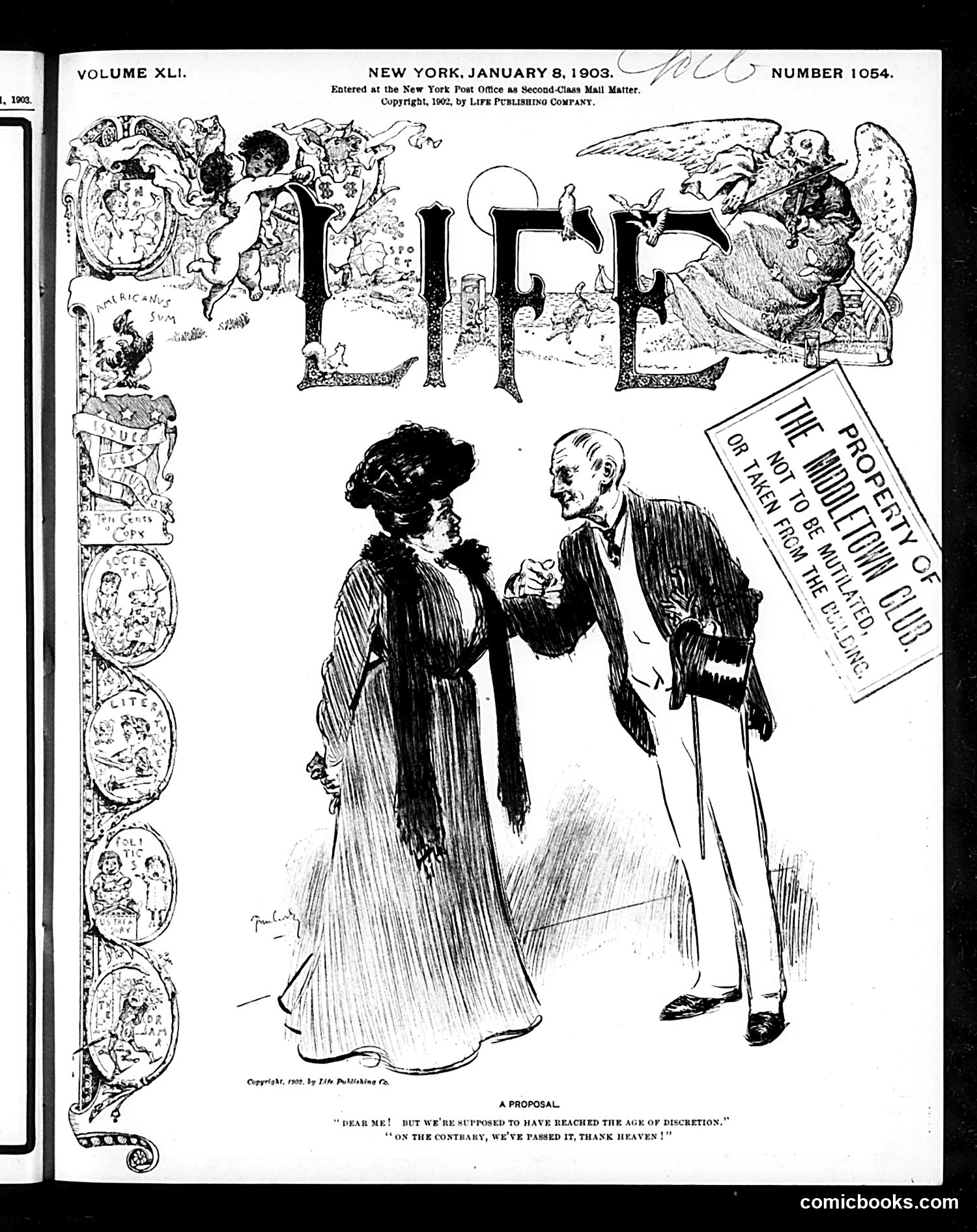
**"A Proposal"** depicts a gentleman asking a woman to marry him, with the caption: "Dear me! but we're supposed to have reached the age of discretion." / "On the contrary, we've passed it, thank heavens!" This is satirical commentary on marriage and courtship customs of the Edwardian era. The joke plays on the phrase "age of discretion"—normally meaning mature judgment. The man suggests they've reached an age when they should be cautious, but the woman cheerfully counters that they've *passed* that cautious age and are now old enough to marry without overthinking it. The elaborate decorative border contains classical allegorical figures typical of Life's art nouveau styling. The satire gently mocks both aging courtship and period gender dynamics.
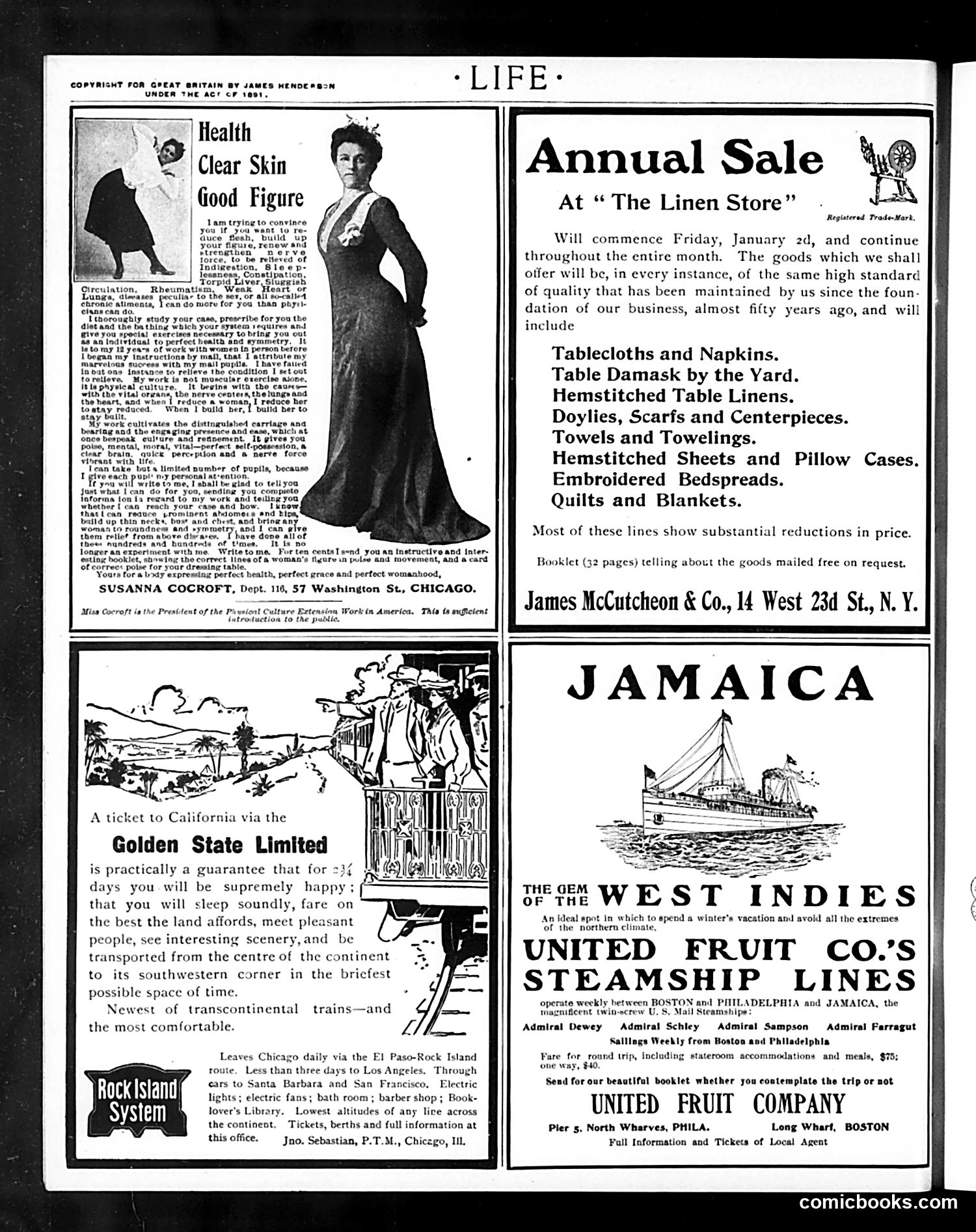
This page contains primarily **advertisements rather than satire or political cartoons**. The upper left features a health advice column by Susanna Cocroft promoting physical exercise and proper posture for women's health and figure. The illustration shows a woman in exercise attire. The remaining content is commercial advertising: - **The Linen Store's annual sale** (table linens, bedding) - **Golden State Limited train** (transcontinental travel to California) - **United Fruit Company's steamship line** to Jamaica and the West Indies This represents a typical Life magazine page from the early 1900s, mixing editorial content with paid advertisements. No political satire is evident on this particular page.
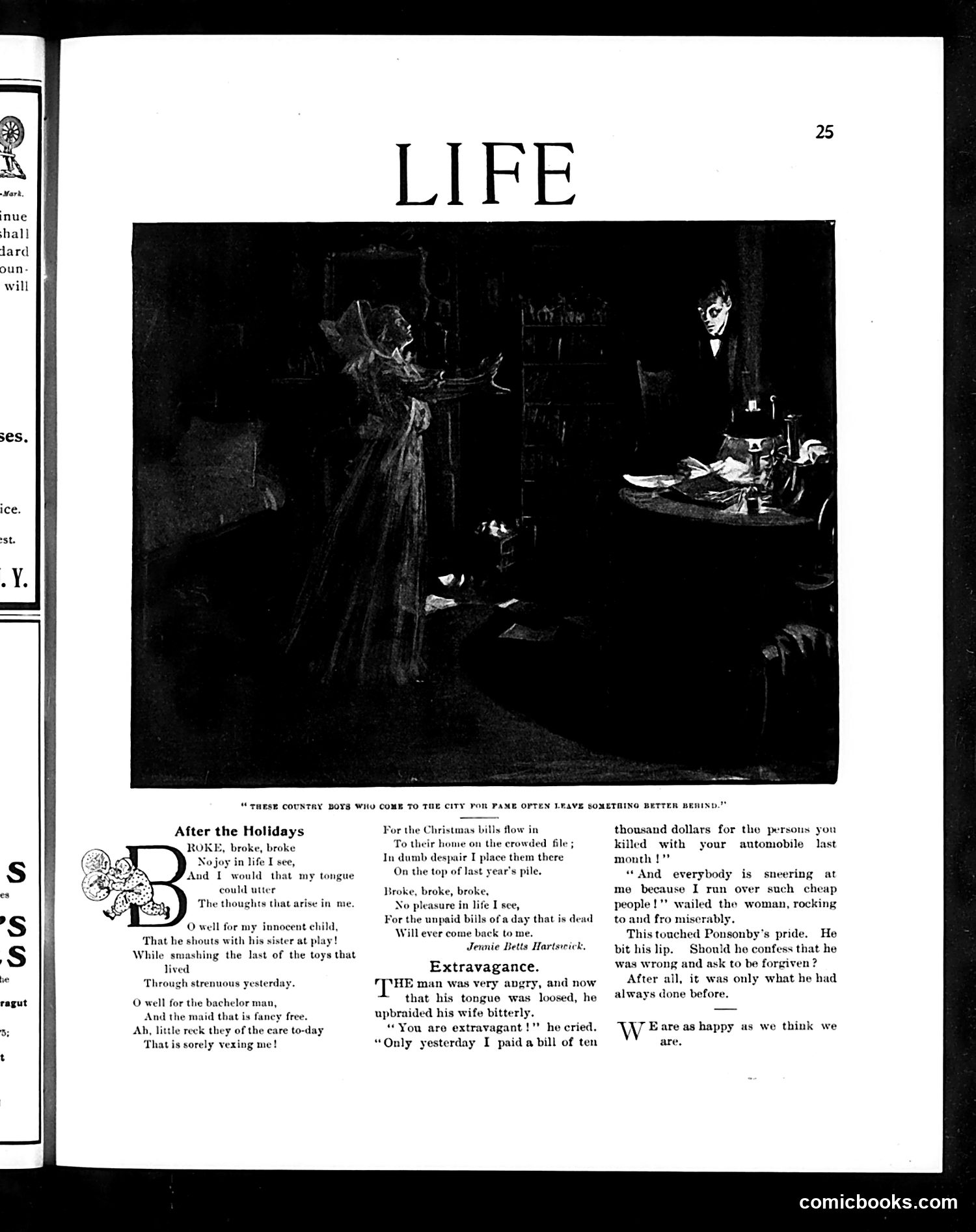
This page contains two satirical pieces about post-holiday financial strain among urban middle-class men. **"After the Holidays"** (poem by Jennie Betts Hardwick) depicts a man's regret over Christmas spending—broken toys, depleted funds, and complaints from his wife about bills. The satire targets the tension between holiday indulgence and financial reality. **"Extravagance"** (brief story) shows an angry husband confronting his wife about overspending, having paid a ten-thousand-dollar automobile bill the previous day. She defends herself by noting everyone else overspends too, concluding "We are as happy as we think we are." The illustration above (captioned about "country boys" visiting the city) appears to show a scene of temptation or vice, reinforcing themes of spending and moral compromise. The satire critiques both consumer excess and marital conflict it generates.
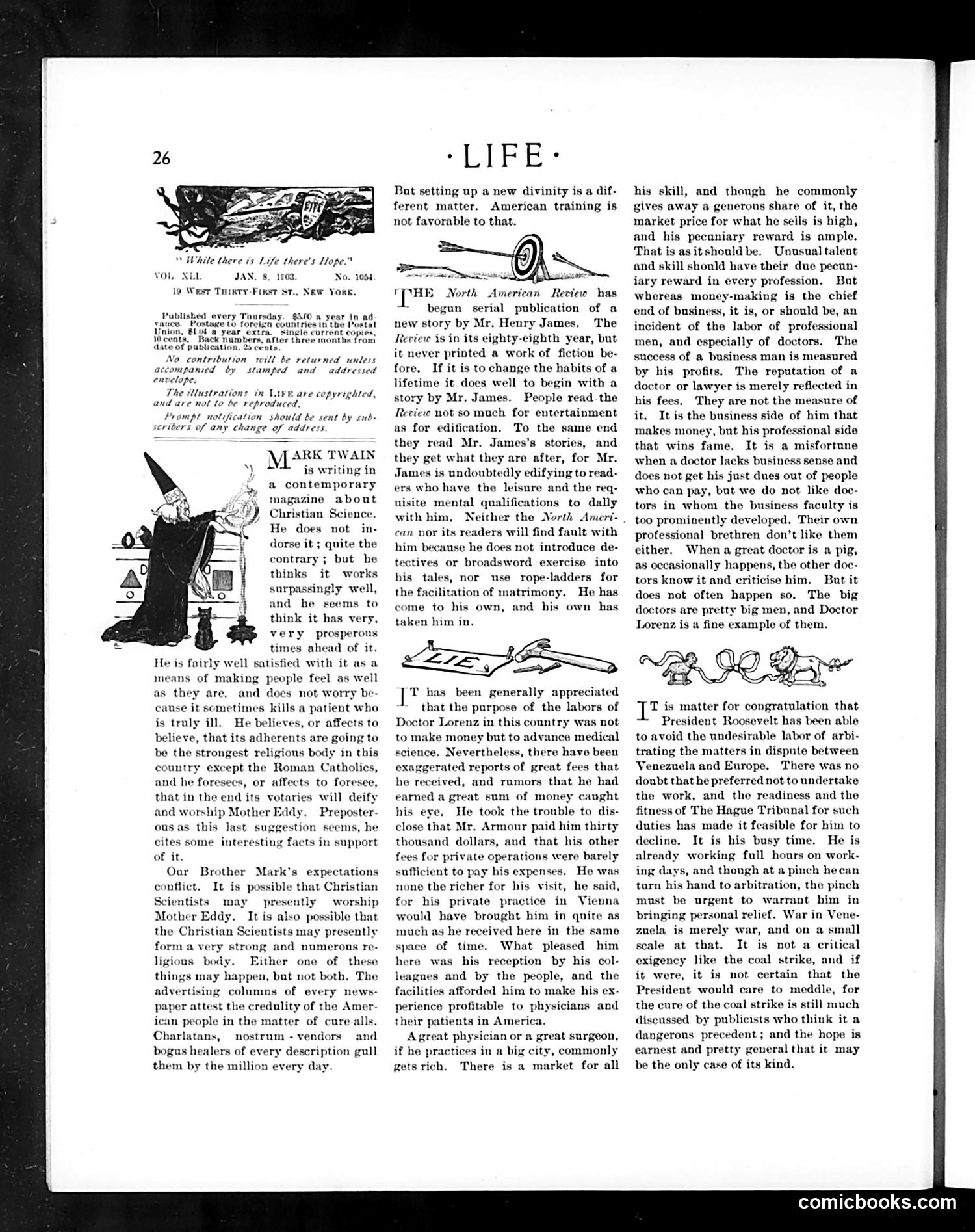
The page contains primarily text articles rather than political cartoons. There is one illustration of a figure wearing a pointed hat with a large "A" on it, appearing to represent **Christian Science** (referenced in Mark Twain's accompanying article about contemporary religion). The figure seems designed as satirical commentary. The main content is an article by **Mark Twain** critiquing Christian Science and discussing **Doctor Lorenz**, an Austrian physician whose methods for treating bone deformities were apparently controversial in America. Twain argues that while Lorenz advanced medical science, sensationalized reports exaggerated his fees and abilities. The satire targets American press hyperbole and the tendency to either over-praise or unfairly criticize foreign practitioners and religious movements.
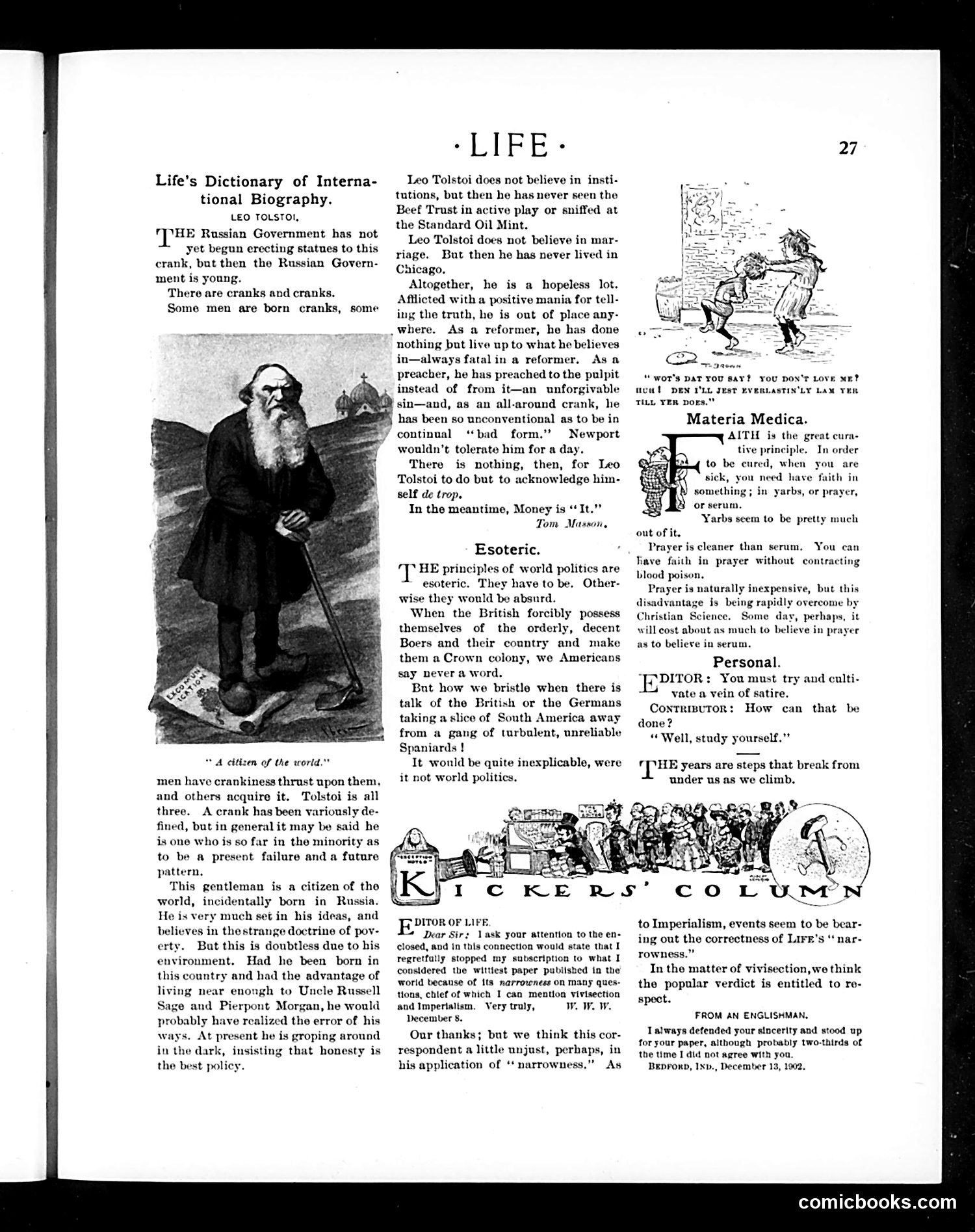
The page features a portrait labeled **"A citizen of the world"** depicting **Leo Tolstoy**, the Russian writer and philosopher. The accompanying text satirizes Tolstoy's contradictory positions: he rejects institutions like the Beef Trust and Standard Oil, yet benefits from them; he opposes marriage but never lived in Chicago; he preaches reform while remaining impractical. The satire's core joke is that Tolstoy, despite his radical rhetoric about truth and reform, remains ineffectual—he's "a hopeless lot" afflicted by obsessive idealism. The text mocks his unconventional behavior and impractical reformism, suggesting his beliefs don't translate into meaningful action. The secondary **"Kickers' Column"** offers reader commentary on the magazine's satirical coverage of contemporary events and imperialism.
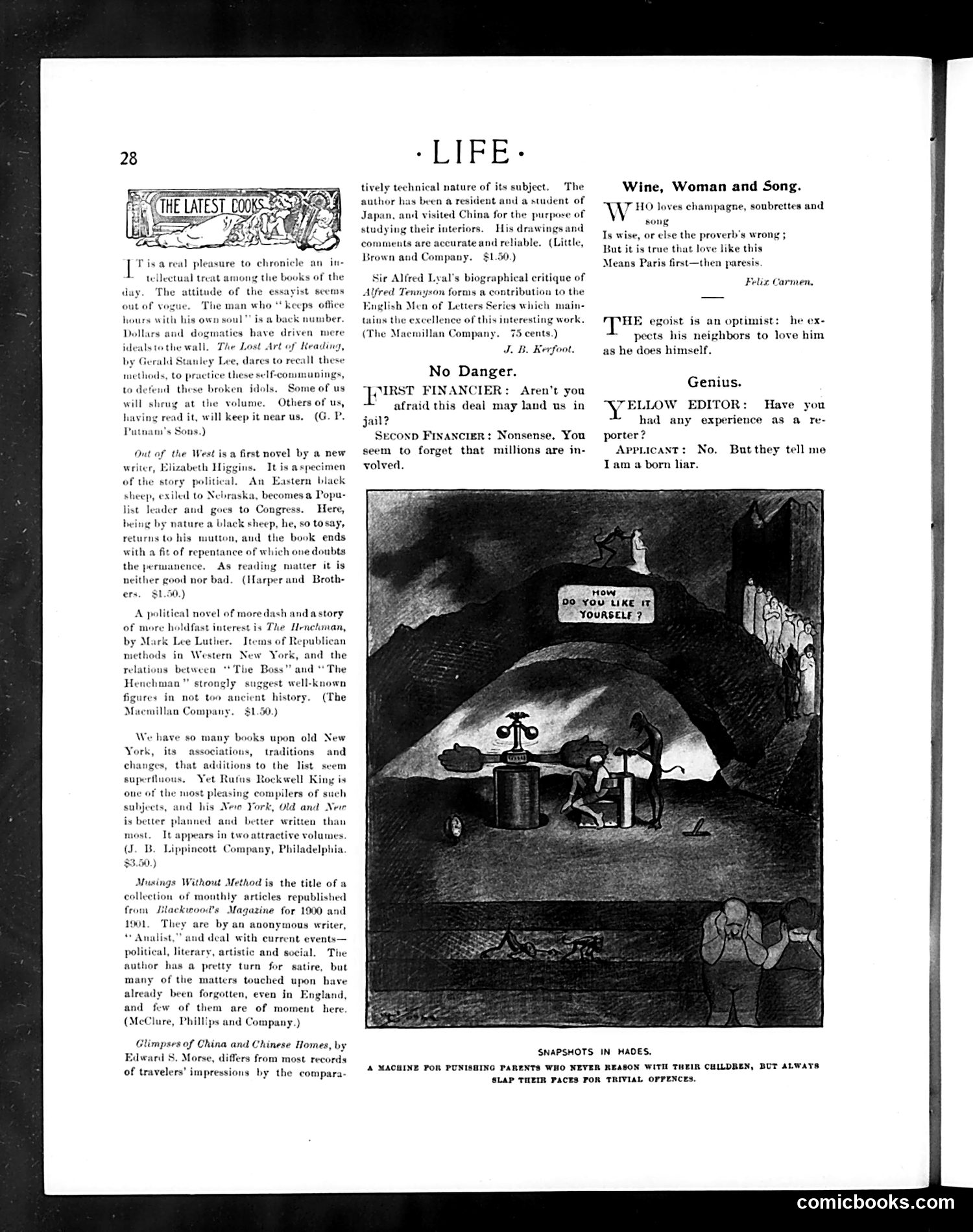
This cartoon satirizes parental indulgence and child discipline. The caption reads: "A MACHINE FOR PUNISHING PARENTS WHO NEVER REASON WITH THEIR CHILDREN, BUT ALWAYS SLAP THEIR FACES FOR TRIVIAL OFFENCES." The image shows what appears to be an infernal contraption in a dark, cave-like setting—suggesting Hell or the underworld ("Hades"). A figure operates a mechanical device designed to punish negligent parents through ironic reversal: rather than reasoning with misbehaving children, such parents resort to physical punishment for minor infractions. The satire targets early-20th-century parenting practices, advocating for rational discipline over corporal punishment. The elaborate machine suggests that parents who physically strike children deserve mechanical retribution—a dark humor commentary on what the magazine considered abusive parenting norms of the era.
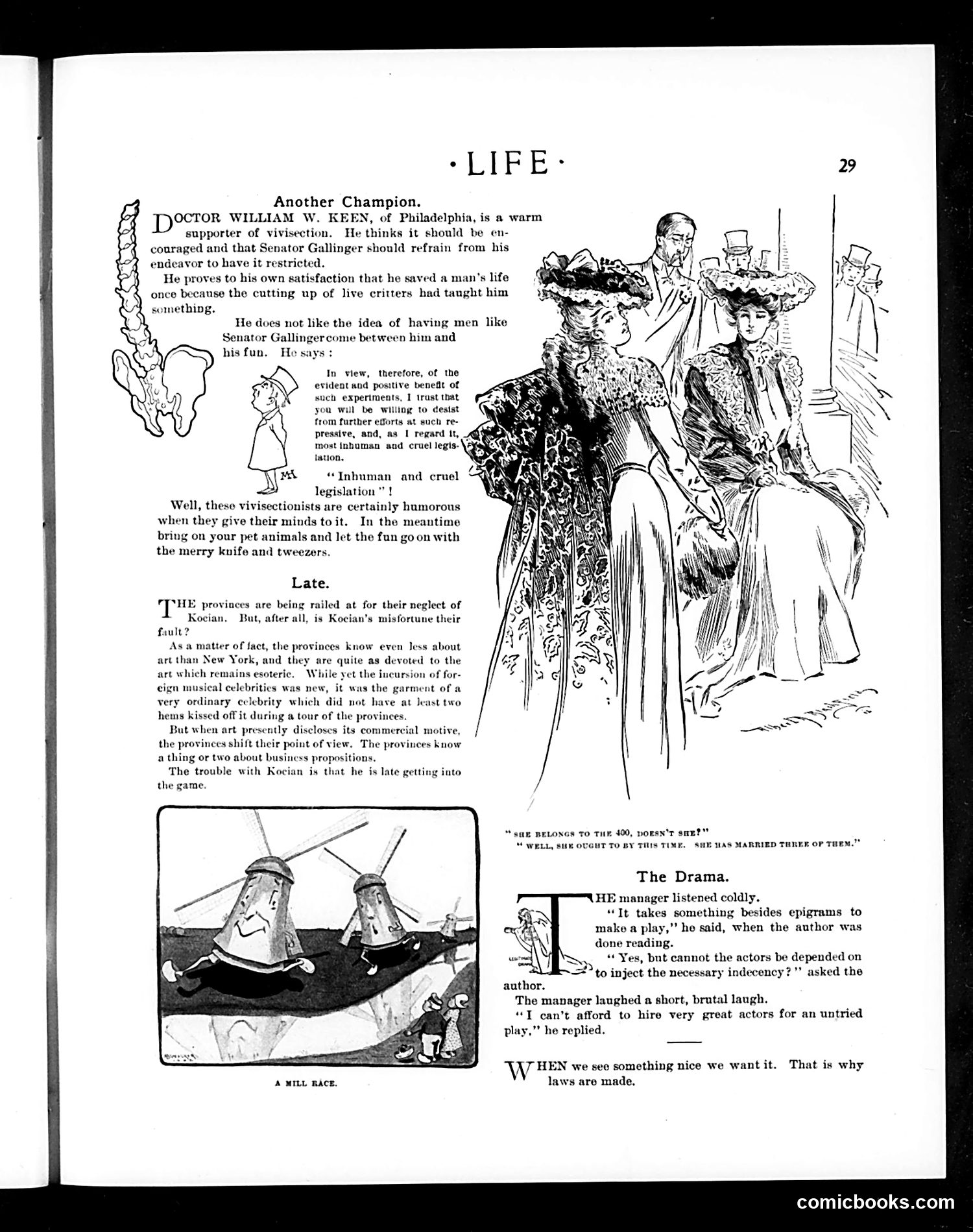
This page satirizes **Doctor William M. Keen** of Philadelphia, a prominent advocate for vivisection (animal experimentation). The text mocks Keen's claim that he once saved a man's life by cutting up three critics—positioning animal testing as ethically justified. The satire ridicules both Keen and **Senator Gallinger** (who apparently restricted vivisection), portraying vivisectionists as humorously callous. The accompanying illustrations—a anatomical sketch and "A Mill Race" (anthropomorphized windmills)—appear to be unrelated cartoons on the same page. The second section, "The Drama," shifts to theatrical satire about hiring cheap actors for untested plays, invoking laws made "when we see something nice we want it." The humor targets scientific establishment figures and legislative debates around animal welfare.
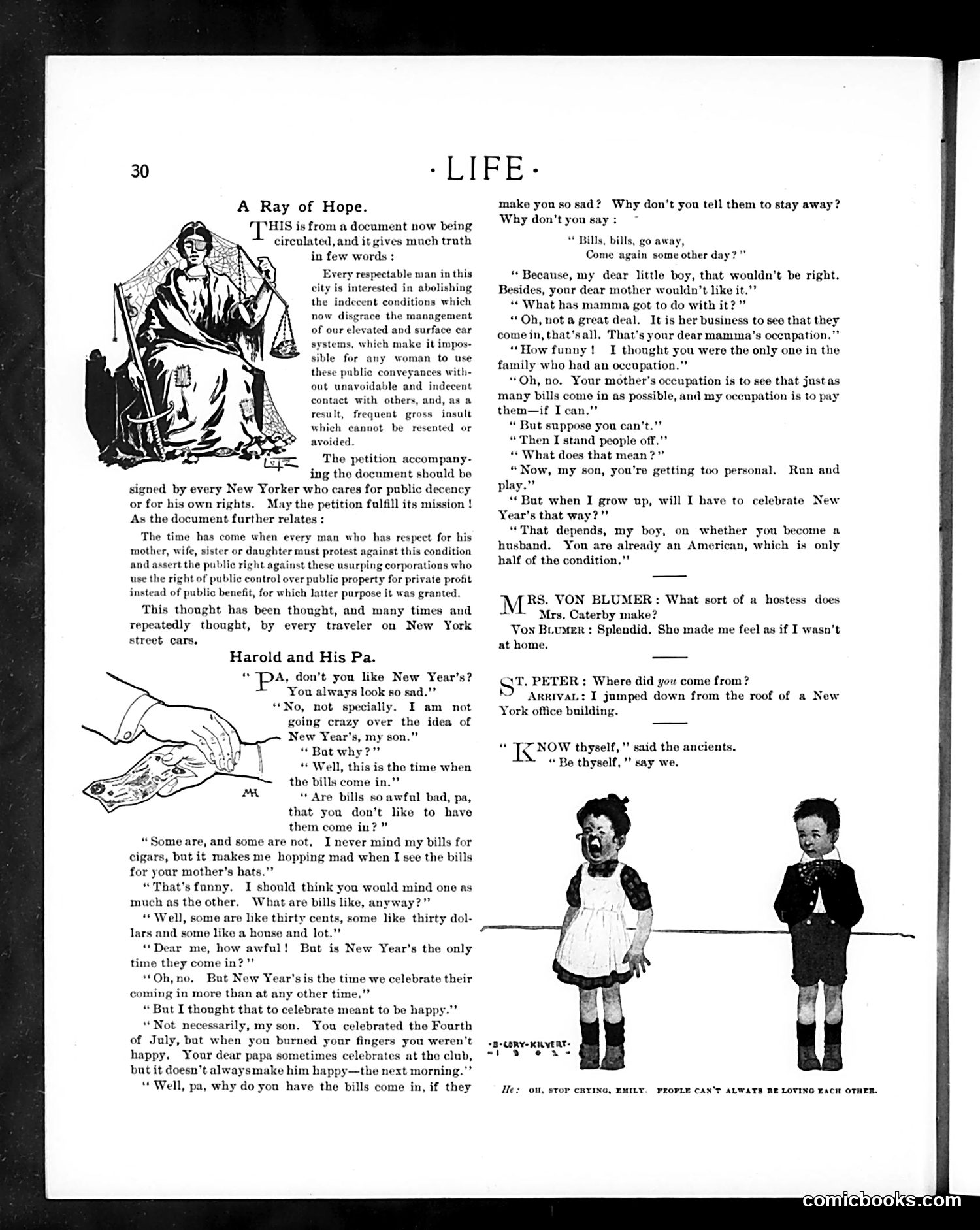
This page contains two satirical pieces about New Year's and urban life: **"A Ray of Hope"** discusses a petition signed by New Yorkers advocating for the abolition of public transit systems' poor conditions and workers' mistreatment. The satire critiques how these dangerous "surface car systems" cause frequent injuries while corporations profit. **"Harold and His Pa"** depicts a conversation between father and son about New Year's and bills. The boy dislikes New Year's; his father explains that bills arrive then, which he pays diligently. The satire mocks working-class financial anxiety—the irony being that celebrating the new year means enduring debt collection. The bottom illustration shows two unhappy children, captioned "Oh, stop crying, Emily. People can't always be loving each other"—likely satirizing sentimental holiday idealization versus family reality.
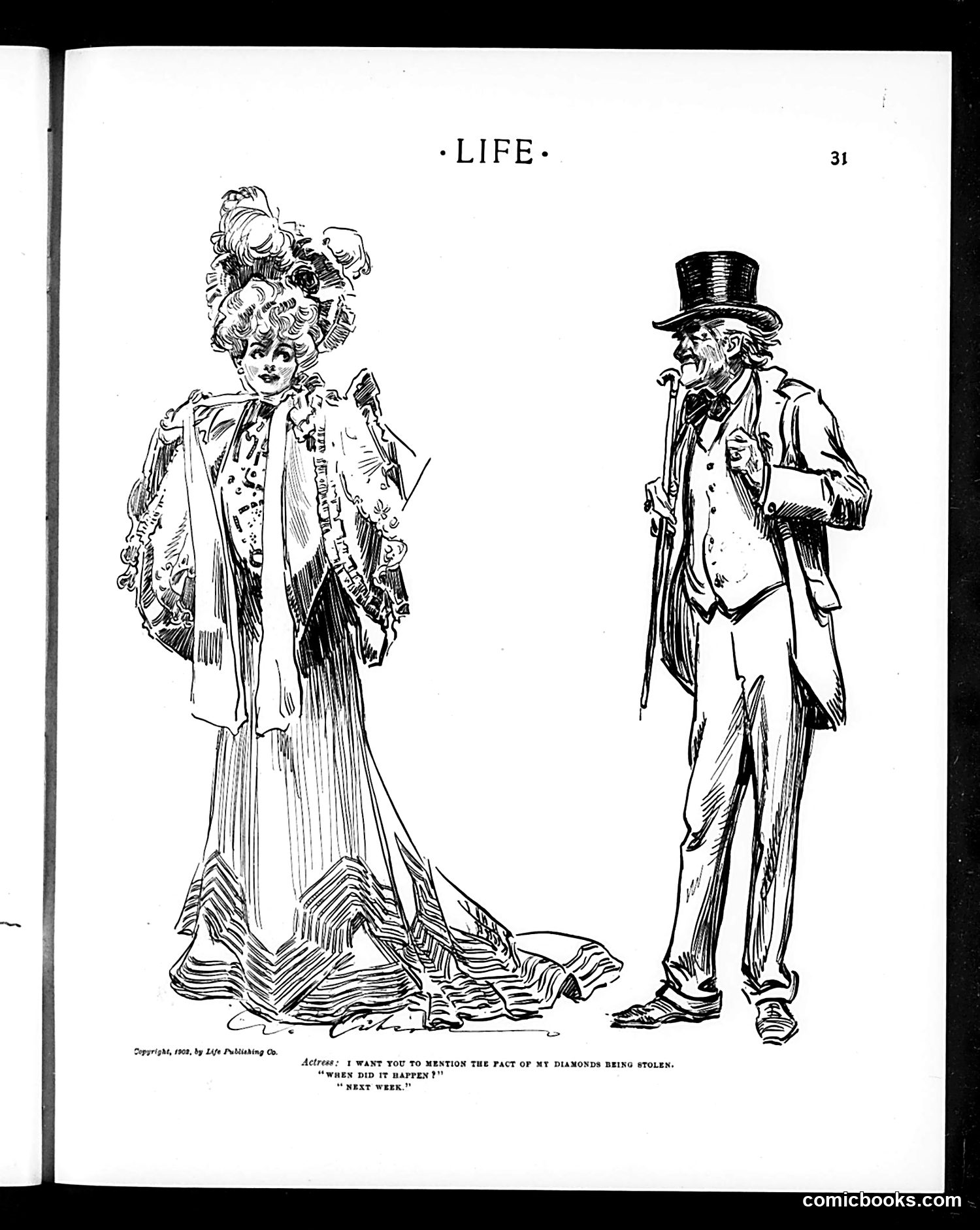
This is a satirical cartoon from *Life* magazine (copyright 1901, Life Publishing Co.) depicting two figures in conversation. The caption reads: "Actress to Old Gentleman: 'Mention the Fact of My Diamonds Being Stolen. When Did It Happen?' 'Next Week.'" The joke satirizes an actress's vanity and self-promotion. She's asking an older gentleman to publicly mention that her diamonds were stolen—but he hasn't yet committed to when the theft will occur ("next week"), revealing her intention to orchestrate or fabricate the theft as publicity. The elaborate costumes emphasize her theatrical nature. This mocks both theatrical personalities and the sensation-seeking culture of the era, where even negative scandals were sought as marketing opportunities.
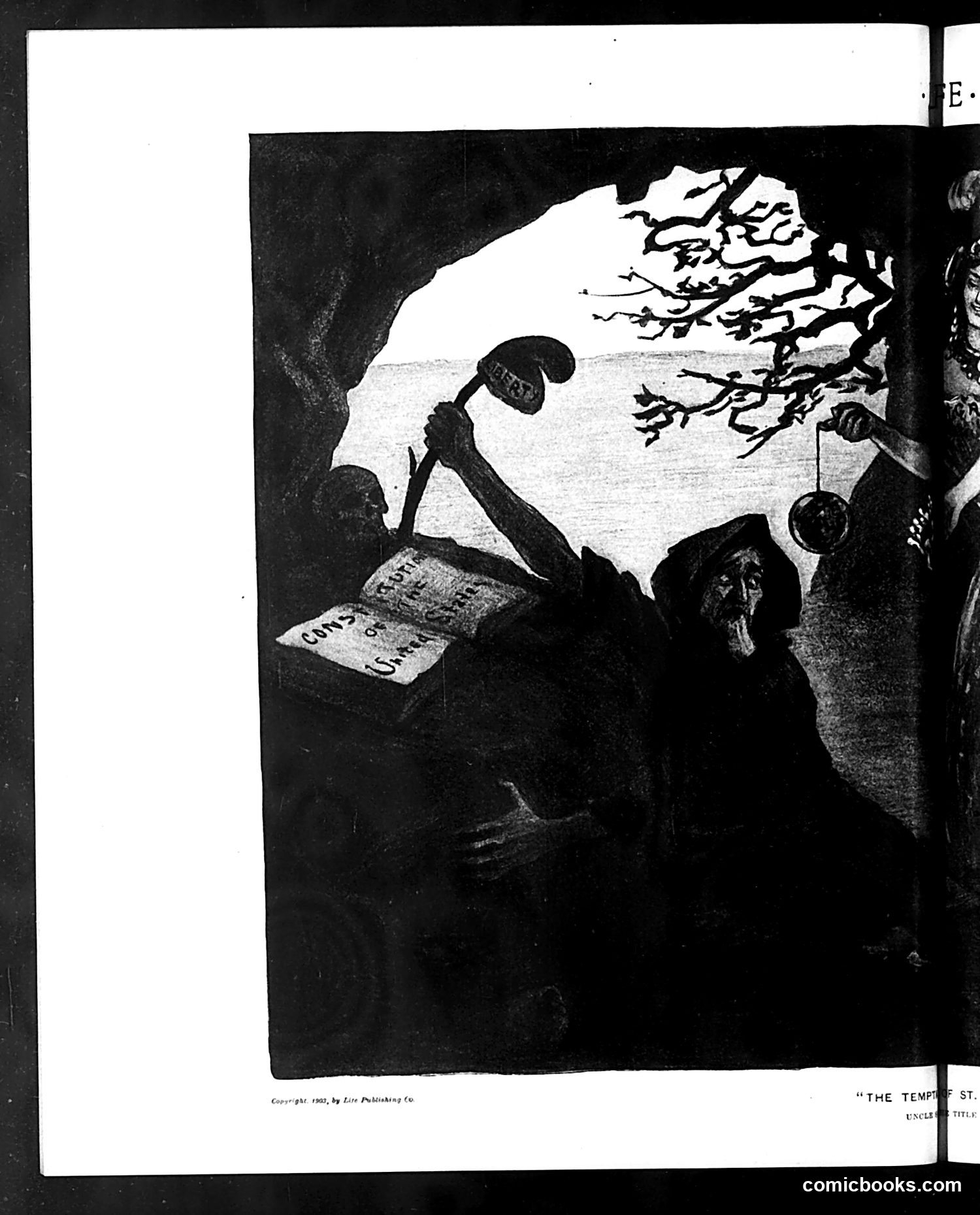
This appears to be an illustration titled "The Tempest" (visible at bottom right), likely referencing Shakespeare's play. The image shows a dramatic silhouetted scene: a figure in a cave or enclosed space reaches upward toward a stormy seascape visible through an opening. Bare, gnarled tree branches frame the composition, and what appears to be a suspended sphere (possibly representing a globe or celestial object) hangs in the scene. The copyright indicates "1903, by Life Publishing Co." The artistic style and theatrical subject matter suggest this is a literary or dramatic illustration rather than political satire. Without additional context text visible on this page, the specific satirical or social commentary—if any—remains unclear from the image alone.
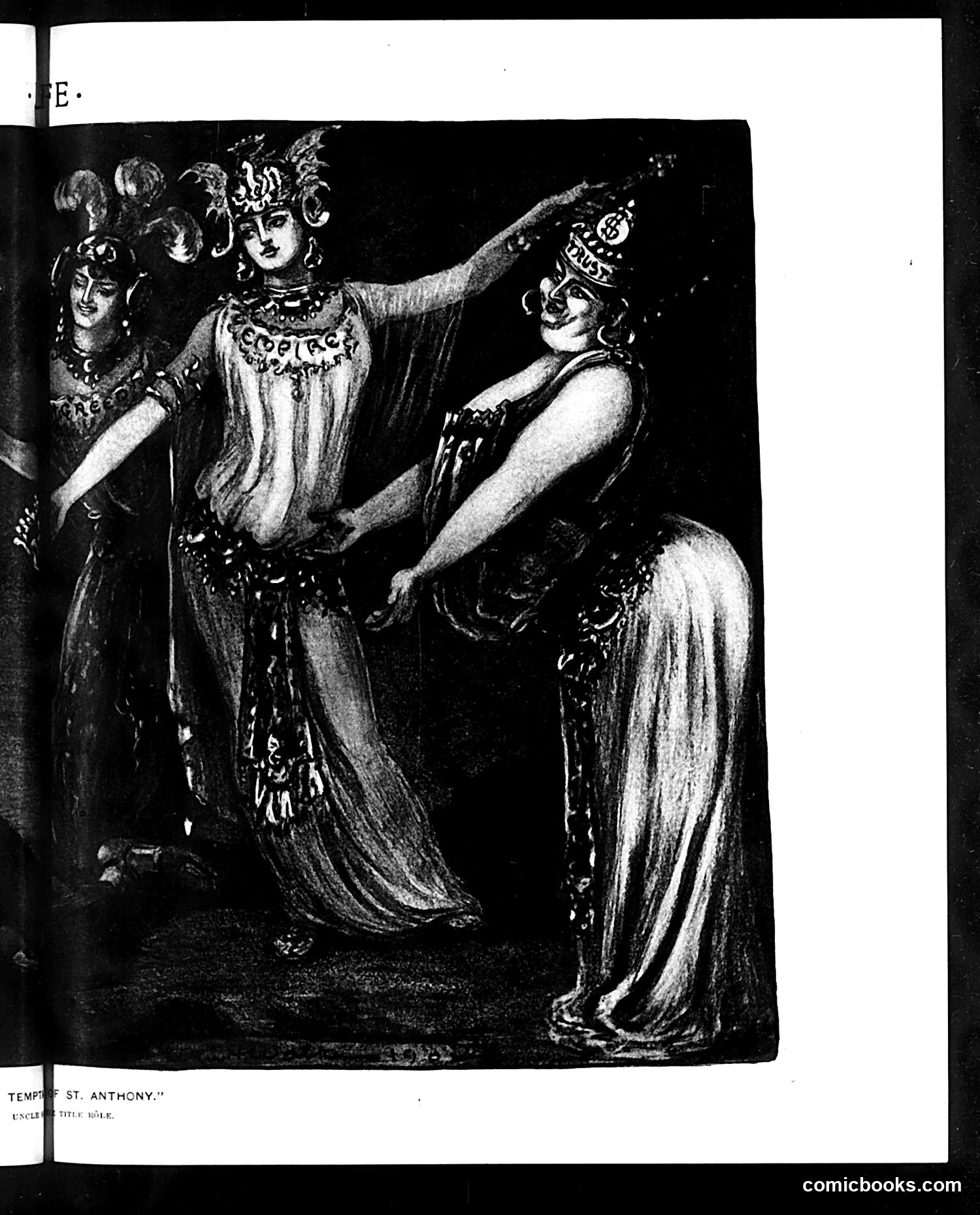
This appears to be an illustration from Life magazine depicting the classical artistic subject of "The Temptation of St. Anthony." The image shows elaborately costumed female figures attempting to tempt a central male figure, referencing the Christian saint's legendary resistance to worldly temptations. The work uses classical religious iconography as a framework for what seems to be satirical commentary on temptation and moral virtue. The ornate costumes, jewelry, and theatrical presentation suggest this may be commenting on contemporary society's seductive distractions or perhaps critiquing how classical morality tales were being reinterpreted for modern audiences. Without additional context, the specific satirical target remains unclear, though the luxurious staging implies commentary on materialism or moral weakness.
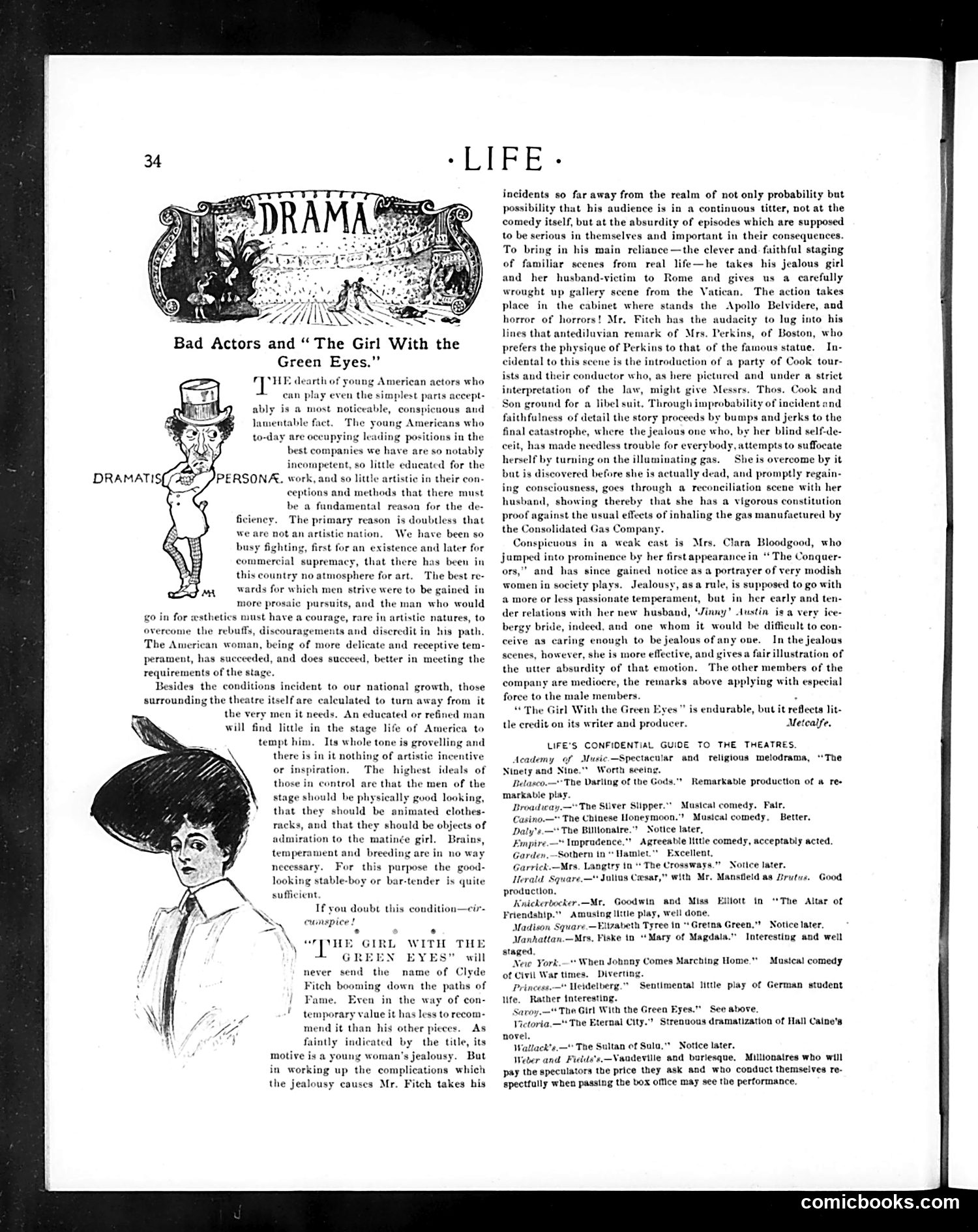
This page reviews theatrical productions, focusing on "Bad Actors and 'The Girl With the Green Eyes.'" The **masthead illustration** (top left) shows a theatrical stage setup, establishing the drama section. The **two caricatures** depict actors in the reviewed plays—likely unflattering character sketches typical of Life's satirical style toward performers. The text criticizes American actors for lacking artistic depth, arguing they pursue commercial success over theatrical craft. The reviewer particularly targets weak performers in supporting roles, noting they lack discipline and refinement. "The Girl With the Green Eyes," based on a young woman's jealousy, is described as endurable but reflecting "little credit on its writer and producer." The page then catalogs other theatrical productions with brief critical assessments—a standard theater guide format for the era.
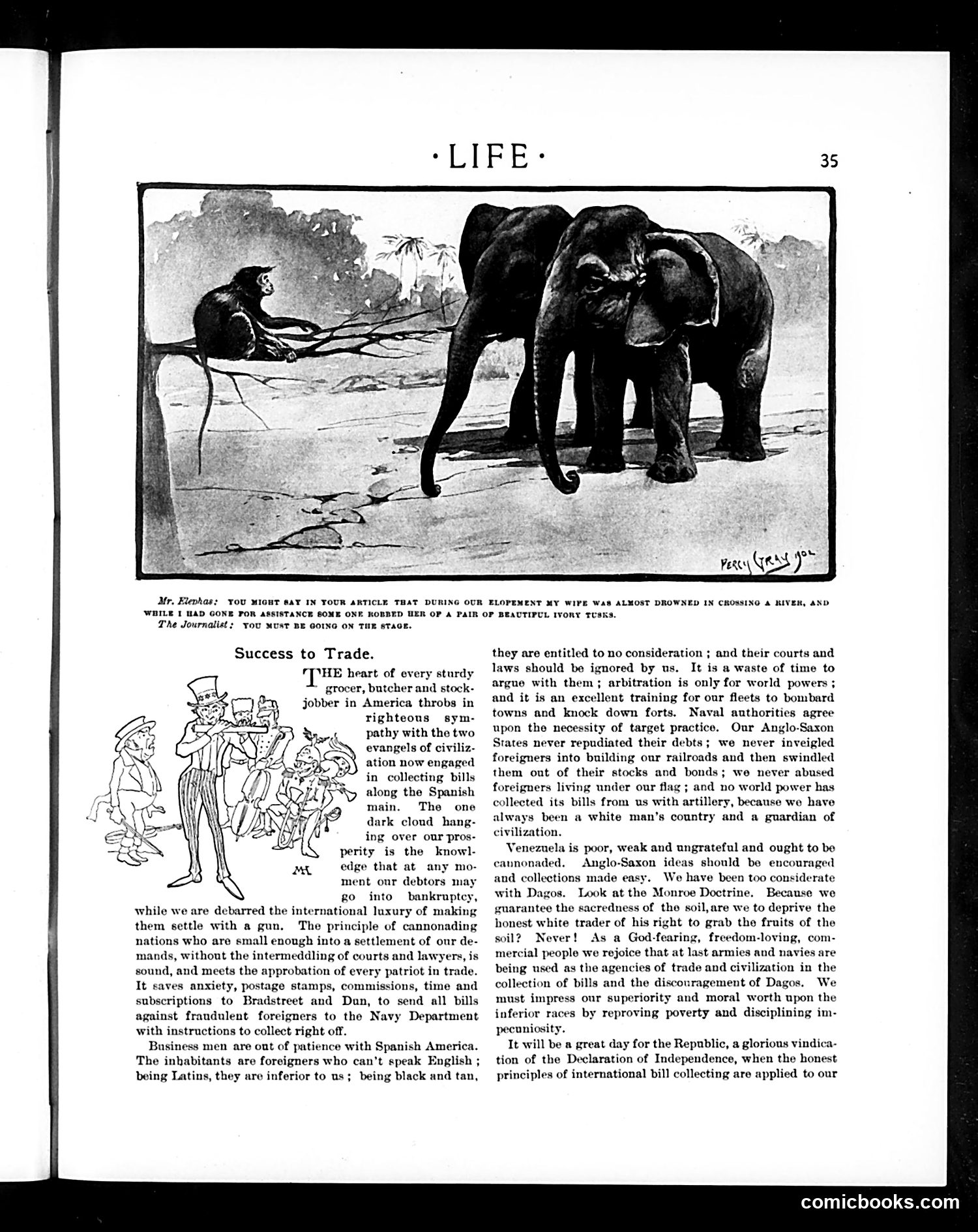
**The Top Cartoon:** A journalist dismisses an elephant's (Mr. Elephas's) absurd story about his wife nearly drowning and being robbed of ivory tusks during an elopement, telling him such fabrications belong "on the stage"—a jab at tall tales. **"Success to Trade":** This is savage satire mocking American imperialist ideology. Life sarcastically celebrates using naval force to collect debts from Latin American nations, particularly Venezuela. The piece ridicules businessmen who advocate military bombardment instead of legal arbitration, framing it as justified by claims of racial and cultural superiority ("Anglo-Saxon," dismissing Latin Americans as "Dagos"—a slur). Life exposes the hypocrisy: American traders had defrauded foreigners through railroad swindles and stock manipulation, yet justify gunboat diplomacy against weaker nations as "civilization" and "trade." The satire condemns this colonial violence masked as commerce and moral superiority, contrasting American claims of righteousness with actual predatory behavior.
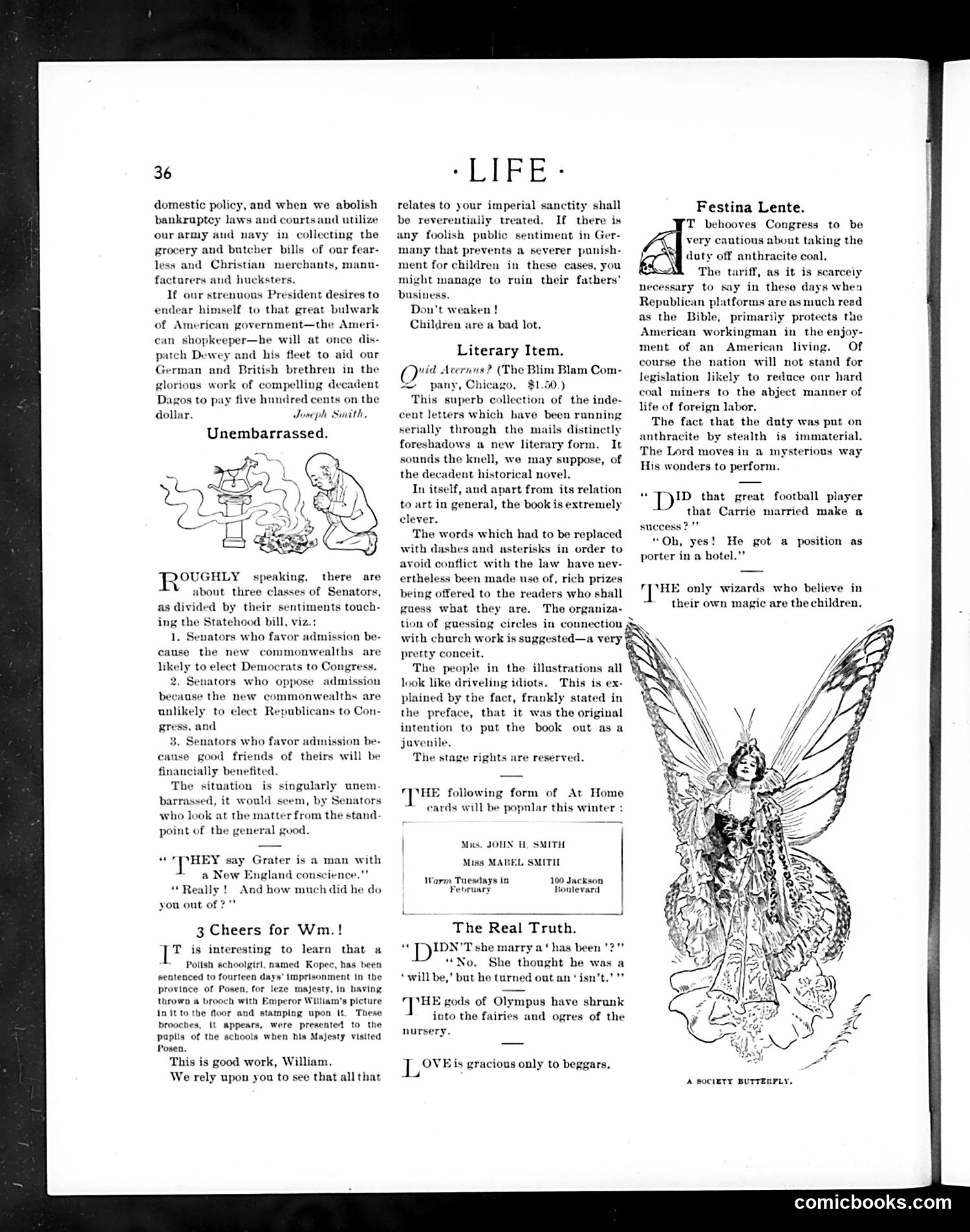
This page contains several political commentaries typical of early 1900s Life magazine: **"Unembarrassed"** satirizes Senate voting on statehood bills, exposing that senators vote based on which party new states will support electorally, or personal financial benefit—not the general good. **"3 Cheers for Wm.!"** mocks Kaiser Wilhelm II's authoritarian control, praising his imprisonment of a Polish schoolgirl for disrespecting his portrait. Life uses heavy sarcasm to critique imperial excess. **The "New England conscience" joke** cynically pairs moral reputation with financial dishonesty. **"Festina Lente"** defends the anthracite coal tariff as protecting American workers, while sarcastically noting Republicans treat their platform like scripture. The illustrations depict cartoon figures in exaggerated, critical poses. The overall tone is cynical about American politics, imperialism, and hypocrisy—Life's signature approach to contemporary issues.
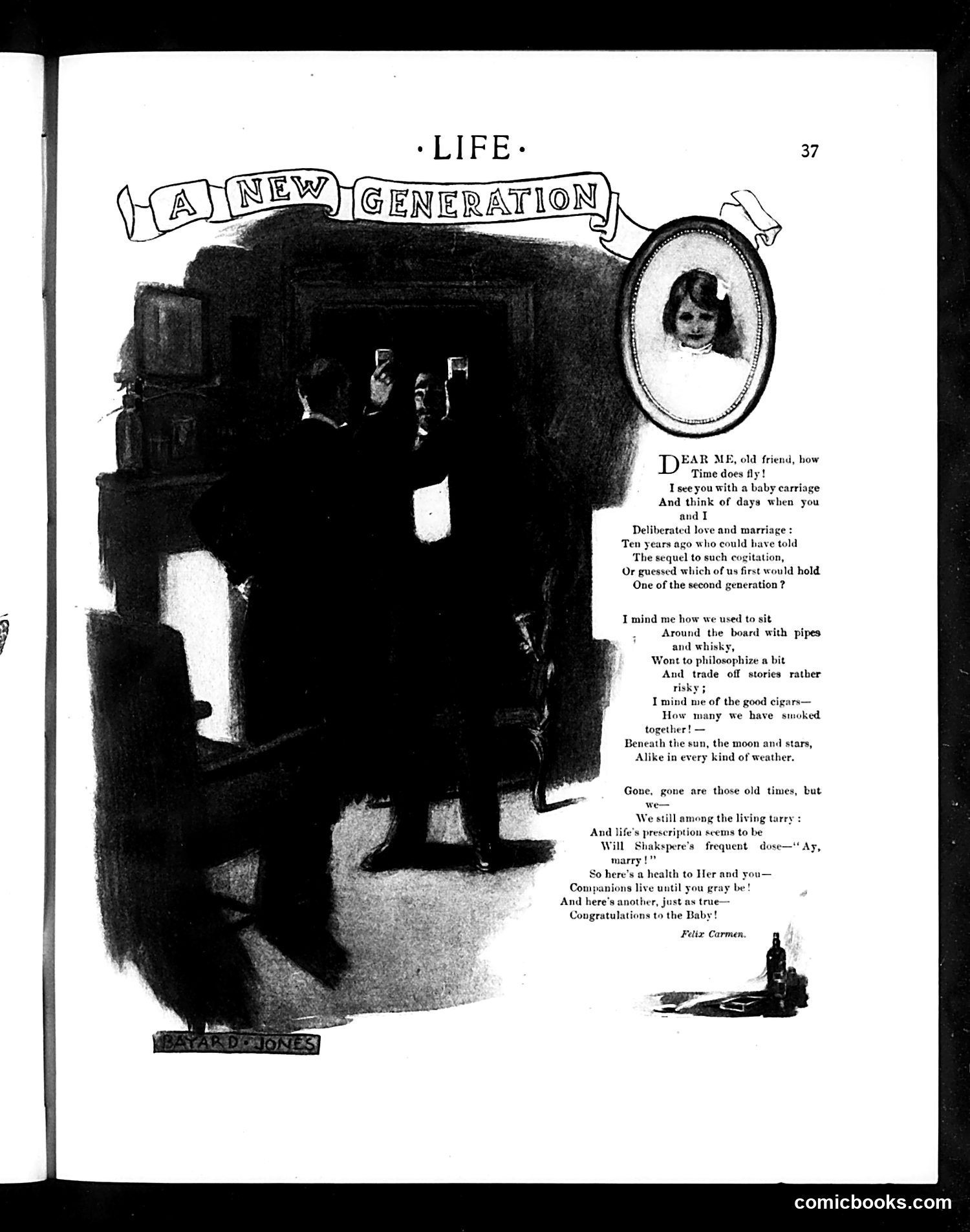
This is a sentimental poem by Félix Carmen accompanying an illustration by Bayard Jones. The piece nostalgically addresses an old friend who now has a baby, reflecting on their shared youth—philosophical discussions, cigars, whisky, and camaraderie under the stars. The cartoon shows silhouetted figures in what appears to be a tavern or social gathering, with a baby carriage visible, contrasting past bachelor life with present domesticity. A portrait medallion of a child appears in the upper right. The joke hinges on life's progression: the speaker and friend once debated love and marriage theoretically; now one has actually married and produced offspring. The Shakespeare reference ("Ay, marry!") provides wordplay—using the pun on "marry" (the word) versus marriage (the state). It's gentle satire about how time transforms youth's philosophical bachelor existence into adult responsibility and parenthood, with toasts to both the friend's companion and their baby.
This page features a humorous poem contrasting two versions of the same woman. The first Mehitable is fabulously rich—dressed in satins, served on golden plates, commanding servants—yet remains miserable and perpetually dissatisfied. The second version, identical in name but opposite in temperament, finds joy despite modest circumstances. The satire targets the assumption that wealth guarantees happiness. Mehitable's riches cannot cure her "corns" (literal discomfort, metaphorical unhappiness); she "soured on sweet" as easily as sour, suggesting material excess breeds only ingratitude and restlessness. The accompanying anecdote about the harried newspaper editor reinforces the theme: even in urgent circumstances, people obsess over trivialities ("Boiler empty / Engineer full"). The remainder is advertising—typical of Life magazine's format. The poem's message reflects period moral values: contentment stems from character, not possessions.
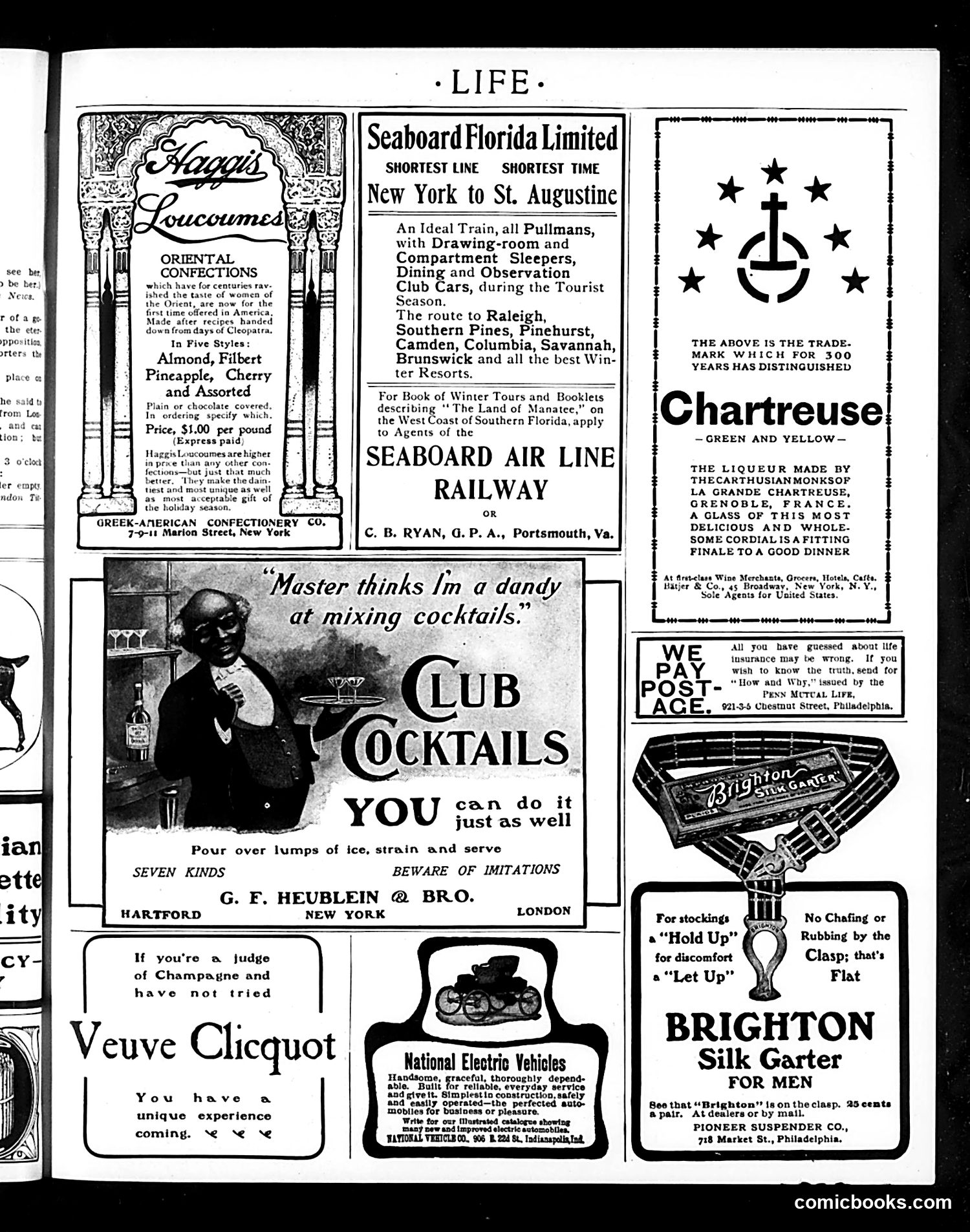
This is primarily an **advertising page** from an early 20th-century issue of Life magazine, with one notable satirical advertisement. The main joke appears in the **Club Cocktails ad** (center), which features a Black servant or bartender with the caption "Master thinks I'm a dandy at mixing cocktails. YOU can do it just as well." This reflects the era's casual racism and servant stereotypes—the humor derives from the "surprising" idea that a white customer could match a Black person's skill, framed as an aspirational challenge rather than genuine compliment. The rest consists of typical period advertisements: a luxury train service (Seaboard Florida Limited), Oriental candies (Haggis Loucoumes), champagne, electric vehicles, Chartreuse liqueur, a postcard service, and men's garters. The ads emphasize luxury goods and leisure travel typical of early 1900s upper-class consumption. The page contains **no political cartoons**—it functions as standard magazine advertising with one casually racist sales pitch embedded within.
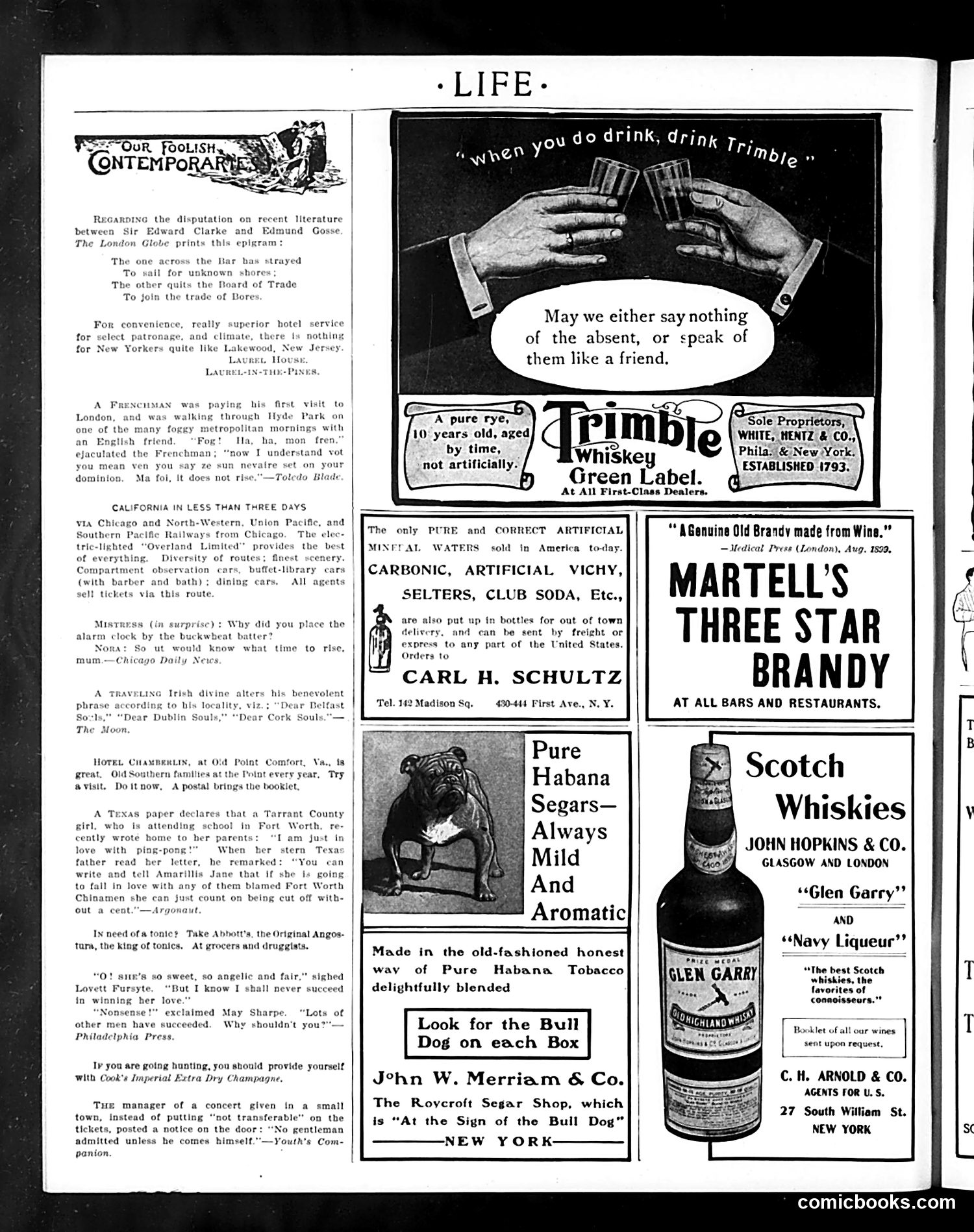
This page is primarily **advertising**, not editorial satire. The left column contains brief humor pieces and anecdotes typical of Life's lighter content—jokes about travel, romance, and social mishaps. These aren't political cartoons but rather short comedic observations on contemporary life. The dominant content is **liquor and tobacco advertising** (Trimble Whiskey, Martell's Brandy, John Hopkins Scotch, Carl H. Schultz mineral waters, and John W. Merriam cigars). This reflects the pre-Prohibition era when such advertisements were standard in American magazines. The only visual elements are product illustrations and hands holding glasses in the Trimble ad. The humor pieces mock contemporary social pretension—a Frenchman's bewilderment at English society, a Texas father's disapproval of his daughter's romantic interests, and romantic miscommunications. **No political figures or satire are evident here.** This is a straightforward example of early 20th-century magazine content blending light entertainment with commercial promotion.
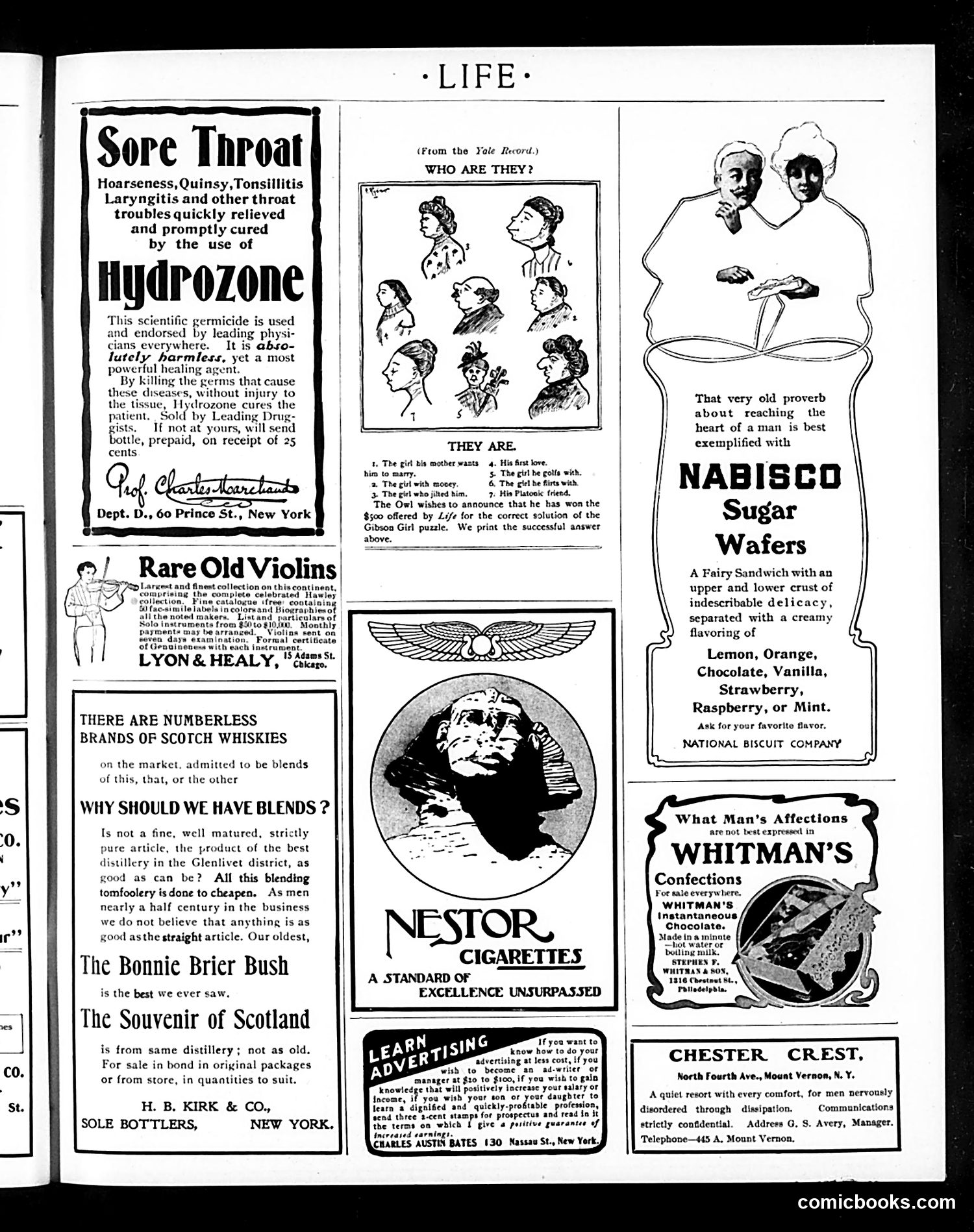
This page is primarily **advertising**, with one cartoon element. The main content is a puzzle from Yale Record titled "Who Are They?" — a Gibson Girl cartoon showing nine illustrated female faces. The puzzle asks readers to identify which girl represents each romantic category (his mother's choice, his first love, the girl he golfs with, etc.). Life magazine announced it had awarded $500 to "The Owl" for solving this puzzle correctly. The satirical point reflects early 20th-century social humor about men's complicated romantic lives and the various types of women they encounter. The "Gibson Girl" reference indicates this targets the era's idealized feminine aesthetic. Surrounding the puzzle are period advertisements for throat remedies (Hydrozone), rare violins, Scotch whisky, Nestor cigarettes, Nabisco wafers, Whitman's chocolates, and Chester Crest resort. These ads are typical of Life's revenue model and reflect contemporary consumer culture and product marketing strategies.
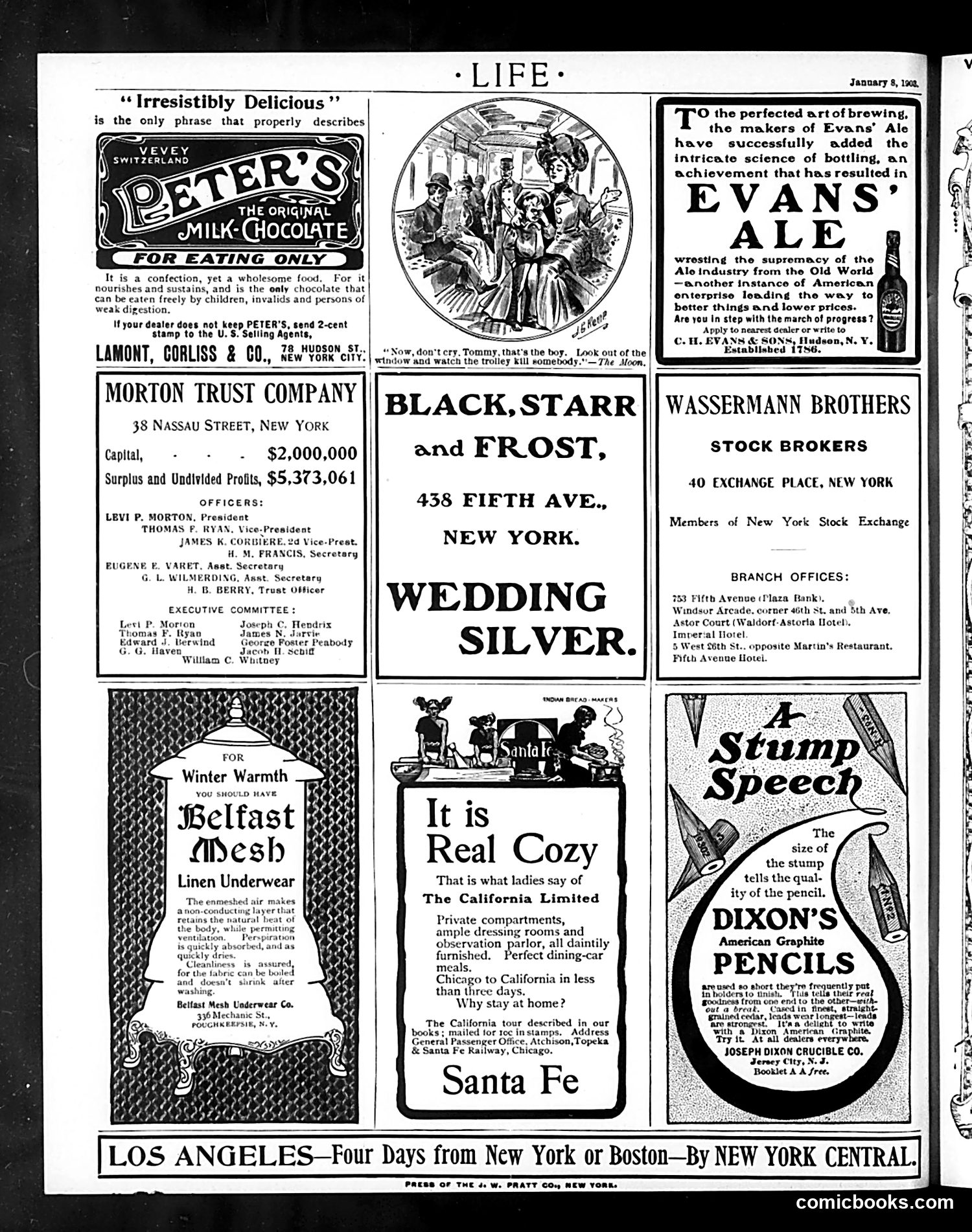
This is primarily an **advertising page** with minimal editorial content. The single cartoon appears in the upper center: a domestic scene captioned "Now, don't cry, Tommy, that's the boy. Look out of the window and watch the trolley kill somebody." **The Joke:** This dark humor satirizes parental indifference and urban danger. The cartoon mocks how carelessly parents might distract fretful children in an era when electric trolleys were becoming common urban hazards causing frequent fatal accidents. The "joke" relies on the shocking contrast between gentle child-soothing language and horrific content—a form of satirical exaggeration typical of *Life* magazine's irreverent humor. **Context:** By 1908, trolley accidents were genuine public concerns in American cities, making this both a social commentary and gallows humor about modern industrial dangers. The remainder of the page consists of period advertisements for chocolate, banks, jewelry, railroads, underwear, and pencils—typical of *Life's* commercial content.