
Life, 1903-01-08 · page 8 of 20
Life — January 8, 1903 — page 8: what you’re looking at
What you’re looking at
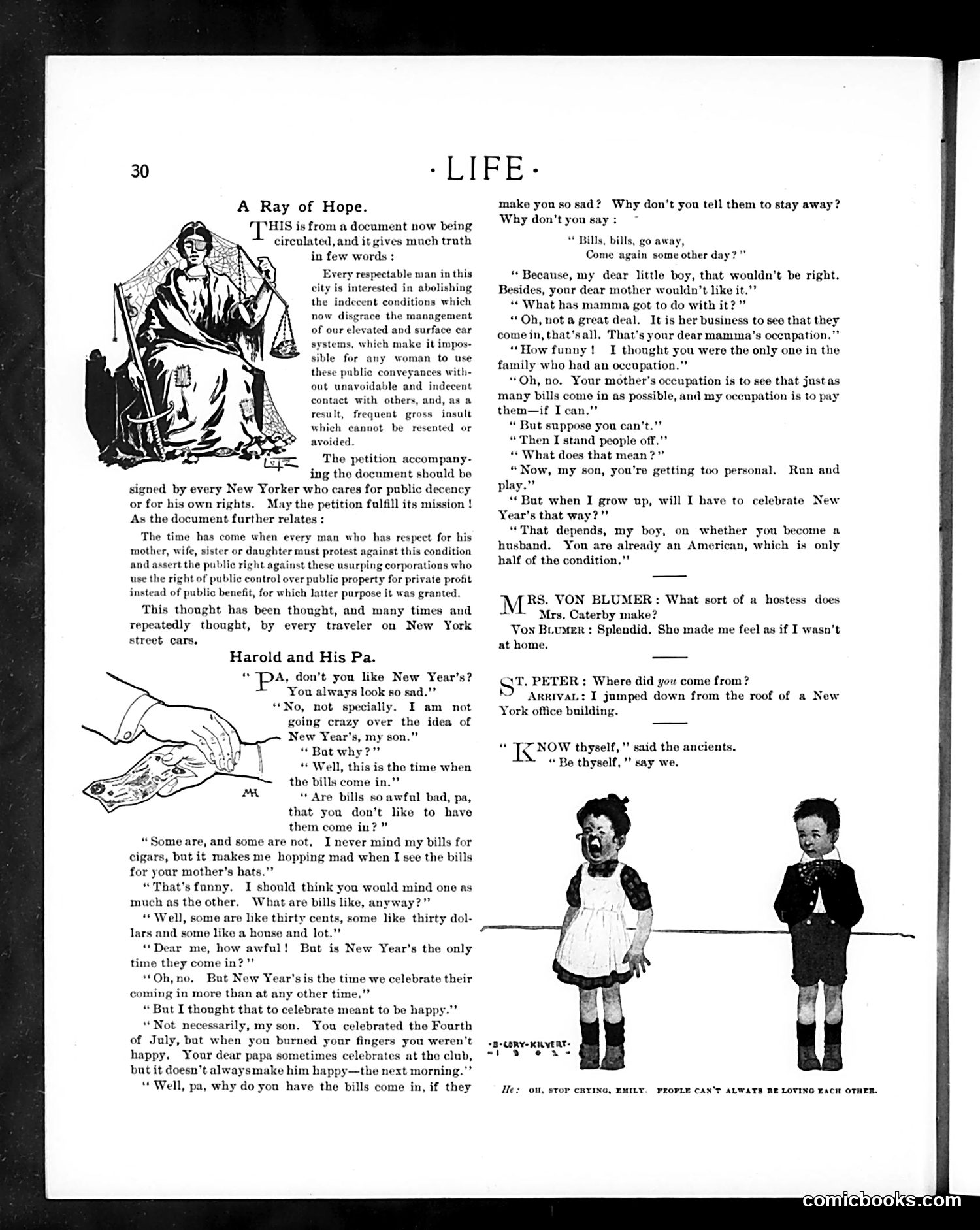
This page contains two satirical pieces about New Year's and urban life: **"A Ray of Hope"** discusses a petition signed by New Yorkers advocating for the abolition of public transit systems' poor conditions and workers' mistreatment. The satire critiques how these dangerous "surface car systems" cause frequent injuries while corporations profit. **"Harold and His Pa"** depicts a conversation between father and son about New Year's and bills. The boy dislikes New Year's; his father explains that bills arrive then, which he pays diligently. The satire mocks working-class financial anxiety—the irony being that celebrating the new year means enduring debt collection. The bottom illustration shows two unhappy children, captioned "Oh, stop crying, Emily. People can't always be loving each other"—likely satirizing sentimental holiday idealization versus family reality.
📄 Transcribed text from this page (OCR, searchable)
Machine-transcribed from the original scan — historical spelling and the odd misread are preserved.
- LIFE A Ray of Hope. THs is from a document now being circulated, and it gives much truth in few words : Every respectable man in this city is interested in abolishing the indecent conditions which now disgrace the management of our elevated and surface car systems, which make it impos- sible for any woman to use these public conveyances with- out unavoidable and indecent contact with others, and, as a result, frequent gross insult which cannot be resented or avoided. The petition accompany- ing the document should be signed by every New Yorker who cares for public decency or for his own rights. May the petition fulfill its mission ! As the document further relates : The time has come when every man who has respect for his mother, wife, sister or daughter must protest against this condition and assert the public right against these usurping corporations who use the right of public control over public property for private profit instead of public benefit, for which latter purpose it was granted. This thought has been thought, and many times and repeatedly thought, by every traveler on New York street cars. Harold and His Pa. ae PA. don’t you like New Year’s? You always look so sad.”” “*No, not specially. I am not going crazy over the idea of New Year's, my son.” “ Bat why?” “ Well, this is the time when the bills come in.”” “Are bills so awful bad, pa, that you don’t like to have them come in?” “Some are, and some are not. I never mind my bills for cigars, but it makes me hopping mad when I see the bills for your mother’s hats.” “That's fanny. I should think you would mind one as much as the other. What are bills like, anyway?” “Well, some are like thirty cents, some like thirty dol- lars and some like a house and lot.’” “Dear me, how awful! But is New Year’s the only time they come in?” ‘Oh,no. But New Year's is the time we celebrate their coming in more than at any other time.” “But I thought that to celebrate meant to be happy.” “Not necessarily, my son. You celebrated the Fourth of July, but when you burned your fingers you weren't happy. Your dear papa sometimes celebrates at the club, but it doesn’t alwaysmake him happy—the next morning."” “ Well, pa, why do you have the bills come in, if they make you so sad? Why don’t you tell them to stay away? Why don’t you say : “ Bills, bills, go away, Come again some other “Because, my dear little boy, that wouldn't be right. sides, your dear mother wouldn’t like it.”” ** What has mamma got to do with it?” “Oh, not a great deal. It is her business to seo that they come in, that’sall. That's your dear mamma’s occupation.” “How funny! I thought you were the only one in the family who had an occupation.” “Oh, no. Your mother's occupation is to see that just as many bills come in as possible, and my occupation is to pay them—if I can.” “ But suppose you can’t." “ Then I stand people off."* “ What does that mean?” “Now, my son, you're getting too personal. play.” “But when I grow up, will I have to celebrate New Year’s that way?" “That depends, my boy, on whether you become a husband. You are already an American, which is only half of the condition.” Ran and M*®. VON BLUMER: What sort of a hostess does Mrs. Caterby make? Vow Biumer : Splendid, She made me feel as if I wasn’t at home. GT. PETER : Where did yo come from? Arriva: I jumped down from the roof of a New York office building. s Jcxyow thyself,” said the ancients, ™~ «Be thyself,’ say we. CORY-KILVERT- 2 ex He: OM, STOP CRYING, EMILY. PEOPLE CAN'T ALWAYS BE LOVING ZACH OTHER.