
A complete issue · 24 pages · 1902
Life — December 11, 1902
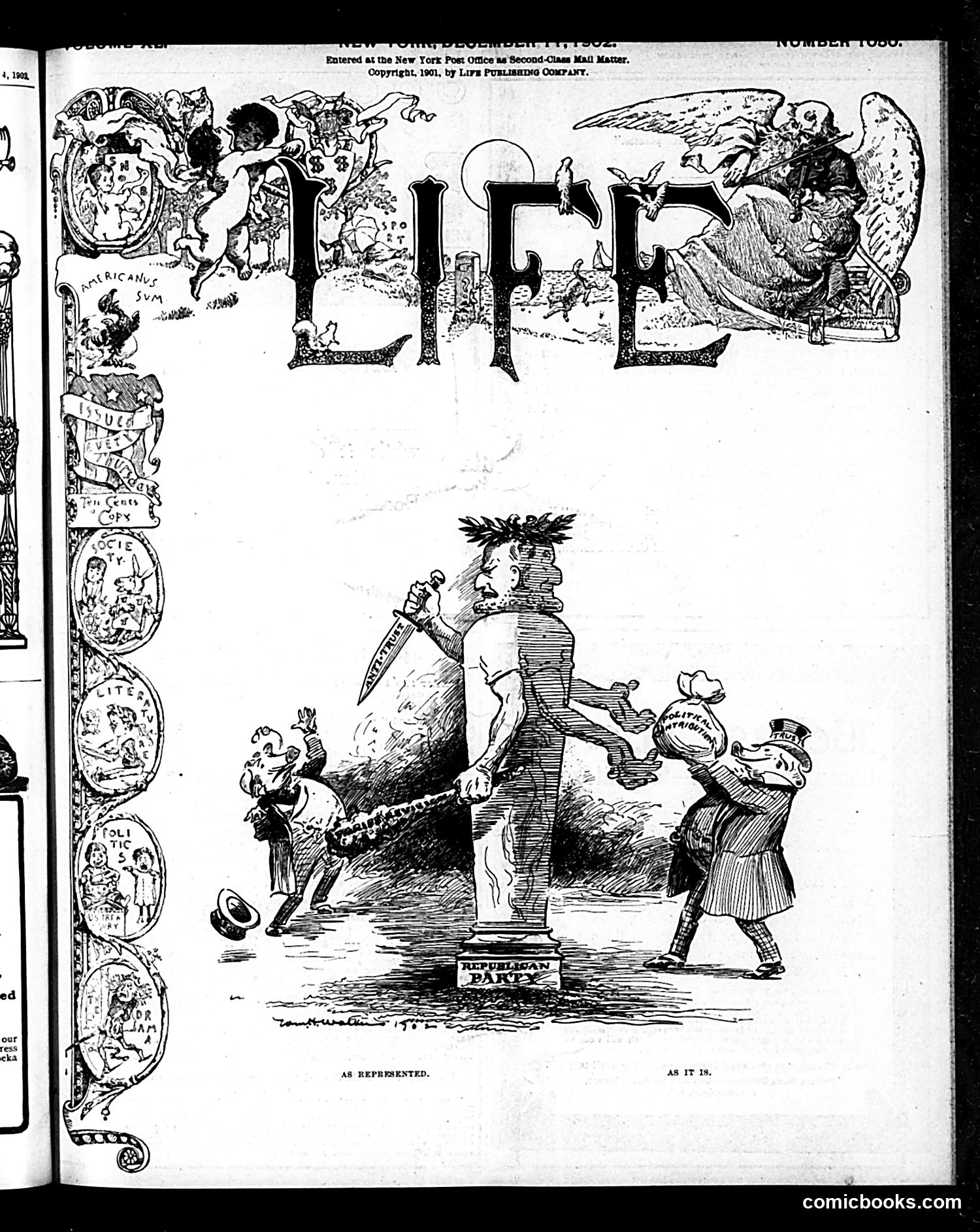
This 1902 *Life* magazine cartoon depicts the Republican Party as a large, menacing figure wielding a dagger, towering over smaller figures labeled with what appear to be political opponents or concerns. The caption reads "AS REPRESENTED" and "AS IT IS," suggesting the cartoon contrasts the Republican Party's public image versus its actual conduct. The caricature portrays Republicans as aggressive and dangerous—literally armed and threatening. The smaller figures being menaced likely represent Democratic opposition or vulnerable interests the GOP is depicted as bullying. The ornate left border contains decorative medallions typical of *Life*'s satirical style. This reflects early 20th-century political tensions, though without additional context about specific 1902 events, the precise targets of this satire remain somewhat unclear.
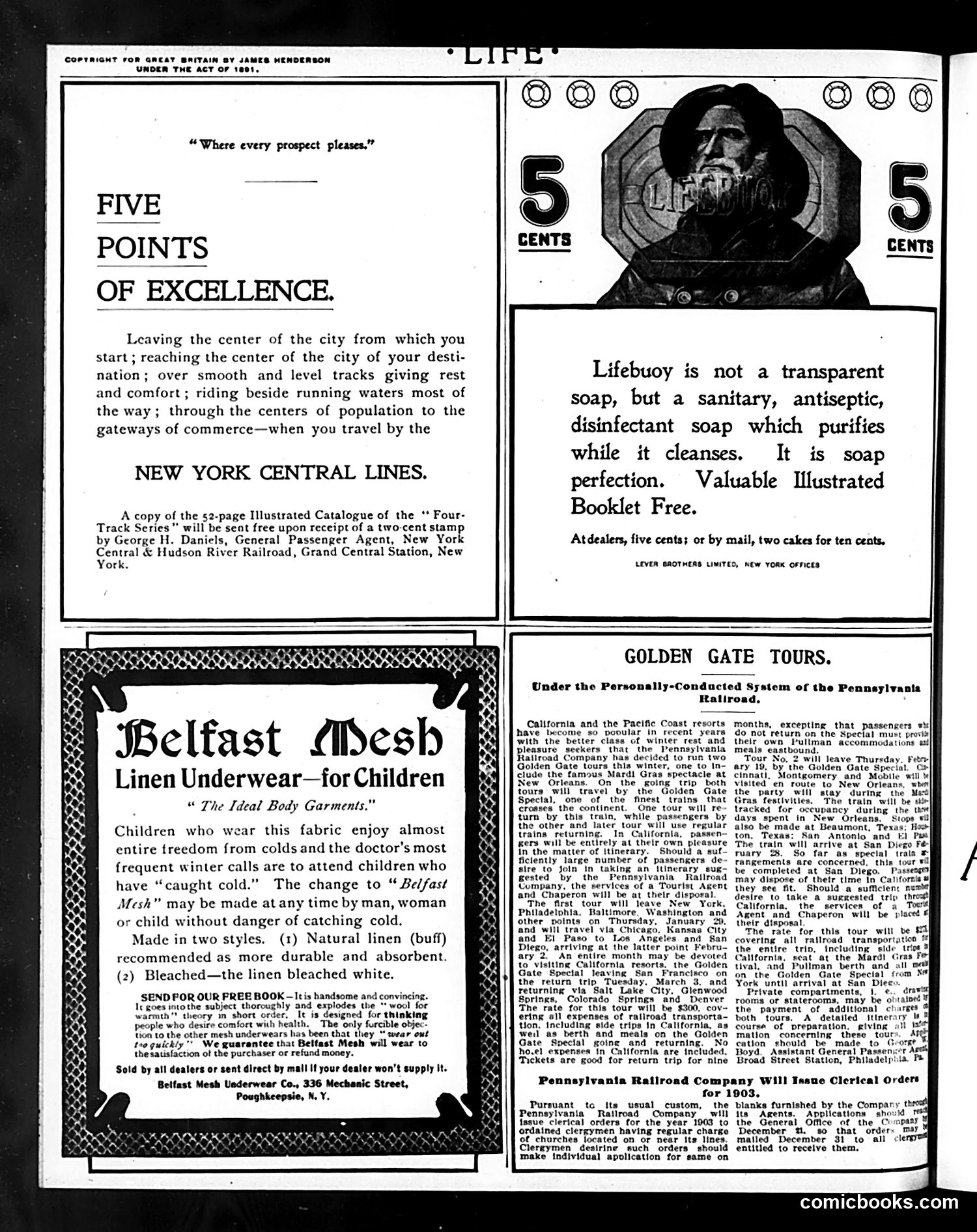
This page is primarily **advertisements** rather than satirical content. The main items are: 1. **New York Central Lines** (top left): A travel advertisement emphasizing comfort and efficiency of train service. 2. **Lifebuoy Soap** (top right): An advertisement for antiseptic soap, featuring a portrait of a man. The ad emphasizes the product's disinfectant properties. 3. **Belfast Mesh Linen Underwear** (bottom left): Children's clothing advertisement claiming the fabric prevents colds. 4. **Golden Gate Tours** (bottom right): Pennsylvania Railroad tour advertisement for California trips. There is **no apparent political cartoon or satire** on this page. This appears to be a standard magazine page from the early 1900s consisting entirely of commercial advertisements typical of the era.
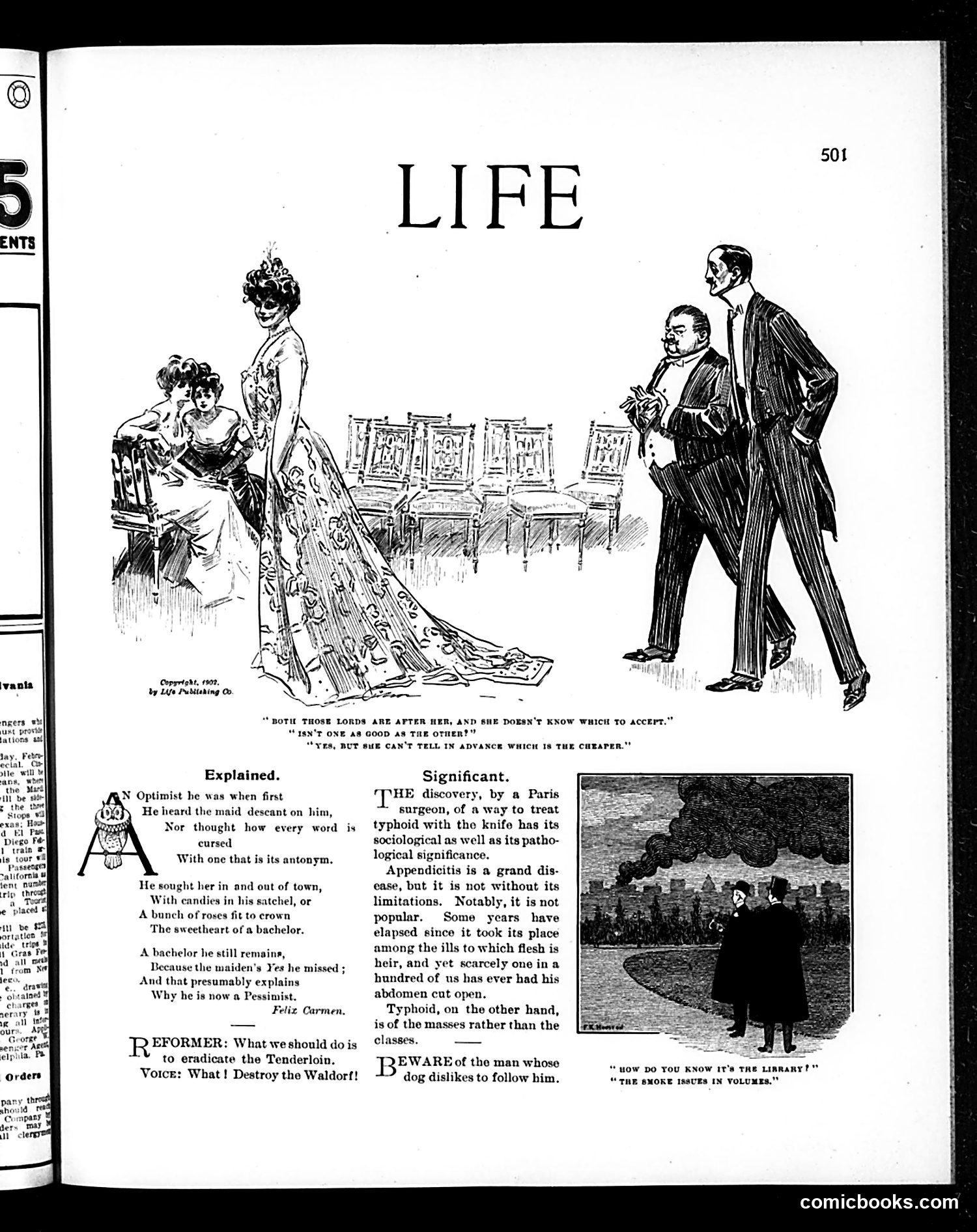
The main cartoon depicts a romantic scenario: a woman in an elaborate gown with a long train stands before two seated women and two men in suits. The caption suggests she's choosing between suitors—"both those lords are after her, and she doesn't know which to accept" / "isn't one as good as the other?" / "yes, but she can't tell in advance." The satire concerns **courtship and marriage selection**. The joke is that a woman cannot adequately evaluate potential husbands before committing, making marriage essentially a gamble. The secondary content includes humorous verses about bachelors and pessimism, plus a small illustration about library knowledge. The overall theme mocks romantic uncertainty and the limitations of female choice in mate selection—reflecting early-1900s social anxieties about marriage.
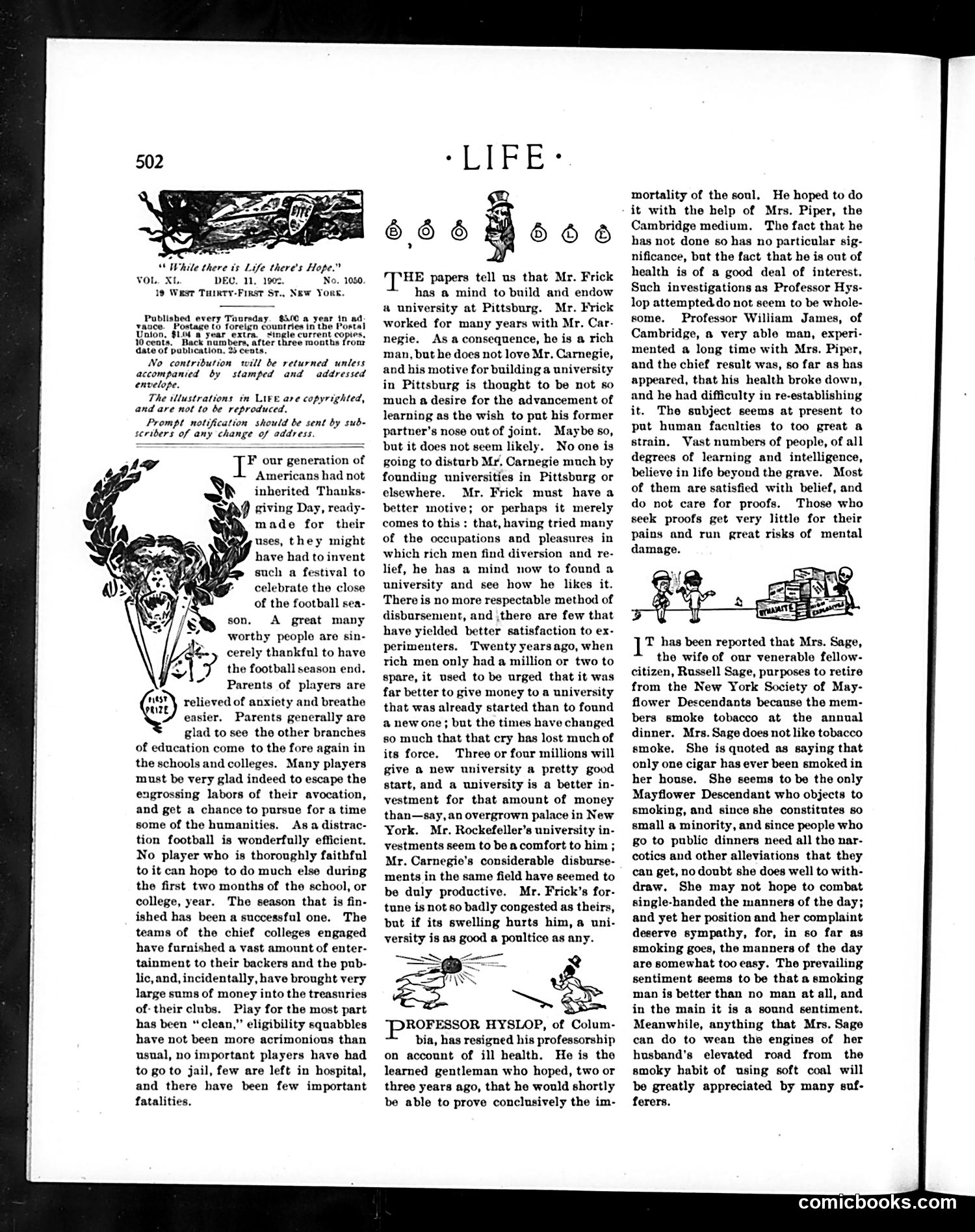
This page contains two distinct satirical pieces about wealthy philanthropists and social reform: **Upper section**: Critiques Mr. Frick's plan to build a university in Pittsburgh rather than support existing institutions. The satire suggests his motive is competitive with Carnegie, arguing that "disturbing Mr. Carnegie much by founding universities" would be petty. The piece mocks wealthy industrialists' need for self-aggrandizement through public institutions. **Lower section**: Satirizes Mrs. Sage's anti-smoking stance. She's described as a "Mayflower Descendant" opposing cigar smoking at public dinners, despite being philanthropic elsewhere. The cartoon ridicules her selective moralism—objecting to smoking while being otherwise progressive—suggesting her position is hypocritical or reflects outdated propriety rather than genuine principle. Both pieces critique how the ultra-wealthy deploy philanthropy and social positions.
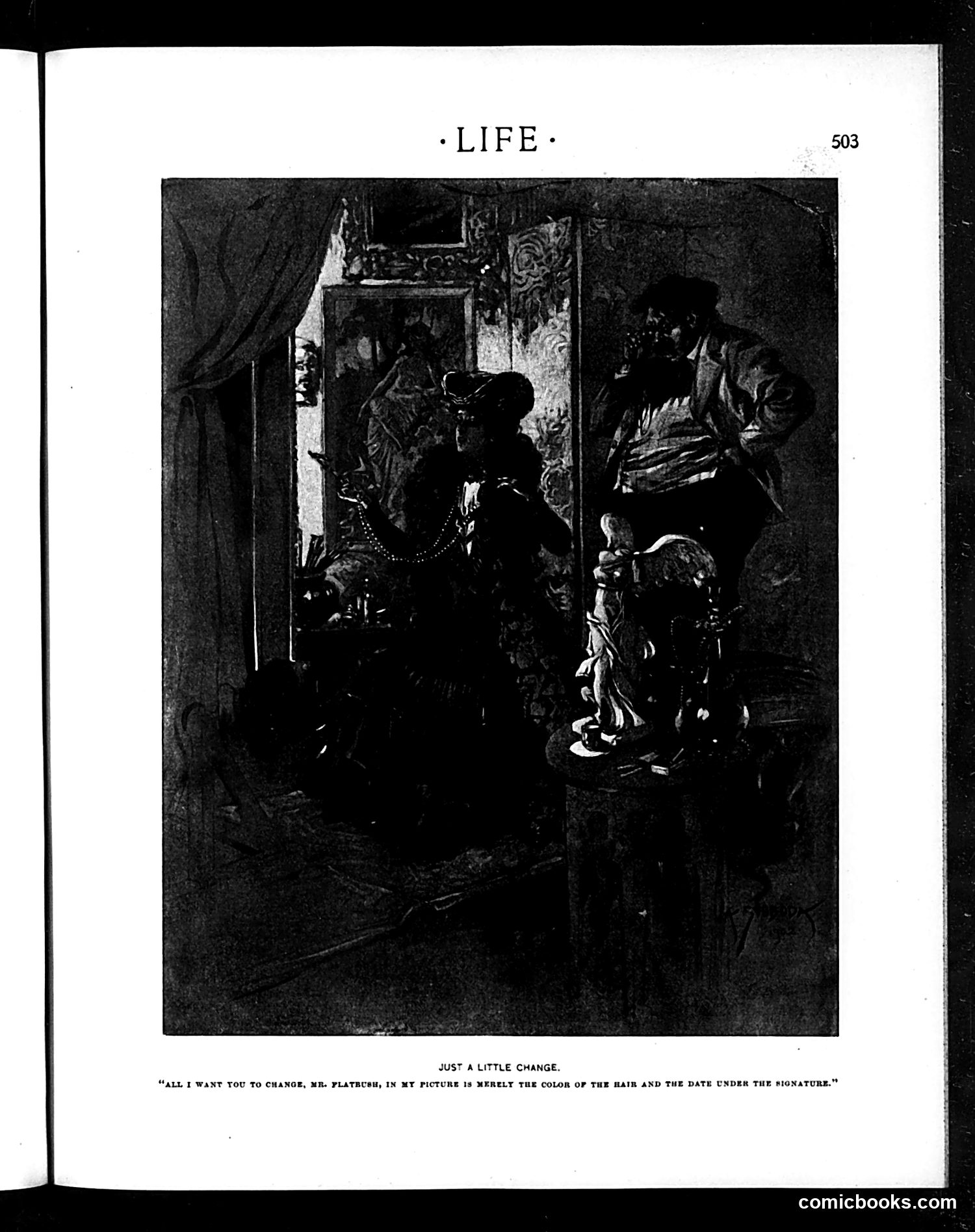
This Life magazine page presents a satirical illustration titled "Just a Little Change." The image depicts what appears to be a portrait painter's studio scene, with figures examining artwork. The caption quotes someone named Playthorn requesting to change a portrait—specifically the hair color and signature date. The satire likely critiques either artistic vanity (a subject wanting to alter their portrait after completion) or broader themes of dishonesty regarding public representation. The darkly-lit, theatrical composition emphasizes the deceptive nature of the transaction. Without additional context about "Playthorn" or the specific historical moment, the precise political target remains unclear, though the humor centers on the absurdity of retroactively falsifying one's documented image.
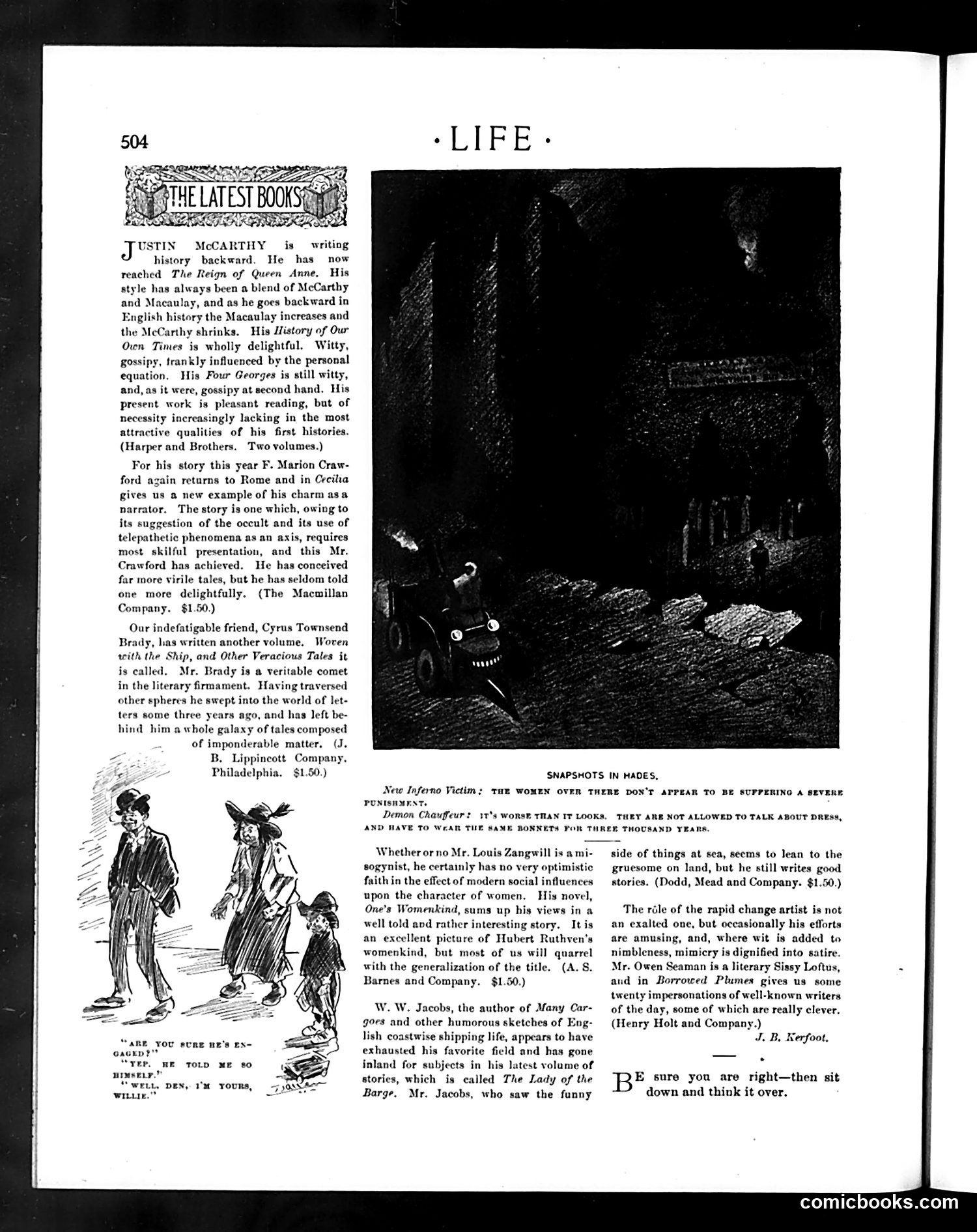
This is a literary review section from *Life* magazine featuring book reviews and illustrations. The main cartoon shows three figures walking together with the caption "ARE YOU SURE HE'S ENGAGED?" "HE TOLD ME HIMSELF." "WELL, DEN, I'M YOURS, WILLIE." The joke appears to be a play on miscommunication about engagement—likely a woman overhearing that a man said he was "engaged" (busy) and misinterpreting it as being engaged to marry, leading her to declare her own availability. The reviews discuss recent books by McCarthy, Crawford, Brady, Zangwill, and Jacobs. The upper illustration shows a dark scene labeled "SNAPSHOTS IN HADES," depicting figures in an underworld setting, accompanying reviews of stories with supernatural or dramatic themes.
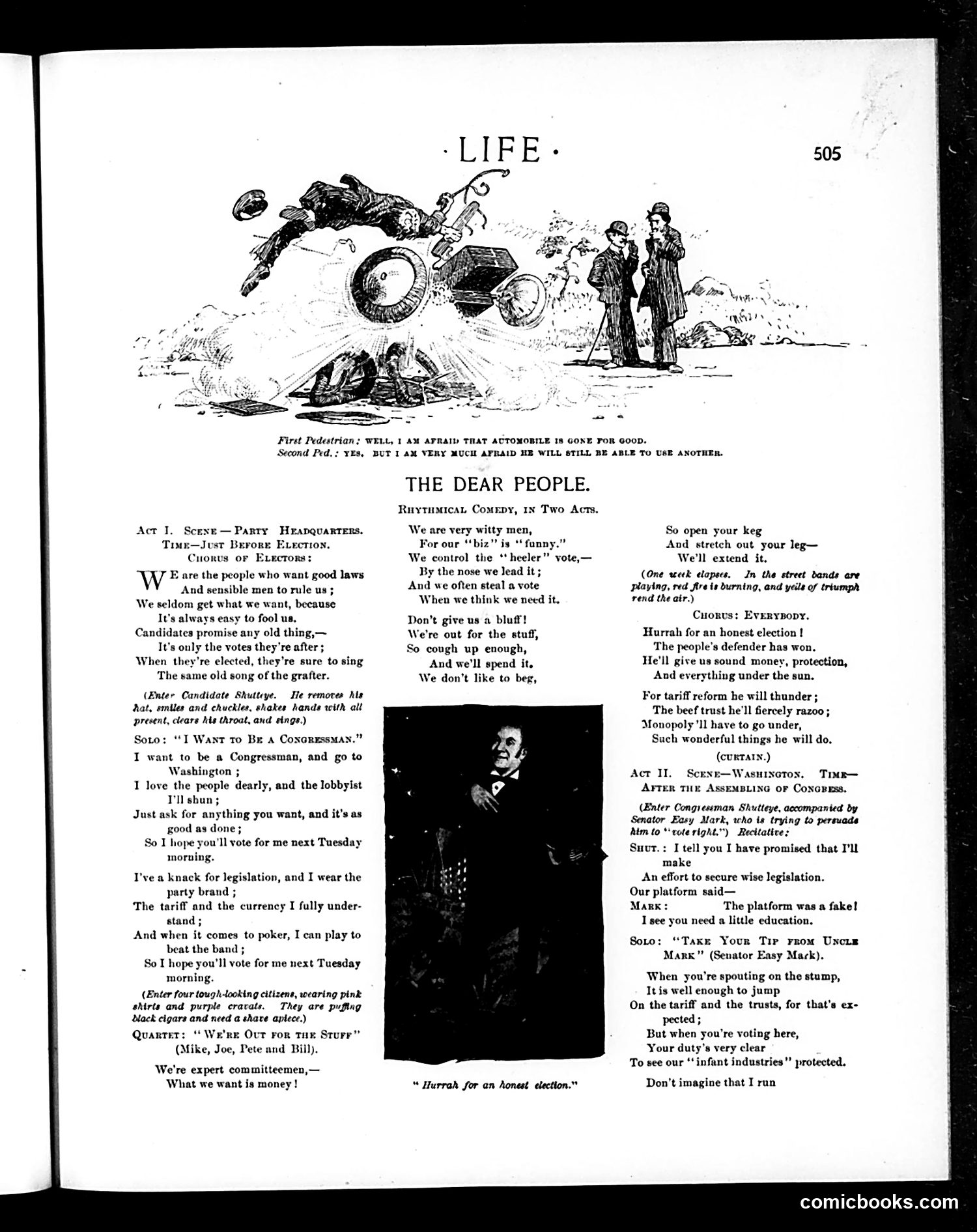
This is a satirical theatrical piece mocking American electoral politics. The cartoon depicts a cynical Congressman character who openly admits his motivations: securing votes through pandering rather than principle. The satire targets **corrupt campaign practices**. The character brags about promising anything to constituents ("Just ask for anything you want, and it's as good as done"), understanding tariffs and currency only superficially, and playing poker with political power. His plea—"I hope you'll vote for me next Tuesday morning"—appears repeatedly, emphasizing hollow repetition over substance. Act II involves a Senator trying to manipulate legislation ("fake" platforms, bribing with "infant industries" protection), revealing backroom dealing behind democratic façade. The piece satirizes how politicians exploit public trust through empty promises and special-interest protection rather than honest governance.
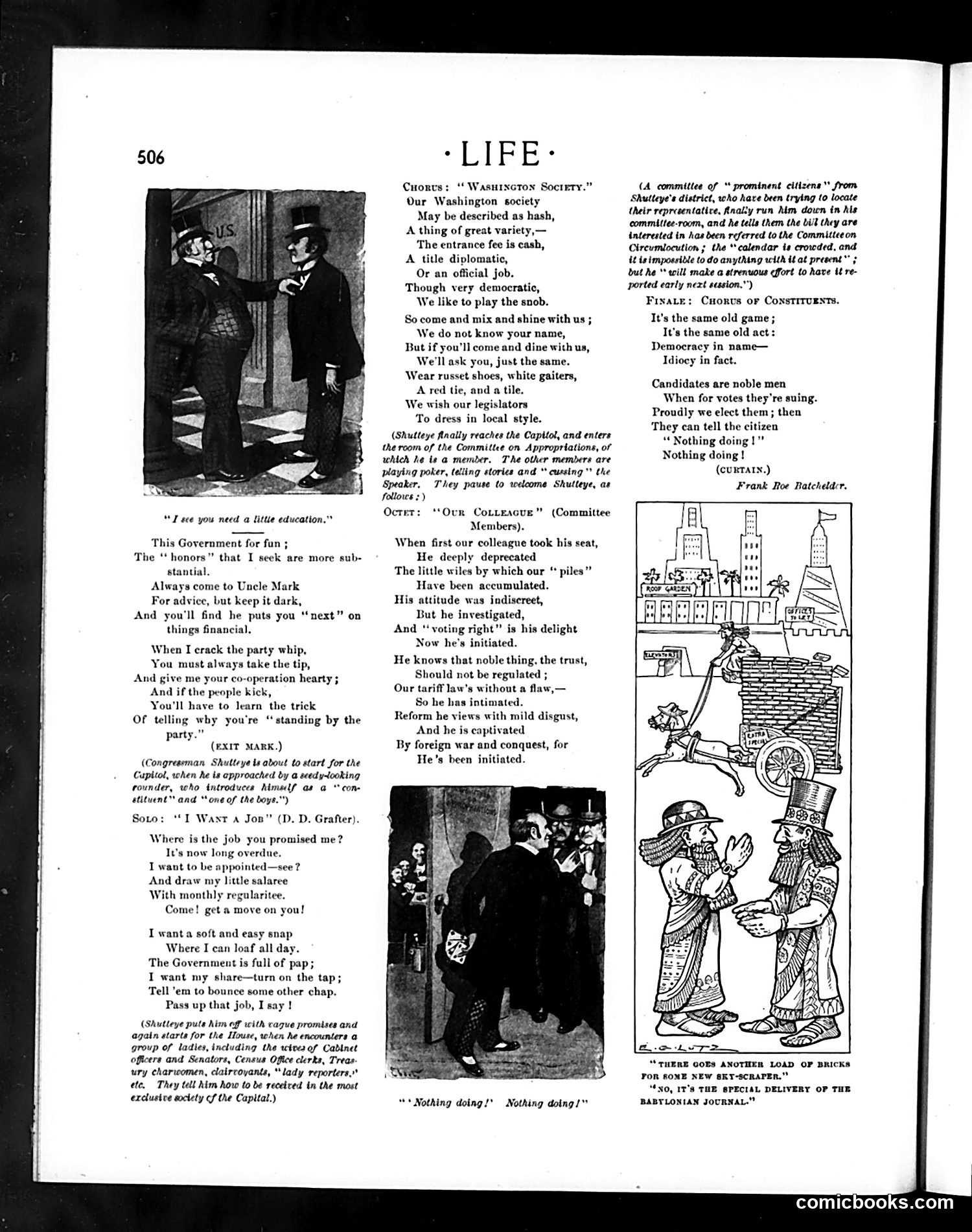
This Life magazine page satirizes Washington politicians as corrupt and incompetent. The "Washington Society" chorus mocks Congress as a social club where members prioritize networking over governance. The "Chorus on Constituents" section ridicules how elected officials ignore actual work ("Nothing doing!"), treating democracy as mere theater while candidates make empty promises to voters. The solo "I Want a Job" appears to mock Congressman Shalleys, showing how political appointments are rewards for patronage rather than merit—with the petitioner promising to "bounce some other chap" from office if given a position. The cartoons and text together present Congress as fundamentally dysfunctional: self-interested, theatrical, and focused on personal gain rather than legislative accomplishment. This reflects Progressive Era frustrations with political corruption.
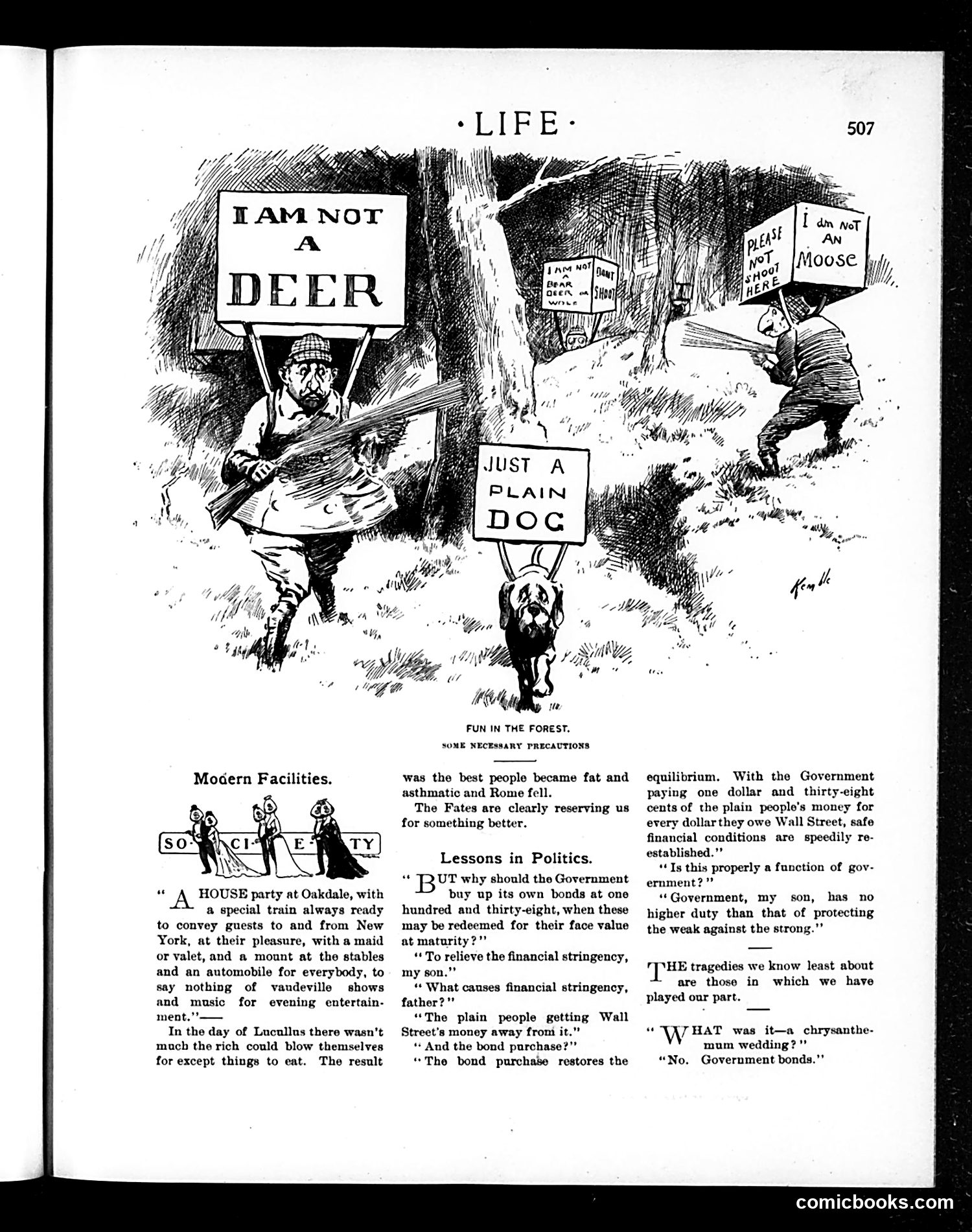
The cartoon "Fun in the Forest" satirizes hunting season safety concerns. A hunter holds a sign reading "I AM NOT A DEER," while a dog nearby displays "JUST A PLAIN DOG," and another figure shows "I AM NOT A MOOSE" and "PLEASE NOT SHOOT HERE." The joke mocks overeager or careless hunters who might mistake other creatures—or possibly other people—for game animals. This reflects genuine dangers of hunting season, when trigger-happy sportsmen posed risks to fellow hunters and non-game animals. Below, sections on "Modern Facilities," "Lessons in Politics," and discussion of government bonds and financial stringency address post-WWI economic issues—likely referencing debates over government spending and financial recovery following World War I. The overall page blends topical political commentary with humorous social observation typical of *Life* magazine's satirical approach.
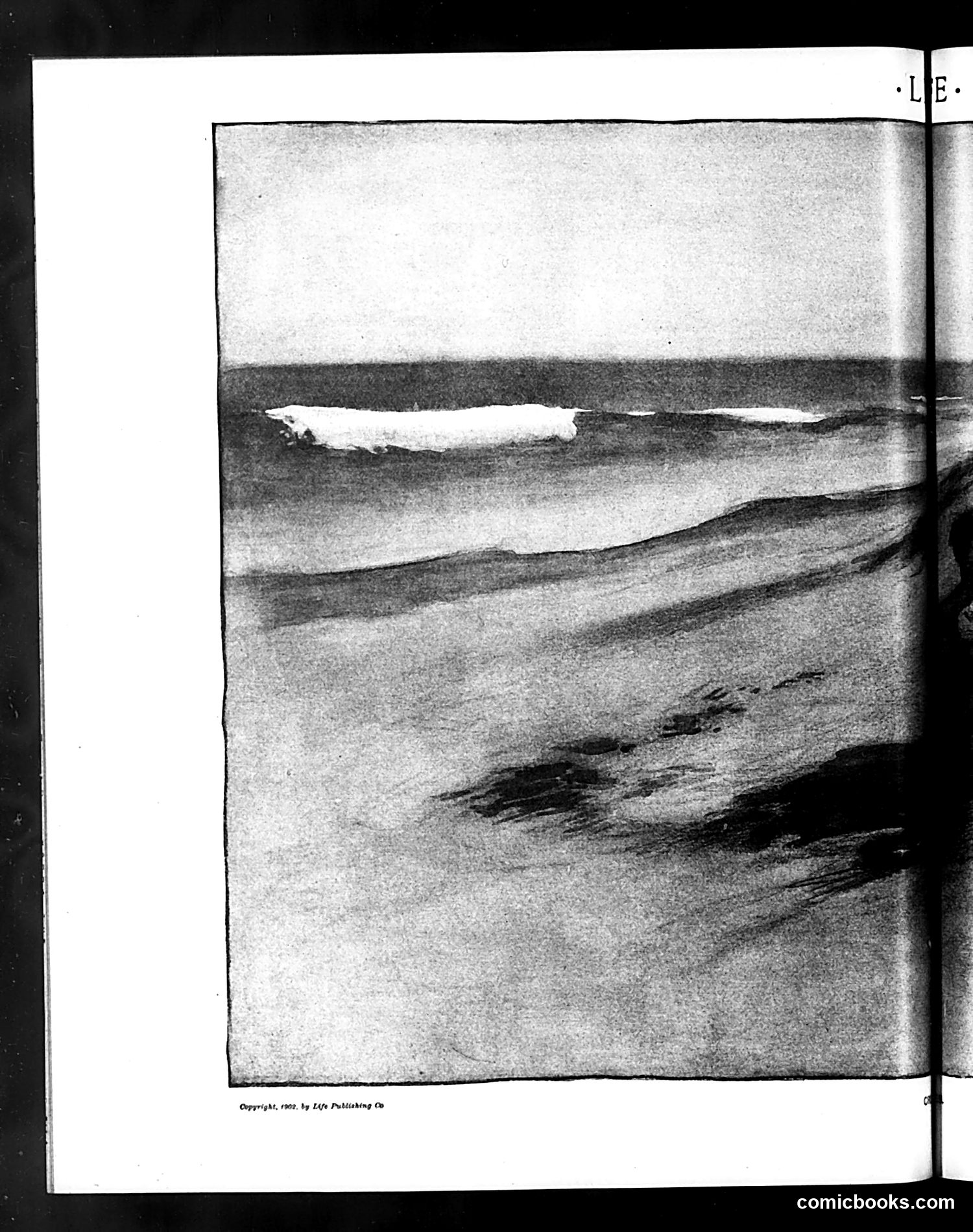
I can see this is a page from Life magazine with a copyright notice from Life Publishing Co., but the image quality and reproduction make it difficult to discern specific details of any cartoon or illustration present. The page appears to show a landscape or seascape with horizontal bands of varying tones, possibly depicting water, sky, or terrain, but I cannot make out clear figures, caricatures, or text that would allow me to identify specific political or social references with confidence. Without being able to read accompanying captions or clearly identify depicted subjects, I cannot reliably explain what satire or joke this cartoon contains. To provide accurate historical context rather than speculation, I'd need a clearer image or additional source information.
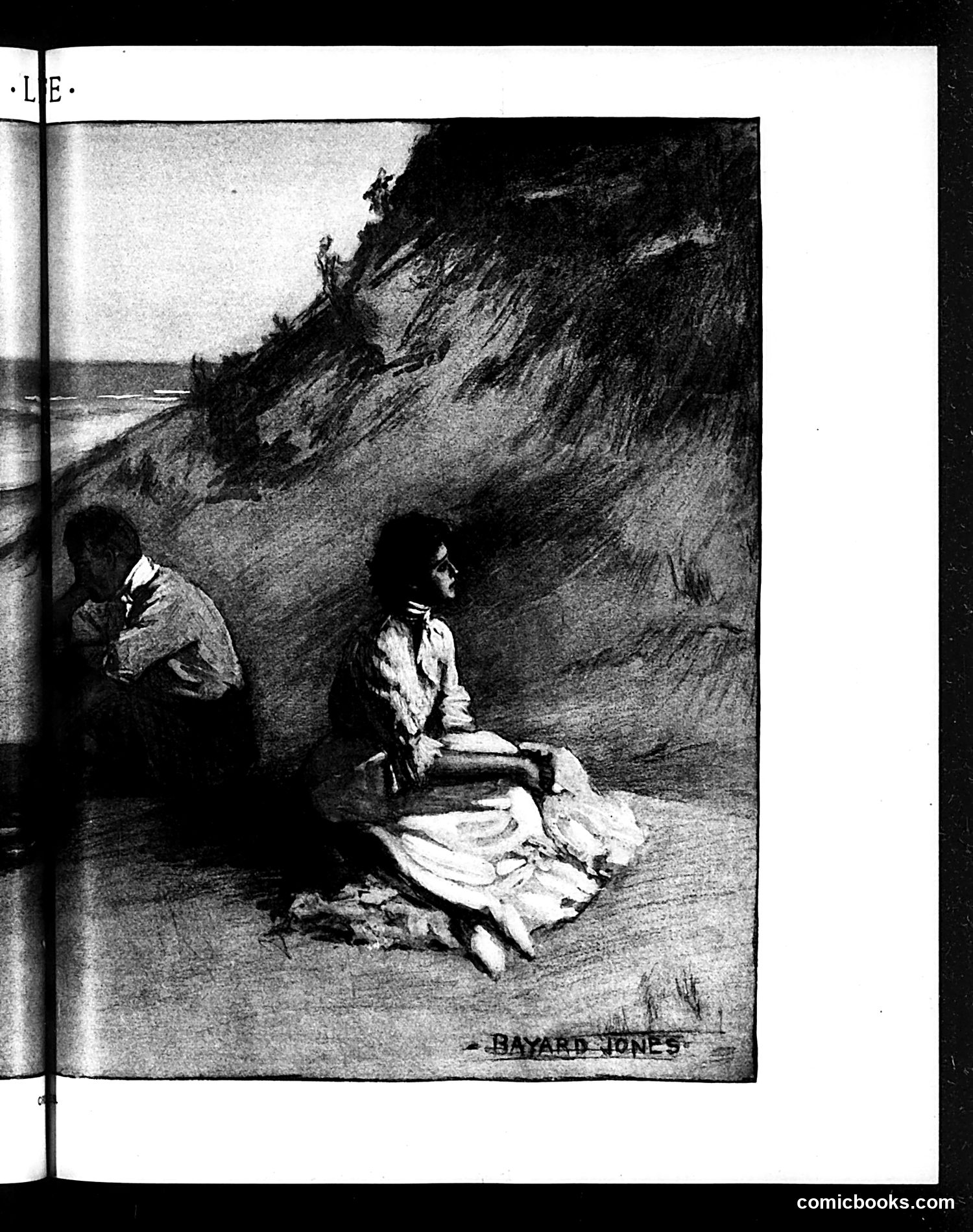
This appears to be an illustration credited to Bayard Jones, showing two figures sitting on a beach beside large sand dunes. The image depicts what seems to be a romantic or intimate scene—a couple relaxing by the shore, with one figure in lighter clothing seated prominently in the foreground. Without additional OCR text from the page, I cannot identify the specific satirical point, political reference, or social commentary this illustration intends. The beach setting and intimate positioning suggest it may be commenting on leisure, romance, or social behavior of the era, but the exact subject and satirical target remain unclear from the image alone. More context from the surrounding text would be necessary to explain what modern readers might miss about this cartoon's meaning.
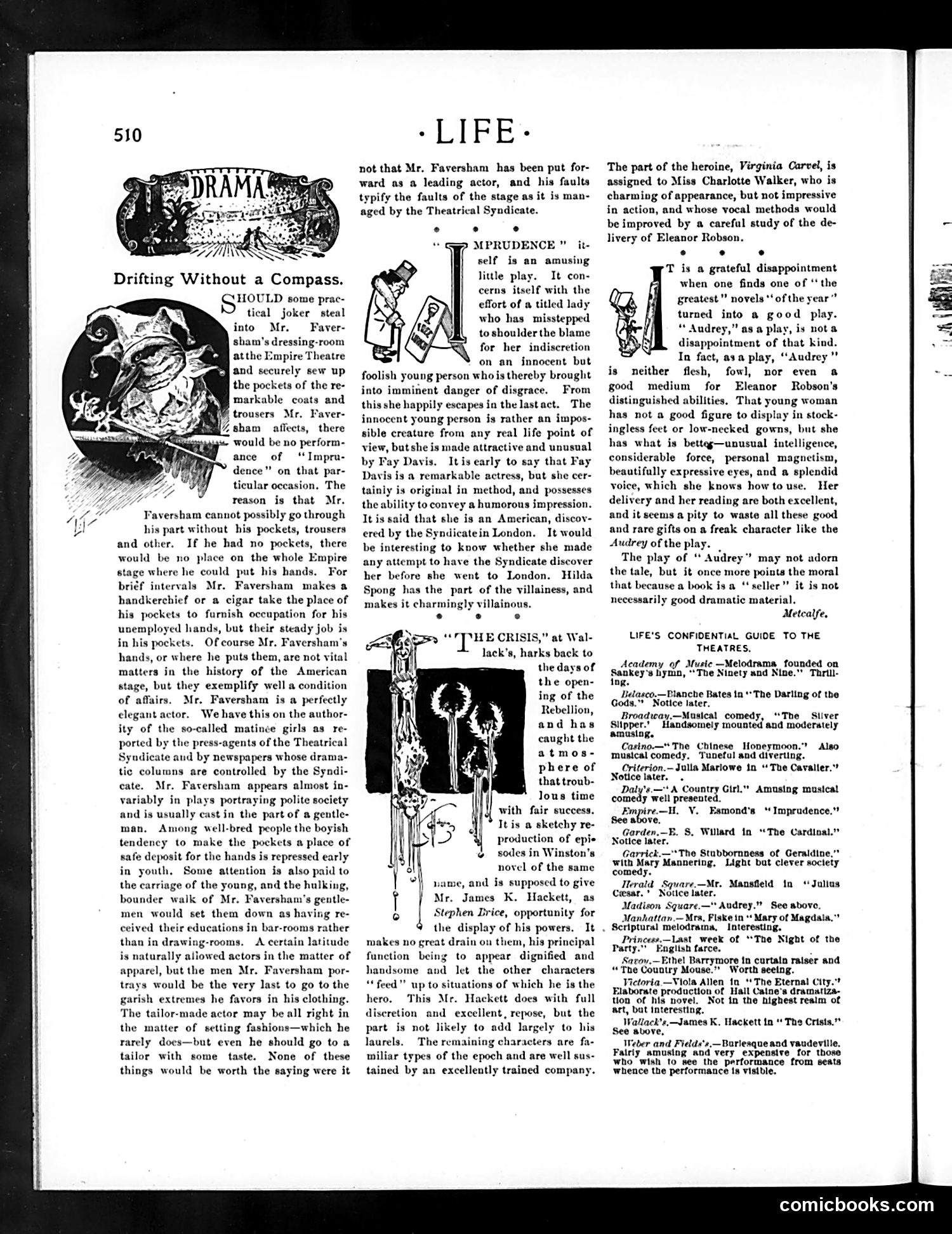
This cartoon satirizes actor **Mr. Faversham** (likely British stage actor William Faversham, popular in early 1900s American theater). The joke centers on Faversham's practical problem: as a wealthy gentleman-actor accustomed to servants handling his belongings, he has no pockets in his fashionable stage costumes and therefore nowhere to carry money or essentials during performances. The satire mocks both Faversham's dependence on servants and the impracticality of high-fashion formal wear. The title suggests he's "lost" without the basic necessities working people take for granted. It's a lighthearted jab at aristocratic pretension and the absurdities of theater world conventions that prioritize appearance over utility.
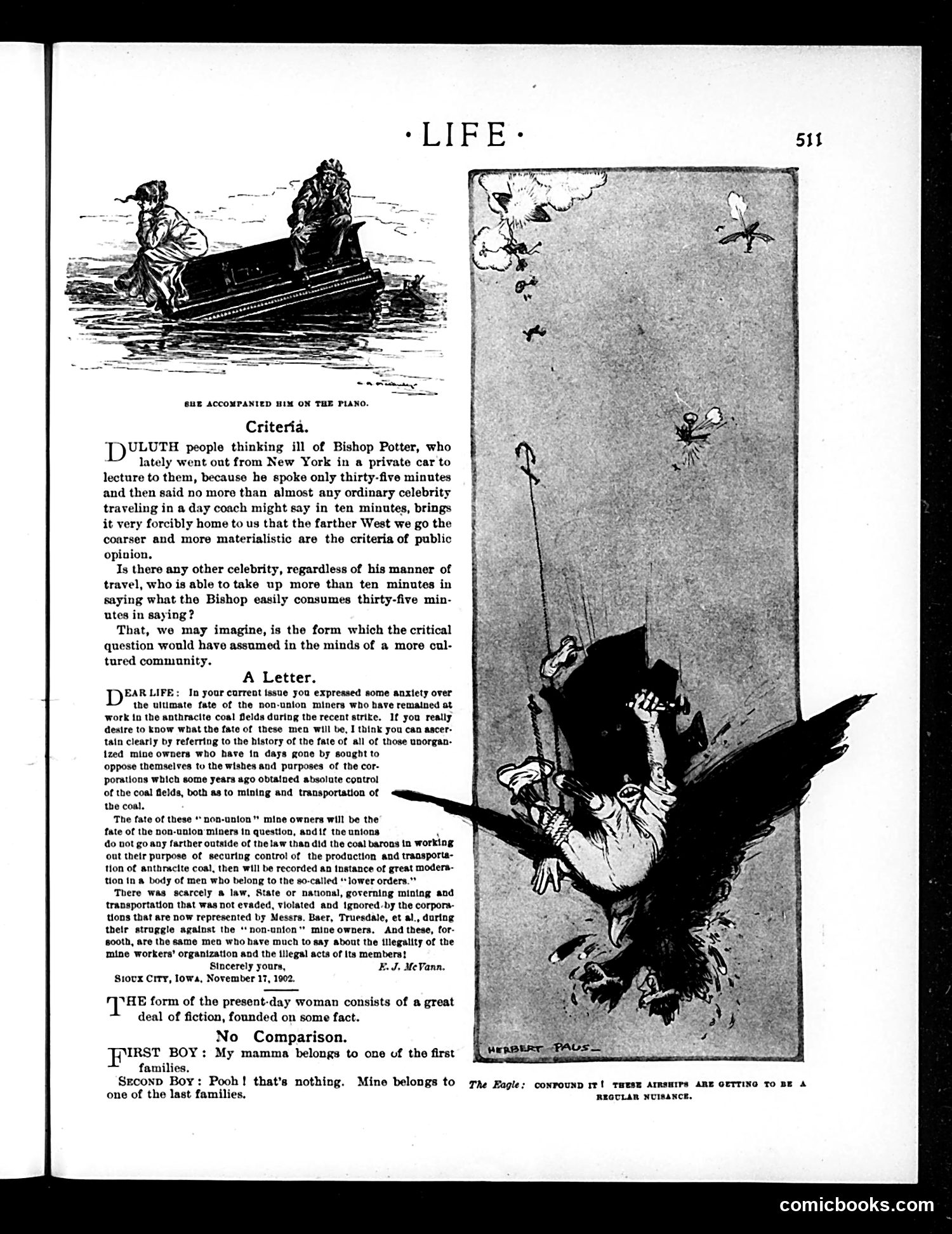
**Main Content:** The page features satirical commentary on class and culture. The "Criteria" section mocks Western materialism by criticizing public disappointment that Bishop Potter—traveling in a private car—only lectured 35 minutes. The satire suggests crude frontier values prioritize duration over substance, unlike "cultured communities." **The Letter:** A reader defends striking coal miners by drawing a parallel to non-union mine owners defeated by corporations. The writer argues that if unions follow no more illegal tactics than the coal barons themselves used, their conduct would demonstrate "moderation." This references the 1902 anthracite coal strike, a major labor conflict. **The Cartoon:** Signed "Herbert Paus," the right illustration shows an eagle attacking airships. The caption notes airships are becoming "a regular nuisance"—satirizing early aviation technology as an emerging public menace. **"No Comparison":** Two boys joke about social class: one claims prestigious family lineage; the other counters that his family belongs to "the last families"—implying either wealth's decline or humorous self-deprecation.
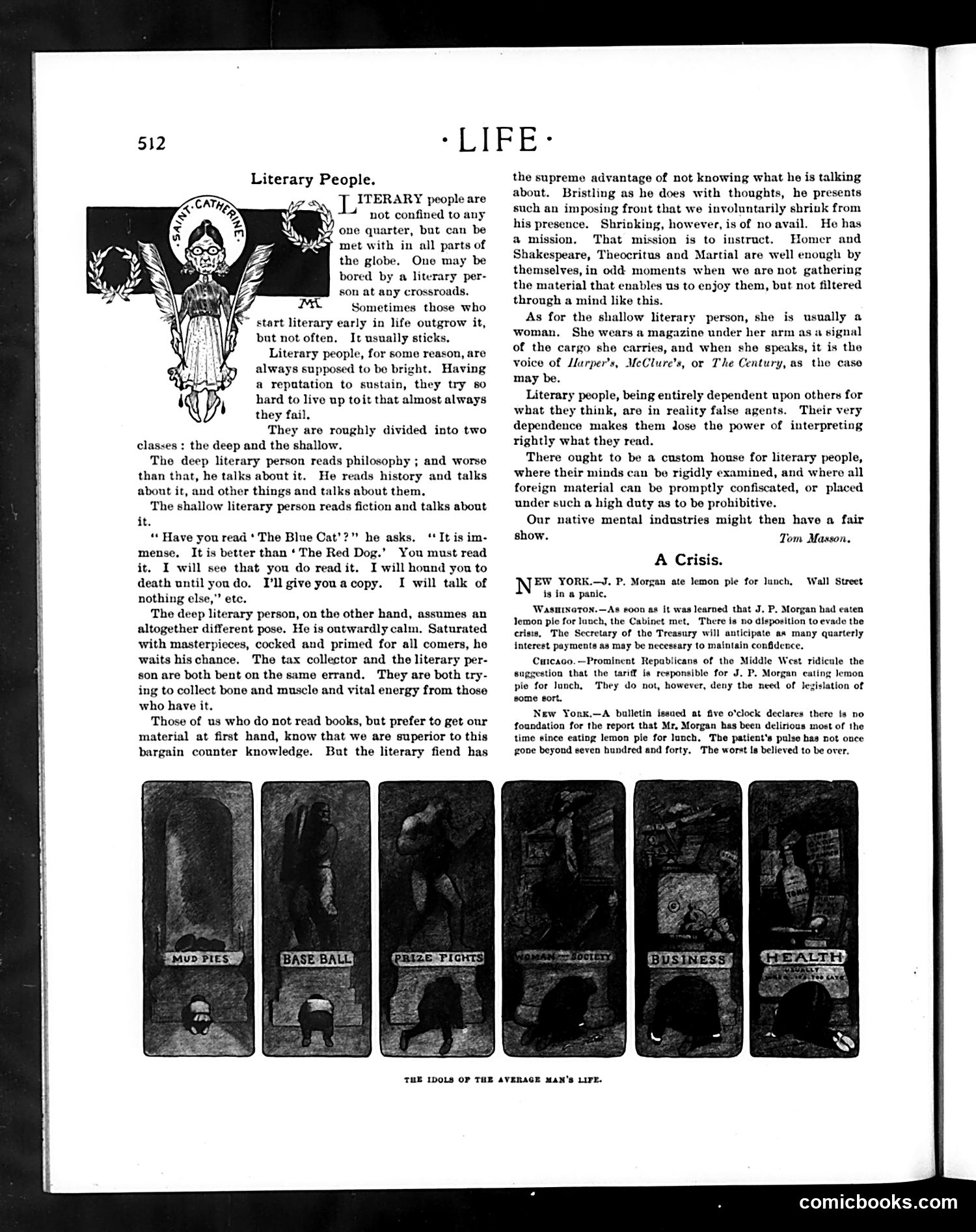
**"Literary People"** mocks pretentious intellectuals in two types. "Deep" literary people pontificate about philosophy and history they've absorbed secondhand, using their learning as social intimidation. "Shallow" literary people (depicted as women) mindlessly repeat magazine articles. The essay satirizes how literary folks lack original thought—they're parasites extracting ideas from others—yet brandish their borrowed knowledge aggressively. The author argues non-readers possess superior insight because they observe life directly rather than filtering it through filtered minds. **"A Crisis"** is political satire about J.P. Morgan (the powerful financier) eating lemon pie for lunch, which supposedly triggers Wall Street panic. The joke ridicules how financiers' every action gets treated as economically consequential. The Cabinet meets, Congress debates tariffs, and newspapers issue bulletins tracking Morgan's health—all over lunch. It mocks the absurd deference powerful business figures command and the herd mentality of markets.
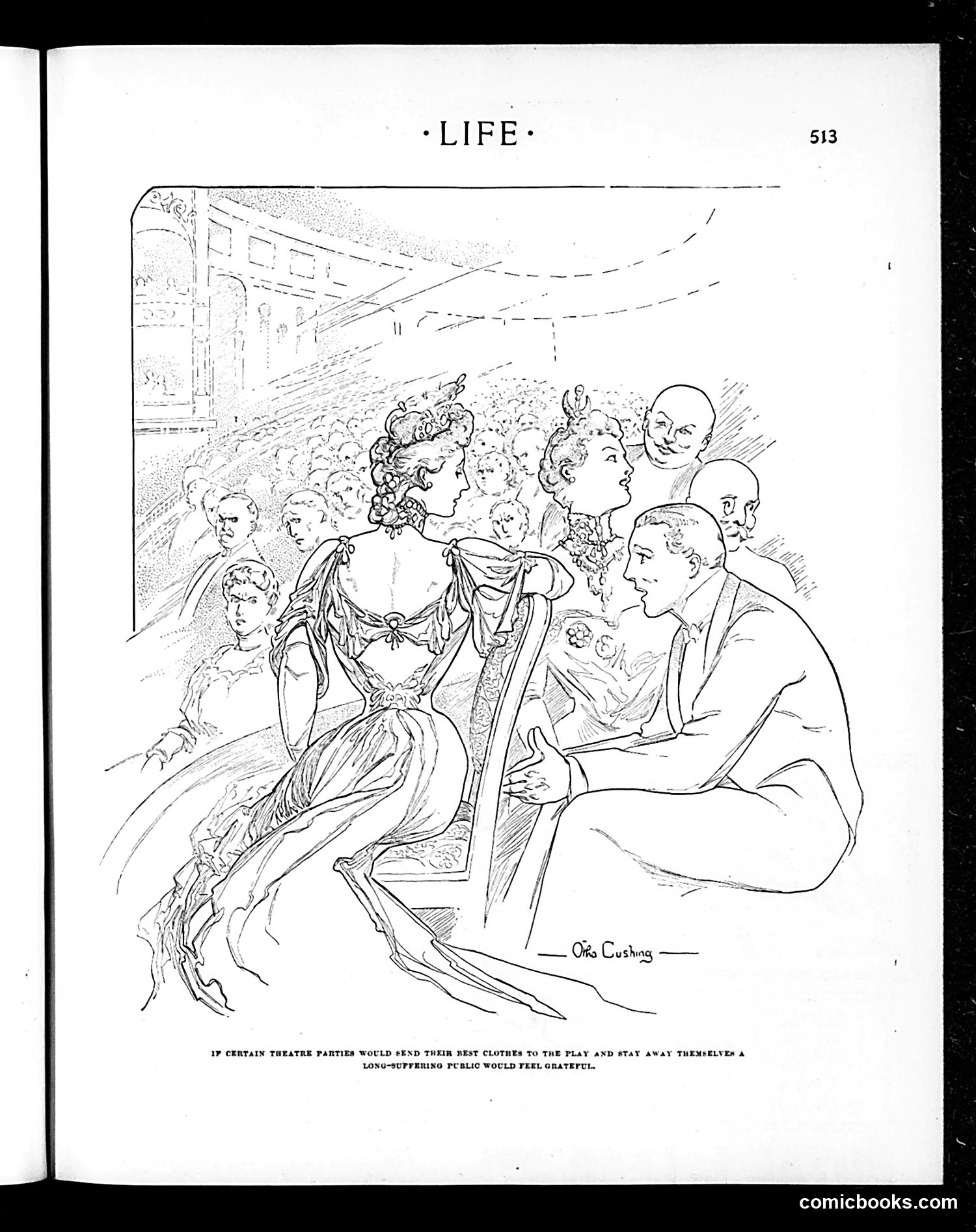
This is a satirical cartoon by Ota Cushing depicting an elegantly dressed theatre audience. The caption suggests a humorous social critique: that if wealthy theatre patrons would send their finest clothing to performances but stay home themselves, the "long-suffering public" would be grateful. The joke targets the pretentious behavior of wealthy theatre-goers of the era—their expensive fashions, ostentatious displays of wealth, and presumably annoying conduct during performances. Rather than attending themselves in their finery, the implication is that these affluent patrons are so objectionable that audiences would prefer to see merely their expensive clothes rather than endure their actual presence. It's a classic satirical jab at class pretension and theatre culture.
This page is primarily **advertising** with a lead satirical poem titled "Just a Girl." The poem mocks the cultural obsession with romantic love and women's power over men by cataloging historical disasters supposedly caused by female desire: Adam's fall, Troy's destruction, and men's general enslavement to romance. The accompanying **short humor pieces** extend this theme through domestic comedy—a father's dismay at having a daughter, and a joke about a supposedly virtuous woman who hypocritically smuggles European fashions, exposing female weakness for luxury goods. The satire reflects early 1900s gender attitudes: women are presented as simultaneously powerful (driving men to ruin) yet frivolous and morally inconsistent. The humor relies on stereotypes about female materialism and the inevitability of male susceptibility to feminine charms. The remainder consists of period advertisements for whiskey, cigarettes, and a golf instruction book.
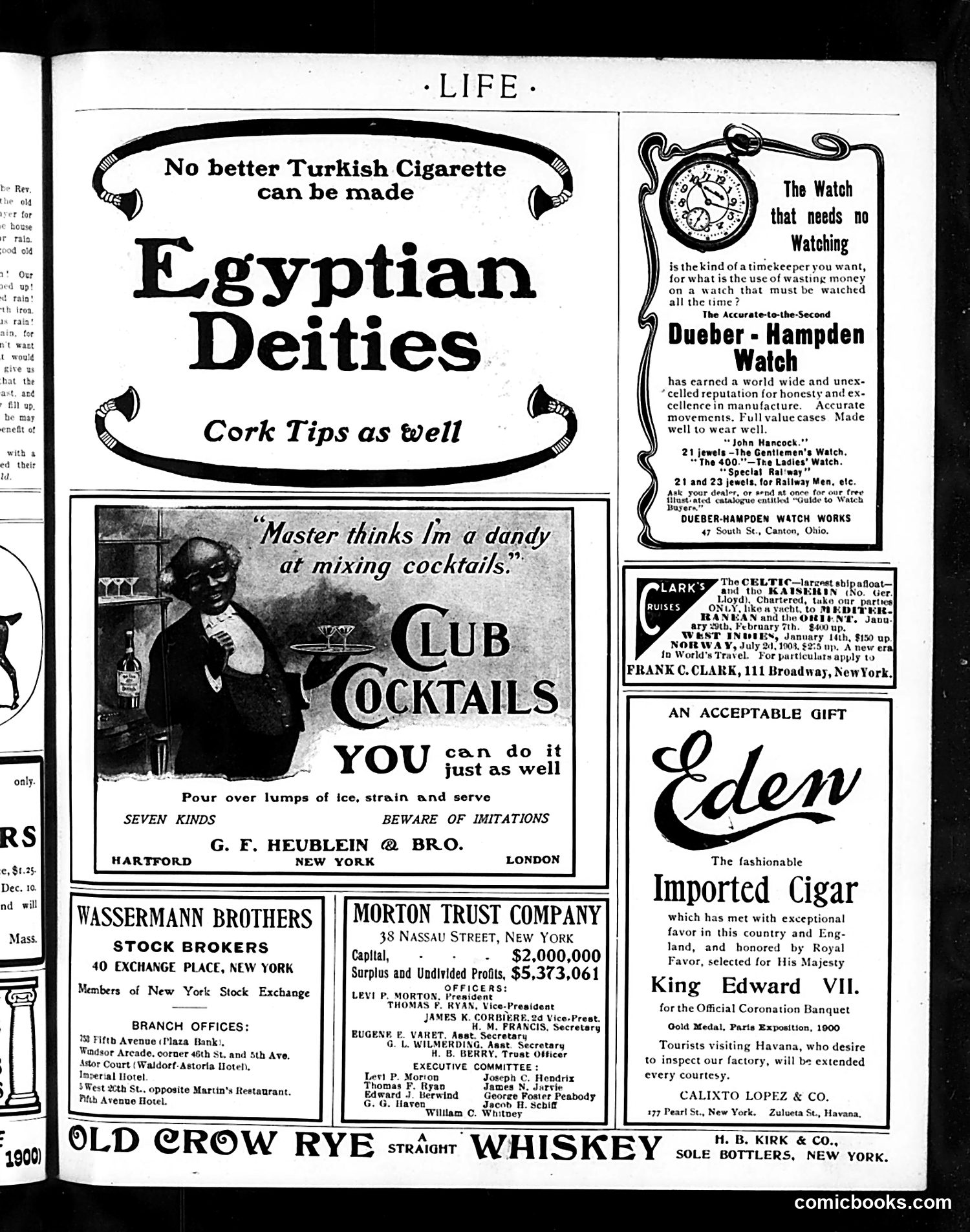
This page is primarily **advertising**, not political satire. It contains product advertisements typical of early 1900s American magazines. The main visual content shows a **Club Cocktails advertisement** featuring a bartender preparing mixed drinks, with the caption "Master thinks I'm a dandy at mixing cocktails." The humor is gentle and domestic—suggesting a servant or bartender considers himself skilled at his trade. This reflects the era's casual attitudes toward alcohol service (pre-Prohibition). The surrounding ads promote luxury goods: Egyptian Deities cigarettes, Dueber-Hampden watches, Eden imported cigars (selected for King Edward VII's 1902 coronation), and Old Crow whiskey. Several feature financial services (Morton Trust Company, Wassermann Brothers stock brokers). **The satire is minimal**—mostly light, class-conscious humor about servants' pretensions and conspicuous consumption among wealthy Americans. The page reflects Gilded Age advertising targeting affluent readers through appeals to sophistication and status symbols.
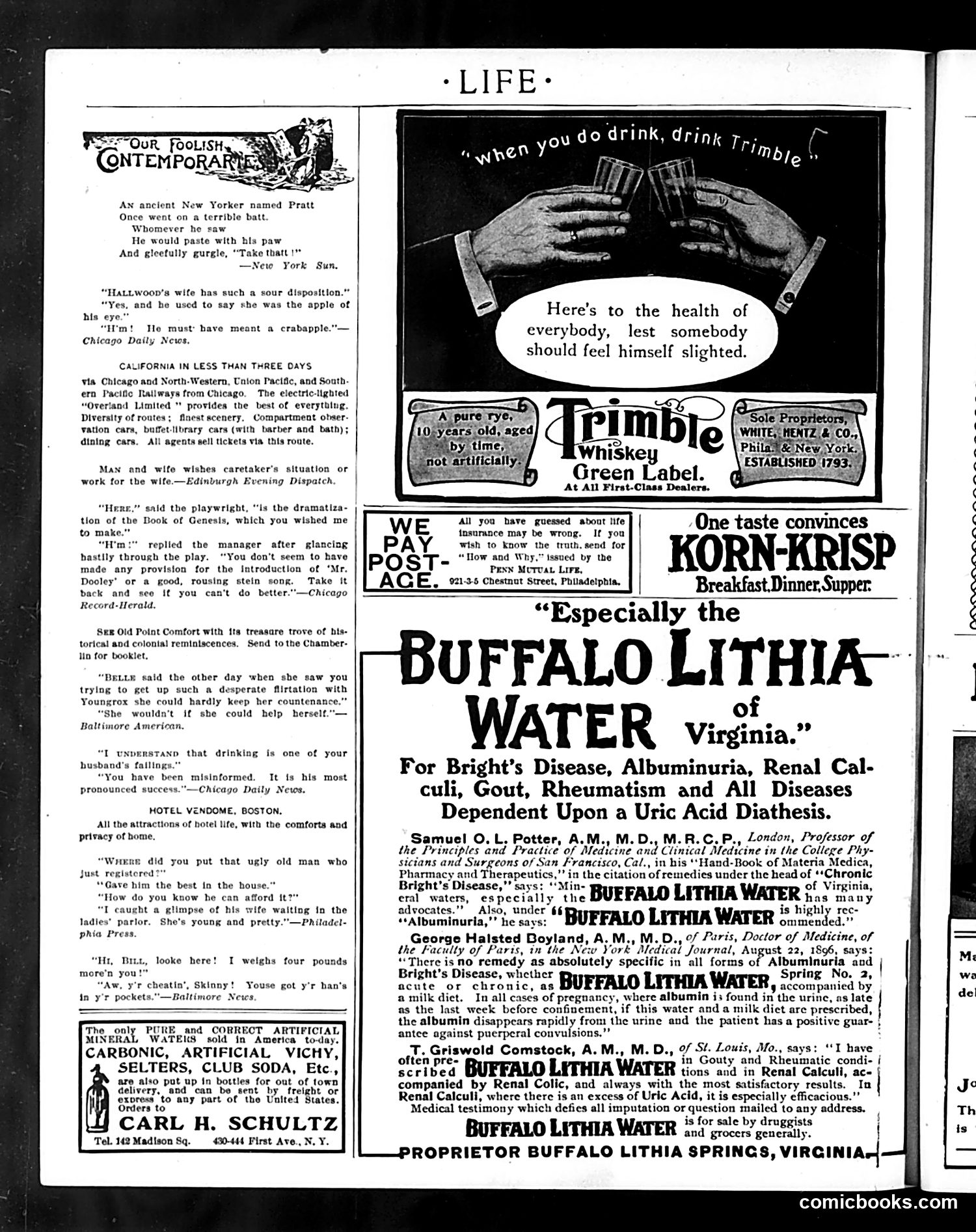
This page is primarily composed of short humor bits and period advertisements rather than political cartoons. The humor section ("Our Foolish Contemporaries") reprints brief jokes from contemporary newspapers, mostly puns and domestic comedy—such as one about a man who drank heavily and another mocking a wife's sour disposition. These gentle satirize everyday social situations and marital dynamics of the era. The advertisements promote transportation (railroads to California), hotels, and patent medicines, particularly "Buffalo Lithia Water" from Virginia, which claims to cure kidney disease, gout, and rheumatism—typical of early 20th-century dubious medical marketing. Another ad pushes "Trimble Whiskey" with the ironic slogan "When you do drink, drink Trimble," and "Korn-Krisp" cereal. There are no identifiable political figures or events. The page reflects mainstream American humor and commercial culture of the period, with no pointed satire beyond gentle domestic comedy.
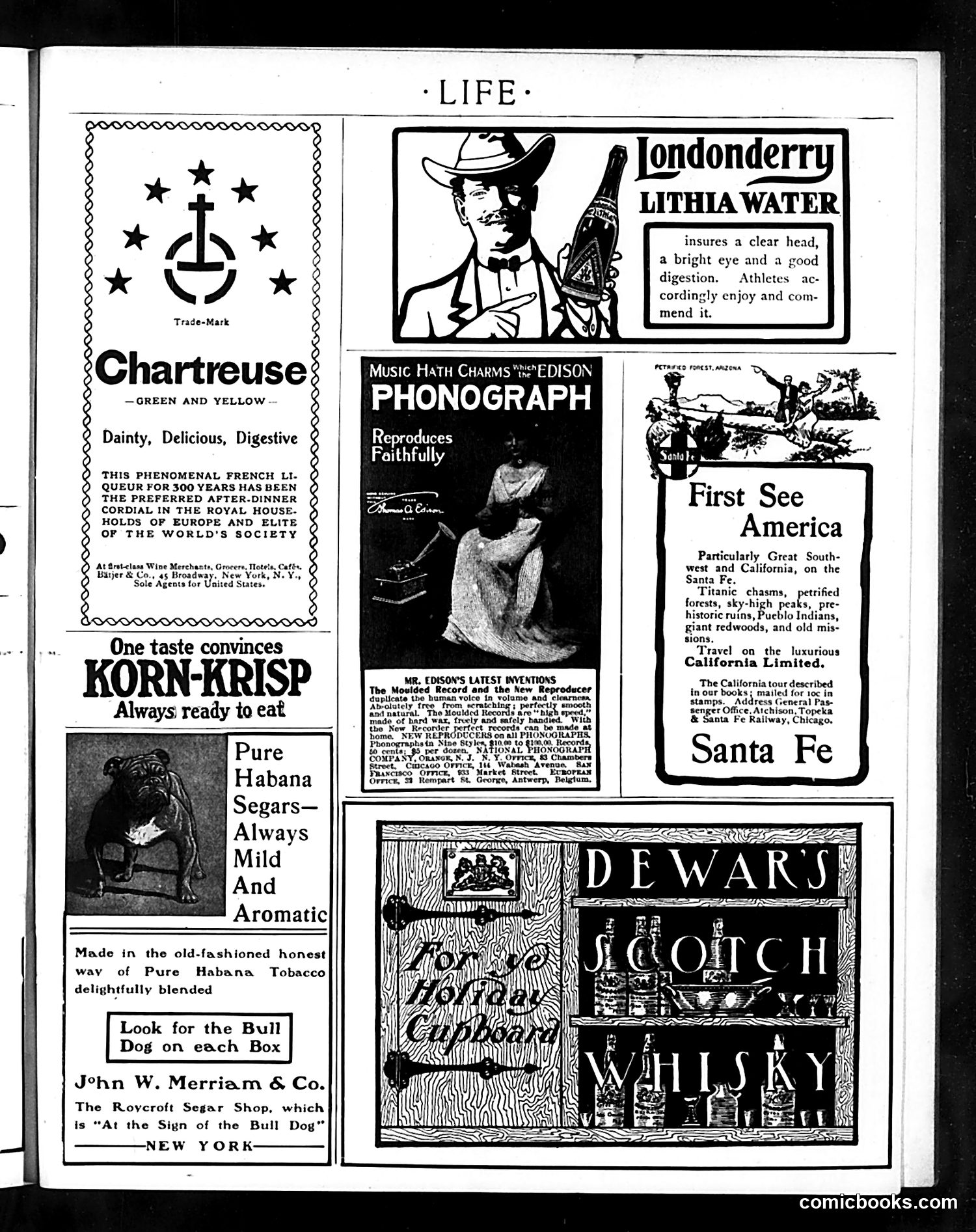
This is primarily an **advertising page**, not satirical content. It showcases luxury consumer goods from the early 20th century targeting affluent readers. The ads include: - **Chartreuse liqueur**: A French after-dinner cordial marketed as refined and aristocratic (endorsed by European royal households) - **Londonderry Lithia Water**: Mineral water promising health benefits—clear thinking and good digestion for athletes - **Edison Phonograph**: The latest "Hath Charms" model, emphasizing faithful sound reproduction - **Santa Fe Railway**: Promoting California tourism via the luxurious "California Limited" train, highlighting natural wonders (Yosemite, Pueblo Indians, redwoods) - **Korn-Krisp cereal**: A convenient ready-to-eat product - **Pure Habana Cigars**: Marketed as mild and aromatic, with a distinctive bulldog trademark The page reflects the era's consumer culture and advertising strategy: associating products with sophistication, health claims, technological progress, and leisure travel.
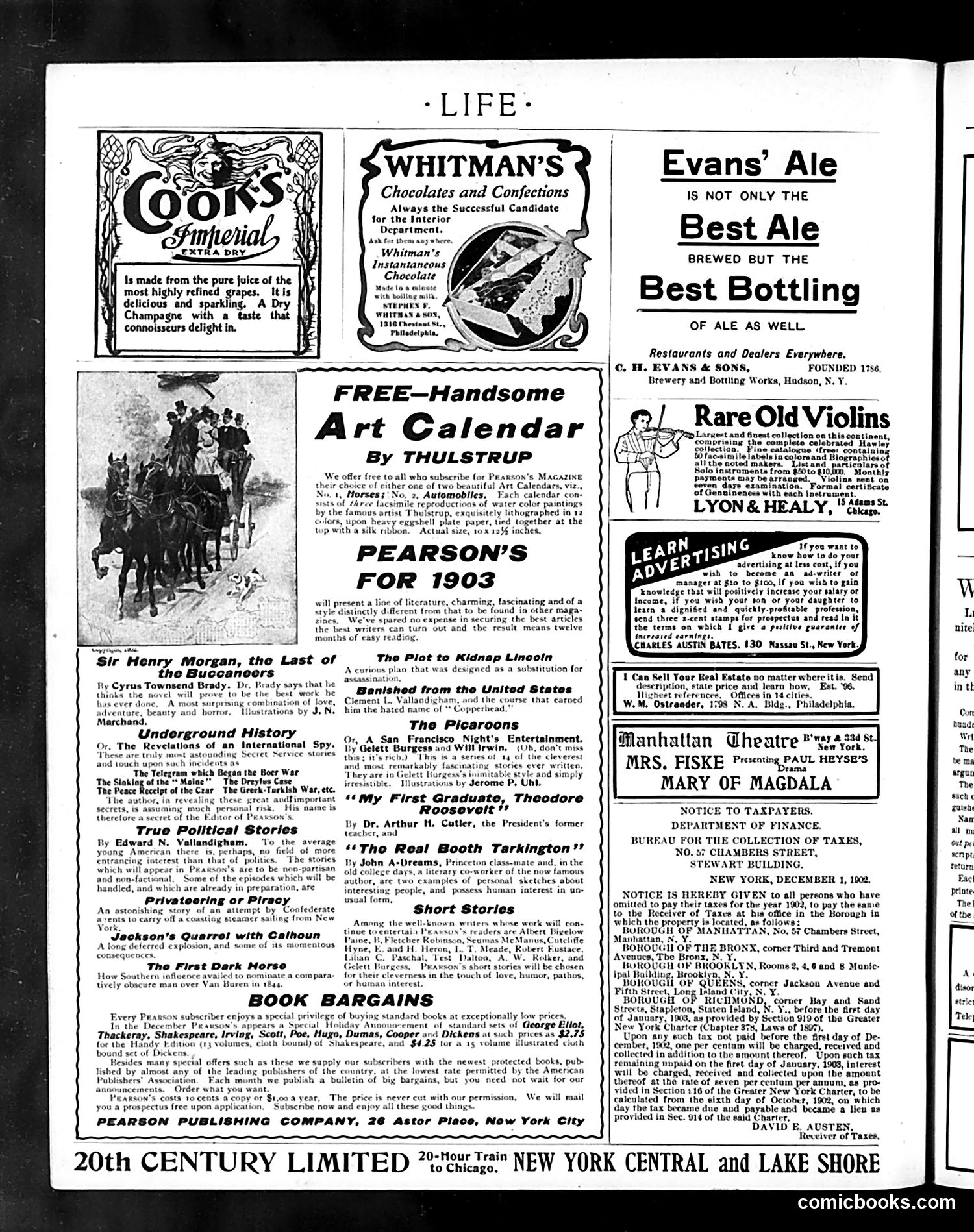
This page is primarily **advertisements and book/magazine promotions** rather than political cartoons or satire. The main elements are: **Central Content:** An advertisement for *Pearson's Magazine* for 1903, promoting upcoming serialized fiction and articles, including pieces by notable figures like Theodore Roosevelt's former teacher and author Booth Tarkington. **Notable References:** - "Whitman's Chocolates" ad notes they're "Always the Successful Candidate for the Interior Department"—likely satirizing how corporate products lobbied for government contracts or favor during the Progressive Era. - Advertised stories reference actual historical events: the Dreyfus Case, the Boer War, the sinking of the Maine—topics of genuine public interest in 1902-1903. - Book bargain offers from Pearson Publishing suggest competitive magazine marketing to middle-class readers. **Verdict:** This is a typical turn-of-century magazine page mixing consumer advertising with content promotion—not primarily satirical commentary on contemporary politics.
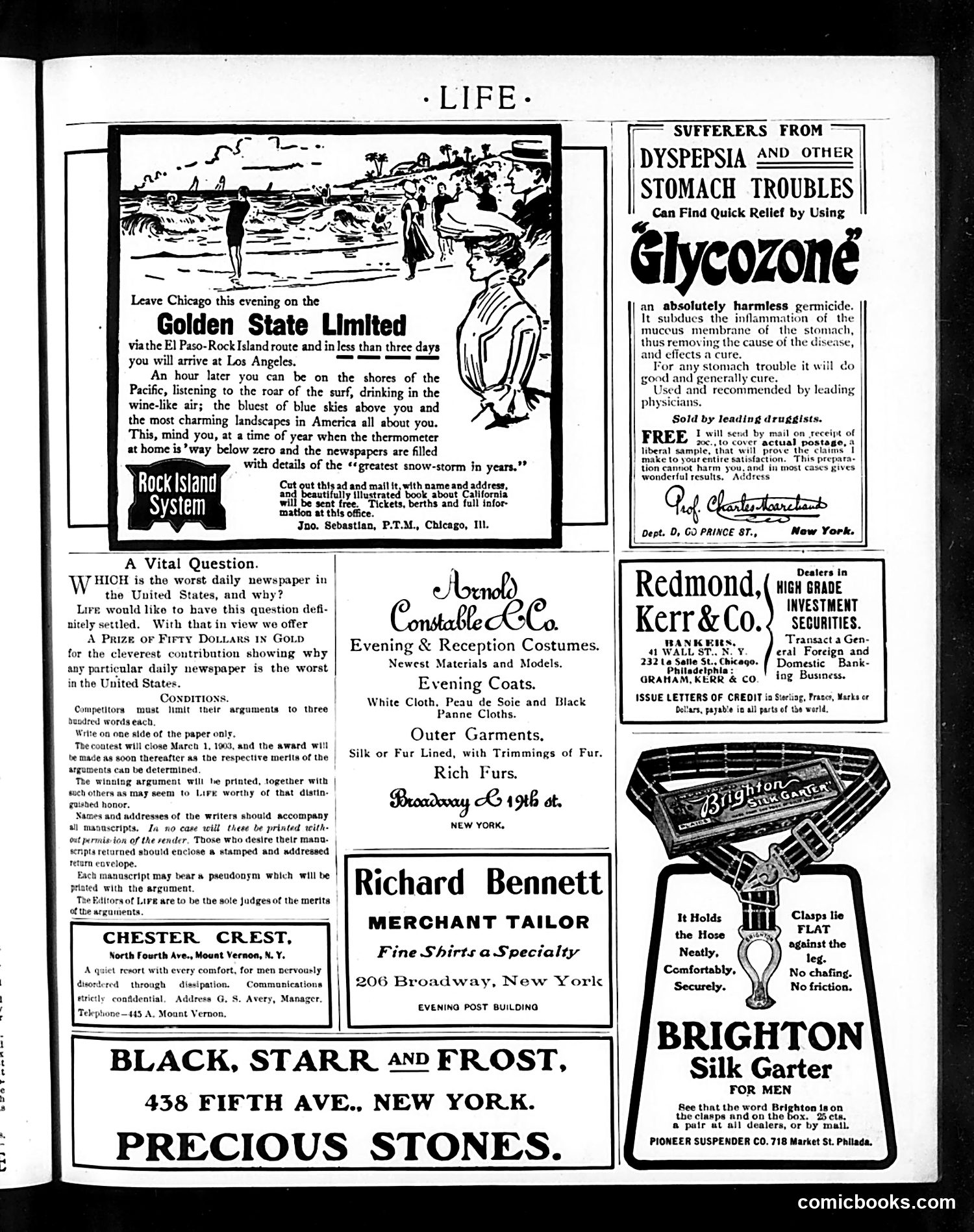
This is primarily an **advertisement and feature page**, not a satirical cartoon. The main content includes: **Featured Article:** "A Vital Question" contests whether readers can identify the worst American daily newspaper. Life offered fifty dollars in gold for the cleverest 300-word argument. This reflects turn-of-the-century publication competition and suggests newspapers were viewed as variable in quality. **Advertising:** The page contains numerous period advertisements (1903, based on the contest deadline), including: - Rail travel (Golden State Limited to Los Angeles) - Patent medicine (Glycozone for stomach troubles) - Luxury goods (clothing, jewelry, financial services) **Notable:** The beach scene illustration promoting California travel reflects the era's romanticization of the West and leisure travel. The contest itself reveals how magazines engaged readers through participatory competitions and how daily newspapers remained culturally significant enough to debate publicly.
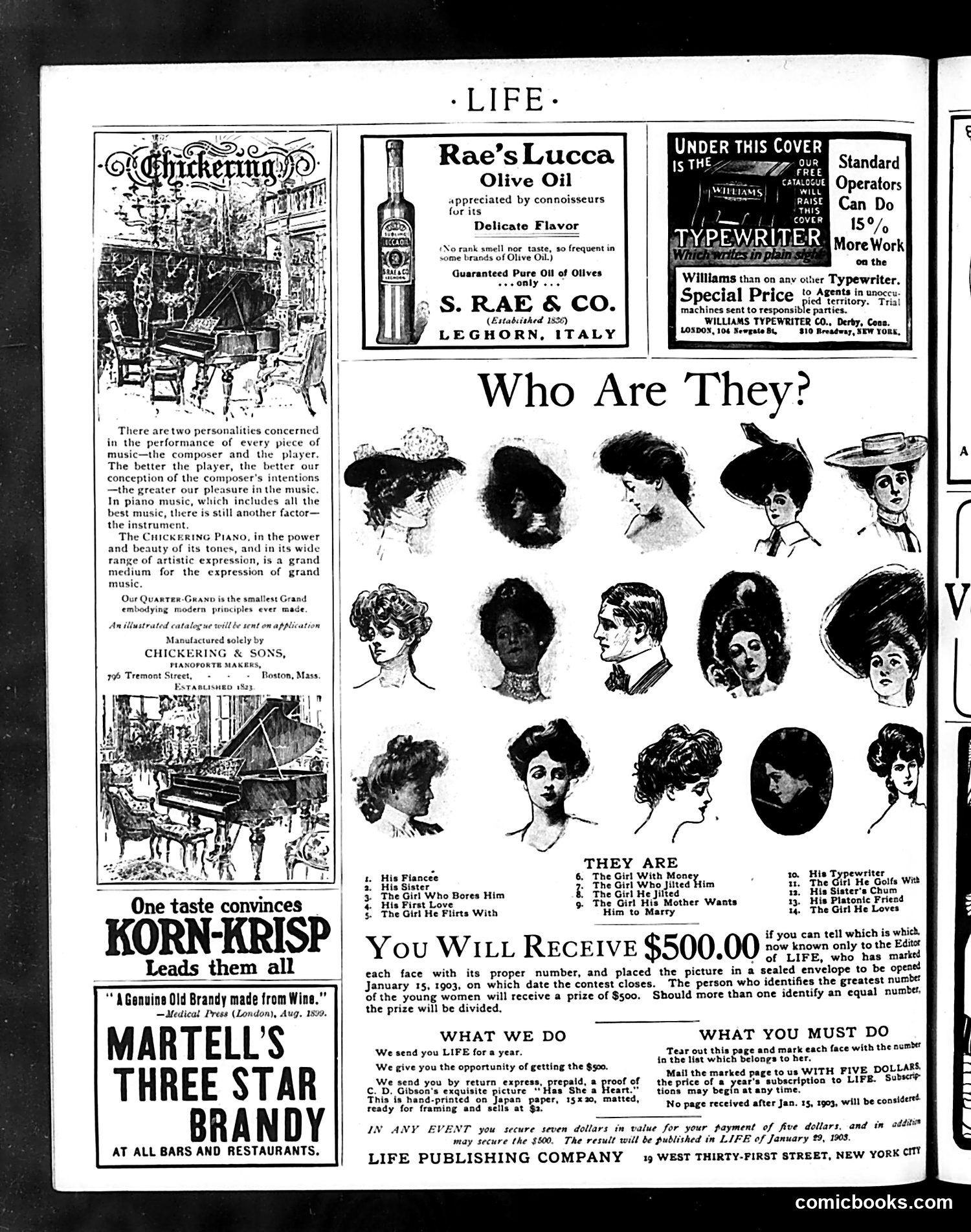
This page features a **contest, not satire**—Life magazine's promotional puzzle for readers. The central image displays twelve illustrated female faces labeled 1-12, each representing a different romantic or social relationship type: "His Fiancée," "His Sister," "The Girl Who Bores Him," "His First Love," etc. Readers were challenged to match each face to its corresponding label. The entry fee was five dollars (paid via subscription), with a $500 prize for whoever correctly identified the most faces. The contest closed January 15, 1903. This reflects early 1900s popular culture: **Life's use of contests to drive subscriptions**, and the era's fascination with illustrated romantic "types"—a common visual language in period magazines. The Gibson Girl aesthetic dominates these portraits, representing idealized femininity of the Edwardian era. The page also contains period advertisements for pianos, brandy, olive oil, and typewriters—typical Life revenue sources.
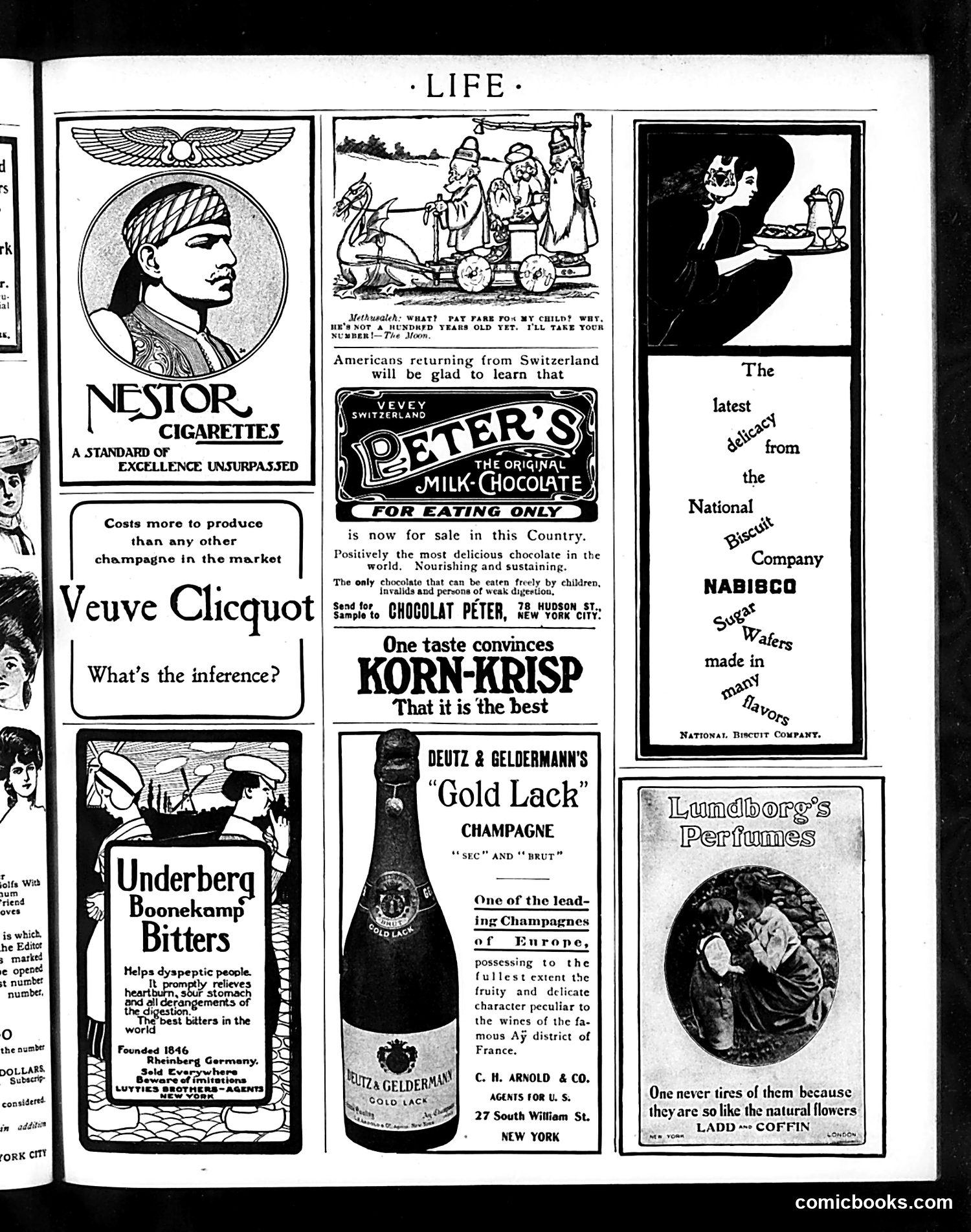
This is primarily an **advertisement page**, not a satirical cartoon page. However, it contains one notable joke: The cartoon labeled "Methusaleh" depicts an ancient biblical figure (Methuselah, who lived 969 years) refusing to pay child support, claiming his child isn't old enough yet—implying the child must reach 100 years old first. This is absurdist humor playing on Methuselah's legendary extreme age. The remainder of the page features luxury product advertisements typical of early 20th-century Life magazine: cigarettes (Nestor), champagne (Veuve Clicquot, Gold Lack), chocolate (Peter's, Korn-Krisp), bitters, biscuits (Nabisco), and perfume (Lundborg's). These ads target wealthy readers and reflect the magazine's upscale audience. The copy emphasizes European origins and quality—appealing to American consumers' aspirations for continental sophistication during this period. The page reflects advertising conventions and consumer culture of the era rather than political satire.
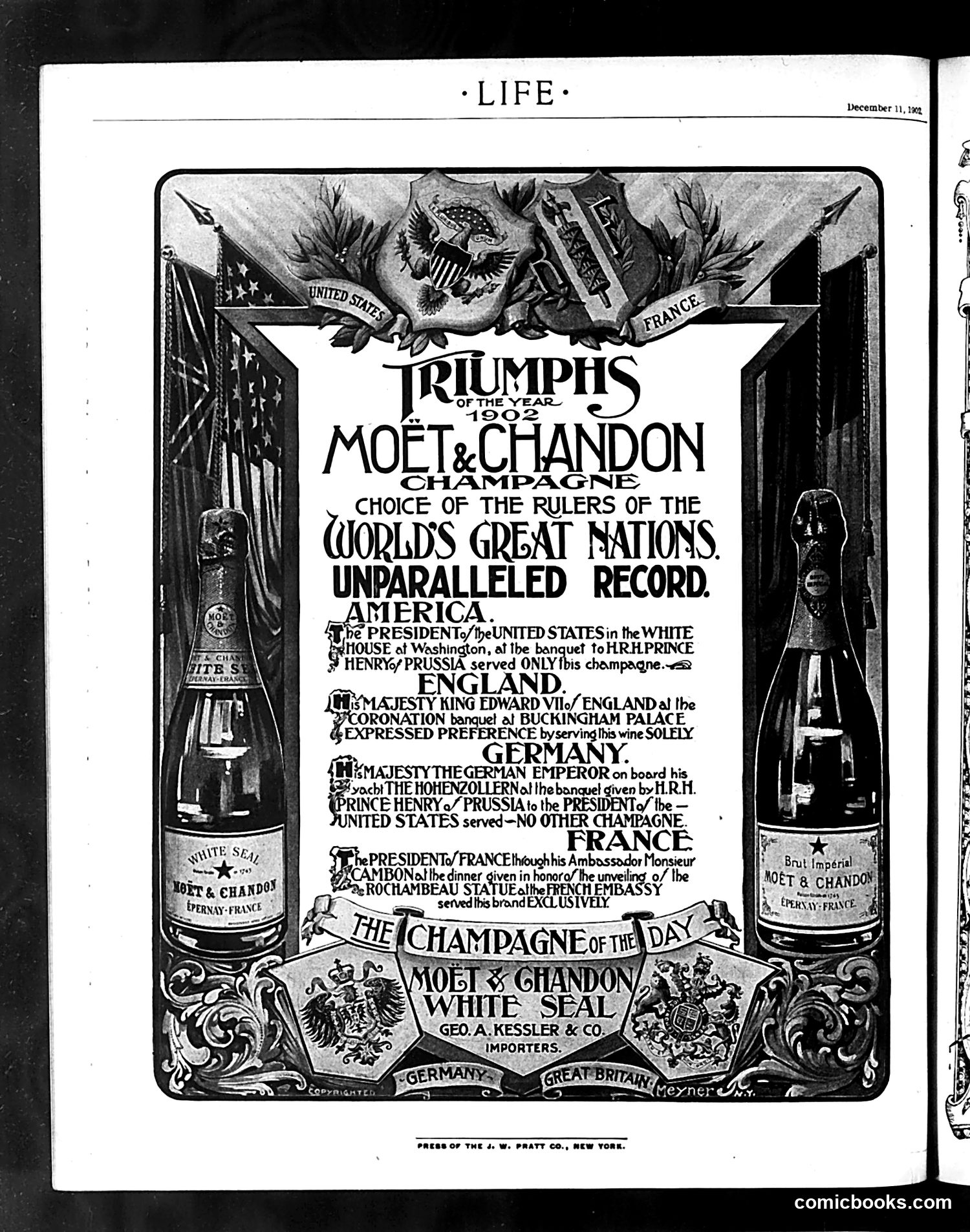
This is **not a cartoon but a luxury advertisement**—a full-page promotion for French champagne disguised as editorial content, a common early 1900s advertising practice. The ad claims Möet & Chandon "White Seal" champagne was the exclusive choice served at state banquets across major world powers: America (President's dinner for Prussian Prince Henry at the White House), England (King Edward VII's coronation at Buckingham Palace), Germany (German Emperor's official event), and France (at the Rochambeauu statue unveiling by the French ambassador). By associating the product with international diplomacy and royal approval, the ad implies that choosing this champagne signals sophisticated, cosmopolitan taste—alignment with powerful nations' official preferences. The ornate design with national eagles and heraldic crests reinforces claims of prestige and global recognition.