
Life, 1902-12-11 · page 12 of 24
Life — December 11, 1902 — page 12: what you’re looking at
What you’re looking at
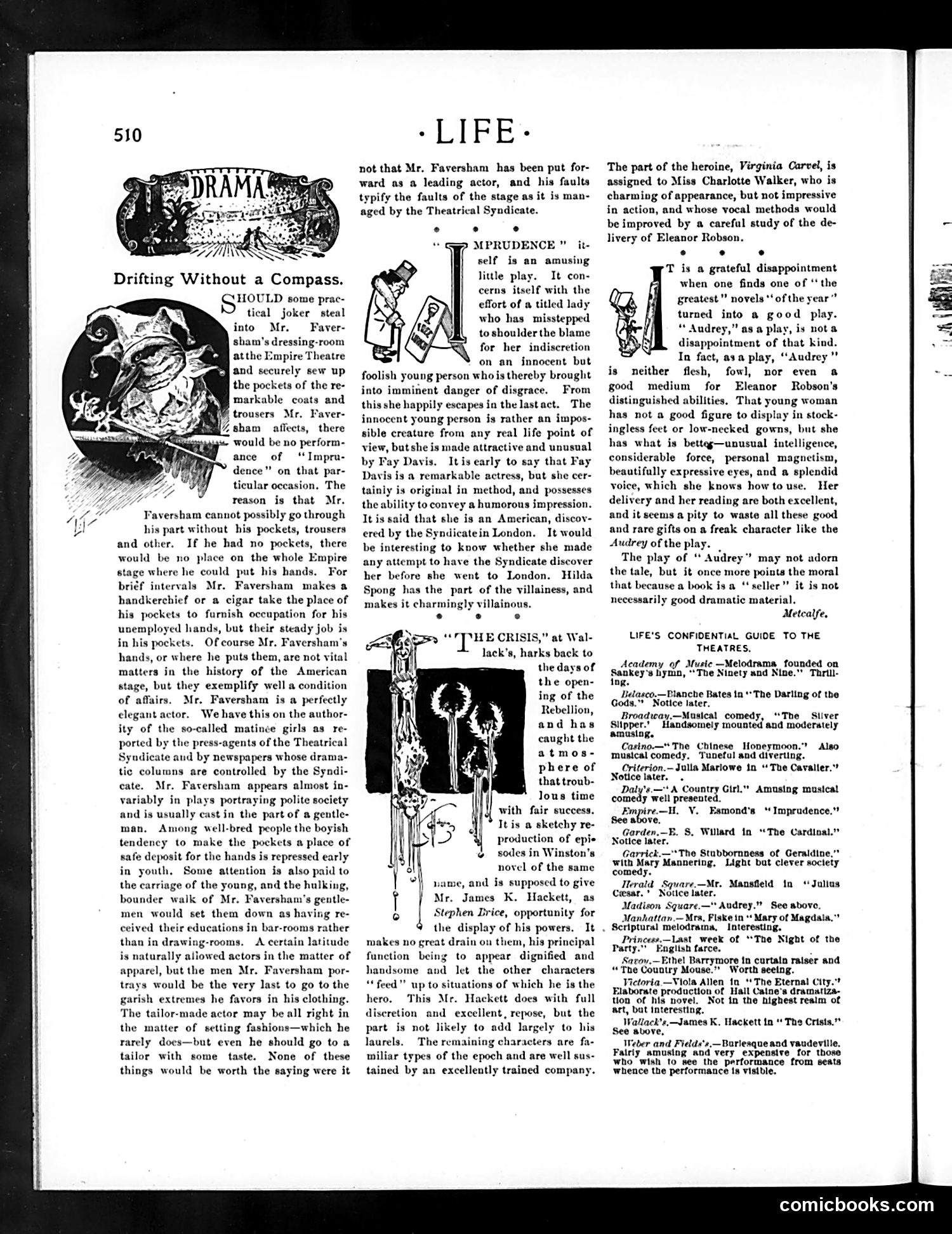
This cartoon satirizes actor **Mr. Faversham** (likely British stage actor William Faversham, popular in early 1900s American theater). The joke centers on Faversham's practical problem: as a wealthy gentleman-actor accustomed to servants handling his belongings, he has no pockets in his fashionable stage costumes and therefore nowhere to carry money or essentials during performances. The satire mocks both Faversham's dependence on servants and the impracticality of high-fashion formal wear. The title suggests he's "lost" without the basic necessities working people take for granted. It's a lighthearted jab at aristocratic pretension and the absurdities of theater world conventions that prioritize appearance over utility.
📄 Transcribed text from this page (OCR, searchable)
Machine-transcribed from the original scan — historical spelling and the odd misread are preserved.
Drifting Without a Compass. HOULD some prac- tical joker steal into Mr. Faver- sbam's dressing-room atthe Empire Theatre and securely sew up the pockets of the re- markable coats and affects, there would be no perform- ance of ‘Impru- dence” on that par- ticular occasion, The reason is that Mr. Faversham cannot possibly go through his part without his pockets, trousers and other. If he had no pockets, there would be no place on the whole Empire stage where he could put his hands. For brief intervals Mr. Faversham makes a handkerchief or a cigar take the place of his pockets to furnish occupation for his unemployed hands, but their steady job is in his pockets. Ofcourse Mr. Faversham’s hands, or where he puts them, are not vital matters in the history of the American stage, but they exemplify well a condition of affairs. Mr. Faversham is a perfectly elegant actor, We have this on the author- ity of the so-called matince girls as re- ported by the press-agents of the Theatrical licate and by newspapers whose drama- tic columns are controlled by the Syndi- eate. Mr. Faversham appears almost in- variably in plays portraying polite society and is usually cast in the part of a gentle- man. Among well-bred people the boyish tendency to make the pockets a place of safe deposit for the hands is repressed early in youth, Some attention is also paid to the carriage of the young, and the hulking, bounder walk of Mr. Faversham's gentle- men would set them down as having re- ceived their educations in bar-rooms rather than in drawing-rooms. A certain latitude is naturally allowed actors in the matter of apparel, but the men Mr. Faversham por- trays would be the very last to go to the garish extremes he favors in his clothing. The tailor-made actor may be all right in the matter of setting fashions—which he rarely does—but even he should go to a tailor with some taste. None of these things would be worth the saying were it » LIPE* not that Mr. Faversham has been put for- ward as a leading actor, and his faults typify the faults of the stage as it is man- aged by the Theatrical Syndicate. ° ° MPRUDENCE " i self is an amusing litle play. It con- cerns itself with the effort of a titled lady who has misstepped to shoulder the blame for her indiscretion on an innocent but foolish young person whois thereby brought into imminent danger of disgrace. From this she happily escapes in the lastact. The innocent young person is rather an impos- sible creature from any real life point of view, but she is made attractive and unusual by Fay Davis. Itis early to say that Fay Davis is a remarkable actress, but she cer- tainly is original in method, and possesses the ability to convey a humorous impression. It is said that she is an American, discov- ered by the Syndicatein London, It would be interesting to know whether she made any attempt to have the Syndicate discover her before she went to London. Hilda Spong has the part of the villainess, and makes it charmingly villainous. ° ° ° mm ** Te CRIS lack’s, harks back to the days of the open- ing of the Rebellion, and has caught the atmos- phere of that troub- lous time with fair success, It is a sketchy re- production of epie sodes in Winston's novel of the same }, uame, and is supposed to give | Mr. James K. Hackett, as ° ° Stephen Brice, opportunity for the display of his powers, It . makes no great drain ou them, his principal function being to appear dignified and handsome and let the other characters “‘feed”’ up to situations of which he is the hero. This Mr. Hackett does with full discretion and excellent, repose, but the part is not likely to add largely to his laurels. The remaining characters are fa- wiliar types of the epoch and are well sus- tained by an excellently trained company. The part of the heroine, Virginia Carvel, is assigned to Miss Charlotte Walker, who is charming of appearance, but not impressive in action, and whose vocal methods would be improved by a careful study of the de- livery of Eleanor Robson. ° ° ° T is a grateful disappointment when one finds one of “the greatest” novels *‘of the year” turned into a good play. “ Audrey,” asa play, is not a disappointment of that kind. In fact, asa play, “Audrey is neither flesh, fowl, nor even @& good medium for Eleanor Robson's distinguished abilities, That young woman has not a good figure to display in stock- ingless feet or low-necked gowns, but she has what is bettes—unusual intelligence, considerable force, personal magnetism, beautifully expressive eyes, and a splendid voice, which she knows how to use. Her delivery and her reading are both excellent, and it seems a pity to waste all these good and rare gifts on a freak character like the Audrey of the play. The play of “ Audrey” may not adorn the tale, but it once more points the moral that because a book is a ‘seller’ it is not necessarily good dramatic material. Metcalfe, LIFE'S CONFIDENTIAL GUIDE TO THE THEATRES, Academy of Muste —Melodrama founded on Sankey's lym, “The Ninety and Nine.” Thrill ng. Beasco.—Pianche Bates tn "The Darling of the Gods." Notice later. Broadway.—Musical comedy, “The | Sliver Slipper.’ _Handsomely mounted and moderately amusing. Casino." The Chinese Honeymoon.” musical comedy, Tuneful and diverting. Criterion. Julla Marlowe in “The Cavalter.”’ Notice inter. |. Daty's.—"* A Country Girl." Amusing musical comedy well presented. Empire—i, V. Esmond's “ Imprudence."? See above. Garden,—B, 8, Willard in “The Cardinal.” Notice later. Garrick.—"The Studbornness of Geraldine.” with Mary Mannering, Light bat clever soctety comedy. Herald Square.—Mr. Mansfeld in Cesar. * Notice later. Madison Square.—" Audrey.” See above, Manhattan.— Mra, Fiske in “* Mary of Magdaia,”* Scriptural melodrama, Interesting. Princess.—Last week of “The Night of the Party.” English farce. Sarov.—Ethel Barrymore tn curtain raiser and “The Country Mouse." Worth seeing. Victoria. —Viola Allen 1n ‘The Eternal City.? Elaborate production of Hall Cain's dramatiza- tion of his novel. Not in the highest realm of art, bat interesting. Waliack's,—James K. Hackett in “The Crista.” See above, Weber and Fields's,—Barlesque and vaudeville, Falrly amusing and very expensive for those who wish to see the performance from seats whence the performance 1s visible. Also “Jolias comicbooks.com