
Life, 1902-12-11 · page 4 of 24
Life — December 11, 1902 — page 4: what you’re looking at
What you’re looking at
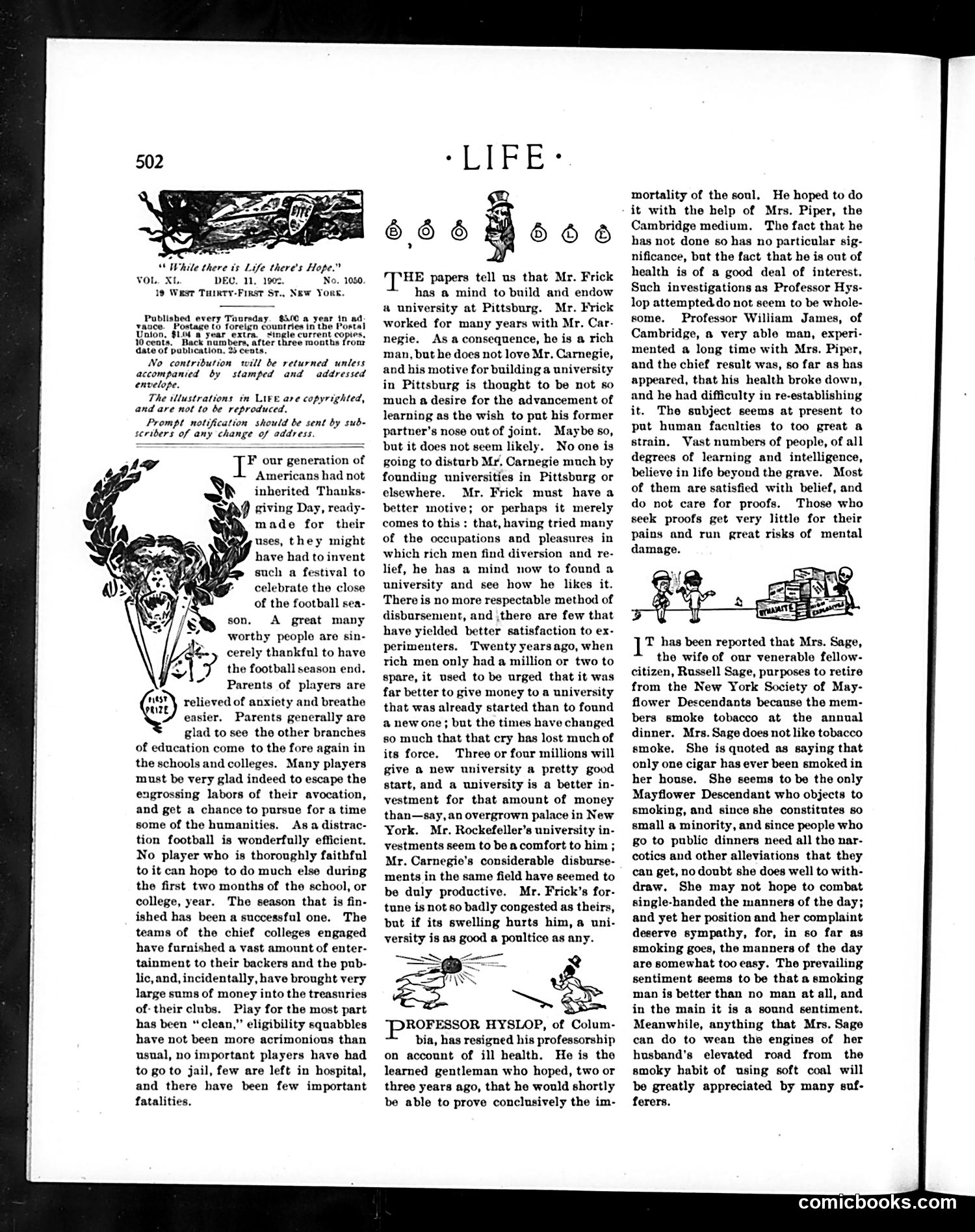
This page contains two distinct satirical pieces about wealthy philanthropists and social reform: **Upper section**: Critiques Mr. Frick's plan to build a university in Pittsburgh rather than support existing institutions. The satire suggests his motive is competitive with Carnegie, arguing that "disturbing Mr. Carnegie much by founding universities" would be petty. The piece mocks wealthy industrialists' need for self-aggrandizement through public institutions. **Lower section**: Satirizes Mrs. Sage's anti-smoking stance. She's described as a "Mayflower Descendant" opposing cigar smoking at public dinners, despite being philanthropic elsewhere. The cartoon ridicules her selective moralism—objecting to smoking while being otherwise progressive—suggesting her position is hypocritical or reflects outdated propriety rather than genuine principle. Both pieces critique how the ultra-wealthy deploy philanthropy and social positions.
📄 Transcribed text from this page (OCR, searchable)
Machine-transcribed from the original scan — historical spelling and the odd misread are preserved.
“* While there is Life there's Hope.” VOL. Xb. DEG. 11, 1902. No. 1080 19 Wrst Taixty-First St., New York. Published every Tauraday. $300 a year in ad ance. Postage to foreign countries in the Postal Union, $1.04 a year extra, single current copies, 1Wcents. Back nambers, after three months from date of publication, 25 cents. No contribution will be returned unless accompanied by stamped and addressed envelope. The illustrations in Lite are copyrighted, and are not to be reproduced. Prompt notification should be sent by sub- scribers of any change of address. F our generation of Americans had not inherited Thanks- p 9 giving Day, ready- made for their uses, they might have had to invent such a festival to celebrate the close of the football sea- son. A great many worthy people are sin- cerely thankful to have the football season end. Parents of players are 4 relieved of anxiety and breathe easier. Parents generally are glad to see the other branches of education come to the fore again in the schools and colleges. Many players must be very glad indeed to escape the engrossing labors of their avocation, and get a chance to pursue for a time some of the humanities. As a distrac- tion football is wonderfully efficient. No player who is thoroughly faithful to it can hope to do much else during the first two months of the school, or college, year. The season that is fin- ished has been a successful one. The teams of the chief colleges engaged have furnished a vast amount of enter- tainment to their backers and the pub- lic, and, incidentally, have brought very large sums of money into the treasuries of- their clubs. Piay for the most part has been “clean,” eligibility squabbles have not been more acrimonious than usual, no important players have had to go to jail, few are left in hospital, and there have been few important fatalities. ‘LIFE 666M 500 THE papers tell us that Mr. Frick has a mind to build and endow a university at Pittsburg. Mr. Frick worked for many years with Mr. Car- negie. As a consequence, he is a rich man, but he does not love Mr. Carnegie, and his motive for building a university in Pittsburg is thought to be not so much a desire for the advancement of learning as the wish to put his former partner’s nose out of joint. Maybe so, but it does not seem likely. No one is going to disturb Mr, Carnegie much by founding universities in Pittsburg or elsewhere. Mr. Frick must have a better motive; or perhaps it merely comes to this: that, having tried many of the occupations and pleasures in which rich men find diversion and re- lief, he has a mind now to found a university and see how he likes it. There is no more respectable method of disbursement, and ,there are few that have yielded better satisfaction to ex- perimenters. Twenty yearsago, when rich men only had a million or two to spare, it used to be urged that it was far better to give money to a university that was already started than to found a new one; but the times have changed so much that that cry has lost much of its force. Three or four millions will give a new university a pretty good start, and a university is a better in- vestment for that amount of money than—say, an overgrown palace in New York. Mr. Rockefeller’s university in- vestments seem to be acomfort to him ; Mr. Carnegie’s considerable disburse- ments in the same field have seemed to be duly productive. Mr. Frick’s for- tune is not so badly congested as theirs, but if its swelling hurts him, a uni- versity is as good a poultice as any. RROFESSOR HYSLOP, of Colum- bia, has resigned his professorship on account of ill health. He is tho learned gentleman who hoped, two or three years ago, that he would shortly be able to prove conclusively the im- mortality of the soul. He hoped to do it with the help of Mrs. Piper, the Cambridge medium. The fact that he has not done so has no particular sig- nificance, but the fact that he is out of health is of a good deal of interest. Such investigations as Professor Hys- lop attempted do not scem to be whole- some. Professor William James, of Cambridge, a very able man, experi- mented a long time with Mrs. Piper, and the chief result was, so far as has appeared, that his health broke down, and he had difficulty in re-establishing it. The subject seems at present to put human faculties to too great a strain. Vast numbers of people, of all degrees of learning and intelligence, believe in life beyond the grave. Most of them are satisfied with belief, and do not care for proofs. Those who seek proofs get very little for their pains and run great risks of mental damage. qt has been reported that Mrs. Sage, the wife of our venerable fellow- citizen, Russell Sage, purposes to retire from the New York Society of May- flower Descendants because the mem- bers smoke tobacco at the annual dinner. Mrs. Sage does not like tobacco smoke. She is quoted as saying that only one cigar has ever been smoked in her house. She seems to be the only Mayflower Descendant who objects to smoking, and since she constitutes so small a minority, and since people who go to public dinners need all the nar- cotics and other alleviations that they can get, no doubt she does well to with- draw. She may not hope to combat single-handed the manners of the day; and yet her position and her complaint deserve sympathy, for, in so far as smoking goes, the manners of the day are somewhat too easy. The prevailing sentiment seems to be that a smoking man is better than no man at all, and in the main it is a sound sentiment. Meanwhile, anything that Mrs. Sage can do to wean the engines of her husband's elevated road from the smoky habit of using soft coal will be greatly appreciated by many suf- ferers. comicbooks.com