
A complete issue · 22 pages · 1902
Life — October 30, 1902
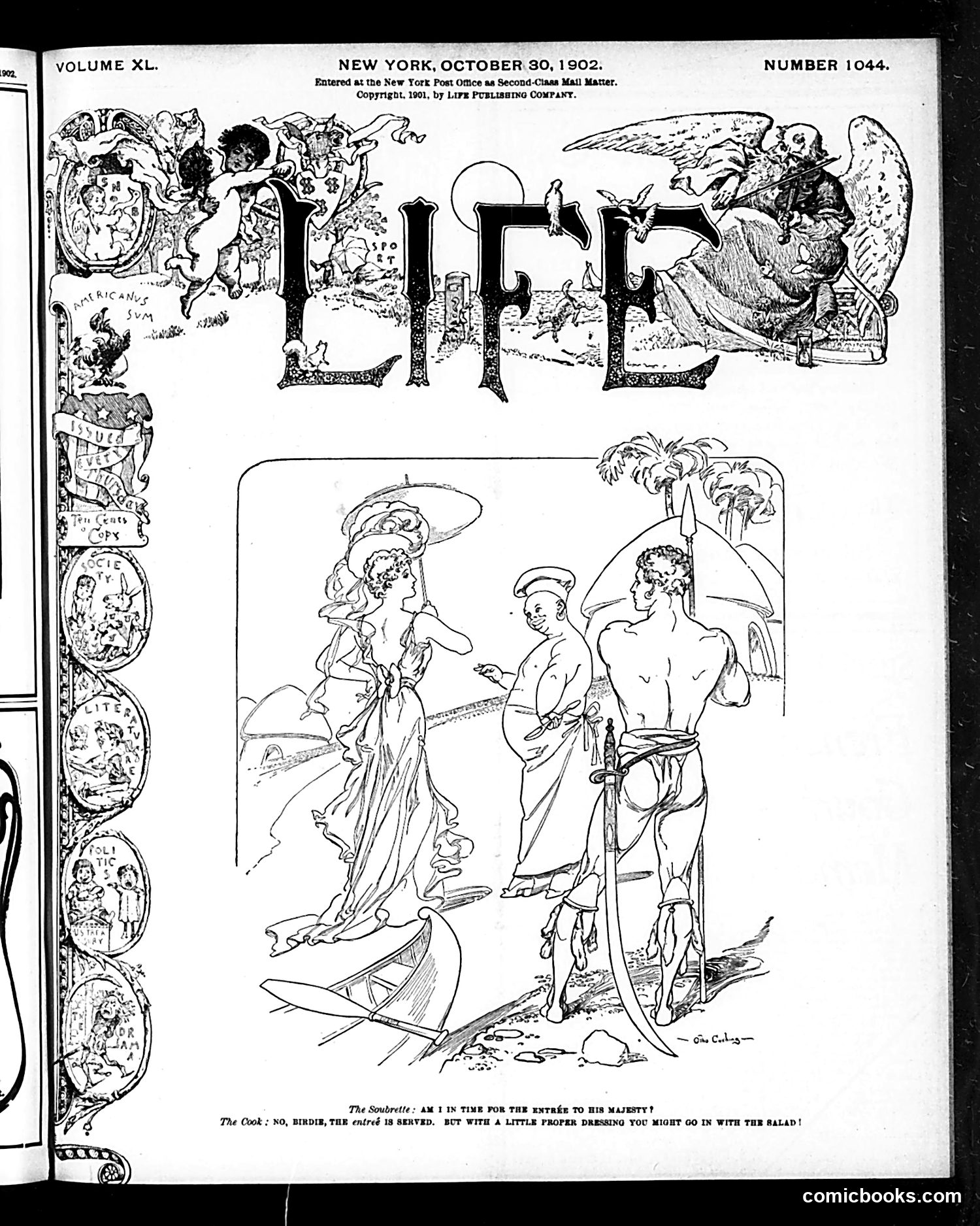
This page features a satirical cartoon titled "Life" with two illustrated scenes. The upper panel shows ornate, fantastical imagery with cherubs and classical figures. The lower panel depicts a beach or tropical scene with a woman in an elaborate dress and two men—one appears to be a cook or servant, the other shirtless. The caption reads: "The Soubrette: 'Am I in time for the entree to his majesty?' The Cook: 'No, Birdie, the entree is served. But with a little proper dressing you might go in with the salad!'" This appears to be a theatrical or vaudeville joke playing on double meanings—"entree" (a dinner course and social admission) and innuendo about the woman's appearance and "proper dressing." The satire likely comments on theatrical performers seeking social advancement.
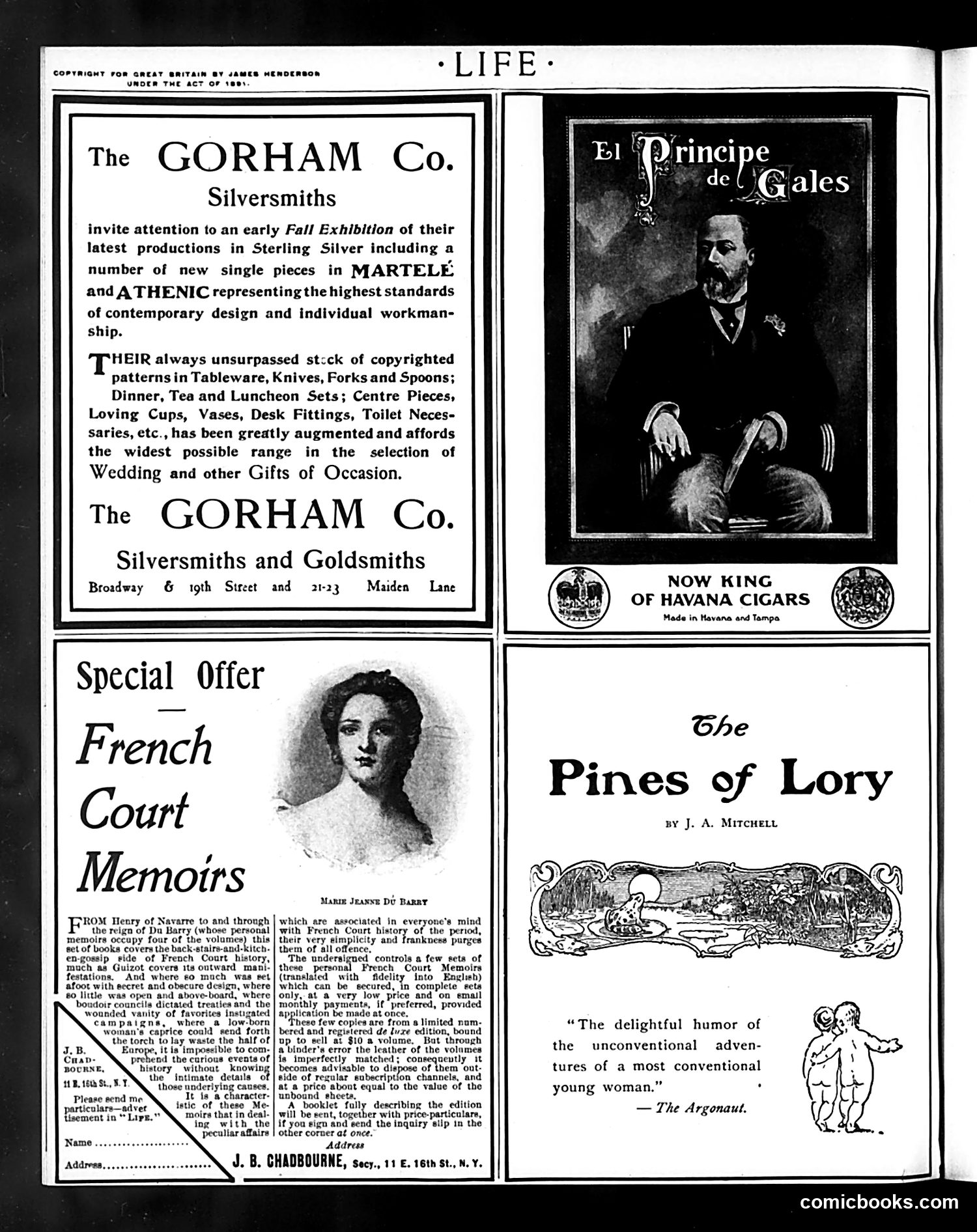
This page is primarily **advertising and literary promotion** rather than political satire. The four advertisements include: - **Gorham Co.** (silversmiths/goldsmiths) promoting fall exhibitions of sterling silver goods - **El Príncipe de Gales** cigars from Havana, featuring a portrait of an unidentified well-dressed man - **French Court Memoirs** by Marie Jeanne du Barry, a historical text about 18th-century French court life - **The Pines of Lory** by J.A. Mitchell, a novel described as humorous adventures of an unconventional young woman The du Barry memoirs advertisement emphasizes gossipy, scandalous court history ("secret and obscure design"). The Mitchell novel emphasizes humor and unconventional female character—suggesting early 20th-century interest in both historical scandal and modern social commentary through fiction. No clear political cartoons appear on this page.
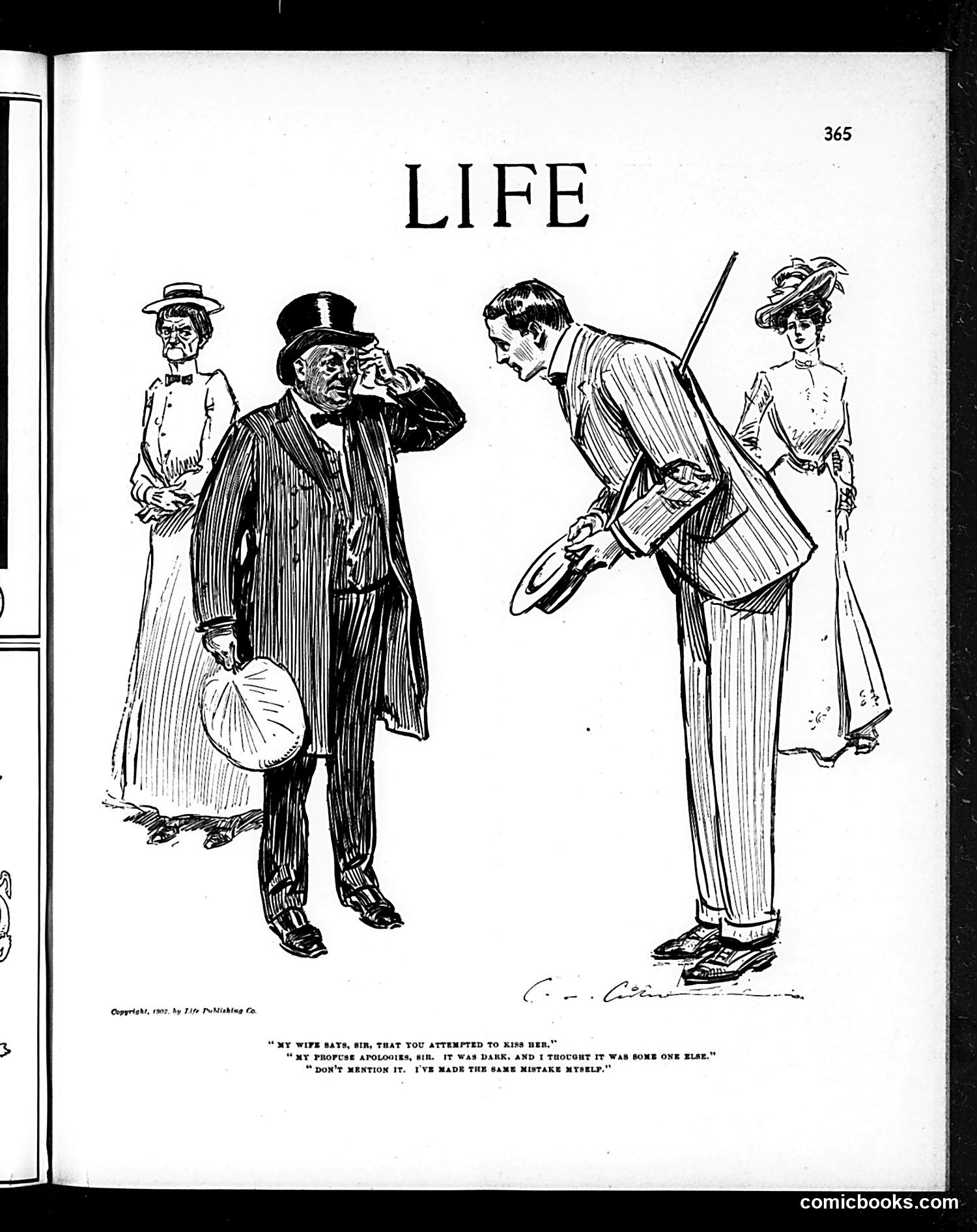
This cartoon satirizes marital infidelity and social embarrassment. The scene shows a man caught in a compromising situation—apparently attempting to kiss a woman—confronted by his wife and her companions. The humor relies on the man's awkward excuses: he claims he was merely attempting to kiss the woman, it was dark and he thought it was "some else," and he's "made the same mistake myself." The caption emphasizes his transparent lying and fumbling apologies. The cartoon reflects early 20th-century concerns about marriage fidelity and social propriety. The well-dressed figures and formal setting suggest upper-class domestic scandal. The satire mocks both male infidelity and the unconvincing excuses men offer when caught, resonating with period anxieties about respectability and women's awareness of male duplicity.
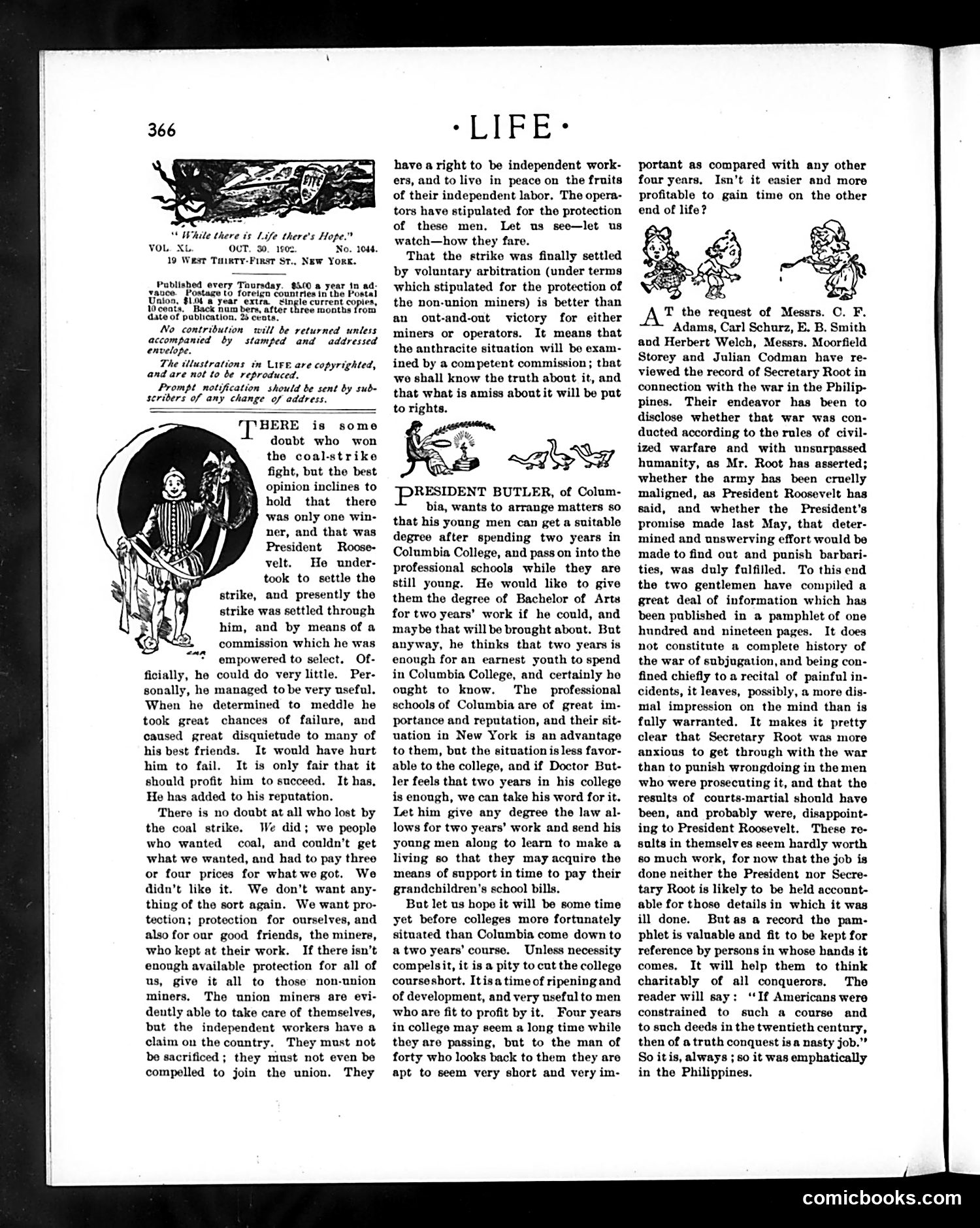
The page contains editorial commentary on labor disputes and education policy. The left column discusses a coal strike, referencing "President Roosevelt" and concerns about miners' rights and union membership. The right column addresses President Butler of Columbia College, who wants to grant Bachelor of Arts degrees for two years of college work. The author argues this would be premature—that serious students need four years of study. The commentary criticizes Butler's proposal as cost-cutting that would shortchange educational rigor. The decorative illustrations appear to be generic allegorical figures rather than specific caricatures of identifiable individuals. The page reflects early 20th-century debates about labor protections, executive power, and educational standards—themes that remain contemporary.
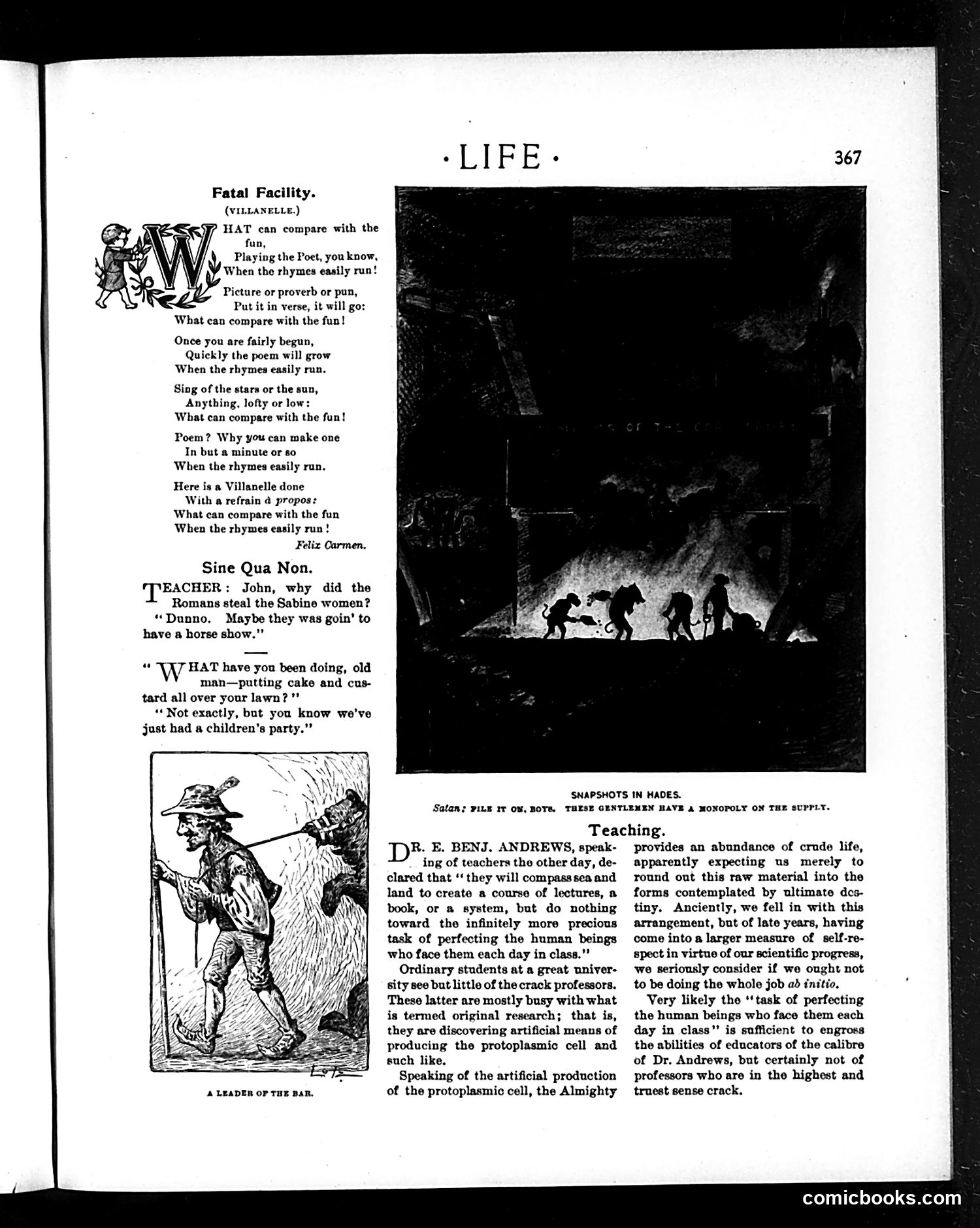
This page contains three distinct sections: **"Fatal Facility"** (top left): A poem by Feliz Gormen about writing villanelles—a poetic form. It's light verse celebrating the ease of composing when rhymes flow naturally. **"Sine Qua Non"** (middle left): A humorous dialogue between a teacher and student "John" about why Romans stole Sabine women. The joke plays on the phrase "horse show"—implying the Romans wanted to display their conquest like displaying horses. **"Teaching"** (right): An article discussing Dr. E. Benj. Andrews' views on university education. It debates whether professors should focus on "original research" versus teaching fundamentals to students. The illustration labeled "A Leader of the Bar" (bottom left) appears to be an unrelated satirical figure, though its specific subject is unclear.
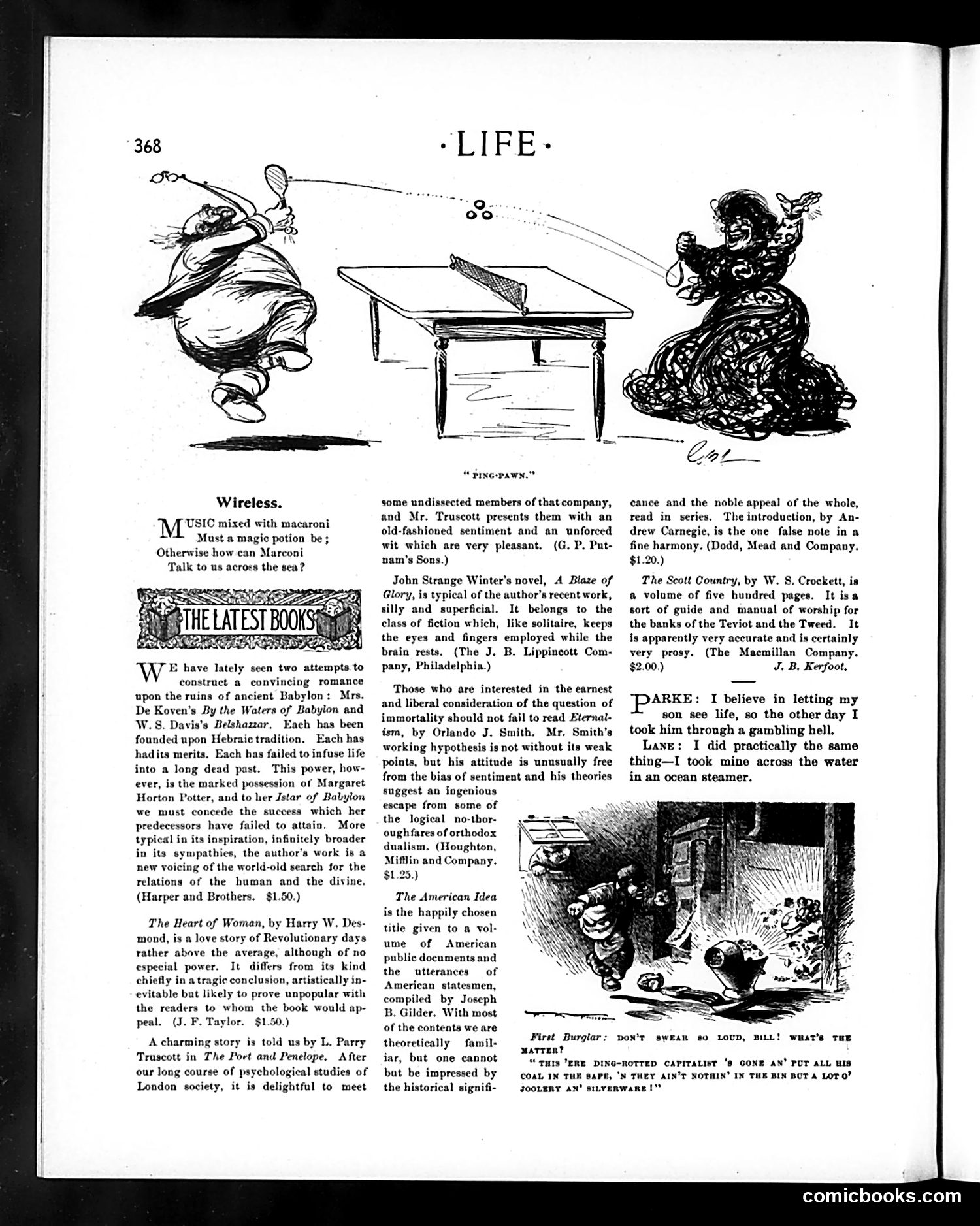
The page contains book reviews and a cartoon titled "PING-PAWN." The cartoon depicts two figures at a ping-pong table with a ball in motion between them. The left figure appears portly and frazzled; the right figure is ornately dressed and composed. Without additional context identifying these specific individuals, the cartoon likely satirizes a social or political contest between two opposing parties or personalities of the era. The ping-pong imagery suggests a back-and-forth exchange or rivalry that appears trivial or absurd compared to more serious matters. The page primarily features literary reviews of contemporary works including books about journalism, romance, and American history. The satirical intent appears directed at literary or social trends rather than specific political figures.
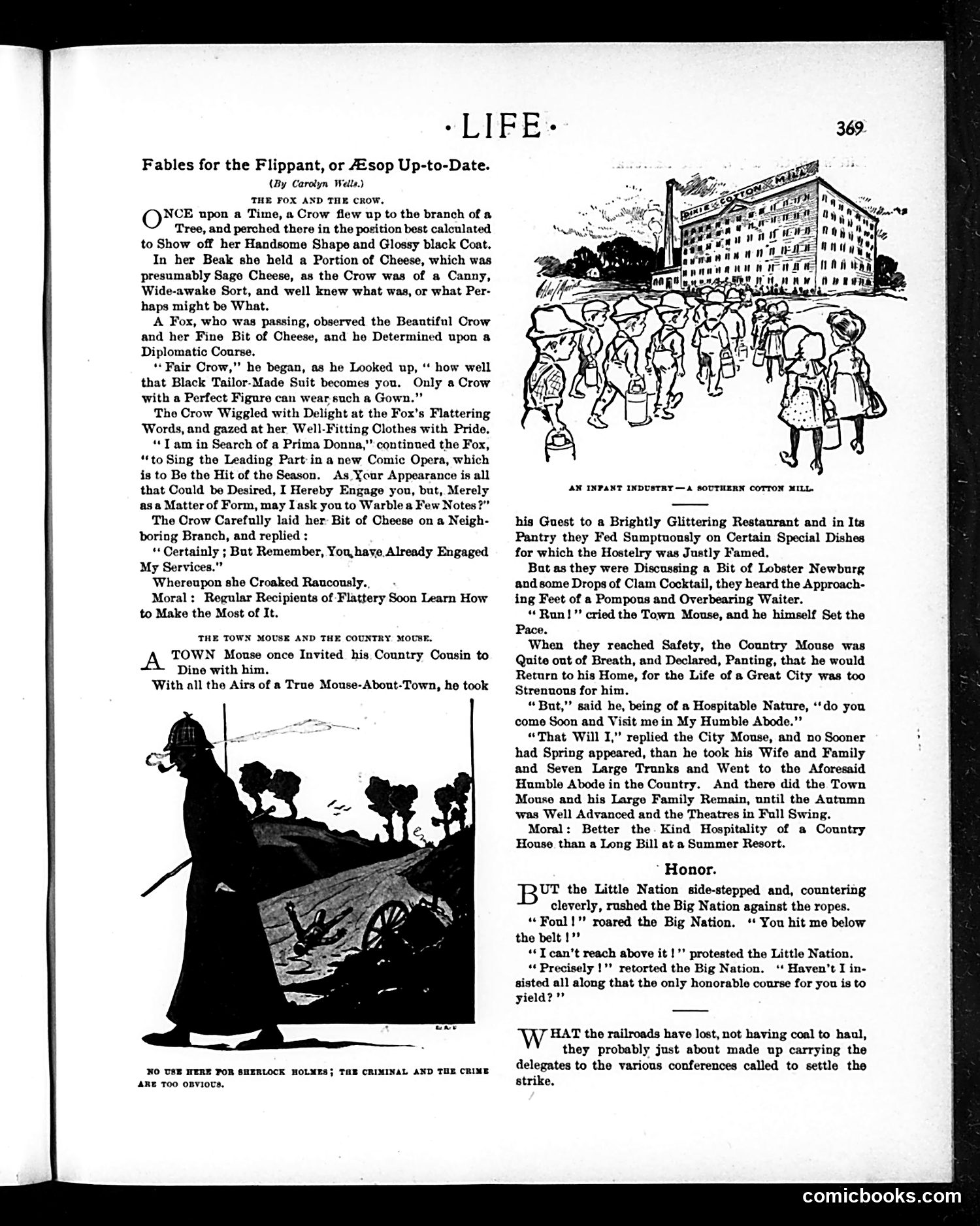
This page contains Aesop's fables updated for contemporary audiences. The left illustration shows a silhouetted figure (appearing to be Sherlock Holmes, based on the caption "No here for Sherlock Holmes") pursuing criminals, satirizing detective fiction's popularity. The right side features two fables: "The Fox and the Crow" (about flattery leading to loss) and "The Town Mouse and the Country Mouse" (contrasting urban and rural life). A third section titled "Honor" depicts conflict between a "Little Nation" and "Big Nation" over ropes—likely a veiled reference to international power dynamics or labor disputes of the era. The final paragraph cryptically references railroad strikes and delegates' conferences, suggesting contemporary labor unrest. The page blends classic moral tales with contemporary satire about crime, class differences, and industrial conflict.
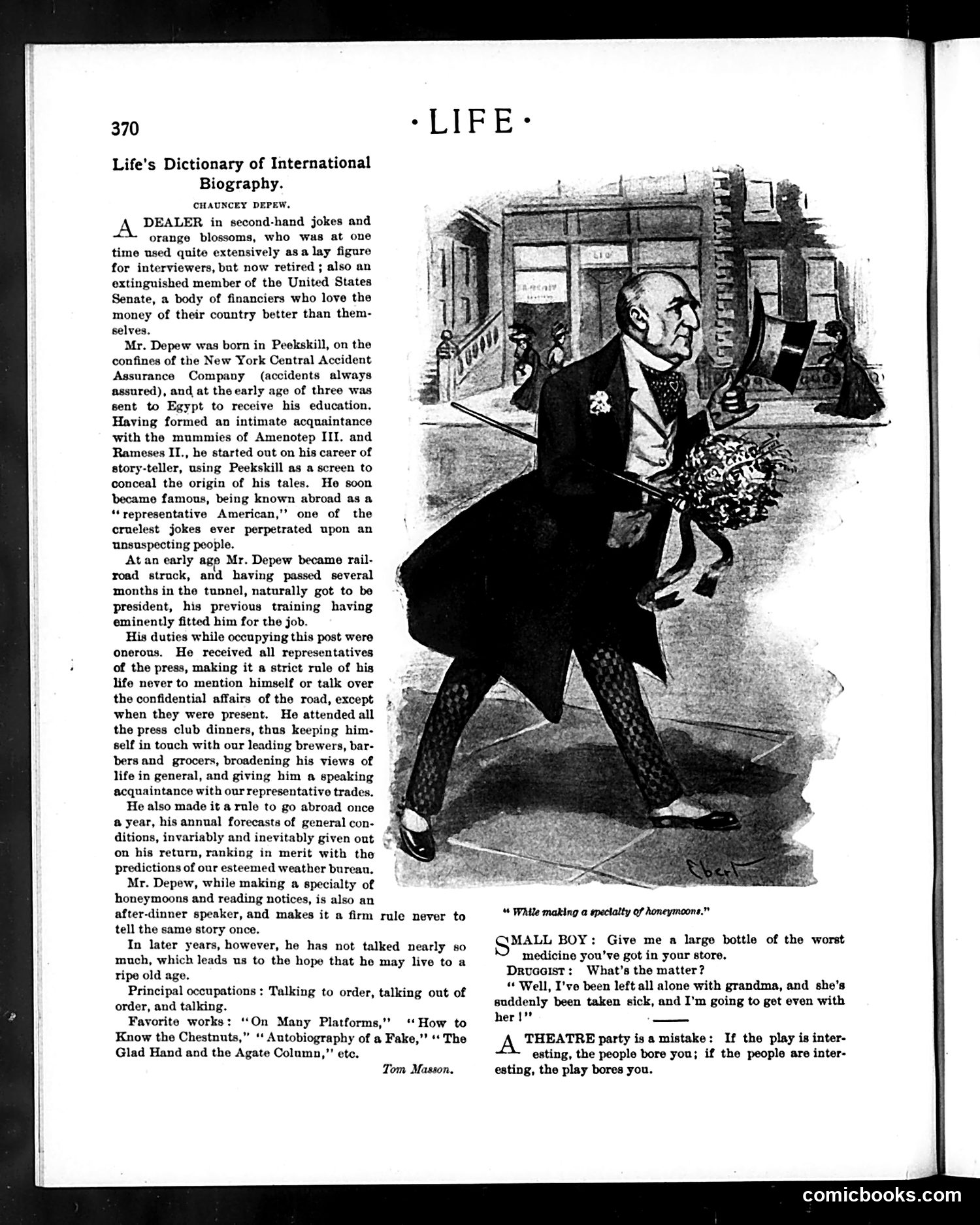
This page features a biographical entry on **Chauncey Depew**, a prominent figure described as a dealer in jokes and anecdotes who became a U.S. Senator. The accompanying illustration satirizes him as a somewhat pompous, rotund gentleman in formal dress, suggesting his self-importance. The satire targets Depew's reputation for telling the same stories repeatedly and his tendency toward self-promotion. The text notes he "never to tell the same story once" and made a "specialty of honeymoons and reading notices"—suggesting he was known for recycled anecdotes rather than original wit. The small dialogue snippets below mock everyday absurdities—a sick grandmother and a boring theatrical performance—typical of Life's humorous commentary on American social life and pretension.
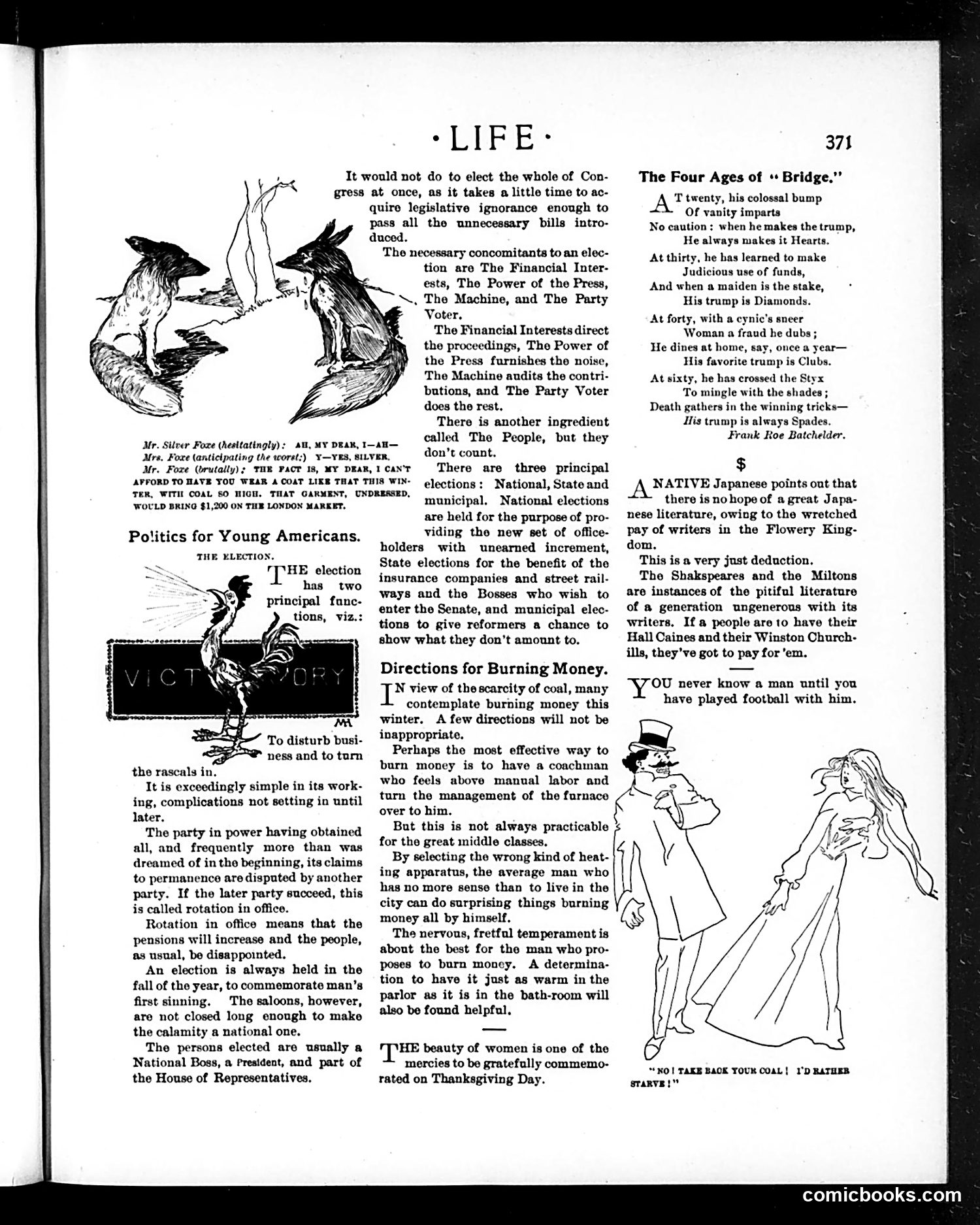
The page contains satirical articles on American politics and social commentary: **"Politics for Young Americans"** mocks the electoral process, particularly how parties rotate in power to distribute patronage and office-holding to supporters rather than merit. The rooster illustration suggests empty political posturing. **"Directions for Burning Money"** satirizes wealthy individuals' wasteful habits—specifically burning coal to heat homes as a display of excess during economic hardship. It suggests this practice reflects either foolishness or nervous temperament among the "great middle classes." **"The Four Ages of Bridge"** and **"Native Japanese Literature"** are lighter satirical pieces about social customs and cultural pretension. The overall tone criticizes political corruption, economic inequality, and upper-class excess with characteristic early-20th-century *Life* magazine irreverence.
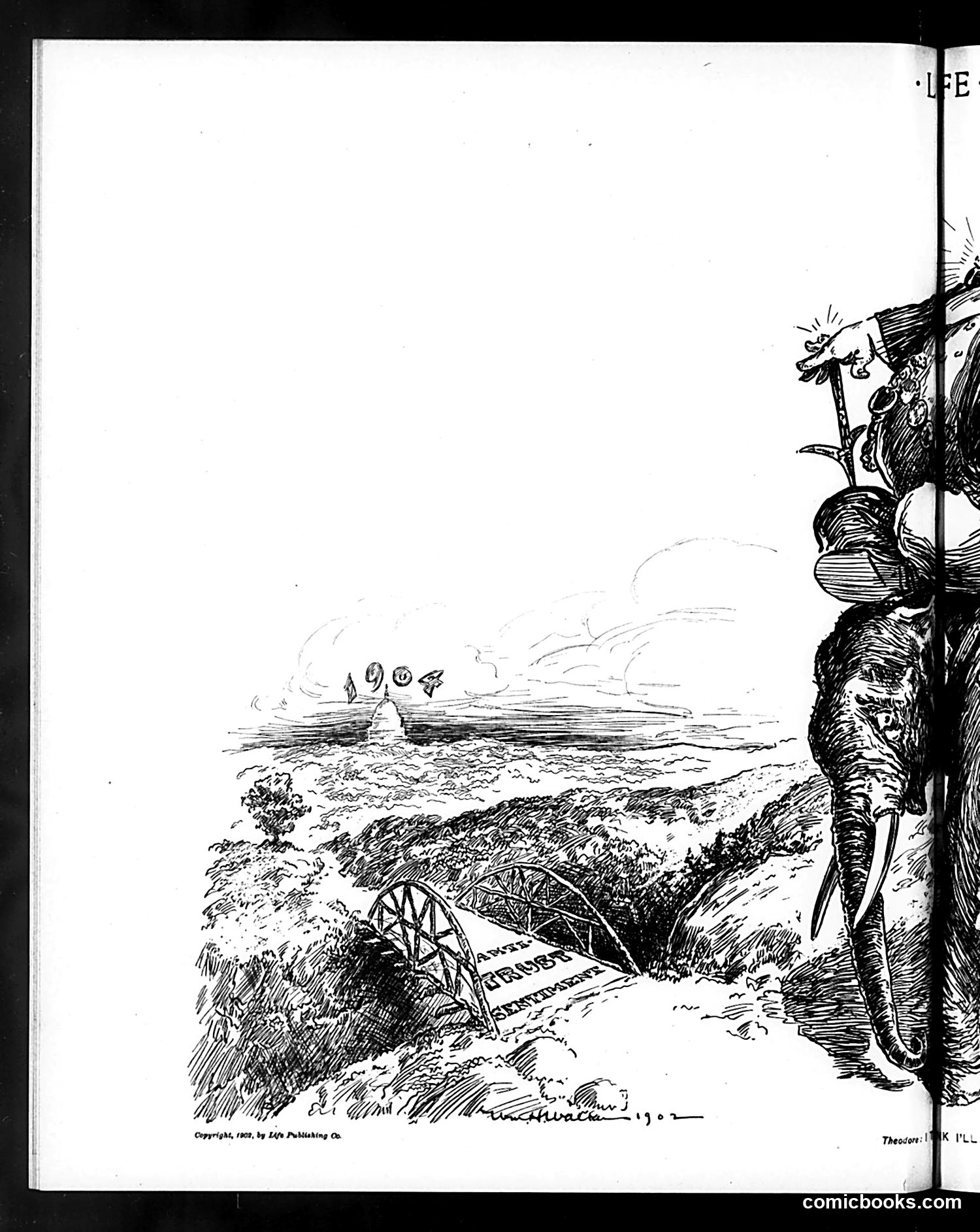
This appears to be a satirical cartoon from Life magazine (copyright 1902, per the visible text). The image depicts a coastal landscape with what looks like military fortifications or defensive structures in the foreground, and figures observing from a vantage point. The sketch shows what appears to be military or naval infrastructure, with an elephant prominently featured on the right side—a common symbol in political cartoons of the era representing the Republican Party or American power. Without clearer text identification visible in the OCR or legible labels on the cartoon itself, I cannot definitively identify the specific political figures or historical event being satirized. The military/coastal setting suggests commentary on American foreign policy, naval expansion, or imperialism circa 1902, but asserting a specific reference would exceed what the image clearly supports.
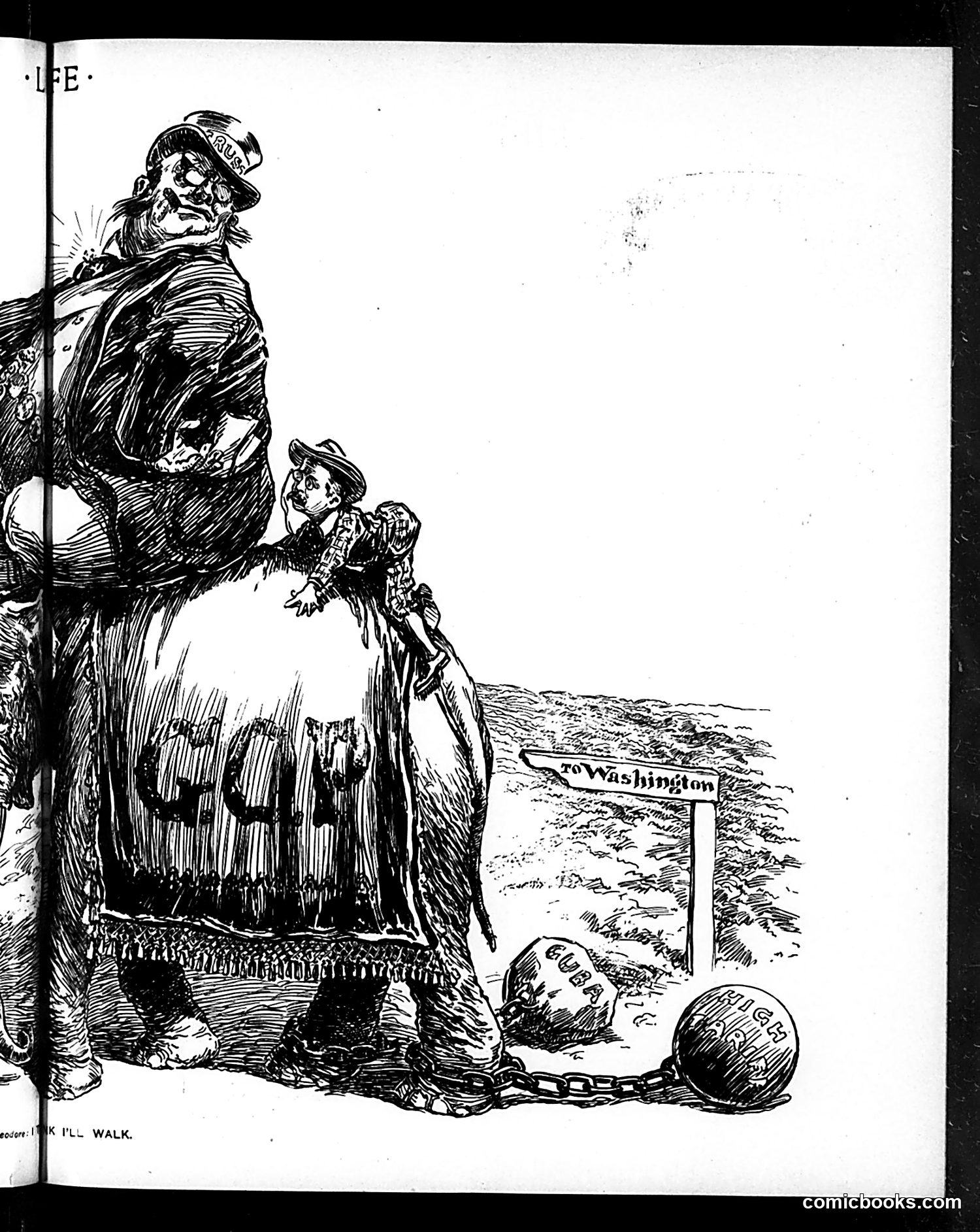
This appears to be an early 20th-century American political cartoon titled "I'll Walk." It depicts a large figure in military uniform and cap standing over a much smaller uniformed figure. The larger figure is chained to a ball labeled "BURDENS," while a signpost points "TO WASHINGTON." The cartoon likely satirizes a political or military leader being constrained by governmental obligations or "burdens" of office—hence the declaration "I'll Walk" despite the impediments. The size disparity emphasizes the weight of responsibility crushing leadership. Without additional context (date, publication details), I cannot definitively identify which specific political figure or crisis this references, but it clearly critiques the difficulty of leadership or unwillingness to bear civic duty.
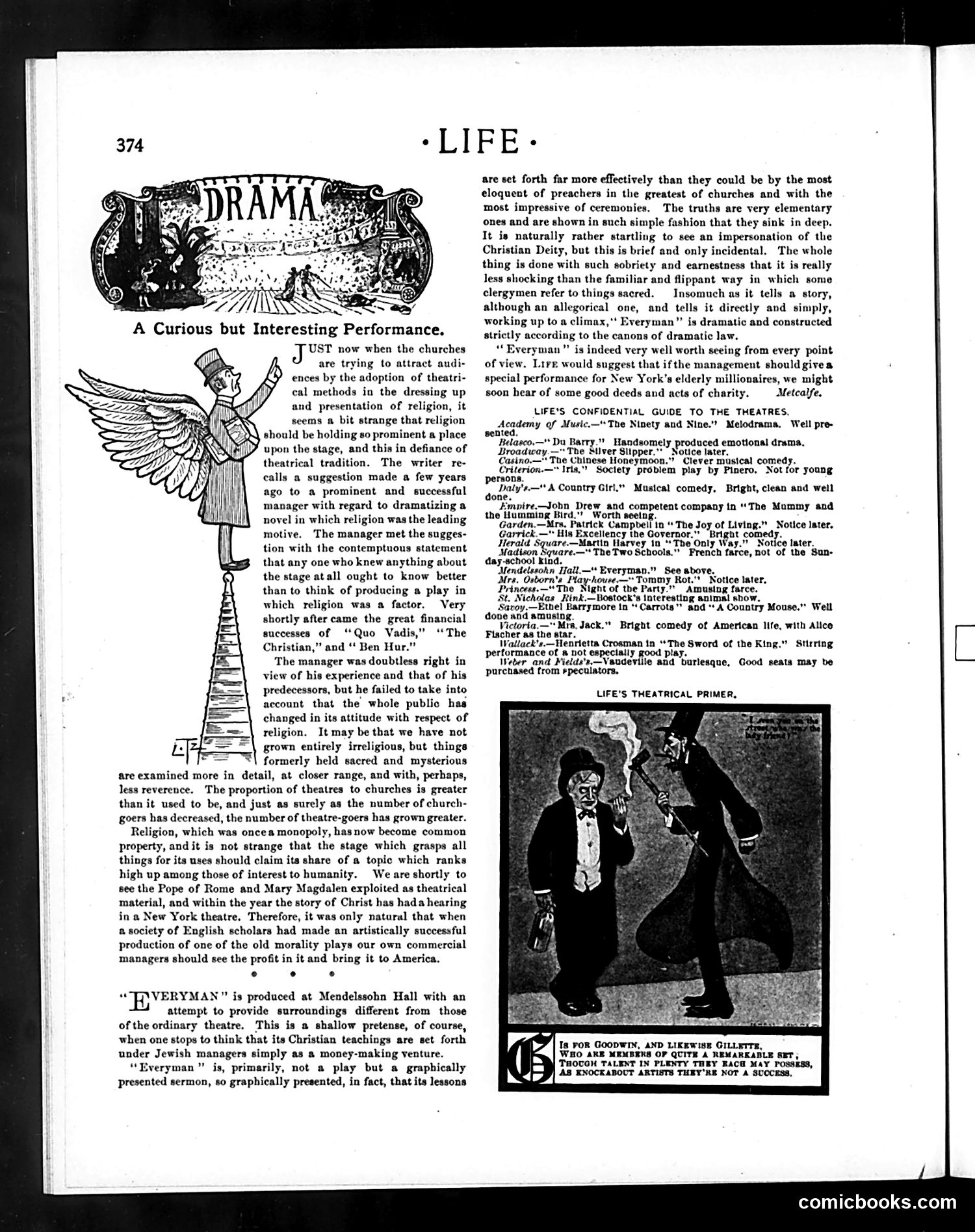
This page discusses the controversy over religious theatrical productions. The main article, "A Curious but Interesting Performance," critiques churches' recent adoption of theatrical methods to attract audiences—particularly plays depicting religious subjects on stage. The central issue: some religious leaders objected to dramatizing sacred Christian narratives, viewing it as undignified. However, the author argues that as theater has become increasingly secular and commonplace, religious institutions should recognize its cultural importance and use it as a vehicle for moral instruction. The page references a production of "Everyman" at Mendelssohn Hall and mentions upcoming theatrical treatments of biblical figures (the Pope, Mary Magdalene, and Christ). The satirical point critiques both religious conservatism resisting modern media and the commercialization of faith through entertainment.
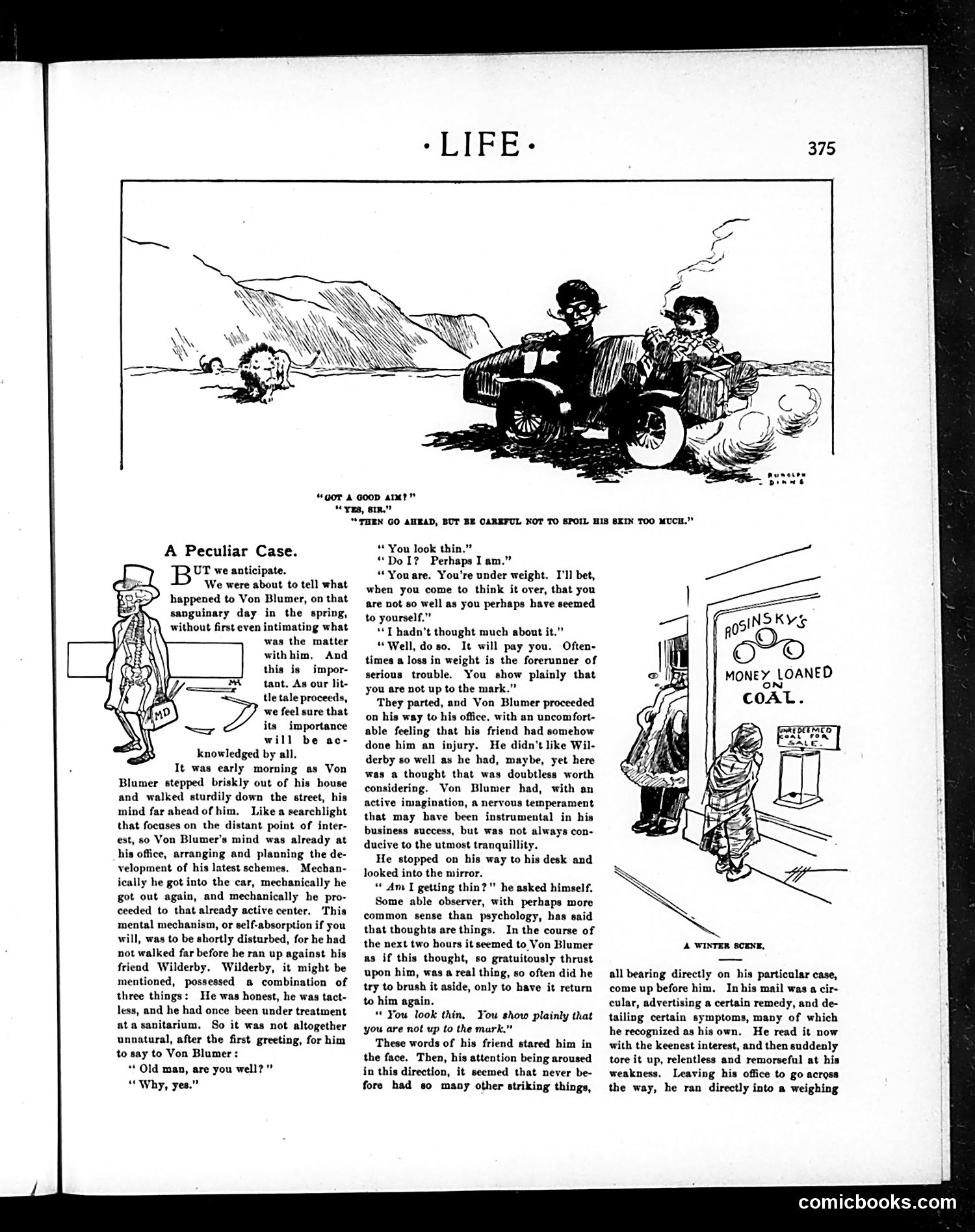
This page presents "A Peculiar Case," a cautionary tale about the power of suggestion and hypochondria. The narrative follows Von Blumer, a successful businessman with an active imagination, who encounters his tactless friend Wilderby. After Wilderby casually remarks that Von Blumer looks thin and unwell—suggesting possible serious illness—the observation becomes an obsessive thought that dominates Von Blumer's day. The satire targets how easily anxious, intelligent people (particularly those of means) can be manipulated by idle comments into imagined ailments. The cartoon at top shows the casual cruelty of Wilderby's observation, while the story illustrates how suggestion becomes "a real thing" in Von Blumer's mind, despite his attempts to dismiss it. The remedy advertisement he encounters reinforces his invented symptoms. This reflects early 20th-century anxiety about both medical advertising's manipulative power and the emerging psychological concept that thoughts can create physical effects.
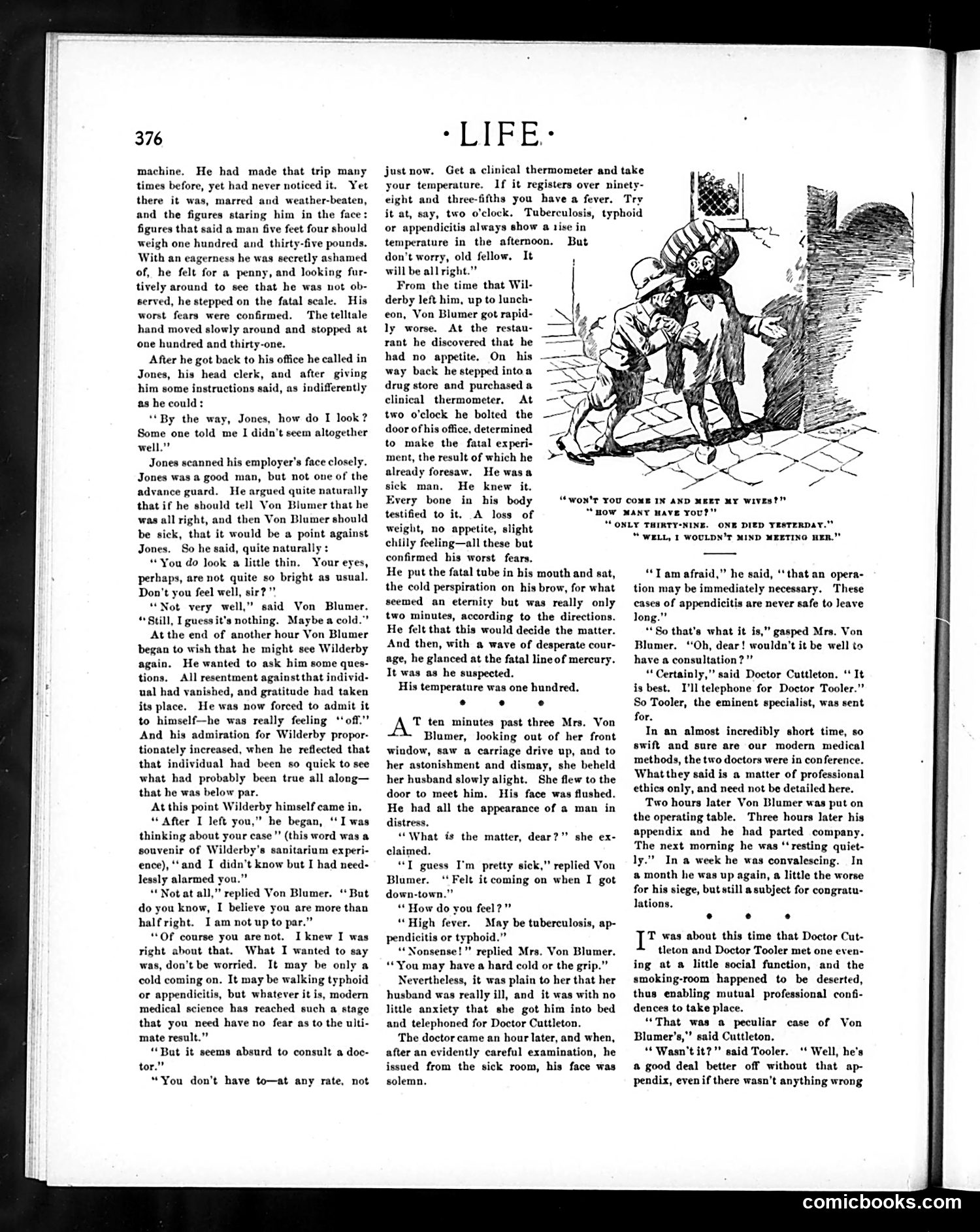
This page illustrates a humorous story about **Von Blumer**, an office worker experiencing health anxiety. The narrative satirizes both hypochondria and pseudo-medical advice-giving. **The setup:** Von Blumer weighs himself, discovers he's four pounds underweight, and becomes convinced he's ill. His head clerk Jones, fearing blame if he reassures his boss who then gets sick, suggests Von Blumer looks unwell. This plants psychological seeds of illness. **The satire's target:** A character named **Wilderby** (appearing to be a medical charlatan or amateur diagnostician) confidently declares Von Blumer sick despite no real examination, citing vague symptoms. Von Blumer's health deteriorates psychosomatically—he becomes actually ill through suggestion alone. **The joke:** The cartoon and text mock how easily people convince themselves of illness through suggestion and how quickly dubious "medical advice" spreads, reflecting early 20th-century anxieties about medical authority and the power of psychological suggestion.
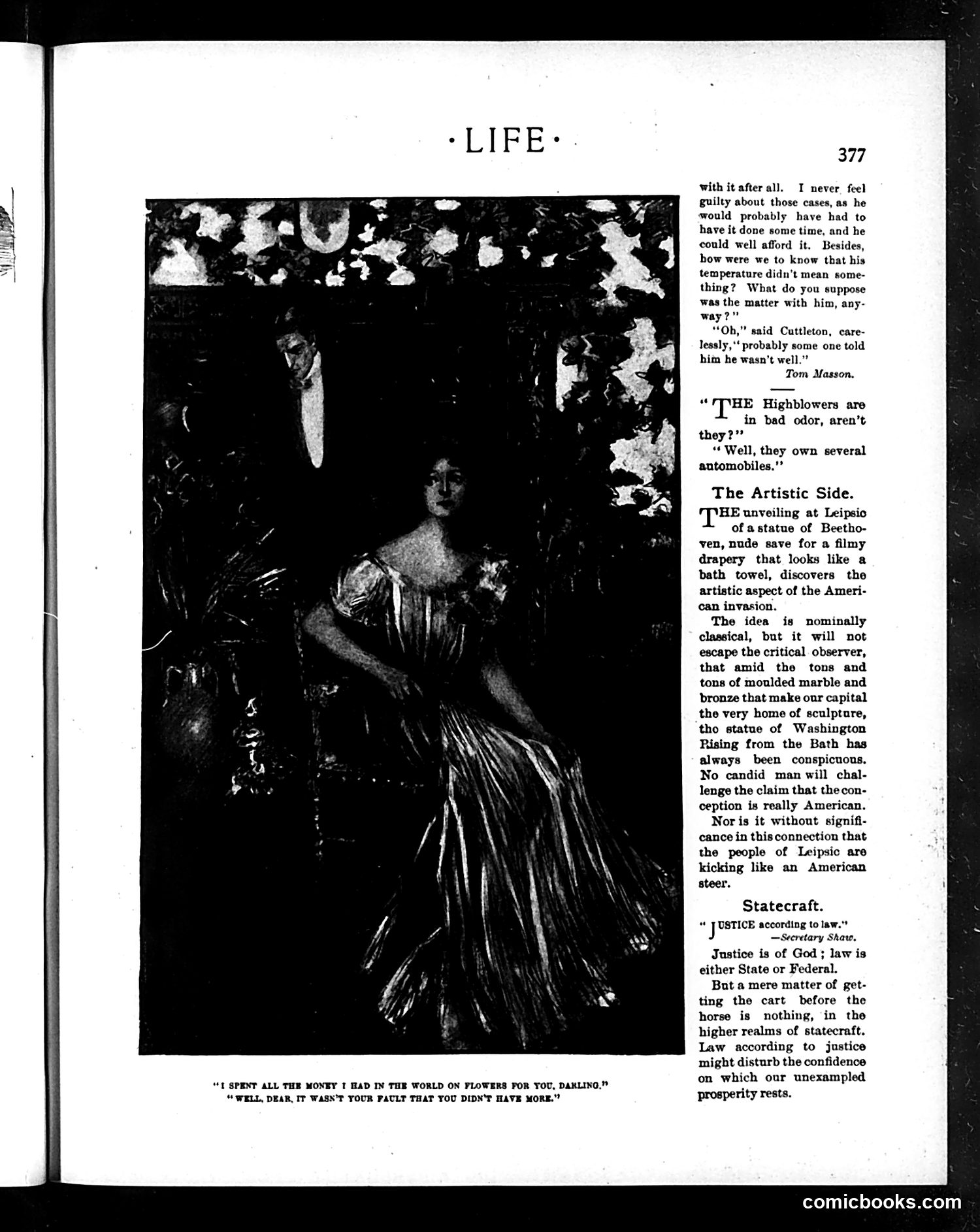
This page contains three brief satirical pieces typical of Life's early 20th-century humor: **The opening dialogue** mocks doctors and wealthy patients' casual attitudes toward unnecessary medical procedures—suggesting the rich could "afford" treatments they didn't truly need. **"The Artistic Side"** satirizes American cultural pretension. A nude Beethoven statue unveiled in Leipzig is criticized as mimicking a supposed American sculpture of "Washington Rising from the Bath"—a fabrication used to mock American claims to classical artistic achievement. The piece jokes that Germans are "kicking like an American steer" at this supposed influence. **"Statecraft"** critiques government prioritizing legal formality over justice, suggesting officials put "the cart before the horse" by following procedure rather than moral principle—and that this protects the wealthy's "prosperity." The accompanying illustration shows a romantic couple; the caption satirizes gender economics: a man spent all his money on flowers for a woman, who consoles him that it "wasn't your fault" he had no more—implying women expect male financial devotion regardless of reality.
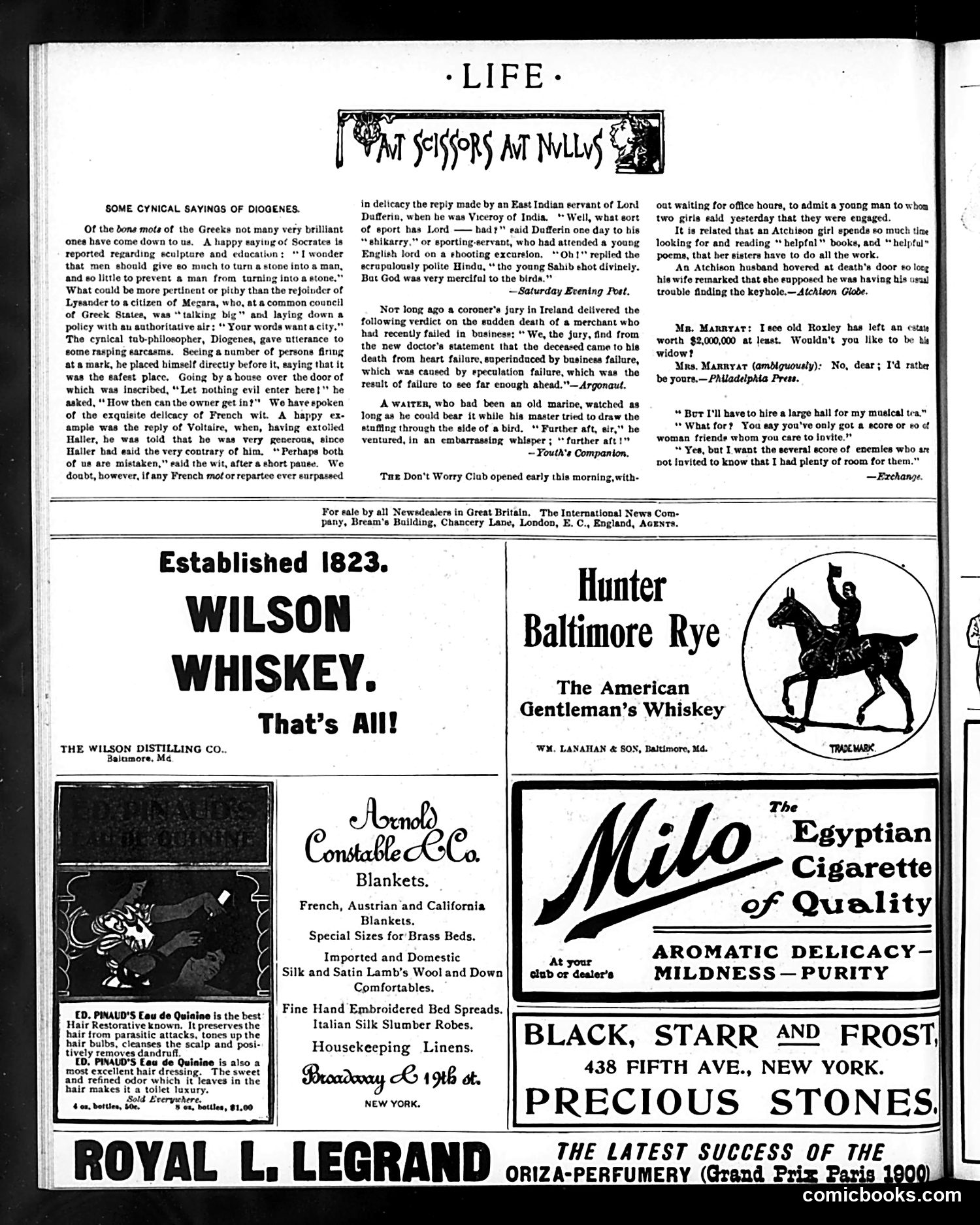
This page from *Life* magazine (early 20th century) is primarily **text and advertisements**, not political cartoons. The upper section collects cynical witticisms attributed to ancient Greek philosophers like Diogenes and Socrates, presenting biting observations about human nature—such as people spending more effort shaping stone than developing character. Below this are several humorous anecdotes or "quips," likely typical of *Life*'s satirical style. One involves an Irish coroner's verdict attributing a merchant's death to cascading failures (business failure caused by speculation failure, etc.)—mocking how people blame external circumstances rather than personal responsibility. The remaining content consists of **period advertisements**: Wilson Whiskey, Hunter Baltimore Rye, Arnold Constable blankets, Milo Egyptian Cigarettes, and precious stones. The page reflects *Life*'s format as a humor and satire magazine mixing classical wit with contemporary jokes and commercial advertisements.
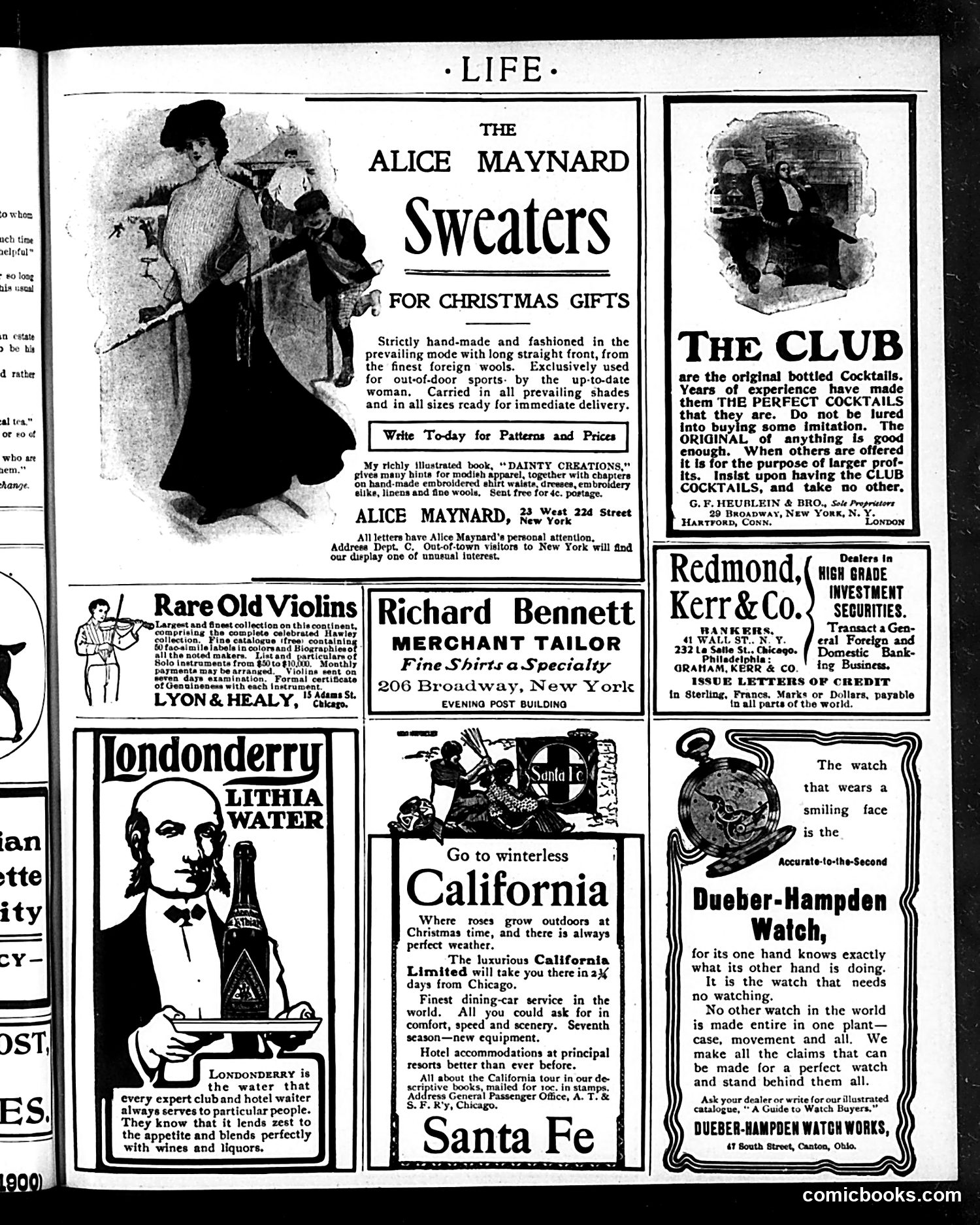
This is **not a cartoon or satire page**, but rather a typical early 20th-century advertisement section from *Life* magazine. The page features luxury goods and services aimed at wealthy readers: Alice Maynard's hand-made sweaters for "up-to-date women," Richard Bennett's bespoke tailoring, Heublein's bottled cocktails (marketed as "original" and superior to imitations), and travel advertisements for California's Santa Fe railway and luxury hotels. Notable is the Londonderry Lithia Water ad, featuring a formal gentleman—likely a celebrity endorsement, though the specific figure is unclear. The Dueber-Hampden Watch employs gentle humor with its "smiling face" design and the pun that "its one hand knows exactly what its other hand is doing." These ads reflect *Life*'s affluent readership and the commercial culture of the era, emphasizing exclusivity, authenticity, and modern leisure.
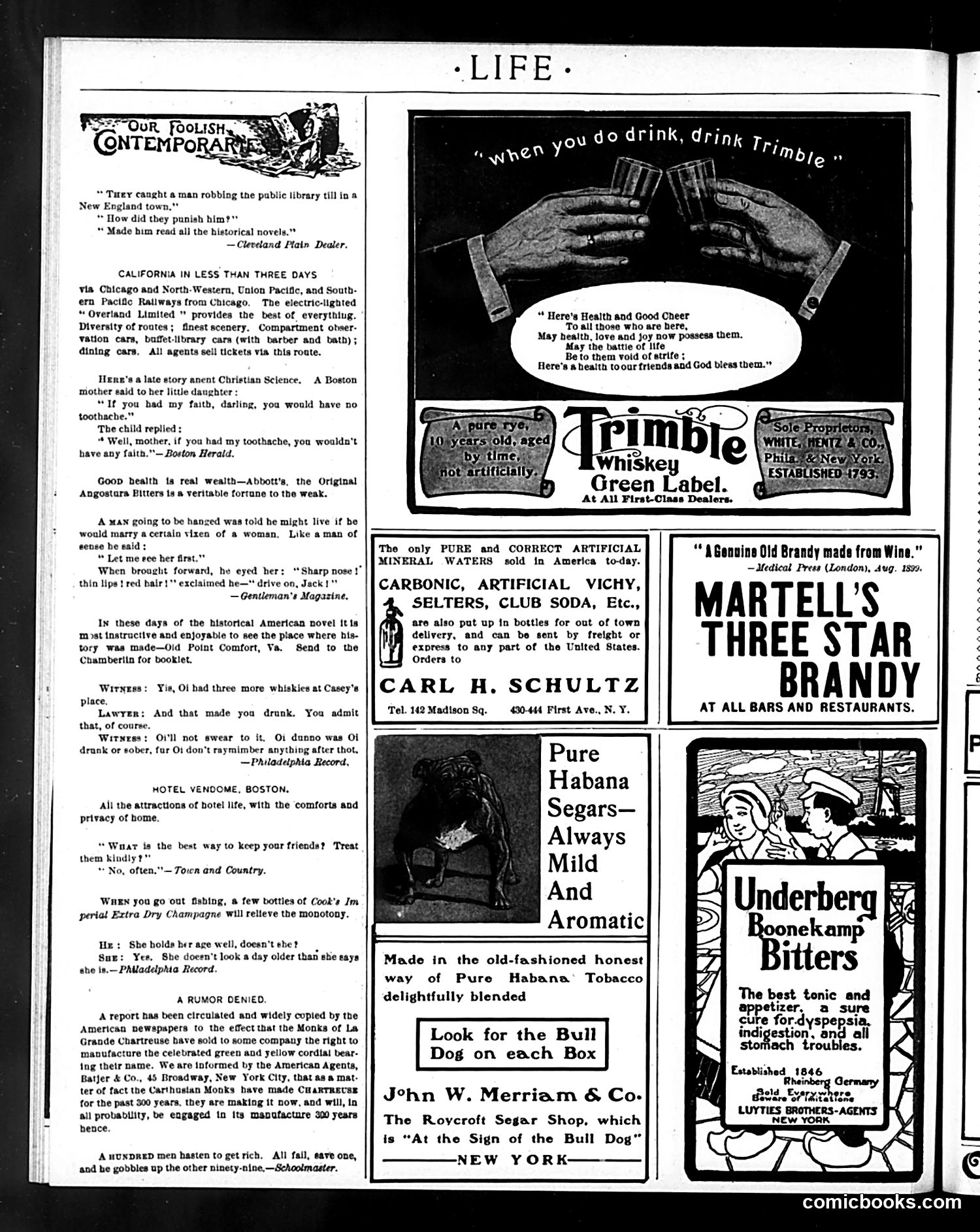
This page is primarily **advertisements interspersed with humorous anecdotes**, typical of Life's format in this era. The satirical content includes brief jokes about: - A library thief punished by reading historical novels (mocking the tedium of such literature) - A Christian Science mother and her toothaching daughter (poking fun at Christian Science faith healing) - A condemned man rejecting marriage to an unattractive woman (dark humor about capital punishment) - Various legal/drunk testimony exchanges (satirizing courtroom absurdity) The bulk of the page consists of **period alcohol and tobacco advertisements**—Trimble whiskey, Martell brandy, Carl Schultz mineral waters, Habana cigars, and Underberg bitters—reflecting turn-of-the-century drinking culture and marketing. One ad includes a verse toasting "health and good cheer." For modern readers: this shows how *Life* blended satirical humor with commercial advertising, and how openly alcohol promotion appeared in magazines. The jokes reflect contemporary attitudes toward faith, capital punishment, and drinking.
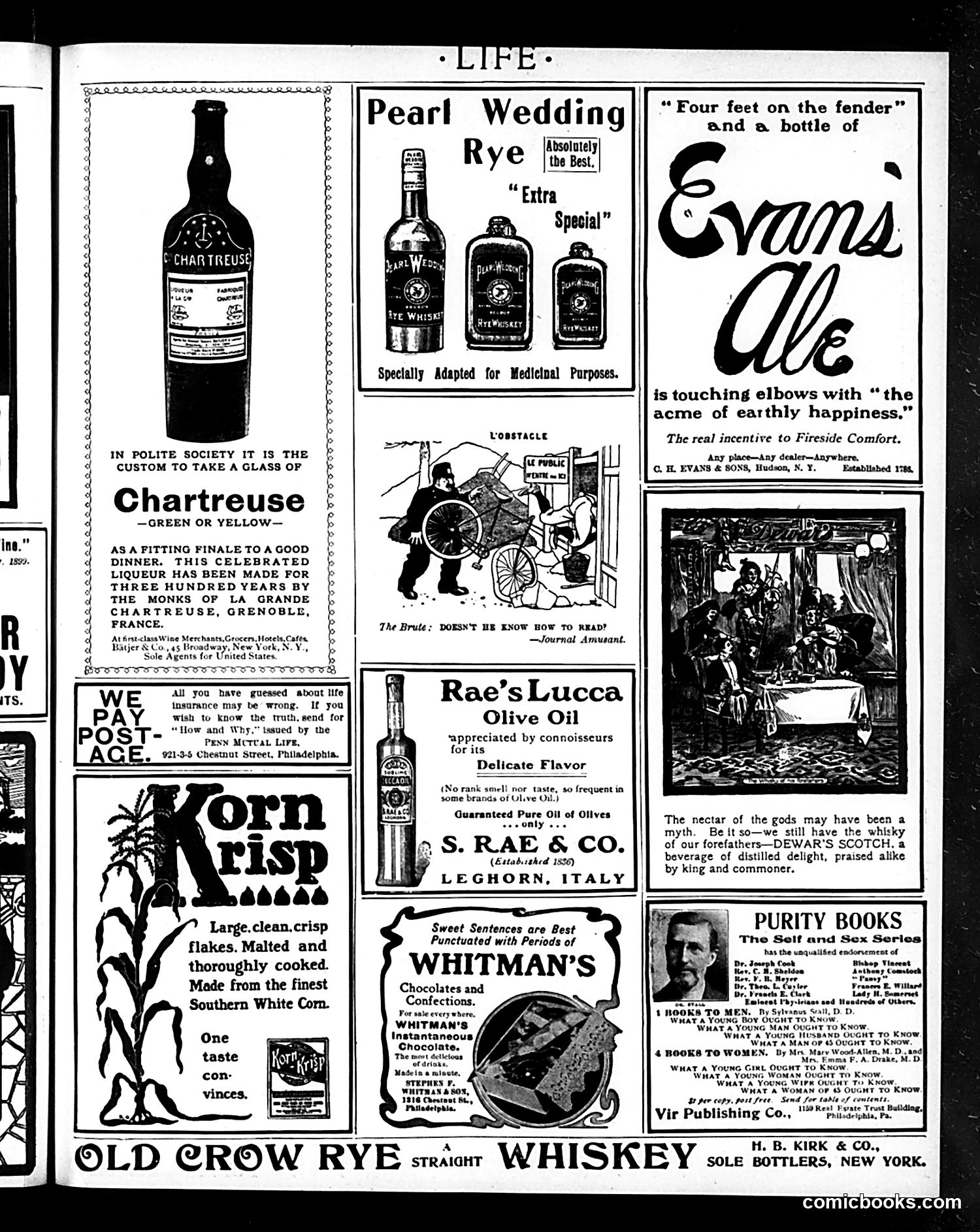
This page is primarily **advertising**, not political satire. It features luxury consumer product ads typical of early 20th-century American magazines. The one cartoon element—labeled "The Brute: DOESN'T HE KNOW HOW TO READ?"—appears to reference a *Journal Amusant* piece showing a man struggling with a bicycle near a sign, suggesting marital discord over his illiteracy or inattention. The ads promote: - **Chartreuse liqueur** as sophisticated after-dinner custom - **Pearl Wedding Rye whiskey** for medicinal purposes - **Evans Ale** as domestic comfort - **Dewar's Scotch** as timeless quality - **Whitman's chocolates**, olive oil, corn flakes, and "Purity Books" (sex education guides) The "Purity Books" ads indicate contemporary anxieties about sexual education and morality—these were marketed as respectable guides despite their sensitive subject matter. Overall, the page reflects Edwardian-era consumer culture and middle-class values around propriety, quality goods, and self-improvement.
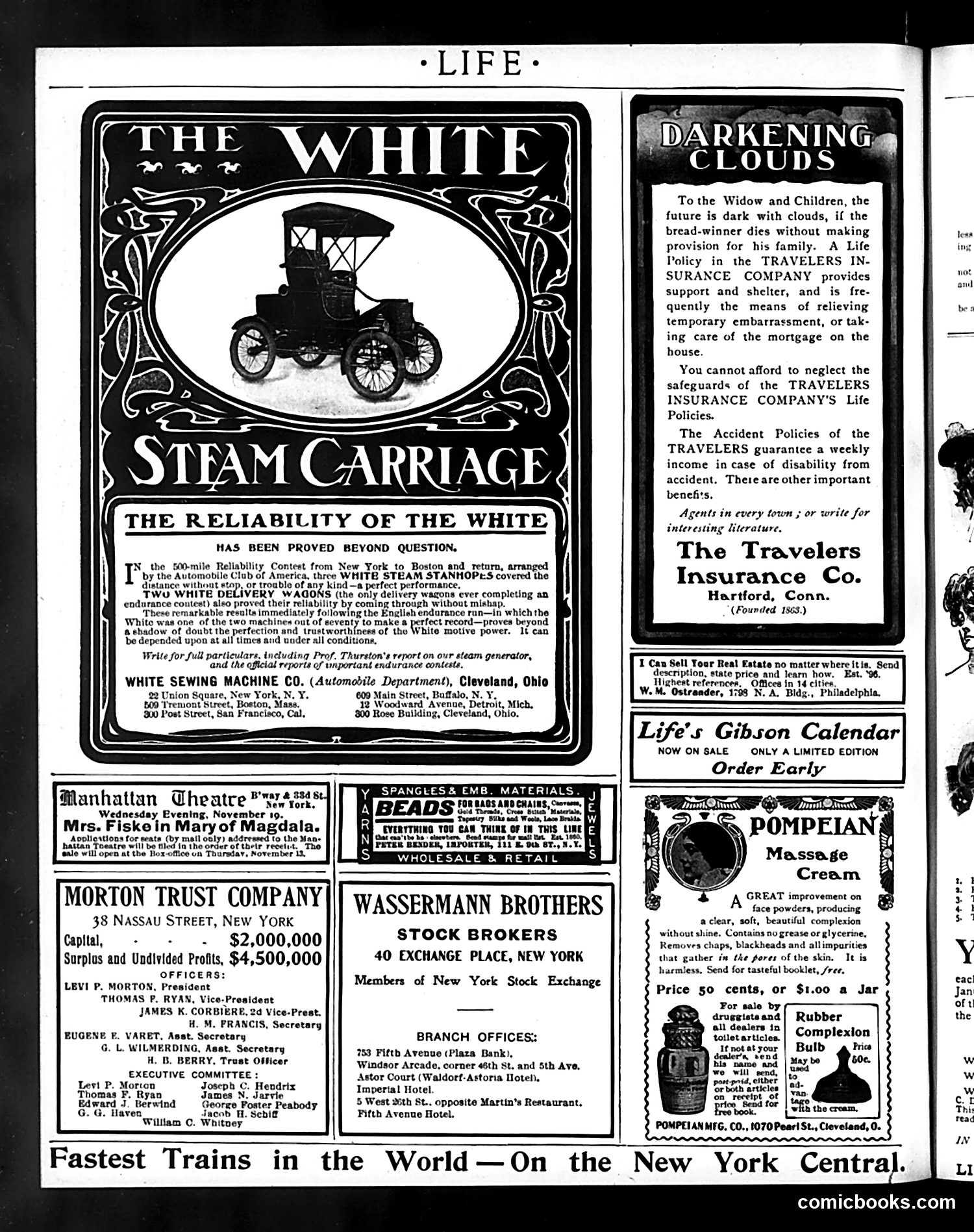
This page is primarily **advertising**, not political satire. It contains multiple commercial advertisements from circa early 1900s, with one notable exception: **The Main Content:** A large ad for White Steam Carriages emphasizes their reliability, citing a 100-mile endurance contest from New York to Boston where three White vehicles completed the journey without trouble. This references actual early automobile reliability races—a major selling point when cars were still new and unreliable. **The "Darkening Clouds" Ad:** The Travelers Insurance Company uses fear-based marketing, warning widows about financial hardship if breadwinners die without life insurance—common messaging of the era. **Other Ads:** Include theatrical promotion (Mrs. Fiske in a play), financial services (Morton Trust Company), stock brokers, beauty cream, and embellishment suppliers. **No Political Cartoon:** This page contains no satire or political commentary—it's a straightforward commercial publication typical of *Life* magazine's advertiser-supported model.
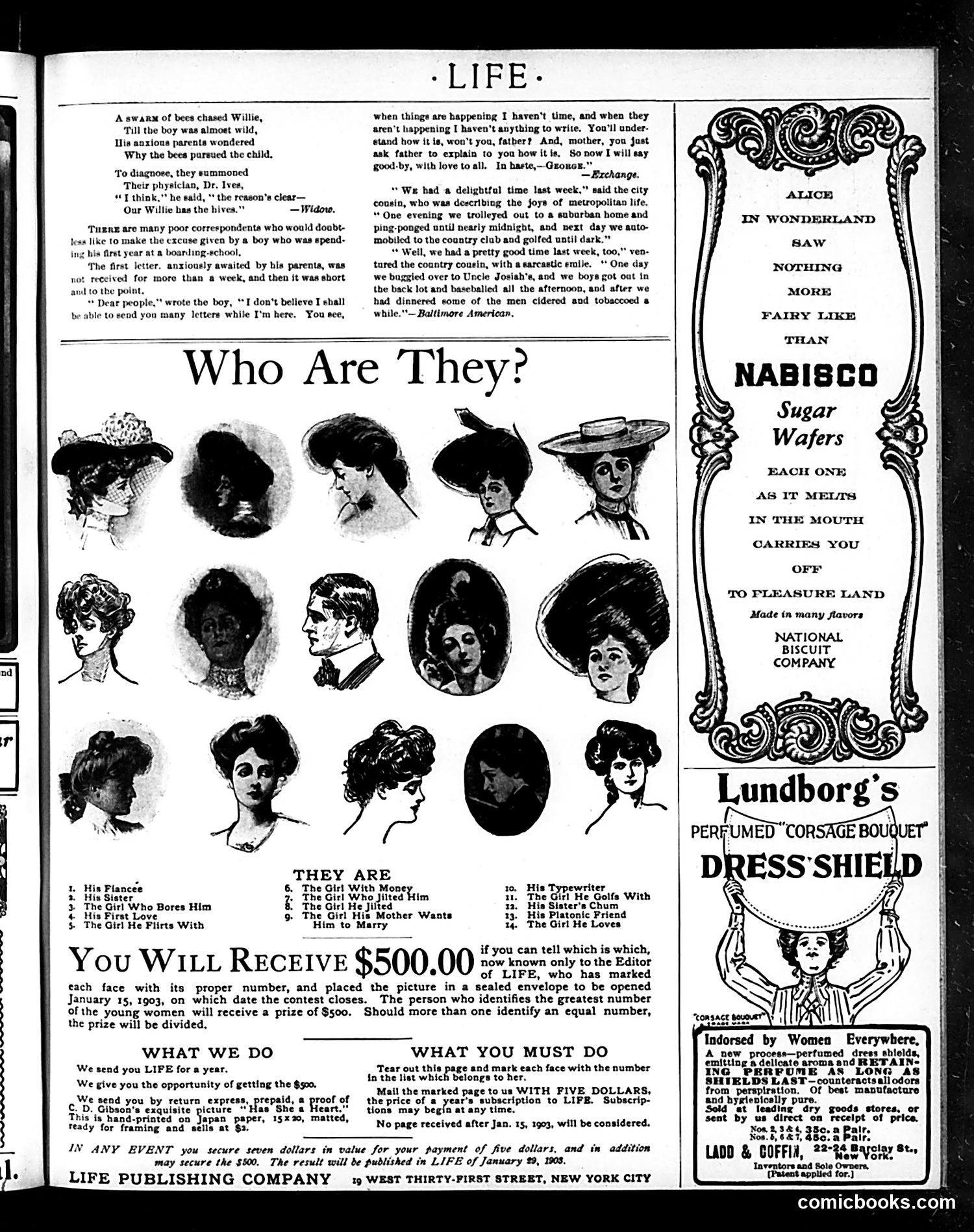
This page features a **puzzle-contest advertisement** from Life magazine (circa 1902-1903). Readers are presented with 15 portrait sketches of young women and must identify which sketch corresponds to each numbered relationship category (e.g., "His Fiancée," "The Girl Who Jilted Him," "His Sister's Chum"). The contest mechanics are straightforward: match faces to roles, mail the marked page with a $5 subscription fee, and compete for a $500 prize (substantial money then). The winner would be announced January 29, 1903. **The satire**: This reflects early-1900s urban social life—the bewildering variety of female relationships a young man might navigate. The categories mock the era's dating customs and social complexity. The page also contains humorous anecdotes about boarding school and a city-versus-country social comparison, plus advertisements for Nabisco wafers and Lundborg's perfumed dress shields—period products now historical curiosities.
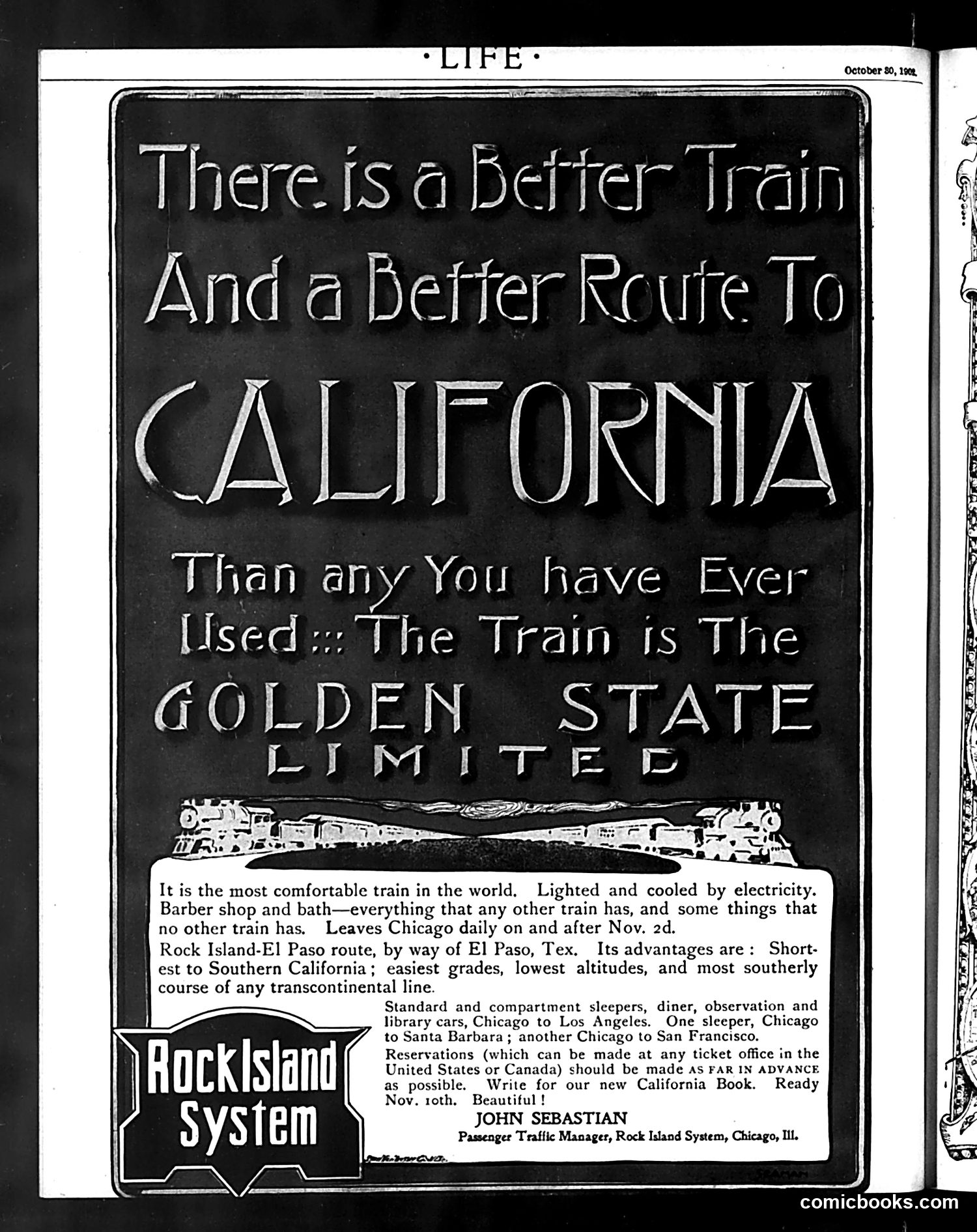
This is not a cartoon or satire—it's a **railroad advertisement** for the Rock Island System's "Golden State Limited" train service to California. The page promotes a luxury transcontinental train departing Chicago daily (after November 2nd) bound for Southern California via El Paso, Texas. The ad emphasizes the train's superior comfort: electric lighting and cooling, barber shop, bath facilities, sleeping cars, dining car, and observation/library cars. The marketing pitch highlights competitive advantages: the shortest route to Southern California, easiest grades, lowest altitudes, and most southerly routing compared to rival transcontinental lines. John Sebastian, the Passenger Traffic Manager, signed the ad and encouraged advance reservations through ticket offices. A new California promotional book was promised for November 10th. This represents early 20th-century luxury rail travel marketing during the era when trains were the primary long-distance transportation method—before automobiles and commercial aviation became dominant.