
Life, 1902-10-30 · page 4 of 22
Life — October 30, 1902 — page 4: what you’re looking at
What you’re looking at
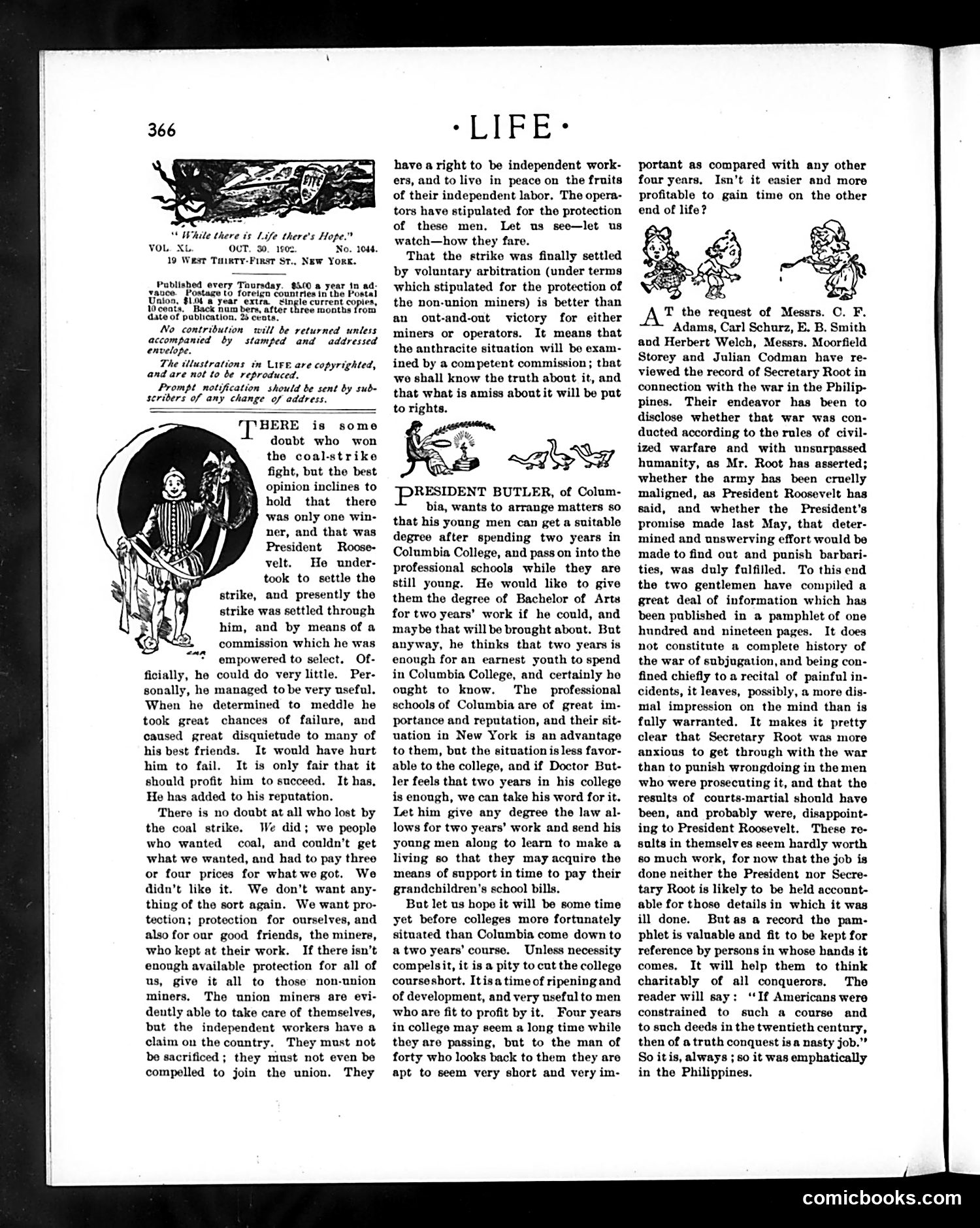
The page contains editorial commentary on labor disputes and education policy. The left column discusses a coal strike, referencing "President Roosevelt" and concerns about miners' rights and union membership. The right column addresses President Butler of Columbia College, who wants to grant Bachelor of Arts degrees for two years of college work. The author argues this would be premature—that serious students need four years of study. The commentary criticizes Butler's proposal as cost-cutting that would shortchange educational rigor. The decorative illustrations appear to be generic allegorical figures rather than specific caricatures of identifiable individuals. The page reflects early 20th-century debates about labor protections, executive power, and educational standards—themes that remain contemporary.
📄 Transcribed text from this page (OCR, searchable)
Machine-transcribed from the original scan — historical spelling and the odd misread are preserved.
“While there is Life there's Hope.” VOL. XL. OCT. 3. 1902. No. 1044. 19 West Taety-Finst St., NEw YORK. Published every Toursday. $300 a year in ad. Yavee. Postage to foreign countries in the Postal Union, $100 @ year extra. eingle current copies, Wceats, num bers, after three months from date of publication. 25 cents. No contribution will be returned unless accompanied by stamped and addressed envelope. The illustrations in LIFE are copyrighted, and are not to be reproduced. Prompt notification should be sent by sub- scribes of any change of address. ‘THERE is some doubt who won the coal-strike fight, but the best opinion inclines to hold that there ‘was only one win- ner, and that was President Roose- velt. He under- took to settle the strike, and presently the strike was settled through him, and by means of a commission which he was empowered to select, Of- ficially, he could do very little. Per- sonally, he managed to be very useful. When he determined to meddle he took great chances of failure, and caused great disquietude to many of his best friends. It would have hurt him to fail. It is only fair that it should profit him to succeed. It has, He has added to his reputation. There is no doubt at all who lost by the coal strike. We did; we people who wanted coal, and couldn’t get what we wanted, and had to pay three or four prices for what we got. We didn’t like it. We don’t want any- thing of the sort again. We want pro- tection; protection for ourselves, and also for our good friends, the miners, who kept at their work. If there isn’t enongh available protection for all of us, give it all to those non-union miners. The union miners are evi- dently able to take care of themselves, but the independent workers have a claim on the country. They must not be sacrificed; they must not even be compelled to join the union. They “LIFE * have a right to be independent work- ers, and to live in peace on the fruits of their independent labor, The opera- tors have stipulated for the protection of these men. Let us see—let us watch—how they fare. That the strike was finally settled by voluntary arbitration (under terms which stipulated for the protection of the non-union miners) is better than an out-and-out victory for either miners or operators. It means that the anthracite situation will be exam- ined by a competent commission; that we shall know the truth about it, and that what is amiss about it will be put RESIDENT BUTLER, of Colum- bia, wants to arrange matters so that his young men can get a suitable degree after spending two years in Columbia College, and pass on into the professional schools while they are still young. He would like to give them the degree of Bachelor of Arts for two years’ work if he could, and maybe that will be brought about. But anyway, he thinks that two years is enough for an earnest youth to spend in Columbia College, and certainly ho ought to know. The professional schools of Columbia are of great im- portance and reputation, and their sit- uation in New York is an advantage to them, but the situation is less favor- able to the college, and if Doctor But- ler feels that two years in his college is enough, we can take his word for it. Let him give any degree the law al- lows for two years’ work and send his young men along to learn to make a living so that they may acquire the means of support in time to pay their grandchildren’s school bills. But let us hope it will be some time yet before colleges more fortunately situated than Columbia come down to a two years’ course. Unless necessity compelsit, it is a pity to cut the college courseshort. Itisa time of ripening and of development, and very useful to men who are fit to profit by it. Four years in college may seem a long time while they are passing, but to the man of forty who looks back to them they are apt to seem very short and very im- portant as compared with any other four years, Isn’t it easier and more profitable to gain time on the other end of life? At the request of Messrs. O. F. Adams, Carl Schurz, E. B. Smith avd Herbert Welch, Messrs. Moorfield Storey and Julian Codman have re- viewed the record of Secretary Root in connection with the war in the Philip- pines. Their endeavor has been to disclose whether that war was con- ducted according to the rules of civil- ized warfare and with unsurpassed humanity, as Mr. Root has asserted; whether the army has been cruelly maligned, as President Roosevelt has said, and whether the President's promise made last May, that deter- mined and unswerving effort would be made to find out and punish barbari- ties, was duly fulfilled. To this end the two gentlemen have compiled a great deal of information which has been published in a pamphlet of one hundred and nineteen pages. It does not constitute a complete history of the war of subjugation, and being con- fined chiefly to a recital of painful in- cidents, it leaves, possibly, a more dis- mal impression on the mind than is fally warranted. It makes it pretty clear that Secretary Root was more anxious to get through with the war than to punish wrongdoing in the men who were prosecuting it, and that the results of courts-martial should have been, and probably were, disappoint- ing to President Roosevelt. These re- sults in themselves seem hardly worth so much work, for now that the job is done neither the President nor Secre- tary Root is likely to be held account- able for those details in which it was ill done. Butas a record the pam- phlet is valuable and fit to be kept for reference by persons in whose hands it comes, It will help them to think charitably of all conquerors. The reader will say: ‘If Americans were constrained to such a course and to such deeds in the twentieth century, then of a truth conquest isa nasty job.” So itis, always ; so it was emphatically in the Philippines. comicbooks.com