
A complete issue · 20 pages · 1902
Life — August 21, 1902
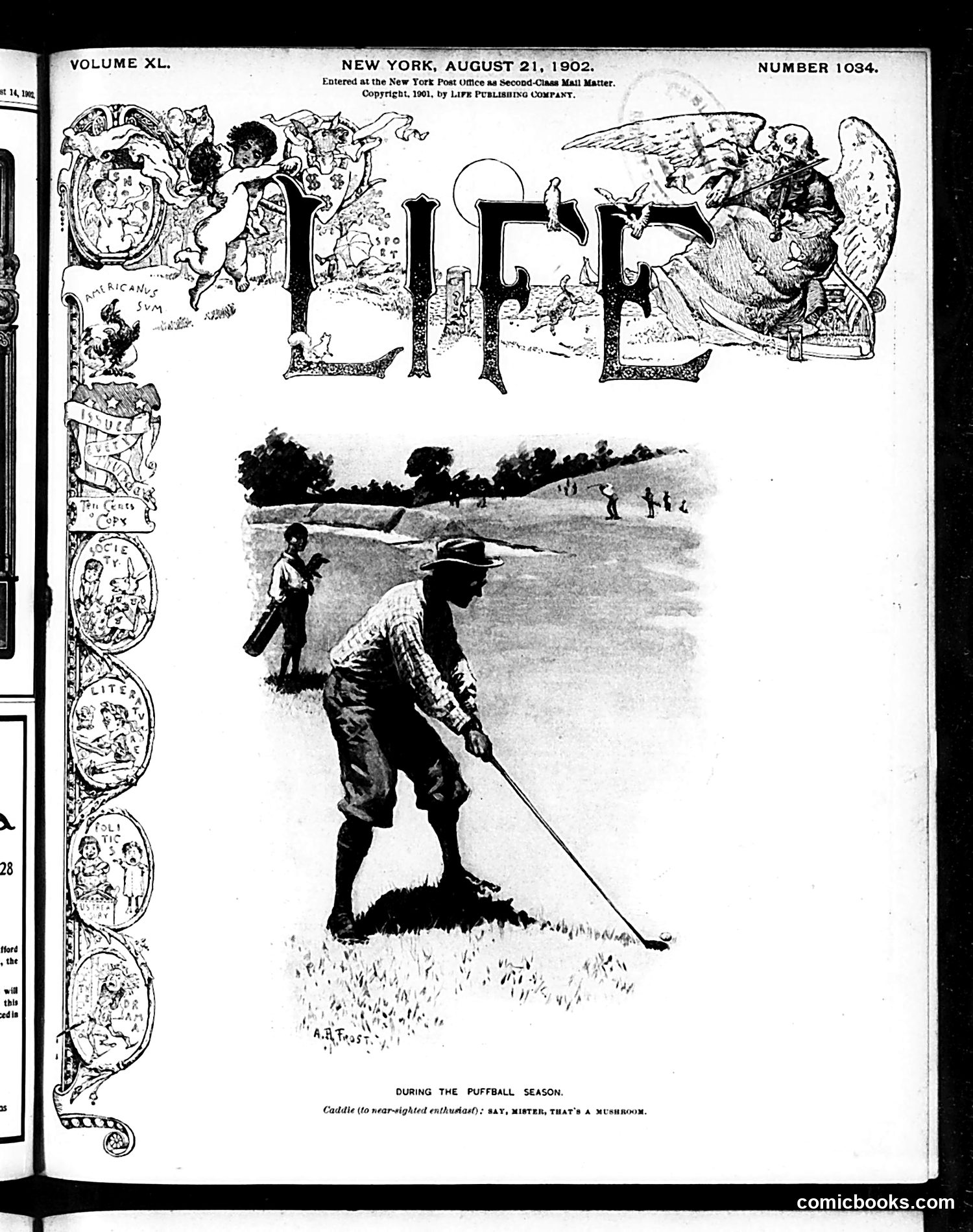
This page features a golf illustration captioned "During the Puffball Season" with the subtitle "Caddie (to near-sighted enthusiast): Say, Mister, That's a Mushroom." The cartoon depicts a golfer about to strike what he believes is a golf ball, but which is actually a puffball mushroom—a fungus that resembles a small white sphere. The humor relies on the golfer's poor eyesight and the caddie's dry observation of his mistake. This appears to be gentle satire mocking golfers, a sport gaining popularity among the American leisure class in the early 1900s. The joke suggests absent-minded enthusiasm among wealthy amateur golfers, poking fun at both the sport and its practitioners' inattentiveness during the mushroom-growing season.
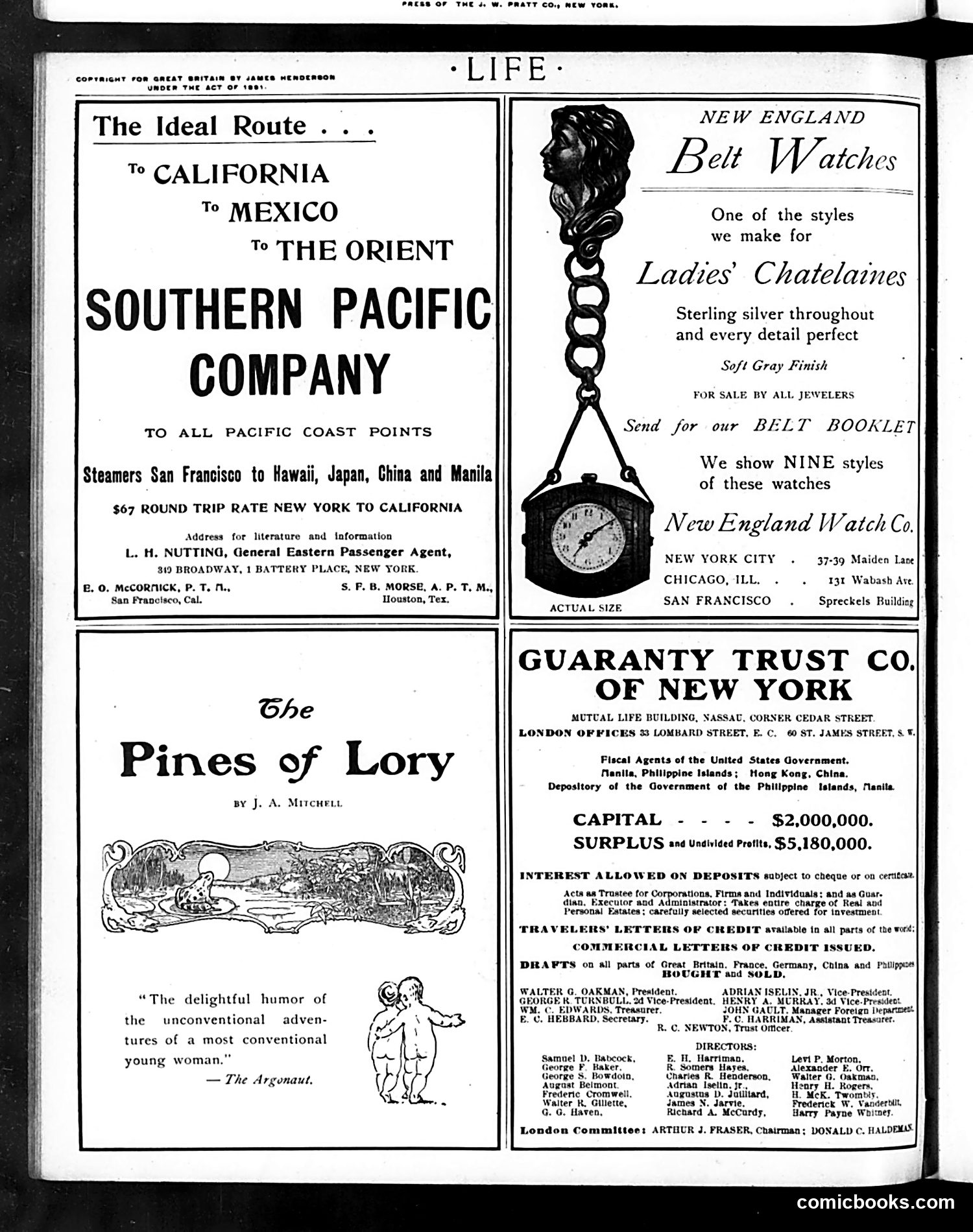
This page is **primarily advertisements** with minimal satirical content. The ads include: - Southern Pacific Company (steamship travel to California and Asia) - New England Belt Watches (sterling silver accessories for women) - Guaranty Trust Co. of New York (financial services) The only potentially satirical element is **"The Pines of Lory"** by J. A. Mitchell—a book advertisement featuring a cherub illustration. The tagline from *The Argonaut* describes it as "the delightful humor of the unconventional adventures of a most conventional young woman," suggesting gentle satire of social conventions, though the full context of the book's content remains unclear from this page alone. Overall, this appears to be a standard magazine page mixing commercial advertising with book promotion rather than primarily political or social satire.
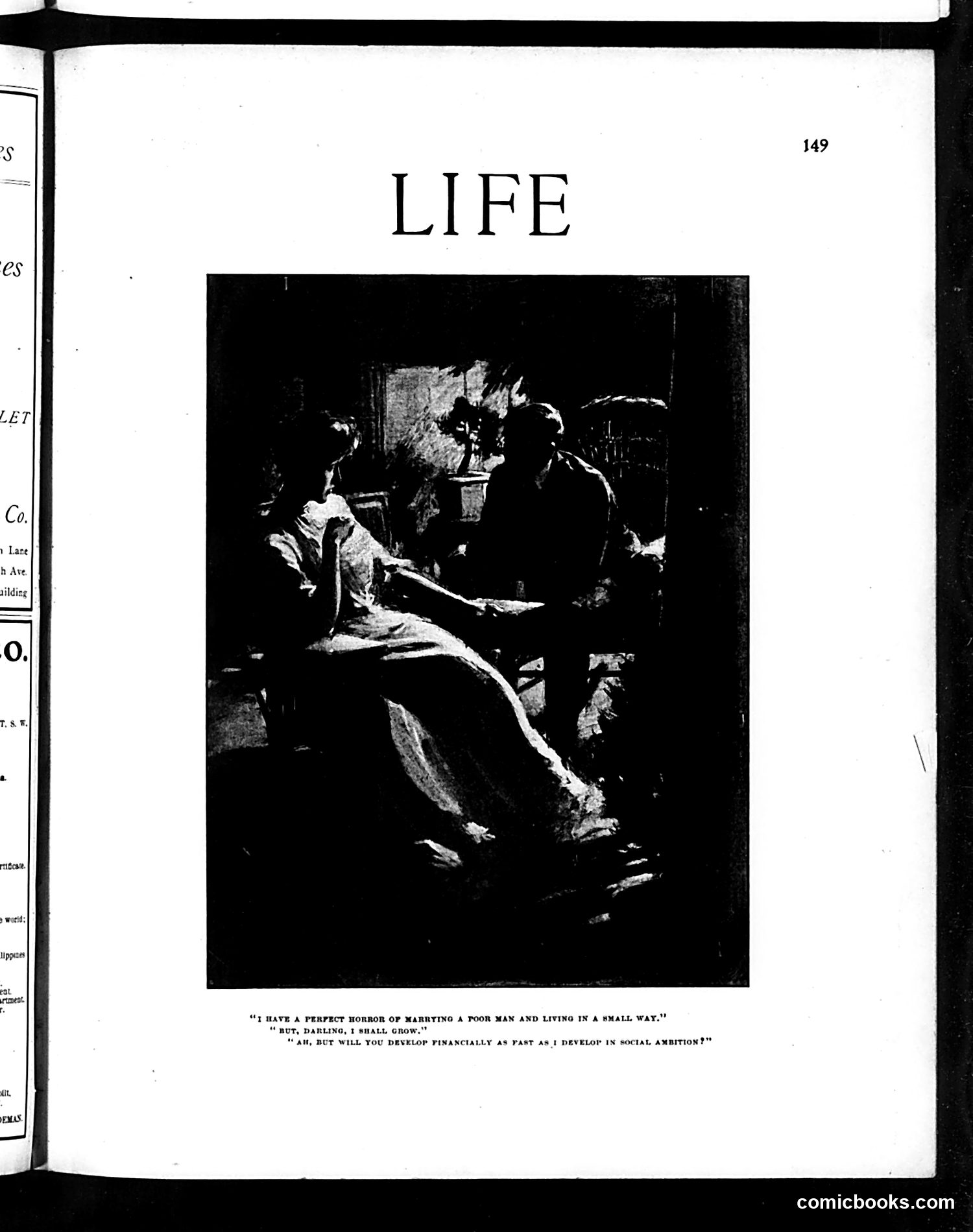
This page presents a darkly lit dramatic scene depicting what appears to be a marital dispute or domestic confrontation. The quoted text below the image addresses anxieties about marriage and financial security. A woman appears distressed while speaking with a man, with other figures present in the shadowy interior. The dialogue suggests satire about gender roles and economic anxiety: a woman expresses horror at marrying "a poor man and living in a small way," while the male response questions whether she'll "develop financially as fast as [she] develop[s] in social ambition." The cartoon mocks both feminine materialism and masculine financial insecurity—common themes in early 20th-century Life magazine satire about courtship, class anxiety, and marriage expectations.
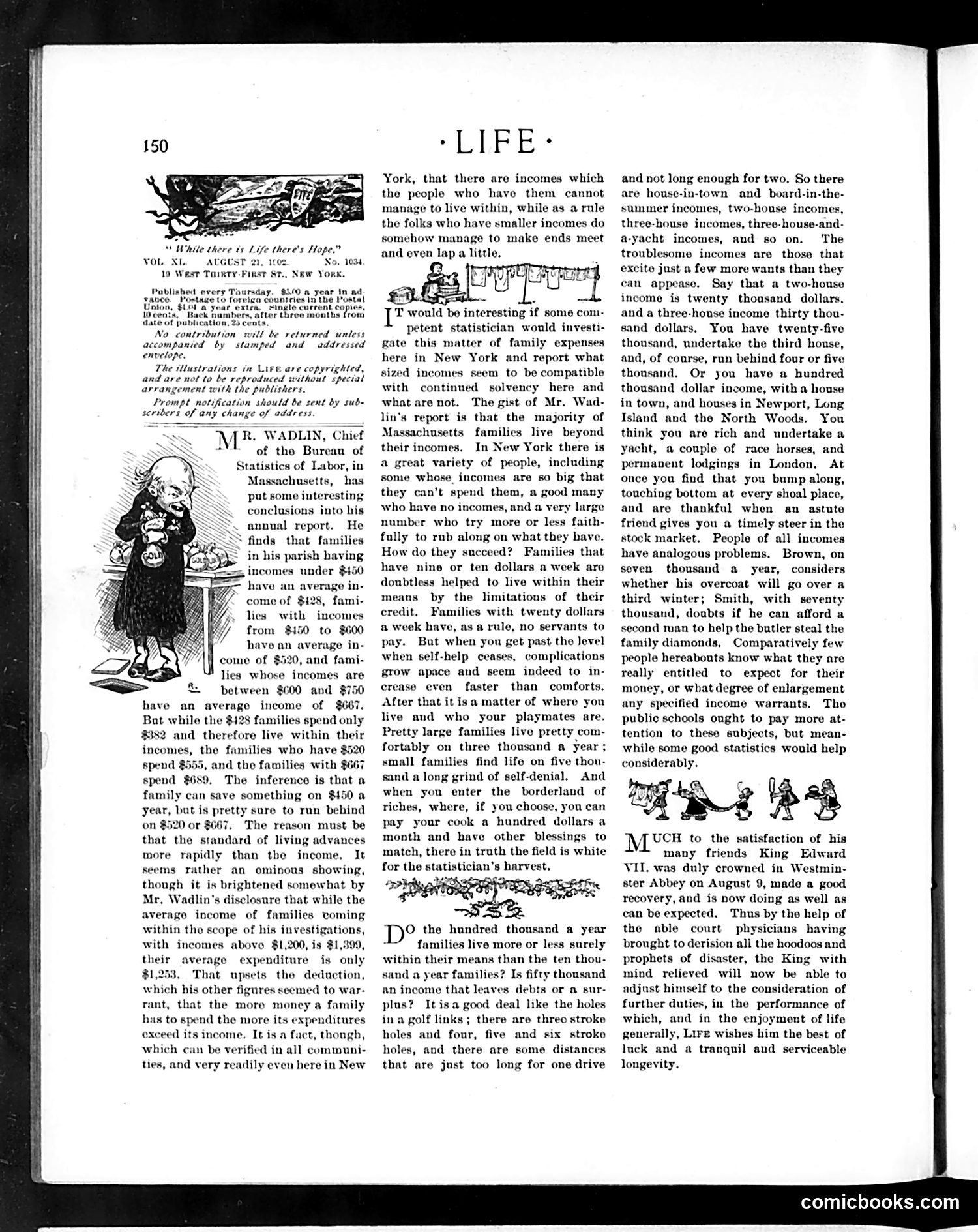
This page discusses family incomes and living standards in early 1900s America, featuring commentary by Mr. Wadlin, Chief of the Bureau of Statistics of Labor in Massachusetts. The left margin contains an illustration of a woman (likely representing the working-class housewife) managing household finances with limited means—a visual representation of the article's subject matter about families living on modest incomes between $150-$800 annually. The text analyzes how different income levels afford varying standards of living, noting that families earning $150-$300 struggle financially, while those with $800-$1,233 can maintain more comfortable circumstances. The satire appears gentle, using the statistician's dry analysis to illustrate economic disparities and the challenges of middle and working-class household management in the Progressive Era.
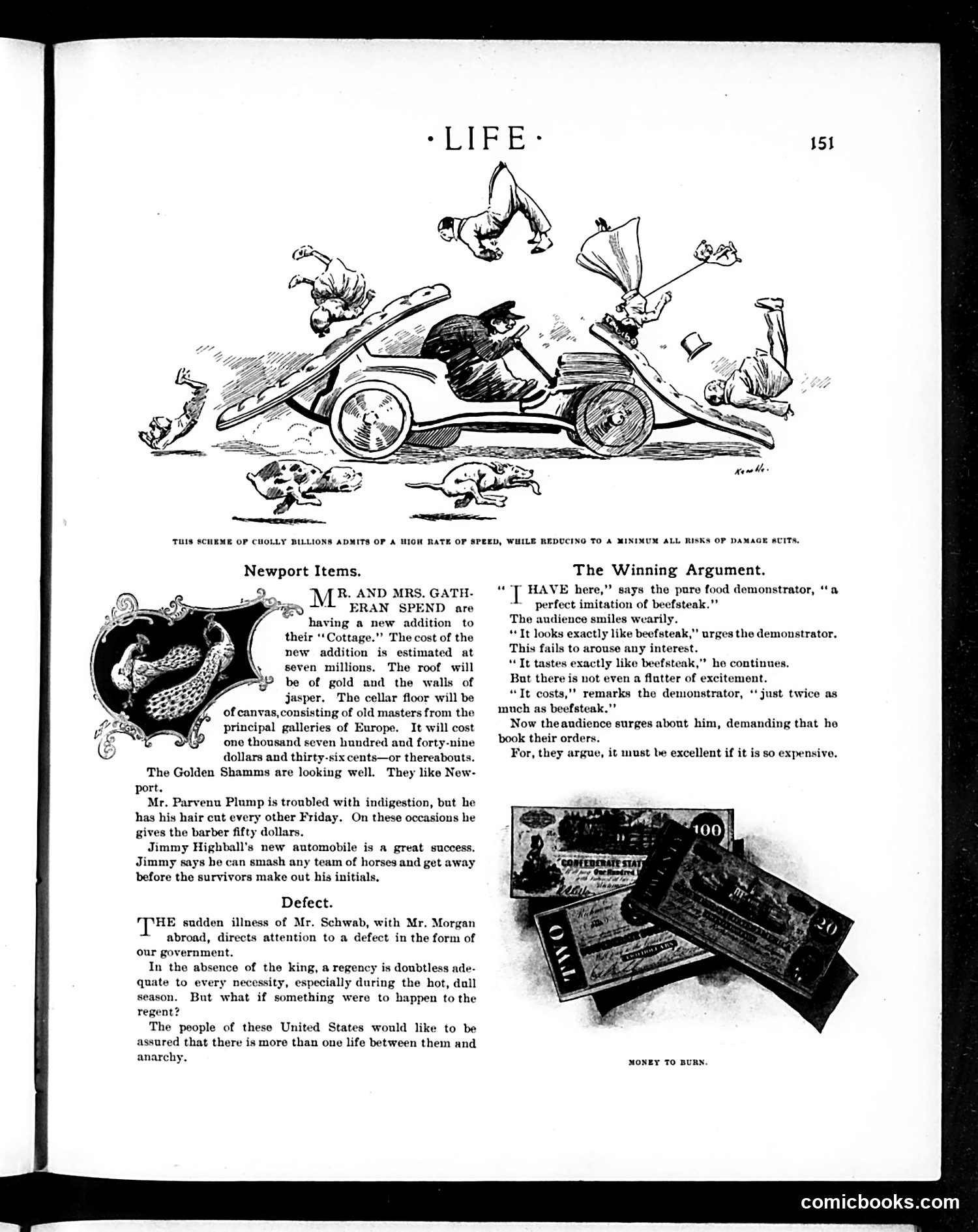
**Main Cartoon:** The large illustration depicts an absurd automobile contraption designed to achieve "high rate of speed, while reducing to a minimum all risks of damage suits." It's a satirical commentary on reckless driving and litigation culture—suggesting that wealthy drivers (particularly in Newport, a wealthy enclave) built ridiculous vehicles to evade legal responsibility for accidents. **Supporting Items:** - "Newport Items" mocks wealthy socialites (Mr. and Mrs. Gatheran) and their extravagant spending habits - "The Winning Argument" satirizes a food demonstrator unable to impress customers despite claims of superiority - "Defect" critiques governmental leadership vacuums during political crises The page reflects early 20th-century anxieties about automobile safety, wealth inequality, and political stability, presented through biting social humor characteristic of *Life* magazine's satirical tradition.
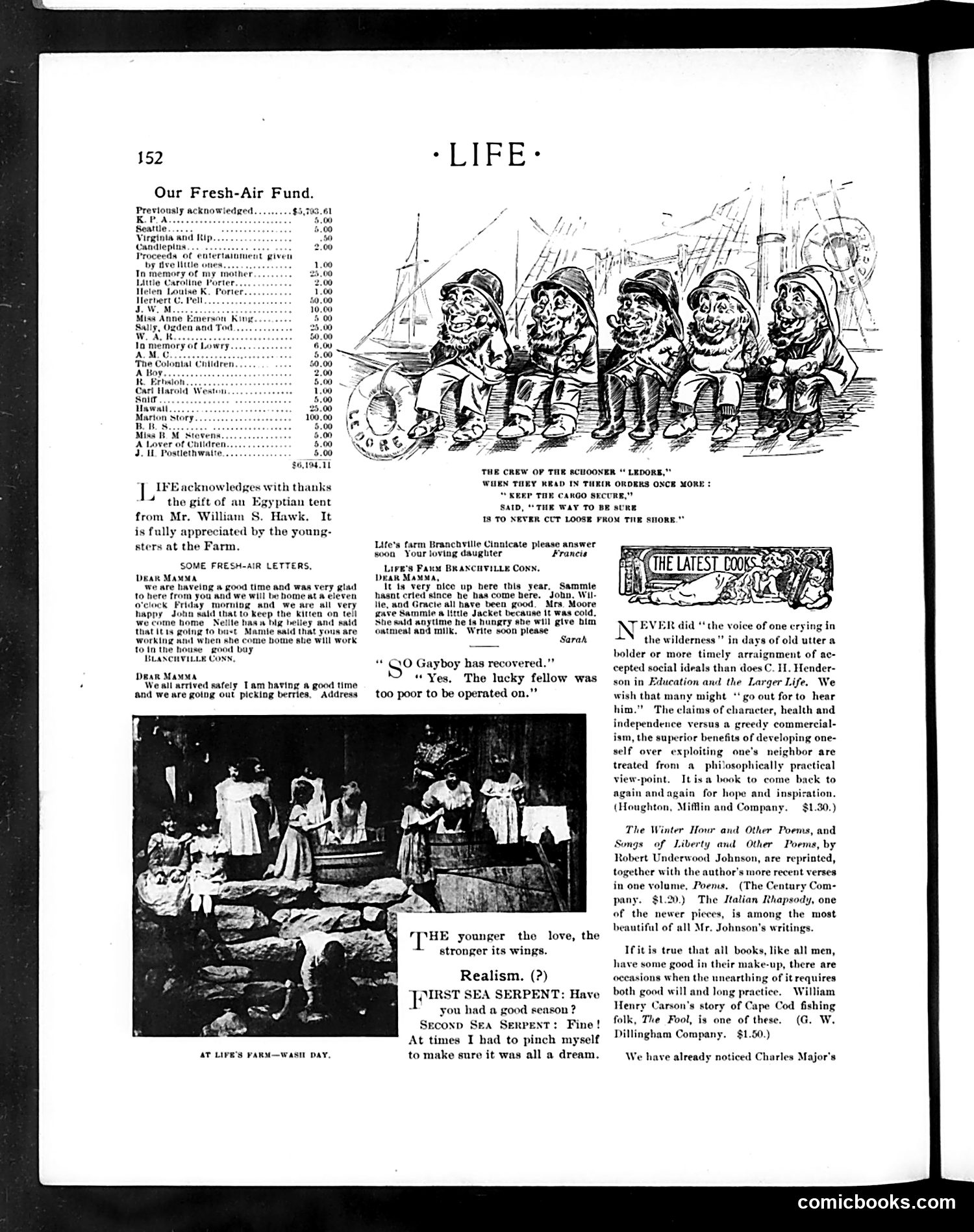
This page contains a satirical cartoon titled "The Crew of the Schooner 'Ledore'" depicting five grotesquely caricatured sailors on a ship. The exaggerated facial features and seated positions suggest mockery of specific individuals, though their identities aren't explicitly labeled here. Below is a photograph labeled "At Life's Farm—Wash Day" showing what appears to be a domestic scene with multiple figures. The page also includes a "Fresh-Air Fund" donation list and readers' letters discussing farm life experiences. Without additional context identifying the specific sailors being caricatured, the exact political or social targets remain unclear, though the crude exaggeration typical of early 20th-century Life magazine satire suggests commentary on contemporary public figures or social types.
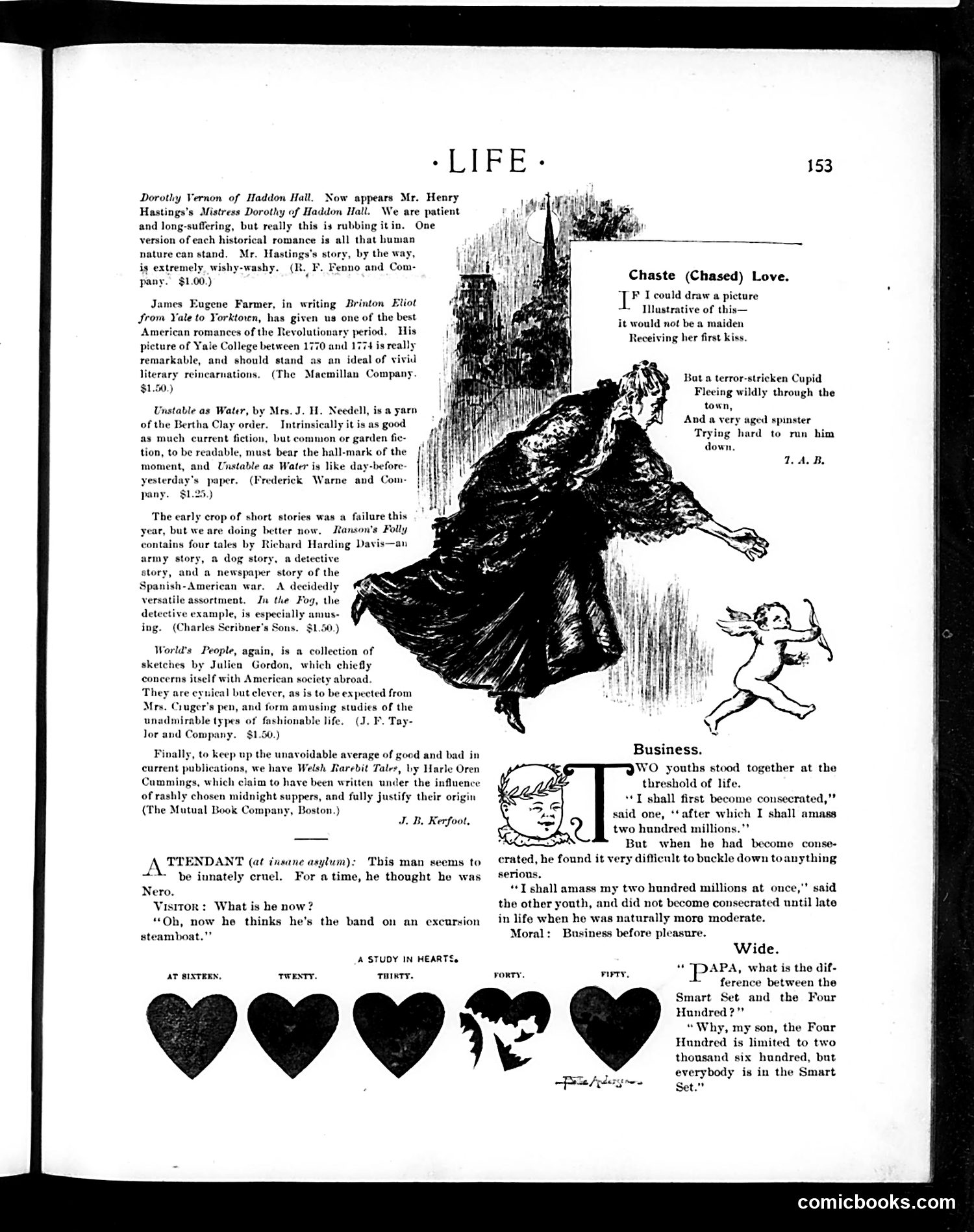
This page contains several literary reviews and humorous short pieces rather than political cartoons. **"Chaste (Chased) Love"** is a poem illustrated with a dramatic woodcut showing a woman fleeing while Cupid pursues her—a playful visual pun on "chaste" versus "chased." **"Business"** presents a dialogue between two youths debating whether to pursue pleasure or accumulate wealth, concluding with the moral that "Business before pleasure." **"A Study in Hearts"** displays five heart illustrations labeled by age (at sisters, twenty, thirty, forty, fifty), visually tracking romantic sentiment across a woman's lifespan. **"Wide"** contains a brief joke about social class distinctions between the "Smart Set" and the "Four Hundred" (wealthy elite). The page reflects early 20th-century upper-class social concerns and gender dynamics through gentle satire.
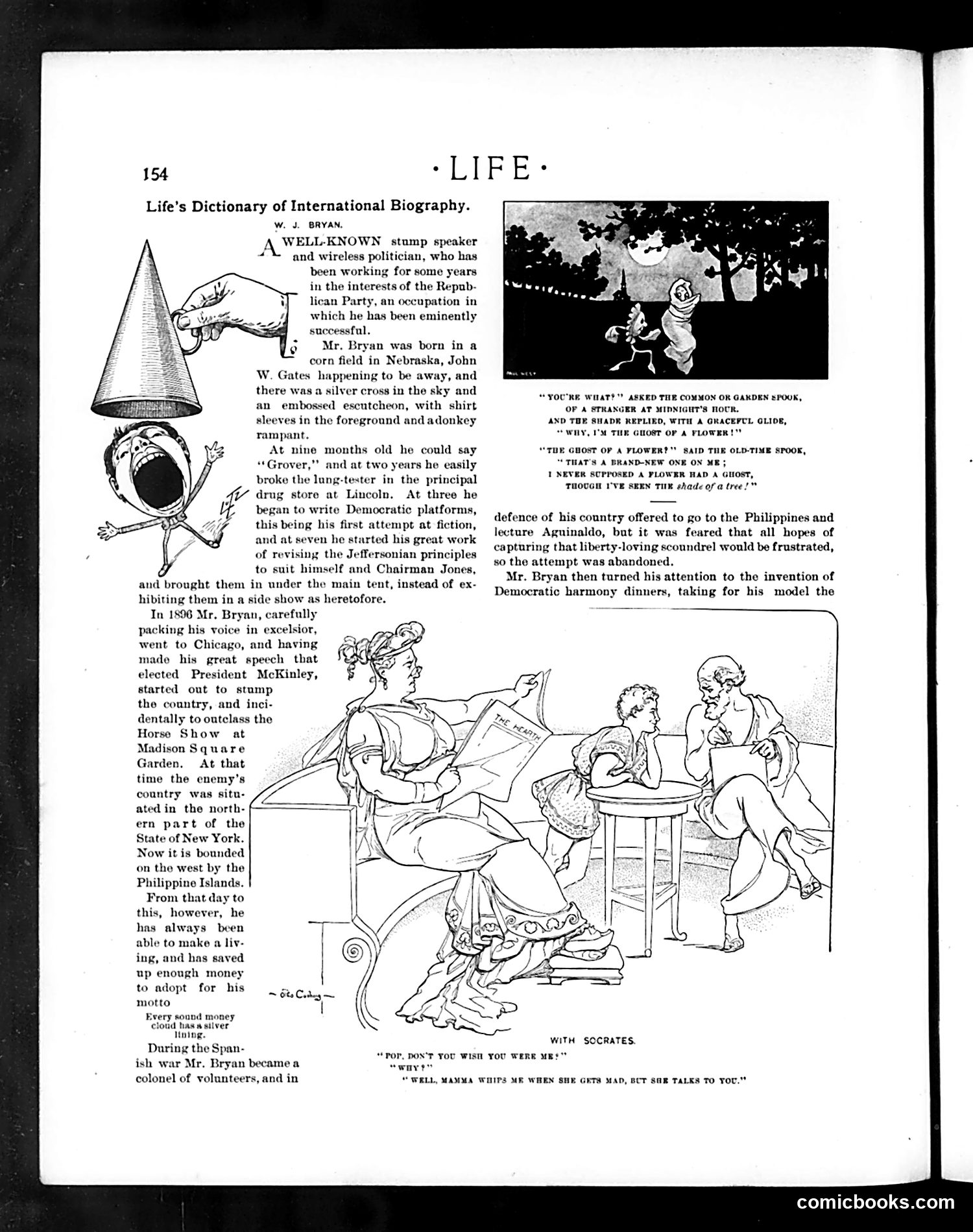
This page features **William Jennings Bryan**, a prominent Republican politician and stump speaker. The biographical entry describes his early life in Nebraska, his rise as a Democratic voice, and his 1896 speech that elected President McKinley. The lower cartoon satirizes **Bryan's "Democratic harmony dinners."** The illustration shows classical figures (appearing to reference Socrates based on the caption) at a banquet. The joke critiques these dinners as theatrical attempts to create party unity—essentially propaganda events. The caption "Why, I'm the ghost of a flower" and dialogue about wishing someone were present suggests the dinners were hollow performances masking actual Democratic discord and absent leadership, mocking Bryan's efforts to manufacture party cohesion through ceremonial gatherings.
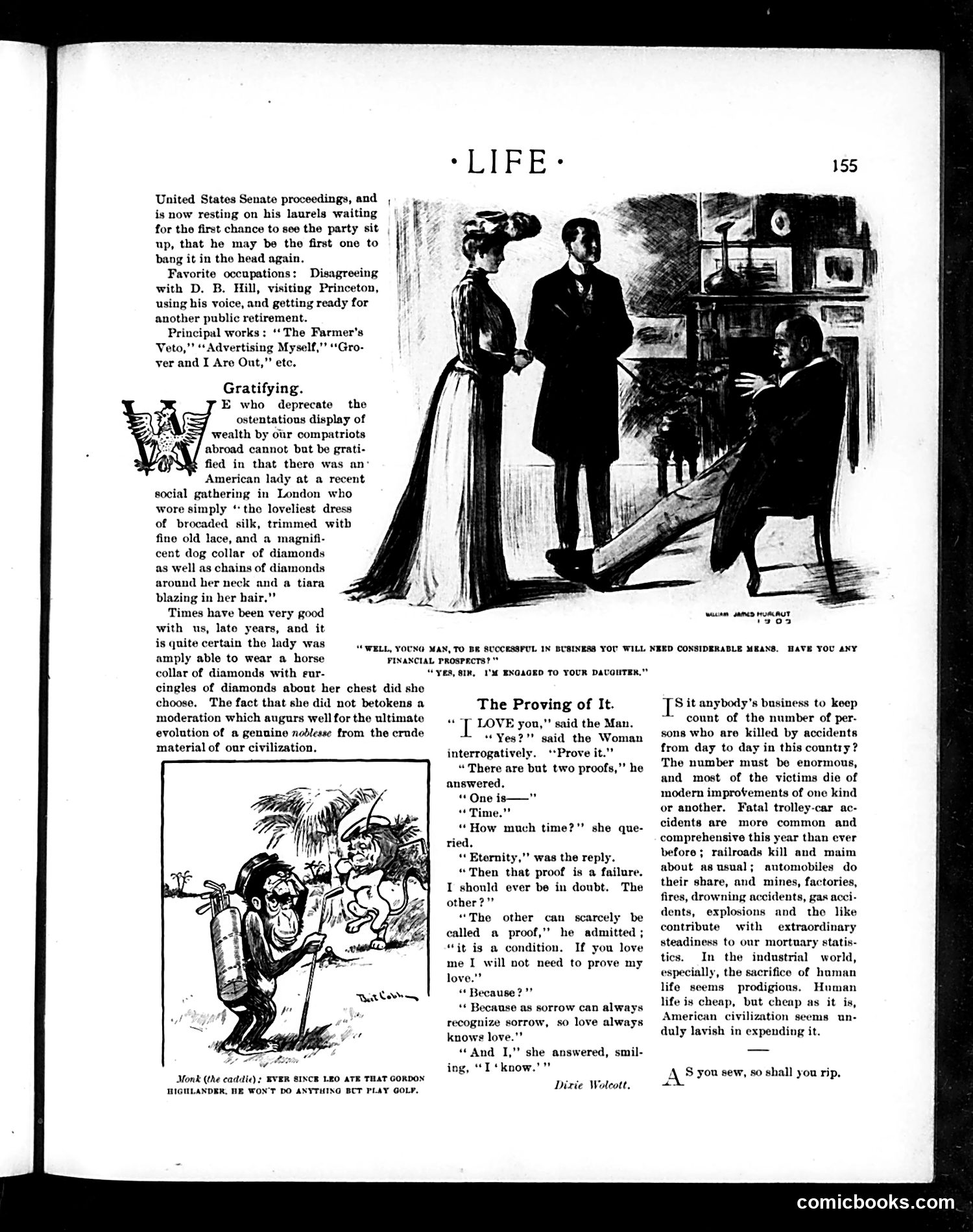
The page contains two distinct pieces of satire: **Top cartoon:** Shows a young man being interviewed, likely by a wealthy woman and her associates. The caption reads: "Well, young man, to be successful in business you will need considerable means. Have you any financial prospects?" His reply: "Yes, sir. I'm engaged to your daughter." This satirizes fortune-hunting—young men marrying into wealth rather than earning success through merit. **Bottom cartoon:** Depicts a Scottish Highlander with a golf club, captioned: "Mark (the caddie): 'Ever since Leo ate that Gordon Highlander, he won't do anything but play golf.'" This appears to be a joke about a dog named Leo who ate a Highlander and now only wants to play golf—likely absurdist humor with a dark edge. The page's other text discusses American wealth display and accidental deaths in industrial America.
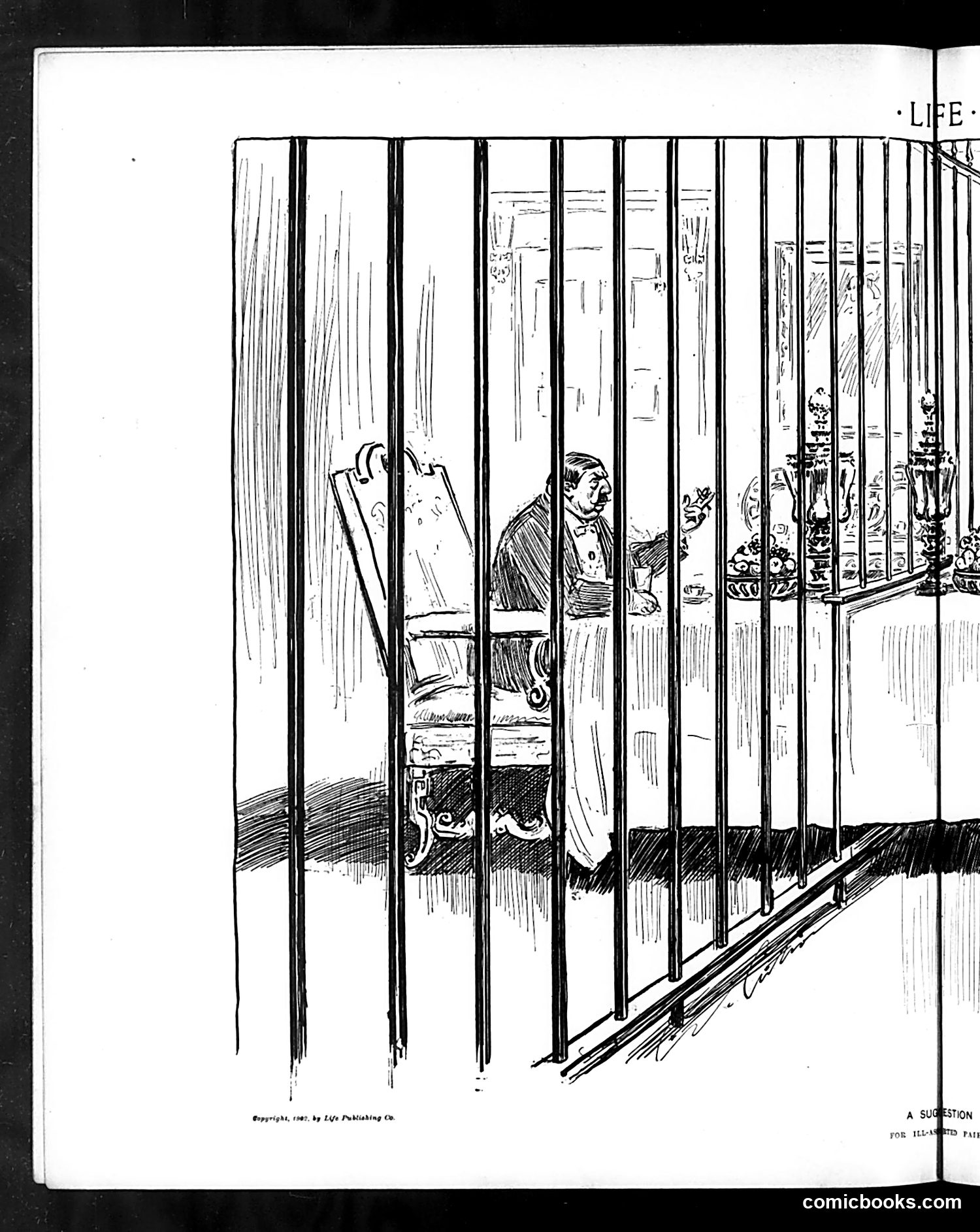
This is a satirical cartoon titled "A Suggestion for Illustrated Fairs" from Life magazine. The image depicts a man in formal attire confined behind vertical bars, appearing to be in a cage or enclosure like an animal exhibit. He sits amid elaborate furnishings and decorative objects, suggesting wealth or status. The satire appears to critique the practice of displaying humans—likely people from other cultures or social classes—as attractions at world's fairs and exhibitions, which were common in the early 20th century. By placing a well-dressed gentleman in a cage alongside luxury goods, the cartoon ironically suggests that wealthy or civilized people should be exhibited the same way "exotic" peoples were, exposing the absurdity and racism of such displays.
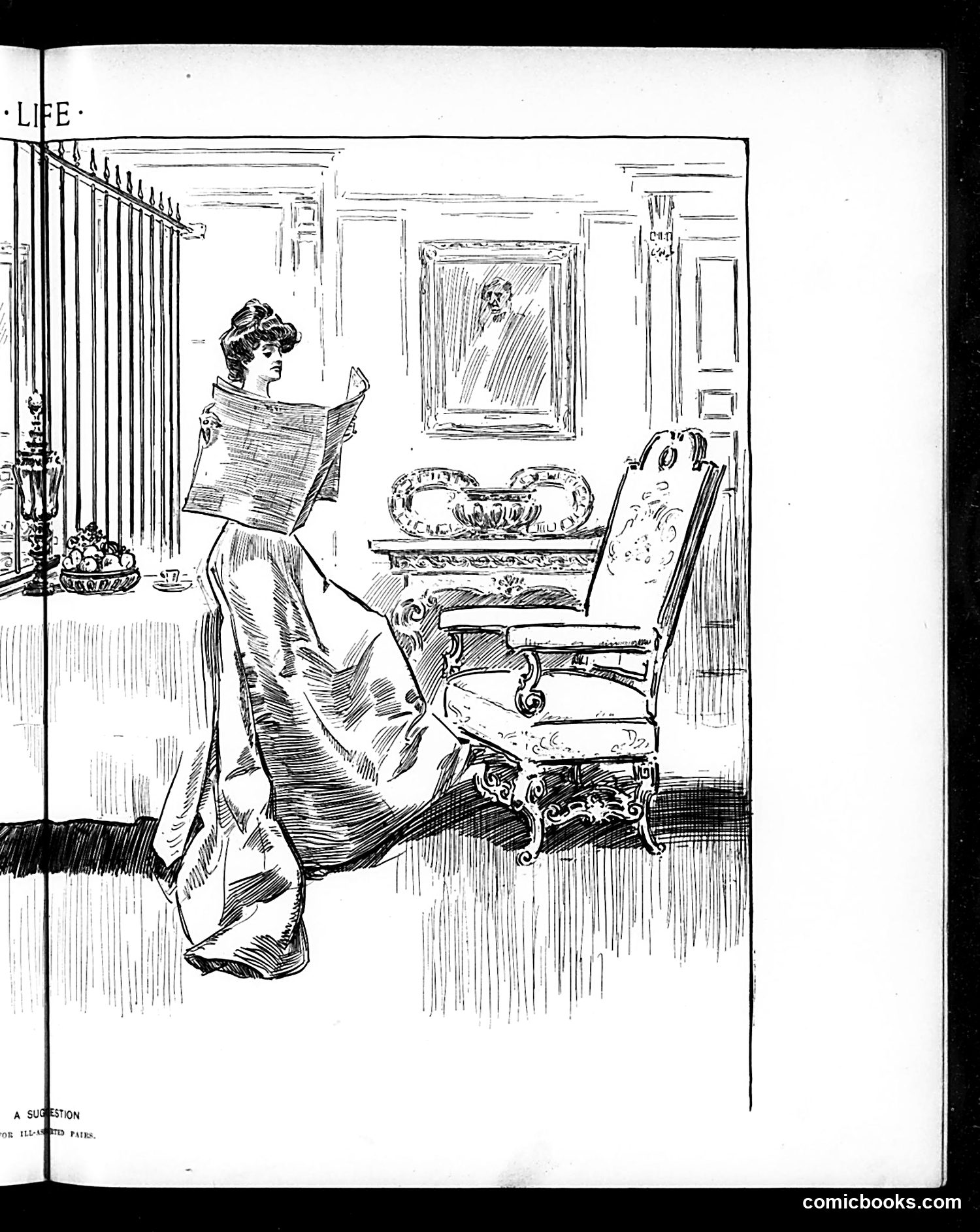
This sketch depicts a fashionable woman reading a newspaper while seated in an ornate chair in an elegant interior. The title "A Suggestion" appears at the bottom. The satire likely comments on women's engagement with current events and news consumption in the early 20th century. The woman's relaxed, comfortable posture while reading—along with the refined furnishings—suggests leisure and education. This was a period when women's intellectual participation in public affairs was debated. The cartoon appears to be either praising women who stayed informed about current events, or possibly satirizing the contrast between women's domestic roles and their growing interest in political/social matters. Without additional context about the specific date or surrounding articles, the precise satirical target remains unclear, though it touches on women's roles in society.
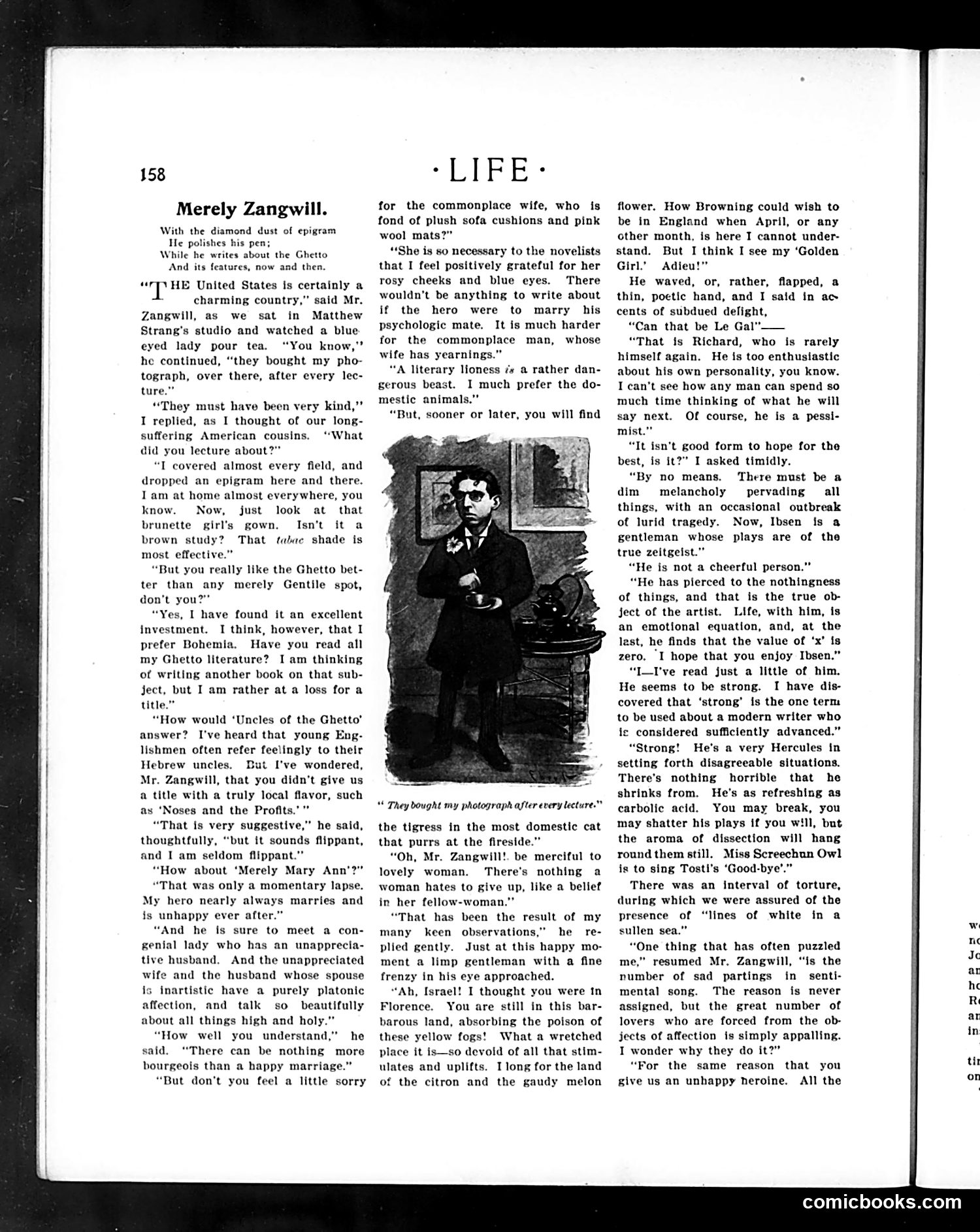
This page features a literary discussion between Matthew Strang's blue-eyed lady and a male interlocutor about writer Israel Zangwill. The accompanying illustration shows a man in profile at a desk or writing surface. The dialogue mocks Zangwill's work, particularly his "Ghetto" literature. The speakers debate whether his writing about Jewish life is artistically valuable or merely sentimental. One character dismisses his work as suitable only for "commonplace" readers, while another defends Zangwill's emotional depth and artistic merit, arguing his melancholy approach to depicting human suffering demonstrates genuine artistic vision. The satire critiques both literary snobbery and debates about authenticity in depicting marginalized communities' experiences.
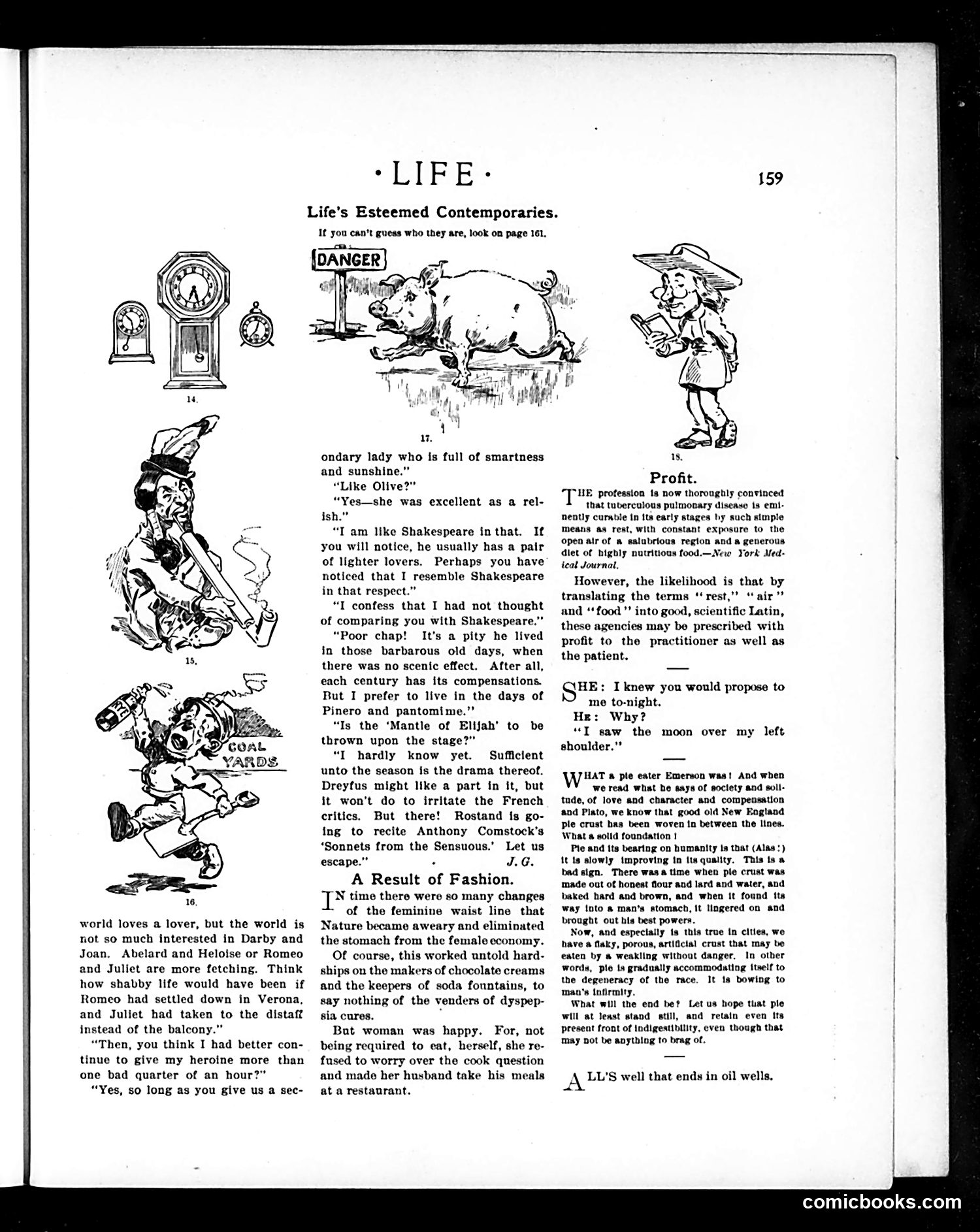
This page from *Life* magazine contains satirical commentary on contemporary figures and social trends: **"Life's Esteemed Contemporaries"** features caricatured figures (numbered 14-18), likely recognizable to 1900s readers but unclear to modern viewers without the answer key on page 161. The accompanying dialogue mockingly depicts a playwright comparing himself to Shakespeare and discussing theatrical trends. **"A Result of Fashion"** satirizes the corseting trend that drastically cinched women's waists, joking that fashion has literally eliminated women's stomachs from their anatomy. The humor lies in claiming women no longer need to eat—thus solving the "cook question"—and must now dine at restaurants. **"Profit"** mocks doctors prescribing tuberculosis treatments (rest, air, diet) by suggesting they charge more when using Latin medical terminology, implying practitioners profit from obfuscating simple remedies. The remaining pieces poke fun at superstition, Emerson's philosophy, and American industrial wealth. The tone throughout is genteel satire aimed at educated readers.
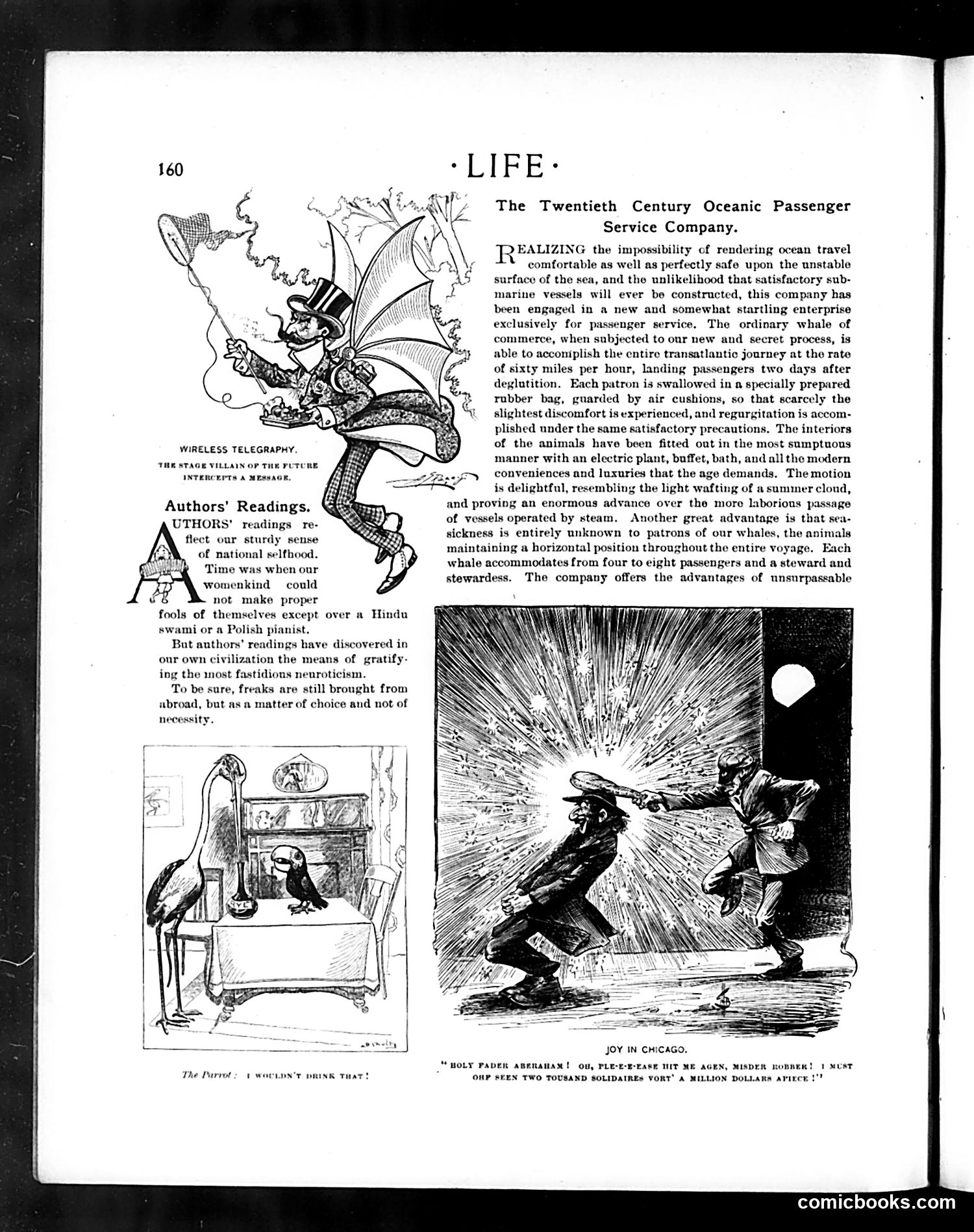
This page contains three separate satirical pieces: **"Wireless Telegraphy"** depicts a villain intercepting wireless messages—mocking fears about this new technology's vulnerability to espionage. **"Authors' Readings"** critiques American women's fascination with celebrity performers and exotic speakers (Hindu swamis, Polish pianists). It sarcastically notes that American culture now provides sufficient "freaks" domestically without importing them. **"The Twentieth Century Oceanic Passenger Service"** is the main satire: a mock-serious advertisement proposing transatlantic whale transport. Passengers are swallowed in rubber bags, transported inside the whale's body at 60 mph, then regurgitated. It parodies both contemporary obsession with technological "progress" and genuinely absurd patent schemes of the era. The cartoon "Joy in Chicago" appears related, showing exuberant response to this ridiculous invention. The satire targets American gullibility toward technological hype and get-rich-quick schemes popular in the early 1900s.
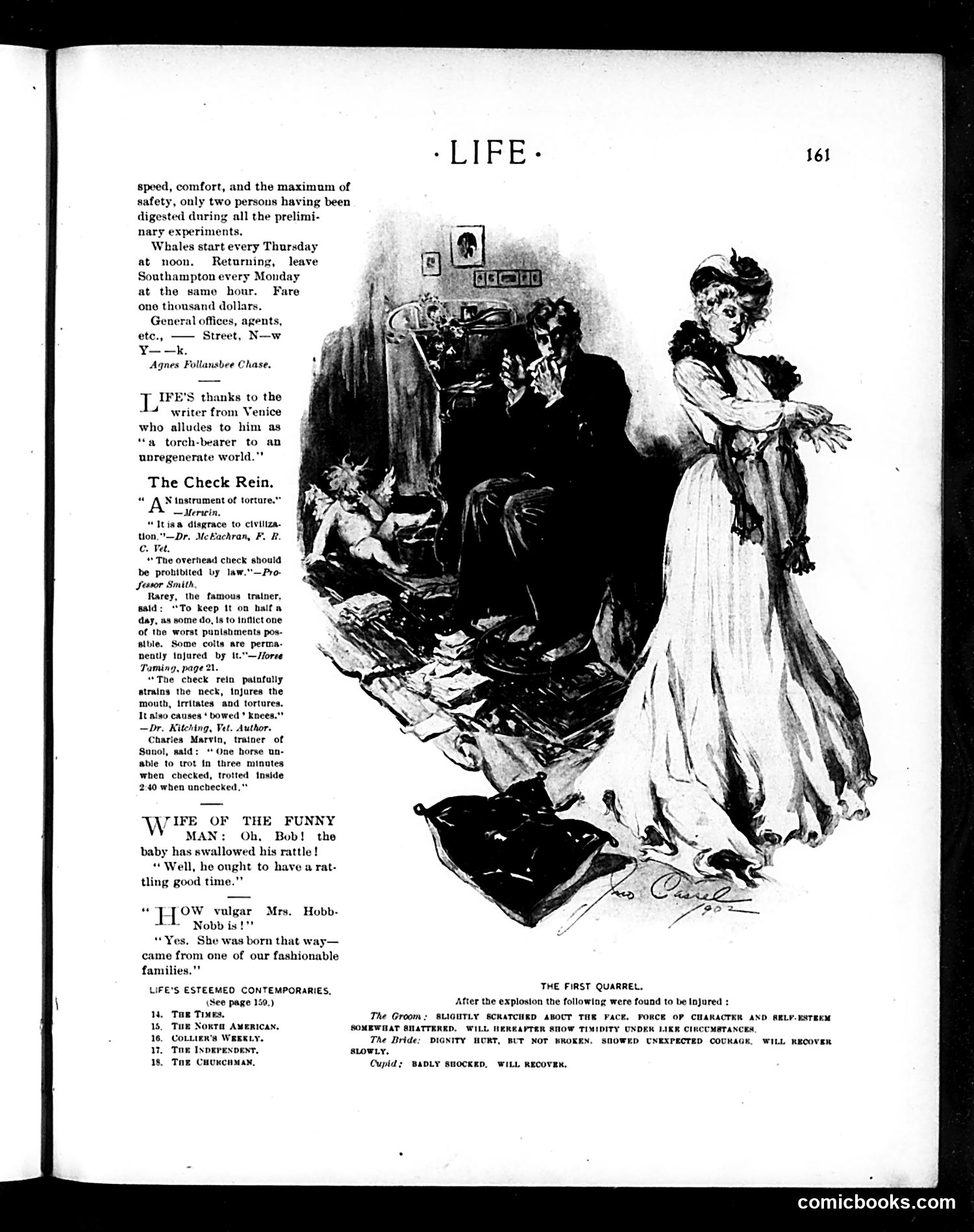
This page contains several satirical pieces typical of Life's humor: **"The Check Rein"** is an editorial cartoon mocking the cruel horse training device of the era. Life presents expert testimonies from veterinarians and famous trainers condemning the overhead check rein for causing neck strain, mouth injuries, and permanent lameness in horses. This appears to be animal welfare advocacy dressed as satire. **"The First Quarrel"** illustration depicts a newlywed couple's argument, with allegorical damage assessments below: the groom suffers wounded pride but retains character; the bride's dignity is hurt but she shows unexpected courage; Cupid (their marriage) is "badly shocked" but will recover. It's gentle romantic satire about marital discord. The page also includes brief joke exchanges about a baby swallowing a rattle and a vulgar woman from a "fashionable family"—standard period humor about class pretension. The whale-ship advertisement at top appears to be satirical fiction, joking about luxury travel with darkly humorous mentions of digestive casualties.
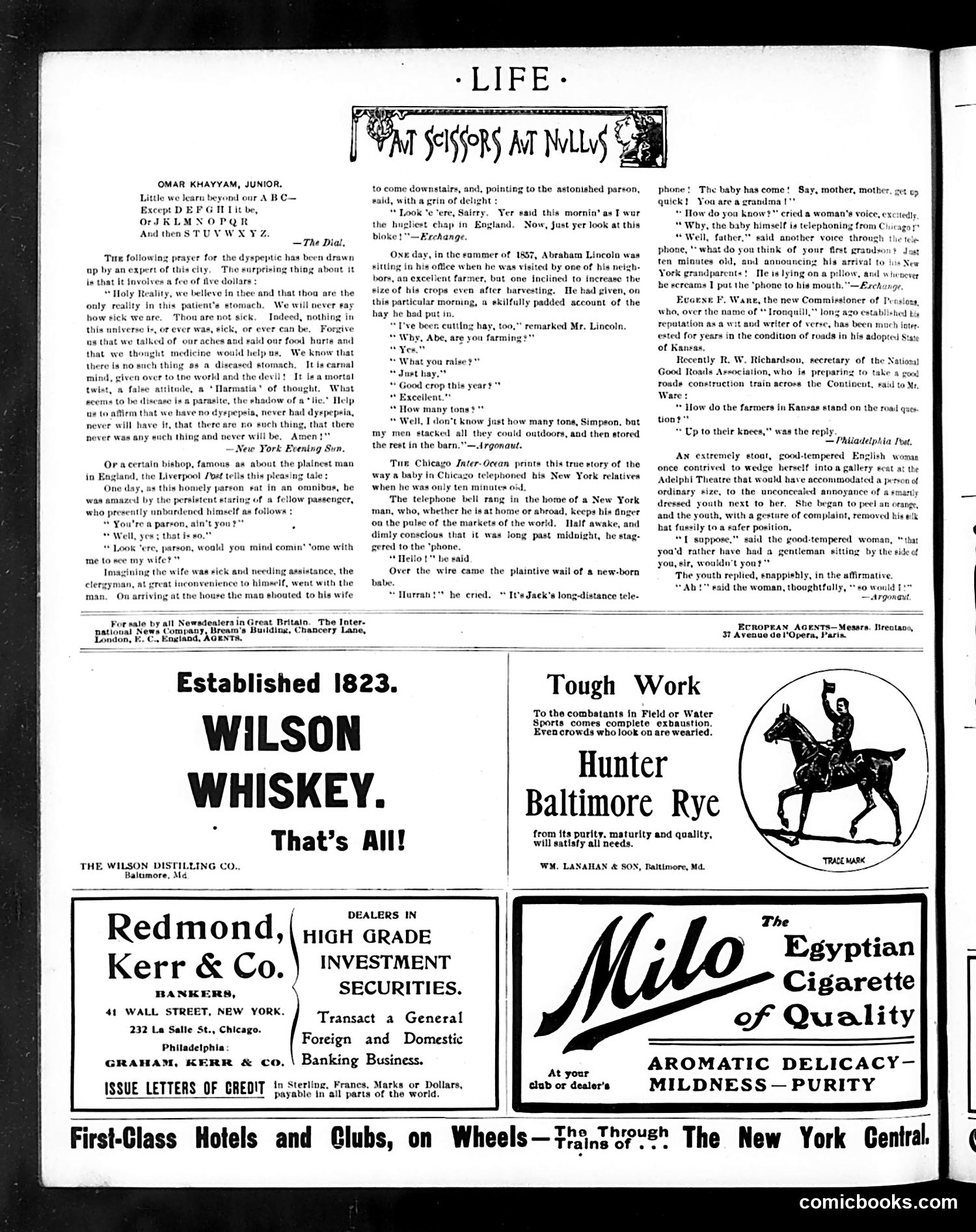
This page contains several humorous anecdotes typical of early 1900s satirical journalism: **Main Content:** A series of short comic stories mocking various subjects: 1. **"Omar Khayyam, Junior"** – A parody of the famous Persian poet, likely satirizing pretentious literary imitation 2. **Dyspeptic Prayer** – Mocks Christian Science or New Thought movement's denial of physical illness, charging five dollars for such "treatment" 3. **Bishop's Story** – A crude joke about comparative ugliness 4. **Lincoln Anecdote** – A tall tale about Lincoln's exaggerated hay harvesting, exemplifying frontier humor about dishonesty 5. **Baby's Long-Distance Call** – A novelty story celebrating early telephone technology and transcontinental connection **Advertisements:** Wilson Whiskey, Hunter Baltimore Rye, Milo Cigarettes, and investment/banking services fill the lower portion. The page reflects early 1900s concerns: medical quackery, technology's marvels, farming life, and humor relying on exaggeration and social observation rather than visual cartooning.
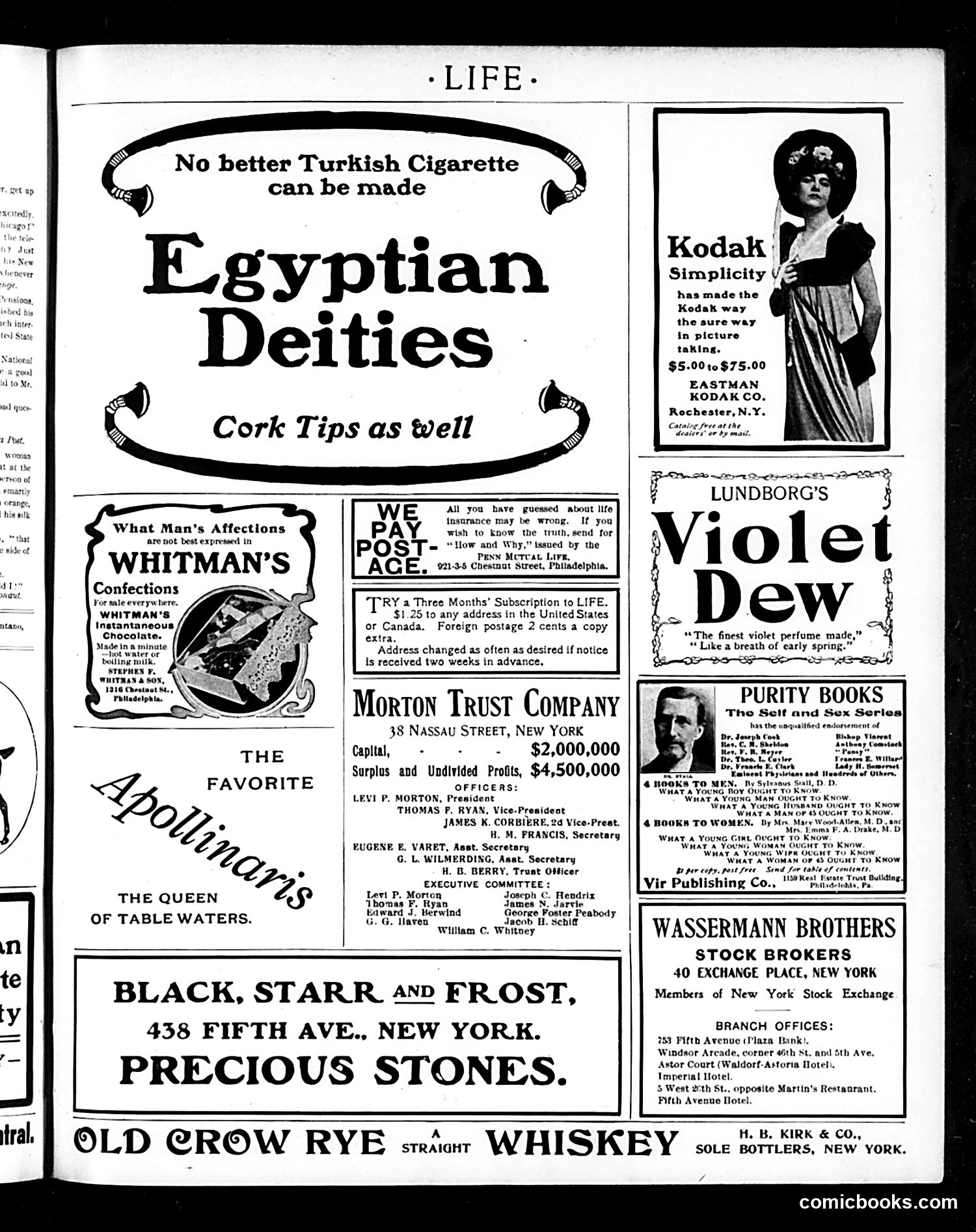
This is primarily an **advertising page** rather than editorial content or political satire. The page features multiple product advertisements from early 20th-century companies, including: - **Egyptian Deities cigarettes** (with cork tips) - **Eastman Kodak cameras** ($5–$75) - **Whitman's Confections** (chocolates) - **Lundborg's Violet Dew** perfume - **Morton Trust Company** (banking) - **Purity Books** (self-help/instructional series) - **Wassermann Brothers** (stock brokers) - **Black, Starr and Frost** (precious stones/jewelry) - **Old Crow Rye whiskey** There is one small editorial element: a notice encouraging three-month **Life magazine subscriptions** ($1.25). The page reflects early 1900s consumer culture and advertising conventions. No significant political cartoons, caricatures, or satirical commentary are visible—it's a straightforward commercial page typical of the era's magazine advertising.
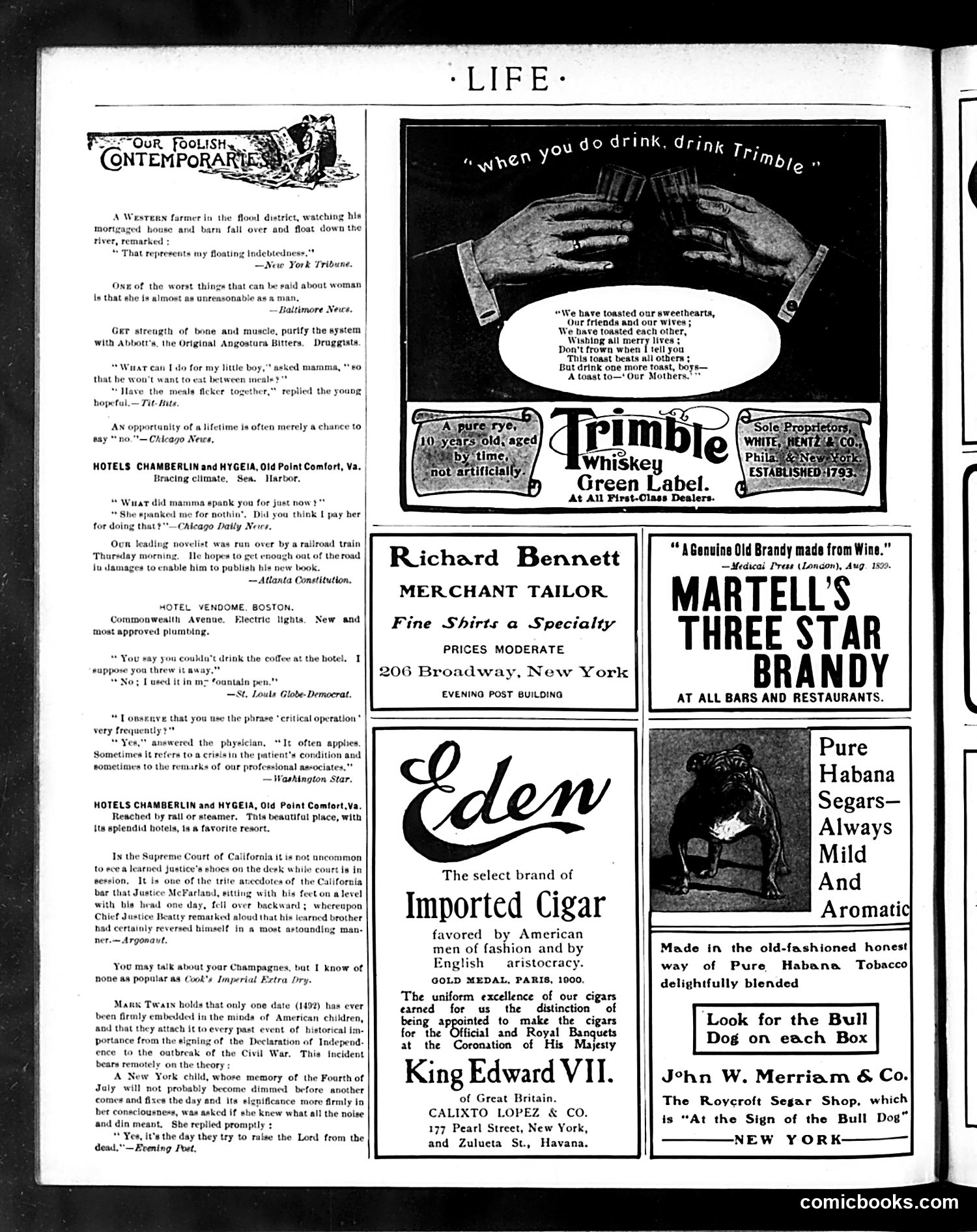
This page from *Life* magazine combines satirical commentary with period advertisements. The main cartoon, "Our Foolish Contemporary," presents brief humorous anecdotes mocking human nature and logic. The opening joke depicts a Western farmer watching his mortgaged property float away during floods, calling it "my floating indebtedness"—satirizing how Americans euphemistically describe financial ruin. Other jokes mock women's reasoning, domestic inefficiency, and professional pretension (a physician claiming "critical operation" refers to colleagues' remarks). A drinking-related advertisement features toasting traditions, emphasizing motherhood as the ultimate honoree—reflecting Victorian sentimentality about maternal figures. The remaining content is primarily **product advertising** for luxury goods: tailoring services, whiskey, brandy, imported cigars, and hotels. These ads target wealthy readers and reflect the magazine's early 1900s audience. The page demonstrates *Life*'s formula: light satire mocking contemporary society, combined with upscale commercial sponsorship.
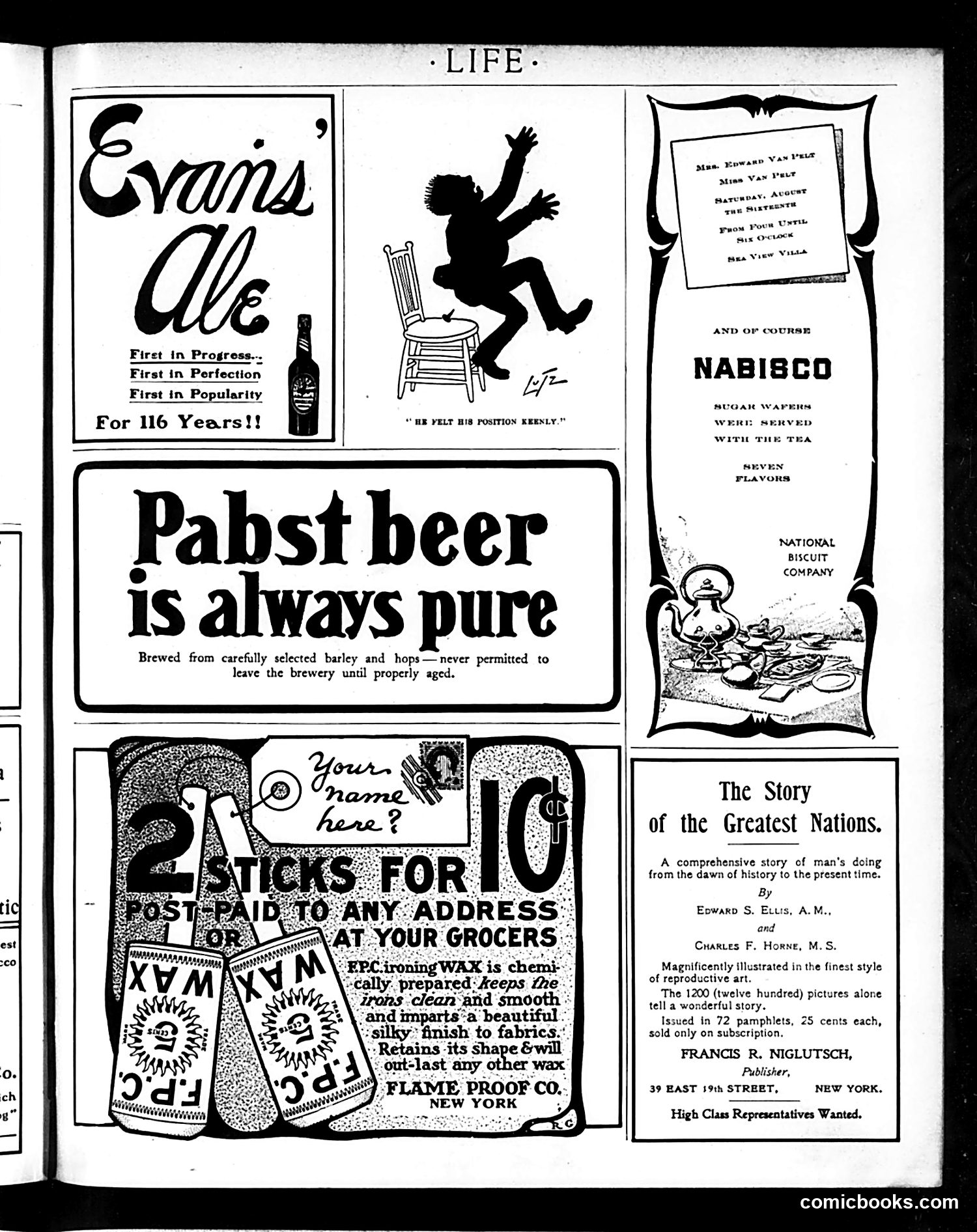
This is primarily an **advertising page** rather than editorial satire. The main content comprises several period product advertisements: **Evans Ale** advertises 116 years of market presence with claims of "First in Progress, Perfection, Popularity." **Pabst Beer** emphasizes purity and proper aging of barley and hops. **XYM Ironing Wax** offers 24 sticks for 10 cents, claiming the product keeps fabrics clean and smooth while being flame-proof. **Nabisco Sugar Wafers** are promoted as served with tea, available in seven flavors. **"The Story of the Greatest Nations"** is a serialized historical book by Edward S. Ellis and Charles F. Horne, issued in 72 pamphlets at 25 cents each. The only cartoon element is a small silhouette of a figure jumping from a chair with caption "He felt his position keenly"—likely a humorous illustration unrelated to the surrounding ads. The page reflects turn-of-the-century consumer culture and mail-order publishing practices.
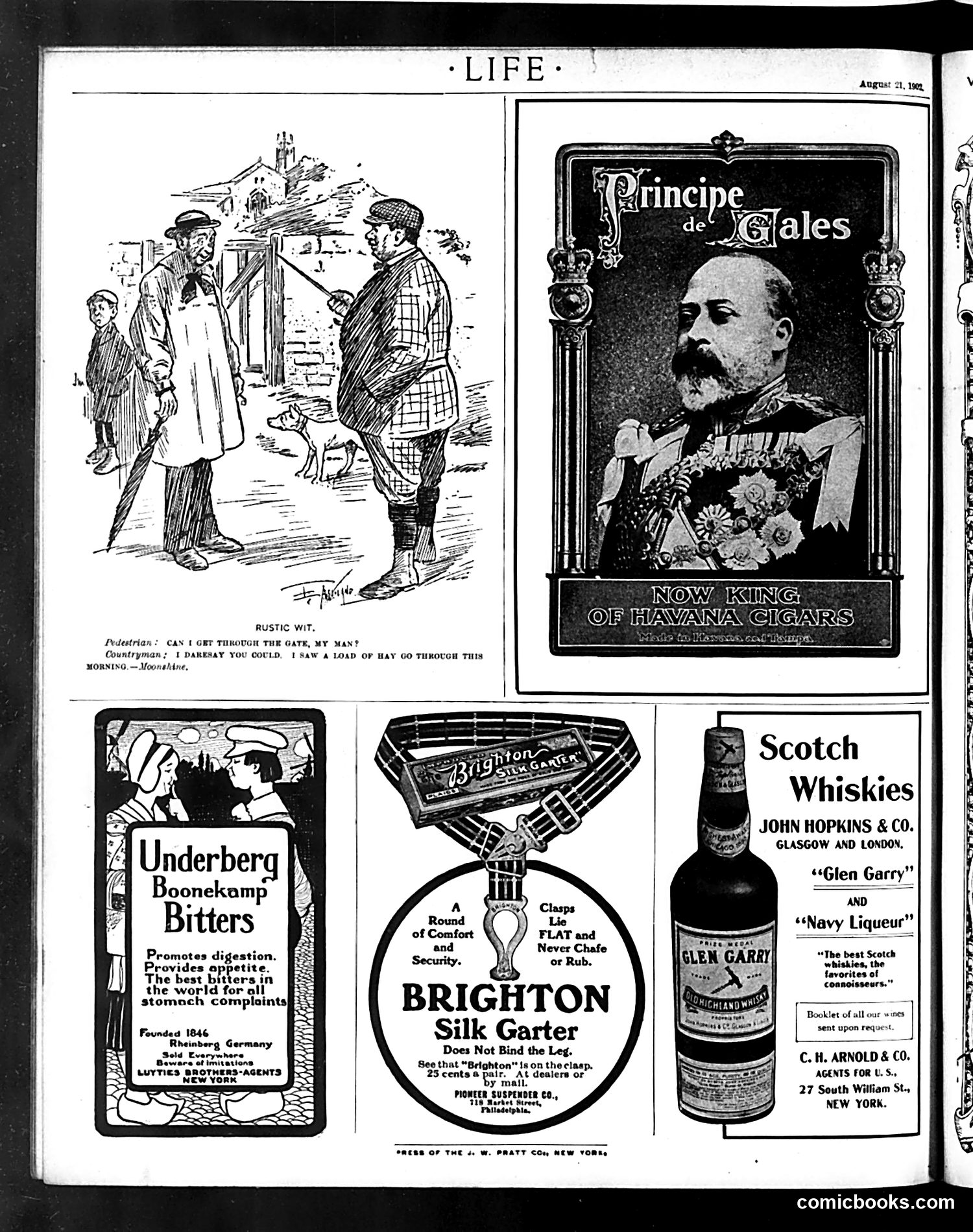
**The Cartoon:** The sketch titled "Rustic Wit" depicts a rural exchange between a countryman and what appears to be a gentleman at a gate. The humor is simple wordplay: when asked if he got through the gate, the rustic replies that he saw a load of hay pass through that morning—implying the gentleman could do the same if hay can fit. This is gentle, class-based humor typical of early 20th-century publications, poking fun at rural simplicity versus urban sophistication. **The Advertisements:** The page is primarily advertising for luxury consumer goods: Havana cigars endorsed by the Prince of Wales, German digestive bitters, Brighton silk garters, and Scotch whisky. These reflect the affluent readership Life targeted—the magazine was satirical but expensive, marketed to upper-class readers interested in both social commentary and luxury products. The overall content represents Life's dual nature: humor for the educated elite alongside aspirational advertisements.