
Life, 1902-08-21 · page 12 of 20
Life — August 21, 1902 — page 12: what you’re looking at
What you’re looking at
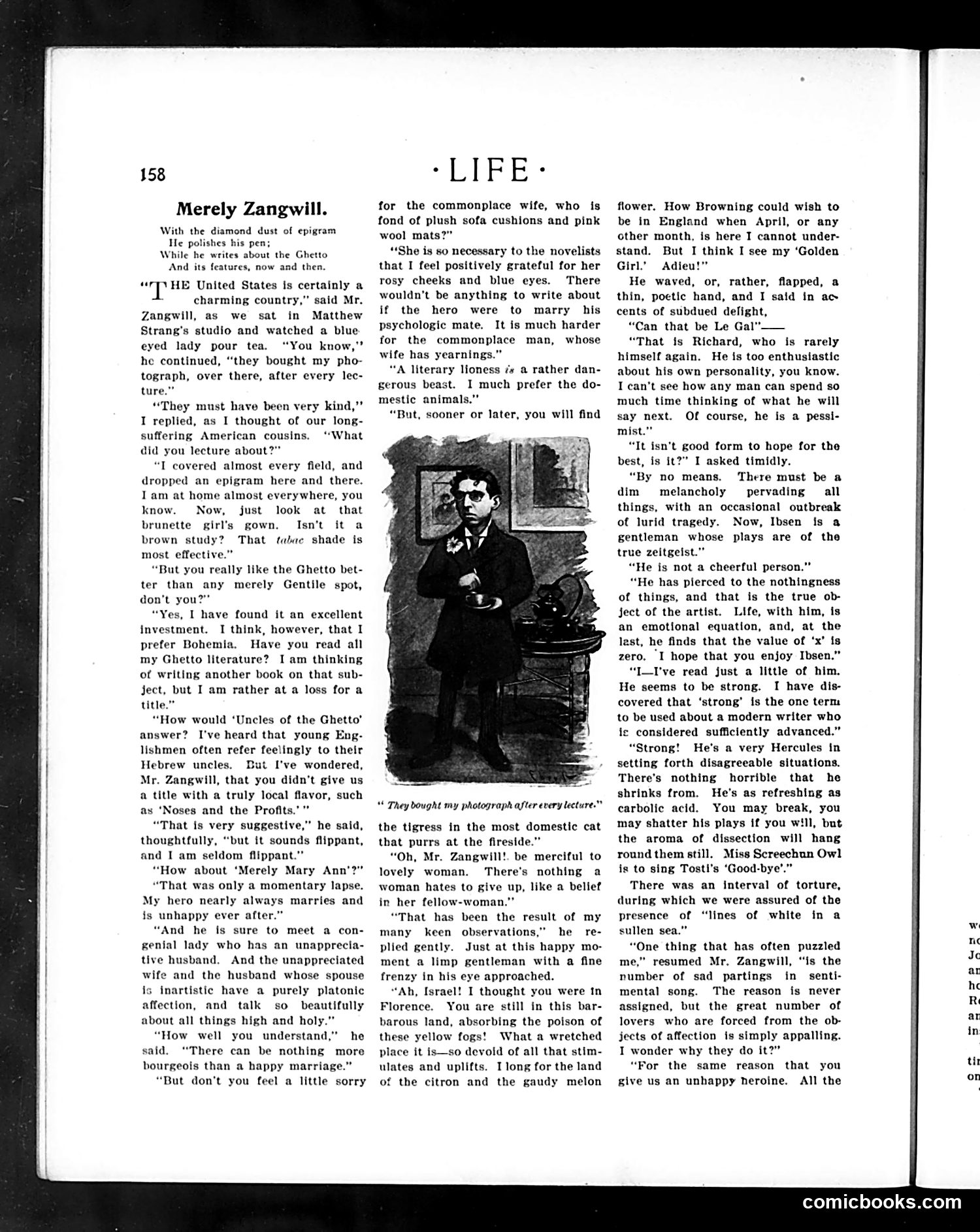
This page features a literary discussion between Matthew Strang's blue-eyed lady and a male interlocutor about writer Israel Zangwill. The accompanying illustration shows a man in profile at a desk or writing surface. The dialogue mocks Zangwill's work, particularly his "Ghetto" literature. The speakers debate whether his writing about Jewish life is artistically valuable or merely sentimental. One character dismisses his work as suitable only for "commonplace" readers, while another defends Zangwill's emotional depth and artistic merit, arguing his melancholy approach to depicting human suffering demonstrates genuine artistic vision. The satire critiques both literary snobbery and debates about authenticity in depicting marginalized communities' experiences.
📄 Transcribed text from this page (OCR, searchable)
Machine-transcribed from the original scan — historical spelling and the odd misread are preserved.
158 Merely Zangwill. With the diamond dust of epigram He polishes his pen; While he writes about the Ghetto And its features, now and then. 8 Bs United States is certainly a charming country,” said Mr. Zangwill, as we sat in Matthew Strang’s studio and watched a blue eyed lady pour tea. “You know," he continued, “they bought my pho- tograph, over there, after every lec- ture.” “They must have been very kind,” I replied, as I thought of our long- suffering American cousins. “What did you lecture about?” “I covered almost every field, and dropped an epigram here and there. I am at home almost everywhere, you know. Now, just look at that brunette girl's gown, Isn't it a brown study? That tate shade is most effective.” “But you really like the Ghetto bet- ter than any merely Gentile spot, don’t you?" “Yes, I have found it an excellent investment. I think, however, that I prefer Bohemia. Have you read all my Ghetto literature? I am thinking of writing another book on that sub- ject, but I am rather at a loss for a title.” “How would ‘Uncles of the Ghetto’ answer? I've heard that young Eng- lishmen often refer feelingly to their Hebrew uncles. But I've wondered, Mr. Zangwill, that you didn’t give us a title with a truly local flavor, such as ‘Noses and the Profits.’ ” “That is very suggestive,” he said, thoughtfully, “but it sounds flippant, and I am seldom flippant.” “How about ‘Merely Mary Ann'?” “That was only a momentary lapse. My hero nearly always marries and is unhappy ever after.” “And he is sure to meet a con- genial lady who has an unapprecia- tive husband, And the unappreciated wife and the husband whose spouse is inartistic have a purely platonic affection, and talk so beautifully about all things high and holy.” “How well you understand,” he said. “There can be nothing more bourgeois than a happy marriage.” “But don't you feel a little sorry ‘LIFE: for the commonplace wife, who is fond of plush sofa cushions and pink wool mats?” “She is so necessary to the novelists that I feel positively grateful for her rosy cheeks and blue eyes. There wouldn't be anything to write about if the hero were to marry his psychologic mate. It is much harder for the commonplace man, whose wife has yearnings.” “A literary lioness ¢s a rather dan- gerous beast. I much prefer the do- mestic animals.” “But, sooner or later, you will find “ They bought my photograph after every lecture. the tigress in the most domestic cat that purrs at the fireside.” “Oh, Mr. Zangwill!. be merciful to lovely woman. There's nothing a woman hates to give up, like a belief in her fellow-woman,”” “That has been the result of my many keen observations,” he re- plied gently. Just at this happy mo- ment a limp gentleman with a fine frenzy in his eye approached. “Ah, Israel! I thought you were In Florence. You are still in this bar- barous land, absorbing the poison of these yellow fogs! What a wretched place it is—so devoid of all that stim- ulates and uplifts. I long for the land of the citron and the gaudy melon flower. How Browning could wish to be in England when April, or any other month, is here I cannot under- stand. But I think I see my ‘Golden Girl.’ Adieu!” He waved, or, rather, flapped, a thin, poetic hand, and I said in aw cents of subdued defight, “Can that be Le Gal”"—— “That is Richard, who is rarely himself again. He is too enthusiastic about his own personality, you know. I can't see how any man can spend so much time thinking of what he will say next. Of course, he is a pessi- mist.” “It isn't good form to hope for the best, is it?” I asked timidly. “By no means. There must be a dim melancholy pervading all things, with an occasional outbreak of lurid tragedy. Now, Ibsen is a gentleman whose plays are of the true zeitgeist.” “He is not a cheerful person.” “He has pierced to the nothingness of things, and that is the true ob- ject of the artist. Life, with him, is an emotional equation, and, at the last, he finds that the value of ‘x’ is zero. I hope that you enjoy Ibsen.” “I_I've read just a little of him. He seems to be strong. I have dis- covered that ‘strong’ is the one term to be used about a modern writer who ic considered sufficiently advanced.” “Strong! He's a very Hercules in setting forth disagreeable situations. There's nothing horrible that he shrinks from. He's as refreshing as carbolic acid. You may break, you may shatter his plays if you will, but the aroma of dissection will hang round them still. Miss Screechan Owl is to sing Tosti’s ‘Good-bye’.” There was an interval of torture, during which we were assured of the presence of “lines of white in a sullen sea.” “One thing that has often puzzled me,” resumed Mr, Zangwill, “is the number of sad partings in senti- mental song. The reason is never assigned, but the great number of lovers who are forced from the ob- jects of affection is simply appalling. I wonder why they do it?” “For the same reason that you sive us an unhappy heroine. All the comicbooks.com