
Life, 1902-08-21 · page 4 of 20
Life — August 21, 1902 — page 4: what you’re looking at
What you’re looking at
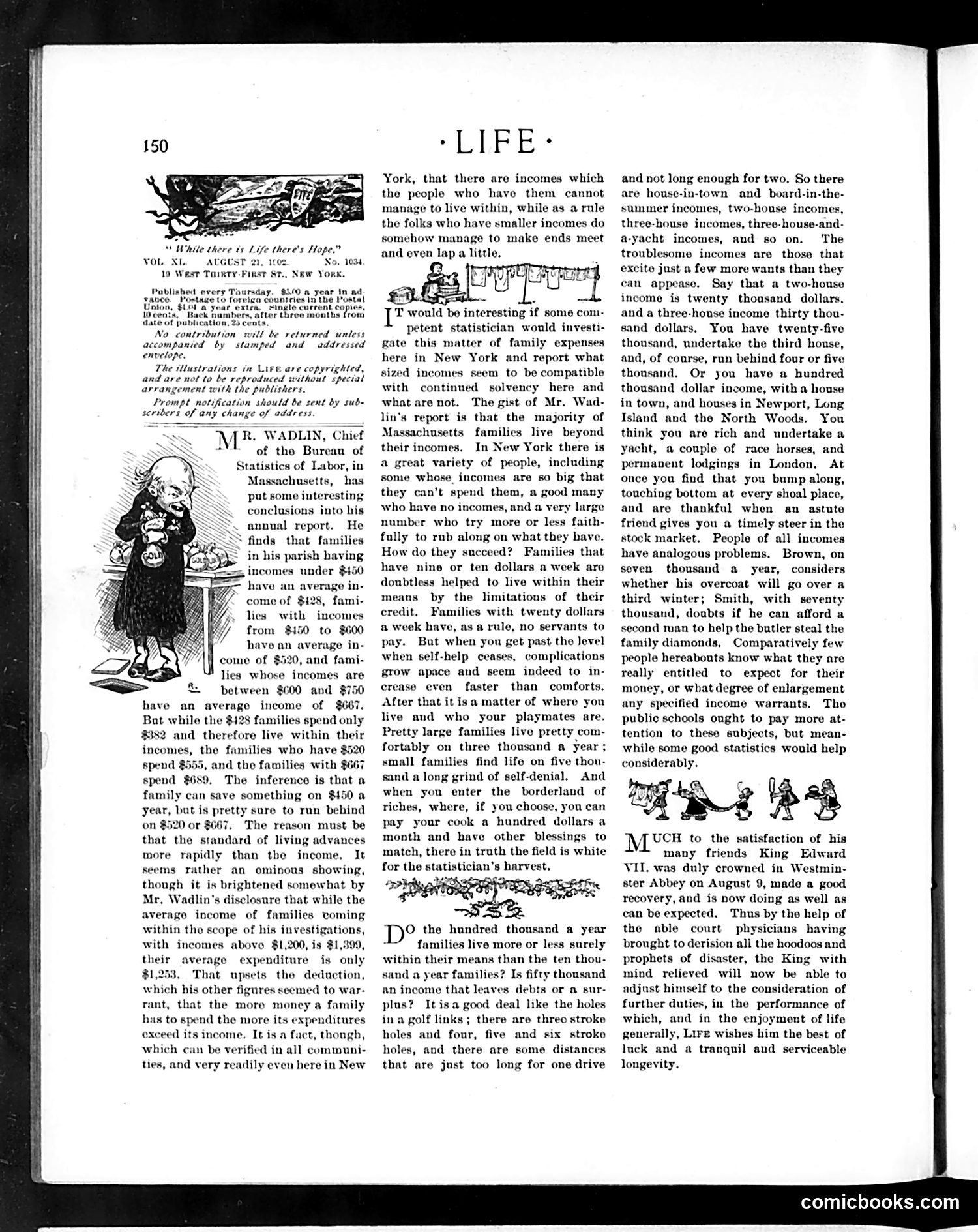
This page discusses family incomes and living standards in early 1900s America, featuring commentary by Mr. Wadlin, Chief of the Bureau of Statistics of Labor in Massachusetts. The left margin contains an illustration of a woman (likely representing the working-class housewife) managing household finances with limited means—a visual representation of the article's subject matter about families living on modest incomes between $150-$800 annually. The text analyzes how different income levels afford varying standards of living, noting that families earning $150-$300 struggle financially, while those with $800-$1,233 can maintain more comfortable circumstances. The satire appears gentle, using the statistician's dry analysis to illustrate economic disparities and the challenges of middle and working-class household management in the Progressive Era.
📄 Transcribed text from this page (OCR, searchable)
Machine-transcribed from the original scan — historical spelling and the odd misread are preserved.
19 West Taixty-First St., New Yorx. Published every Thursday. $300 a year tn ad Postage sn countries in the Postal Single current copies, after three months from ation, 2) cents. No contribution will be returned untess accompanied by stamped and addressed envelope. The illustrations in Lire are copyrighted, and are not to be reproduced without special arrangement with the publishers, Prompt notification should be sent by sub- seribers of any change of address. WADL IN, Chief MES of the Bureau of Statistics of Labor, in Massachusetts, has put some interesting conclusions into his annual report. He ‘ finds that families in his parish having have an average in- come of $428, fami- lies with incomes from $150 to $600 have an average in- 520, and fami- lies whose incomes are between $600 and 3750 have an average income of $667. Bat whilo the $128 families spend only $382 and therefore live within thei incomes, the families who have spend $55 nd the families with $6 spend $689, The inference is that family can save something on $150 year, but is pretty sure to run behind on $520 or $6 The reason must be that the standard of living advances more rapidly than the income. It seems rather an ominous showing, though it is brightened somewhat by Mr. Wadlin’s disclosure that while the average income of families coming within the scope of his investigations, with incomes abovo $1,200, is $1,399, their average expenditure is only $1,253. That upsets the deduction, which his other figures seemed to war- rant, that the more money a family has to spend the more its expenditures xceed its income. It is a fact, though, which can be verified in all communi- ties, and very readily even here in New LIFE York, that there are incomes which the people who have them cannot manage to live within, while as a rule the folks who have smaller incomes do somehow manage to make ends meet and even lap a litde. iw) ofl T would be interesting it some com- petent statistician would investi- gate this matter of family expenses here in New York and report what sized incomes seem to be compatible h continued solvency here and what are not. The gist of Mr. Wad- lin’s report is that the majority of Massachusetts families live beyond their incomes. In New York there is a great variety of people, including some whose incomes are so big that they can’t spend them, a good many who have no incomes, and a very large number who try more or less faith- fally to rub along on what they have. How do they succeed? Families that have nine or ten dollars a week are doubtless helped to live within their means by the limitations of their credit. Families with twenty dollars a week have, as a rule, no servants to pay. But when you get past the level when self-help ceases, complications grow apace and seem indeed to in- crease even faster than comforts. After that it isa matter of where you live and who your playmates are. Pretty large families live pretty com- fortably on three thousand a year; small families find life on five thou- sand a long grind of self-denial. And when you enter the borderland of tiches, where, if you choose, you can pay your cook a hundred dollars a month and have other blessings to match, there in truth the field is white for the statistician’s harvest. bD° the hundred thousand a year - families live more or less surely within their means than the ten thou- sand a year families? Is fifty thousand an income that leaves debts or a sur- plus? It isa good deal like the holes ina golf links; there are threo stroke holes and four, five and six stroke holes, and there are some distances that are just too long for one drive and not long enough for two, So there are house-in-town and board-in-the- summer incomes, two-house incomes, three-house incomes, three-house-and- a-yacht incomes, and so on. The troublesome incomes are those that excite just a few more wants than they can appease. Say that a two-house income is twenty thousand dollars, and a three-house income thirty thou- sand dollars, You have twenty-five thousand, undertake the third honse, and, of course, run behind four or five thousand. Or you have a hundred thousand dollar income, with a house in town, and houses in Newport, Long Island and the North Woods. You think you are rich and undertake a yacht, a couple of race horses, and permanent lodgings in London, At once you find that you bump along, touching bottom at every shoal place, and are thankful when an astute friend gives you a timely steer in the stock market. People of all incomes have analogous problems. Brown, on seven thousand a year, considers whether his overcoat will go over a third winter; Smith, with seventy thousand, doubts if he can afford a second man to help the butler steal the family diamonds, Comparatively few people hereabouts know what they are really entitled to expect for their money, or what degree of enlargement any specified income warrants, The public schools ought to pay more at- tention to these subjects, but mean- while some good statistics would help considerably. MW UCH to the satisfaction of his many friends King Edward VII. was duly crowned in Westmin- ster Abbey on August 9, made a good recovery, and is now doing as well as can be expected. Thus by the help of the able court physicians having brought to derision all the hoodoos and prophets of disaster, the King with mind relieved will now be able to adjust himself to the consideration of further duties, in the performance of which, and in the enjoyment of life generally, Lire wishes him the best of luck and a tranquil and serviceable longevity. comicbooks.com