
A complete issue · 20 pages · 1902
Life — July 31, 1902
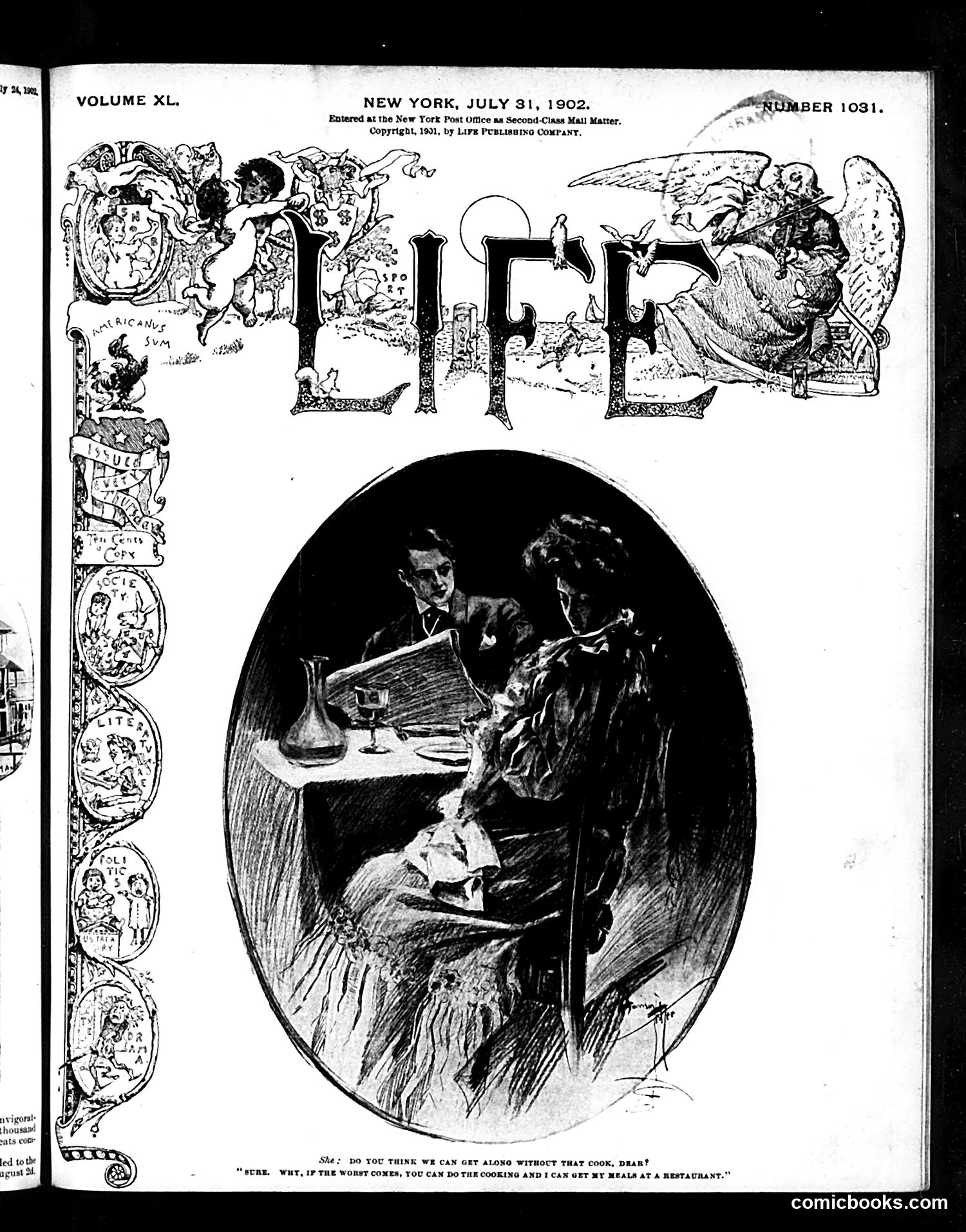
This page features a satirical cartoon about domestic economics and gender roles. The illustration shows a couple at home, with the man reading what appears to be a newspaper or bill while the woman sits nearby. The caption reads: "SHE: 'Why do you think we can get along without that cook, dear?' / HE: 'Why, if the worst comes, you can do the cooking and I can get my meals at a restaurant.'" The joke satirizes the husband's dismissive attitude toward household labor and the wife's economic dependence. It mocks his illogical solution—suggesting his wife cook while he eats elsewhere—as absurd reasoning that reveals men's obliviousness to domestic responsibilities. The cartoon critiques both male privilege and the financial pressures facing middle-class households in the early 1900s.
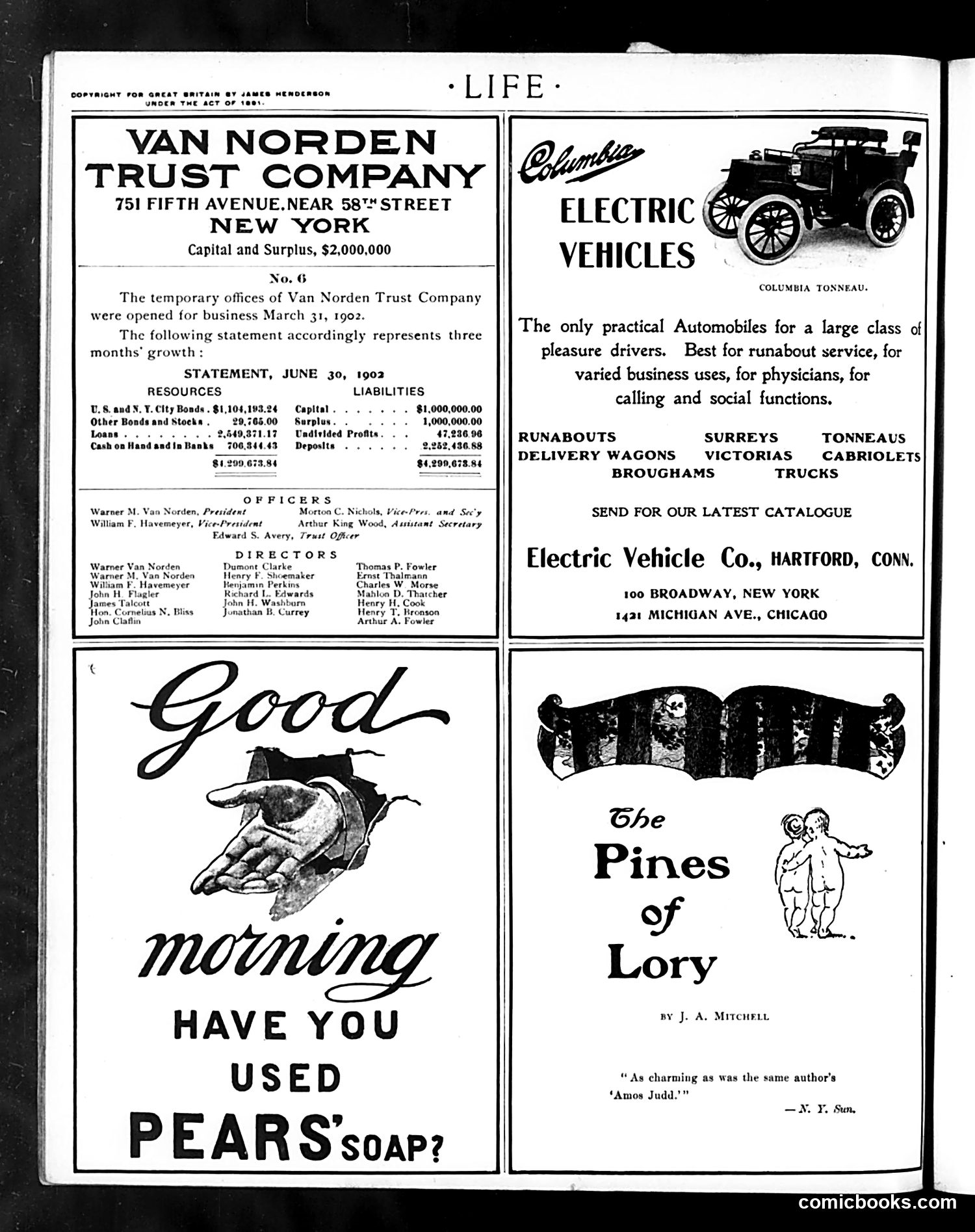
This page is primarily **advertising** from a 1902 Life magazine, not political satire. It contains: 1. **Van Norden Trust Company** ad (top left): A financial institution announcement with officer listings and June 1902 financial statements. 2. **Columbia Electric Vehicles** ad (top right): Marketing early automobiles as practical for "pleasure drivers," physicians, and business use—reflecting the novelty of motorized vehicles in this era. 3. **Pears' Soap ad** (bottom left): A standard product advertisement with the phrase "Good morning, have you used Pears' Soap?"—a famous slogan from this period. 4. **"The Pines of Lory"** (bottom right): A book advertisement by J.A. Mitchell, compared favorably to the author's previous work "Amos Judd." The page demonstrates early 1900s advertising conventions and consumer products rather than containing political or satirical content.
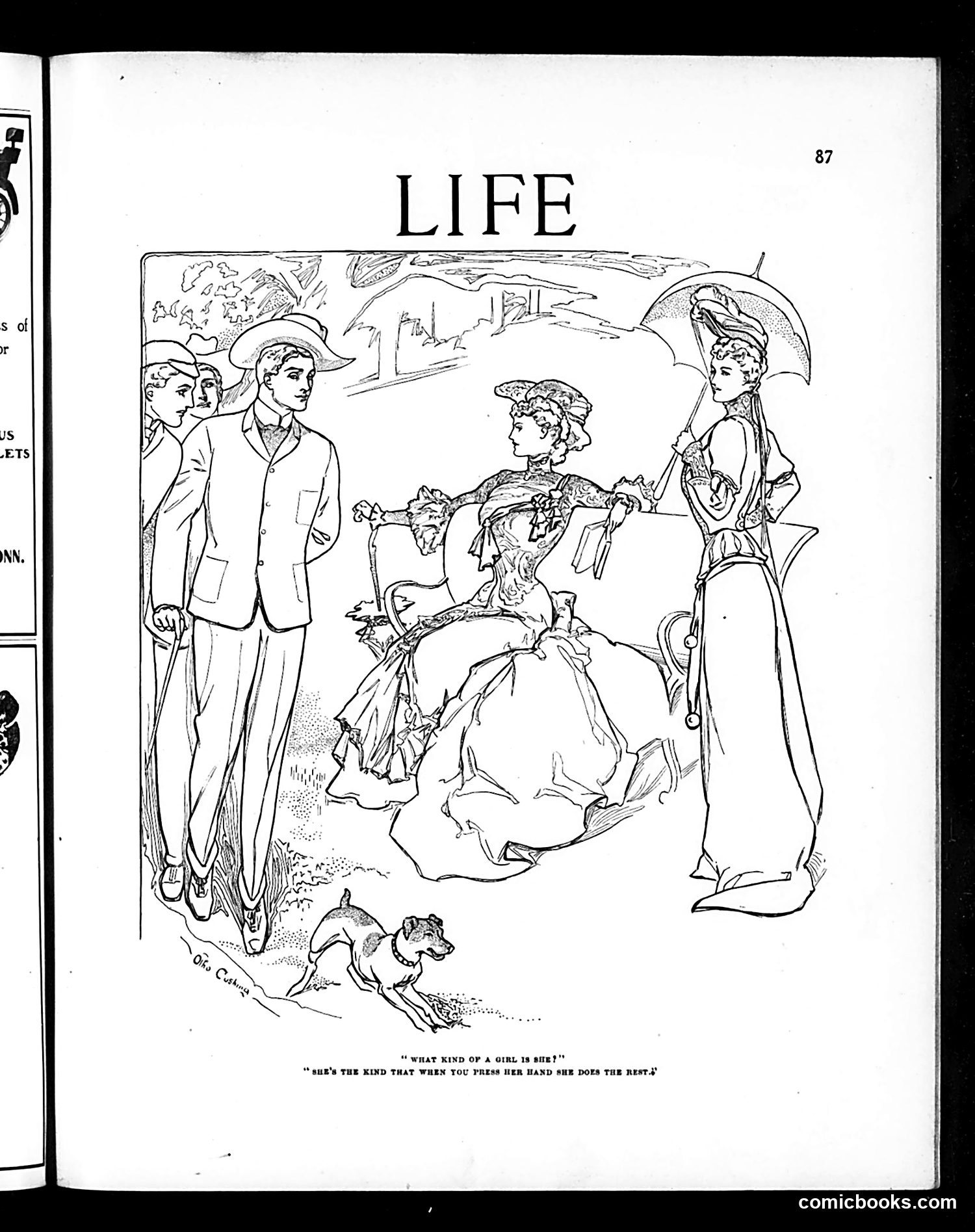
This cartoon depicts a social interaction centered on **gender and courtship norms**. The caption reads: "What kind of a girl is she?" / "She's the kind that when you press her hand she does the rest." The scene shows two men in suits observing a well-dressed woman with an umbrella, conversating with what appears to be a suitor. A small dog is present at the bottom. **The satire targets**: Early 20th-century sexual double standards and male gossip about women's morality. The "joke" relies on the insinuation that certain women will reciprocate physical advances beyond hand-holding—a commentary on how men publicly categorized and discussed women's reputations and sexual availability, presenting this crude assessment as casual conversation humor.
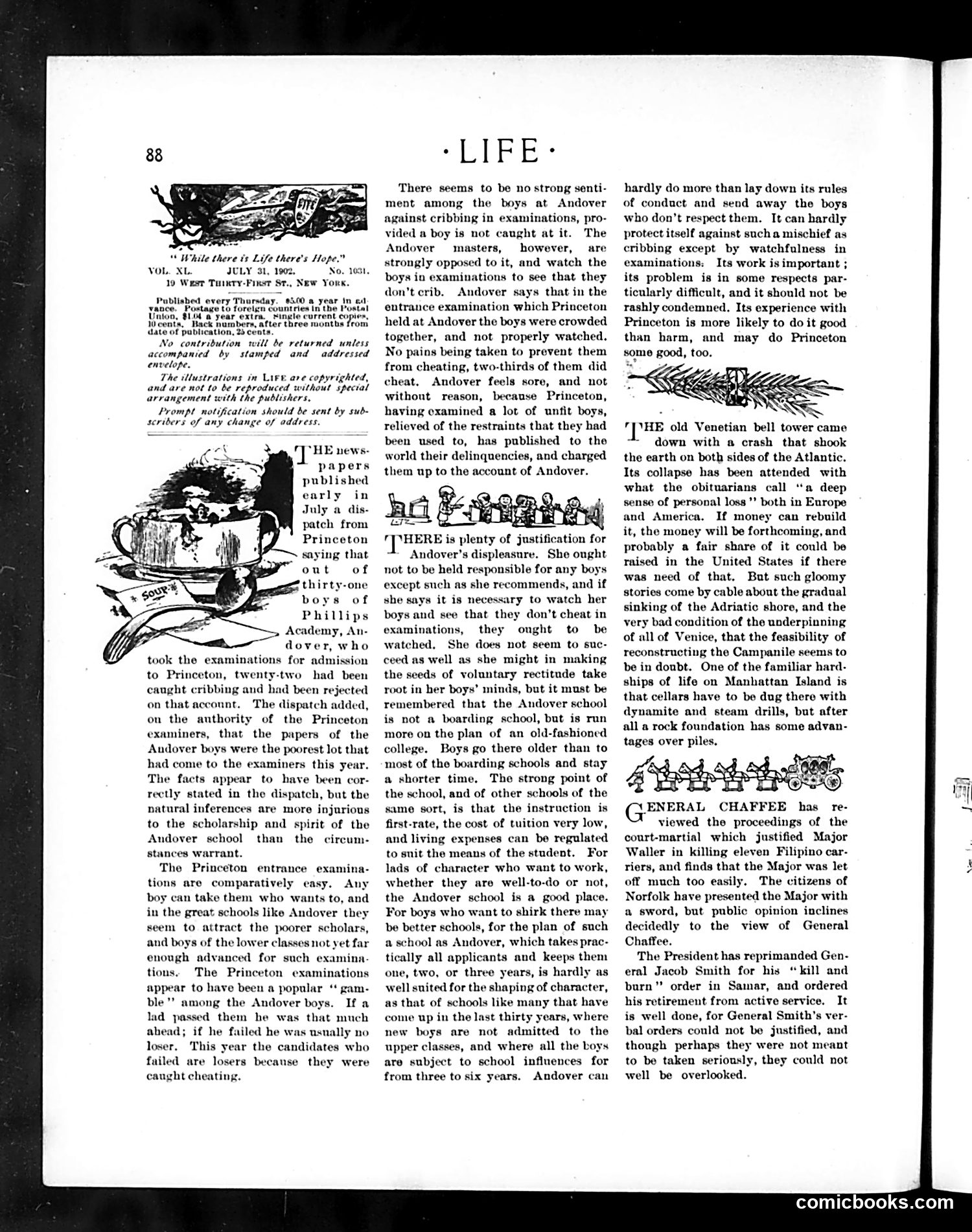
This page discusses cheating at Princeton University's entrance examinations. The left illustration shows a student in a barrel labeled "SOUP," satirizing how Princeton boys hide to cheat during proctored exams. The main text criticizes Andover Academy for failing to prevent cheating during Princeton entrance exams held at Andover. The author argues that while Andover's headmaster bears some responsibility, the real problem lies with Princeton's examination system itself—it's inadequately supervised and encourages dishonesty. The satirical point: prestigious institutions' entrance exams are so poorly monitored that cheating is rampant and students face temptation to compromise their character. The cartoon visually mocks this institutional failure through the absurd image of a hidden student in a soup barrel.
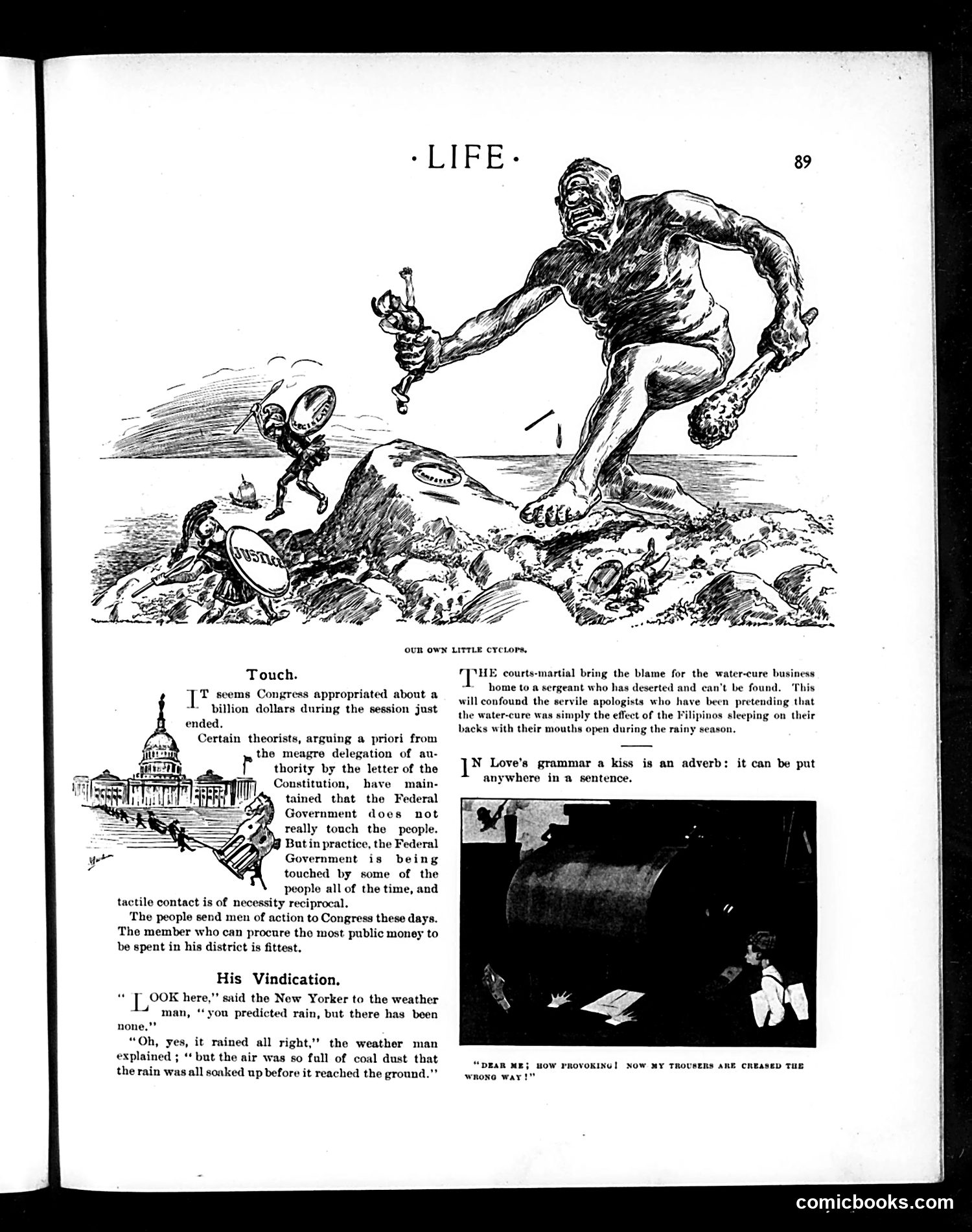
**"Our Own Little Cyclops"** (top illustration): A large, grotesque one-eyed giant tramples tiny human figures. This appears to be satirizing monopolistic power or corporate dominance, with the "cyclops" representing an unstoppable, inhuman economic force crushing ordinary citizens. **"Touch"** (left section): Critiques Federal Government's reach into citizens' lives, arguing that despite theoretical constitutional limits, the government constantly "touches" people through taxation and regulation. Politicians compete for funding to spend in their districts—essentially bribing constituents. **"His Vindication"** (bottom): A weather forecaster's prediction proved partially correct (rain did fall), though he blamed coal dust in the air for preventing ground saturation—a humorous excuse for imprecise meteorology. The page satirizes government overreach, corporate power, and professional incompetence.
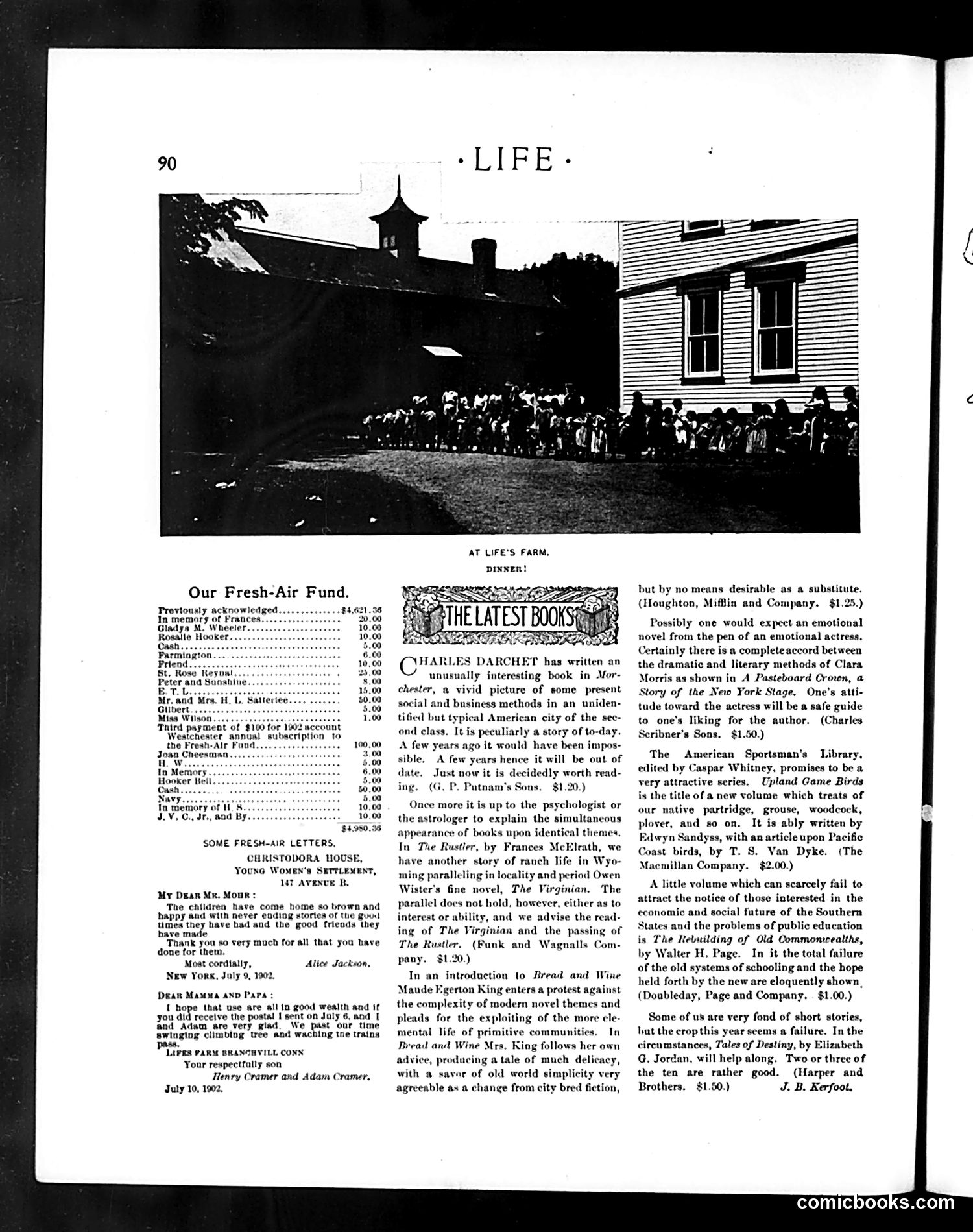
This page contains a photograph labeled "At Life's Farm, Dinner!" showing a large gathering of people outside a building with a church steeple visible. Below is a "Fresh-Air Fund" section listing donations "in memory of Frances" and other contributors, suggesting this documents a charitable initiative providing outdoor experiences for urban children. The remainder of the page consists of "The Latest Books" section—a book review column discussing recent publications including works by Charles Darnett, Frances McElrath, and others. These are straightforward literary reviews without apparent satire or political commentary. The page is primarily **documentary and commercial in nature** rather than satirical, featuring genuine charity work and standard book criticism typical of Life magazine's content from this era.
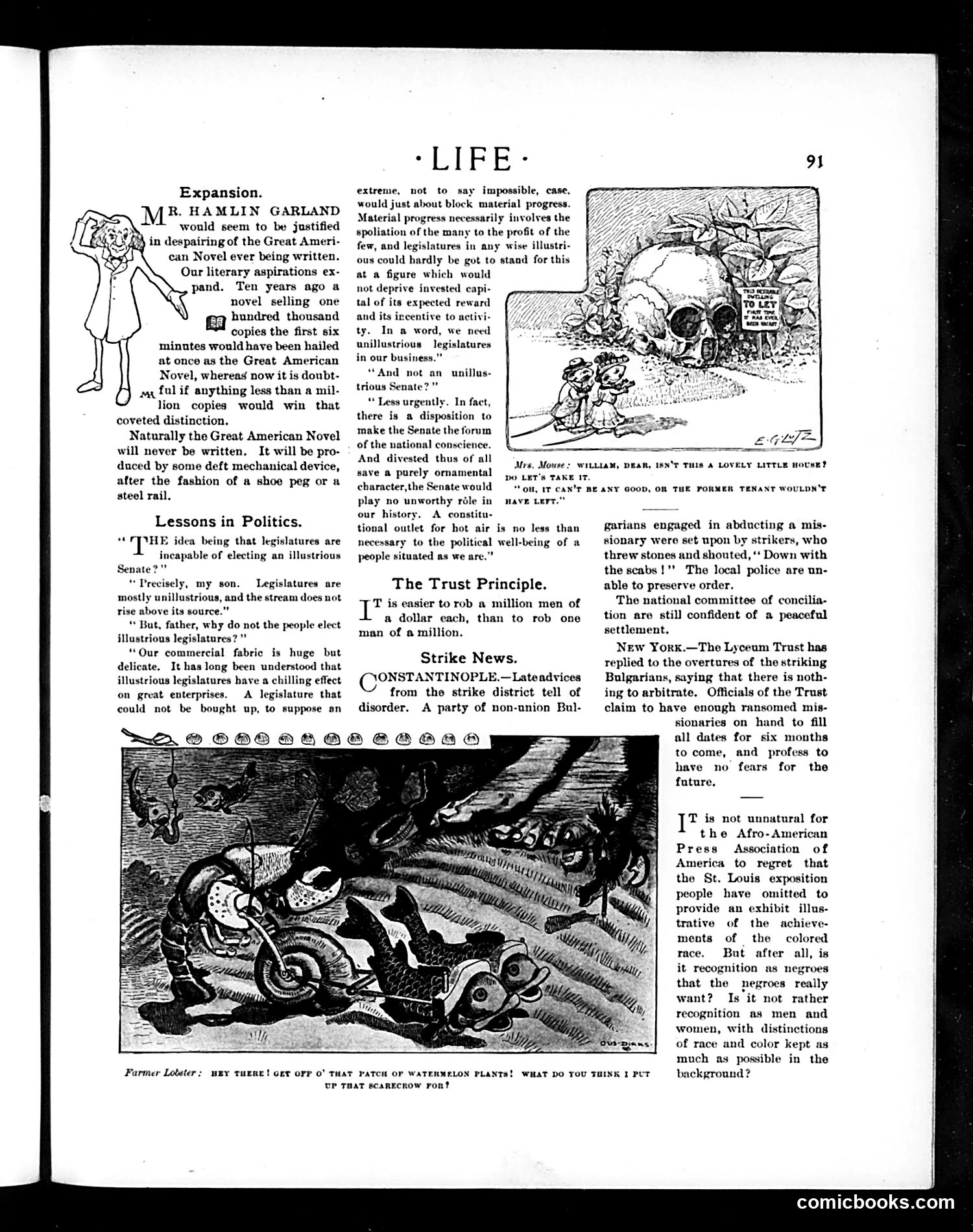
This page contains several satirical pieces on American politics and social issues circa early 1900s. **"Expansion"** mocks Hamlin Garland's defense of American imperialism, suggesting the "Great American Novel" will never be written because material progress (colonial expansion) corrupts literature. **"Lessons in Politics"** ridicules legislatures as inherently corrupt and unelectable, using a father-son dialogue. It satirizes the idea that legislatures cannot effectively govern themselves. **"The Trust Principle"** presents a cynical economic metaphor: robbing one millionaire is worse than robbing a million poor people—commentary on wealth inequality and trust monopolies. **The bottom cartoon** depicts a former lobbyist and scarecrow, likely satirizing corruption in agriculture or political lobbying during the Progressive Era. The overall tone criticizes American political institutions, corporate greed, and imperialism.
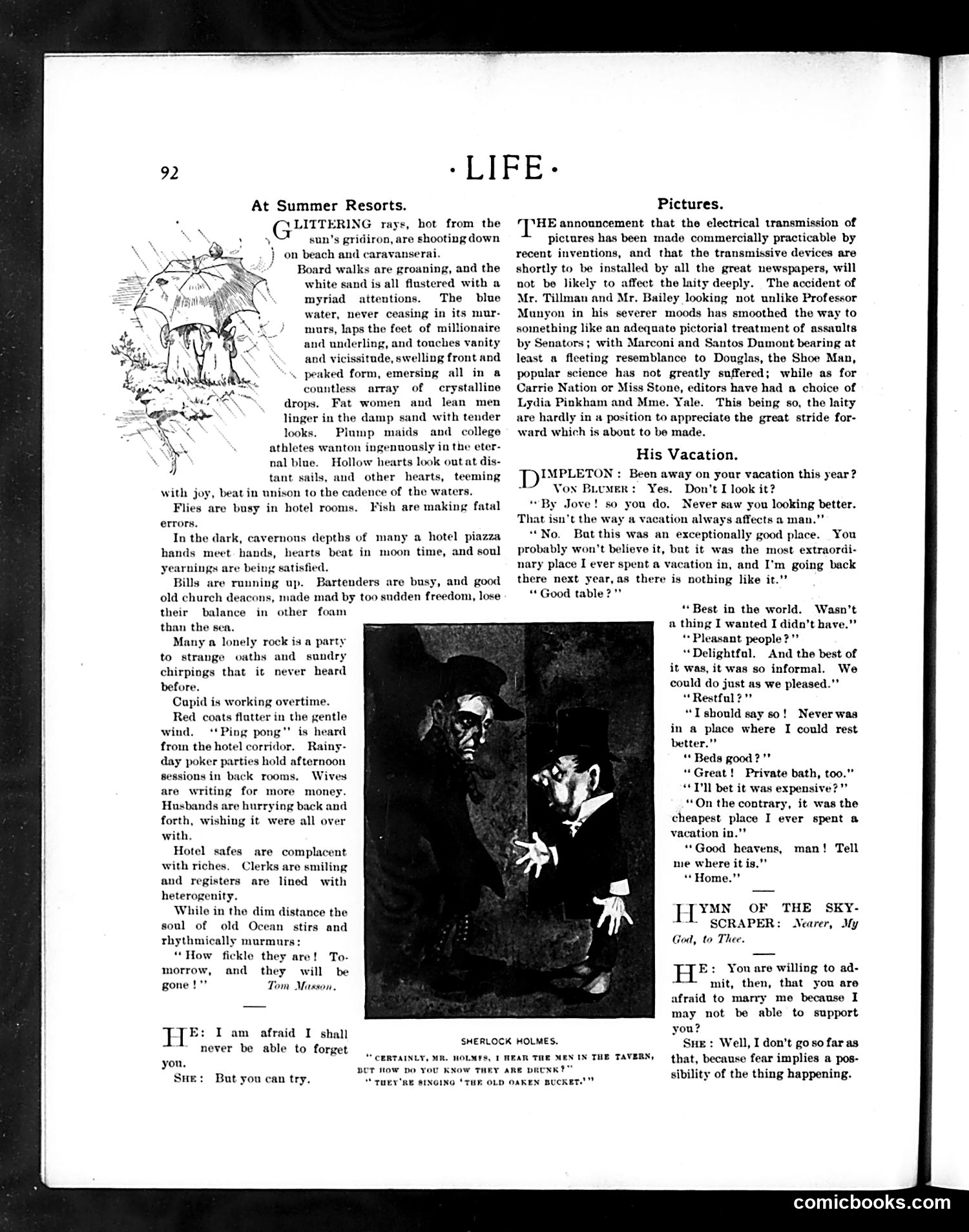
The page contains three distinct sections: 1. **"At Summer Resorts"** (left): A humorous essay about hotel life, describing various social scenes—wealthy guests, working staff, and idle pastimes. The illustration shows a couple with an umbrella in rain. 2. **Central photograph**: Labeled "SHERLOCK HOLMES," showing two men in what appears to be a tavern scene. The caption quotes Holmes discussing drunken men singing "The Old Oaken Bucket," playing on Holmes's deductive abilities to identify people by their behavior. 3. **"His Vacation"** and **"Hymn of the Sky-Scraper"** (right): Humorous dialogues—one about vacation experiences, another featuring romantic tension between a man and woman discussing financial security. The satire targets leisured class pretensions and romantic anxieties of the era.
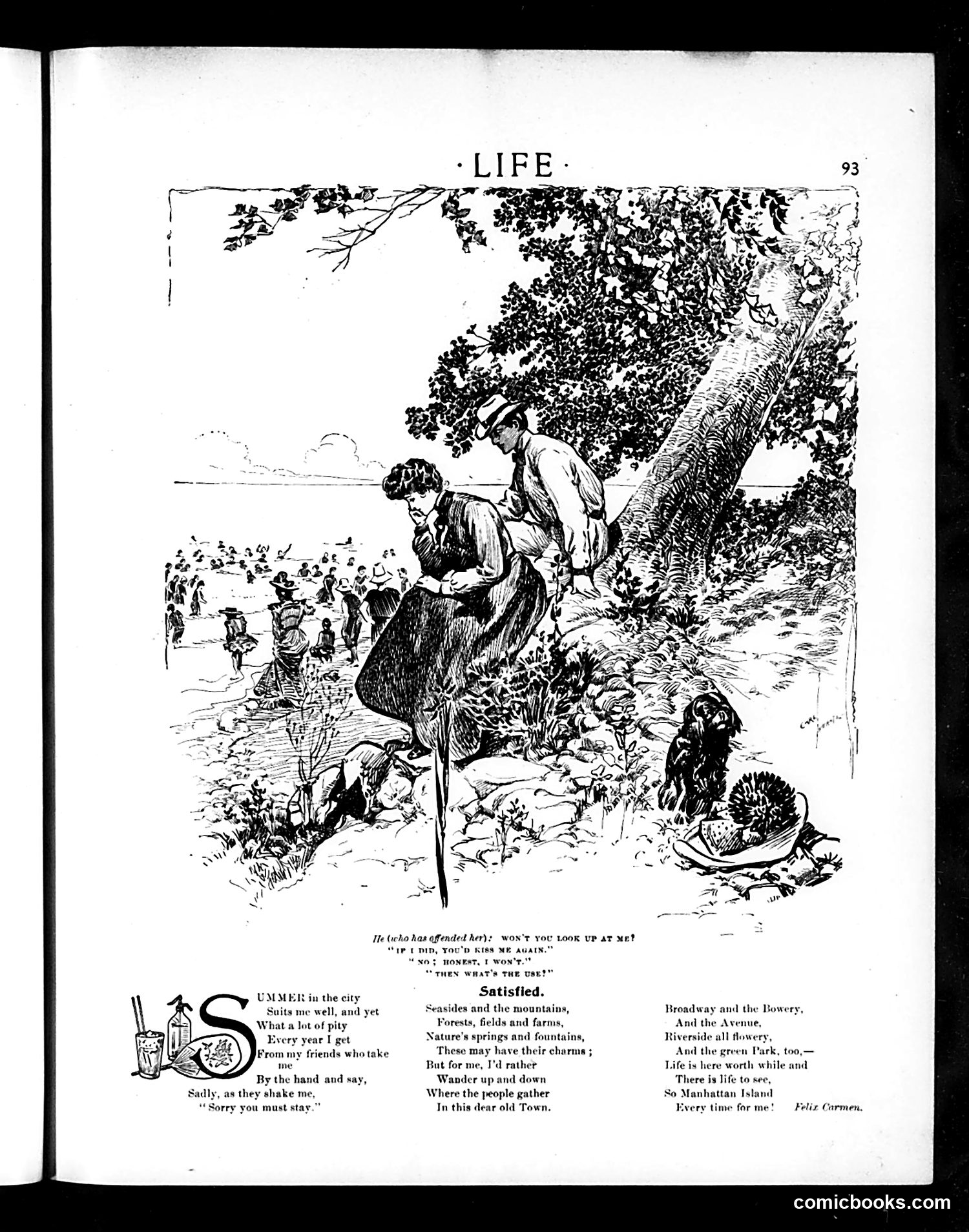
This page features an illustration and poem titled "Satisfied" by Felix Carmen (credited at bottom right). The sketch depicts two figures on a beach or waterfront near a large tree, observing a crowded seaside town in the distance. The dialogue bubble reads: "He (who has offended her): won't you look at me? 'If I said 'I'm sorry,' would you listen?' 'No; honest, I won't.' 'Then what's the use?'" The accompanying poem contrasts urban life—summer in the city, Broadway, the Bowery—with rural attractions (mountains, forests, fountains). The speaker expresses preference for wandering through places "Where the people gather / In this dear old Town," finding Manhattan Island satisfying. The cartoon appears to humorously illustrate romantic conflict and reconciliation, while the poem celebrates urban social gathering over rural solitude—typical themes for Life's satirical commentary on American leisure and social life.
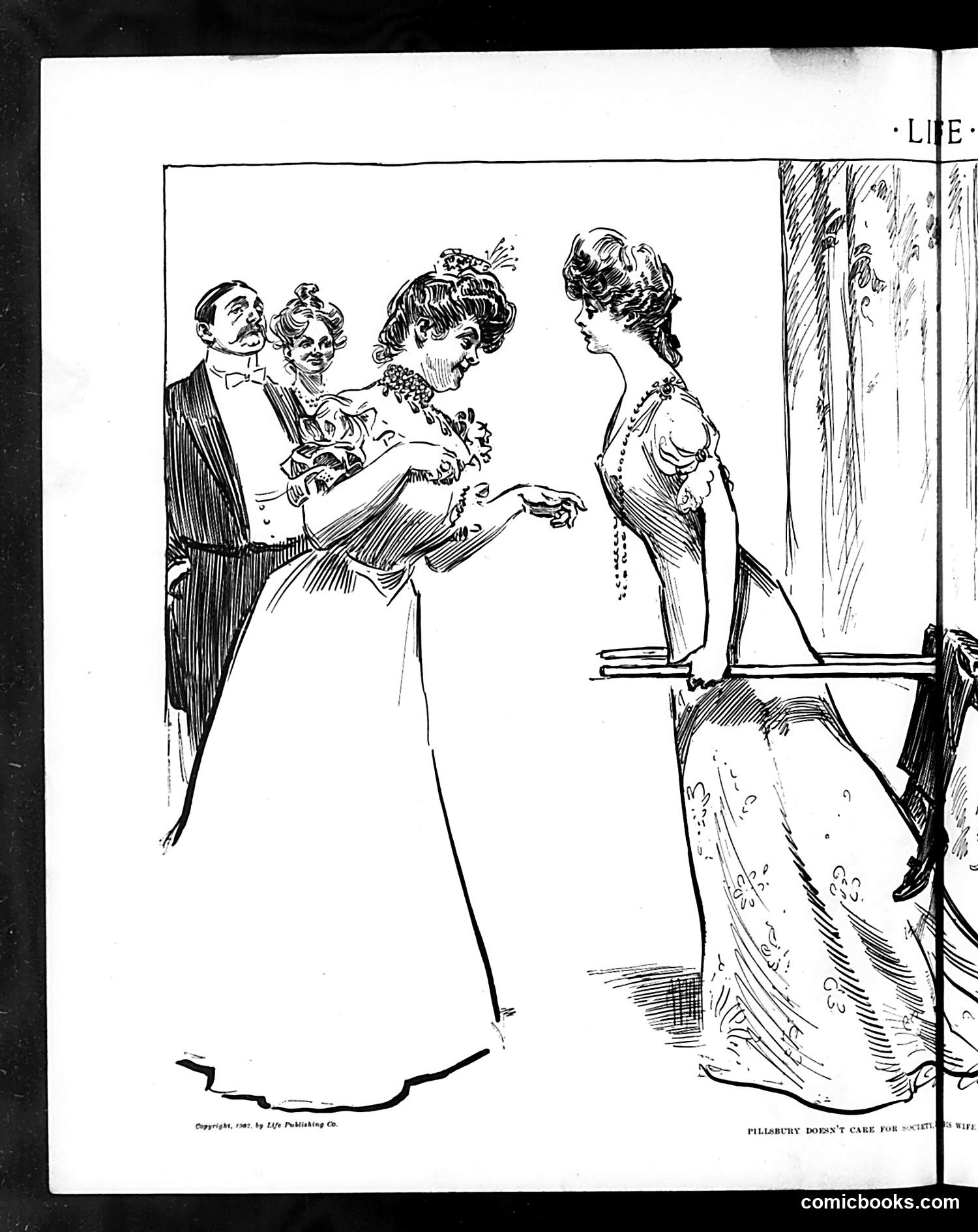
This illustration from *Life* magazine (copyright 1908) shows a social scene titled "Pillsbury Doesn't Care for Society's Wife." The cartoon depicts a man in formal attire holding a small child, conversing with a fashionably dressed woman. A second woman stands to the right, seemingly excluded from the interaction. The satire appears to target someone named Pillsbury, suggesting he prioritizes domestic life and children over high society's social conventions and expectations. By showing him engaged with a child rather than attending to the society woman, the cartoon mocks either Pillsbury's unconventional priorities or satirizes upper-class social pretensions. The "Life" masthead indicates this was satirical commentary on contemporary social attitudes regarding family, class, and social obligations among the wealthy.
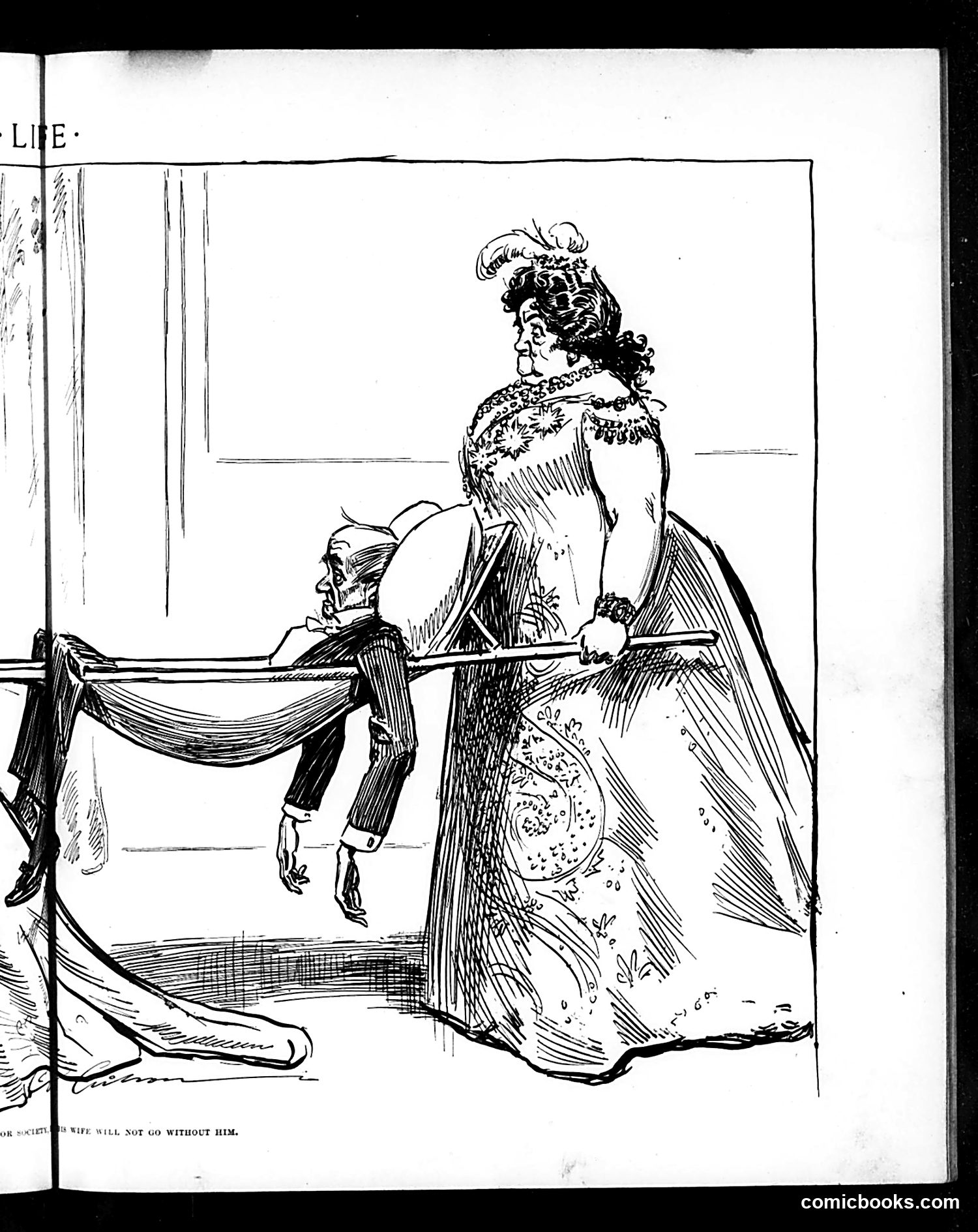
This appears to be an early 20th-century satirical cartoon from Life magazine. The image shows a diminutive man in formal attire being pulled along by a large, elaborately dressed woman wearing jewels, feathered hat, and an ornate gown. The visible caption reads "MY WIFE WILL NOT GO WITHOUT HIM," suggesting commentary on marital dynamics and social hierarchy. The cartoon satirizes the reversal of traditional power roles—depicting the wife as dominant and controlling while the husband is literally dragged along, portrayed as small and subservient. This likely reflects contemporary anxieties about women's increasing independence and changing gender roles during the Progressive Era, mocking both wives who asserted authority and husbands perceived as weak or henpecked. The exaggerated physical size difference emphasizes the satirical point about power imbalance in marriage.
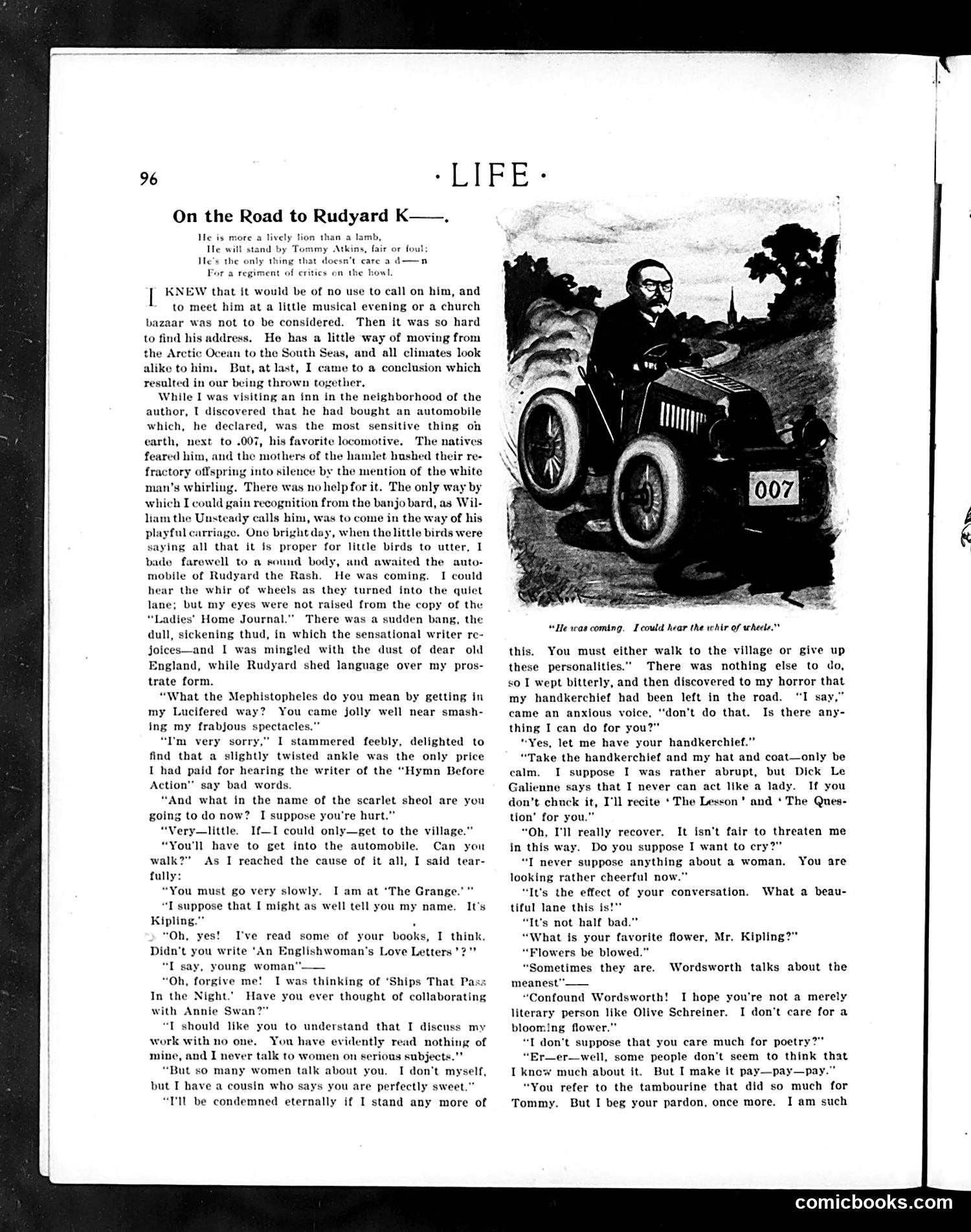
This is a literary satire about meeting **Rudyard Kipling** (the name is deliberately abbreviated). The illustration shows a man and woman in an early automobile marked "007." The text describes the author's difficulty locating Kipling, who apparently moves frequently between climates. When they finally meet, Kipling is portrayed as cantankerous and dismissive—he complains about his automobile being "the most sensitive thing on earth," insults the narrator's literary knowledge, and makes disparaging remarks about women writers and poetry. The satire mocks Kipling's reputation as a difficult, curmudgeonly personality. The "007" license plate may reference espionage/mystery themes, though this connection is unclear. The piece presents Kipling as vain, misogynistic, and quick to insult, playing on contemporary perceptions of the famous author's temperament.
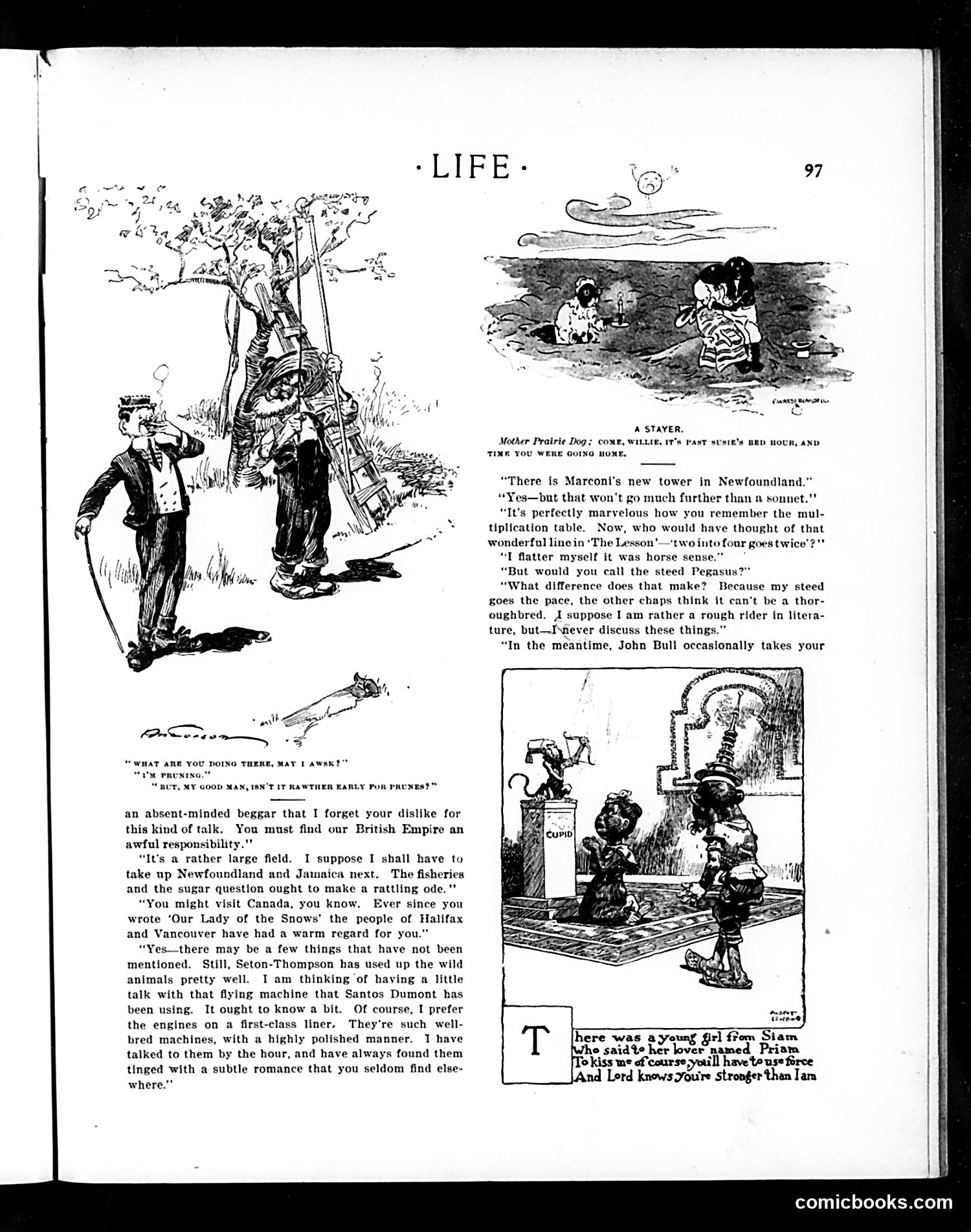
This page satirizes **Rudyard Kipling**, the celebrated British writer and imperialist poet. The central conversation mocks his prolific output and grandiose subject matter. **The Satire:** A character boasts of writing about anything—Marconi's wireless tower, multiplication tables, Pegasus, the British Empire, Newfoundland, Jamaica, Canada (referencing Kipling's "Our Lady of the Snows"), wild animals, and flying machines. The humor lies in presenting this as literary achievement despite evident mediocrity ("horse sense" rather than true insight). **Key References:** - "John Bull occasionally takes your [literary] line"—British imperial subject matter - References to Seton-Thompson (wildlife writer) and Santos Dumont (aviation pioneer)—competitors in specialized subjects - The opening cartoon shows a figure pruning trees, with dialogue about timing—likely commenting on Kipling's perceived careless or untimely output **The Point:** Life ridicules Kipling's tendency to write authoritatively about any topic and his association with British imperial expansion, suggesting his work lacks depth despite its volume and public acclaim.
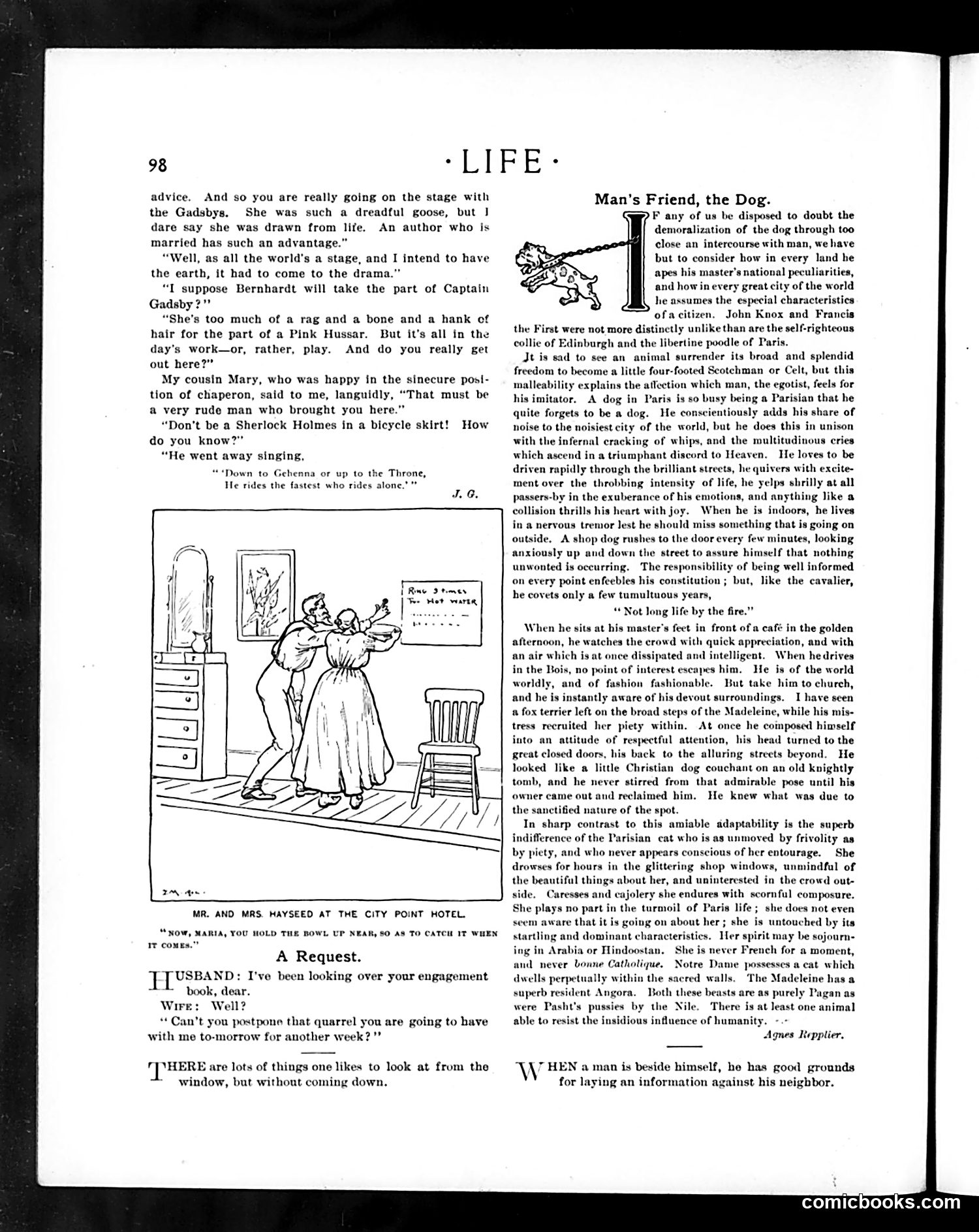
This page contains two distinct satirical pieces typical of Life magazine's humor: **"A Request" (cartoon):** A domestic comedy sketch where a husband, reviewing his wife's engagement calendar, asks her to postpone their scheduled quarrel to next week. The humor lies in the absurd formality of scheduling marital conflict like a social appointment—satirizing both Victorian etiquette and predictable domestic friction. **"Man's Friend, the Dog" (essay with illustration):** A longer satirical piece arguing that dogs have become corrupted by imitating their masters' national characteristics. The author contrasts a "self-righteous collie of Edinburgh" with a "libertine poodle of Paris," suggesting dogs absorb human vices and anxieties. The Parisian dog example—nervous, status-conscious, fashion-obsessed—is the sharper satire, mocking both canine servility and urban French superficiality. The piece uses dog behavior as a mirror to critique human society's materialism and pretension. Both pieces employ gentle mockery of bourgeois social conventions and human nature.
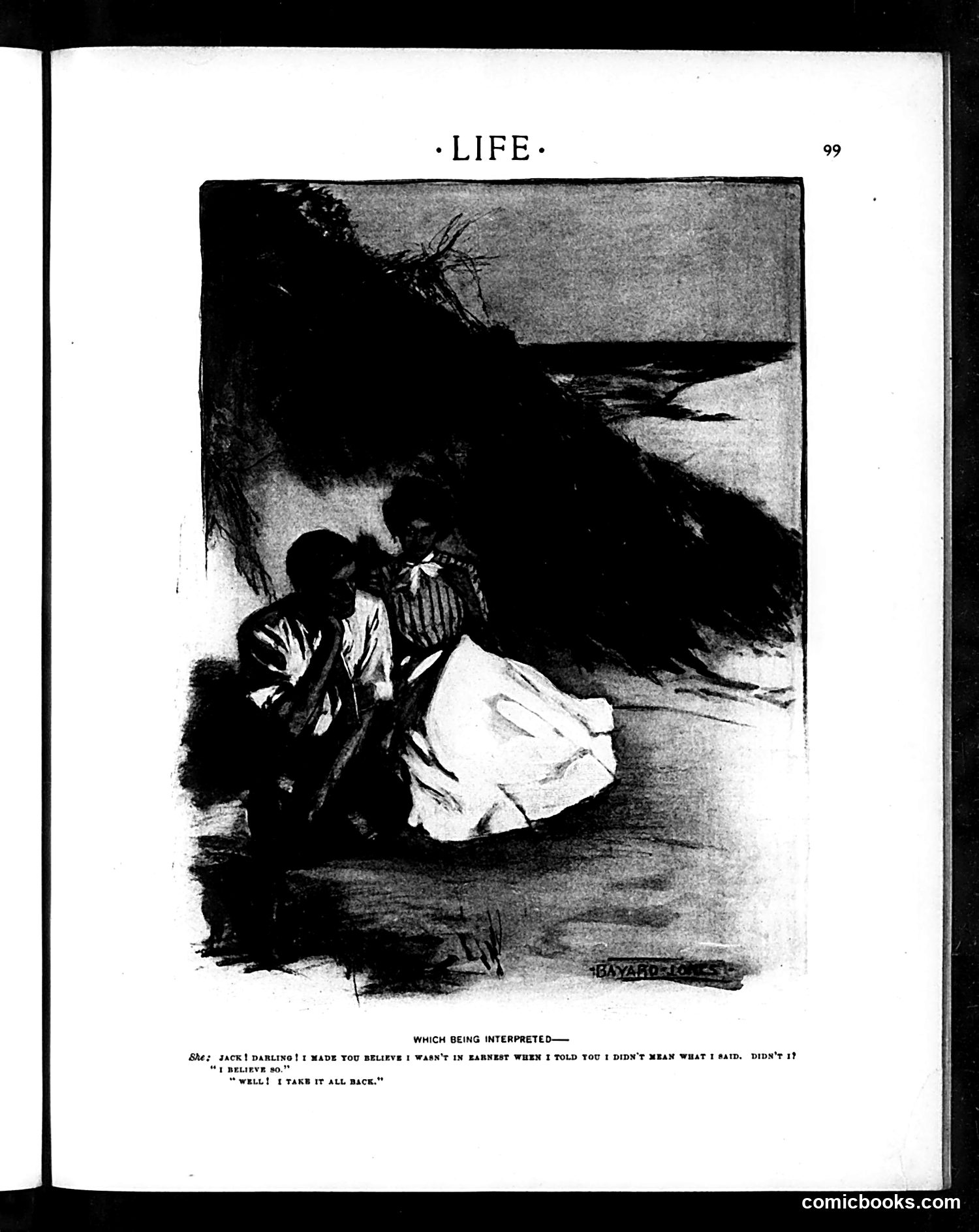
This cartoon satirizes the confusion and contradiction in romantic communication. A woman has deliberately misled her male partner about her previous statement, creating a deliberately tangled web of negatives ("I didn't mean what I said" that she didn't mean). The man, appearing bewildered in the illustration, struggles to parse her convoluted logic. His response—"I believe so" followed by "Well! I take it all back"—suggests he's surrendering to confusion rather than understanding. The satire targets how relationship miscommunication exploits rhetorical games and emotional manipulation, particularly mocking women's stereotypical use of calculated ambiguity to control romantic narratives. It's commentary on the exhausting illogic couples navigate when one partner weaponizes carefully worded denials.
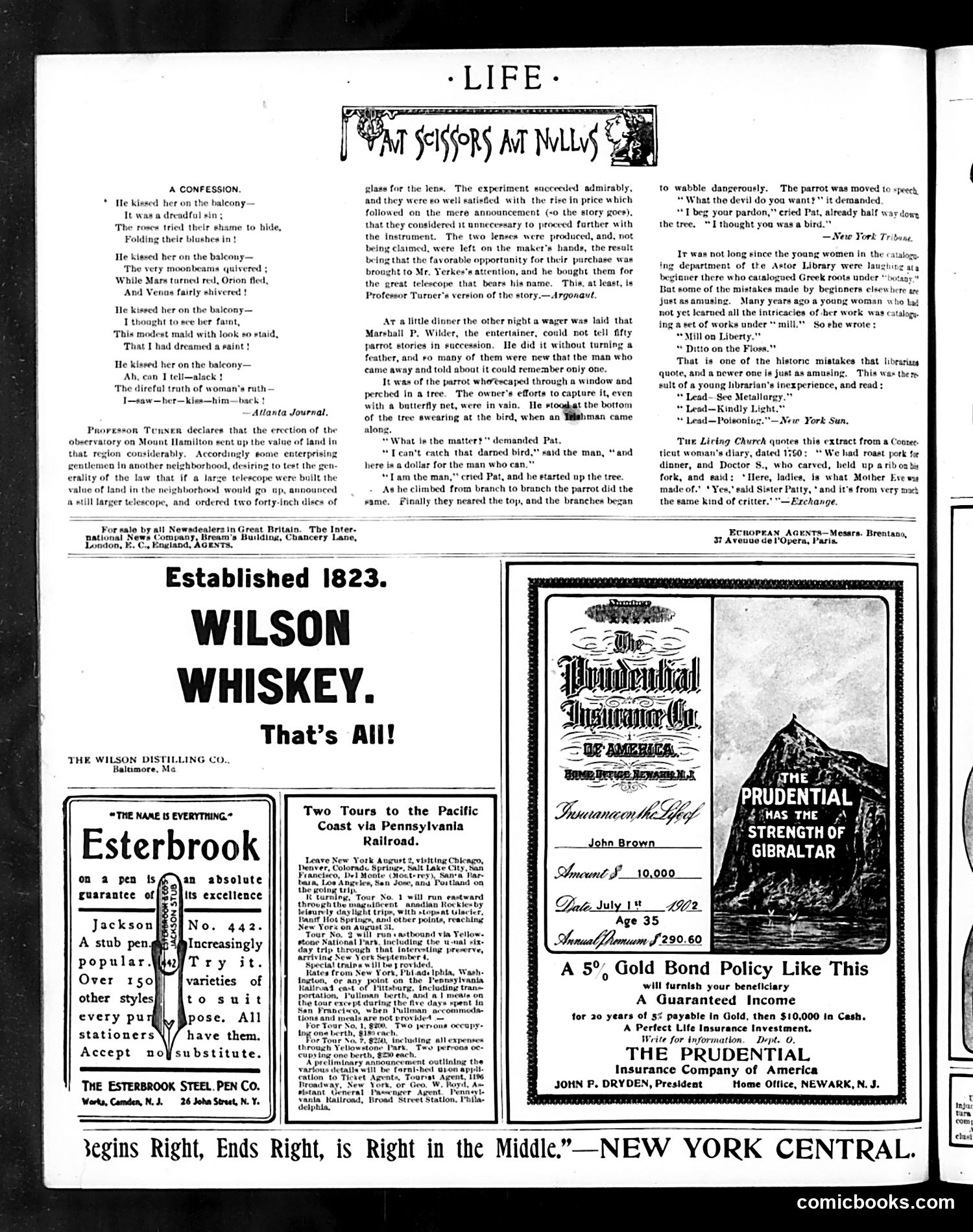
This page from *Life* magazine (a 19th-century American satirical publication) is primarily **advertising and humorous prose anecdotes**, not political cartoons. The featured content includes: **"A Confession"** — a sentimental poem about a man kissing a woman on a balcony, presented ironically with comically pedantic footnotes correcting literary references (e.g., "*Ditto on the Floss*"). **Anecdotes about library cataloging errors** — humorous stories about young library workers at the Astor Library making absurd mistakes while filing Greek roots and other materials. The satire mocks both incompetent clerks and overly pedantic cataloging systems. **Marshall P. Wilder parrot story** — a comedic anecdote about an entertainer who tells fifty consecutive parrot stories, one involving a man chasing an escaped parrot up a tree. The page is predominantly filled with **period advertisements** (Wilson Whiskey, Esterbrook pens, insurance policies), which was standard *Life* magazine format. There is no coherent political message—the humor targets individual human folly and institutional pretension rather than political figures or movements.
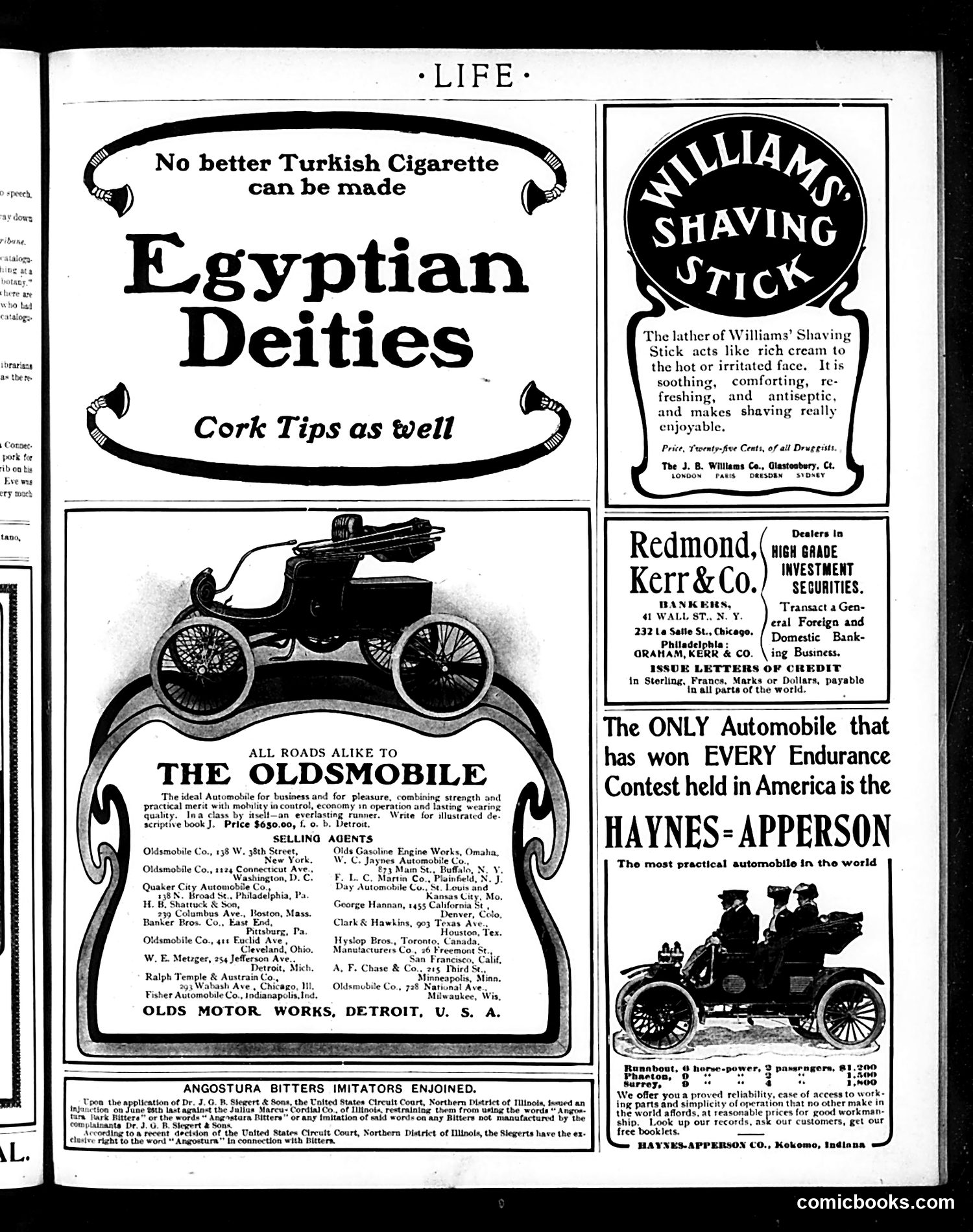
This is primarily an **advertising page**, not satire or political cartoons. It contains five distinct advertisements: 1. **Egyptian Deities cigarettes** — promoting Turkish cigarettes with cork tips 2. **Williams' Shaving Stick** — lather product for sensitive skin 3. **Oldsmobile automobiles** — emphasizing durability and widespread dealer network 4. **Haynes-Apperson automobiles** — claiming superiority in endurance contests 5. **Redmond, Kerr & Co.** — banking/investment services 6. **Angostura Bitters** — legal notice about trademark protection against imitators The page reflects early 20th-century consumer capitalism: competing auto manufacturers making performance claims, grooming products targeting male consumers, and financial services advertising. There is **no political satire or caricature** visible—this is straightforward commercial advertising typical of Life magazine's revenue model during this era.
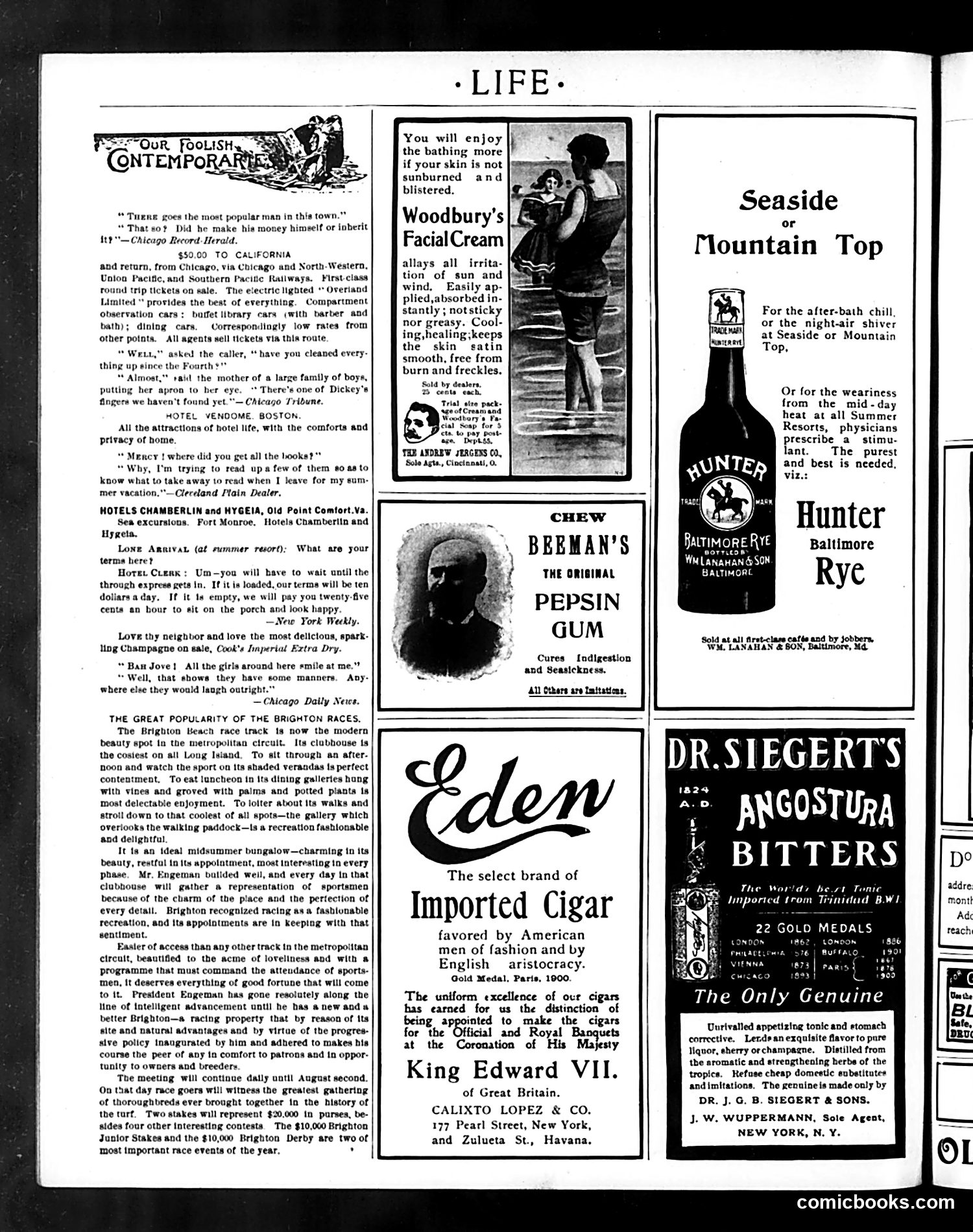
This page is primarily **advertising with brief humorous fillers** rather than political cartoons. The main content consists of product advertisements (Woodbury's Facial Cream, Hunter Baltimore Rye, Beeman's Pepsin Gum, Eden Imported Cigars, Dr. Siegert's Angostura Bitters) interspersed with short joke-exchanges typical of early 20th-century humor magazines. The jokes reflect period concerns: a wealthy man's social standing, post-Fourth of July household cleanup, hotel pricing anxiety, and summer resort etiquette. One references Brighton Beach racetrack, a fashionable leisure destination of the era. The humor relies on class anxieties, domestic mishaps, and social climbing—themes relevant to Life's affluent readership. However, **there are no identifiable political cartoons or specific caricatures** on this page. It's primarily a commercial/entertainment page showcasing consumer products marketed to upper-middle-class readers circa early 1900s.
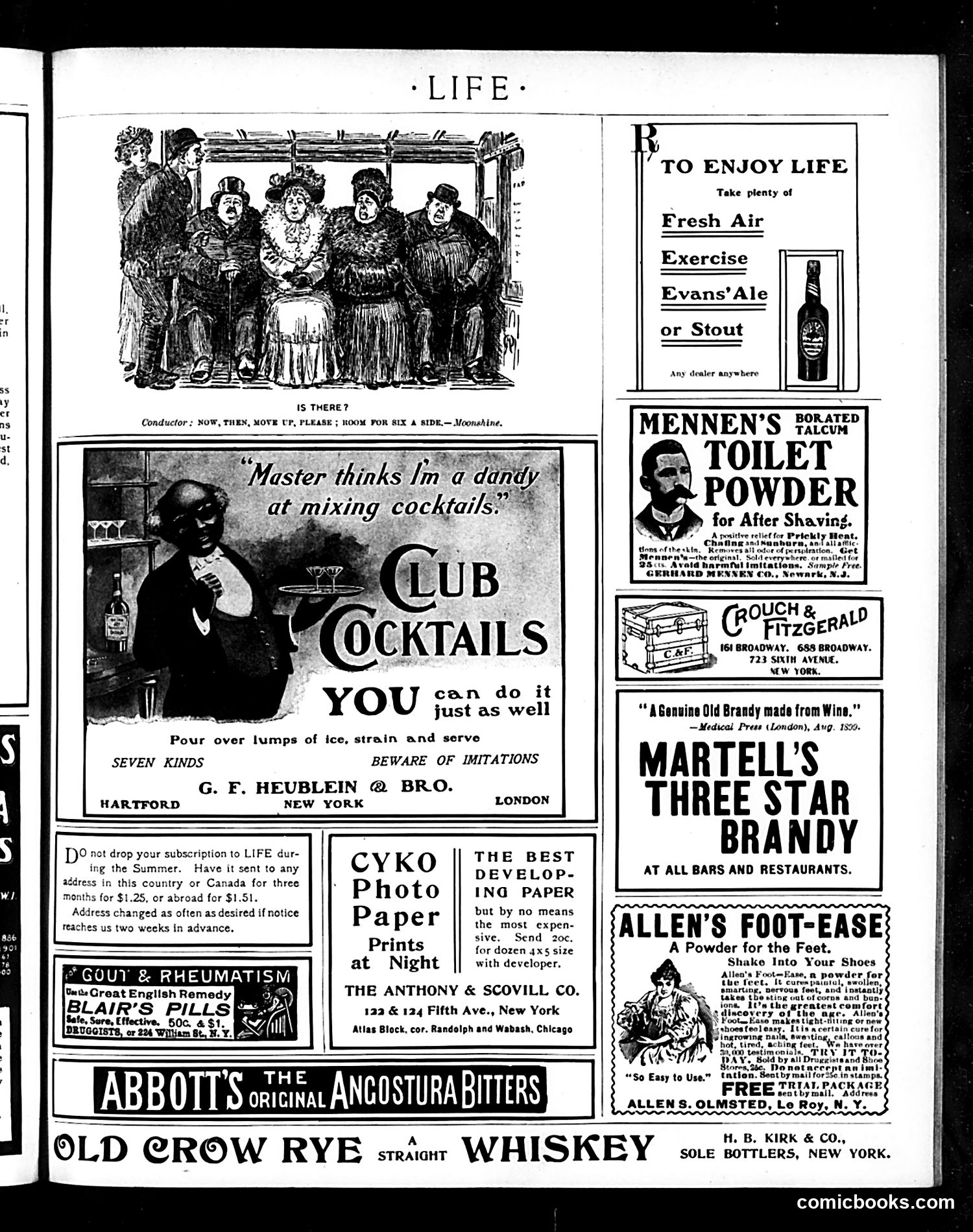
This is primarily an **advertising page** with one small cartoon at the top. The main cartoon shows a crowded streetcar or omnibus with a conductor calling "Now, then, move up, please; room for six a side." The caption "Is There?" sardonically questions whether there's actually room—a joke about overcrowded public transportation, a common urban complaint of the era. Below sits a larger advertisement for **Club Cocktails** by G.F. Heublein & Bro., featuring a servant mixing drinks with the tagline "Master thinks I'm a dandy at mixing cocktails. You can do it just as well." This reflects pre-Prohibition attitudes toward home cocktail-making. The rest of the page is dominated by period product advertisements: alcoholic beverages (Evans' Ale, Martell's Brandy, Old Crow Whiskey), patent medicines (Blair's Pills), and personal care items (Mennen's Powder, Allen's Foot-Ease). The ads reflect early 1900s consumer culture and the common practice of advertising alcohol and dubious remedies in mainstream publications.
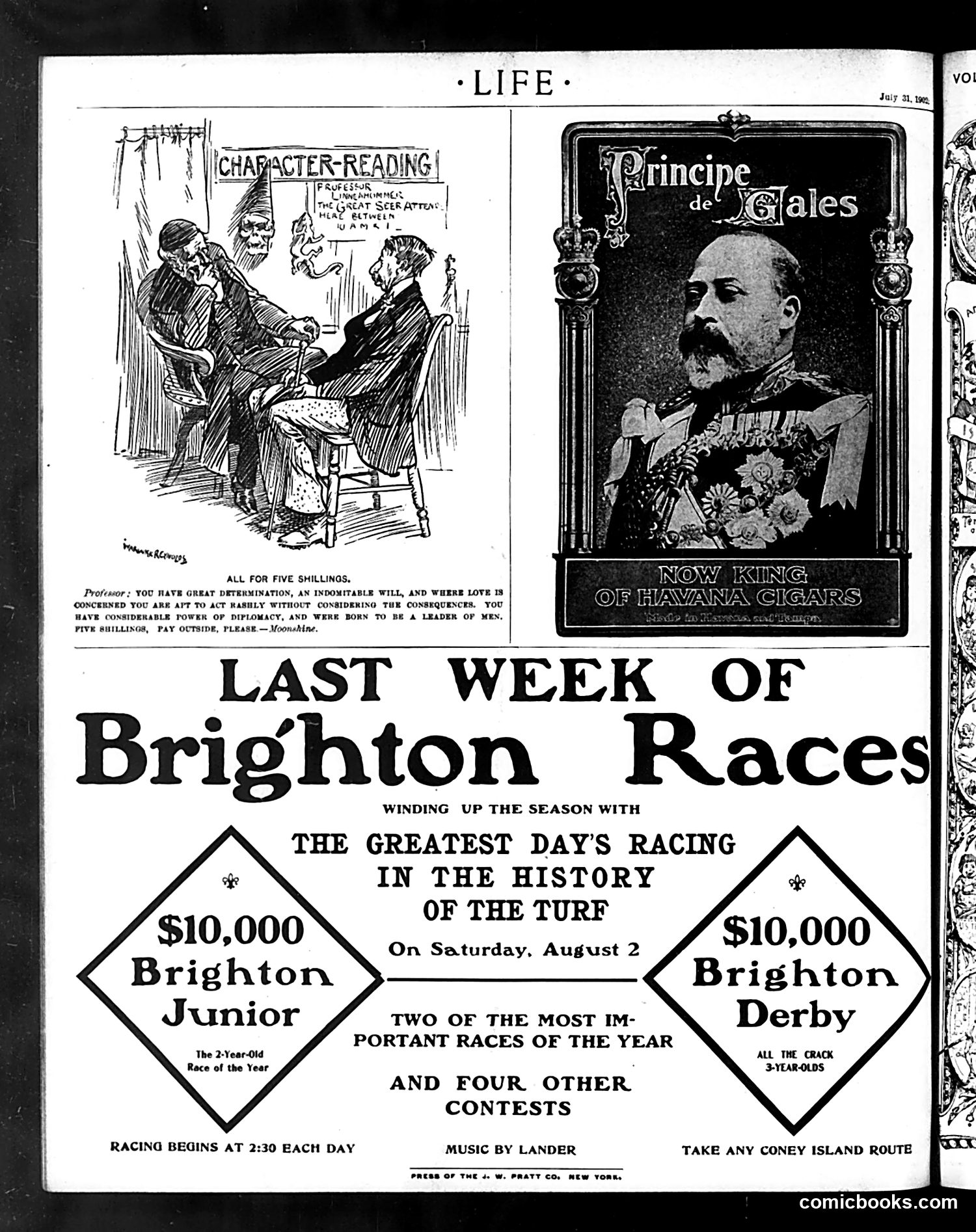
The top cartoon is a character-reading sketch labeled "All for Five Shillings," depicting what appears to be a fortune teller or phrenologist examining a client's head while reading his character traits aloud. The joke satirizes pseudoscientific character analysis—a popular Victorian parlor entertainment where practitioners would "read" personality from facial features or skull shape, then flatter clients with generic praise about their "determination" and "indomitable will" in exchange for payment. The rest of the page is advertising for Brighton horse races scheduled for August 2, featuring two major $10,000 races and musical entertainment. The "Principe de Gales" advertisement features a military officer, likely promoting cigars. The page demonstrates how Life magazine mixed satirical humor with commercial advertising.