
Life, 1902-07-31 · page 7 of 20
Life — July 31, 1902 — page 7: what you’re looking at
What you’re looking at
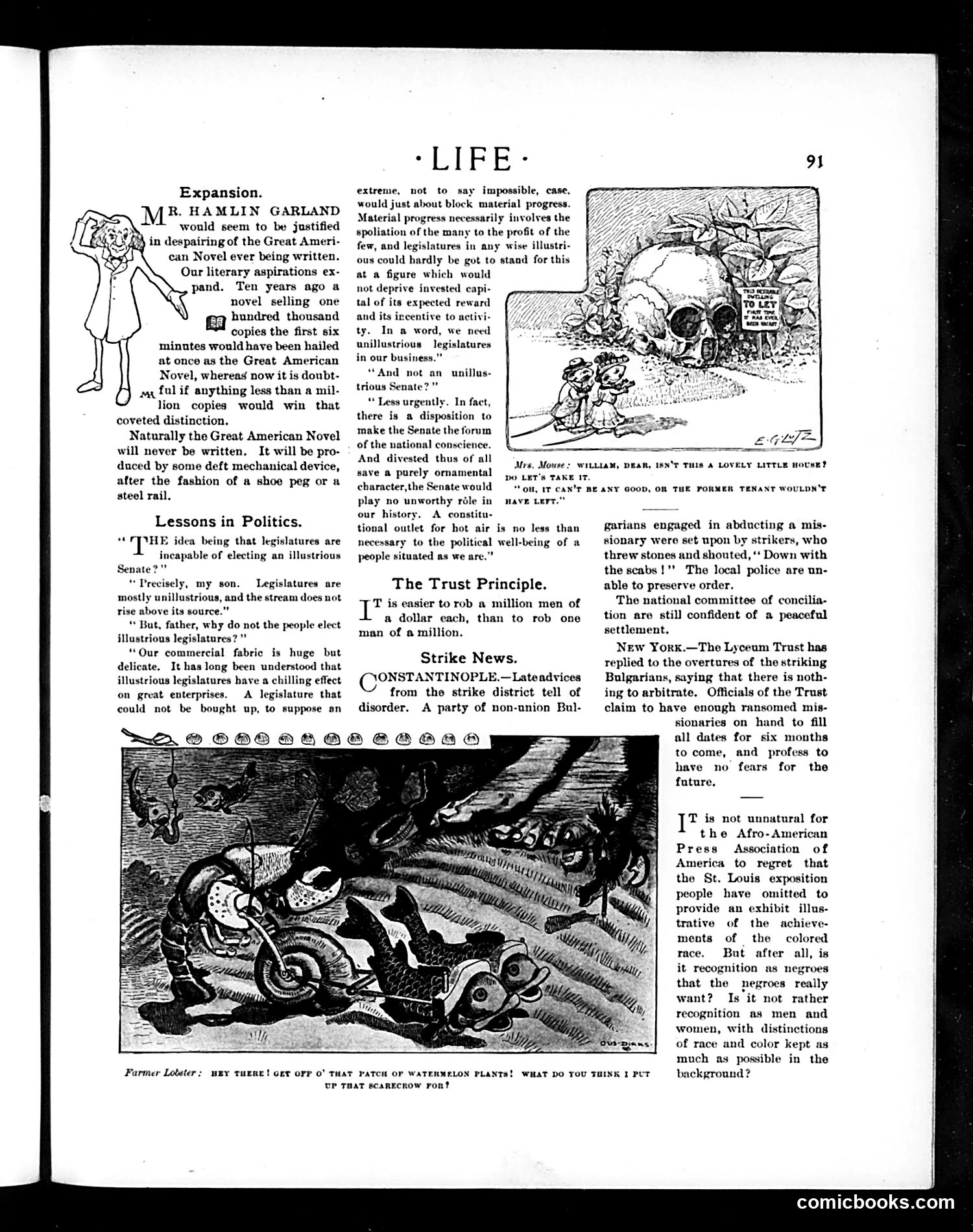
This page contains several satirical pieces on American politics and social issues circa early 1900s. **"Expansion"** mocks Hamlin Garland's defense of American imperialism, suggesting the "Great American Novel" will never be written because material progress (colonial expansion) corrupts literature. **"Lessons in Politics"** ridicules legislatures as inherently corrupt and unelectable, using a father-son dialogue. It satirizes the idea that legislatures cannot effectively govern themselves. **"The Trust Principle"** presents a cynical economic metaphor: robbing one millionaire is worse than robbing a million poor people—commentary on wealth inequality and trust monopolies. **The bottom cartoon** depicts a former lobbyist and scarecrow, likely satirizing corruption in agriculture or political lobbying during the Progressive Era. The overall tone criticizes American political institutions, corporate greed, and imperialism.
📄 Transcribed text from this page (OCR, searchable)
Machine-transcribed from the original scan — historical spelling and the odd misread are preserved.
Expansion. M®. HAMLIN GARLAND would seem to be justified in despairing of the Great Ameri- can Novel ever being written. Onur literary aspirations ex- pand. Ten years ago a novel selling one fa hundred thousand copies the first six minutes would have been hailed at once as the Great American Novel, whereas now it is doubt- Om ful if anything less than a mil- lion copies would win that coveted distinction. Naturally the Great American Novel will never be written, It will be pro- duced by some deft mechanical device, after the fashion of a shoe peg or a steel rail, Lessons in Politics. **TINHE idea being that legislatures are incapable of electing an illustrious Senate?” “Precisely, my son. Legislatures are mostly unillustrious, and the stream does not rise above its source.” “ But, father, why do not the people elect illustrious legislatures?” ‘Our commercial fabric is huge but delicate. It has long been understood that illustrious legislatures have a chilling effect on great enterprises. A legislature that could not be bought up, to suppose an a) ®&AS Farmer Lobster : «LIFE - extreme, not to say impossible, case, would just about block material progress. Material progress necessarily involves the spoliation of the many to the profit of the few, and legislatures in any wise illustri- ous could hardly be got to stand for this at a figure which would not deprive invested capi- tal of its expected reward and its incentive to activi- ty. In a word, we need unillustrious legislatures in our business.” “And not an trious Senate?" * Less urgently. In fact, there is a disposition to make the Senate the forum of the national conscience. And divested thus of all save a purely ornamental character,the Senate would play no unworthy réle in A constitu- tional outlet for hot air is no less than necessary to the political well-being of a people situated as we are.” unillus- HAVE Lert.” our history. The Trust Principle. J’ is easier to rob a million men of a dollar each, than to rob one man of a million. Strike News. ONSTANTINOPLE,.— Lateadvices from the strike district tell of disorder. A party of non-union Bul- AA @® @SGH@AO NEY THERE! OLT OFF O' THAT PATCH OF WATERMELON PLANTS! WHAT DO YOU THINK I PUT UP THAT SCARECROW For? Mrs, Mouse: WitLtaM, DEAR, ISN'T THIS A LOVELY LITTLE HoUSR? DO LET'S TAKE 17. “ou, IT CAN'T BE ANY GOOD, OR THE FORMER TENANT WOULDN'T garians engaged in abducting a mis- sionary wero set upon by strikers, who threw stones and shouted, ‘* Down with the scabs !’’ The local police are un- able to preserve order. The national committee of concilia- tion aro still confident of a peaceful settlement. New York.—The Lyceum Trust has replied to the overtures of the striking Bulgarians, saying that there is noth- ing to arbitrate. Officials of the Trust claim to have enough ransomed mis- sionaries on hand to fill all dates for six months to come, and profess to have no fears for the fature. T is not unnatural for the Afro-American Press Association of America to regret that the St. Louis exposition people have omitted to provide an exhibit illus- trative of the achieve- ments of the colored race. But after all, is it recognition as negroes that the negroes really want? Is it not rather recognition as men and women, with distinctions of race and color kept as much as possible in the background? comicbooks.com