
Life, 1902-07-31 · page 12 of 20
Life — July 31, 1902 — page 12: what you’re looking at
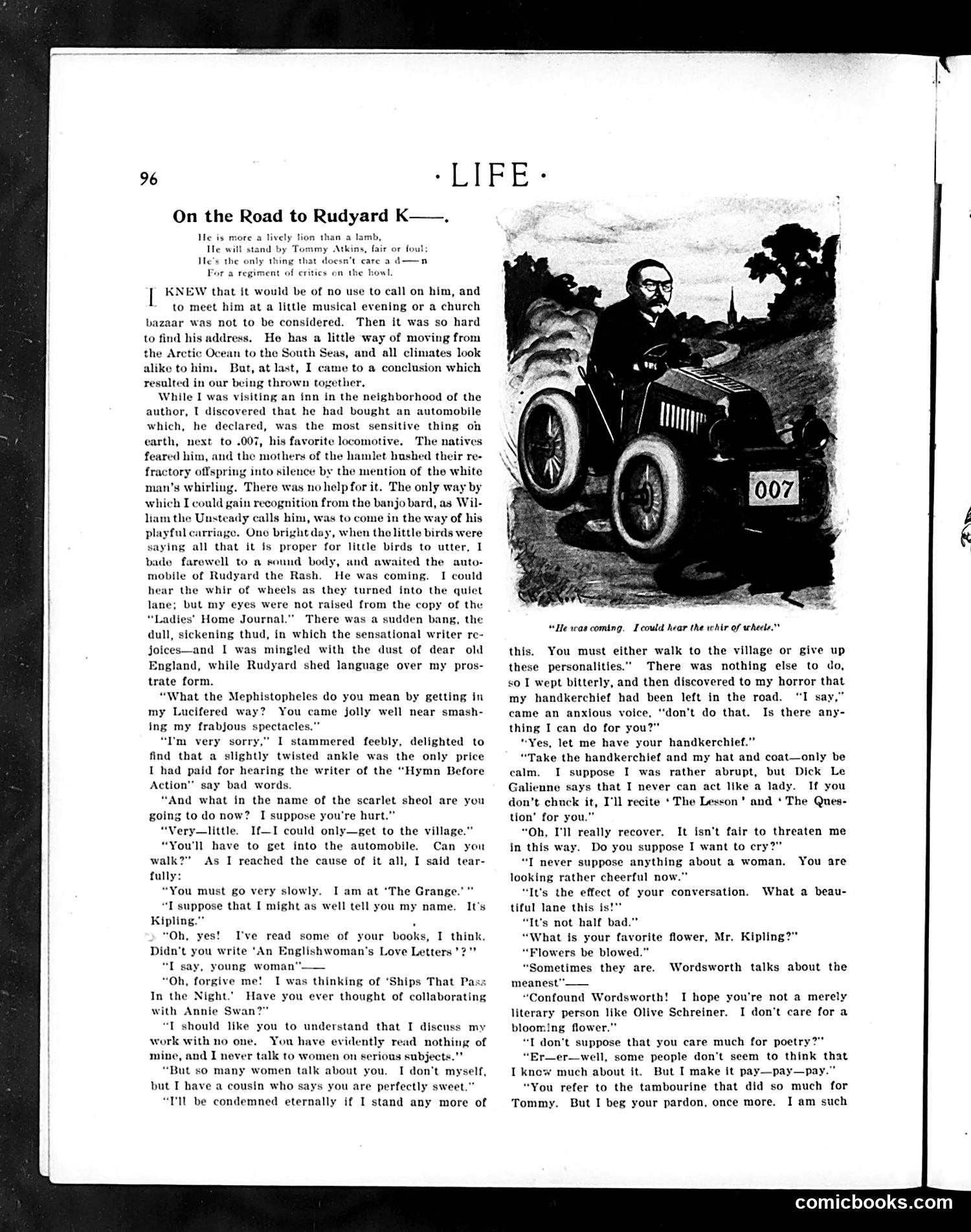
What you’re looking at
This is a literary satire about meeting **Rudyard Kipling** (the name is deliberately abbreviated). The illustration shows a man and woman in an early automobile marked "007." The text describes the author's difficulty locating Kipling, who apparently moves frequently between climates. When they finally meet, Kipling is portrayed as cantankerous and dismissive—he complains about his automobile being "the most sensitive thing on earth," insults the narrator's literary knowledge, and makes disparaging remarks about women writers and poetry. The satire mocks Kipling's reputation as a difficult, curmudgeonly personality. The "007" license plate may reference espionage/mystery themes, though this connection is unclear. The piece presents Kipling as vain, misogynistic, and quick to insult, playing on contemporary perceptions of the famous author's temperament.
📄 Transcribed text from this page (OCR, searchable)
Machine-transcribed from the original scan — historical spelling and the odd misread are preserved.
» LIFE « On the Road to Rudyard K—_. He is more a lively lion than a lamb, He will stand by Tommy Atkins, fair or foul He's the only thing that doesn’t care a d— Por a regiment of critics on the howl. KNEW that it would be of no use to call on him, and to meet him at a little musical evening or a church bazaar was not to be considered. Then it was so hard to find his address. He has a little way of moving from the Arctic Ocean to the South Seas, and all climates look alike tohim, Bat, at last, I came to a conclusion which resulted in our being thrown together. While I was visiting an inn in the neighborhood of the author, I discovered that he had bought an automobile which, he declared, was the most sensitive thing on earth, next to .007, his favorite locomotive. The natives feared him, and the mothers of the hamlet hushed their re- fractory offspring into silence by the mention of the white man’s whirling. There was no help for it. The only way by which I could gain recognition from the banjo bard, as Wil. liam the Unsteady calls him, was to come in the way of his playful carriage. One bright day, when the little birds were saying all that it is proper for little birds to utter, I bade farewell to a sound body, and awaited the auto- mobile of Rudyard the Rash. He was coming. I could hear the whir of wheels as they turned into the quict lane; but my eyes were not raised from the copy of the ‘Ladies’ Home Journal.” There was a sudden bang, the dull, sickening thud, in which the sensational writer re- joices—and I was mingled with the dust of dear old England, while Rudyard shed language over my pros- trate form. “What the Mephistopheles do you mean by getting in my Lucifered way? You came jolly well near smash- ing my frabjous spectacles.” “I'm very sorry,” I stammered feebly, delighted to find that a slightly twisted ankle was the only price I had paid for hearing the writer of the “Hymn Before Action” say bad words. “And what in the name of the scarlet sheol are you going to do now? I suppose you're hurt.” Very—little. If—I could only—get to the village.” “You'll have to get into the automobile. Can you walk?” As I reached the cause of it all, I said tear- fully: “You must go very slowly. I am at ‘The Grange.’ “I suppose that I might as well tell you my name. It's Kipling.” : “Oh, yes! I've read some of your books, I think. Didn't you write ‘An Englishwoman’s Love Letters ’?” i young woman”. “Oh, forgive me! I was thinking of ‘Ships That Pa. In the Night.’ Have you ever thought of collaborating with Annie Swan?” “I should like you to understand that I discuss my work with no one. You have evidently read nothing of mine, and I never talk to women on serious subjects.”” “But so many women talk about you. I don't myself, but I have a cousin who says you are perfectly sweet. “TM be condemned eternally if I stand any more of “He was coming. I could hear the whir of wheels.” this. You must either walk to the village or give up these personalities.” There was nothing else to do, so I wept bitterly, and then discovered to my horror that my handkerchief had been left in the road. came an anxious voice, “don't do that. Is there any- thing I can do for you?” "Yes, let me have your handkerchief.” “Take the handkerchief and my hat and coat—only be calm. I suppose I was rather abrupt, but Dick Le Galienne says that I never can act like a lady. If you don’t chuck it, I'll recite ‘The Lesson’ and ‘The Ques- tion’ for you.” “Oh, I'll really recover. It isn’t fair to threaten me in this way. Do you suppose I want to cry?” “I never suppose anything about a woman. looking rather cheerful now.” “It's the effect of your conversation. tiful lane this is!” “It’s not half bad.” “What is your favorite flower, Mr. Kipling?” “lowers be blowed.” “Sometimes they are. meanest" “Confound Wordsworth! I hope you're not a merely literary person like Olive Schreiner. I don't care for a blooming flower.” “I don’t suppose that you care much for poetry “Er—er—well, some people don’t seem to think that I knew much about it. But I make it pay—pay—pay “You refer to the tambourine that did so much for Tommy. But I beg your pardon, once more. I am such You are What a beau- Wordsworth talks about the comicbooks.com