
A complete issue · 31 pages · 1902
Life — June 26, 1902
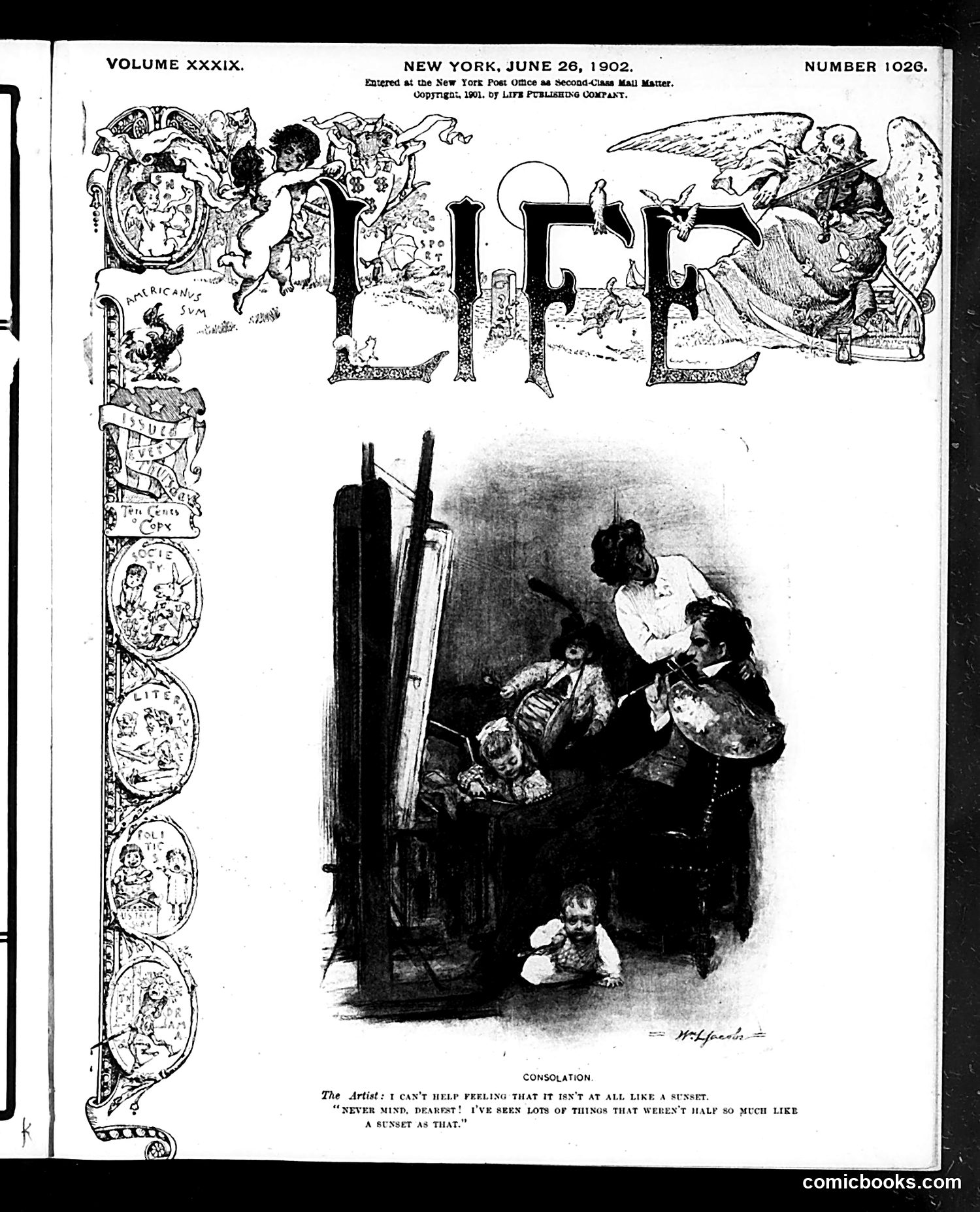
This cartoon depicts an artist consoling a dejected patron, likely a wealthy art collector or patron. The artist expresses frustration that a sunset he painted "isn't at all like a sunset," claiming he's seen "lots of things that weren't half so much like a sunset as that." The satire targets the disconnect between artistic vision and realistic representation—a common debate in early 20th-century art circles. The artist defends stylized or impressionistic work against demands for photographic accuracy. The ornate left border suggests this is from Life's satirical commentary on aesthetic and cultural pretensions of the era, poking fun at both artists' defensive attitudes and patrons' expectations of literal realism in fine art.
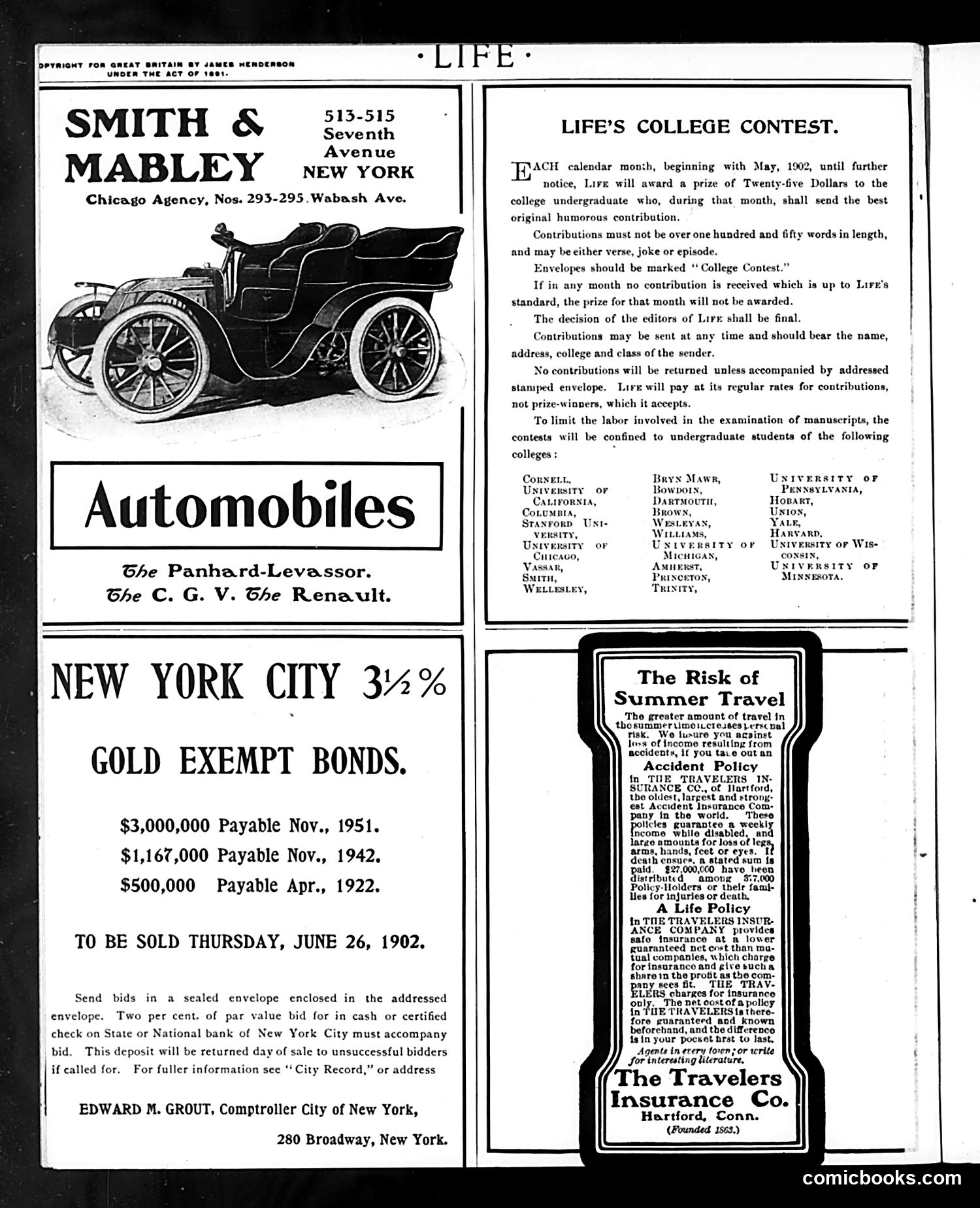
This page is **primarily advertising** with minimal cartoon or satirical content. The left side features ads for Smith & Mabley automobiles (with an illustration of an early 1900s car) and New York City 3½% Gold Exempt Bonds to be sold June 26, 1902. The right side contains **Life's College Contest** announcement—a literary competition offering a $25 prize for humorous original contributions from college undergraduates (maximum 150 words), running from May 1902 onward. Eligible colleges are listed. Below that is an insurance advertisement for The Travelers Insurance Co. promoting accident and life policies for summer travel risks. There are **no political cartoons or satirical commentary** on this particular page—it's essentially a commercial/announcements page from an early 1900s magazine issue.
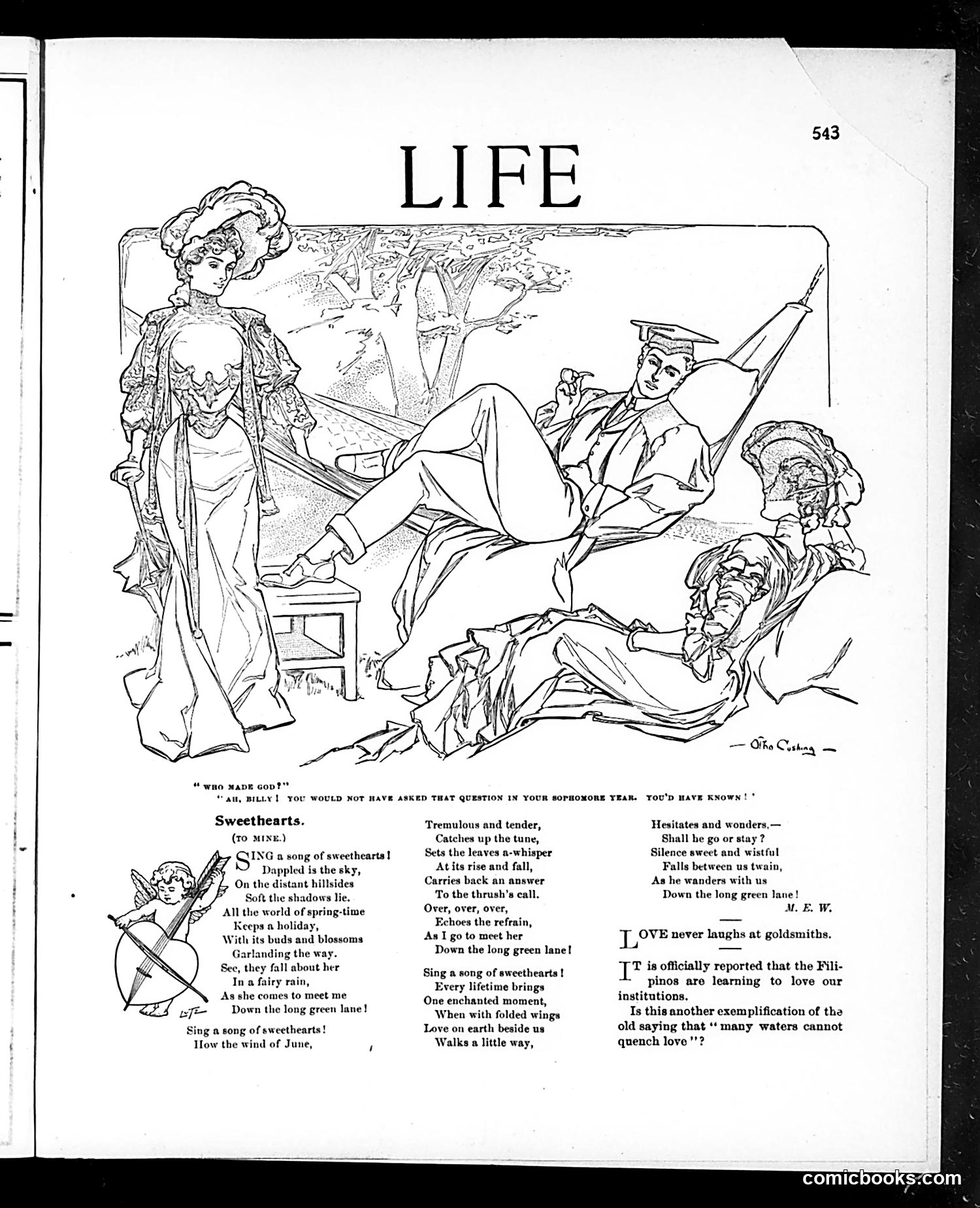
This page features poetry and illustration rather than political cartooning. The main image depicts a woman standing while men recline or lounge around her, illustrating the poem "Sweethearts" below. The caption quote—"WHO MADE GOD?" / "AH, BILLIE! I WOULD NOT HAVE ASKED THAT QUESTION IN YOUR SOPHOMORE YEAR. YOU'D HAVE KNOWN!"—suggests satire about lost innocence or how education complicates youthful certainty. The poetry collection includes romantic verses about love and courtship, with a Cupid illustration. The final section notes Filipinos adopting American institutions, quipping about "many waters cannot quench love." The humor appears to be lighthearted and literary rather than sharply political—typical of Life's satirical but genteel content from the early 20th century.
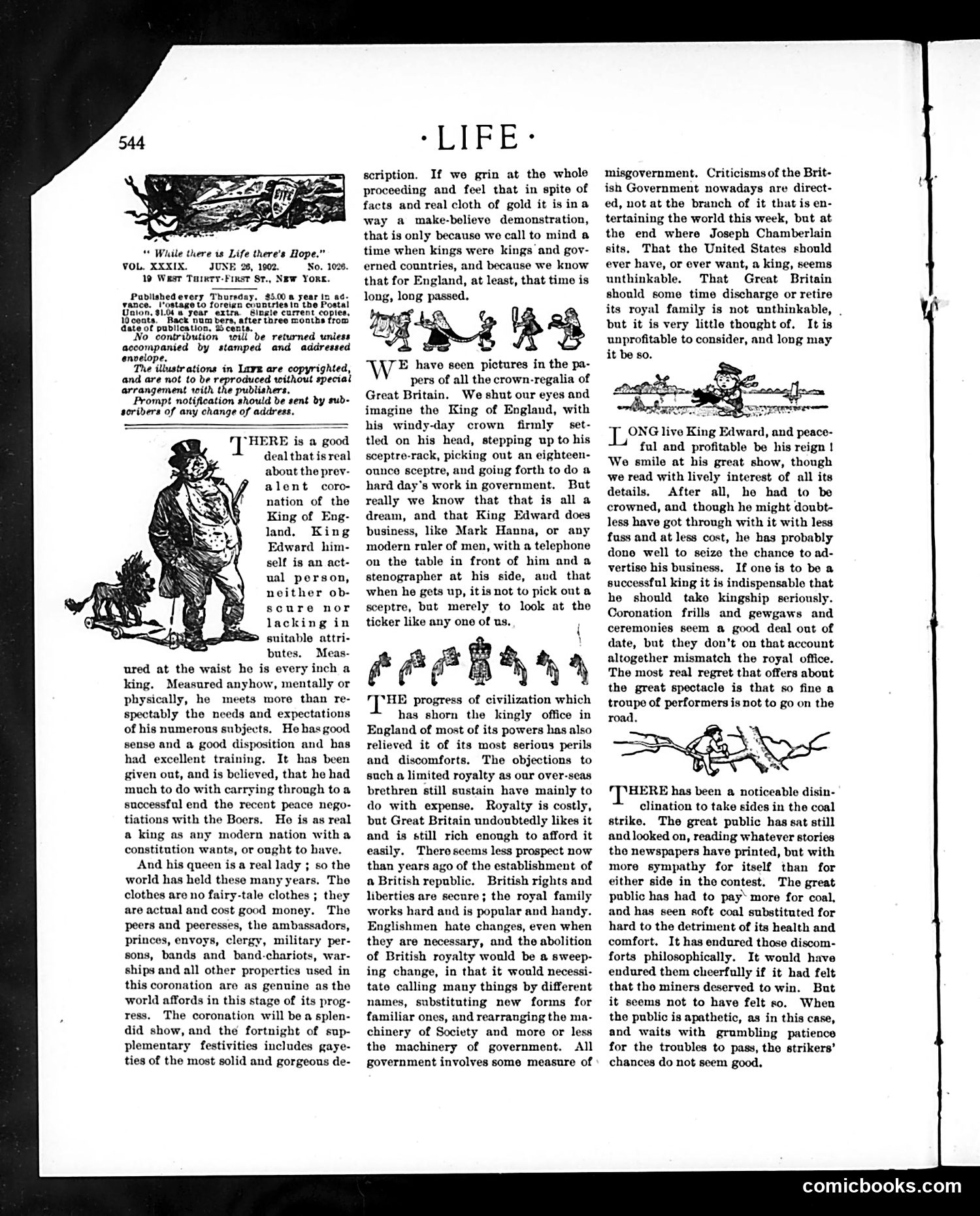
This page contains editorial commentary on King Edward VII's coronation and British royalty, with accompanying illustrations. The text defends the British monarchy against republican criticism, arguing that England's royal institution is affordable and functional—comparable to a modern business executive with administrative staff. The cartoons appear to satirize republican objections to monarchy. One illustration shows a figure in formal dress, likely representing royal dignity or authority. The piece also addresses a recent coal miners' strike, suggesting public sympathy favored labor over management, making the strikers' position stronger than anticipated. The author implies public apathy about royal matters contrasts with engaged interest in labor disputes. The tone is moderately conservative, defending traditional institutions while acknowledging legitimate public concerns about costs and labor conditions.
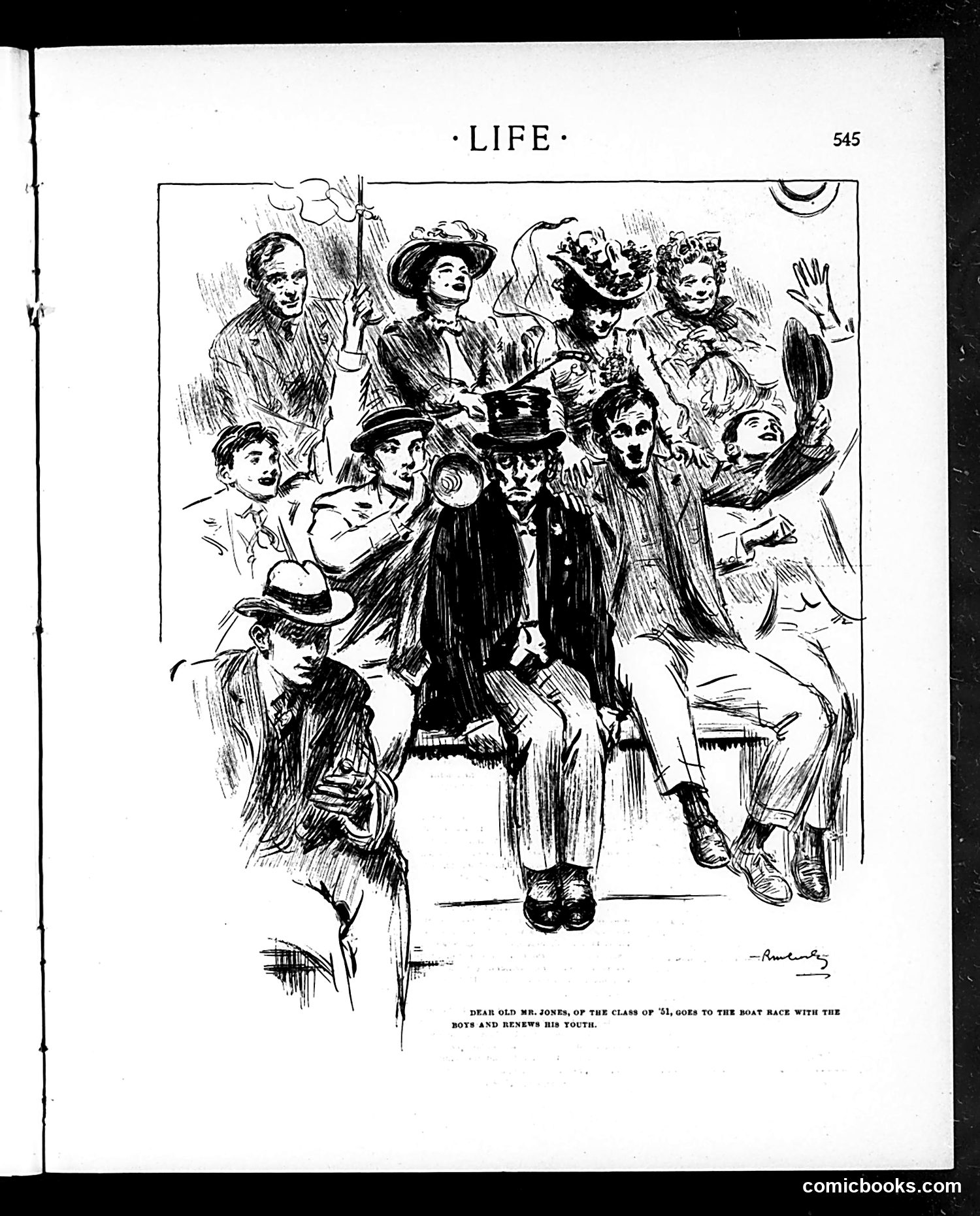
This Life magazine illustration depicts a social scene from the early 1900s. The caption indicates "Dear Old Mr. Jones, of the Class of '21, goes to the Boat Race with the Boys and Renews his Youth." The cartoon satirizes nostalgia and middle-aged men attempting to recapture their college days. Mr. Jones, the central figure in top hat and formal wear, is surrounded by younger men and fashionably dressed women at what appears to be a prestigious rowing event—likely the Yale-Harvard boat race, a major American sporting tradition. The satire targets the somewhat ridiculous spectacle of an older gentleman trying to relive his youth by attending youthful social gatherings. The artist captures the contrast between Jones's formal, somewhat dated appearance and the energetic younger crowd surrounding him, mocking the universal human impulse to desperately cling to one's past glory.
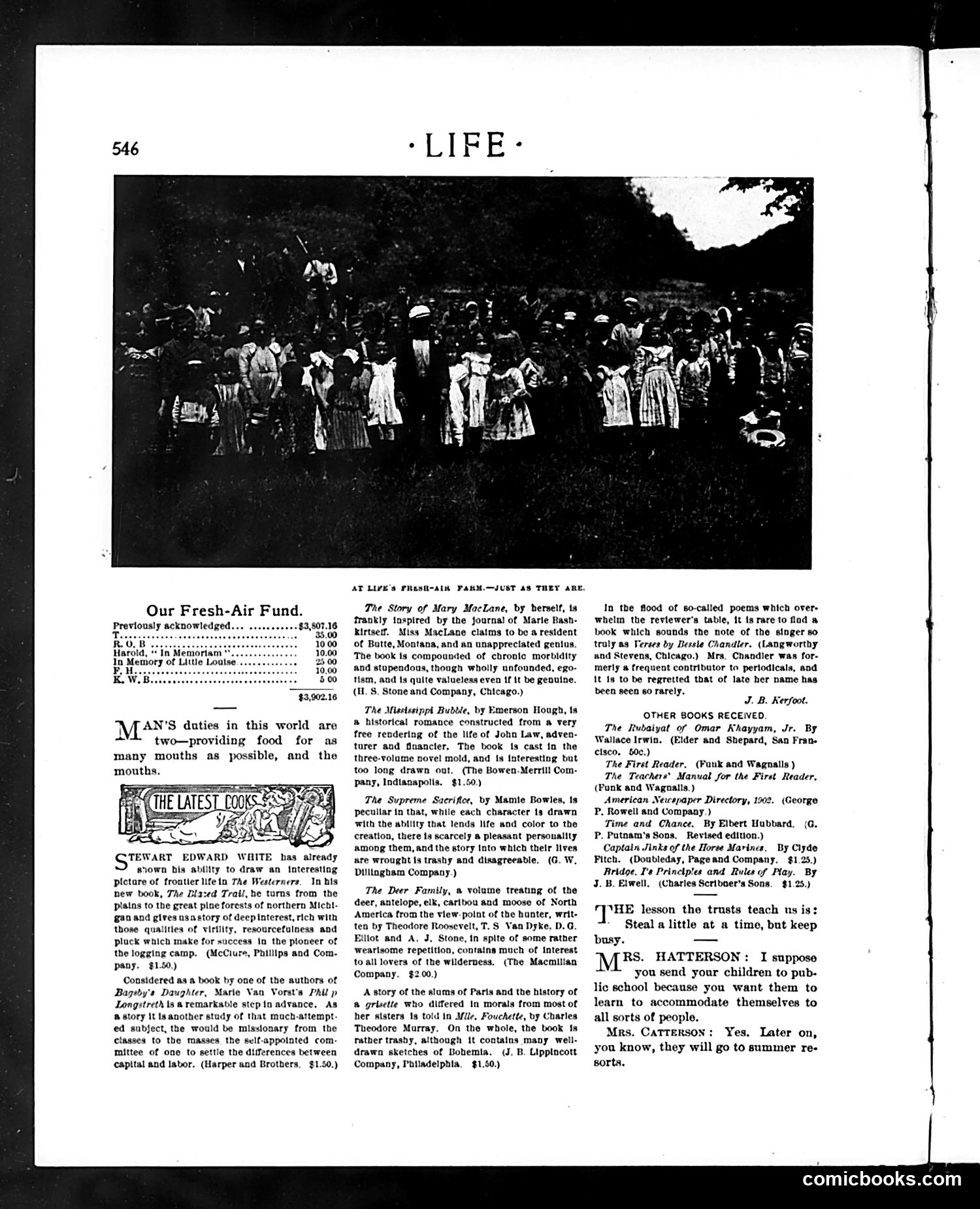
**The Image:** A black-and-white photograph showing a large outdoor gathering of people in period dress (appears to be early 20th century), labeled "AT LIFE'S FRESH-AIR FARM—JUST AS THEY ARE." **The Content:** This page primarily features book reviews and a "Fresh-Air Fund" fundraising notice, rather than political satire. The photograph documents LIFE magazine's charitable Fresh-Air Farm initiative—a real philanthropic program providing outdoor recreation for underprivileged children and city dwellers. **Historical Context:** The Fresh-Air movement was a genuine Progressive Era social welfare effort. LIFE magazine, founded 1883, used satire for social commentary but also engaged in earnest charitable work. This page shows that dual mission: documenting actual good works while reviewing contemporary literature. The content reflects early 20th-century American progressivism's emphasis on public health and charity.
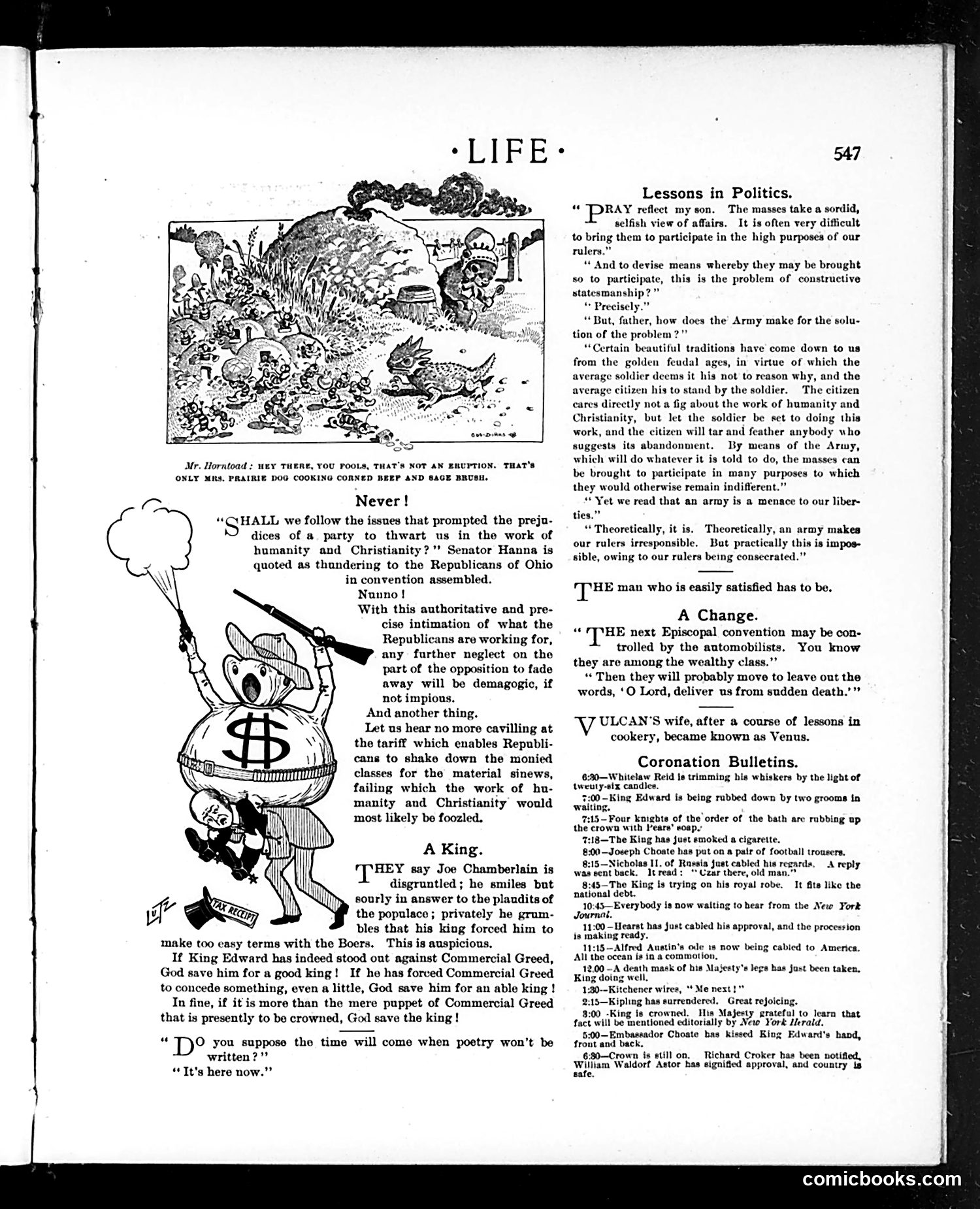
The main cartoon depicts **Mr. Hornstoad** addressing "fools" about what appears to be a prairie dog cooking corned beef and sage brush—likely absurdist humor mocking political rhetoric. The accompanying text contains satirical "Lessons in Politics" criticizing Republican positions. A caricatured figure with a dollar sign for a body represents **Commercial Greed**, mocked for forcing King Edward's hand in political compromises. The satire argues that if the king had stood against commercial interests, he'd be truly strong. The section attacks those prioritizing financial interests over humanitarian and Christian values, suggesting Republican leadership serves Corporate interests rather than public welfare. This reflects early 20th-century Progressive Era criticism of business influence in politics.
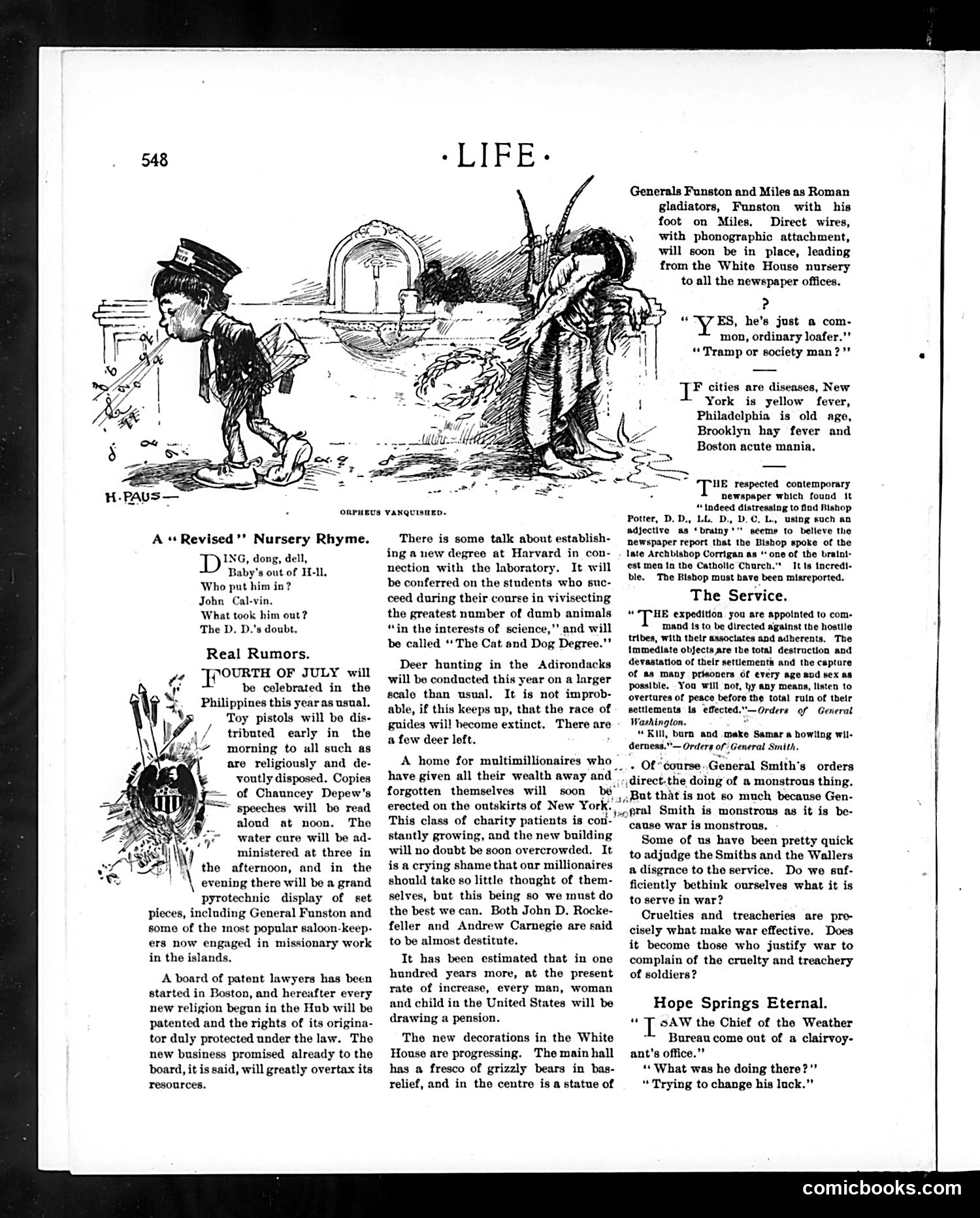
The main illustration shows two figures in tattered clothes standing over what appears to be fallen or defeated forms. The caption reads "ORPHANS VANQUISHED," suggesting these are caricatures of wealthy industrialists or politicians triumphing over orphans or the poor. The surrounding text discusses real social issues: disease in American cities, the establishment of millionaire charitable homes, and General Smith's military orders. One section criticizes that "our millionaires should take so little thought of themselves" while orphans suffer. The cartoon appears to satirize the hypocrisy of the wealthy—they boast of charity while actual poor children remain abandoned. The artist (H. PAUS, visible in signature) uses dark humor to critique how the rich "vanquish" rather than genuinely help society's most vulnerable members.
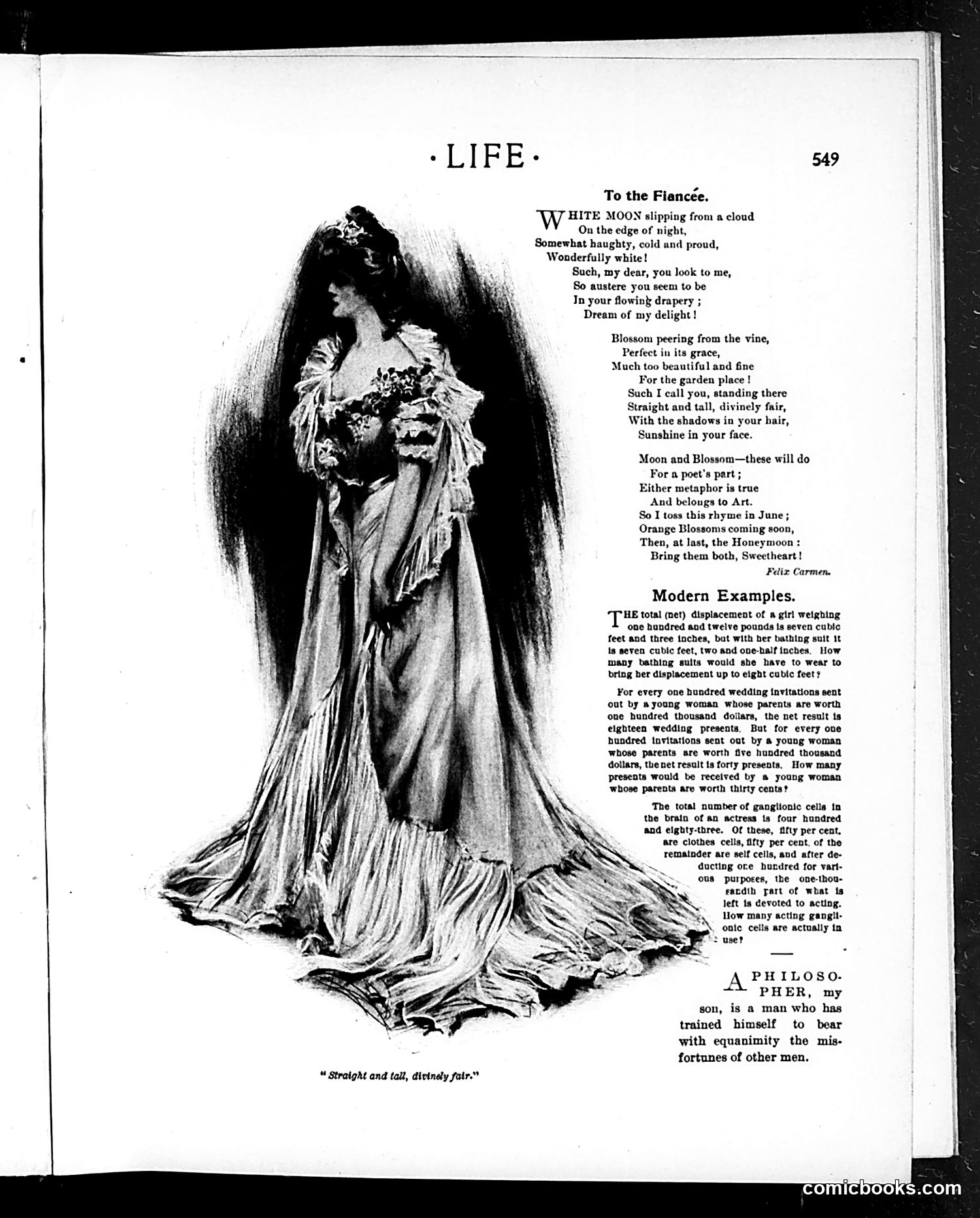
This page from *Life* magazine (page 549) contains a romantic poem titled "To the Fiancée" paired with an elegant illustration of a woman in flowing drapery. The poem celebrates feminine beauty and grace, using moon and blossom imagery as poetic devices. Below this is a section called "Modern Examples," which presents mathematical word problems—apparently satirizing the contrast between romantic idealization and practical reality. The problems address mundane domestic concerns (bathing suits, wedding presents, brain cell percentages) in dry, technical language. The satire appears to mock the gap between sentimental Victorian romance and modern life's unglamorous realities. The juxtaposition suggests *Life's* critique of overly romantic sentimentality in contemporary culture, replacing flowery verse with cold arithmetic about everyday married life.
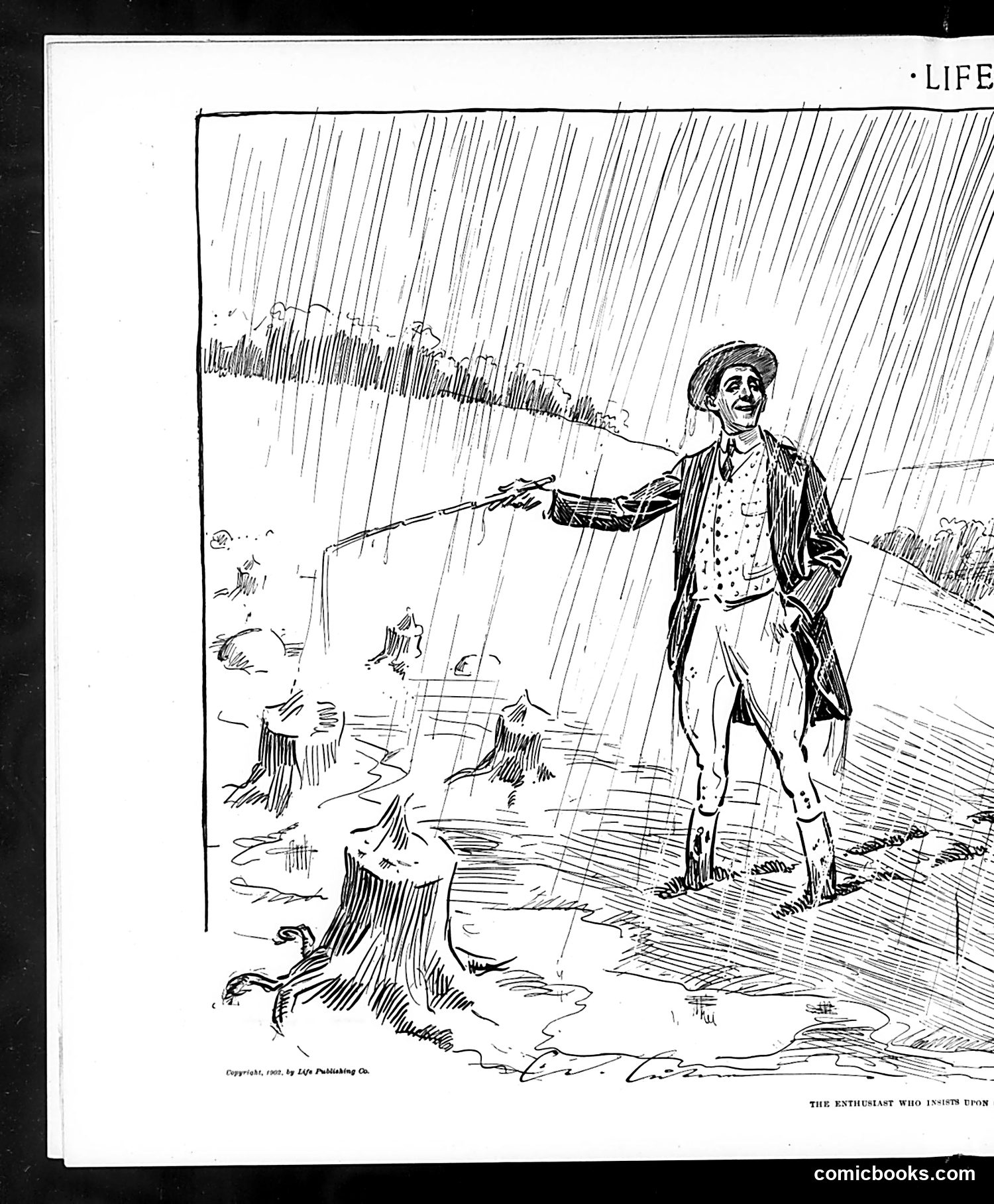
This cartoon depicts a cheerful man standing in heavy rain amid tree stumps in what appears to be a deforested landscape. He holds a fishing rod, smiling despite the downpour and barren surroundings. The satire targets environmental destruction masquerading as recreation or progress. The "enthusiast" represents someone who stubbornly pursues his hobby (fishing) or business interests regardless of ecological damage—the cleared trees and degraded landscape. His oblivious cheerfulness despite obvious environmental ruin suggests the cartoon critiques those who ignore or dismiss the consequences of industrial logging and resource extraction. The incomplete caption suggests this was part of a series commenting on American attitudes toward nature and land use during the early 20th century.
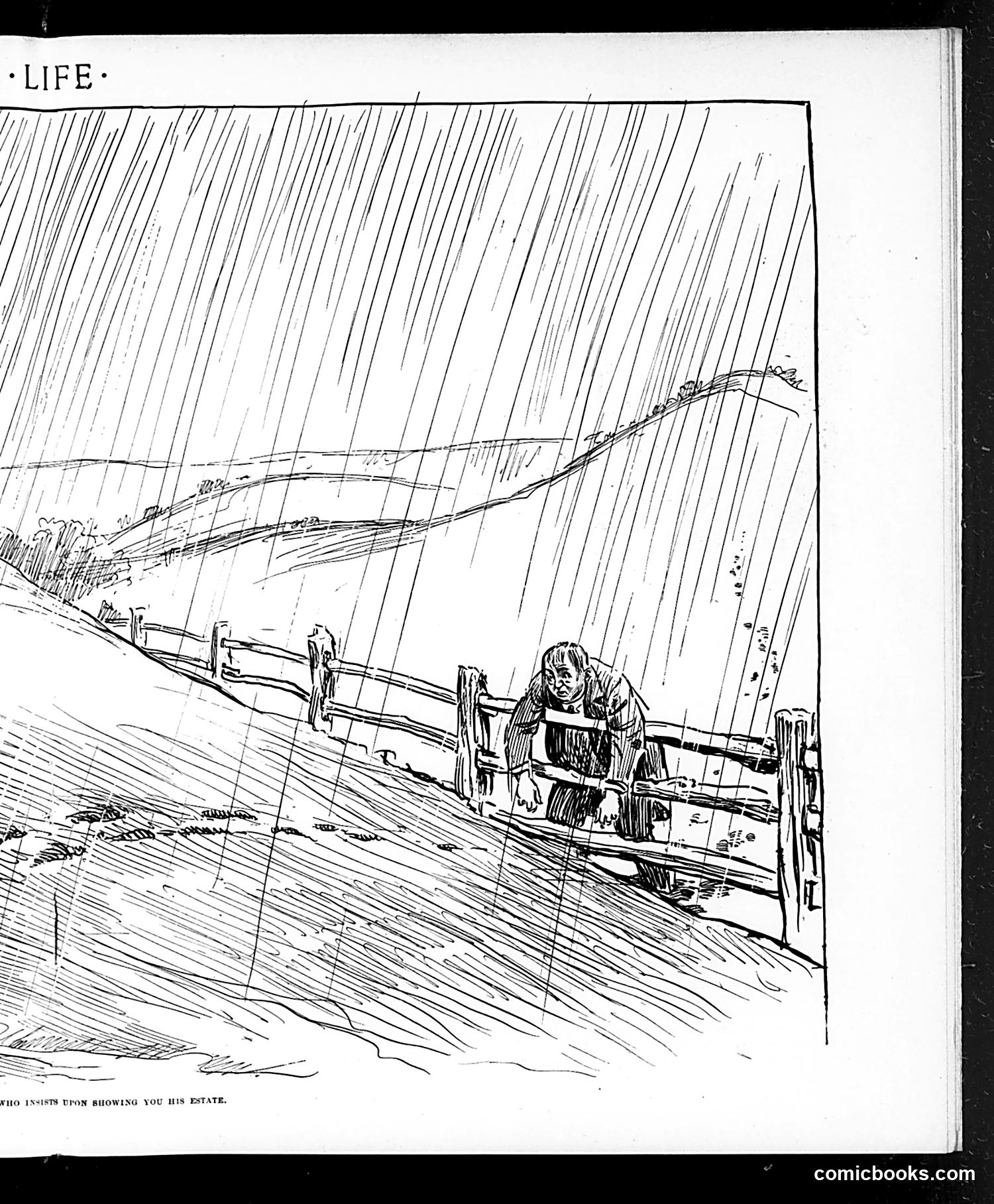
This is a cartoon from *Life* magazine titled "WHO INSIST UPON SHOWING YOU HIS ESTATE" (visible at bottom). The drawing depicts a man in formal attire standing at a wooden fence in heavy rain, gesturing toward his property. The artistic style—with diagonal rain lines covering most of the composition—emphasizes the terrible weather conditions obscuring any actual view of the estate. The satire targets a social type: the wealthy landowner who proudly insists on displaying his property to guests, but does so at the worst possible moment (a downpour), making the boasted-about estate completely invisible. It's a joke about social pretension and poor judgment—the man's pride in ownership outweighs practical sense.
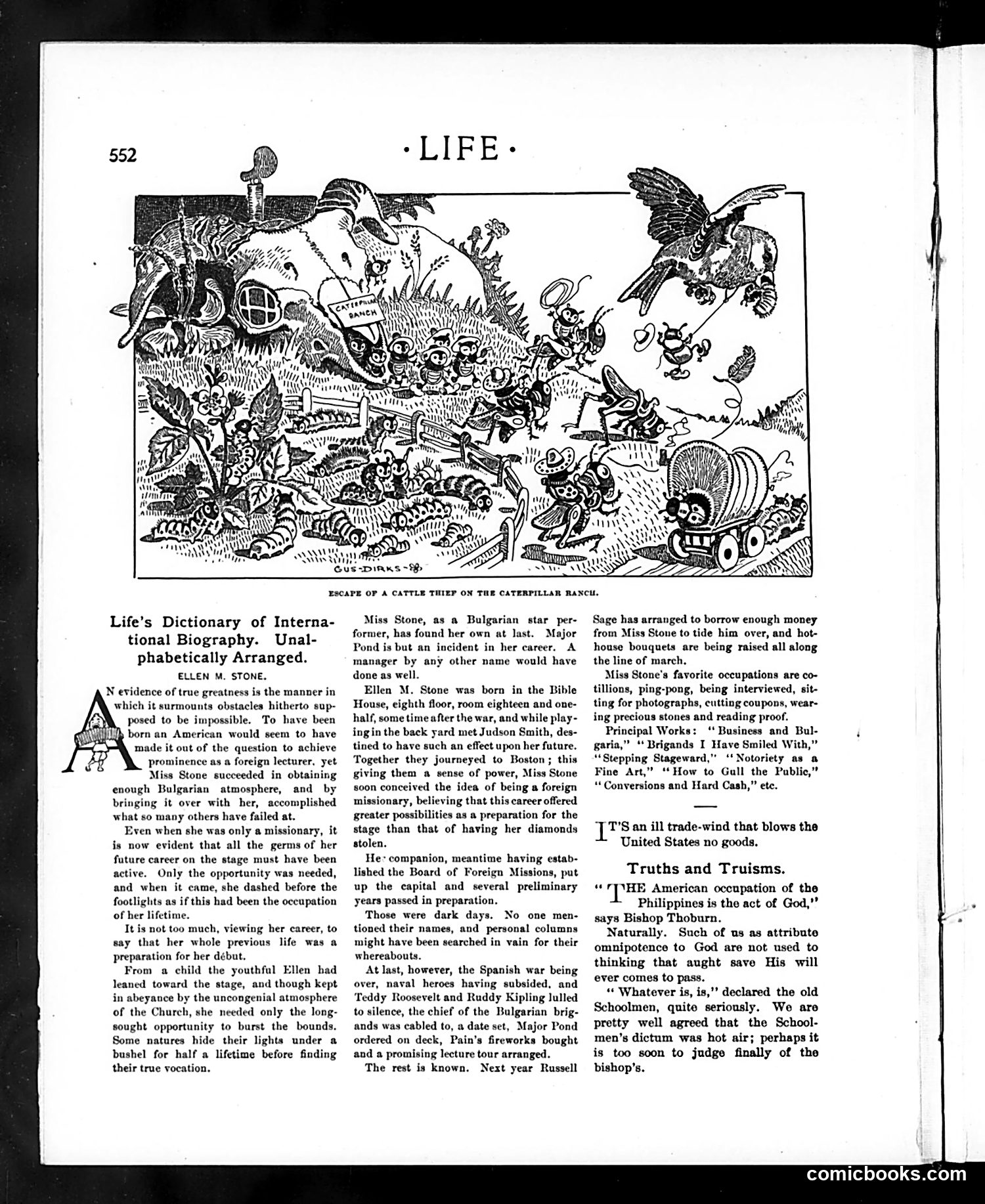
This is a humorous illustration satirizing industrial-era chaos and incompetence. The detailed cartoon depicts a comedic scene of a cattle thief's escape from what's labeled the "Caterpillar Ranch," filled with absurdly malfunctioning machinery, anthropomorphized insects, and frantic activity. The artist uses exaggerated visual pandemonium—scattered mechanical parts, confused characters, and chaotic movement—to mock either agricultural modernization or corporate bungling. The accompanying biographical text about Ellen M. Stone, a Bulgarian-American performer, appears unrelated to the cartoon, suggesting this was a typical Life magazine layout mixing satirical art with biographical features. The specific ranch reference and mechanical imagery likely parody contemporary farming operations or industrial ventures.
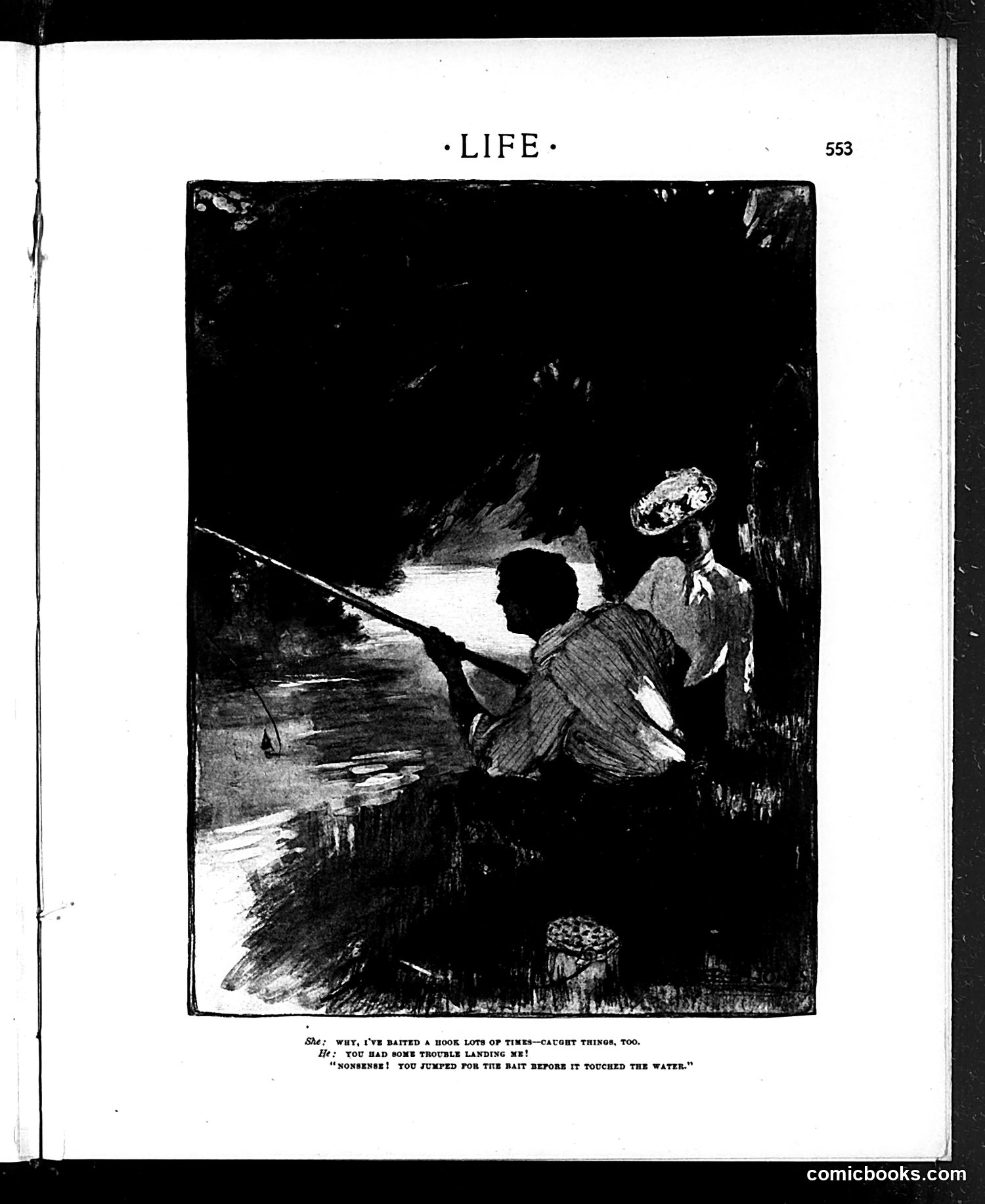
This is a single-panel cartoon depicting two figures by a body of water. The person on the left holds a fishing rod while addressing someone on the right, who appears to be a fish or fish-like creature. The joke is a literal play on the phrase "jumping for the bait"—the fish claims experience catching things with baited hooks, but the fisherman counters that this particular fish was so eager it jumped for the bait before it even touched the water. It's a straightforward humorous exchange mocking the fish's gullibility and overeagerness. The cartoon appears to be a simple pun-based gag with no apparent political or social commentary—purely recreational satire about fishing and foolish behavior.
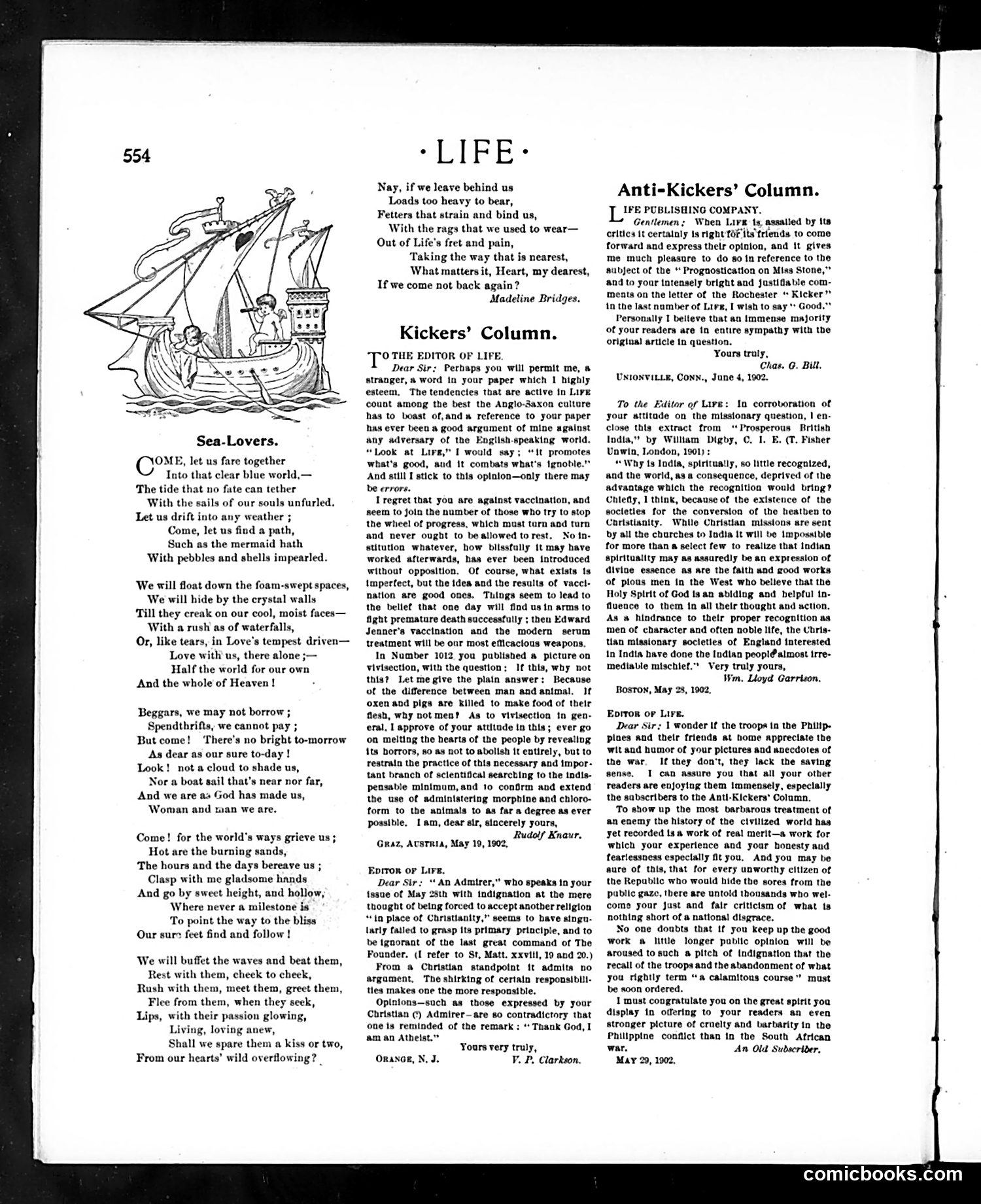
This page contains **poetry and reader letters**, not political cartoons. The main illustration shows a **sailing ship with figures**, accompanying "Sea-Lovers," a romantic poem by Madeline Bridges about escaping worldly burdens through love and adventure at sea. The "**Kickers' Column**" presents reader letters debating contemporary issues: 1. **Rudolf Knauer** (Austria) praises *Life*'s editorial stance but criticizes its anti-vaccination position. He defends vaccination and vivisection as necessary scientific progress, arguing they differ from killing animals for food because they serve humanity's medical advancement. 2. **Anti-Kickers' Column** responses address vaccination skepticism and defend missionaries in India, arguing Christian conversion efforts are justified despite colonial contexts. The page reflects **early-1900s debates** over scientific progress, particularly vaccination (controversial then despite Jenner's 18th-century innovation) and the ethics of animal testing versus human benefit—issues that *Life* magazine apparently took editorial positions on that some readers disputed.
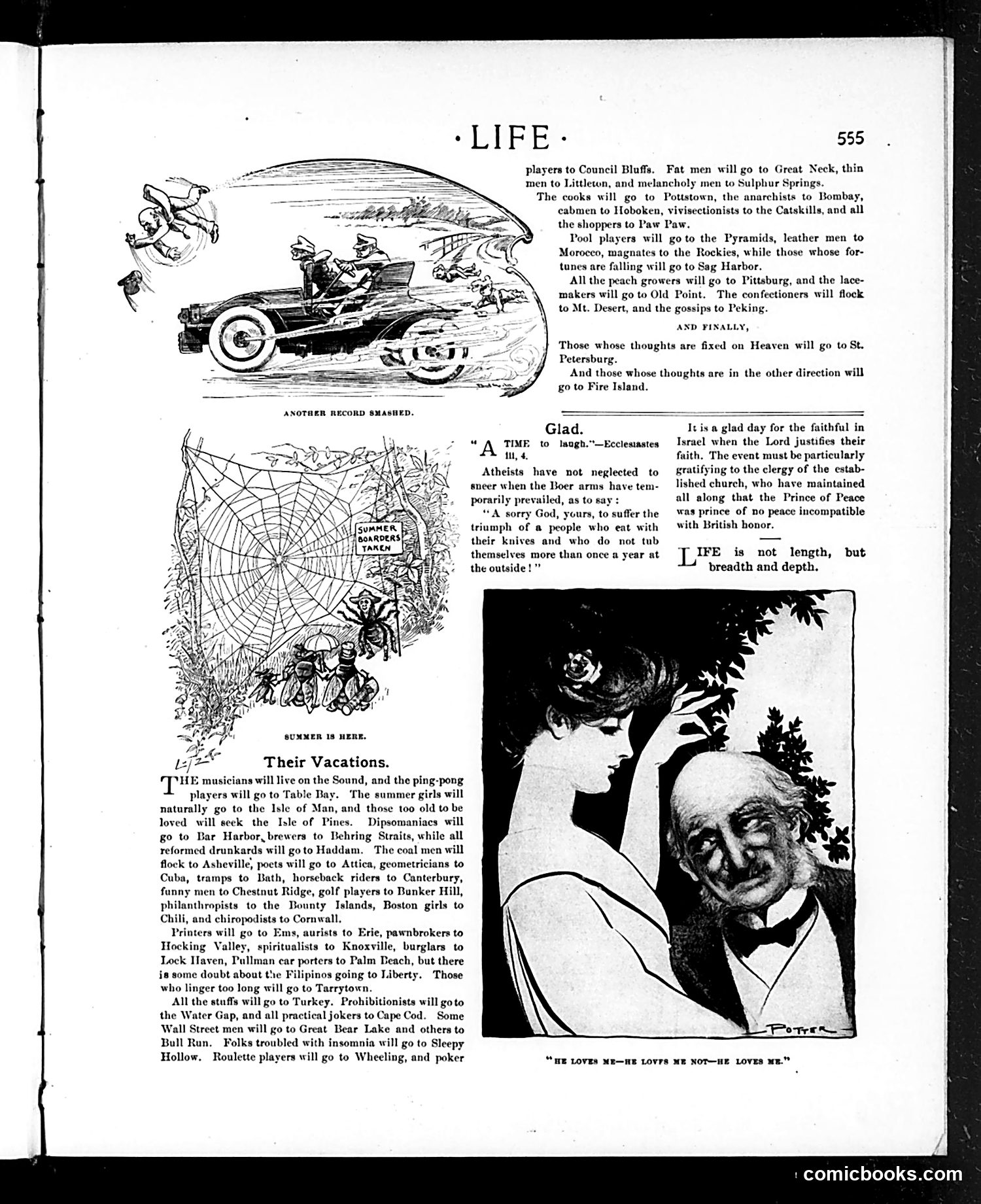
This is a **satirical humor piece** from Life magazine using clever wordplay. The main text, "Their Vacations," is a pun-based joke where various professions are matched to vacation destinations that sound like or literally are place names with relevant meanings. Examples of the wordplay: - **Musicians** go to "Ems" (the letter M, music notation) - **Printers** go to "Ems" (typography unit) - **Coal men** go to "Asheville" (ash) - **Dipsomaniacs** (alcoholics) go to "Bar Harbor" - **Folks with insomnia** go to "Sleepy Hollow" The piece also includes a separate section titled **"Glad"** responding to the **Boer War** (South African conflict), where the author mocks atheists for questioning God's power while celebrating British military victory, framing it as divine vindication. The illustrations—a car breaking speed records and a large spider web—appear to be separate satirical cartoons, though their specific commentary is unclear from this page alone.
This page is primarily **advertising and humor content** rather than political cartooning. The main feature is a series of absurdist jokes about the Shakespeare-Bacon authorship controversy—a genuinely heated 19th-century debate over whether Francis Bacon, not William Shakespeare, wrote the plays attributed to him. The satirical point: the piece mocks how cranks on both sides had generated increasingly ridiculous and contradictory theories to support their positions. By listing mutually exclusive claims (that Bacon and Shakespeare were the same person, yet also separate partners, yet maybe neither wrote them), it ridicules the debate's departure from reason. The other humor items include period anecdotes about whiskey, a glass eye used as surveillance, and medical misunderstandings—typical of Life's lighthearted satirical content. The page is otherwise filled with **period advertisements** for Wilson Whiskey, Hunter Rye, Silo Cigarettes, and other products, reflecting the magazine's commercial revenue model.
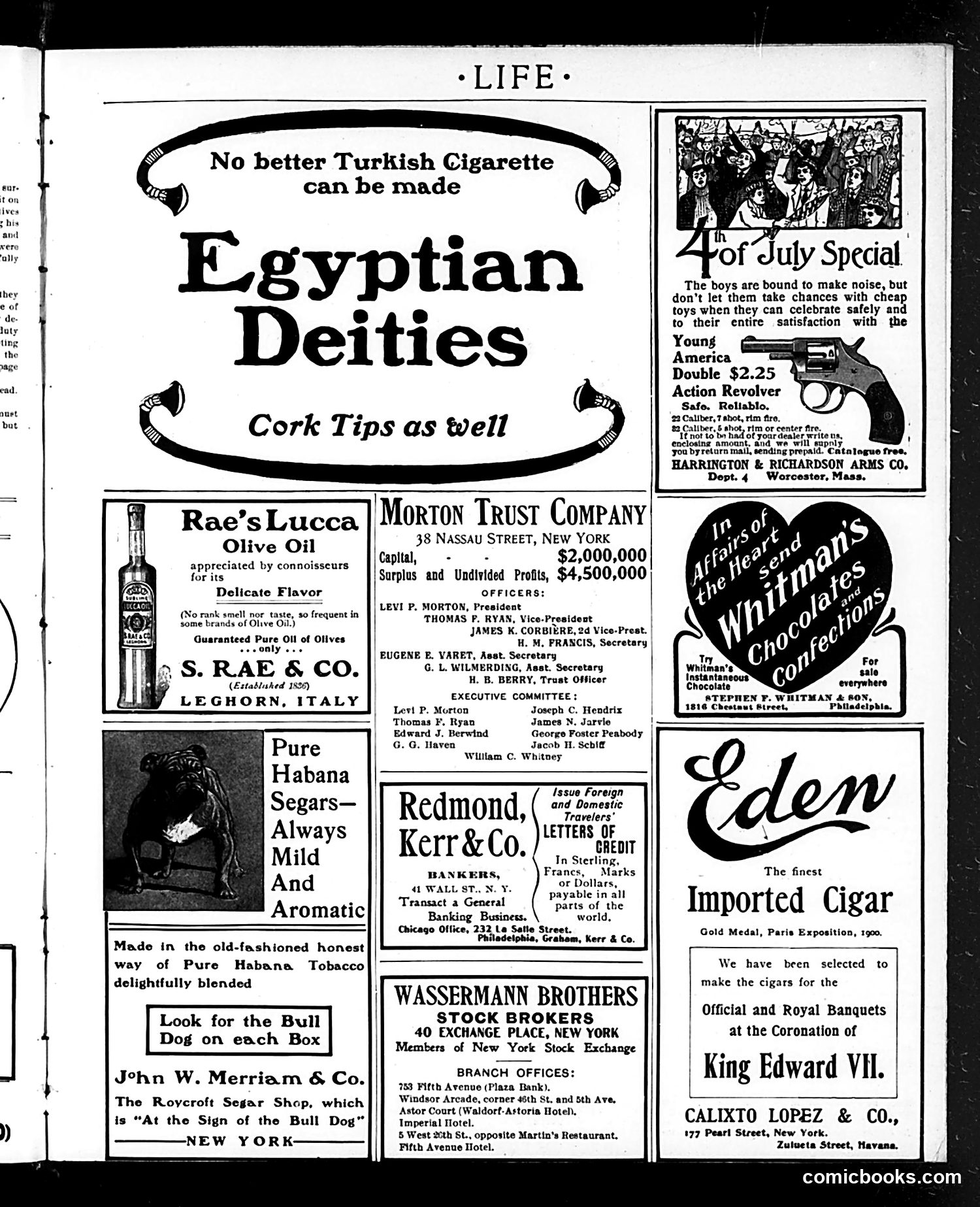
This is primarily an **advertising page**, not satirical content. The dominant feature is an ad for "Egyptian Deities" cigarettes with cork tips—a Turkish cigarette brand. The name plays on Egypt's ancient mystique to suggest exotic quality and sophistication. The page is filled with luxury product advertisements typical of early 1900s *Life* magazine: olive oil, cigars, banking services, and notably a "Young America Double Action Revolver" marketed as a safe July 4th toy for boys—reflecting an era when such items were considered appropriate children's gifts. The prestige brands advertise through prominent financiers and society figures listed (William C. Whitney, Levi P. Morton), reflecting how wealth and social standing endorsed consumer products. **Key historical context:** This predates modern advertising regulations. The firearm ad targeting children, alongside luxury imports, shows pre-regulation consumer culture aimed at affluent readers.
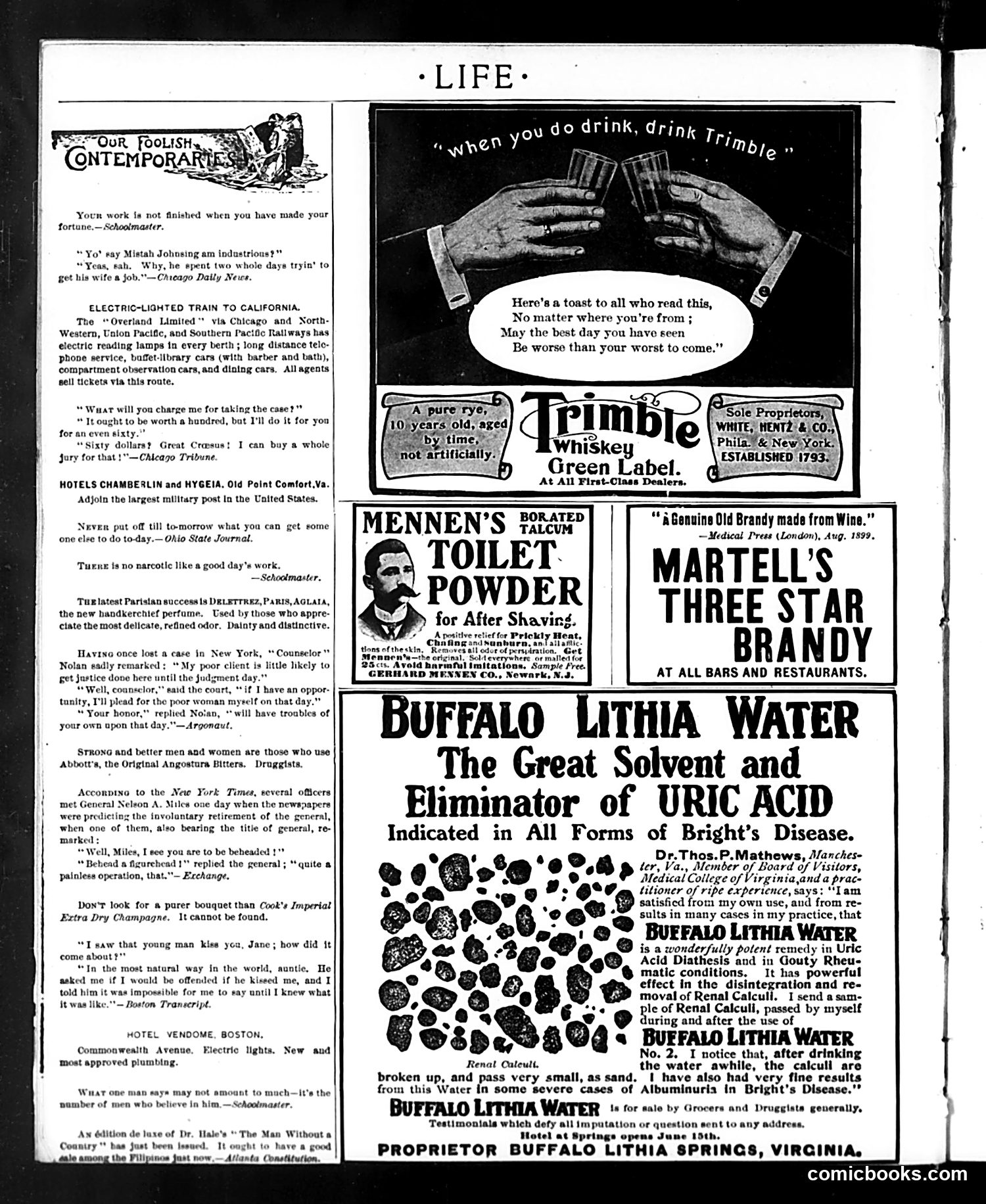
This page from *Life* magazine is primarily **advertising and humor snippets**, not political cartoons. The satirical content is mild and disconnected: **The Jokes:** Brief quips mock: - Lazy husbands trying to find their wives employment - Lawyers' excessive fees ("I can buy a whole jury for that!") - The legal system's slowness **The Advertisements** dominate, hawking: - **Trimble Whiskey** (with a toast urging drinking) - **Martell's Three Star Brandy** - **Mennen's Toilet Powder** (aftershave) - **Buffalo Lithia Water** (claiming to cure "Bright's Disease" and gout)—a common *patent medicine* claim of that era **The Satire:** The magazine name ("Our Foolish Contemporaries") suggests gentle mockery of society's foibles, but no specific political figure or event is targeted. The humor is genteel, domestic, and occupational. **The medical claims are now recognized as fraudulent quackery.** The page reflects early 1900s sensibilities: casual promotion of alcohol and dubious health "cures."
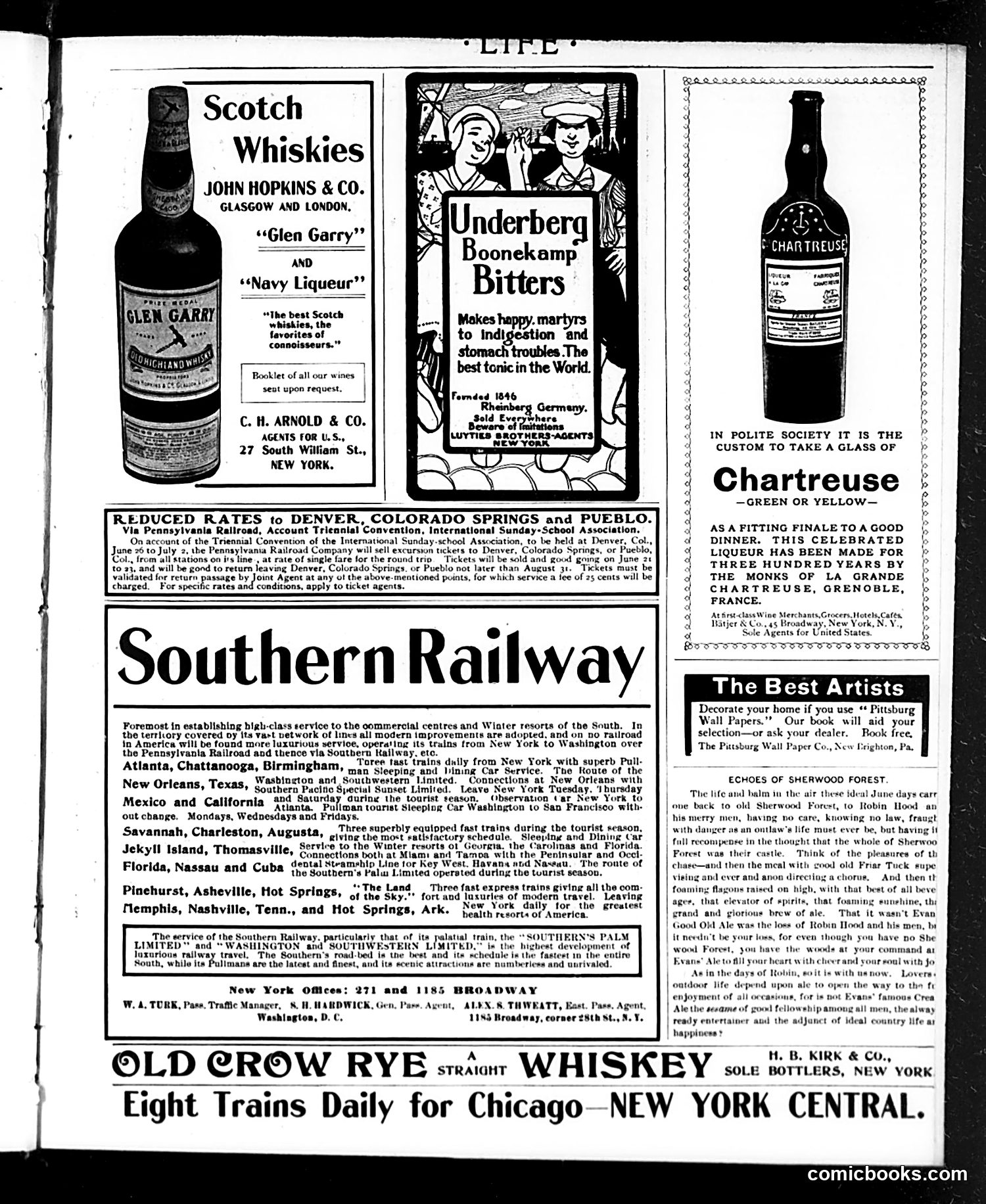
This page is primarily **advertising**, not editorial satire or political cartoons. It contains commercial advertisements for alcoholic beverages (Scotch whisky, bitters, liqueur, rye whiskey) and travel services (Southern Railway, Pennsylvania Railroad). The only semi-humorous content is a small advertisement for Pittsburg Wall Papers that includes a decorative vignette titled "Echoes of Sherwood Forest," romanticizing Robin Hood and his "merry men" in the forest. This appears to be nostalgic decorative copy rather than satire—appealing to genteel sensibilities by associating the product with literary charm and freedom from care. The page reflects early-20th-century advertising conventions: lavish product descriptions, appeals to social propriety ("In polite society..."), and lengthy railroad promotional text. There is no political commentary or editorial cartooning visible. The magazine's satirical content, if present, appears on other pages.
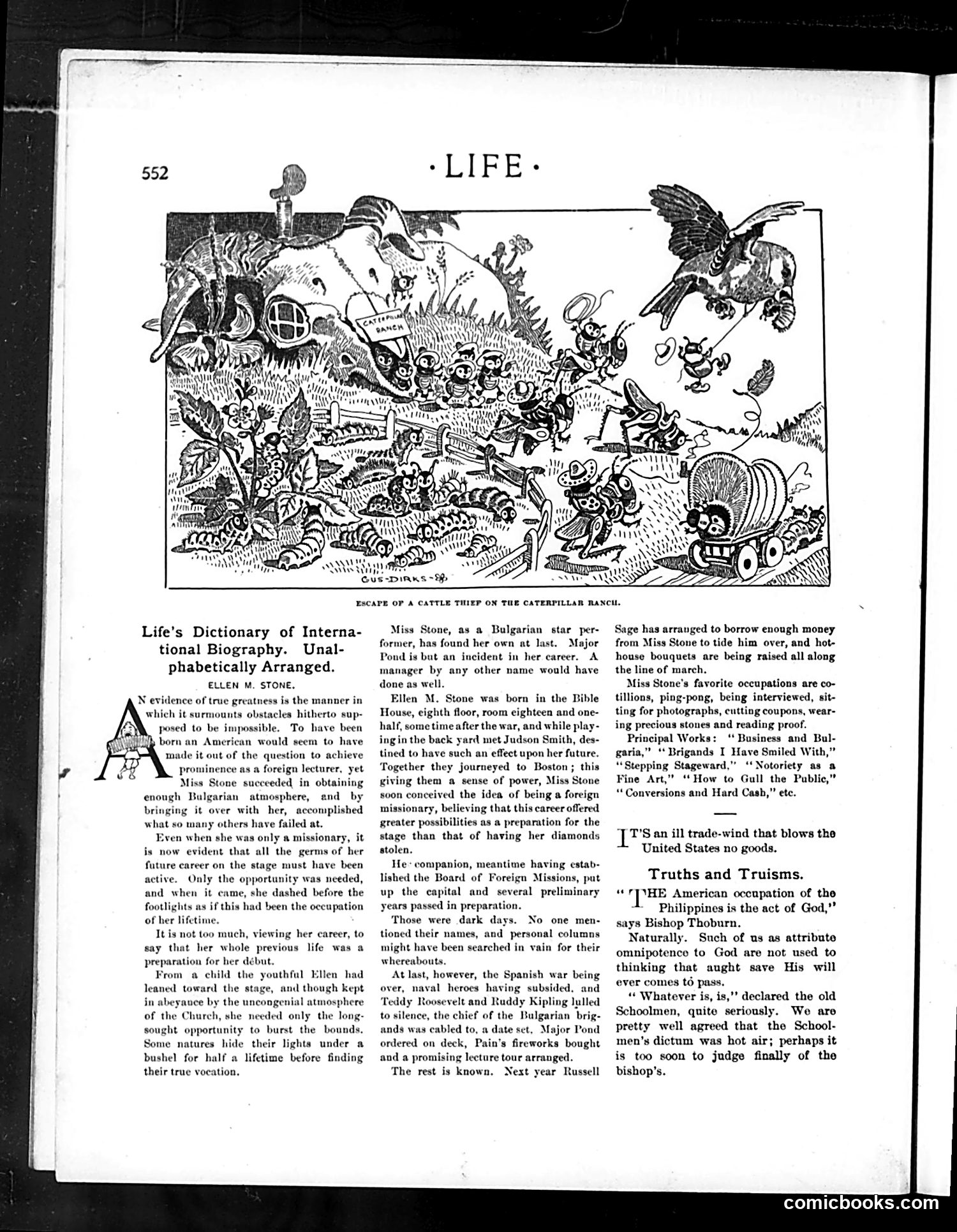
This page mocks Ellen M. Stone, a real American missionary who was kidnapped by Bulgarian brigands in 1901 and ransomed. The satire suggests her entire missionary work was merely a calculated stepping stone to launch a lucrative lecture-hall career. The cartoon ("Escape of a Cattle Thief on the Caterpillar Ranch") appears to be anarchic visual humor unrelated to the Stone biography. The biographical entry sarcastically praises Stone for turning personal tragedy into entertainment, claiming her childhood and religious work were unconscious "preparation" for the stage. It mocks her celebrity status and associated activities (coupons, interviews, photographs), while skewering lecture-circuit entrepreneur Major Pond and implying the whole affair was opportunistic theater. The final jab suggests even wealthy Russell Sage would need to borrow money from her—positioning Stone as having profited enormously from her kidnapping and notoriety.
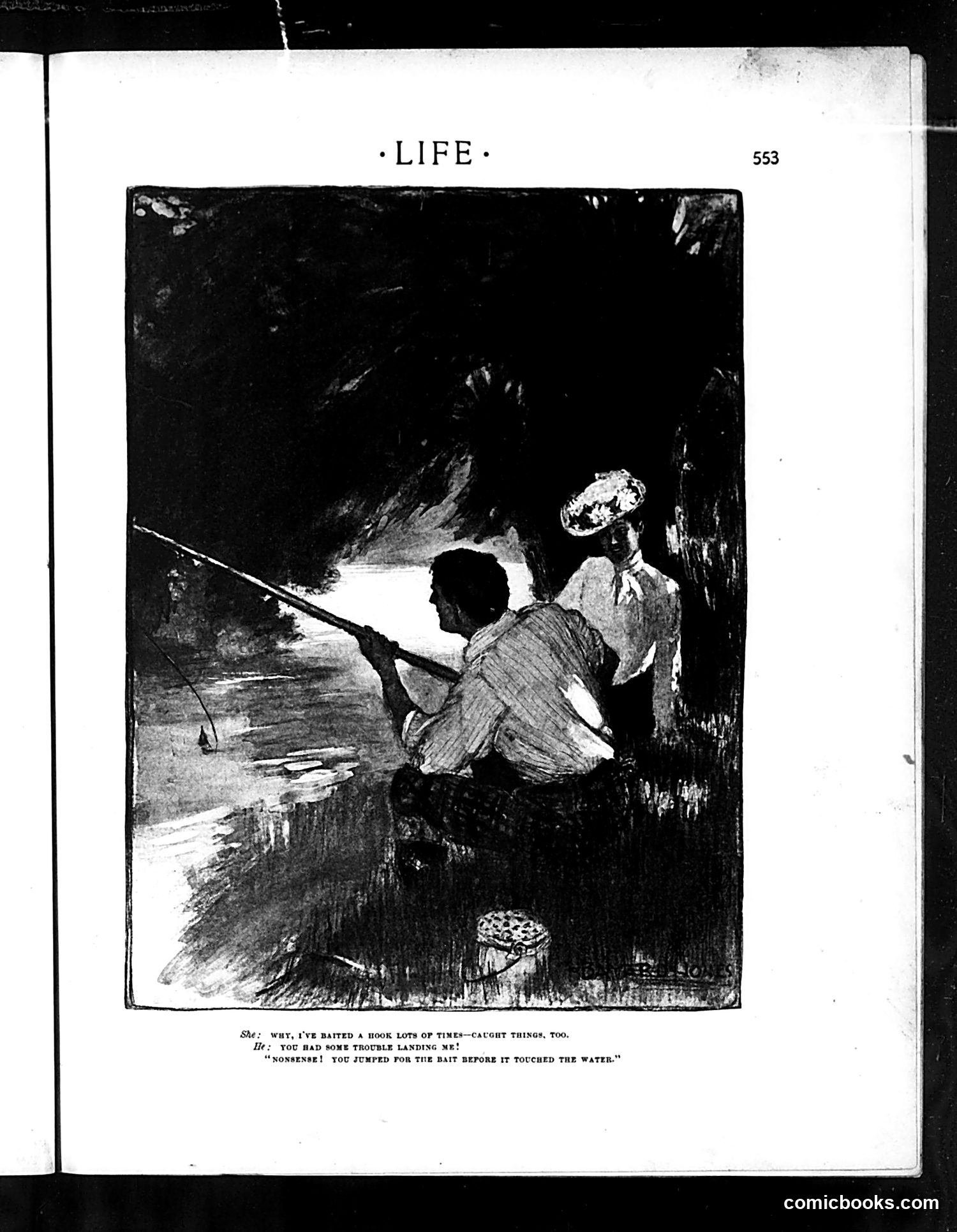
This is a humorous fishing scene where a man has caught what appears to be a woman instead of a fish. The dialogue reveals the joke: she claims experience ("I've baited a hook lots of times—caught things, too"), while he complains she was difficult to land. Her retort—"You jumped for the bait before it touched the water"—suggests she deliberately took the bait too eagerly, implying she's too eager or impulsive. The satire appears to mock both genders: women for being overeager regarding romance/courtship, and men for complaining about the difficulties of romantic pursuit. It's a clever visual pun treating romantic "catching" as literal fishing, typical of early-to-mid 20th century humor about courtship and gender relations.
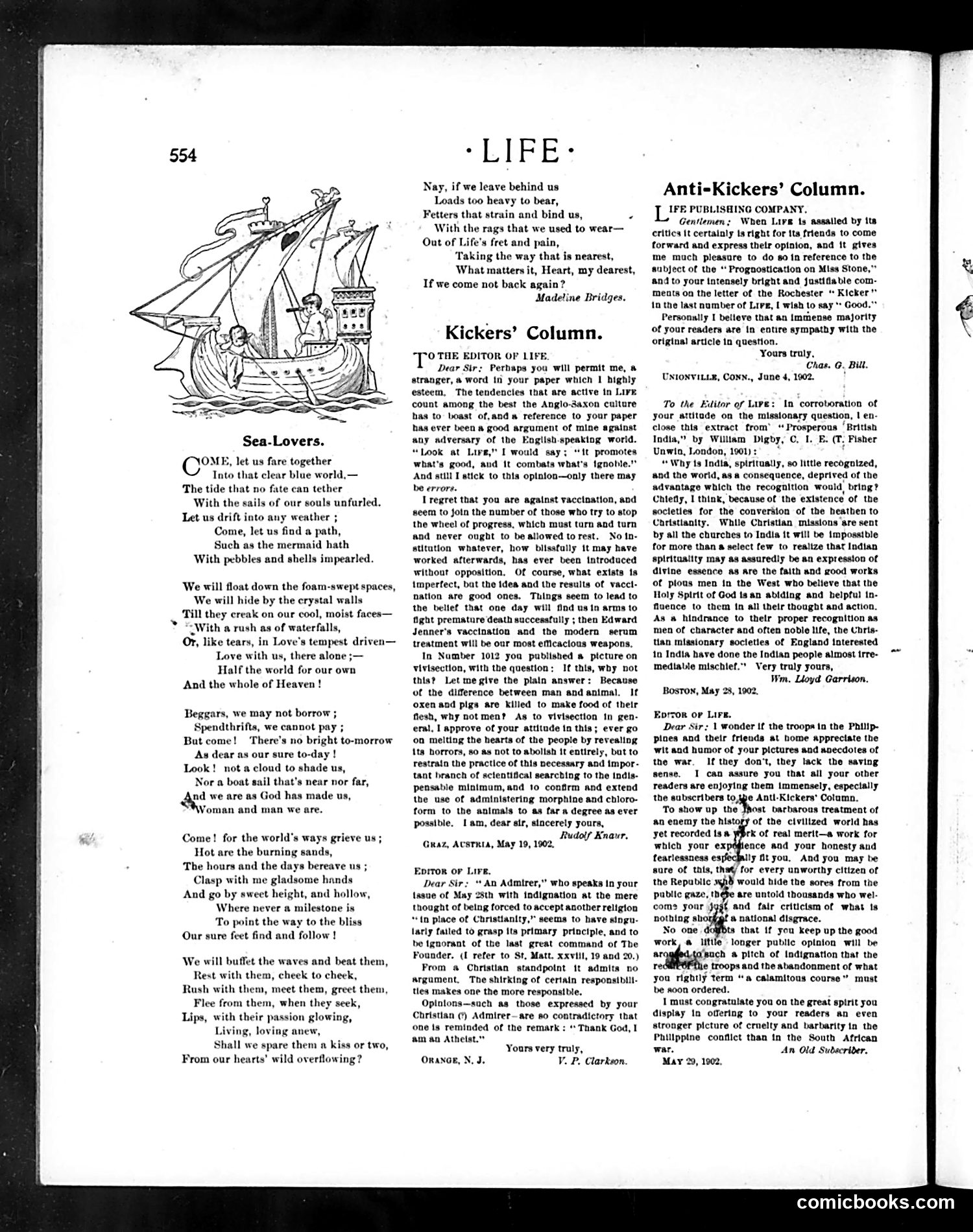
This page from *Life* magazine (circa 1902) contains romantic poetry paired with a "Kickers' Column" of reader letters debating social issues. **The Poetry Section:** "Sea-Lovers" by Madeline Bridges is a romantic poem about two lovers escaping worldly burdens together. "Life" (the personified magazine) responds with skepticism, questioning whether abandoning responsibilities ("loads too heavy to bear") is wise. **The Letters:** Readers debate *Life*'s editorial positions: - A supporter from Austria defends the magazine's promotion of "what's good" and argues *Life* is wrong to oppose vaccination, calling it progress - The same writer approves of *Life*'s anti-vivisection stance but argues some animal testing is necessary for medical advancement - Another letter (partially visible) discusses religious tolerance **The Satire:** The "Kickers' Column" format allows *Life* to present opposing viewpoints on progressive 1900s issues—medical science, animal welfare, religion—positioning itself as a forum for reasoned debate on contemporary concerns.
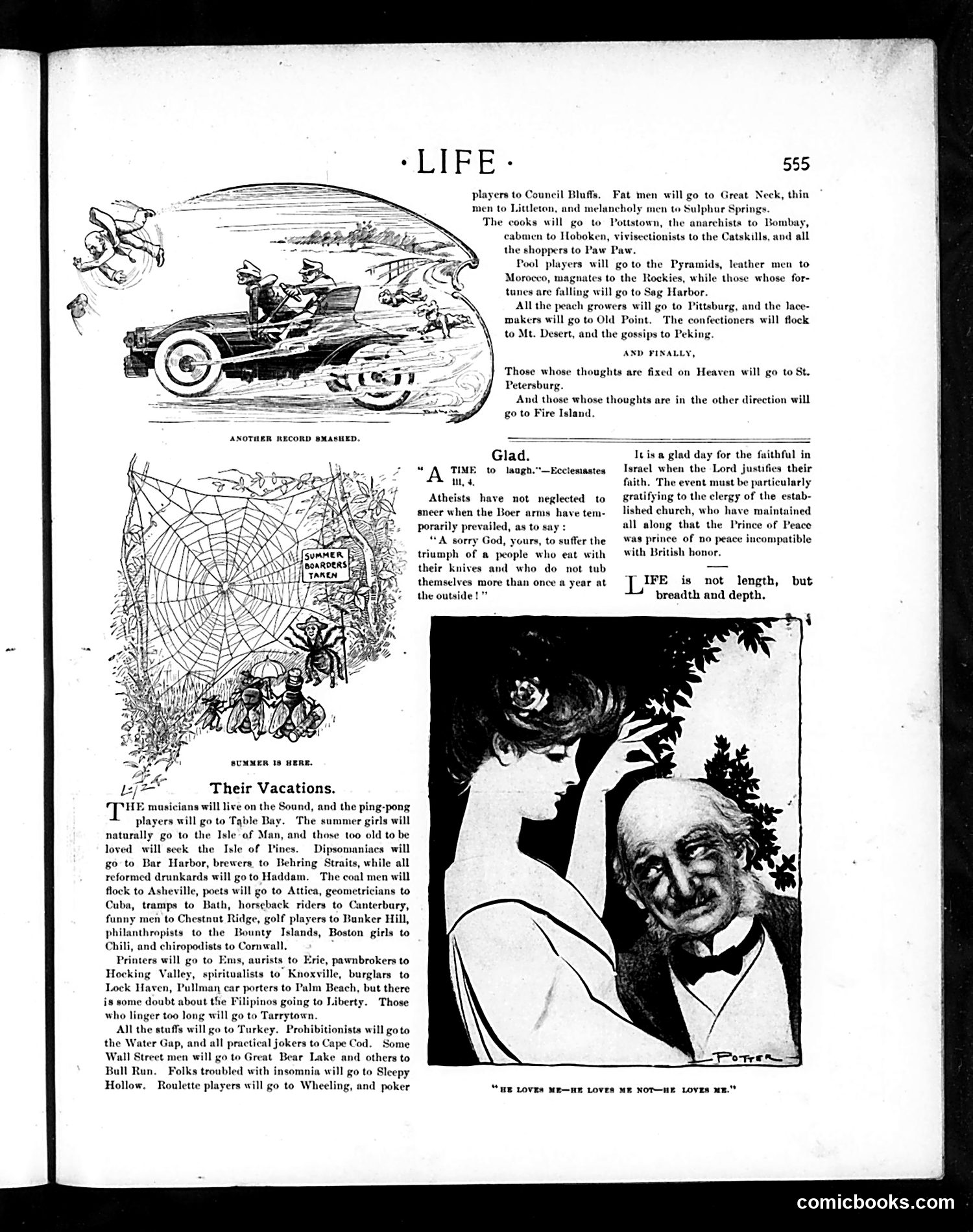
This Life magazine page contains two satirical pieces: **"Their Vacations"** is a long joke using puns and place names to mock various professions and types. Examples: musicians go to "Ems" (musical notes), printers to "Ems" (a typographic unit), reformers to "Haddam" (a play on abstinence). The humor relies on matching occupations or character flaws with location names that sound like relevant words—a wordplay-heavy style popular in early 20th-century American satire. **"Glad"** references the Second Boer War (British vs. Dutch settlers in South Africa). It mocks atheists who criticized British military failures, sarcastically suggesting God has now vindicated British honor by granting victory. The jab at Boers eating "with their knives" reflects Victorian British class prejudice. This satirizes both religious hypocrisy and jingoism during the ongoing conflict. The portrait labeled "He loves me—he loves me not—he loves me" appears to be accompanying romantic content, though context is unclear from this page alone.
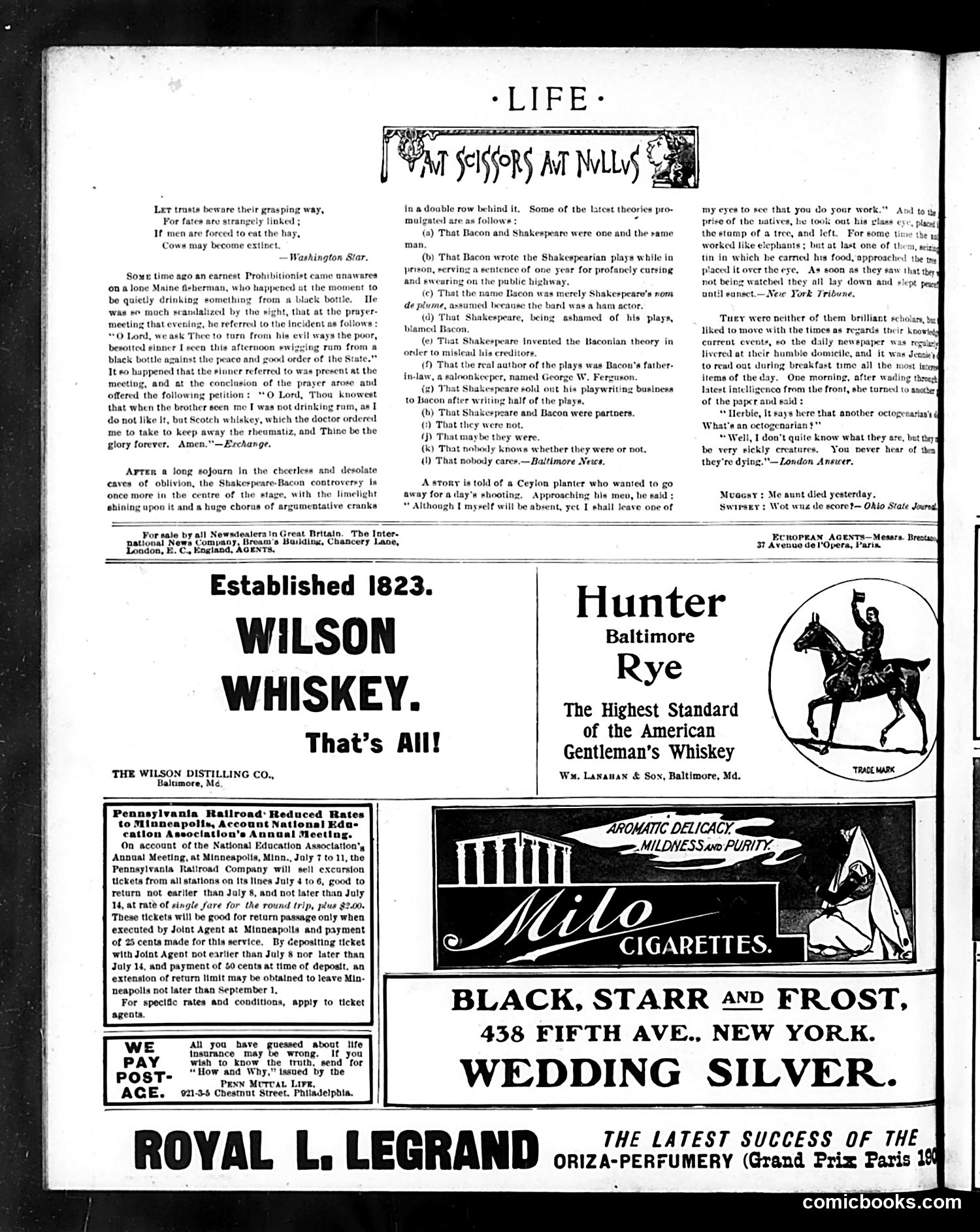
This page is primarily **advertisements and miscellaneous content** rather than political cartoons. The main editorial content includes: **"Shakespeare-Bacon Controversy"**: A satirical list of absurd theories about whether Francis Bacon or William Shakespeare authored the plays—theories like Bacon writing them in prison, or that "Shakespeare invented the Baconian theory to mislead his creditors." This mocks the era's intense scholarly debate over Shakespeare's authorship by presenting increasingly ridiculous claims. **"Prohibitionist" anecdote**: A humorous story about a temperance advocate mistaking a fisherman's Scotch whiskey for rum. The joke critiques Prohibition zealots' self-righteousness and the fisherman's clever reframing of drinking as medical necessity. **Other brief jokes** appear scattered throughout, typical of Life's humor-magazine format. The page is otherwise dominated by **period advertisements** for Wilson Whiskey, Hunter Rye, Milo Cigarettes, and other products—reflecting the magazine's revenue model and the era's marketing practices.
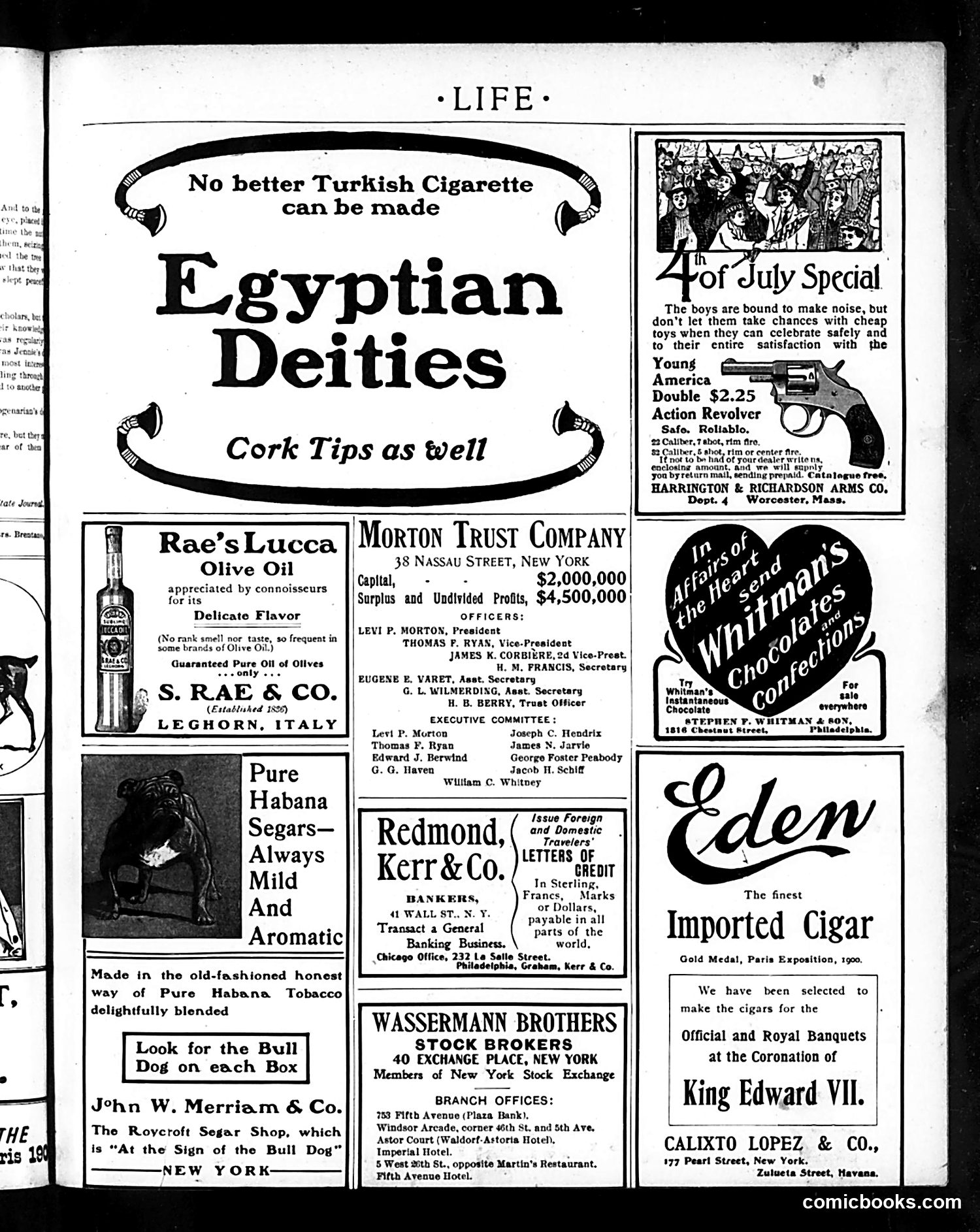
This page is primarily **advertising**, not political satire. It's a collection of commercial advertisements from the early 1900s, with no apparent cartoon or satirical content. The ads promote luxury goods targeting affluent consumers: Turkish and Havana cigarettes, olive oil, imported cigars (one celebrating King Edward VII's coronation), chocolates, banking services, and stock brokers. Notable is an ad for a children's toy revolver—a "Young America Double Action Revolver"—marketed as "safe" and preferable to "cheap toys," reflecting an era when such items were sold without modern safety concerns. The only potentially notable element is the prominence of financial institutions (Morton Trust Company, Wassermann Brothers stock brokers) advertising alongside consumer goods, suggesting the magazine's audience was wealthy and investment-focused. The page reflects early 20th-century commercial culture and attitudes toward product safety that would be unthinkable today.
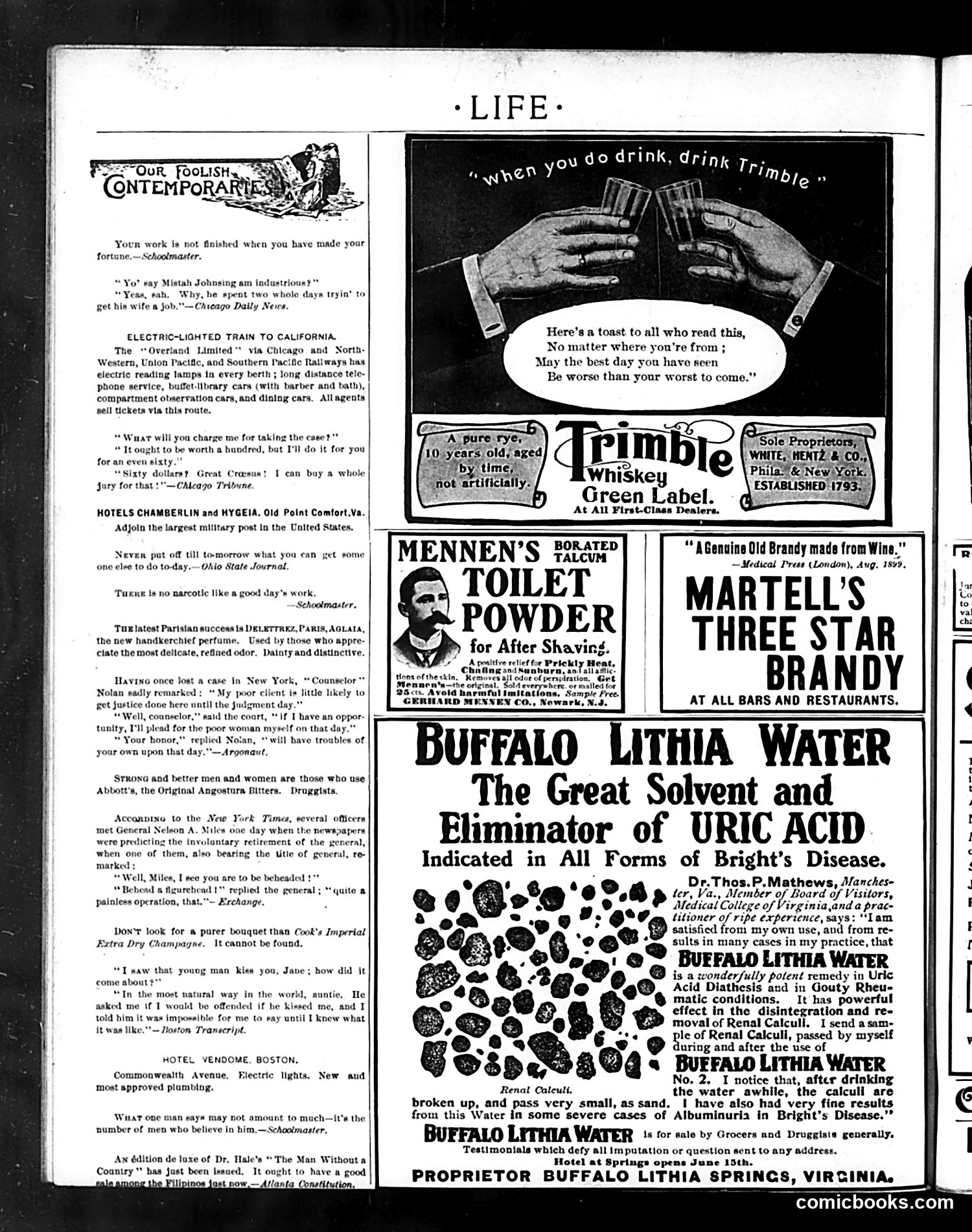
This page from *Life* magazine is primarily **advertising**, with brief satirical quotes interspersed—typical of early 1900s format. The satirical content consists of short, punchy jokes about contemporary life: - A joke about an industrious man spending two days trying to get his wife a job (social commentary on employment) - Legal humor about courtroom fees and delayed justice - A quip about a general being "beheaded" (a figurehead without real power) The **advertisements** dominate, promoting patent medicines and luxury goods now recognized as dubious or harmful: Buffalo Lithia Water claims to cure Bright's Disease and gout; Mennen's Toilet Powder; Trimble Whiskey; Martell's Brandy. These ads reflect the era's unregulated pharmaceutical marketing—products made exaggerated medical claims without FDA oversight. The whiskey and brandy ads appear alongside "health" tonics, typical of an age when alcohol was marketed as medicinal. The page satirizes contemporary foolishness (hence "Our Foolish Contemporaries") through both jokes and the implicit critique of readers' gullibility toward such advertisements.
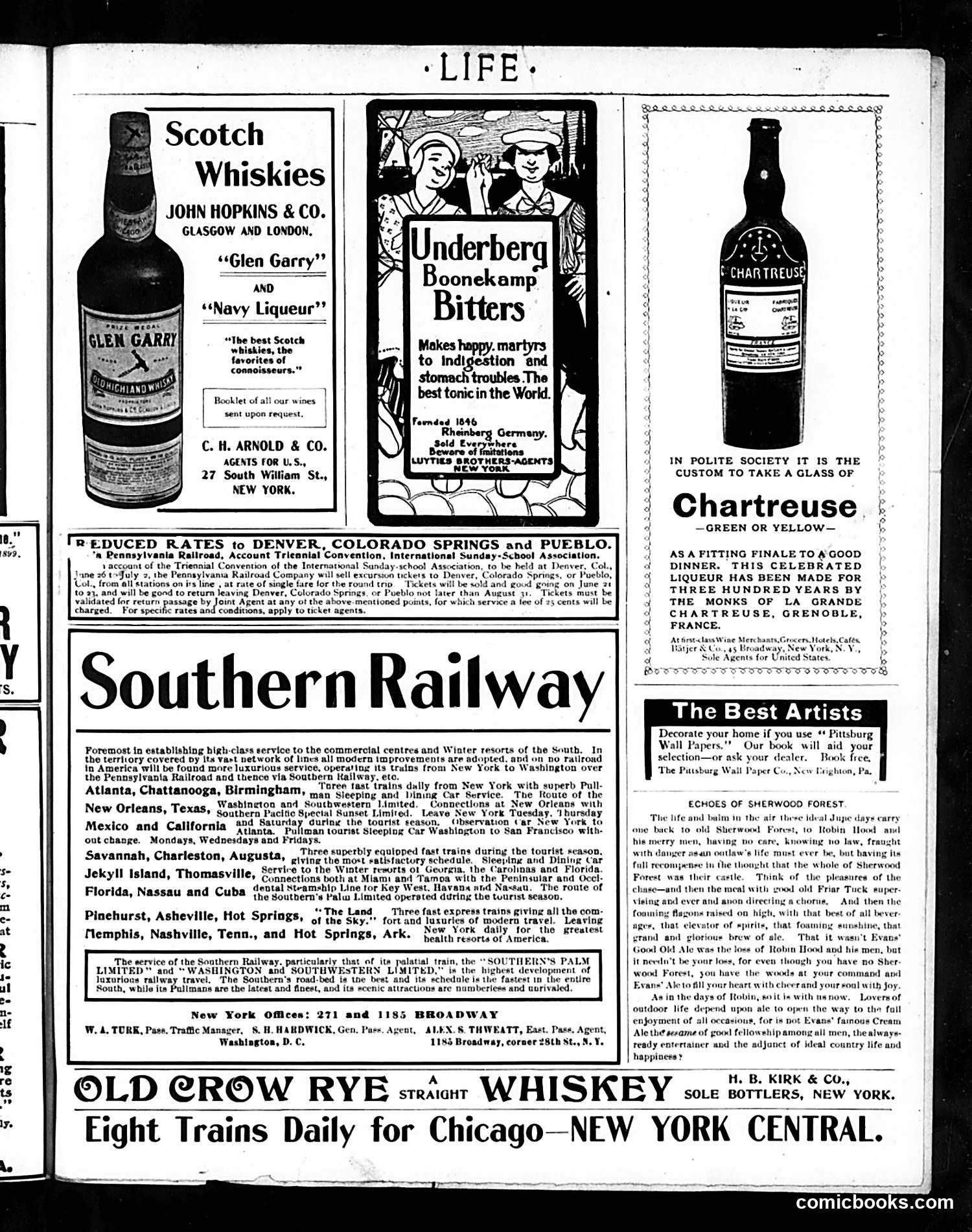
This is primarily an **advertising page** from Life magazine, not a political cartoon. It contains several liquor advertisements (Scotch whisky, bitters, Chartreuse) and railroad promotions—typical commercial content from early 20th-century publications. The only visual content with potential satirical intent appears in the center: an illustration for "Underberg Boonekamp Bitters" showing two figures in period dress. The accompanying text claims it "makes happy, martyrs to indigestion and stomach troubles" and is "the best tonic in the World." This represents **patent medicine advertising**—a common target of era satire. Such tonics frequently made exaggerated health claims (often containing alcohol and questionable ingredients), playing on consumer anxiety about digestive ailments. The railroad advertisements emphasize luxury service—Pullman cars, dining facilities—reflecting commercial competition for wealthy travelers during the tourist season. **Overall**: This is advertising copy reflecting Gilded Age consumer culture, not editorial satire or political commentary.
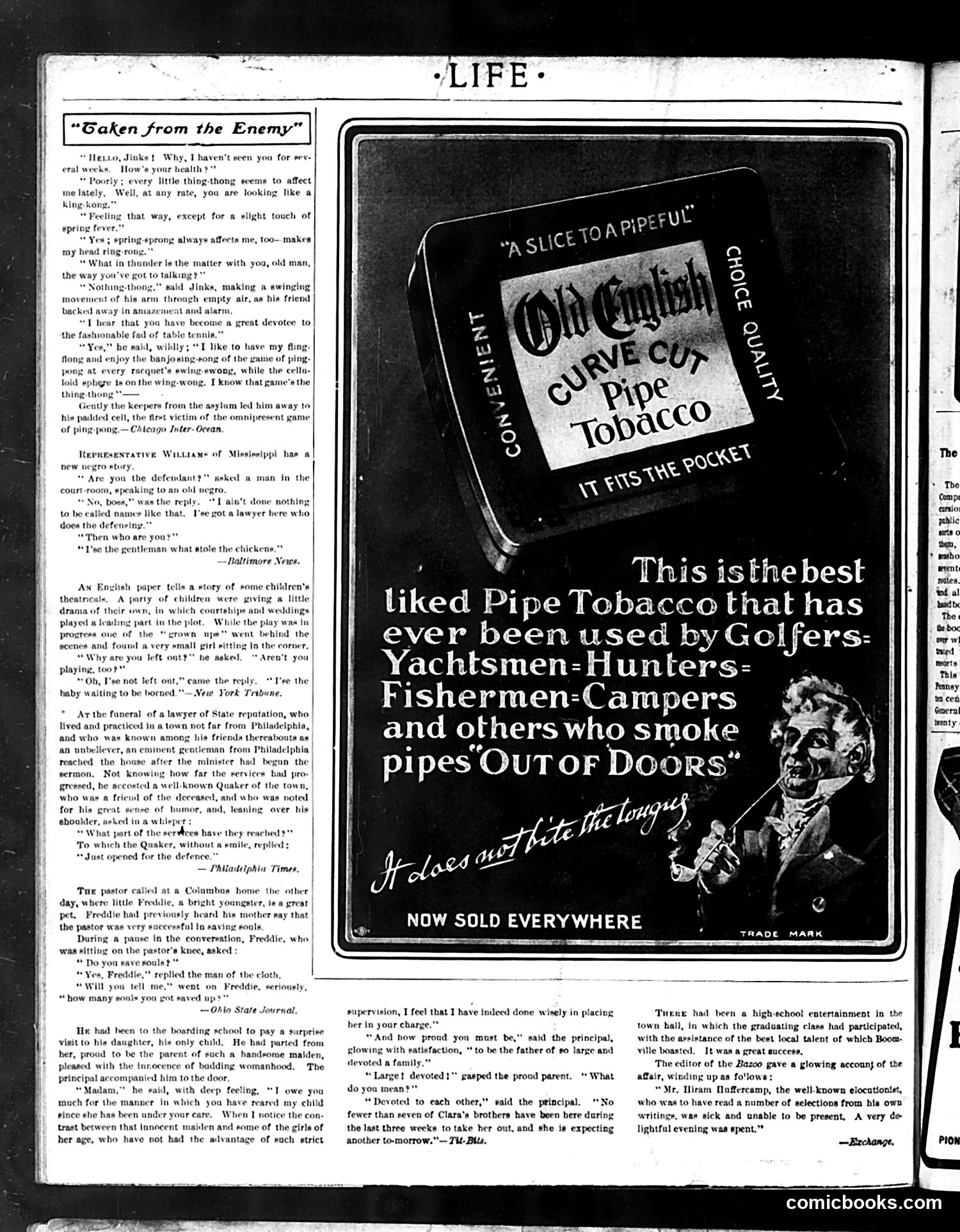
This page contains humorous anecdotes and one large **tobacco advertisement** rather than political cartoons. The left column presents short jokes and stories typical of Life's satirical humor circa early 1900s: - "Taken from the Enemy" satirizes the ping-pong craze, mocking its obsessive popularity by suggesting it drove a man to asylum - Brief humorous exchanges about innocence and misunderstandings (a child's confusion about "saved souls," a woman's naïveté) - A Quaker's dry wit at a funeral The dominant right-side advertisement promotes **Craven "A" Pipe Tobacco**, targeting outdoor enthusiasts (golfers, hunters, yachtsmen, fishermen, campers). It claims the product "fits the pocket" and "closes out country" - emphasizing portability and quality for active men. The illustrated face suggests a satisfied, rugged outdoorsman. The ad's appeal is straightforward product promotion without obvious political content - typical commercial messaging from this era celebrating masculine leisure activities and quality tobacco consumption outdoors.
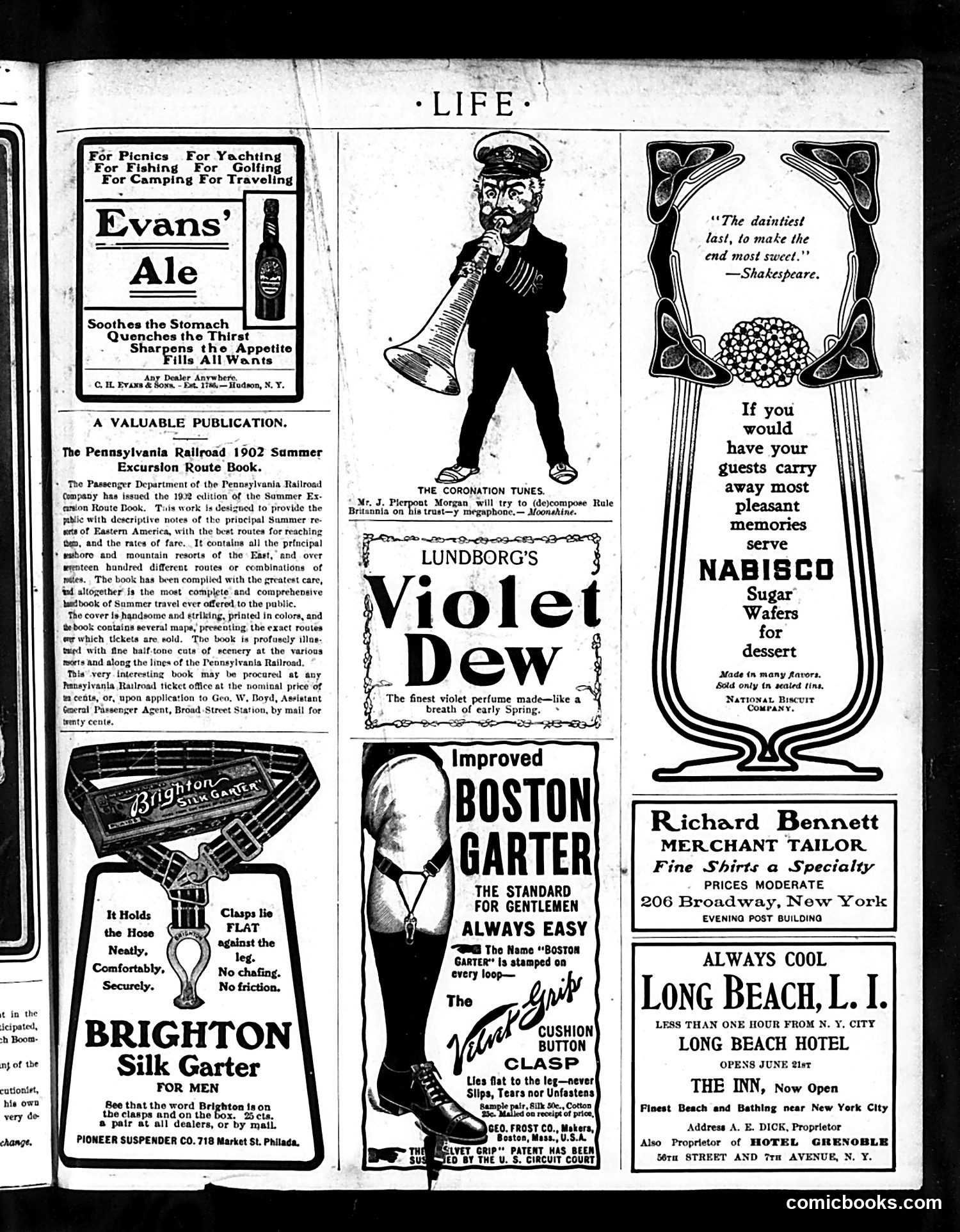
This page is primarily **advertisements** with one small political cartoon. The cartoon depicts **J.P. Morgan**, the powerful industrialist and financier, holding a megaphone labeled "trust." The caption jokes that Morgan will try to "(de)compose Rule Britannia"—a pun suggesting he'll decompose (destroy) the famous British patriotic song while composing it on his "trust-y megaphone." **The satire**: Morgan's monopolistic business trusts were widely seen as threatening to American institutions and values. By showing him attempting to appropriate even British national symbols through his financial power, the cartoonist mocks the perceived arrogance and overreach of robber barons. The wordplay on "compose/decompose" emphasizes the destructive nature of trust monopolies. The rest of the page contains period product advertisements (ale, garters, perfume, wafers) and travel/hotel promotions typical of early 1900s Life magazine advertising.
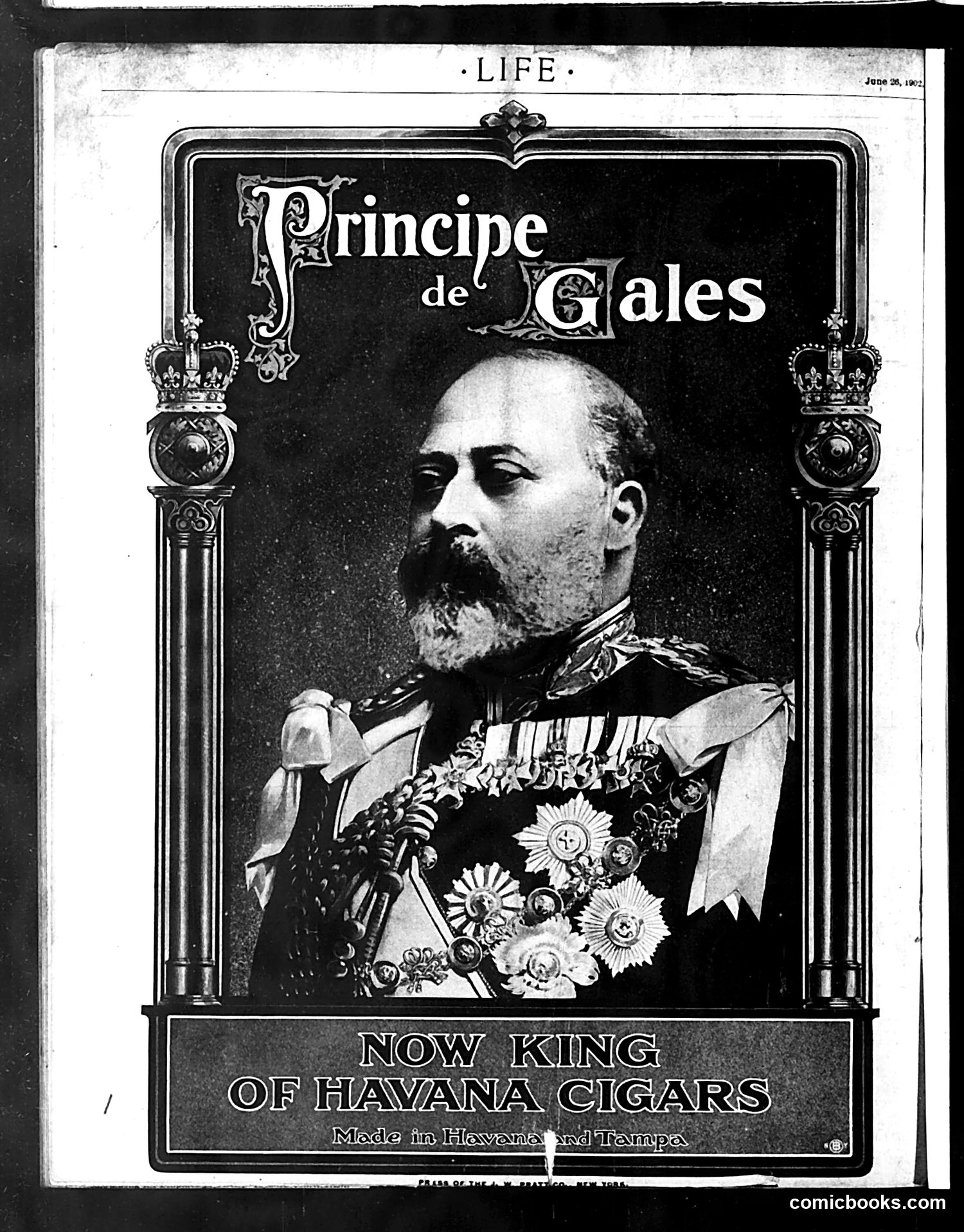
This appears to be a **cigar advertisement** rather than political satire. The page shows a portrait of a bearded man in military dress uniform, heavily decorated with medals and ribbons, labeled "Principe de Gales" (Prince of Wales). The advertisement claims he is "NOW KING OF HAVANA CIGARS" and notes the product is "Made in Havana and Tampa." The satire likely works by **elevating a cigar brand to royal status**—suggesting the product is so superior it deserves princely rank. This was common advertising rhetoric of the early 1900s. However, without the cover date clearly visible, I cannot definitively identify which Prince of Wales is depicted or confirm the exact historical context intended by the comparison.

I can see this is a page from Life magazine (based on the watermark "comicbooks.com" visible at the bottom), but the image quality is too poor to read any text clearly or identify specific cartoon figures, captions, or content with confidence. The page appears predominantly black with some faint patterns or imagery that might be illustrations, but I cannot make out enough detail to accurately identify political figures, historical references, or the satirical point being made. To provide the accurate analysis you've requested following your rules, I would need a clearer image where the text and illustrations are legible. I cannot responsibly guess at identities or meanings when the source material isn't sufficiently visible.