
Life, 1902-06-26 · page 14 of 31
Life — June 26, 1902 — page 14: what you’re looking at
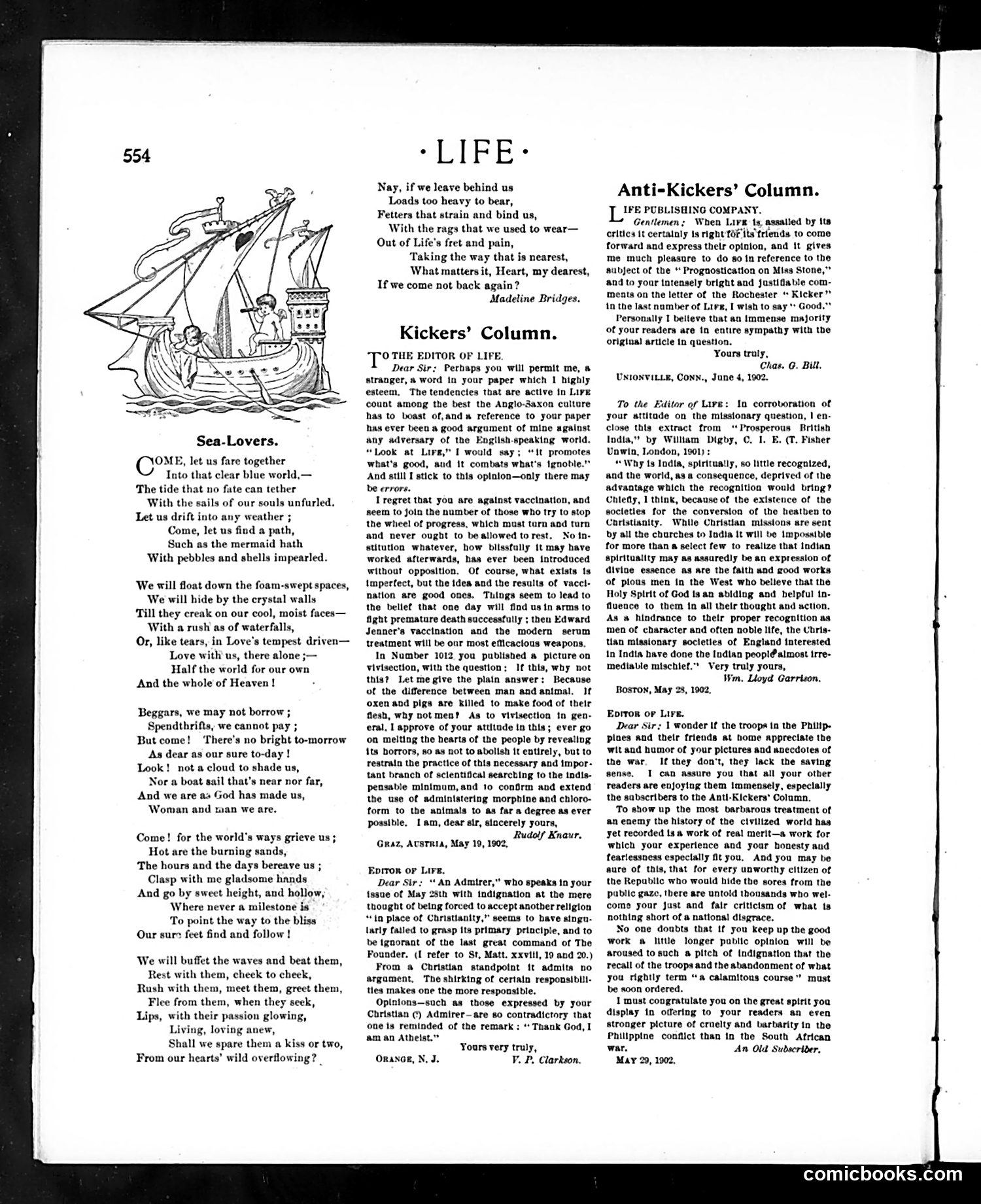
What you’re looking at
This page contains **poetry and reader letters**, not political cartoons. The main illustration shows a **sailing ship with figures**, accompanying "Sea-Lovers," a romantic poem by Madeline Bridges about escaping worldly burdens through love and adventure at sea. The "**Kickers' Column**" presents reader letters debating contemporary issues: 1. **Rudolf Knauer** (Austria) praises *Life*'s editorial stance but criticizes its anti-vaccination position. He defends vaccination and vivisection as necessary scientific progress, arguing they differ from killing animals for food because they serve humanity's medical advancement. 2. **Anti-Kickers' Column** responses address vaccination skepticism and defend missionaries in India, arguing Christian conversion efforts are justified despite colonial contexts. The page reflects **early-1900s debates** over scientific progress, particularly vaccination (controversial then despite Jenner's 18th-century innovation) and the ethics of animal testing versus human benefit—issues that *Life* magazine apparently took editorial positions on that some readers disputed.
📄 Transcribed text from this page (OCR, searchable)
Machine-transcribed from the original scan — historical spelling and the odd misread are preserved.
Sea-Lovers. OME, let us fare together Into that clear blue world,— The tide that no fate can tether With the sails of our souls unfurled. Let us drift into any weather ; Come, let us find a path, Such as the mermaid hath With pebbles and shells impearled. ‘We will float down the foam-swept spaces, We will hide by the crystal walls Till they creak on our cool, moist faces— With a rush as of waterfalls, Or, like tears, in Love's tempest driven— Love with us, there alone ;— Half the world for our own And the whole of Heaven ! Beggars, we may not borrow ; Spendthrifts, we cannot pay ; Butcome! There's no bright to-morrow As dear as our sure to-day ! Look! not a cloud to shade us, Nor a boat sail that’s near nor far, And we are as God has made us, Woman and man we are. Come! for the world’s ways grieve us; Hot are the burning sands, ‘The hours and the days bereave us ; Clasp with me gladsome hands And go by sweet height, and hollow, Where never a milestone is To point the way to the bliss Our sure feet find and follow ! We will buffet the waves and beat them, Rest with them, cheek to cheek, Rush with them, meet them, greet them, Flee from them, when they seek, Lips, with their passion glowing, Living, loving anew, Shall we spare them a kiss or two, From our hearts’ wild overflowing? _ «TIPE Nay, if we leave behind us Loads too heavy to bear, Fetters that strain and bind us, With the rags that we used to wear— Out of Life's fret and pain, Taking the way that is nearest, What matters it, Heart, my dearest, If we come not back again? Madeline Bridges. Kickers’ Column. OTHE EDITOR OF LIFE. Dear Sir; Perhaps you will permit me, a stranger, a word in your paper which 1 highly esteem, The tendencies that are active in Lire count among the best the Anglo-Saxon culture has to boast of,and # reference to your paper has ever been a good argument of mine against ‘any adversary of the English-speaking world. “Look at Lirg,” I would say; “{t promotes what's good, aud tt combats what's Ignoble.” And still I stick to this opinion—only there may be errors. Tregret that you are against vaccination, and seem to Join the number of those who try to stop the wheel of progress, which must turn and turn and never ought to be allowed torest, No tn- stitution whatever, how bilssfully {t may have worked afterwards, has ever been introduced without opposition, Of course, what exists 1s Imperfect, but the idea and the results of vacct- nation are good ones, Things seem to lead to the belief that one day will find us in arms to fight premature death successfully ; then Edward Jenner's vaccination and the modern serum treatment will be our most efficactous weapons, In Number 1012 you published a picture on vivisection, with the question; If this, why not this? Let me give the plain answer: Because of the difference between man and animal. If oxen and pigs are killed to make food of their flesh, why not men? As to vivisection in gen- eral, | approve of your attitude In this; ever go on melting the hearts of the people by revealing, {ts horrors, 80 as not to abolish it entirely, but to restrain the practice of this necessary and Impor- tant branch of sclentifical searching to the indls- pensable minimum, and to confrm and extend the use of administering morphine and chloro- form to the animals to as fara degree as ever possible, 1am, dear sir, slocerely yours, Rudolf Knaur, Graz, AUSTRIA, May 19, 1902, Eprron or Lirg, Dear Sir; “An Admirer,” who speaks tn your issue of May 28th with indignation at the mere thought of being forced to accept another religion “tn place of Christianity,” seems to bave singu- larly fatled to grasp its primary principle, and to be tgnorant of the last great command of The Founder. (I refer to St, Matt. xxvill, 19 and 20.) From a Christian standpoint it admita no argament, The shirking of certain responsibill- tles makes one the more responsible. Optntons—such as those expressed by your Christian ¢) Admirer—are 80 contradictory that one 1s reminded of the remark : “* Thank God, I am an Athelst.” Yours very truly, Onanog, N, J. V. P. Clarkson. Anti-Kickers’ Column. IFE PUBLISHING COMPANY. Gentlemen; When Live 1s, assailed by its critics it certalnly ts right TdF its friends to come forward and express thelr opinion, and it gives me much pleasure to do 80 in reference to the subject of the “ Prognostication on Miss Stone,” ‘and to your Intensely bright and justifiable com- meats on the letter of the Rochester * Kicker” 1n the last namber of Lrg, I wish to say ‘+ Good."* Personally I belteve that an Immense majority of your readers are in entire aympathy with the original article in question. Yours truly, Chas. @. Bilt. UNIONVILLE, Conn., June 4, 1902. To the Editor of Lire: tn corroboration of your attitade on the misstonary question, | en- close this extract from “Prosperous Britian India,” by William Digby, C, 1. E. (T. Fisher Vawin, London, 1901) : «Why 1s India, spiritually, so little recognized, and the world, as a consequence, deprived of the advantage which the recognition would bring? Chiefy, I think, because of the existence of the societies for the conversion of the heathen to Christianity. While Christian misstons are sent by all the churches to India It will be Impossible for more than a select few to realize that Indian spirituality may as assaredly be an expression of divine essence as are the faith and good works of pious men in the West who believe that the Holy Spirit of God ts an abiding and helpful in- fluence to them in all thelr thought and action. As @ hindrance to thelr proper recognition as men of character and often noble life, the Chris- tian missionary societies of England interested In India have done the Indian peop!@ almost irre- mediable mischief.” Very traly yours, i¥m. Lloyd Garrison, Bostox, May 23, 1902, Eprror or Lire. Dear Sir; 1 wonder if the troops in the Phillp- pines and their friends at home appreciate the wit and humor of your pictures and anecdotes of the war. If they don't, they lack the saving sense, T can assure you that all your other readers are enjoying them immensely, especially the subscribers to the Antl-Kickers’ Column. To show up the most barbarous treatment of ‘an enemy the history of the civilized world has yet recorded {8 a work of real merit—a work for which your expertence and your honesty aud fearlessness especially fit you. And you may be sure of this, that for every unworthy citizen of the Repablic who would hide the sores from the public gaze, there are untold thousands who wel- come your Just and falr criticism of what ts nothing short of a national disgrace, No one doubts that if you keep up the good work ® little longer public opinion will be aroused to such a pitch of indignation that the recall of the troops and the abandonment of what you rightly term “a calamitous course” must be soon ordered. I must congratulate you on the great spirit you display in offering to your readers an even stronger picture of cruelty and barbarity in the Philippine confict than in the South African war. An Old Subscriber, May 29, 1902, comicbooks.com