
A complete issue · 20 pages · 1902
Life — June 12, 1902
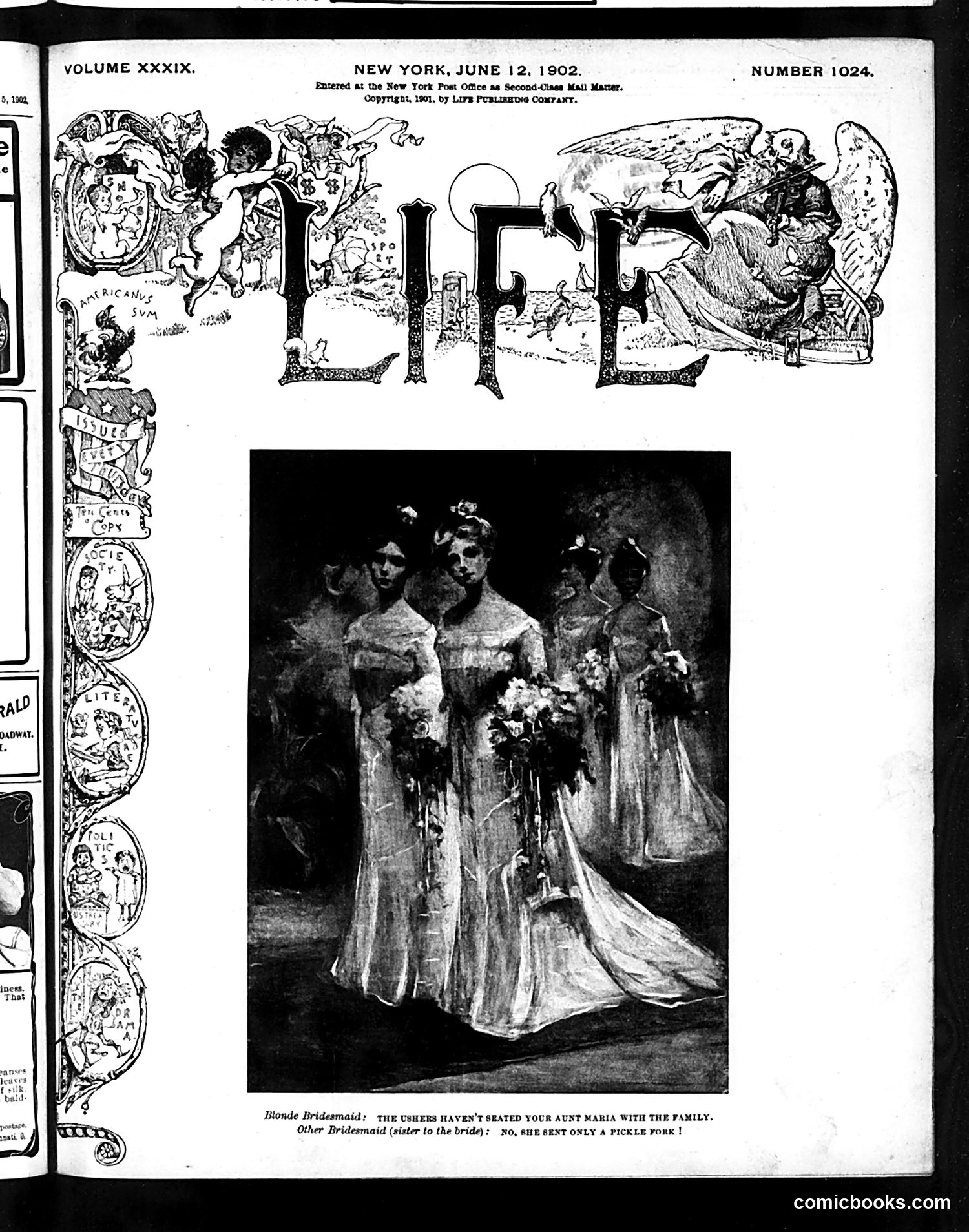
This page features a satirical cartoon about weddings and bridesmaids. The ornate header illustration shows cherubs and classical figures in a wedding-themed composition. The photograph below depicts three women in elaborate Edwardian-era wedding attire with long trains and flowers. The caption reads: "Blonde Bridesmaid: 'THE USHERS HAVEN'T TREATED YOUR AUNT MARIA WITH THE FAMILY. Other Bridesmaid (sister to the bride): 'NO, SHE BEST ONLY A PICKLE FORK!'" The joke appears to satirize upper-class wedding etiquette and social hierarchies of the era—specifically the proper treatment and seating of wedding guests according to strict social rules. The reference to a "pickle fork" suggests either a slight or inadequate place setting, mocking the anxieties about proper formal dining protocol among wealthy families during this period.
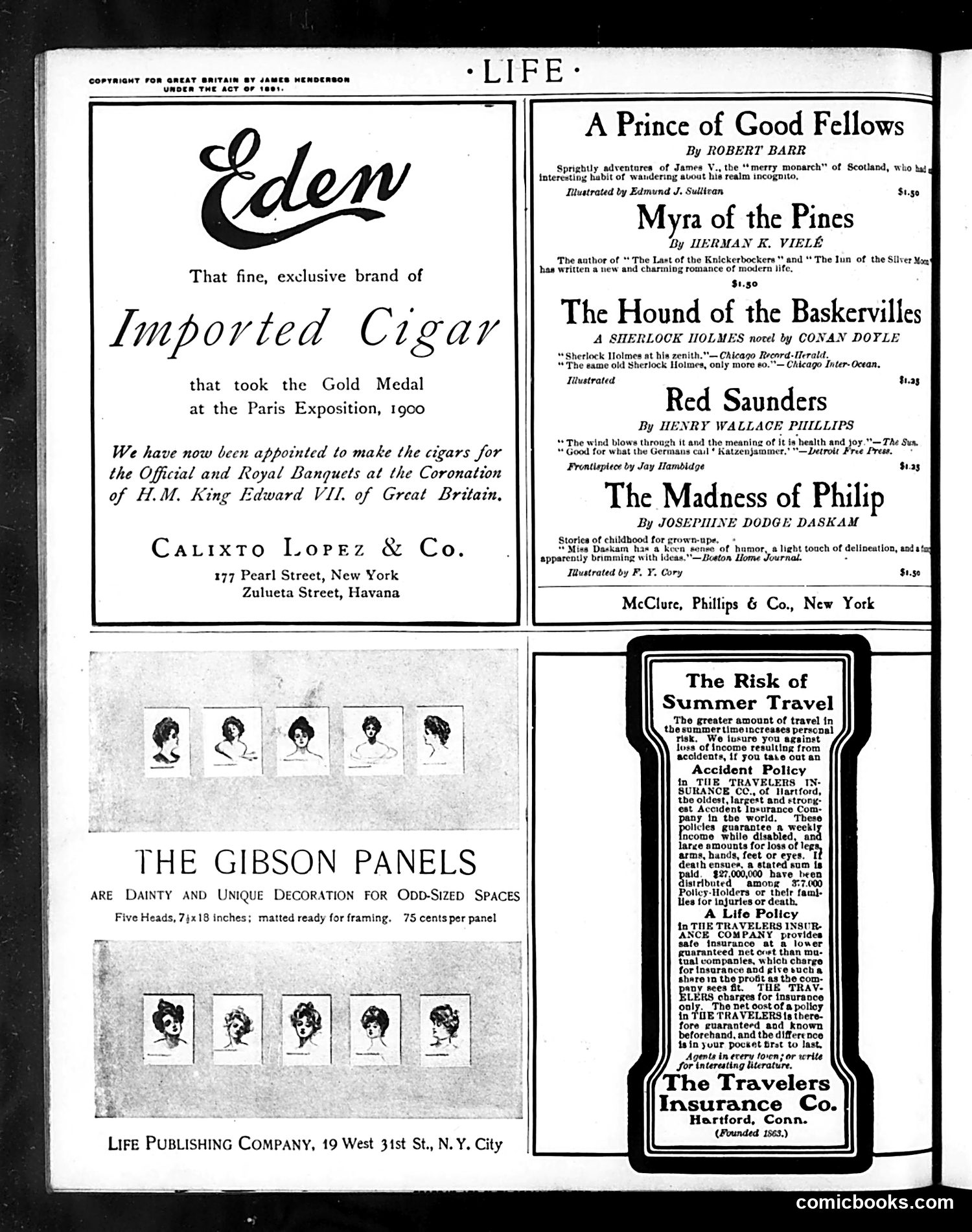
This page is **primarily advertising** with no political cartoons or satirical content. The left side features an **Eden cigar advertisement** emphasizing exclusivity and a Paris Exposition gold medal, noting the company was appointed to make cigars for King Edward VII's coronation banquet. Below is an advertisement for **Gibson Panels**—decorative wall panels featuring five illustrated female heads (likely Gibson Girl illustrations), marketed as "dainty and unique decoration for odd-sized spaces." The right side lists **book advertisements** from McClure, Phillips & Co., including Sherlock Holmes and other period literature. The bottom right shows an **insurance advertisement** for The Travelers Insurance Company of Hartford, promoting accident and life policies. This is a typical early-20th-century magazine page mixing consumer goods advertising with literary promotions.
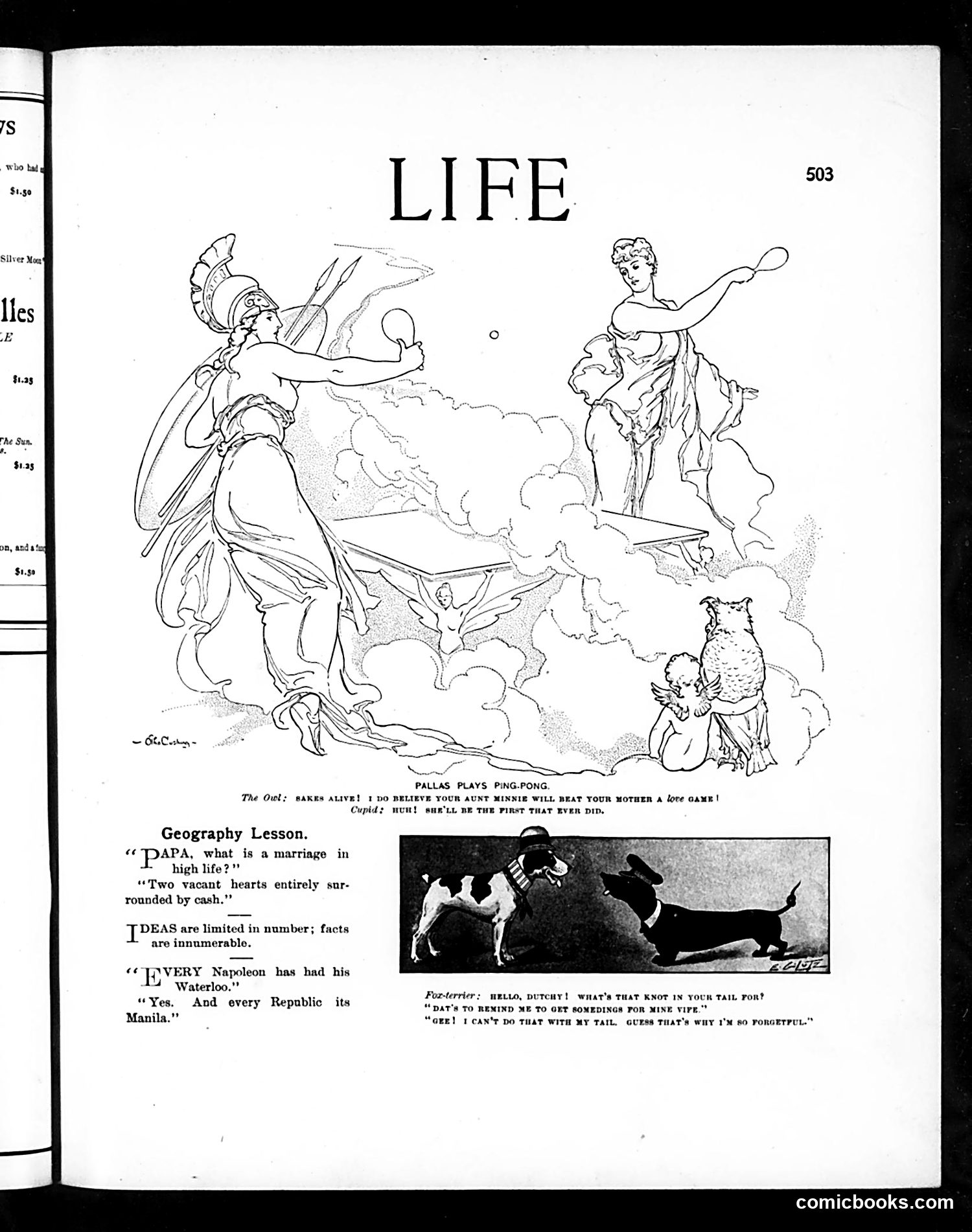
**Top Cartoon - "Pallas Plays Ping-Pong":** Classical allegorical figures (likely representing wisdom/virtue and fortune) play ping-pong among clouds. The caption references Pallas beating one's aunt Minnie and mother at ping-pong, suggesting this is a humorous domestic scene dressed in classical mythology—satirizing how absurdly pretentious language makes ordinary activities sound grand. **Bottom Section:** A "Geography Lesson" presents witty definitions: marriage in "high life" as "two vacant hearts entirely surrounded by cash," and a quip about every nation having its Waterloo. **Dog Cartoon:** Two dogs converse about the knot in one dog's tail, with implied crude humor about tail-related misfortunes and forgetfulness. These represent typical early-20th-century Life magazine humor: clever wordplay, classical allusions, and social satire targeting upper-class pretension.
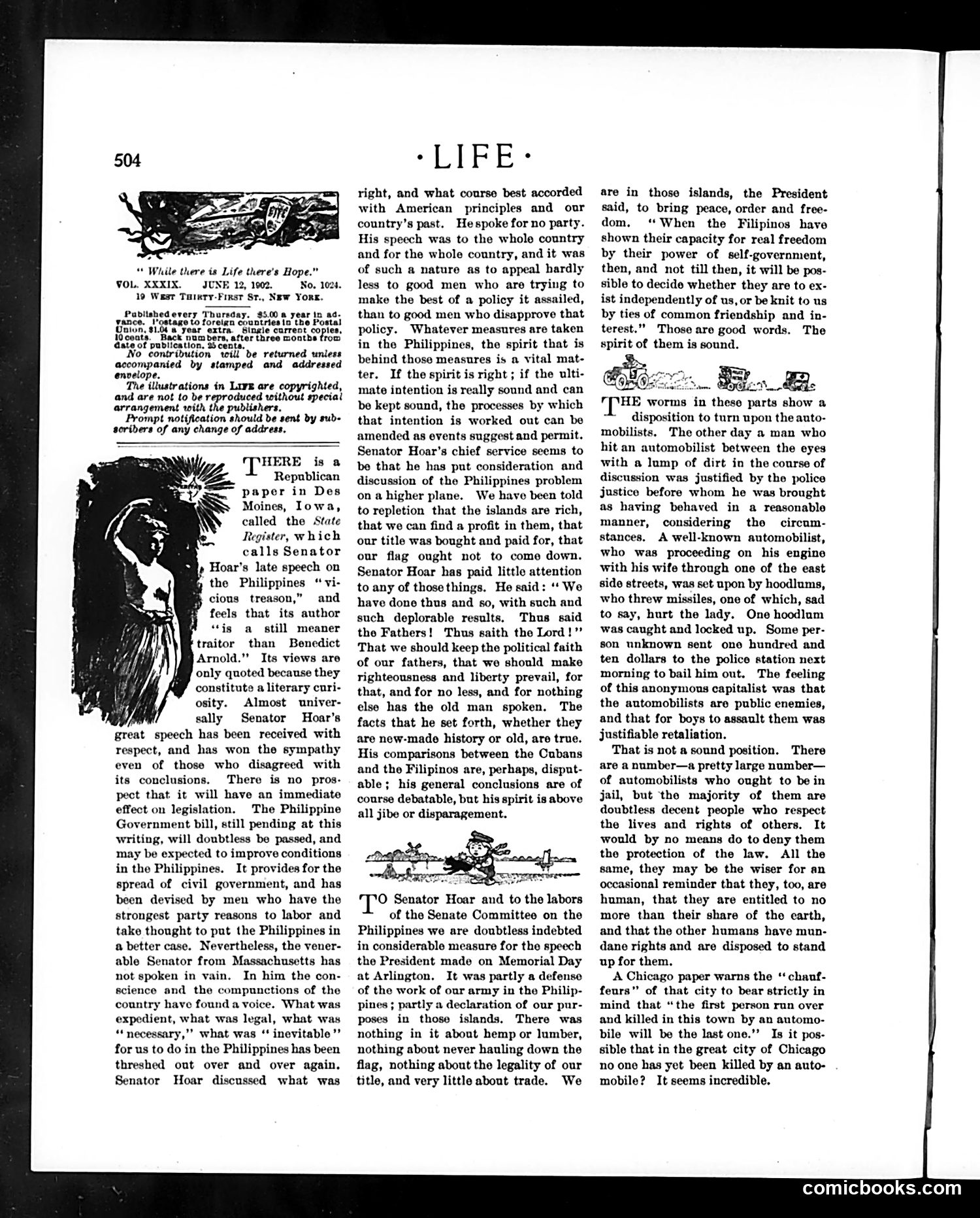
The main cartoon depicts **Senator Hoar** of Massachusetts as an elderly bearded figure labeled "Register"—referencing his recent speech criticizing U.S. Philippine policy as "pious reason" and "disloyal." The article defends Hoar's moral position on the Philippines while critiquing his lack of practical proposals. It argues his comparisons between U.S. and Cuban/Philippine situations are "disputable," though his "spirit is above all gibe or disparagement." The second cartoon illustrates a satirical anecdote about automobiles causing accidents in cities—a contemporary social problem. It mocks public outcry over automotive deaths while suggesting such incidents reflect broader human carelessness rather than justifying restricting the new technology.
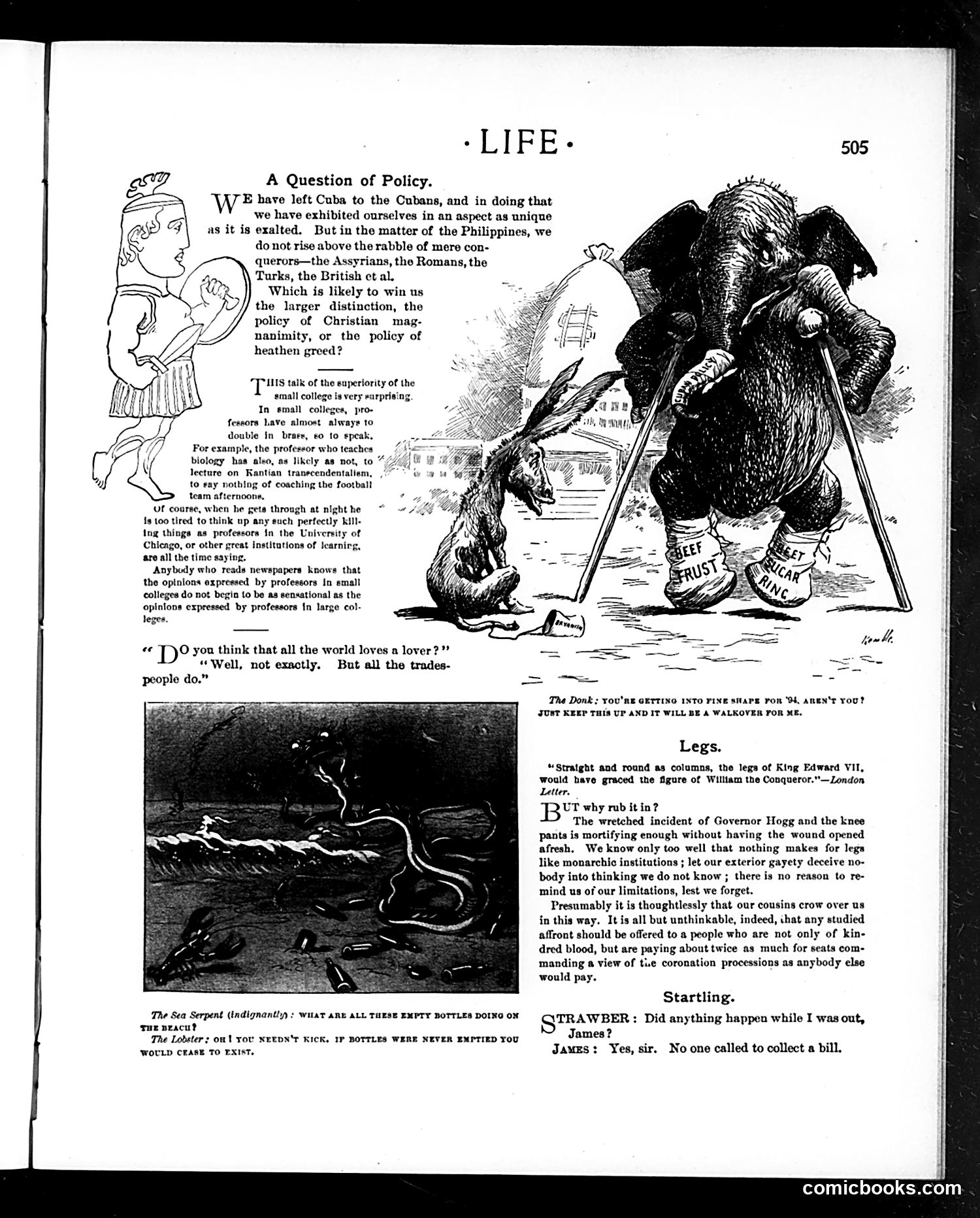
The main political cartoon depicts an elephant (the Republican party symbol) struggling on crutches, labeled "TRUST" and "BRITISH INFLUENCE." This appears to satirize Republican Party difficulties, possibly related to trust-busting debates or foreign policy concerns of the era. The header "A Question of Policy" discusses the Philippines, referencing debates about American colonial policy and whether to pursue Christian missionary expansion versus pragmatic imperialism—a major political controversy of the early 1900s. The "Legs" section mocks Governor Hogg's knee-pants scandal, while "Startling" presents a humorous dialogue between servants about lack of bill collectors visiting—satirizing either wealthy idleness or economic hardship. The overall page uses cartoons to critique Republican policies and American imperialism.
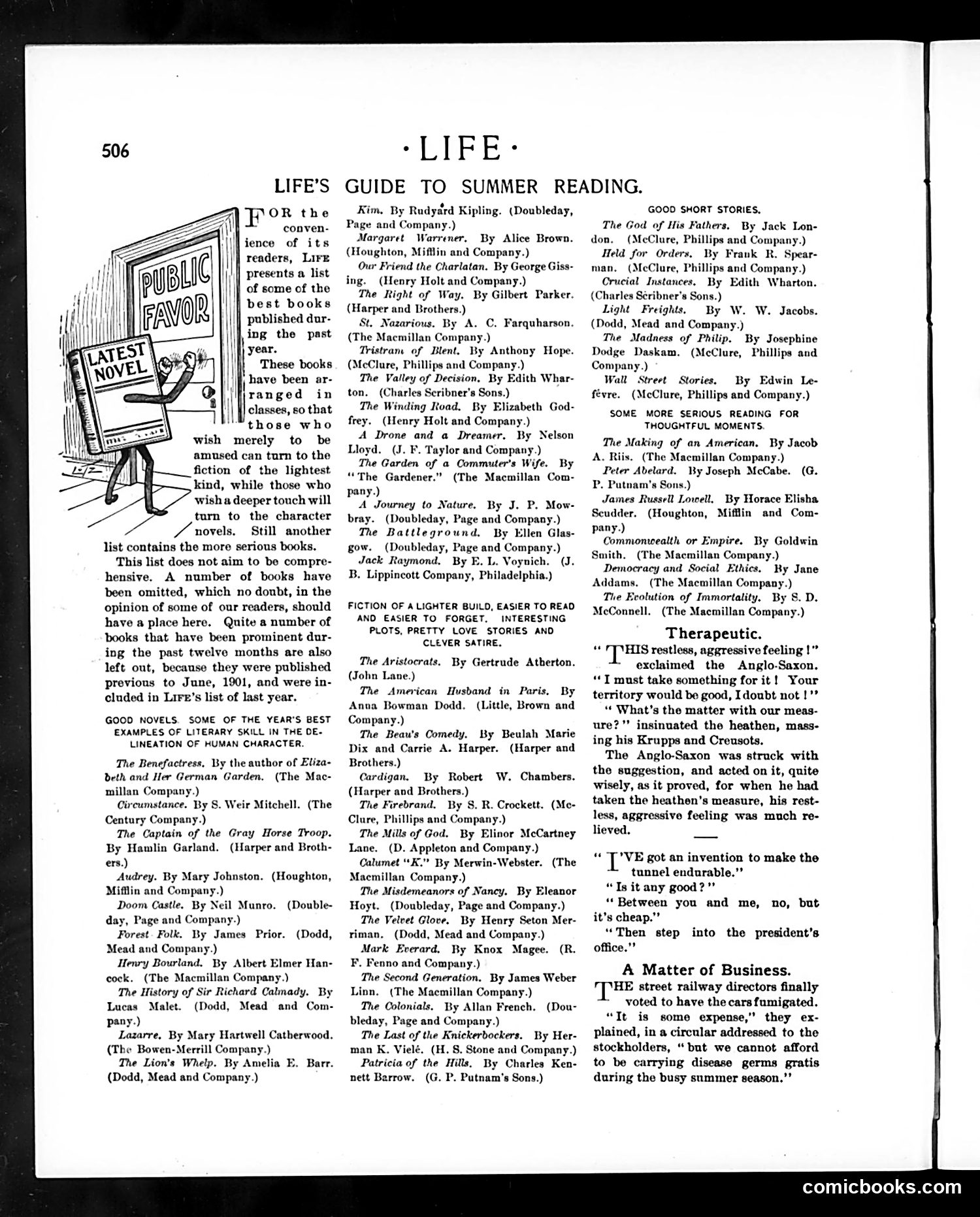
This page is primarily **reading recommendations**, not political satire. The main illustration shows a figure sitting in a chair reading "PUBLIC FAVOR / LATEST NOVEL" — a visual pun about summer reading popularity. The content consists of book lists organized by genre: "Good Short Stories," "Good Novels," "Fiction of a Lighter Build," and sections on "Thoughtful Moments" and "Therapeutic" reading. Publishers and authors are credited. Two small dialogue snippets appear near the bottom under "Therapeutic" and "A Matter of Business" headings, offering humorous observations about everyday situations — one about feeling restless, another about streetcar directors rejecting a disease-prevention proposal as too expensive. This is essentially a **book review and recommendation feature**, typical of *Life* magazine's cultural content.
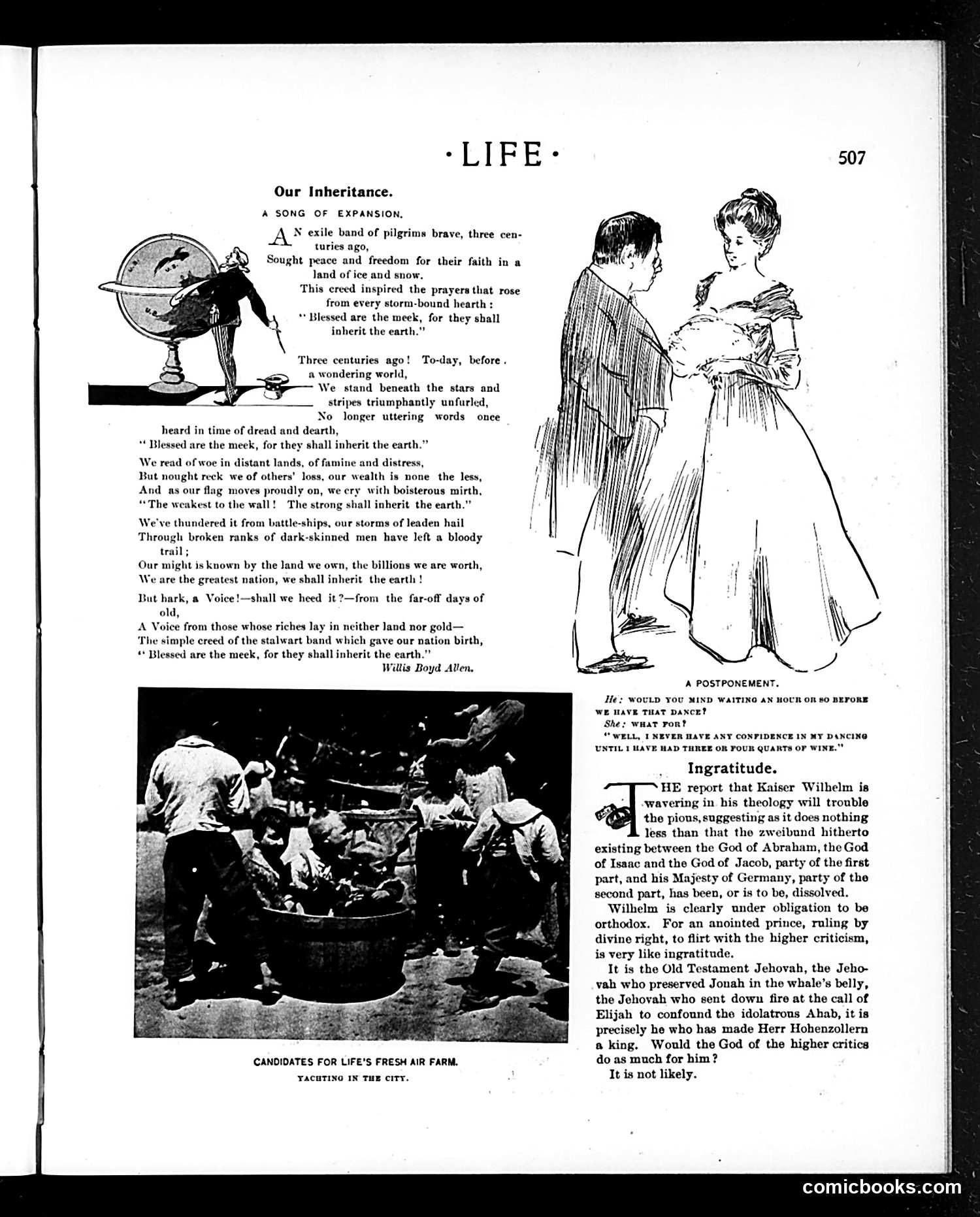
This page contains three distinct elements: 1. **"Our Inheritance"** — A poem by Willis Boyd Allen about religious pilgrims and social equality, using the phrase "Blessed are the meek, for they shall inherit the earth" as its refrain. It appears to celebrate democratic ideals and warn against class hierarchy. 2. **"A Postponement"** — A sketch showing a couple where the man asks about postponing a dance. The woman refuses, citing lack of confidence in his dancing "until I have had three or four hours of practice" — a light domestic humor piece. 3. **"Ingratitude"** — Commentary suggesting Kaiser Wilhelm II's theology troubles pious Germans, ironically comparing his position to biblical figures like Jonah and Elijah. The piece critiques Wilhelm's pride and suggests higher critics wouldn't support him either. The overall tone blends social commentary with satire of German Imperial pretensions.
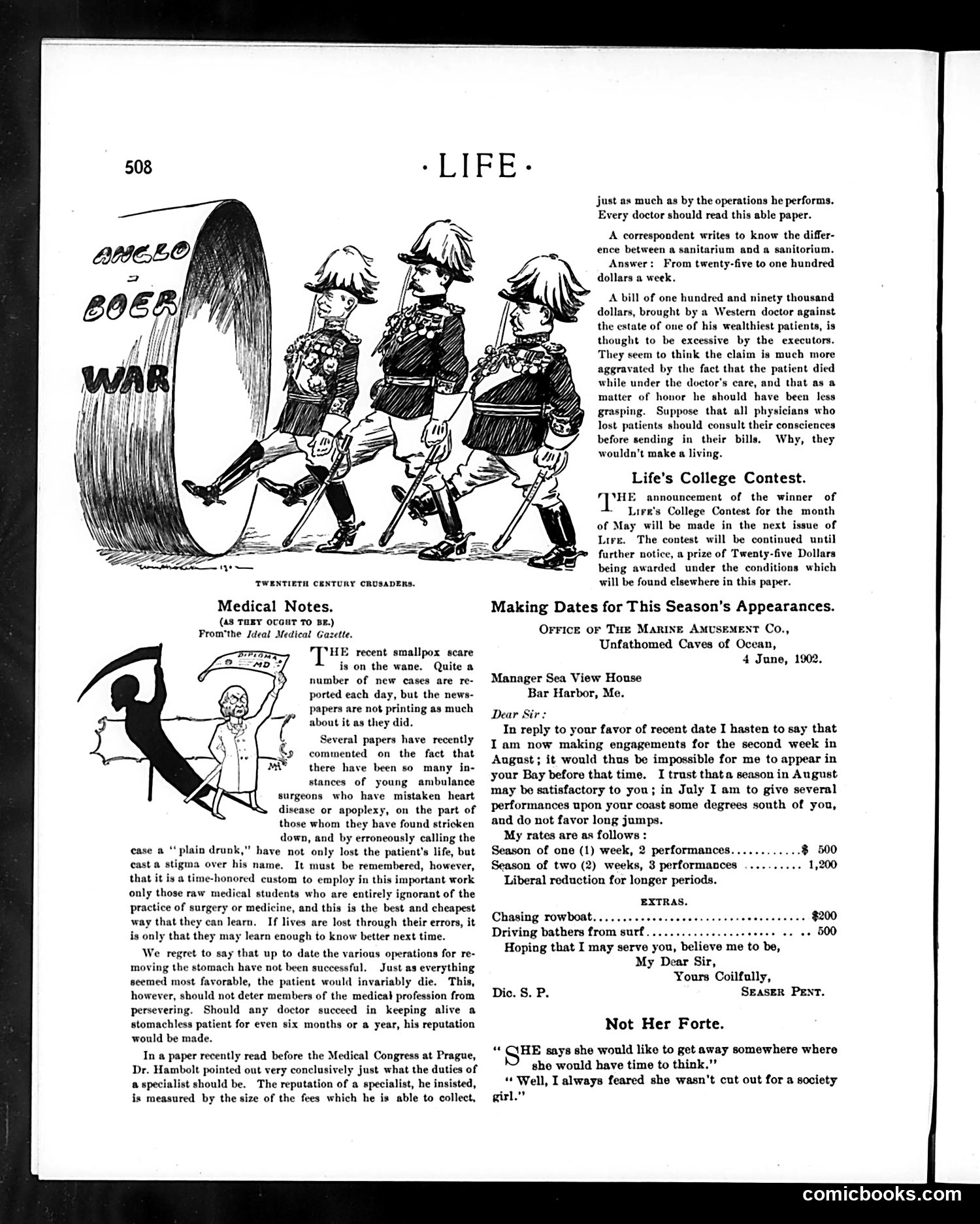
The main cartoon titled "Twentieth Century Crusaders" depicts three military figures marching past a large, grim reaper-like death figure labeled "ANGLO BOER WAR." The satire criticizes military leadership during the Second Boer War (1899-1902), suggesting that commanders are leading soldiers into needless death. The marching soldiers appear cheerful and oblivious, contrasting sharply with the death specter looming over them—the cartoonist's commentary on the disconnect between military planners and the horrific reality of battlefield casualties. The page also contains "Medical Notes" discussing doctors' errors in treating patients, suggesting broader criticism of professional incompetence during this era.
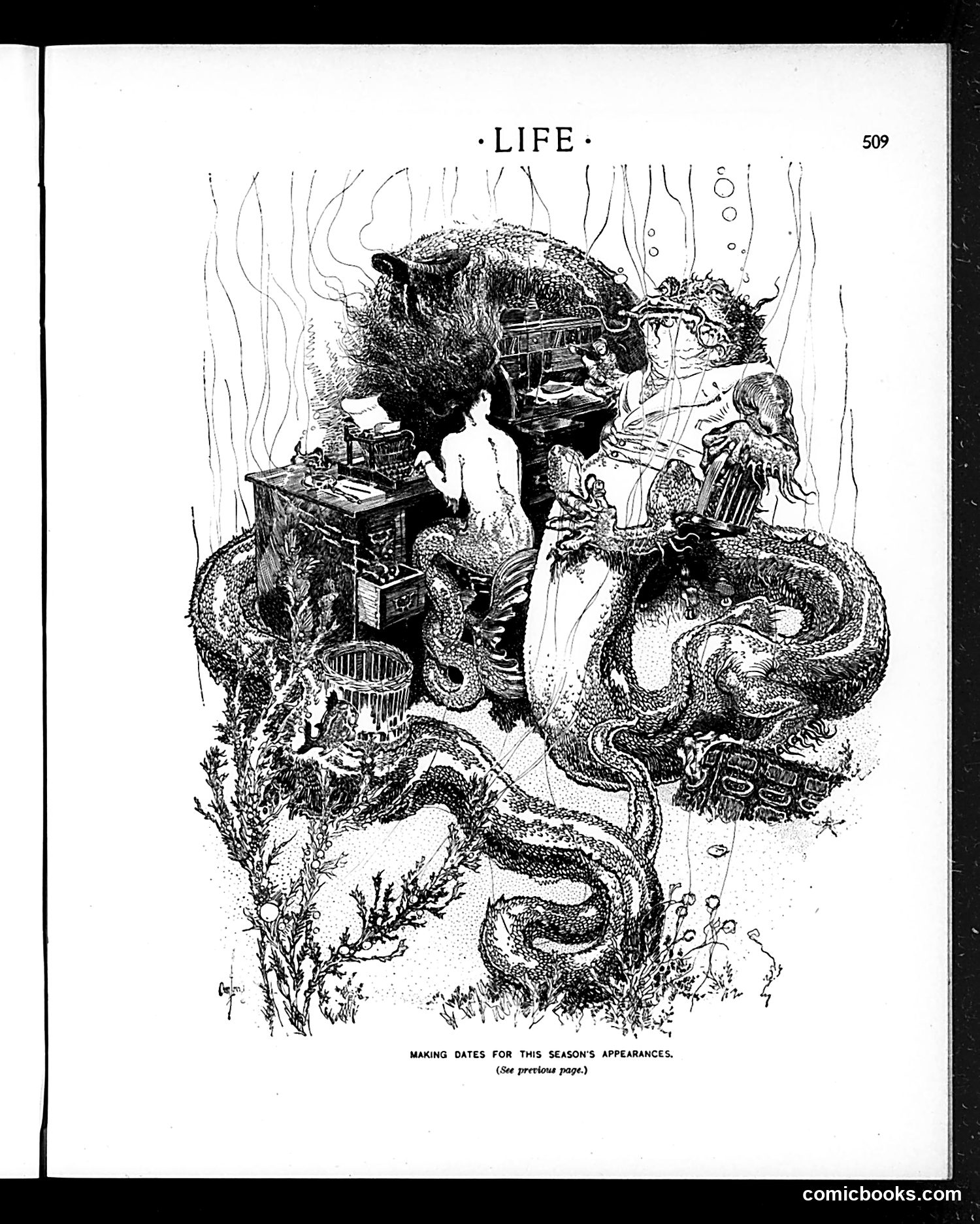
This page features a fantastical illustration titled "Making Dates for This Season's Appearances" with a note to see the previous page for context (which we lack). The image depicts an underwater or mythological scene with various creatures and human figures. A woman in classical dress sits centrally, surrounded by sea creatures (fish, eels, serpents), mythological beasts, and cherubs. There's what appears to be theatrical or entertainment equipment (possibly a stage or machinery) integrated into the composition. Without the referenced previous page, the specific satire remains unclear. However, this appears to be theatrical or entertainment-related commentary, possibly mocking actors' schedules, theatrical productions, or social appearances during a particular season. The surreal mixing of classical mythology with modern entertainment equipment suggests social or cultural satire typical of Life magazine's style.
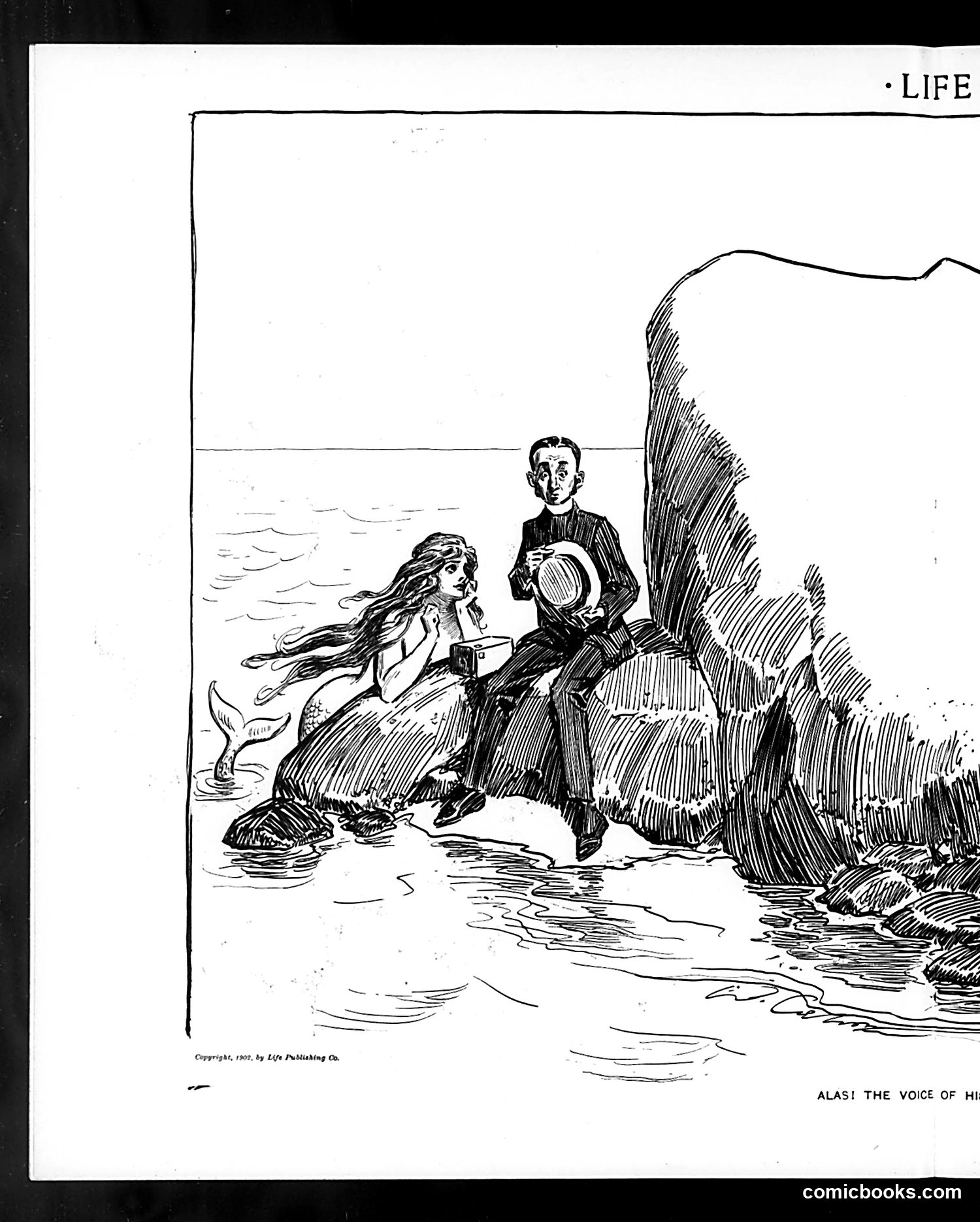
This appears to be a satirical illustration from Life magazine (copyright 1907, per the visible text). The cartoon depicts a man in formal attire standing on a beach with a mermaid emerging from the water. The man holds what appears to be a hat, and the incomplete caption at bottom reads "ALAS! THE VOICE OF HI[S]..." The satire likely plays on romantic or fantastical notions—possibly mocking idealized relationships or the disappointment of reality versus imagination. The mermaid represents an alluring fantasy, while the formally-dressed man's apparent dismay suggests disillusionment. Without the complete caption, the exact political or social target remains unclear, though it likely comments on contemporary attitudes toward romance, desire, or perhaps the gap between expectation and reality in relationships or social situations.
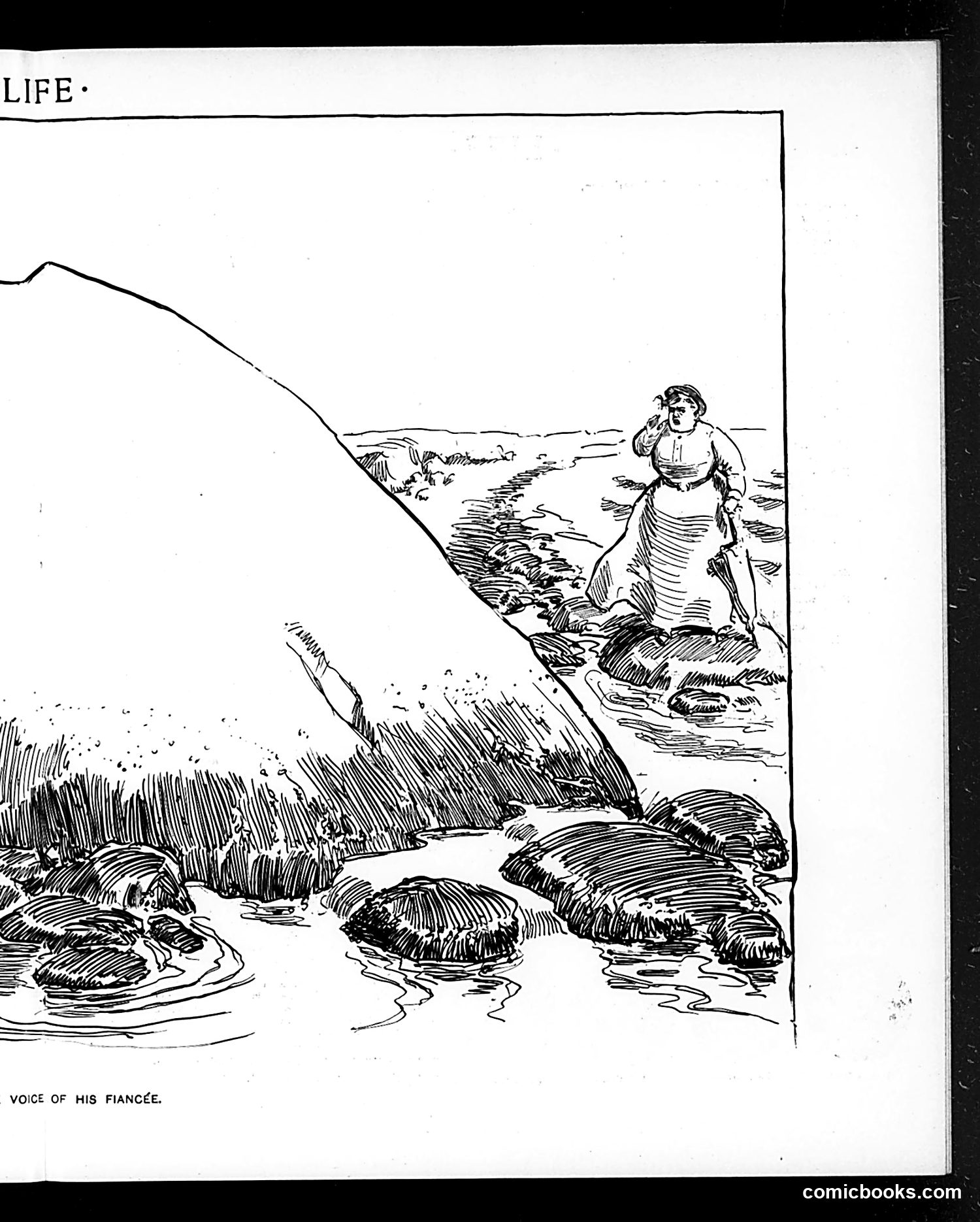
This cartoon satirizes a man's relationship dynamics. A portly man stands on rocky terrain near water, appearing distressed or startled. In the background, a woman in a dress gestures toward him from higher ground, seemingly scolding or commanding him. The caption "Voice of His Fiancée" suggests the woman is calling out orders or complaints to her betrothed. The joke likely plays on contemporary anxieties about marriage and loss of male independence—specifically that engagement or marriage meant surrendering to a woman's authority and demands. The cartoon reflects early-20th-century gender humor common in *Life* magazine, where domineering fiancées or wives were stock comic subjects mocking men's powerlessness in romantic relationships.
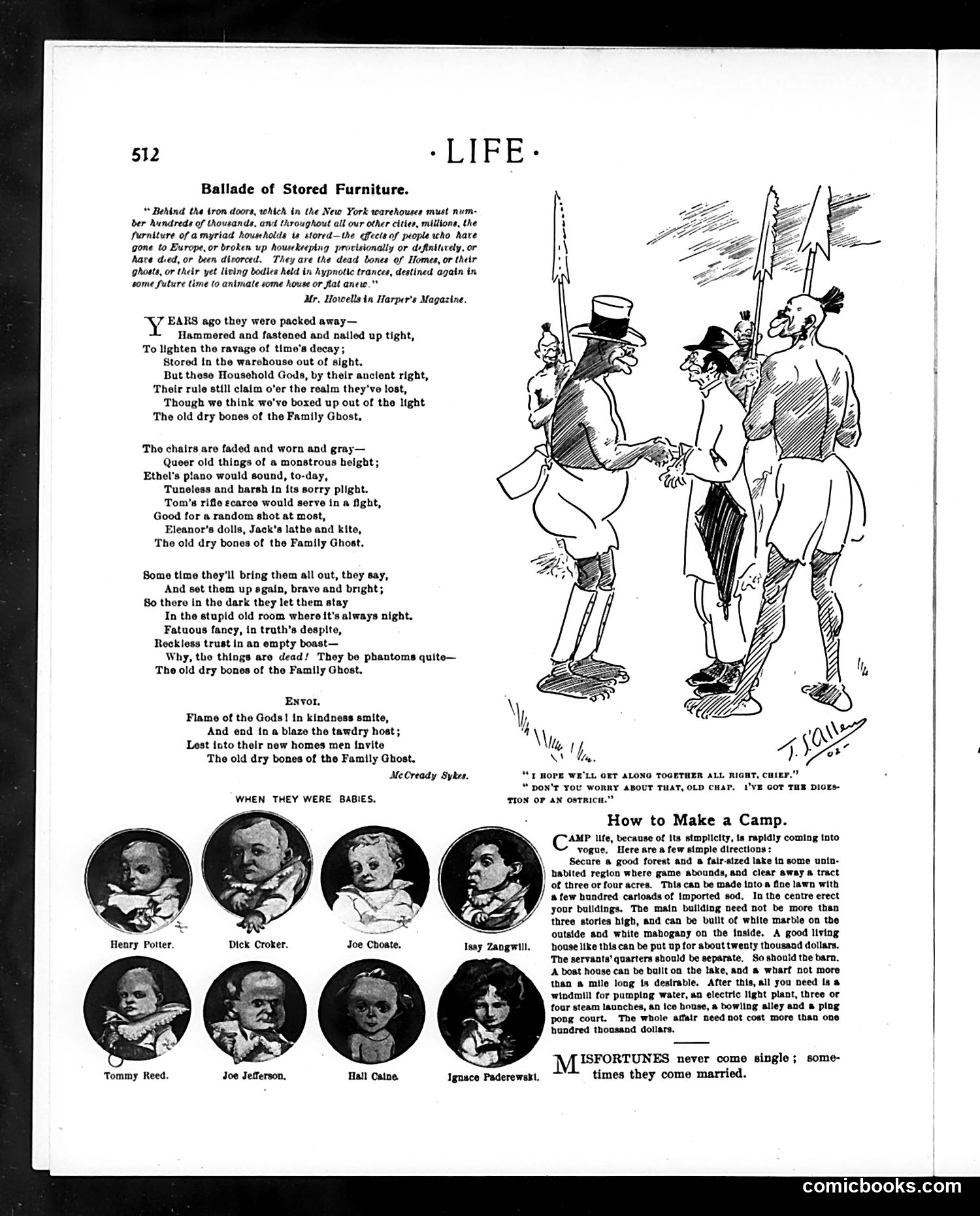
This page contains two main elements: **"Ballade of Stored Furniture"** — A poem about household items placed in storage warehouses, treating them as if deceased ("The old dry bones of the Family Ghost"). The satire mocks the sentimental attachment people have to furniture and possessions, implying these objects represent family memory and identity. **"When They Were Babies"** — Seven circular portrait photographs of men identified as Henry Potter, Dick Croker, Joe Choate, Isay Zangwill, Tommy Reed, Joe Jefferson, Hall Caine, and Ignace Paderewski. Without additional context, the specific satirical point is unclear, though the juxtaposition of baby photos with these apparently notable figures likely makes a humorous comment about their prominence or character. A separate section, **"How to Make a Camp,"** provides practical domestic advice unrelated to the satire above.
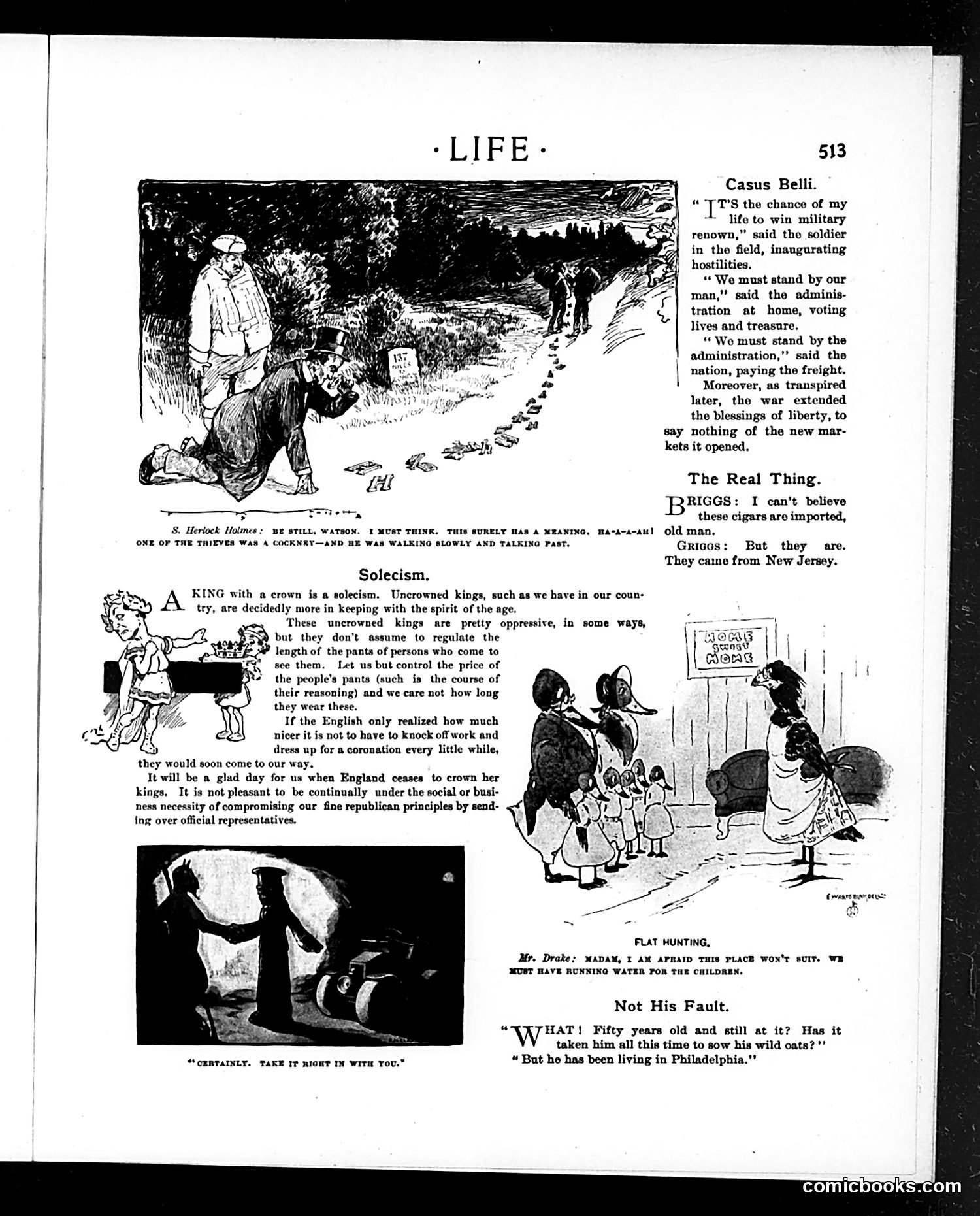
This page contains several satirical pieces typical of early 20th-century American humor: **"Casus Belli"** mocks the cascading consequences of war support—soldiers seek glory, the administration mobilizes citizens, the nation pays costs, and ultimately new markets emerge. The satire suggests war's true beneficiary is commercial expansion, not patriotic duty. **"The Real Thing"** parodies Sherlock Holmes deducing a criminal's working-class accent, then deflating the logic: cigars labeled "imported" actually come from New Jersey, suggesting American products masquerade as foreign to appear superior. **"Solecism"** contrasts American and English governance: uncrowned kings (American industrialists/oligarchs) impose economic control without formal coronation ceremony, whereas England wastes resources on mandatory civic observance of crowned monarchs. **"Flat Hunting"** and **"Not His Fault"** are brief domestic humor pieces about apartment-hunting standards and a Philadelphian's extended youthful indiscretion. The cartoons target American commercialism, false pretense, and oligarchic power masked by republican rhetoric.
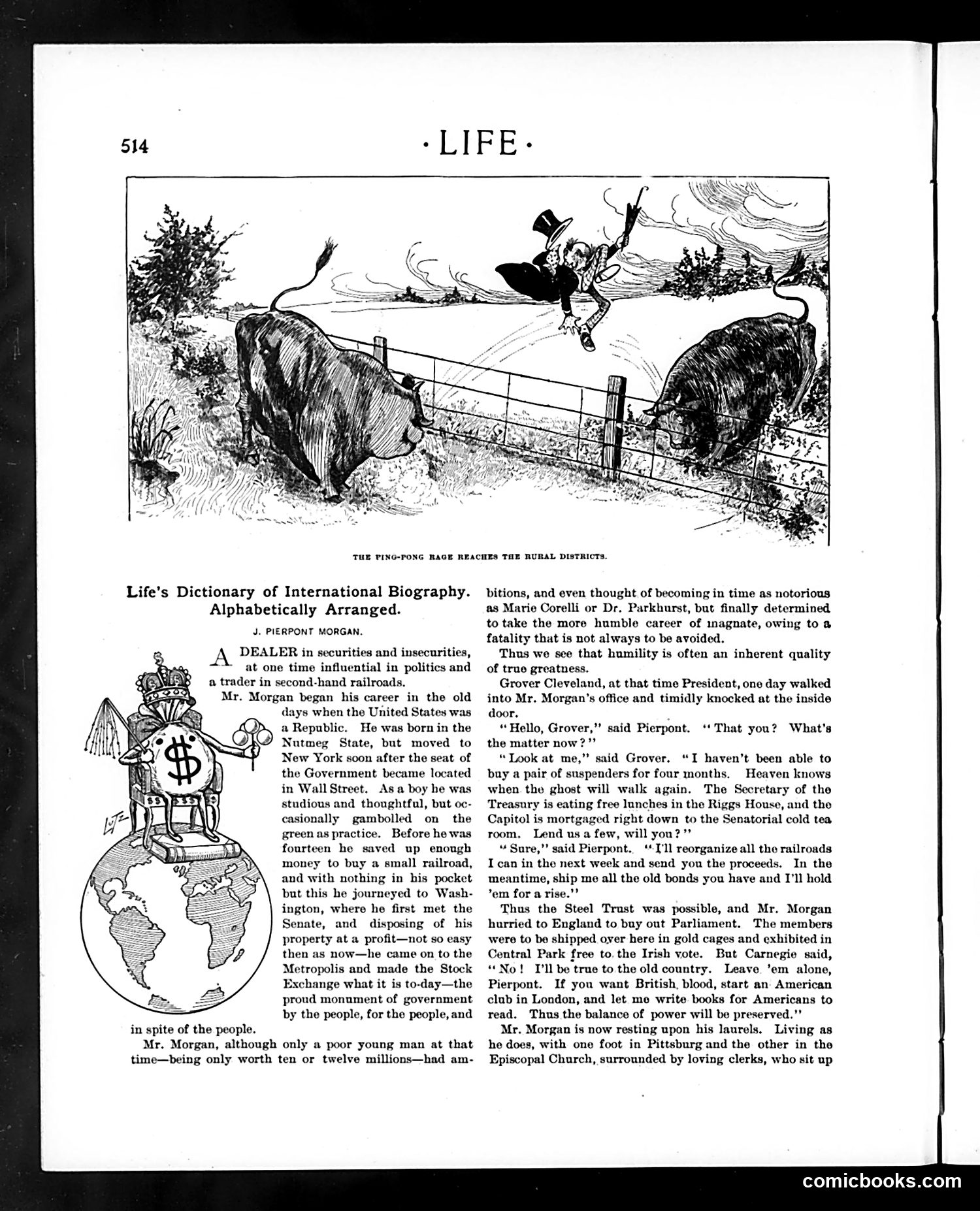
This page satirizes **J. Pierpont Morgan**, the real railroad and finance magnate, through Life magazine's mock-biographical dictionary entry. **The Satire's Points:** 1. **Wealth from nothing**: Morgan allegedly bought railroads as a boy with only the money in his pocket—mocking his self-made-man mythology. 2. **Political influence**: The entry claims Morgan became so powerful that Wall Street replaced the actual government ("the proud monument of government by the people...in spite of the people"). 3. **President as supplicant**: The cartoon imagines President Grover Cleveland begging Morgan for a personal loan because the federal treasury is empty—suggesting Morgan, not elected officials, truly controls America's finances. 4. **Trust monopolies**: References to "Steel Trust" and acquiring Parliament itself mock Morgan's actual role in organizing corporate monopolies. 5. **Top illustration**: The "ping-pong rage" cartoon shows rural people playing the then-trendy game, satirizing how fads spread nationwide. The overall message: Morgan's financial power exceeds governmental authority, a common Progressive-era critique of the Gilded Age robber barons.
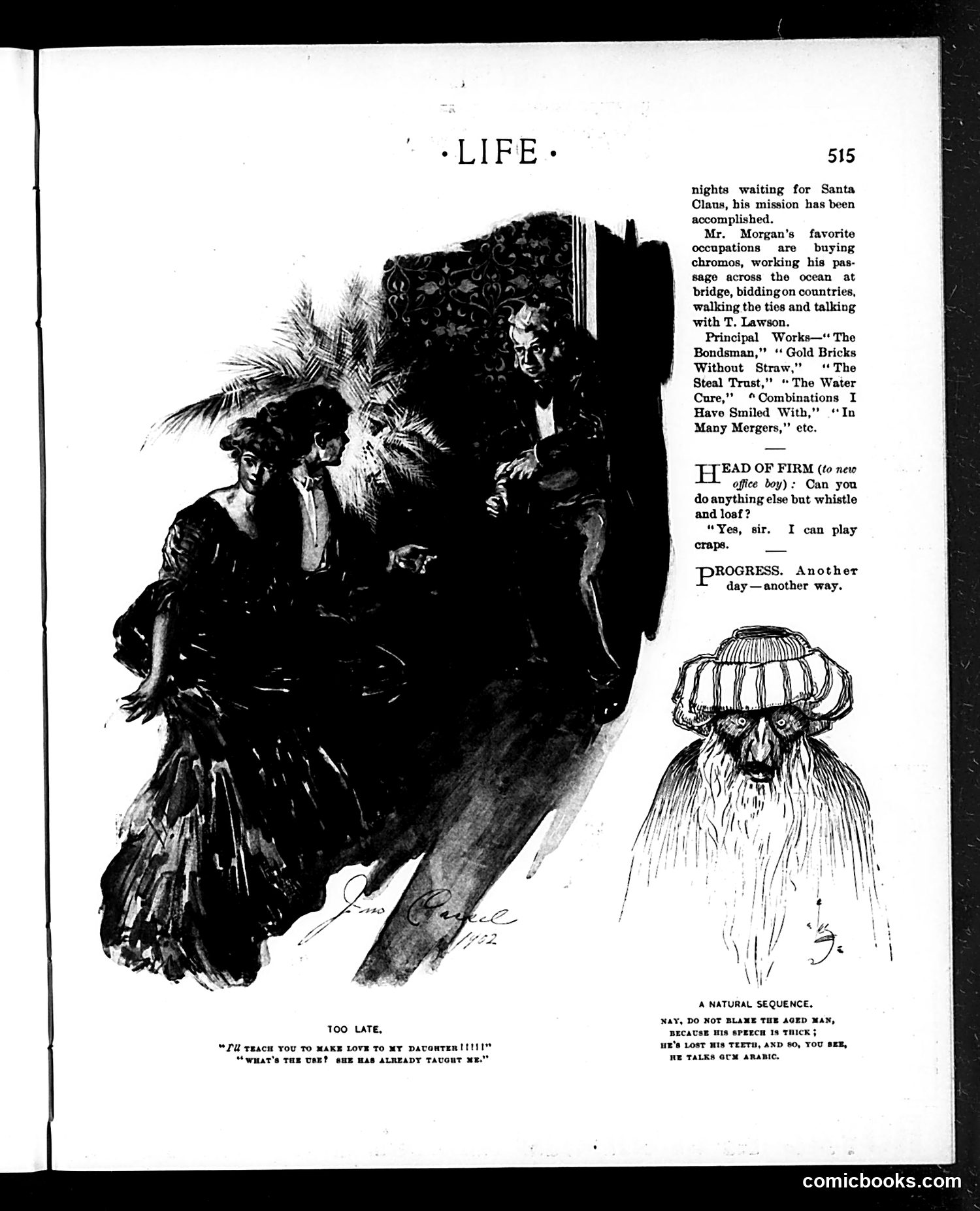
This page contains three satirical pieces mocking business and social figures of the era. **Top section**: A biographical parody of "Mr. Morgan" (likely J.P. Morgan, the famous banker/industrialist). The text humorously lists his "occupations" as buying chromos (cheap prints), playing bridge, and "bidding on countries"—mocking wealthy industrialists' power and acquisitive behavior. His "principal works" are fake book titles satirizing corporate monopolies and financial schemes ("The Steal Trust," "Gold Bricks Without Straw"). **Middle cartoon ("Head of Firm")**: A boss asks a new office boy what skills he has beyond whistling and loafing. The boy replies he can play craps (gambling)—satirizing workplace incompetence and idleness. **Bottom cartoon ("Too Late")**: An old man tries teaching his daughter romance, but his dentures have fallen out and he speaks Arabic. The caption blames his age, not his speech impediment—dark humor about aging and irrelevance. The overall tone mocks corporate excess, worker laziness, and social pretension typical of early 1900s American satirical journalism.
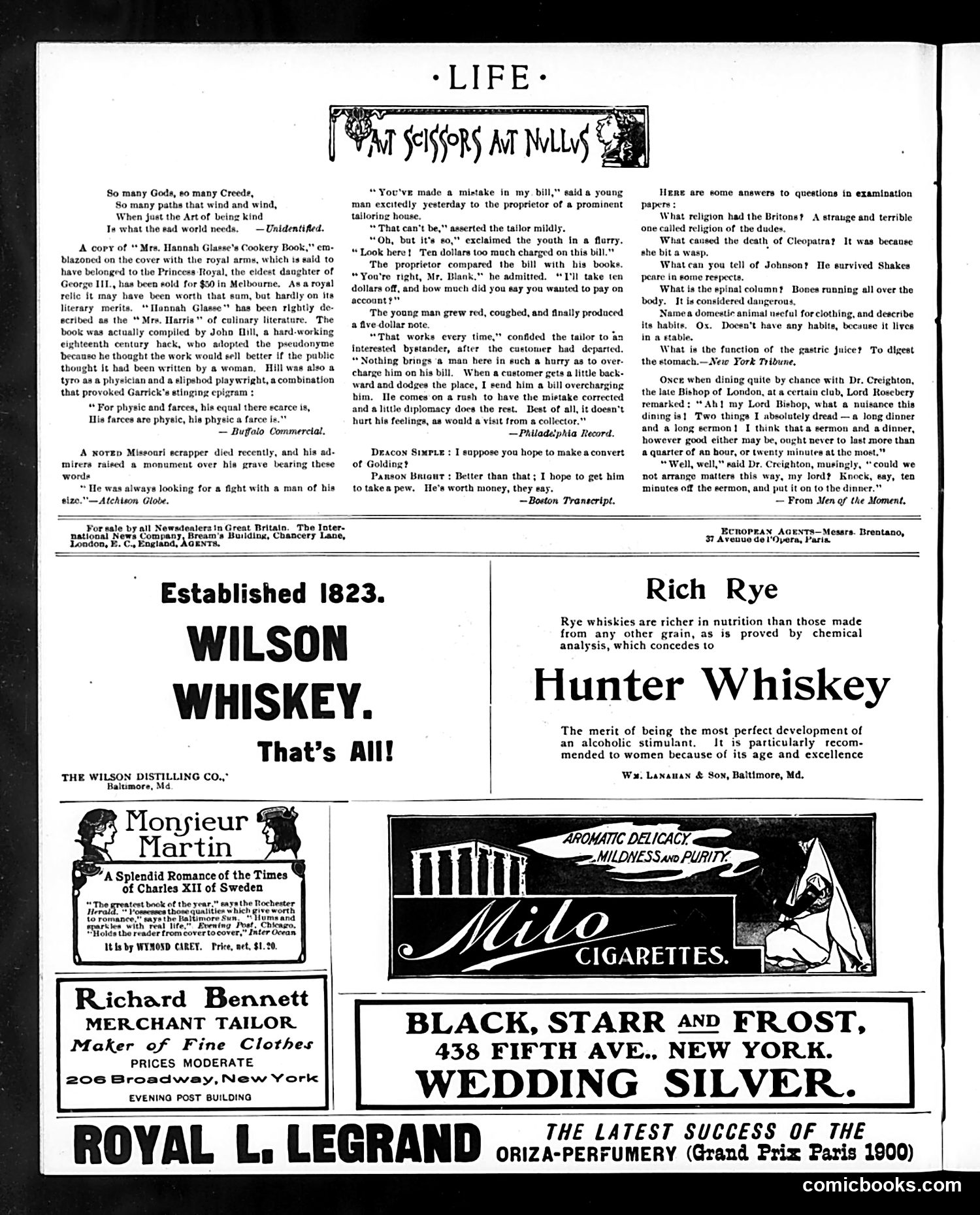
This page is primarily **advertising with framing content**, not a political cartoon. The main feature is a series of humorous anecdotes and examination paper blunders, flanked by period advertisements. The humor relies on early 20th-century sensibilities: 1. **The tailor anecdote**: A merchant intentionally overcharges customers, knowing they'll rush back to correct "errors"—a commentary on dubious business practices. 2. **Student exam answers**: Mock responses like "Cleopatra died because she bit a wasp" and defining the spinal column as "bones running all over the body" satirize student ignorance—a timeless trope. 3. **The Bishop's dinner quip**: A witty exchange between Lord Rosebery and a Bishop about sermon length versus meal duration—gentle social satire about ecclesiastical tedium. The page also includes a historical note about "Hannah Glasse's Cookery Book," exposing that a male hack writer (John Mill) published under a female pseudonym because he thought it would sell better—social commentary on gender and publishing. Advertisements for Wilson Whiskey, Hunter Whiskey, Milo Cigarettes, and wedding silver represent period consumer culture.
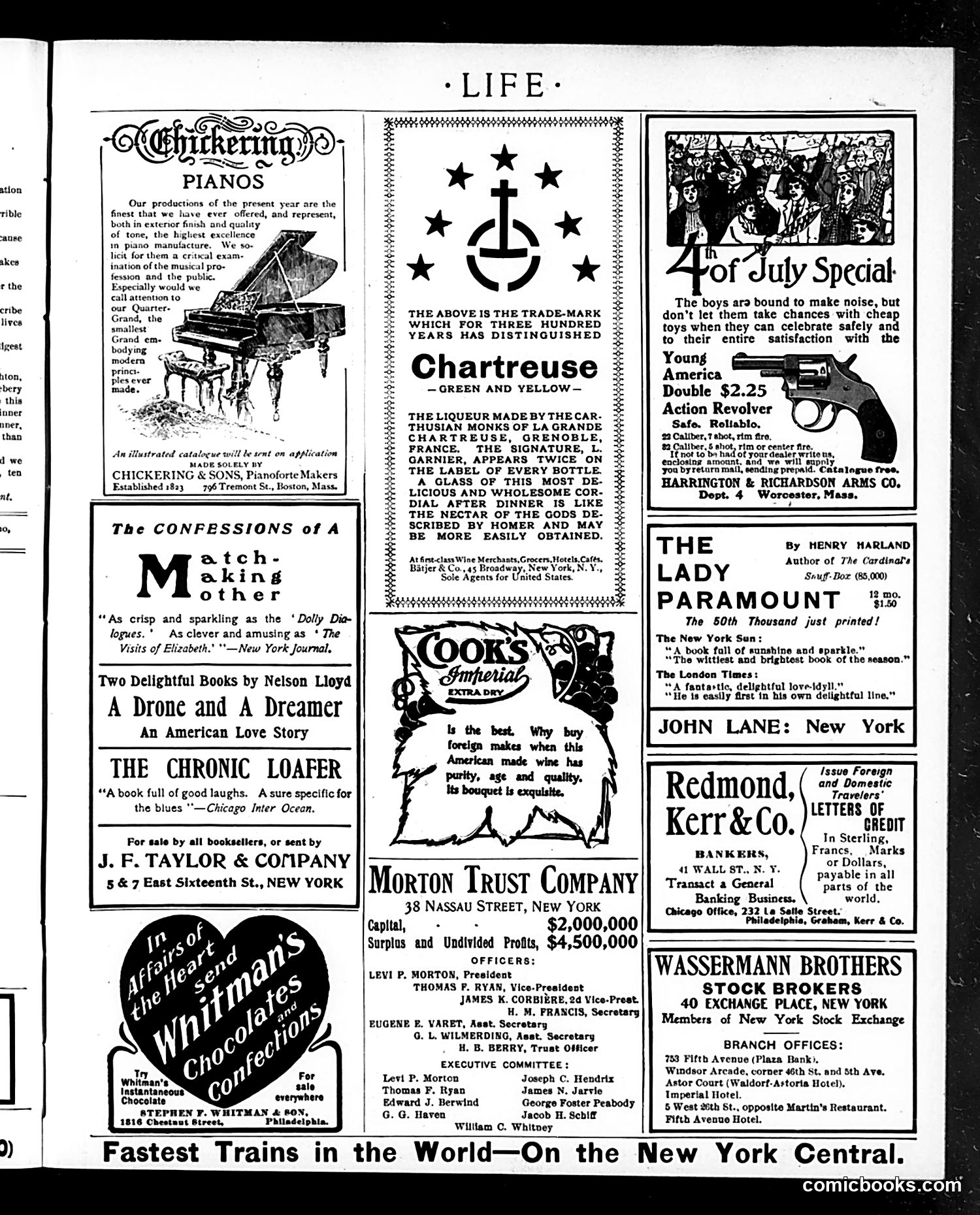
This page is primarily **advertising** from an early Life magazine issue (likely early 1900s based on style). There are no political cartoons or social satire present. The content consists entirely of commercial advertisements for: - Pianos and books (Chickering, Nelson Lloyd novels) - Luxury spirits (Chartreuse liqueur) - Toys (a "Young America" revolver for children—notably a cap gun) - Financial services (Morton Trust Company, stock brokers) - Candy, wine, and banking services One item stands out to modern readers: the **children's toy revolver** advertisement promoting a realistic-looking gun for sale "safely" to young boys. This reflects early-20th-century attitudes toward toy weapons that would be considered shocking today. The page displays no satire or cartoon content requiring historical interpretation—it's simply a period commercial page showcasing the products and services advertised in Life magazine.
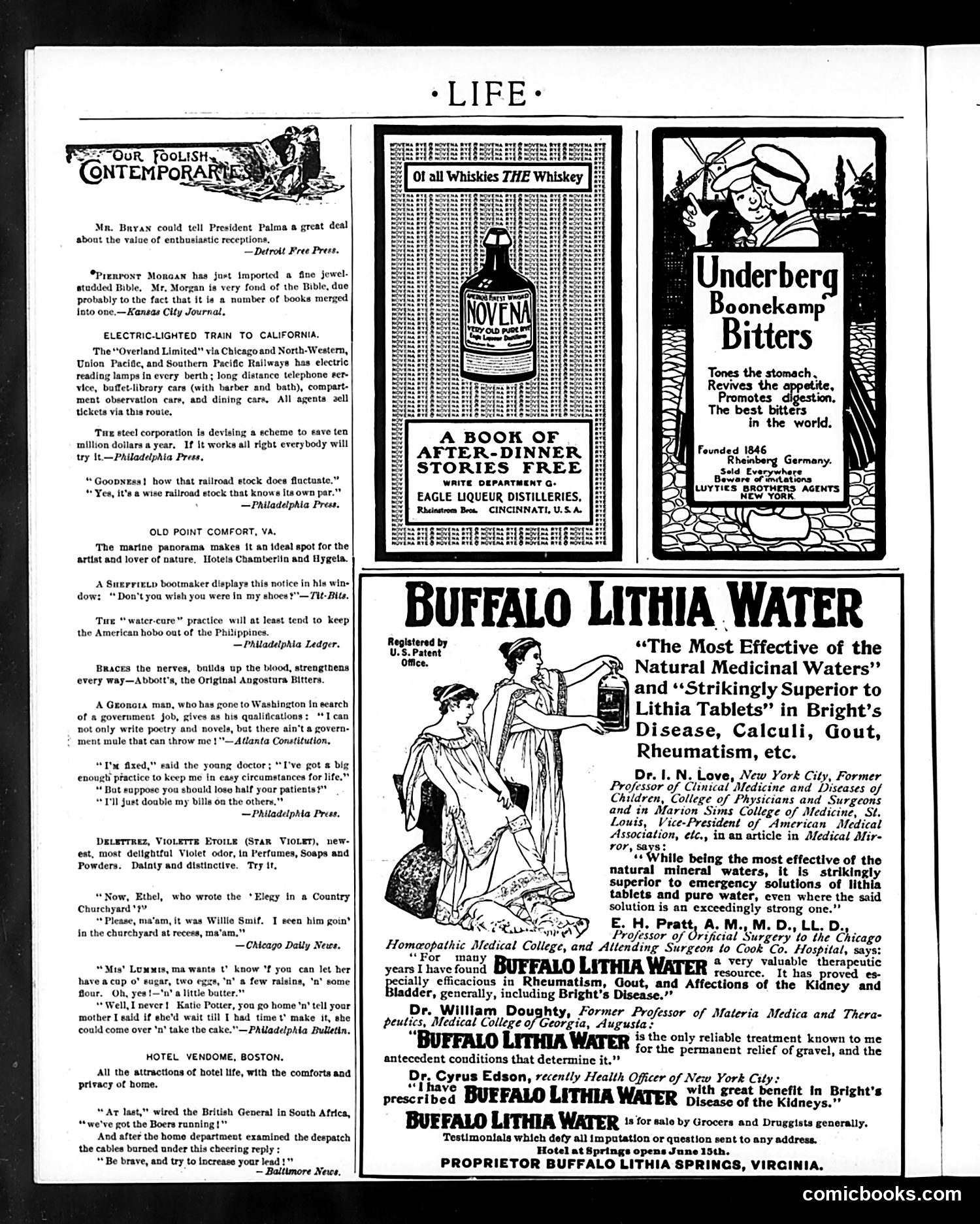
This is primarily an **advertising page** masquerading as satirical content. The page mixes brief humorous quips ("Our Foolish Contemporaries") with product advertisements. The satirical section consists of short jokes mocking contemporary figures and issues: - **William Jennings Bryan** receiving enthusiastic receptions (political jab at his campaign style) - **J.P. Morgan** collecting a jeweled Bible, implying his materialism contradicts piety - Minor jibes at railroad stocks, government job-seekers, and a British general's exaggerated war report The bulk of the page, however, features advertisements for products like **Underberg Bitters**, **Buffalo Lithia Water**, and liqueur, using testimonials from doctors to promote medicinal claims now known to be dubious—typical of early-1900s patent medicine marketing. The page reflects *Life* magazine's business model: mixing light satire with lucrative patent-medicine advertising, targeting readers with ailments and disposable income.
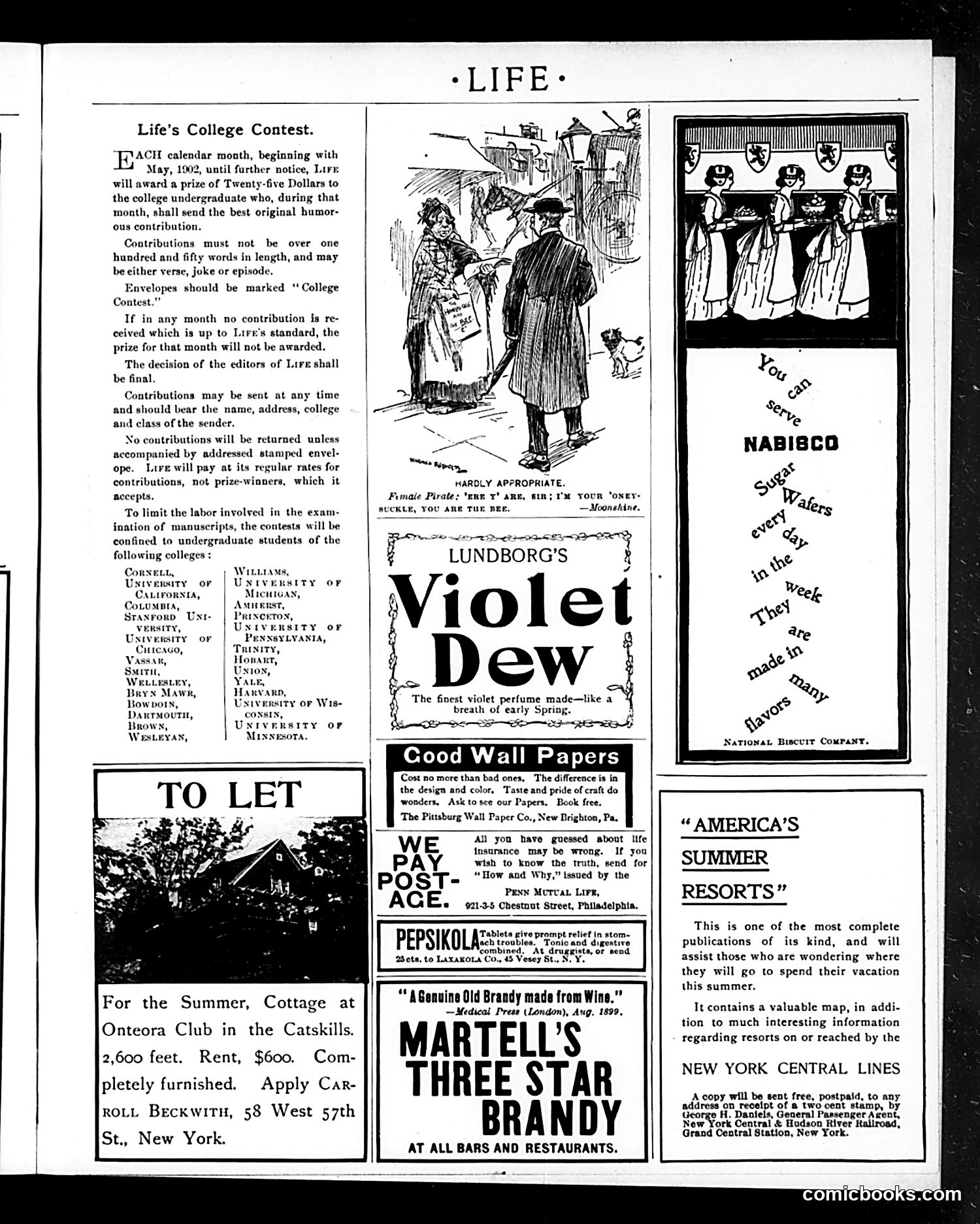
This page is primarily **advertising and announcements** rather than satirical content. The one cartoon present—titled "Hardly Appropriate"—shows a female pirate addressing a man as her "honeysuckle," calling him "the bee." The joke plays on flowery romantic language incongruously applied to piracy: a dangerous criminal using saccharine endearments creates mild absurdist humor. The page's main content is **Life's College Contest**, announcing a monthly $25 prize for undergraduate humor contributions (verse, jokes, or episodes) from named prestigious colleges including Yale, Harvard, Princeton, and Stanford. This was Life's mechanism for crowdsourcing comedic material from educated youth. The remaining space contains period advertisements for perfume (Violet Dew), wallpaper, life insurance, brandy, vacation resorts, and biscuits—typical commercial placements in early 1900s magazines. No significant political or social satire appears on this page.
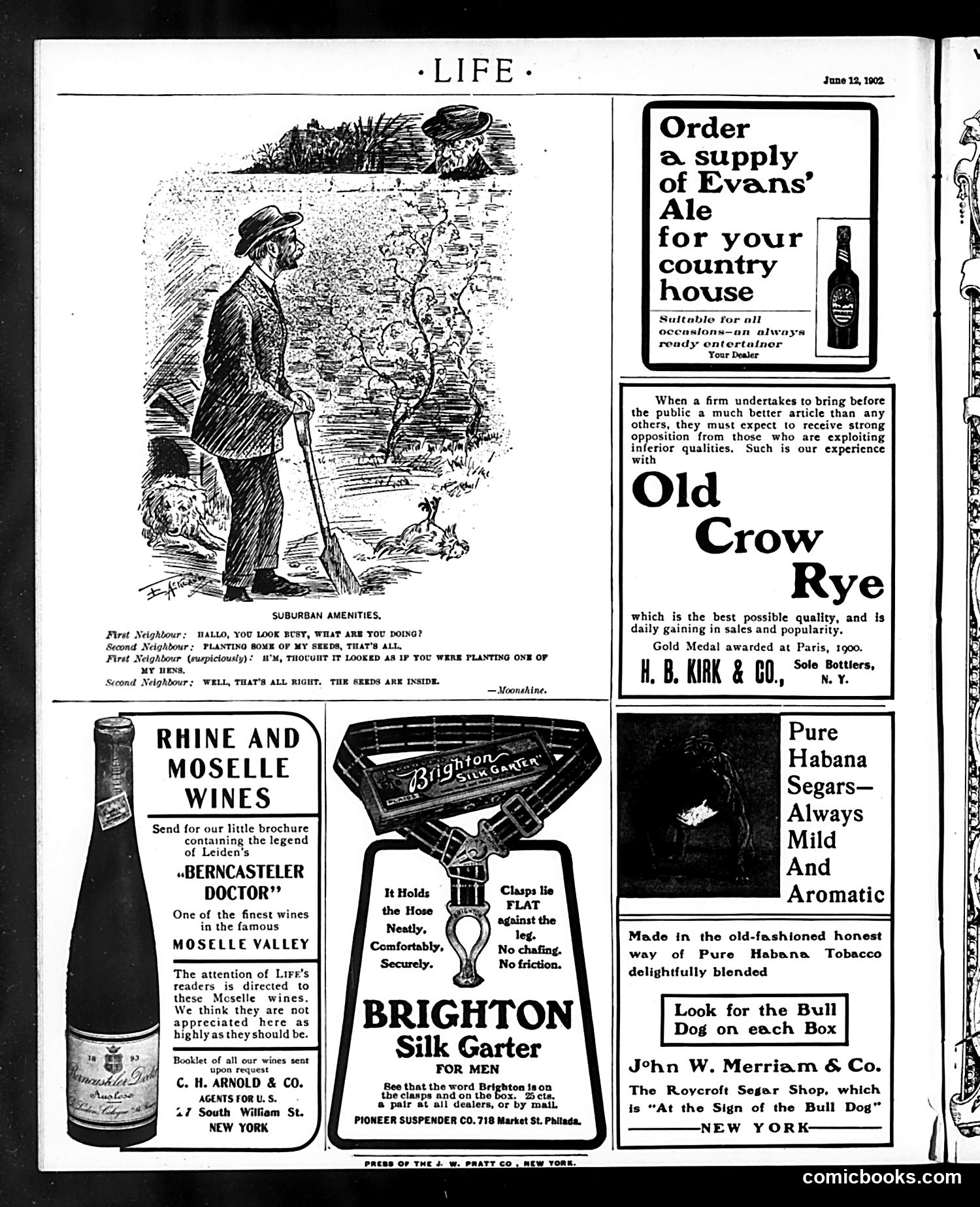
This 1902 *Life* magazine cartoon satirizes suburban property disputes and neighborly dishonesty. The joke depicts two neighbors discussing gardening: the first suspects the second of planting seeds from his own garden, but the second defensively claims the seeds are "inside"—implying they're his own seeds, not stolen ones. The satire mocks the tension between suburban residents over property boundaries and shared resources. The humor lies in the second neighbor's transparent lie: his suspicious behavior and evasive response suggest he's actually planting the first neighbor's seeds despite denying it. This reflects early 1900s anxieties about suburban living, where close proximity to neighbors created friction over gardens, fences, and property lines. The page is primarily advertisements for wines, ale, garters, and cigars—typical 1902 luxury goods marketing.