
Life, 1902-06-12 · page 4 of 20
Life — June 12, 1902 — page 4: what you’re looking at
What you’re looking at
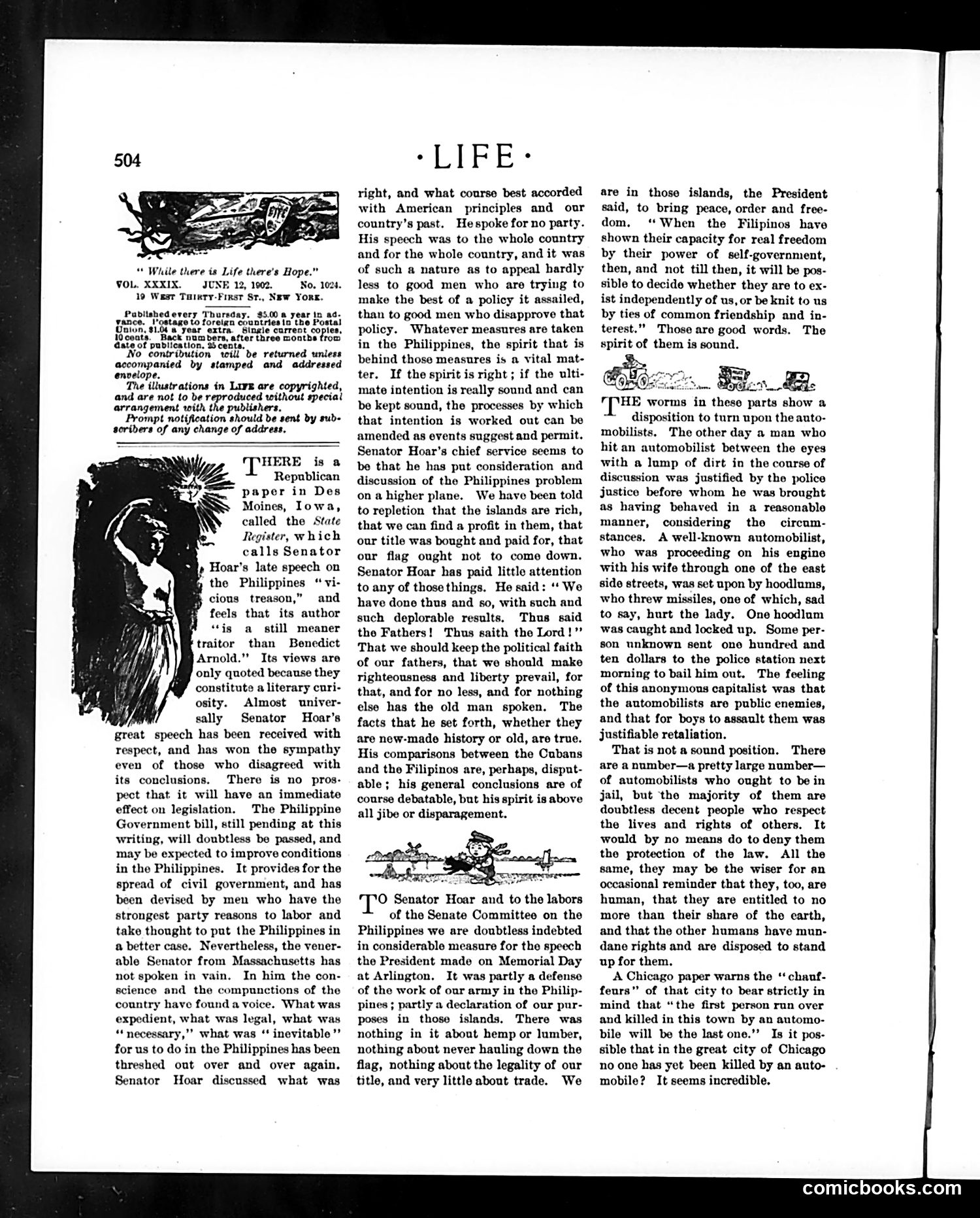
The main cartoon depicts **Senator Hoar** of Massachusetts as an elderly bearded figure labeled "Register"—referencing his recent speech criticizing U.S. Philippine policy as "pious reason" and "disloyal." The article defends Hoar's moral position on the Philippines while critiquing his lack of practical proposals. It argues his comparisons between U.S. and Cuban/Philippine situations are "disputable," though his "spirit is above all gibe or disparagement." The second cartoon illustrates a satirical anecdote about automobiles causing accidents in cities—a contemporary social problem. It mocks public outcry over automotive deaths while suggesting such incidents reflect broader human carelessness rather than justifying restricting the new technology.
📄 Transcribed text from this page (OCR, searchable)
Machine-transcribed from the original scan — historical spelling and the odd misread are preserved.
VOL. XXXIX. JUNE 12, 1902, No. 1024. 19 Wasr Talery-Finst St., New Yorg. echabllshed every Thursday. $5.00 0 year in ag: ‘ostage to foreign countries in the Postal bea Fear extra, ‘Single current coples, coats sack gembers.s after three months from Gate of pudiication, 25 ce ‘No contribution twill be returned unless accompanied by stamped and addressed envelope. The illustrations in Lure are copyrighted, and are not to be reproduced without special arrangement with the publishers. Prompt notification should be sent by sub- soribers of any change of address. HERE is a Republican paper in Des called the State Register, which calls Senator Hoar’s late speech on b the Philippines “ vi- cious treason,” and feels that its author “is a still meaner traitor than Benedict Arnold.” Its views are only quoted because they constitute a literary curi- osity. Almost univer- sally Senator Hoar’s great speech has been received with respect, and has won the sympathy even of those who disagreed with its conclusions. There is no pros- pect that it will have an immediate effect on legislation. The Philippine Government bill, still pending at this writing, will doubtless be passed, and may be expected to improve conditions in the Philippines. It provides for the spread of civil government, and has been devised by men who have the strongest party reasons to labor and take thought to put the Philippines in a better case. Nevertheless, the vener- able Senator from Massachusetts has not spoken in vain, In him the con- science and the compunctions of the country have found a voice. What was expedient, what was legal, what was “necessary,’’ what was ‘‘ inevitable’’ for us to do in the Philippines has been threshed ont over and over again. Senator Hoar discussed what was LIFE right, and what course best accorded with American principles and our country’s past. Hespoke for no party. His speech was to the whole country and for the whole country, and it was of such a nature as to appeal hardly less to good men who are trying to make the best of a policy it assailed, than to good men who disapprove that policy. Whatever measures are taken in the Philippines, the spirit that is behind those measures is a vital mat- ter. If the spirit is right; if the ulti- mate intention is really sound and can be kept sound, the processes by which that intention is worked out can be amended as events suggest and permit. Senator Hoar’s chief service seems to be that he has put consideration and discussion of the Philippines problem on ahigher plane. We have been told to repletion that the islands are rich, that we can find a profit in them, that our title was bought and paid for, that our flag ought not to come down. Senator Hoar has paid little attention to any of thosethings. He said: ‘We have done thus and s0, with such and such deplorable results. Thus said the Fathers! Thus saith the Lord!”” That we should keep the political faith of our fathers, that we should make righteousness and liberty prevail, for that, and for no less, and for nothing else has the old man spoken. The facts that he set forth, whether they are new-made history or old, are true. His comparisons between the Cubans and tho Filipinos are, perhaps, disput- able; his general conclusions are of course debatable, but his spirit is above all jibe or disparagement. 'O Senator Hoar and to the labors of the Senate Committee on the Philippines we are doubtless indebted in considerable measure for the speech the President made on Memorial Day at Arlington, It was partly a defense of the work of our army in the Philip- pines ; partly a declaration of our pur- poses in those islands. There was nothing in it about hemp or lumber, nothing about never hauling down the flag, nothing about the legality of our title, and very little about trade. We are in those islands, the President said, to bring peace, order and free- dom. ‘When the Filipinos have shown their capacity for real freedom by their power of self-government, then, and not till then, it will be pos- sible to decide whether they are to ex- ist independently of us, or be knit to us by ties of common friendship and in- terest.” Those are good words. The spirit of them is sound. Cec. BR ae THe worms fa. these parts show a disposition to turn upon the auto- mobilists. The other day a man who hit an automobilist between the eyes with a lump of dirt in the course of discussion was justified by the police justice before whom he was brought as having behaved in a reasonable manner, considering the circam- stances. A well-known automobilist, who was proceeding on his engine with his wife through one of the east side streets, was set upon by hoodlums, who threw missiles, one of which, sad to say, hurt the lady. One hoodlum was caught and locked up. Some per- son unknown sent one hundred and ten dollars to the police station next morning to bail him out. The feeling of this anonymous capitalist was that the automobilists are public enemies, and that for boys to assault them was justifiable retaliation. That is not a sound position. There are a number—a pretty large number— of automobilists who ought to be in jail, but the majority of them are doubtless decent people who respect the lives and rights of others. It would by no means do to deny them the protection of the law. All the same, they may be the wiser for an occasional reminder that they, too, are human, that they are entitled to no more than their share of the earth, and that the other humans have mun- dane rights and are disposed to stand up for them, A Chicago paper warns the ‘ chanf- feurs” of that city to bear strictly in mind that “the first person run over and killed in this town by an automo- bile will be the last one.”’ Is it pos- sible that in the great city of Chicago no one has yet been killed by an auto- mobile? It seems incredible. comicbooks.com