
Life, 1902-06-12 · page 6 of 20
Life — June 12, 1902 — page 6: what you’re looking at
What you’re looking at
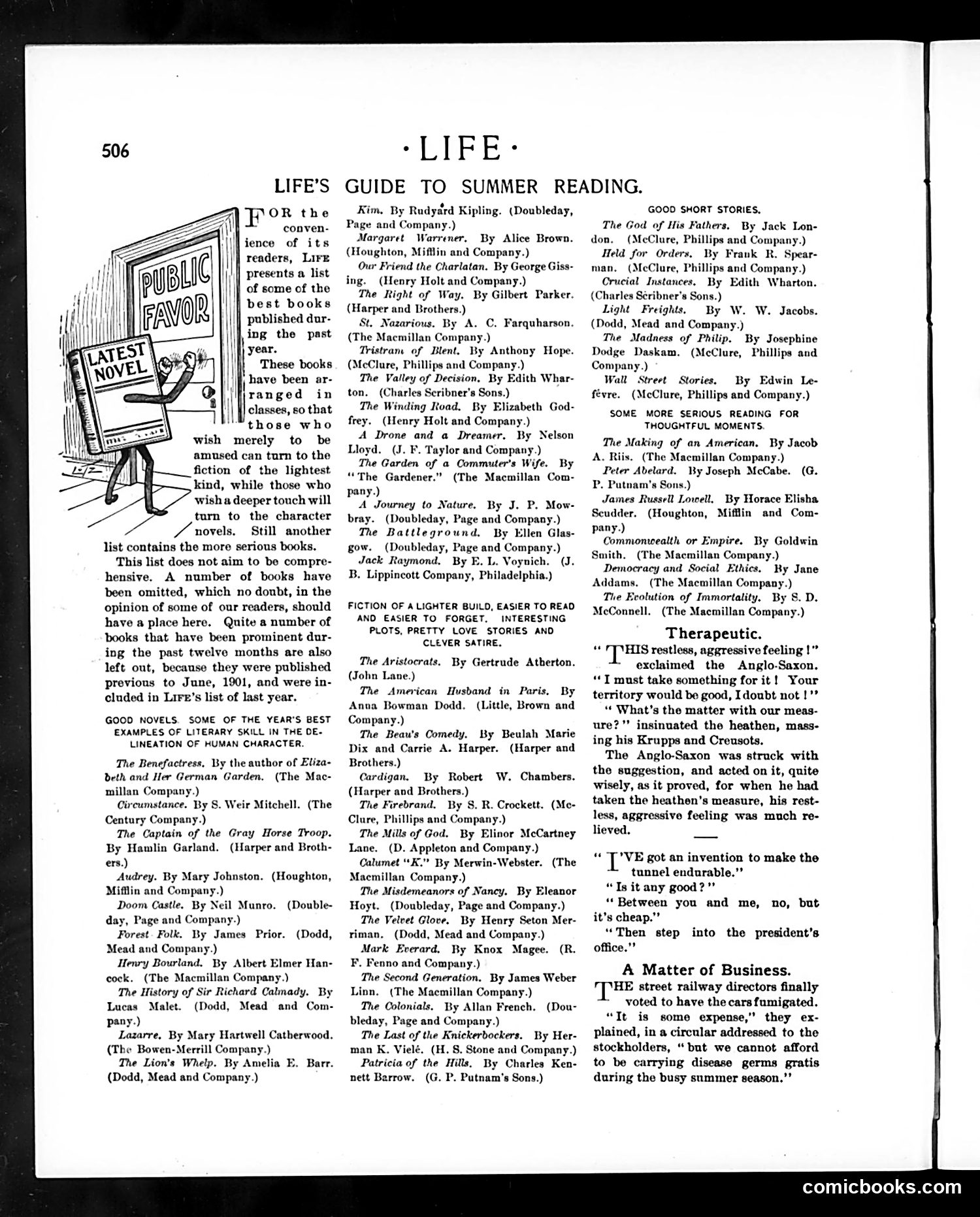
This page is primarily **reading recommendations**, not political satire. The main illustration shows a figure sitting in a chair reading "PUBLIC FAVOR / LATEST NOVEL" — a visual pun about summer reading popularity. The content consists of book lists organized by genre: "Good Short Stories," "Good Novels," "Fiction of a Lighter Build," and sections on "Thoughtful Moments" and "Therapeutic" reading. Publishers and authors are credited. Two small dialogue snippets appear near the bottom under "Therapeutic" and "A Matter of Business" headings, offering humorous observations about everyday situations — one about feeling restless, another about streetcar directors rejecting a disease-prevention proposal as too expensive. This is essentially a **book review and recommendation feature**, typical of *Life* magazine's cultural content.
📄 Transcribed text from this page (OCR, searchable)
Machine-transcribed from the original scan — historical spelling and the odd misread are preserved.
LIFE’S FOR the conven- ience of its readers, Lire presents a list of some of the best books published dur- ing the past have been ar- ranged in classes, 80 that “those who wish merely to be amused can turn to the fiction of the lightest kind, while those who wish a deeper touch will turn to the character novels. Still another list contains the more serious books. This list does not aim to be compre- hensive. A number of books have been omitted, which no doubt, in the opinion of some of our readers, should have a place here. Quite a number of books that have been prominent dur- ing the past twelve months are also left out, because they were published previous to June, 1901, and were in- cluded in Lire’s list of last year. GOOD NOVELS. SOME OF THE YEAR'S BEST EXAMPLES OF LITERARY SKILL IN THE DE- LINEATION OF HUMAN CHARACTER. The Benefactress, By the author of Eliza- Deth and Her German Garden. (The Mac- millan Company.) Circumstance. By 8. Weir Mitchell. (The Century Company.) The Captain of the Gray Horse Troop. By Hamlin Garland. (Harper and Broth- ers.) Audrey. By Mary Johnston. (Houghton, Mifflin and Company.) Doom Castle. By Neil Munro. day, Page and Company.) Forest. Folk. By James Prior. Mead and Company.) Henry Bourland. By Albert Elmer Han- cock. (The Macmillan Company.) ‘The History of Sir Richard Calmady. By Lucas Malet. (Dodd, Mead and Com- pany.) Lazarre, By Mary Hartwell Catherwood. (The Bowen-Merrill Company.) The Lion’s Whelp. By Amelia E. Barr. (Dodd, Mead and Company.) (Double- (Dodd, »LIFE* GUIDE TO SUMMER READING. Kim, By Rudyard Kipling. (Doubleday, Page and Company.) Margaret Warrener, By Alice Brown. (Houghton, Mifflin and Company.) Our Friend the Charlatan. By George Giss- ing. (Henry Holt and Company.) The Right of Way. By Gilbert Parker. (Harper and Brothers.) St. Nazarious. By A. C. Farquharson. (The Macmillan Company.) Tristram of Blent, By Anthony Hope. (McClure, Phillips and Company.) The Valley of Decision, By Edith Whar- ton. (Charles Scribner's Sons.) The Winding Road. By Elizabeth God- frey. (Henry Holt and Company.) A Drone and a Dreamer, By Nelson Lloyd. (J. F. Taylor and Company.) The Garden of a Commuter’s Wife. By “The Gardener.” (The Macmillan Com- pany.) A Journey to Nature. By J. P. Mow- bray. (Doubleday, Page and Company.) The Battleground. By Ellen Glas- gow. (Doubleday, Page and Company.) Jack Raymond. By E. 1. Voynich. (J. B. Lippincott Company, Philadelphia.) FICTION OF A LIGHTER BUILO, EASIER TO READ AND EASIER TO FORGET. INTERESTING PLOTS, PRETTY LOVE STORIES AND CLEVER SATIRE. The Aristocrats. By Gertrude Atherton. (John Lane.) The American Husband in Paris, By Anna Bowman Dodd. (Little, Brown and Company.) The Beau's Comedy, By Beulah Marie Dix and Carrie A. Harper. (Harper and Brothers.) Cardigan. By Robert W. Chambers. (Harper and Brothers.) The Firebrand. By 8. R. Crockett. (Me- Clure, Phillips and Company.) The Mills of God. By Elinor McCartney Lane. (D. Appleton and Company.) Calumet “K.” By Merwin-Webster. (The Macmillan Company.) The Misdemeanors of Nancy. By Eleanor Hoyt. (Doubleday, Page and Company.) The Velvet Glove. By Henry Seton Mer- riman. (Dodd, Mead and Company.) Mark Everard, By Knox Magee. (R. F. Fenno and Company.) The Second Generation. By James Weber Linn. (The Macmillan Company.) The Colonials, By Allan French. (Dou- bleday, Page and Company.) The Last of the Knickerbockers. By Her- man K. Vielé, (H. 8. Stone and Company.) Patricia of the Hills, By Charles Ken- nett Barrow. (G. P. Putnam's Sons.) GOOD SHORT STORIES, The God of His Fathers, By Jack Lon- don. (McClure, Phillips and Company.) Held for Orders, By Frauk R. Spear- man. (McClure, Phillips and Company.) Crucial Instances. By Edith Wharton. (Charles Séribner’s Sons.) Light Freights. By W. W. Jacobs. (Dodd, Mead and Company.) The Madness of Philip. By Josephine Dodge Daskam. (McClure, Phillips and Company.) Wall Street Stories, By Edwin Le- févre. (McClure, Phillips and Company.) SOME MORE SERIOUS READING FOR THOUGHTFUL MOMENTS. The Making of an American. By Jacob A. Riis. (The Macmillan Company.) Peter Abelard. By Joseph McCabe. (G. P. Putnam's Sons.) James Russell Lowell, Scudder. pany.) Commonwealth or Empire. By Goldwin Smith. (The Macmillan Company.) Democracy and Social Ethics. By Jane Addams. (The Macmillan Company.) The Evolution of Immortality. By 8. D. McConnell. (The Macmillan Company.) By Horace Elisha (Houghton, Miffin and Com- Therapeutic. Cs THs restless, aggressive feeling !"” exclaimed the Anglo-Saxon. “I must take something for it! Your territory would be good, Idoubt not !’” “‘ What's the matter with our meas- ure?’’ insinuated the heathen, mass- ing his Krupps and Creusots. The Anglo-Saxon was struck with the suggestion, and acted on it, quite wisely, as it proved, for when he had taken the heathen's measure, his rest- less, aggressive feeling was much re- lieved. ee [VE got an invention to make the tunnel endurable.”” “Is it any good?” “Between you and me, it’s cheap.” “Then step office.”” no, but into the president’s A Matter of Business. TH street railway directors finally voted to have the cars fumigated. “It is some expense,” they ex- plained, in a circular addressed to the stockholders, “ bat we cannot afford to be carrying disease germs gratis during the busy summer season.” comicbooks.com