
Life, 1902-06-12 · page 7 of 20
Life — June 12, 1902 — page 7: what you’re looking at
What you’re looking at
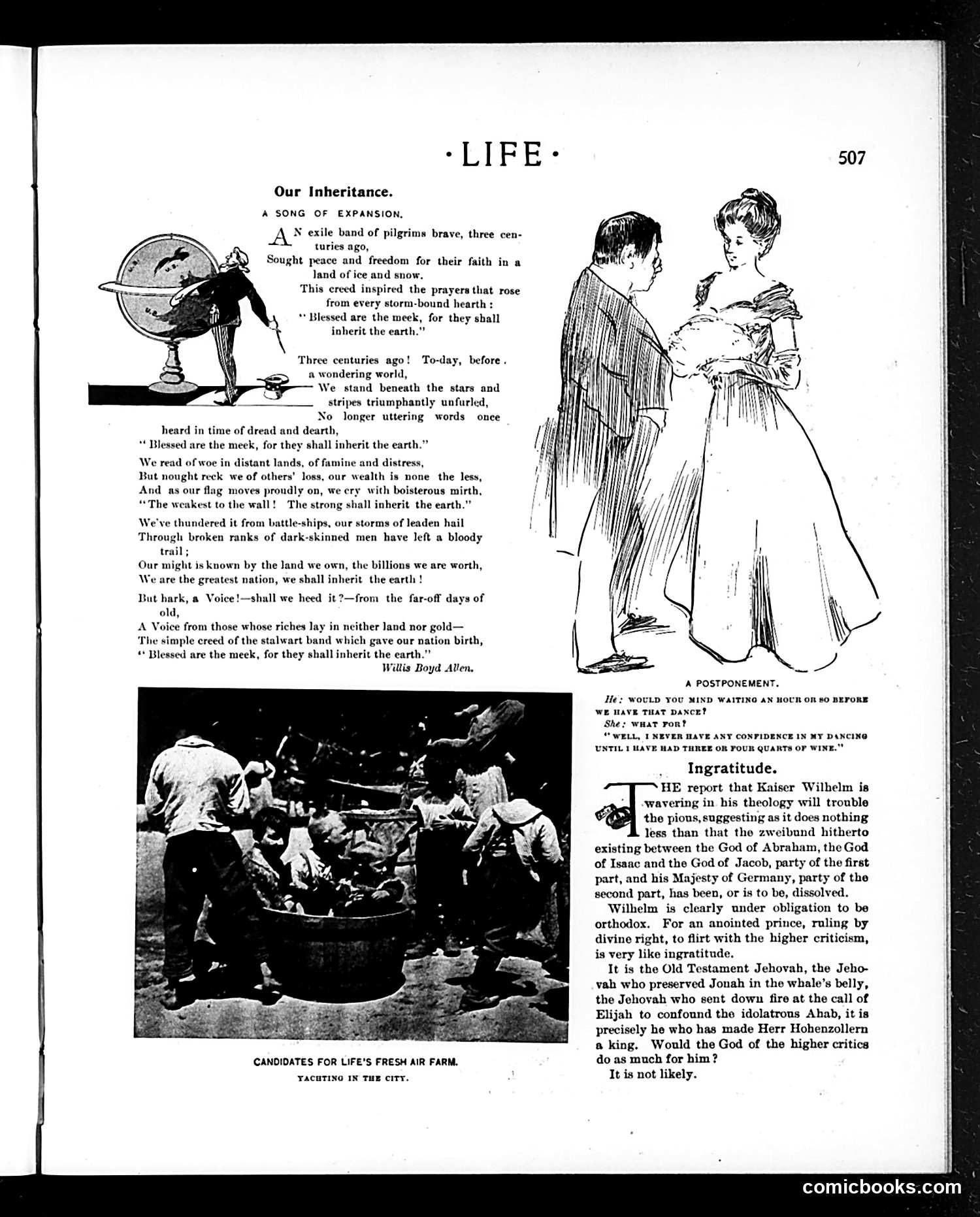
This page contains three distinct elements: 1. **"Our Inheritance"** — A poem by Willis Boyd Allen about religious pilgrims and social equality, using the phrase "Blessed are the meek, for they shall inherit the earth" as its refrain. It appears to celebrate democratic ideals and warn against class hierarchy. 2. **"A Postponement"** — A sketch showing a couple where the man asks about postponing a dance. The woman refuses, citing lack of confidence in his dancing "until I have had three or four hours of practice" — a light domestic humor piece. 3. **"Ingratitude"** — Commentary suggesting Kaiser Wilhelm II's theology troubles pious Germans, ironically comparing his position to biblical figures like Jonah and Elijah. The piece critiques Wilhelm's pride and suggests higher critics wouldn't support him either. The overall tone blends social commentary with satire of German Imperial pretensions.
📄 Transcribed text from this page (OCR, searchable)
Machine-transcribed from the original scan — historical spelling and the odd misread are preserved.
-LIFE* Our Inheritance. A SONG OF EXPANSION, N exile band of pilgrims brave, three cen- A turies ago, Sought peace and freedom for their faith in a land of ice and snow. This creed inspired the prayers that rose from every storm-bound hearth : * Blessed are the meek, for they shall inherit the earth.” ‘Three centuries ago! To-day, before. a wondering world, We stand beneath the stars and stripes triumphantly unfurled, No longer uttering words once heard in time of dread and dearth, ** Blessed are the meek, for they shall inherit the earth.” We read of woe in distant lands, of famine and distress, But nought reck we of others’ loss, our wealth is none the less, And as our flag moves proudly on, we cry with boisterous mirth, “The weakest to the wall! The strong shall inherit the earth.” We've thundered it from batt! ‘ips, our storms of leaden hail Through broken ranks of dark-skinned men have left a bloody Our might is known by the Jand we own, the billions we are worth, We are the greatest nation, we shall inherit the earth ! But hark, a Voice!—shall we heed it ?—from the far-off days of old, A Voice from those whose riches lay in neither land nor gold— ‘The simple creed of the stalwart band which gave our nation birth, “ Blessed are the meek, for they shall inherit the earth.” Willis Boyd Allen, A POSTPONEMENT, He: WovLD You MIND WAITING AN HOUT On 80 BEFORE WE NAVE THAT DANCE? She: wnat ror? WELL, I NEVER HAVE ANY CONFIDENCE IN MY DANCING UNTIL 1 MAVE MAD THREE OR FOUR QUARTS OF WINE.” Ingratitude. HE report that Kaiser Wilhelm is wavering in his theology will trouble the pious, suggesting as it does nothing less than that the zweibund hitherto existing between the God of Abraham, the God of Isaac and the God of Jacob, party of the first part, and his Majesty of Germany, party of the second part, has been, or is to be, dissolved. Wilhelm is clearly under obligation to be orthodox. For an anointed prince, ruling by divine right, to flirt with the higher criticism, is very like ingratitude. It is the Old Testament Jehovah, the Jeho- vah who preserved Jonah in the whale’s belly, the Jehovah who sent down fire at the call of Elijah to confound the idolatrous Ahab, it is precisely he who has made Herr Hohenzollern a king. Would the God of the higher critics CANDIDATES FOR LIFE'S FRESH AIR FARM. do as much for him? YACHTING IN THE CITY. It is not likely. comicbooks.com