
A complete issue · 20 pages · 1902
Life — May 15, 1902
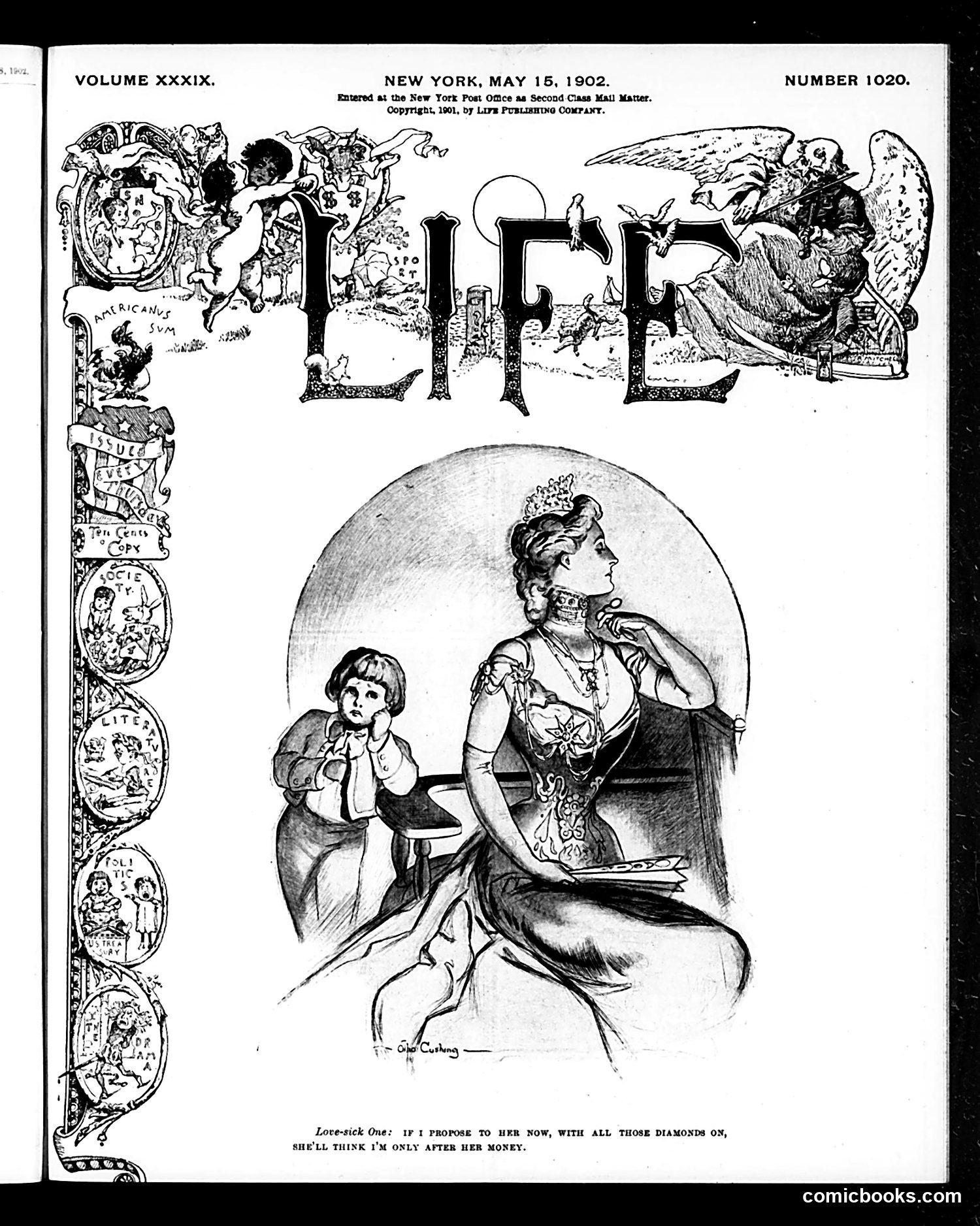
This is a satirical illustration about courtship and marriage among wealthy people. The main image shows an elegantly dressed woman with a young man, captioned: "Love-sick One: If I propose to her now, with all those diamonds on, she'll think I'm only after her money." The joke targets gold-digger anxieties—the man fears that proposing to a wealthy woman adorned with expensive jewelry will make him appear mercenary rather than genuinely romantic. It satirizes both masculine insecurity about appearing fortune-hunting and the stereotype of wealthy women as materialistic. The ornate left border contains small vignette illustrations typical of Life's decorative style. The cover's elaborate typographic design of "LIFE" reflects the magazine's sophisticated, humorous tone aimed at educated, upper-class readers concerned with social etiquette and romantic expectations.
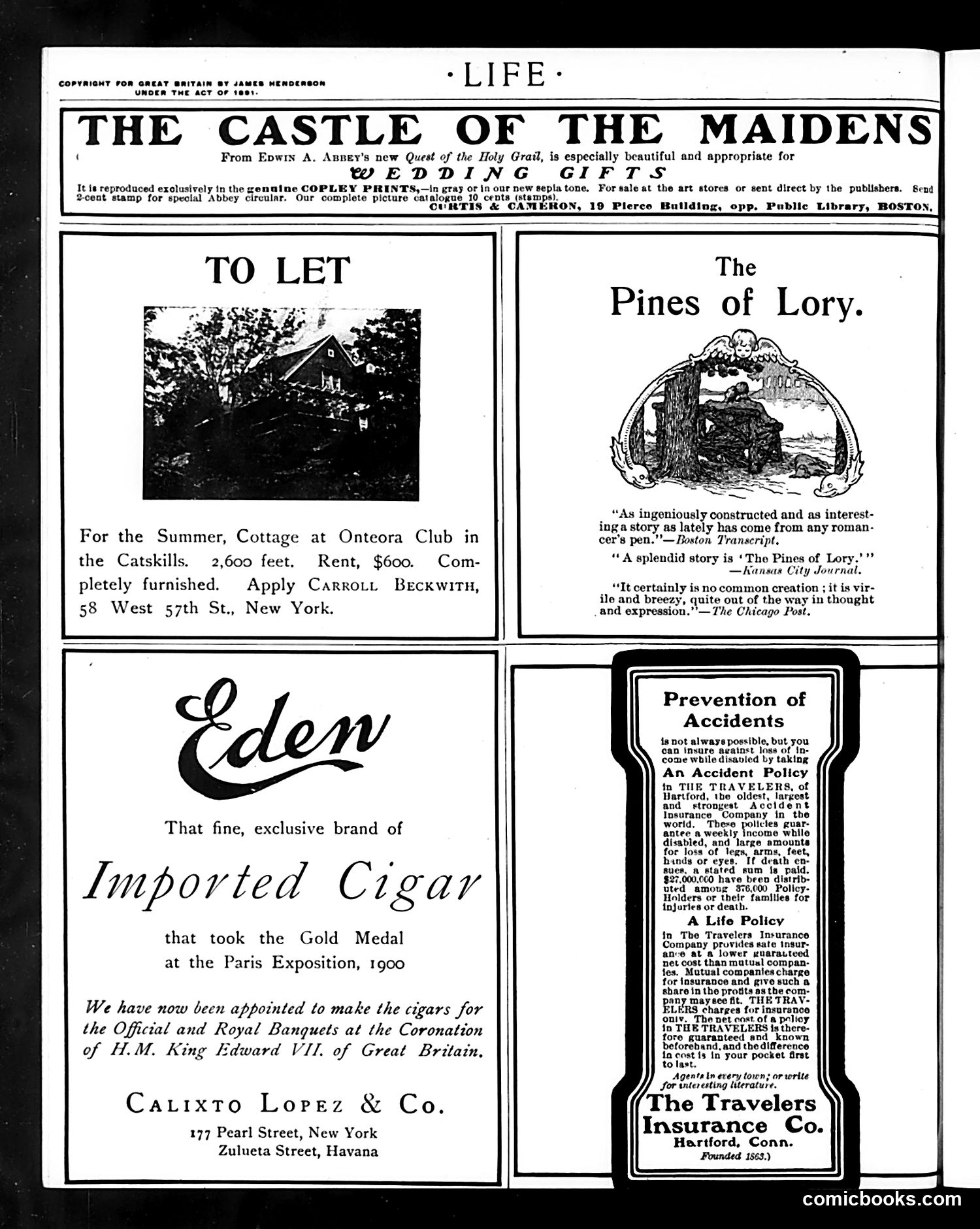
This page is **primarily advertising**, not satire or political commentary. It contains four advertisements: 1. **"To Let"** — a rental listing for a Catskills cottage 2. **"The Pines of Lory"** — a book advertisement citing positive reviews 3. **"Eden Imported Cigar"** — promoting cigars that won a gold medal at the 1900 Paris Exposition, now official supplier to King Edward VII 4. **"The Travelers Insurance Co."** — accident insurance advertisement The page reflects early 1900s consumer culture and advertising conventions. The only potentially noteworthy element is the cigar ad's reference to King Edward VII's patronage, suggesting how companies leveraged royal endorsements for prestige. Otherwise, this is a straightforward commercial page with no apparent political satire or social commentary.
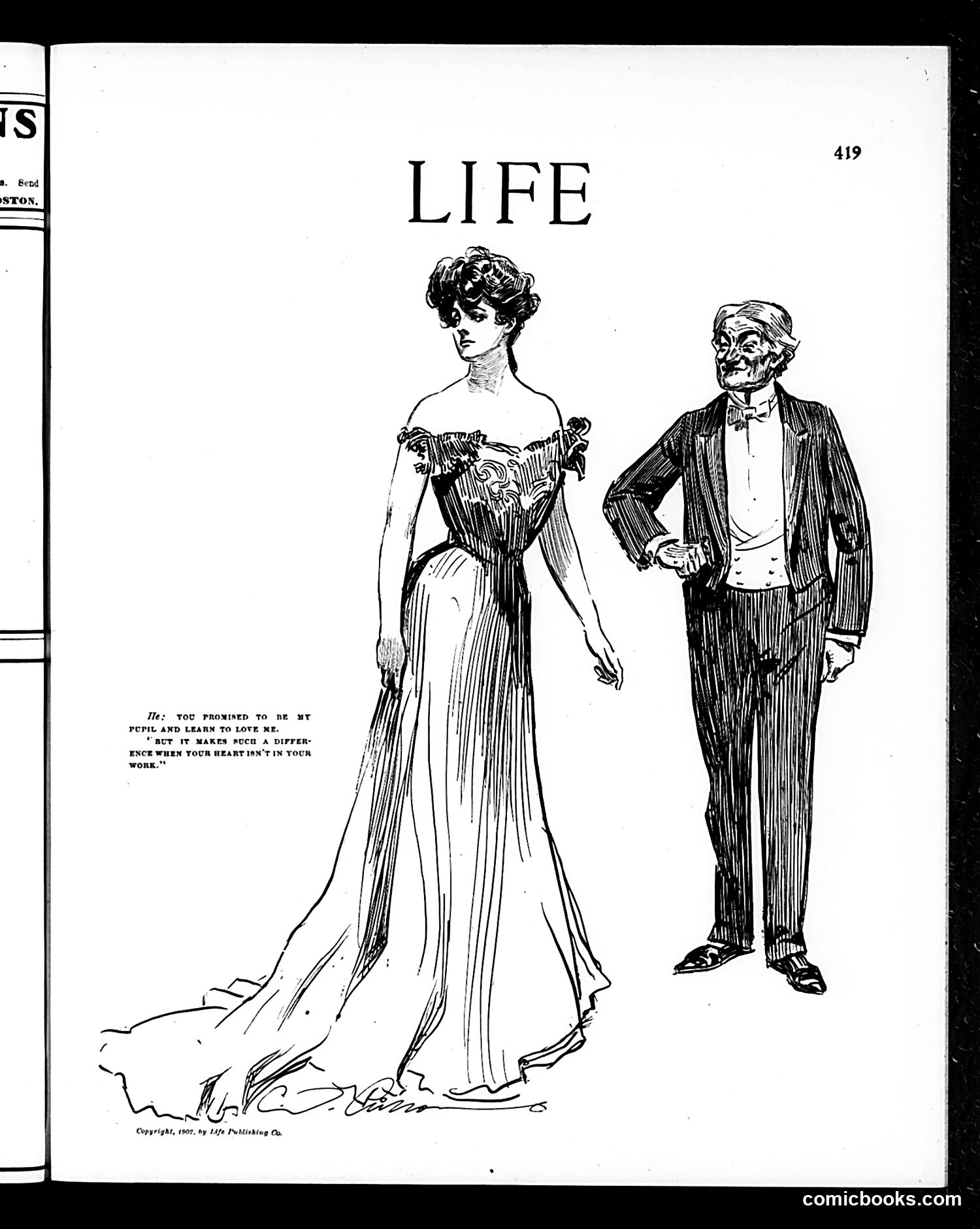
This *Life* magazine page (page 419) depicts two figures in formal evening wear engaged in dialogue. The caption reads: "He: 'You promised to be my pupil and learn to love me.' / 'But it makes such a difference when you ask me to give your heart's key in your word.'" The illustration satirizes romantic courtship dynamics of the early 1900s. The woman in an elegant off-shoulder gown represents the idealized "Gibson Girl" aesthetic popular in that era. The man's exaggerated facial features and posture suggest satirical mockery of male romantic presumption. The joke appears to critique men who demand emotional reciprocation as a condition of courtship—particularly the contradiction between framing love as something to be "taught" while simultaneously asking women to surrender their autonomy ("give your heart's key"). The satire targets outdated gender dynamics and manipulative romantic rhetoric common to that period.
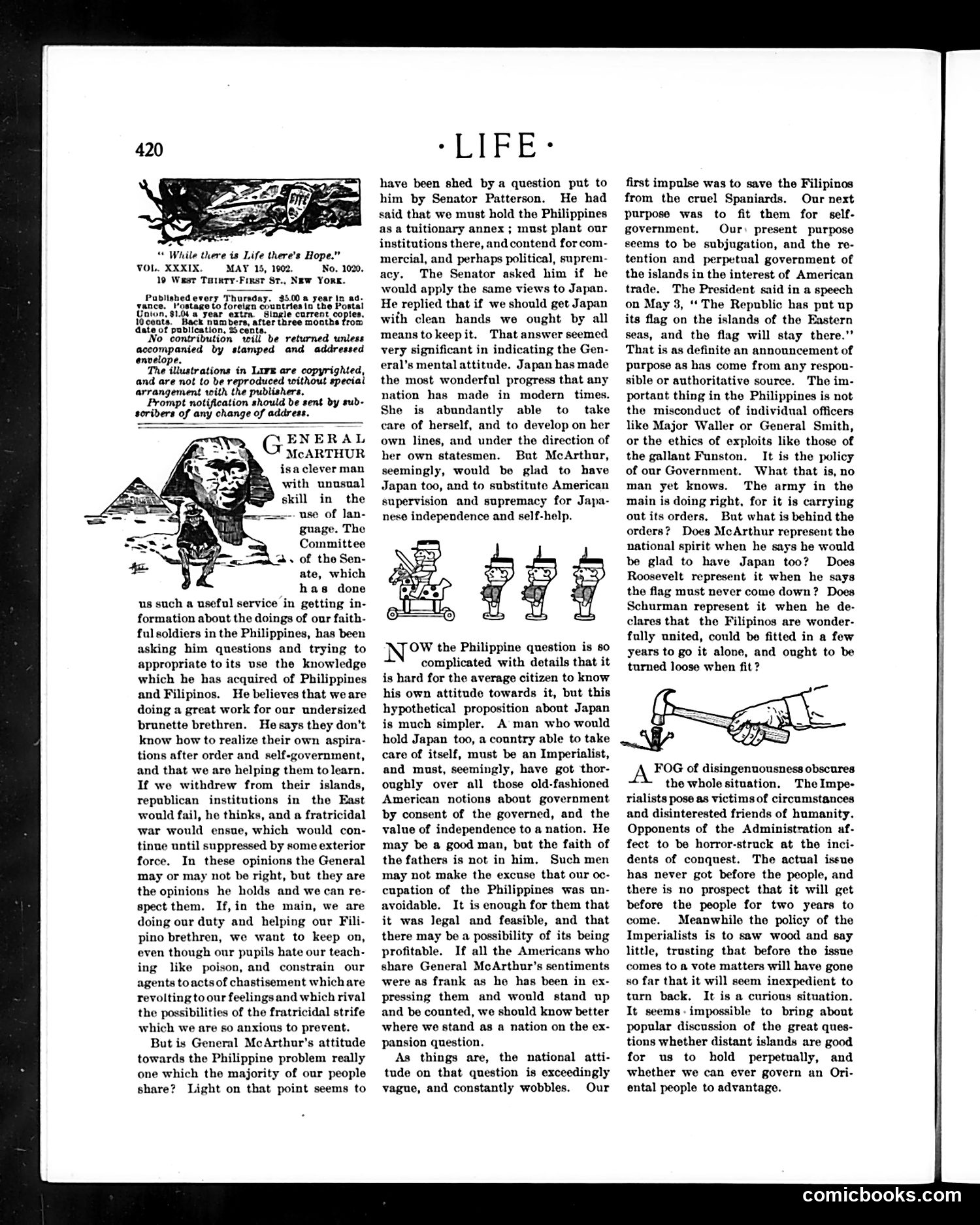
The main cartoon depicts **General MacArthur** as a caricatured figure overlooking terrain, illustrating the text's discussion of his role and attitudes toward the Philippines. The article debates MacArthur's stance on Philippine independence. The text criticizes those who would simultaneously hold the Philippines as a U.S. possession while advocating Japan's independence—viewing this as hypocritical imperialism. The cartoon and surrounding commentary question whether America should govern distant Oriental populations "to advantage," challenging the logic of maintaining colonial control. The smaller illustration shows figures on what appears to be a military vehicle, likely reinforcing themes of American military presence and authority in the region. The piece reflects early 20th-century American debates over imperialism and colonial administration.
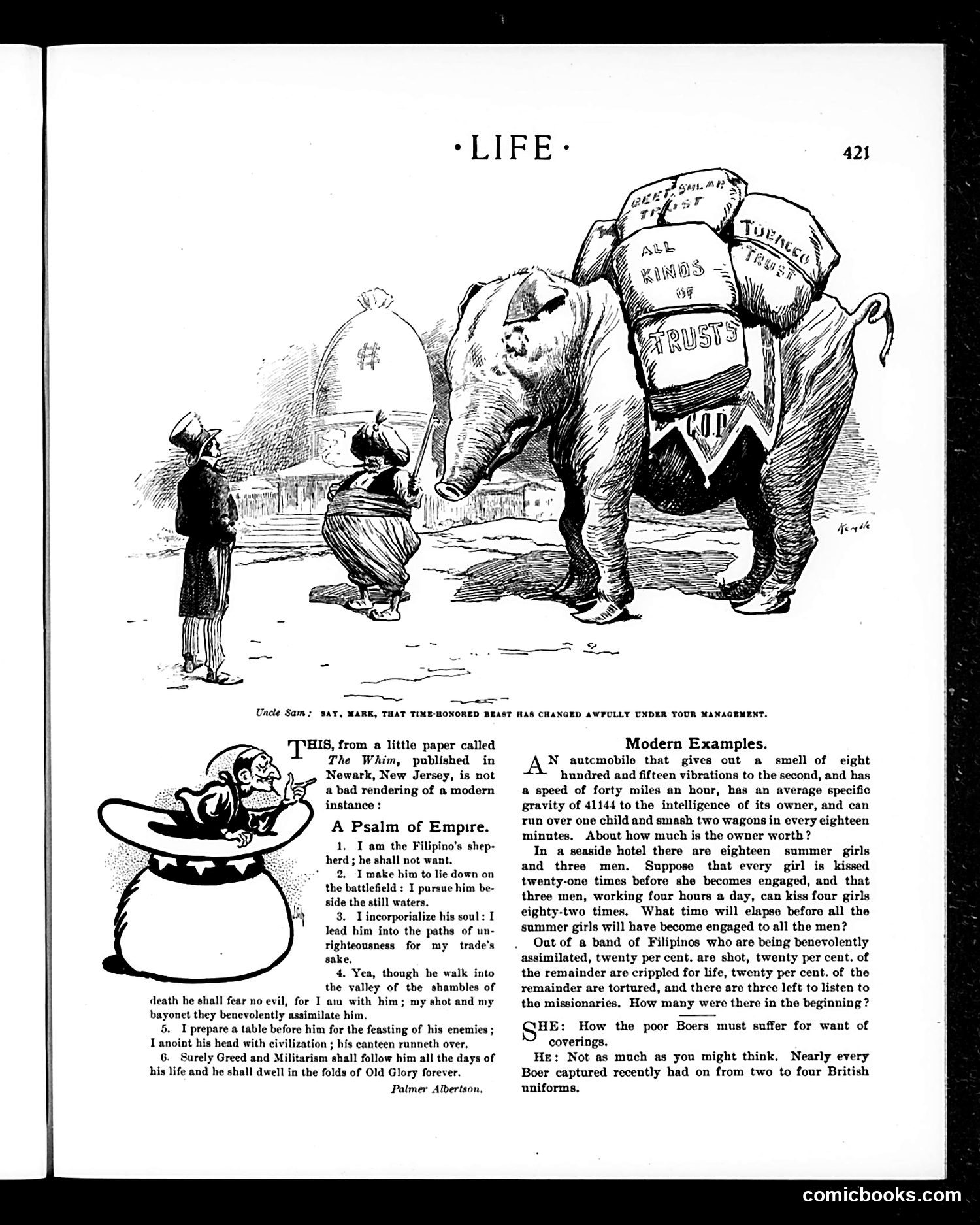
**Main Cartoon (top):** Depicts an elephant labeled with various corporate trusts ("Beef Trust," "Oil," etc.) being examined by small figures labeled "Uncle Sam." The satire critiques massive corporate monopolies of the era—the "trusts" that dominated American industry. The elephant's massive size versus the tiny observers emphasizes how these corporations dwarfed government oversight. **Context:** This reflects early 20th-century "trust-busting" debates, when monopolistic corporations controlled entire industries. The cartoon suggests Uncle Sam struggles to manage or control these economic giants. **Lower text:** Includes satirical content ("A Psalm of Empire") and "Modern Examples" discussing automobiles and Filipino assimilation—likely commenting on American imperialism and technological/social change of the period.
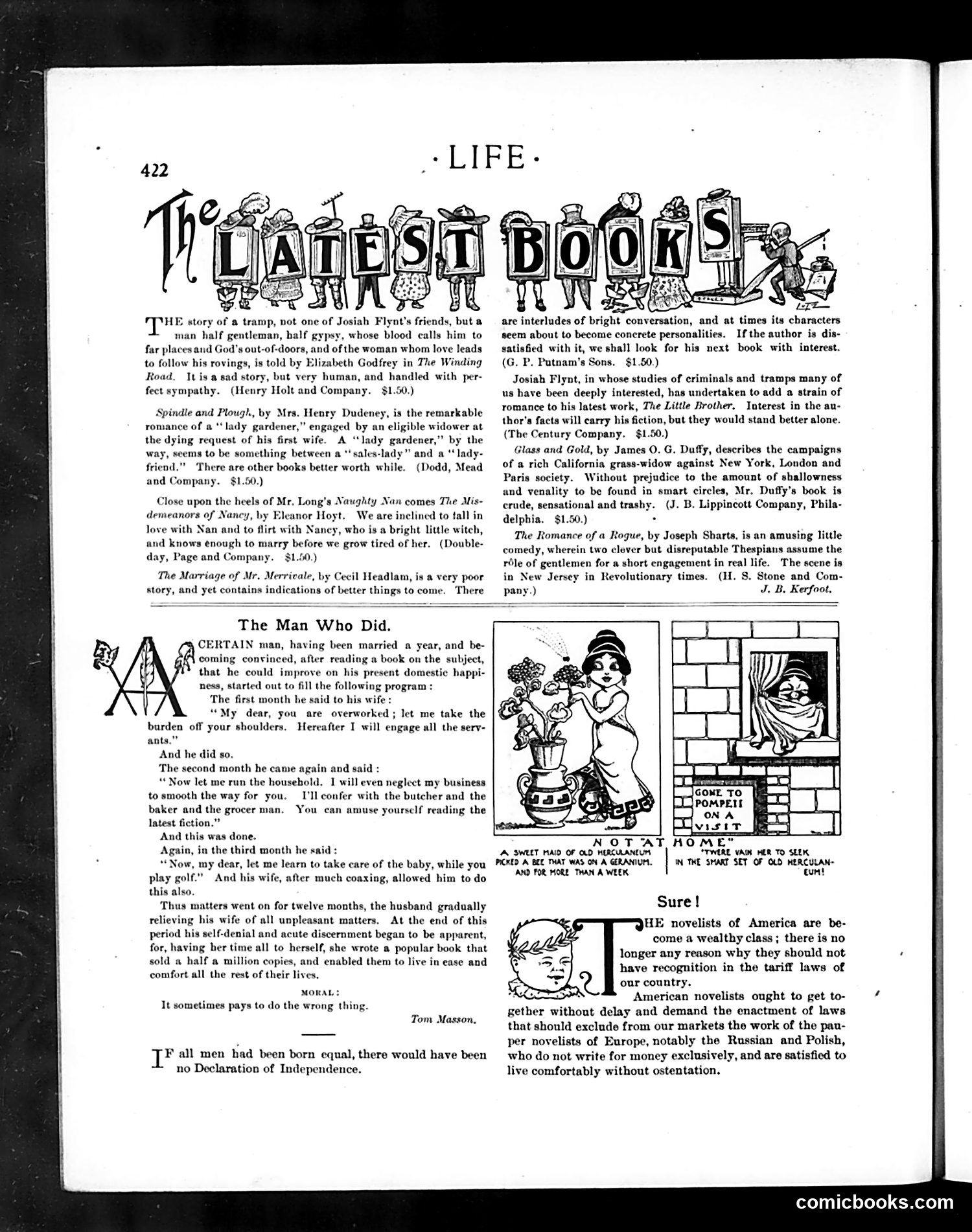
This cartoon satirizes a husband's approach to domestic happiness. Over twelve months, he progressively surrenders control to his wife: first delegating household management to her, then neglecting his business, then abandoning his hobbies entirely. The moral states: "It sometimes pays to do the wrong thing." The satire cuts both ways—mocking both the husband's spinelessness and the implicit critique of wives who dominate their marriages. By the final panel showing him confined indoors, the joke is that his complete capitulation has backfired: he's achieved neither marital harmony nor personal satisfaction. The accompanying comic strip (right) humorously depicts a maid's chaotic housekeeping, reinforcing early-20th-century anxieties about domestic service and household management.
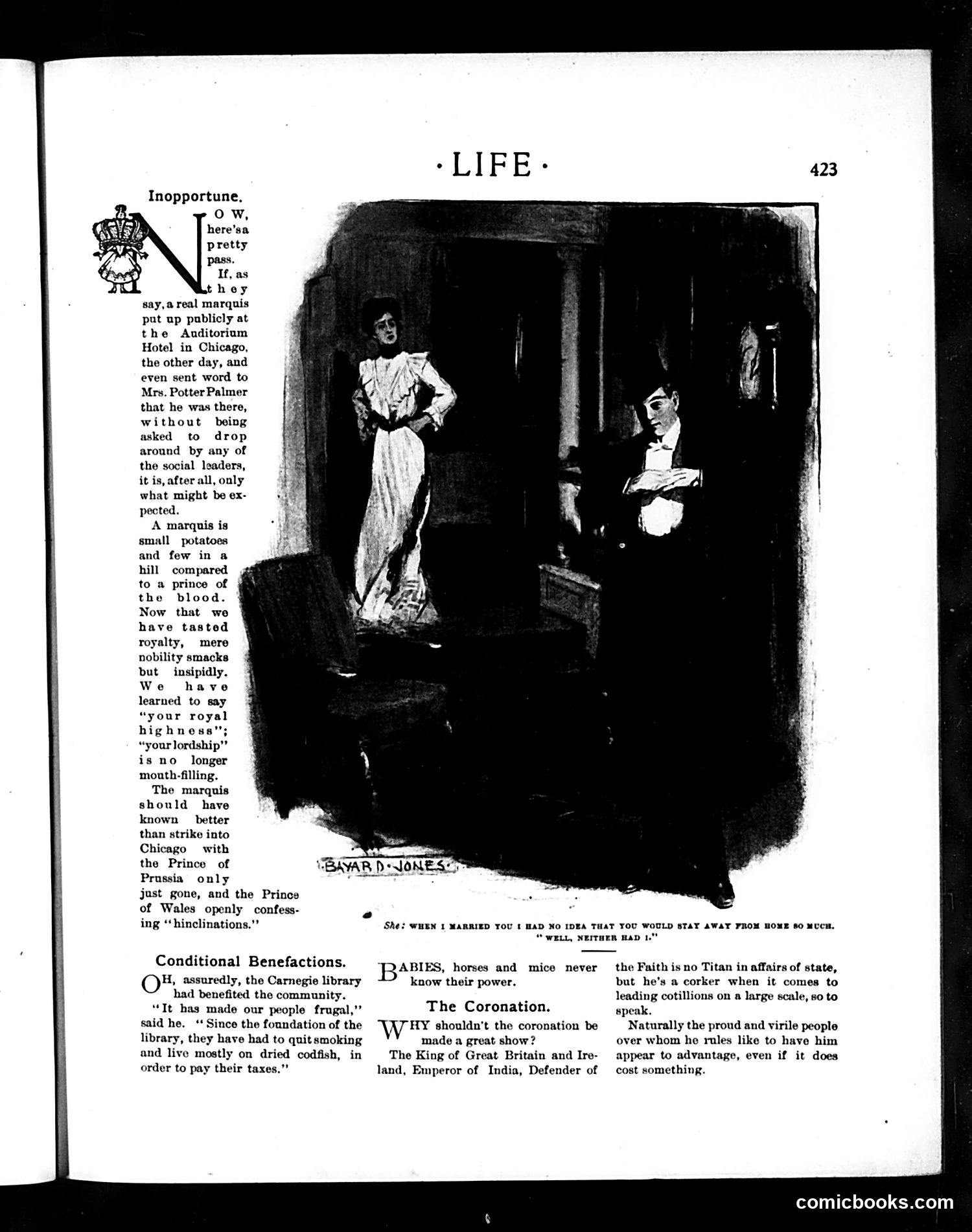
This page contains a satirical cartoon by Cesare (signature visible) depicting a domestic scene. The caption reads: "She: 'When I married you I had no idea that you would stay away from home so much.' He: 'Well, neither had I.'" The humor targets marital expectations versus reality. A woman in an elegant white gown confronts a man absorbed in reading a newspaper, sarcastically expressing surprise at his domestic absence. His deadpan response—that he too was unprepared for this outcome—uses ironic reversal to mock both spouses' unrealistic pre-marriage assumptions about married life. The accompanying text columns discuss unrelated topics (Carnegie libraries, coronations), suggesting this is a standard Life magazine layout mixing satirical cartoons with commentary pieces on contemporary social and political matters.
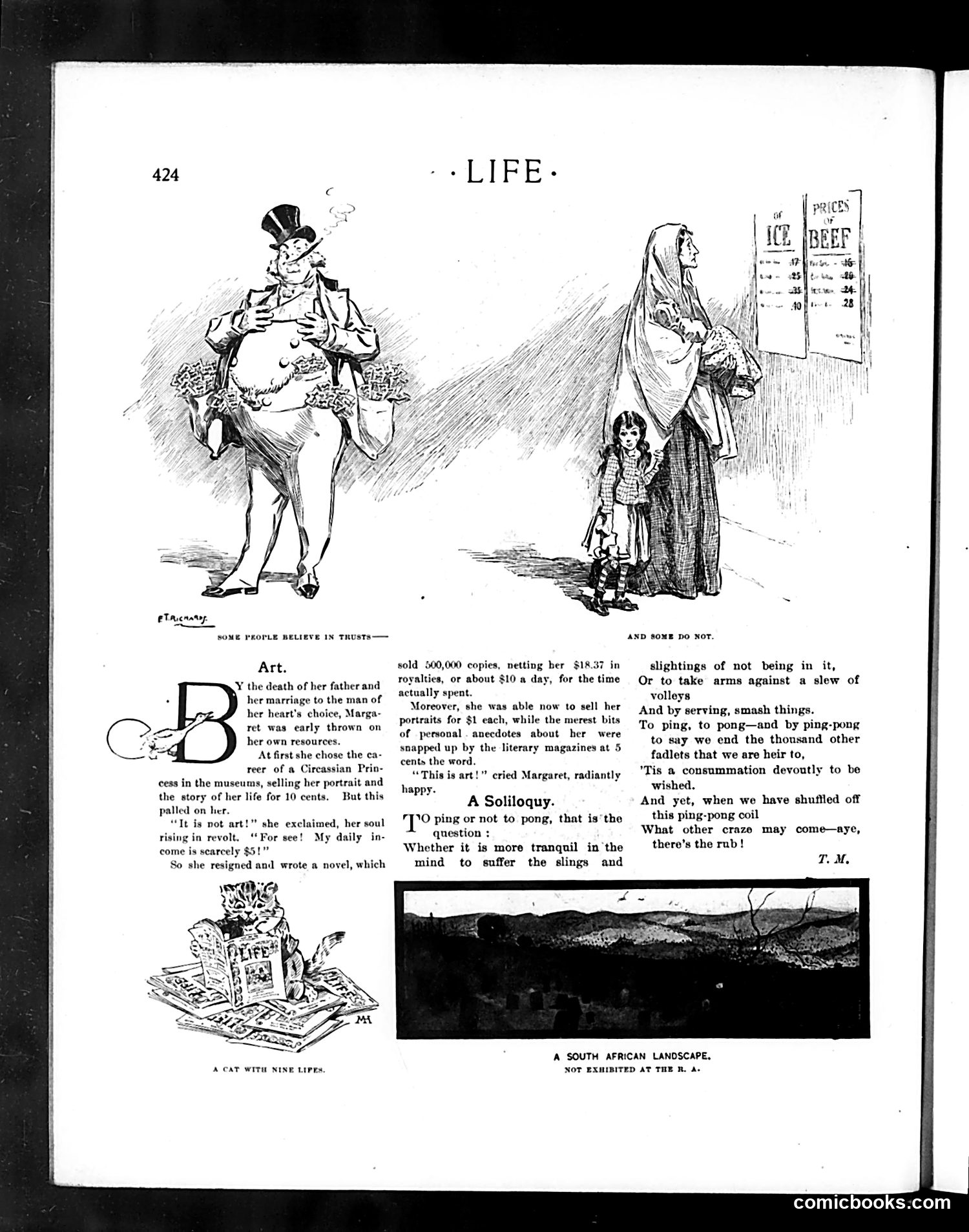
**Top Cartoons: "Some People Believe in Trusts — And Some Do Not"** The left figure is a wealthy, well-fed businessman with a top hat, labeled as representing those who support trusts (monopolistic business combinations). The right shows a poor woman and child looking at a price board for ice and beef, representing working-class citizens suffering from high prices caused by trusts. **The Satire:** This critiques economic inequality and the trust system's impact on ordinary people. While wealthy industrialists benefit from monopolies, everyday families struggle with inflated food costs. The juxtaposition directly blames trusts for consumer hardship. **Bottom Content:** Includes unrelated cartoons and a South African landscape photograph (noted as unexhibited at the Royal Academy), typical of Life's eclectic satirical format.
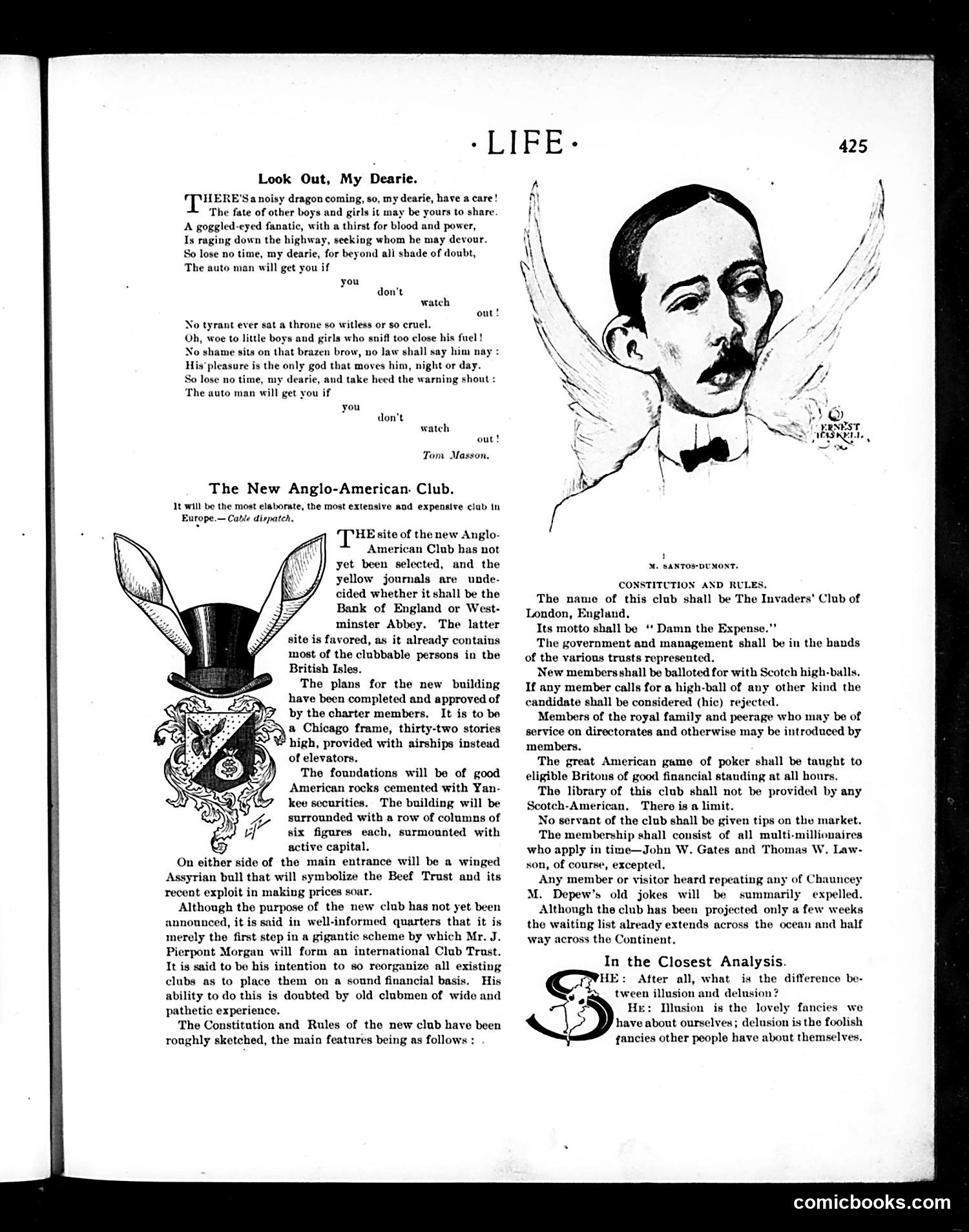
**"Look Out, My Dearie"** is a satirical poem by Tom Masson warning against an unnamed threat—described as "a noisy dragon" seeking blood and power, racing down the highway. The vague language likely references anxieties about industrial dangers or corporate monopolies of the era. **The portrait** (signed Ernest Haskell) shows **W. Santos-Dumont**, identified in the caption as associated with "The Invaders' Club of London." The accompanying satirical "club rules" mock-propose absurd governance structures, insider financial schemes, and exclusionary practices—appearing to satirize wealthy industrialists' secretive trusts and monopolistic behavior. **"In the Closest Analysis"** presents a brief philosophical joke distinguishing illusion from delusion through human vanity. The overall tone critiques wealthy elites and their consolidating power structures.
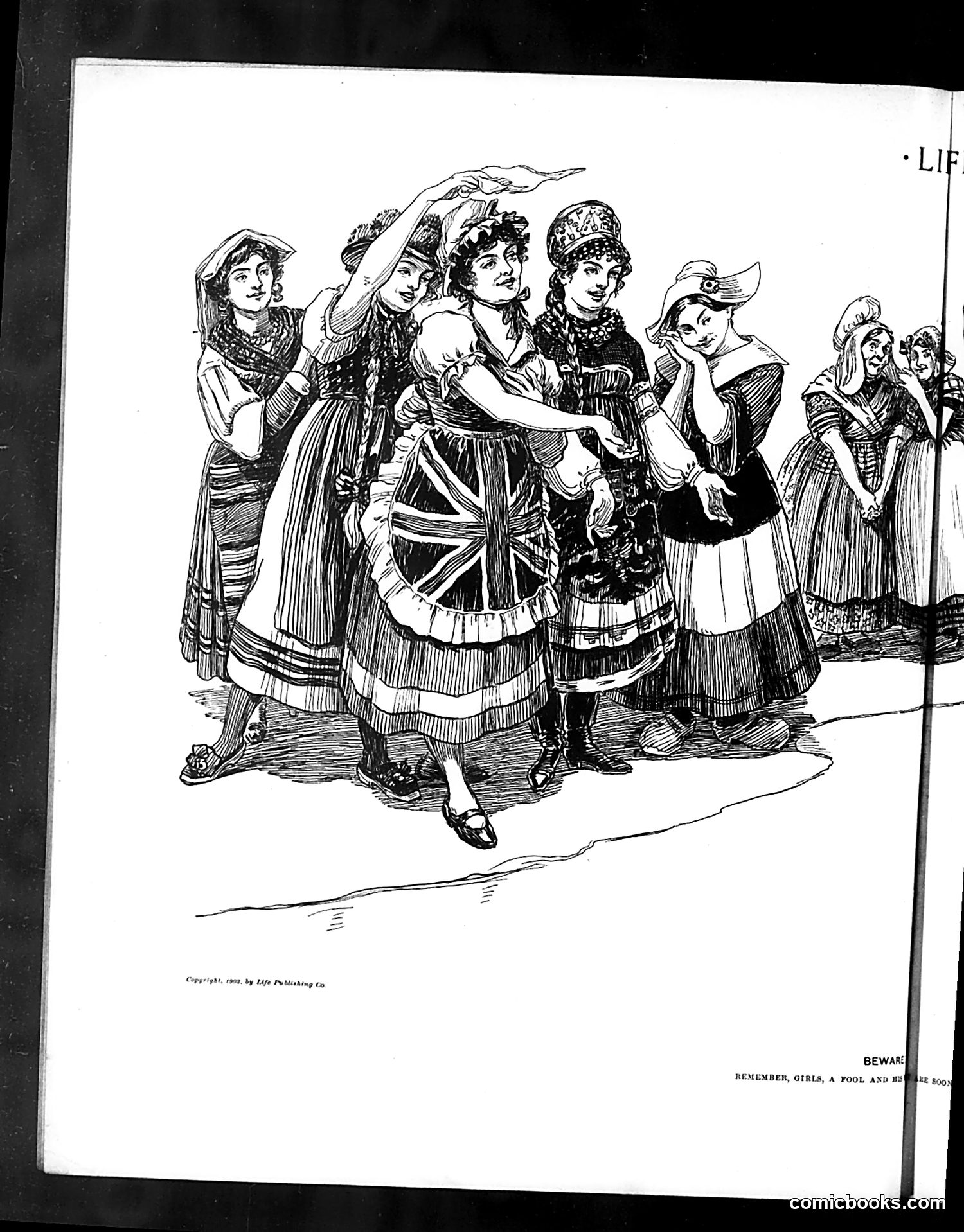
This is a satirical illustration from *Life* magazine (copyright 1903) depicting a group of fashionably dressed women in elaborate Edwardian-era clothing and hats. The partial text visible at the bottom reads "BEWARE! REMEMBER, GIRLS, A FOOL AND HIS SOON" (likely continuing off-page). The cartoon appears to satirize women's fashion trends of the early 1900s—particularly the ornate hats, corseted silhouettes, and decorative elements that were extremely popular among upper-class women. The "beware" caption suggests the satire targets female vanity or the foolish spending habits associated with pursuing fashionable dress. The gathered group composition emphasizes the conformity and herd-like behavior of fashion followers. This reflects common *Life* magazine social commentary mocking both conspicuous consumption and women's fashion culture of the era.
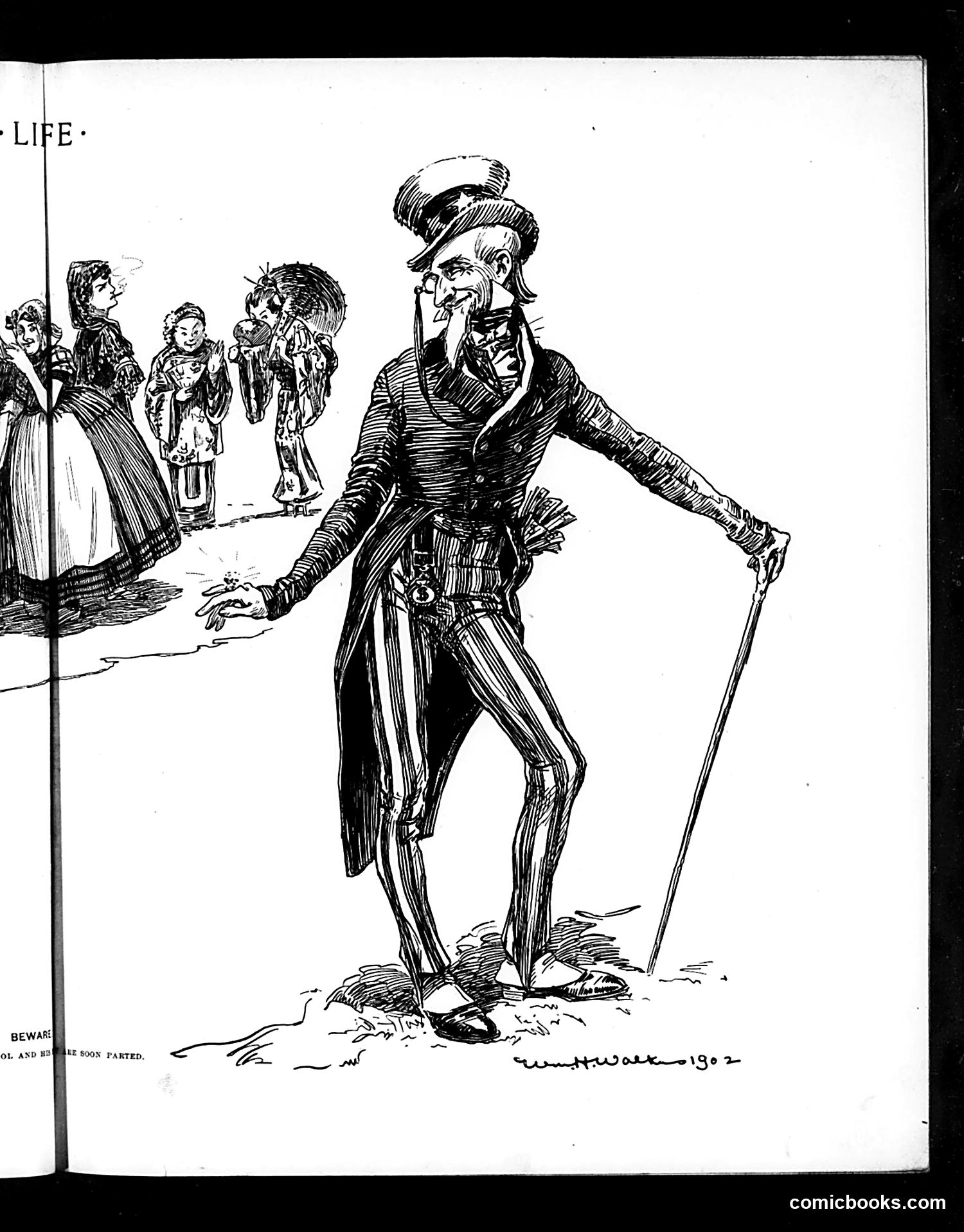
This is a satirical cartoon dated 1902 depicting a tall, exaggerated figure in military dress with a distinctive tall hat, holding a cane. The figure appears to be a caricature of a political or military leader of that era. In the background, smaller figures (appearing to be women and children) observe the scene. The text fragment "BEWARE" and partial text mentioning "OIL AND RUBBER BOOTS PARTED" suggests commentary on commercial or colonial exploitation. The grotesque facial features and posture are typical of early 20th-century political satire aimed at ridiculing authority figures. Without clearer text identification or additional context clues visible in the image, the specific identity of the caricatured figure and the precise political reference remain unclear, though the satirical intent—mocking military pretension or colonial power—is evident.
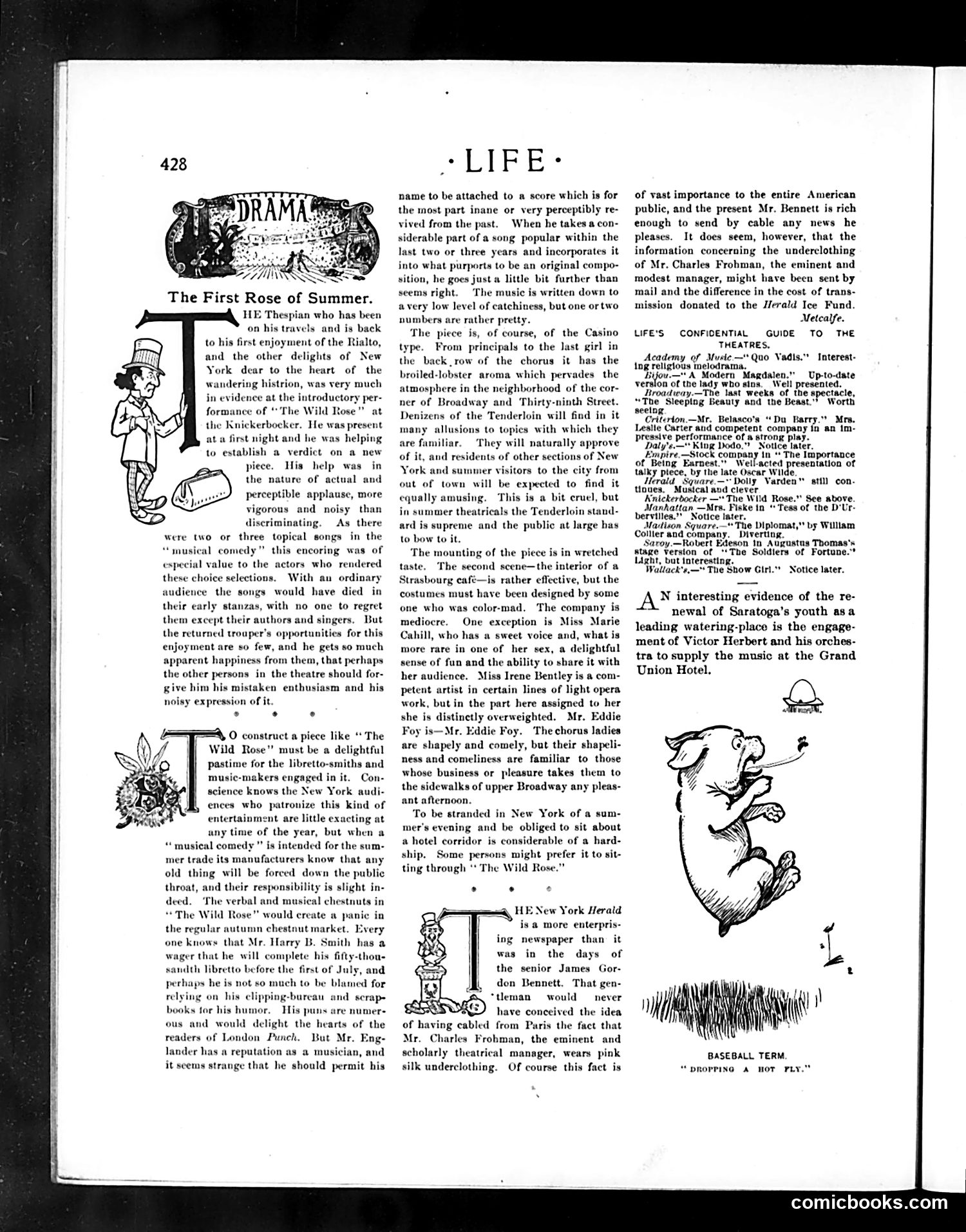
This page contains a theater review column discussing Broadway productions. The main illustrated article reviews "The First Rose of Summer," a musical comedy at the Tenderloin theater district. The text critiques the show's taste and execution, noting the interior Strasbourg café scene is "rather effective" but costumes are mediocre, with one exception: actress Marie Cahill, praised for her "sweet voice" and rare ability to "share it with her audience." The decorative illustrations (a man in a top hat, floral designs, and a baseball player labeled "dropping a hot fly") are typical Life magazine ornamental elements rather than political satire. The content focuses on theatrical criticism and gossip rather than political commentary.
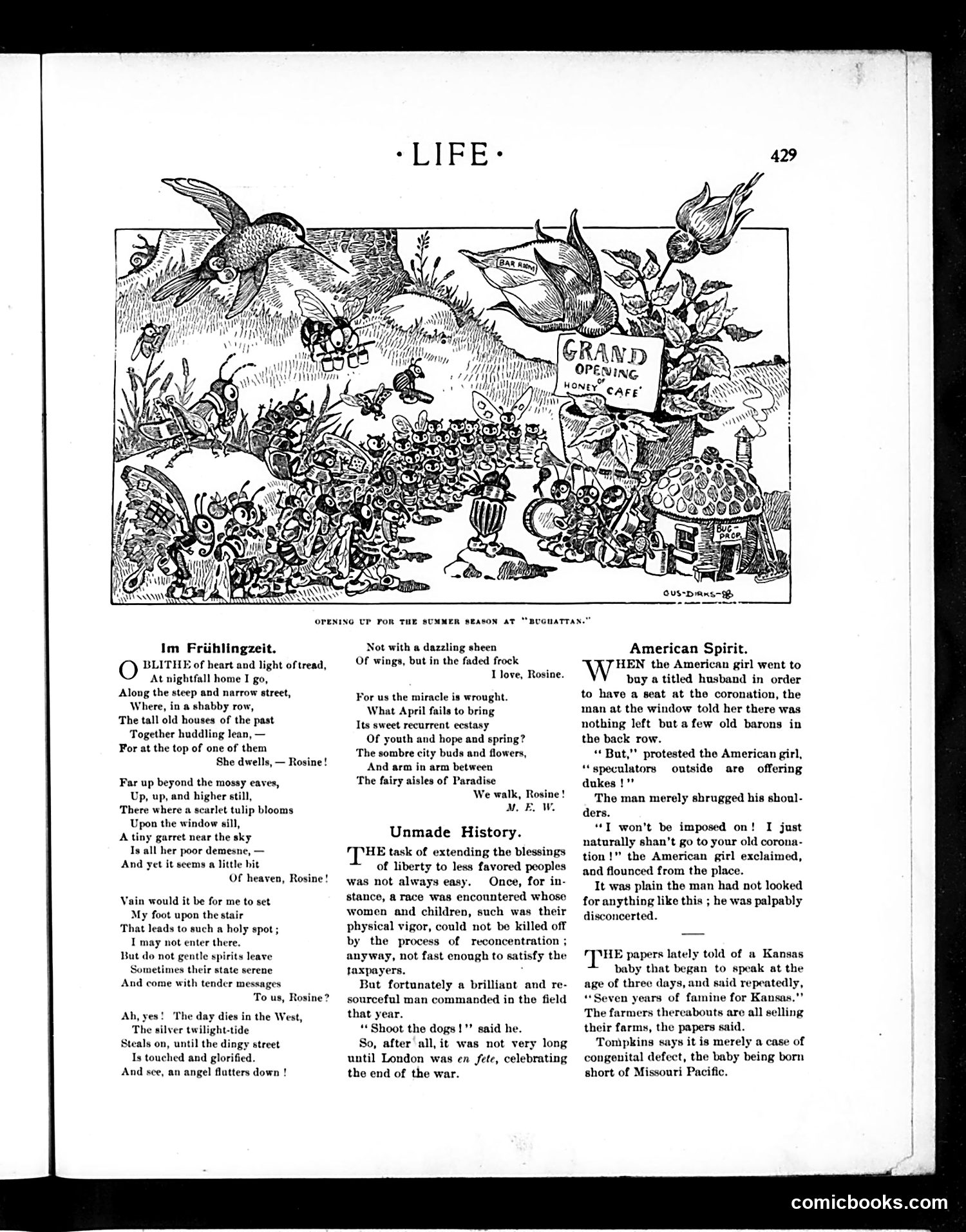
This page contains three satirical pieces mocking American society and imperialism: **"Unmade History"** appears to reference U.S. military campaigns (likely the Philippines or similar colonial conflicts), sarcastically praising a commander who ordered brutal tactics ("Shoot the dogs!") against indigenous populations. The satire criticizes both the violence and Americans' casual celebration afterward—the bitter irony being that colonial "civilization" involved mass killing. **"American Spirit"** mocks wealthy American women seeking to marry titled European nobility for social status. The joke turns when a woman, refused a duke, indignantly refuses to attend the coronation—satirizing American entitlement and mercenary attitudes toward European aristocracy. **"Kansas Baby"** jokes darkly about agricultural depression, imagining an infant prophesying famine while making a pun about railroad stocks ("Missouri Pacific"). The cartoon at top, "Opening Up for the Summer Season at 'Bughatton,'" depicts insects in a mock-vacation resort, likely anthropomorphic social commentary, though specific targets are unclear. The page also includes romantic poetry ("Im Frühlingzeit") contrasting sharply with the cynical prose pieces.
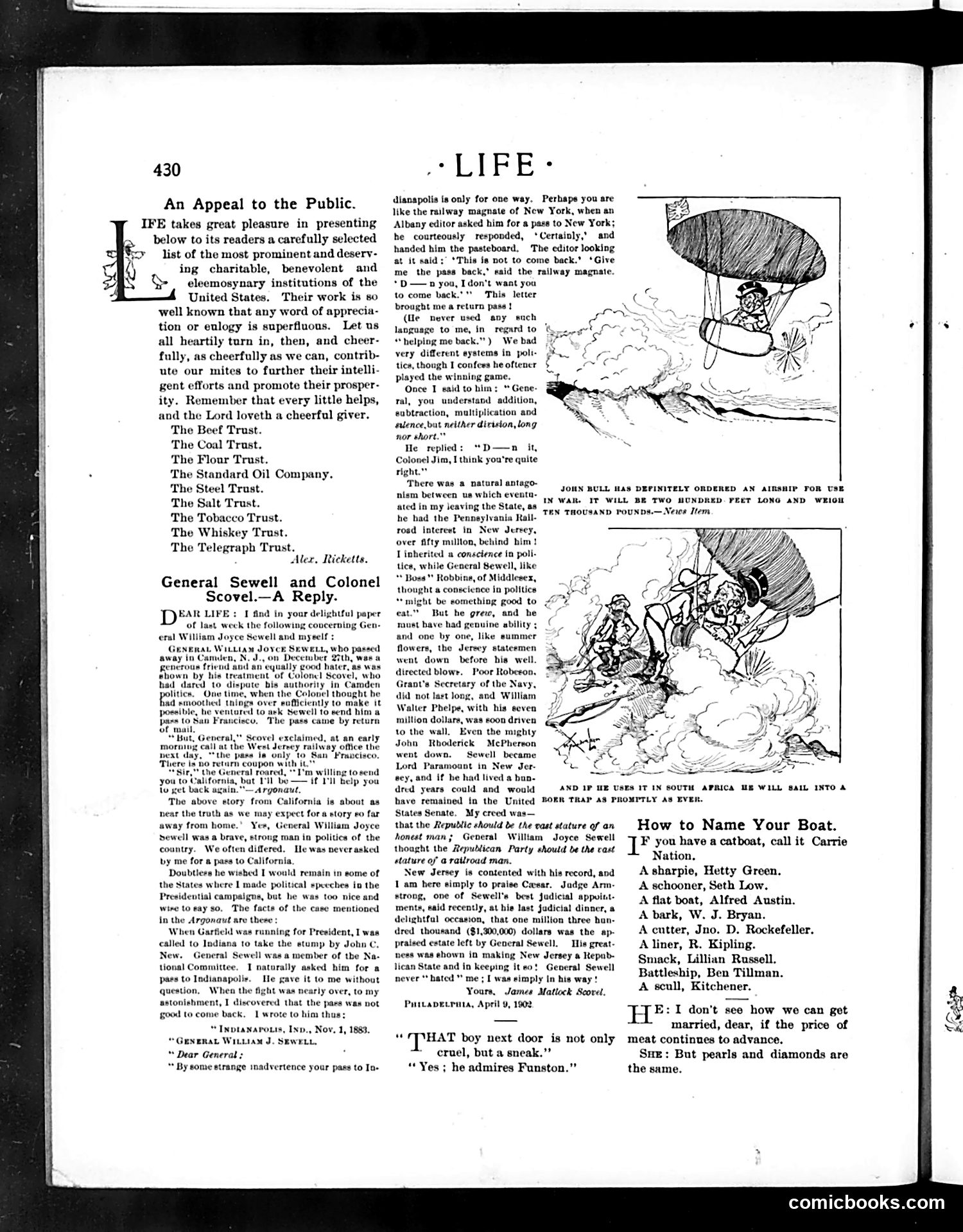
This page contains two distinct pieces of satire: **"An Appeal to the Public"** (top left) is a satirical list of American monopolies presented as "charitable institutions" deserving public donations. By artist Alex Ricketts, it mocks the massive corporate trusts of the Gilded Age—Standard Oil, Steel Trust, Beef Trust, etc.—by sarcastically treating them like benevolent charities. The joke targets how these monopolies dominated the economy while claiming social benefit. **"General Sewell and Colonel Scovel—A Reply"** (bottom) is a lengthy letter-to-editor defending Colonel Scovel's character against criticism, while also settling old political scores with the now-deceased General William Joyce Sewell, a New Jersey Republican politician. Scovel recounts their disagreements over railroad passes and political patronage, praising Sewell's eventual growth while maintaining their fundamental differences were irreconcilable. The page also includes unrelated joke snippets and a boat-naming humor section at bottom right.
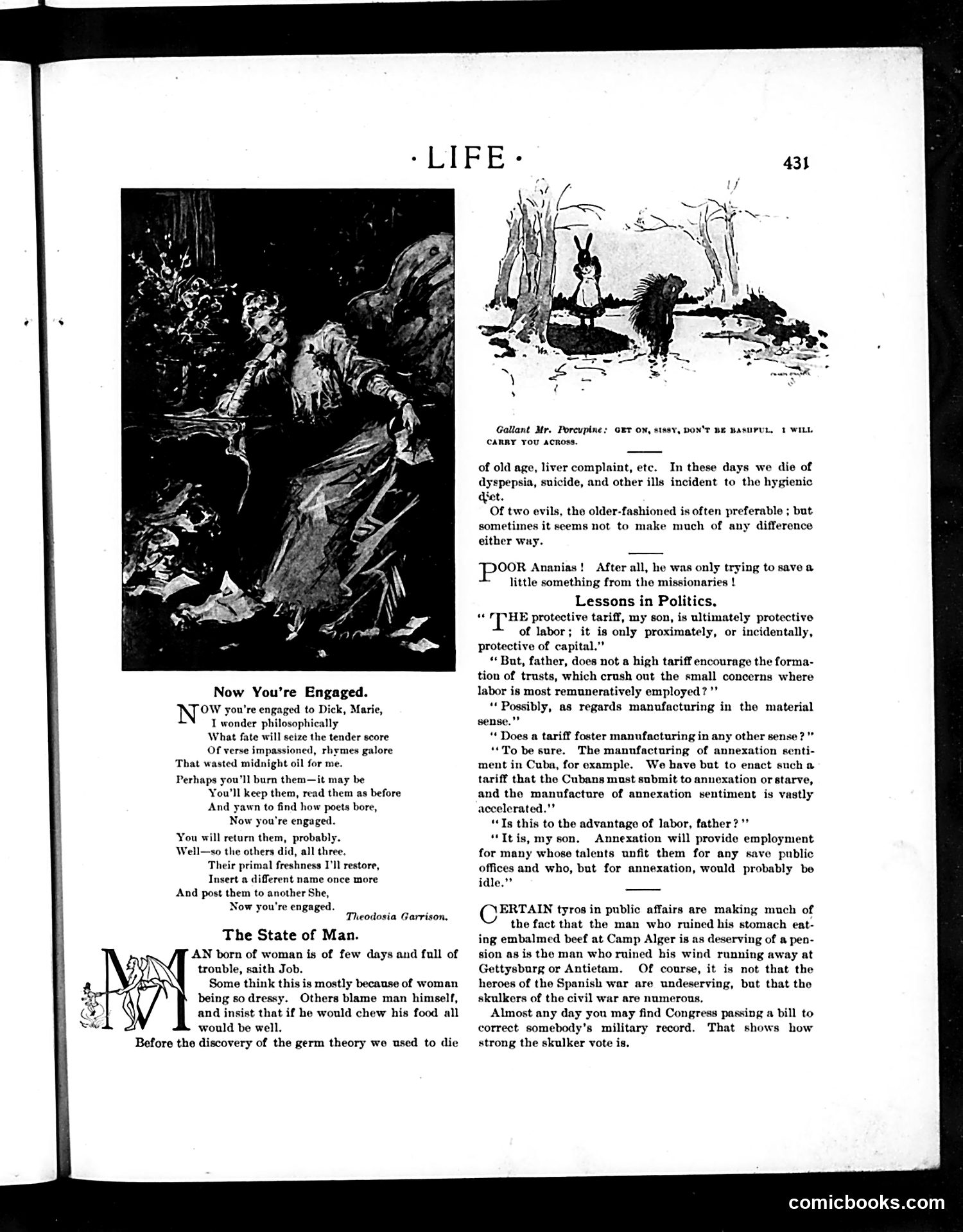
This page contains three separate satirical pieces typical of *Life* magazine's humor: **"Now You're Engaged"** (poem by Theodosia Garrison): A witty commentary on romantic poetry recycling. The speaker admits to reusing passionate verses written for previous lovers, simply changing the woman's name before sending them to new romantic interests. The humor mocks both the insincerity of romantic declarations and the disposability of love letters—suggesting male poets treated courtship as an assembly-line process. **"Lessons in Politics"** (dialogue): A father-son exchange satirizing protectionist tariff arguments and American imperialism, likely referencing the Spanish-American War and U.S. designs on Cuba. The father cynically admits tariffs don't actually help labor but do manufacture political support for annexation—even if it requires starving Cubans into submission. The satire exposes how economic policy masks imperial ambition. **"The State of Man"**: Brief commentary on human suffering, contrasting old causes of death (age, disease) with modern ones (dyspepsia, suicide)—mocking contemporary health obsessions and the "hygienic diet" trend.
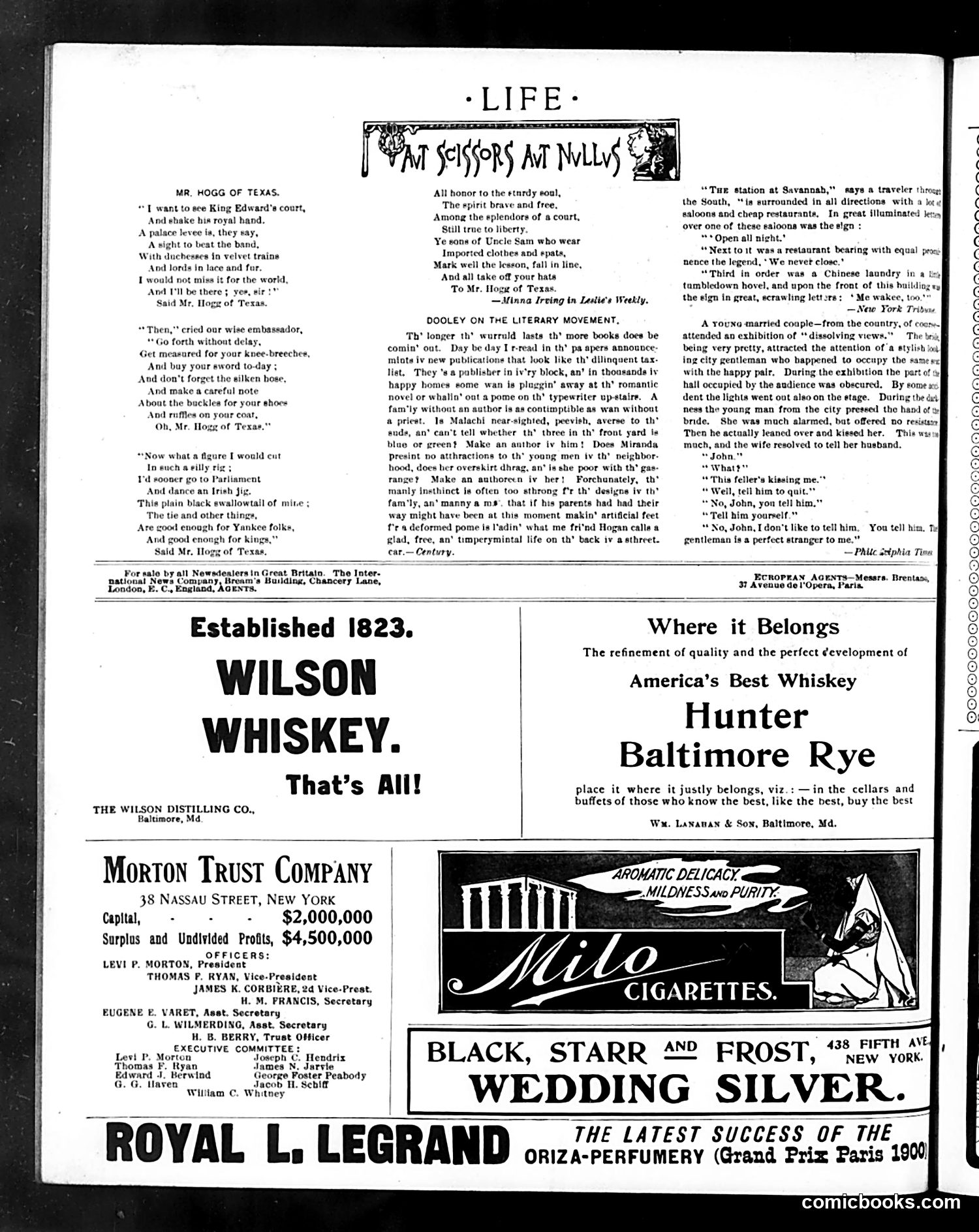
This page contains three distinct satirical pieces from *Life* magazine: **"Mr. Hogg of Texas"** (top): A poem mocking an American Texan named Hogg who refuses to dress formally for King Edward's court, insisting his plain American clothes are good enough. The satire celebrates his democratic defiance of European aristocratic pretension—a patriotic stance presented as admirable resistance to snobbish formality. **"Dooley on the Literary Movement"** (middle): Written in Irish-immigrant dialect, this mocks the era's publishing explosion and middle-class aspiration to authorship. The satirist suggests ordinary people are abandoning productive work to write novels and poetry, treating literary ambition as a silly status-seeking fad. **Bottom anecdotes**: Two brief humorous stories about social misunderstandings—one contrasting a Southern city's vulgar commercialism, another depicting awkward behavior at a "dissolving views" (early projected image) exhibition. The page is primarily satirical commentary on American class, culture, and pretension circa 1900s.
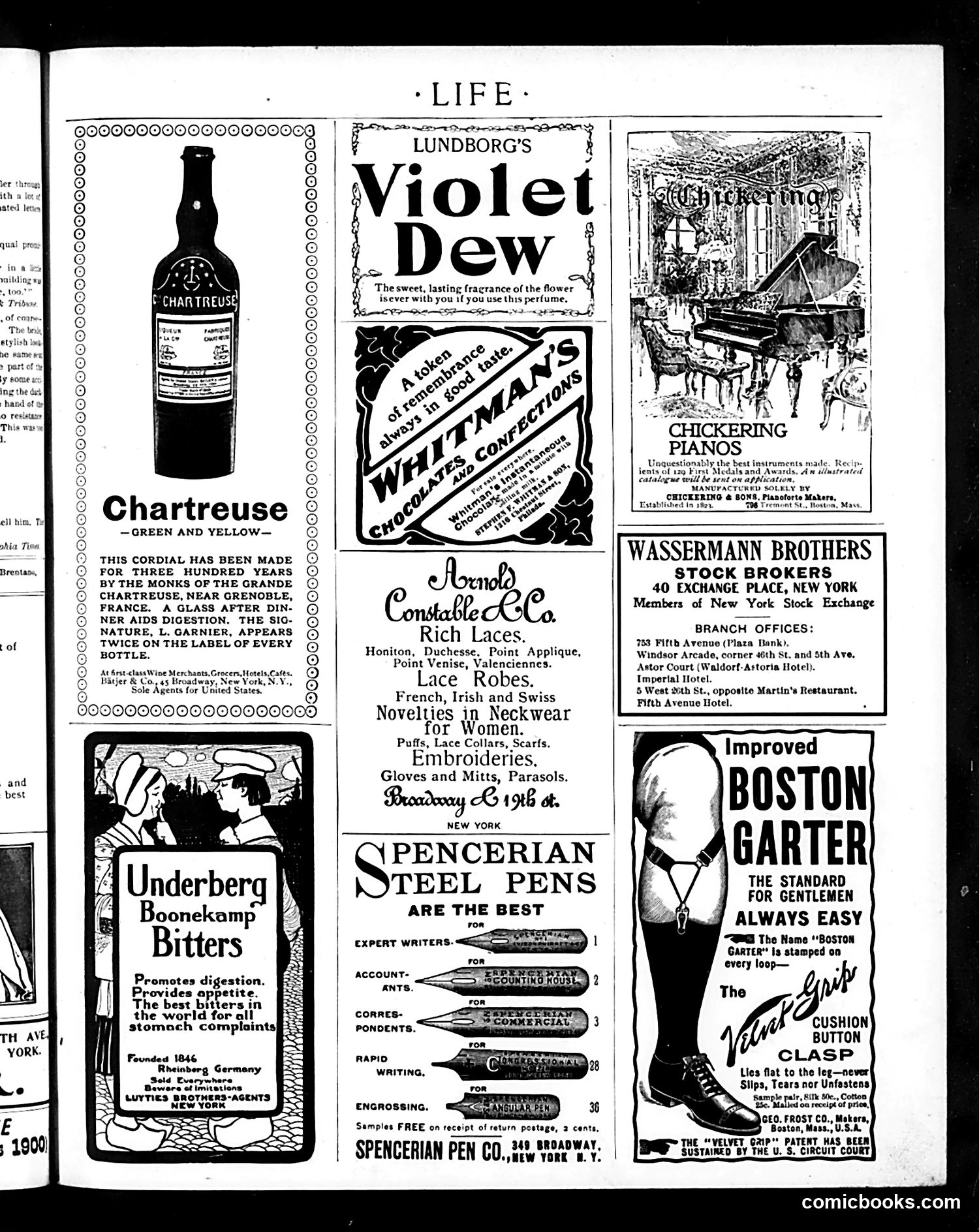
This is **primarily an advertisements page**, not a political cartoon. It contains various early 1900s product ads with no satirical content or social commentary visible. The ads showcase period consumer goods: Chartruse liqueur (digestive aid), Underberg Bitters (stomach remedy), Lundborg's Violet Dew perfume, Arnold Constable laces and neckwear, Spencerian steel pens, Wassermann Brothers stockbrokers, Boston Garters, and Chickering Pianos. These ads reflect **early 20th-century consumer culture and gender roles**—perfume and lace targeted women, garters and pens targeted men. The emphasis on digestive aids and "stomach complaints" suggests common health concerns of the era. Multiple European-origin brands (French laces, German bitters) indicate international trade. **There is no identifiable satire or political commentary on this page**—it functions as standard period advertising space, typical of how *Life* magazine monetized itself.
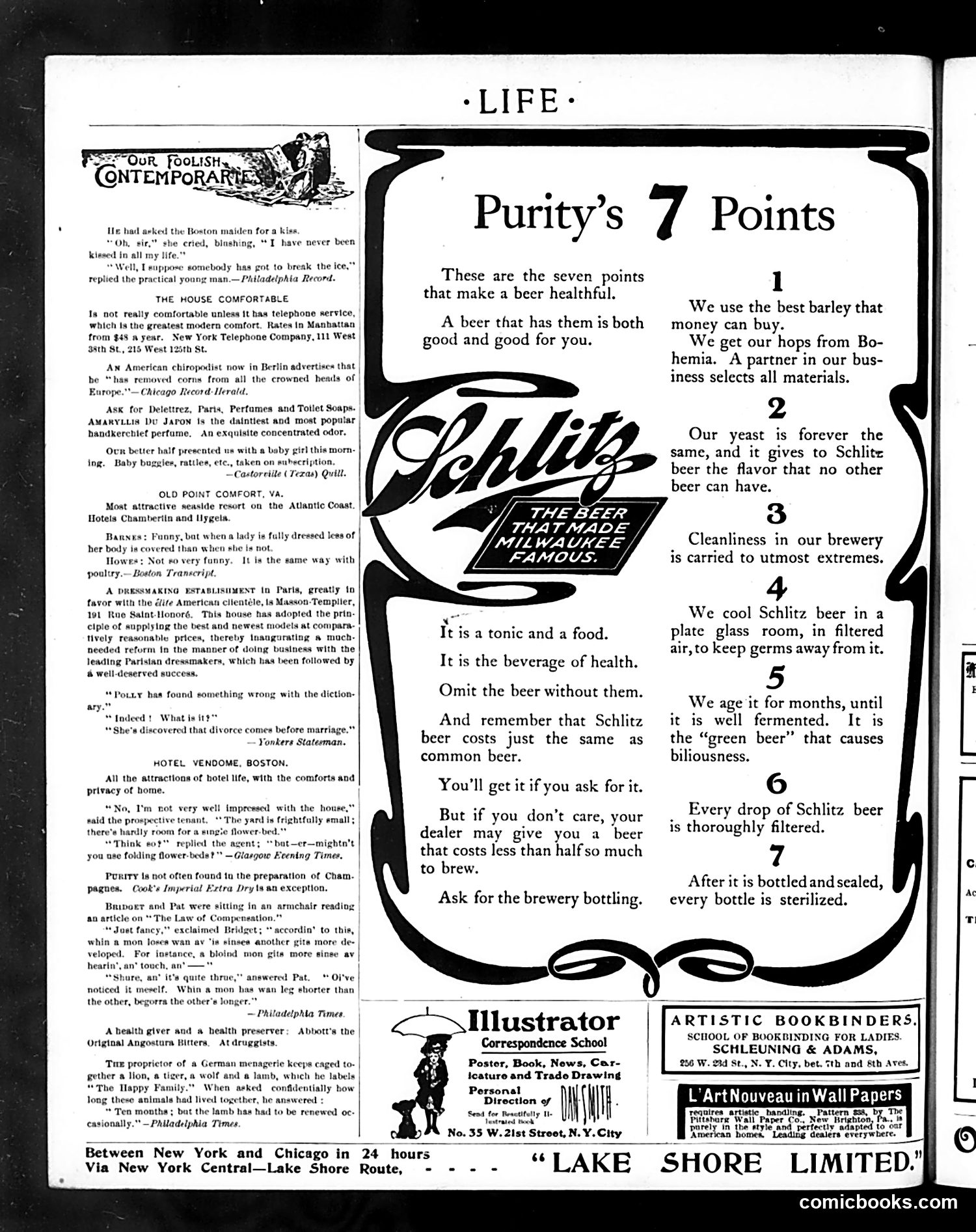
This page is primarily a **Schlitz beer advertisement** disguised as editorial content. The large central section lists "seven points" claimed to make Schlitz beer healthful—emphasizing superior ingredients, consistent yeast, cleanliness, temperature control, proper aging, filtration, and sterilization. The surrounding "Our Foolish Contemporaries" column contains brief satirical items mocking various social absurdities (a chiropodist treating "crowned heads," fashion establishments, marital mishaps). **Context for modern readers:** This appears from the Prohibition era or just before it, when beer companies aggressively marketed their products as health tonics rather than mere alcohol. The advertisement's quasi-scientific "7 Points" format mimics health claims common to the period. The framing as satire rather than obvious advertising was typical of how companies embedded promotional content in magazines.
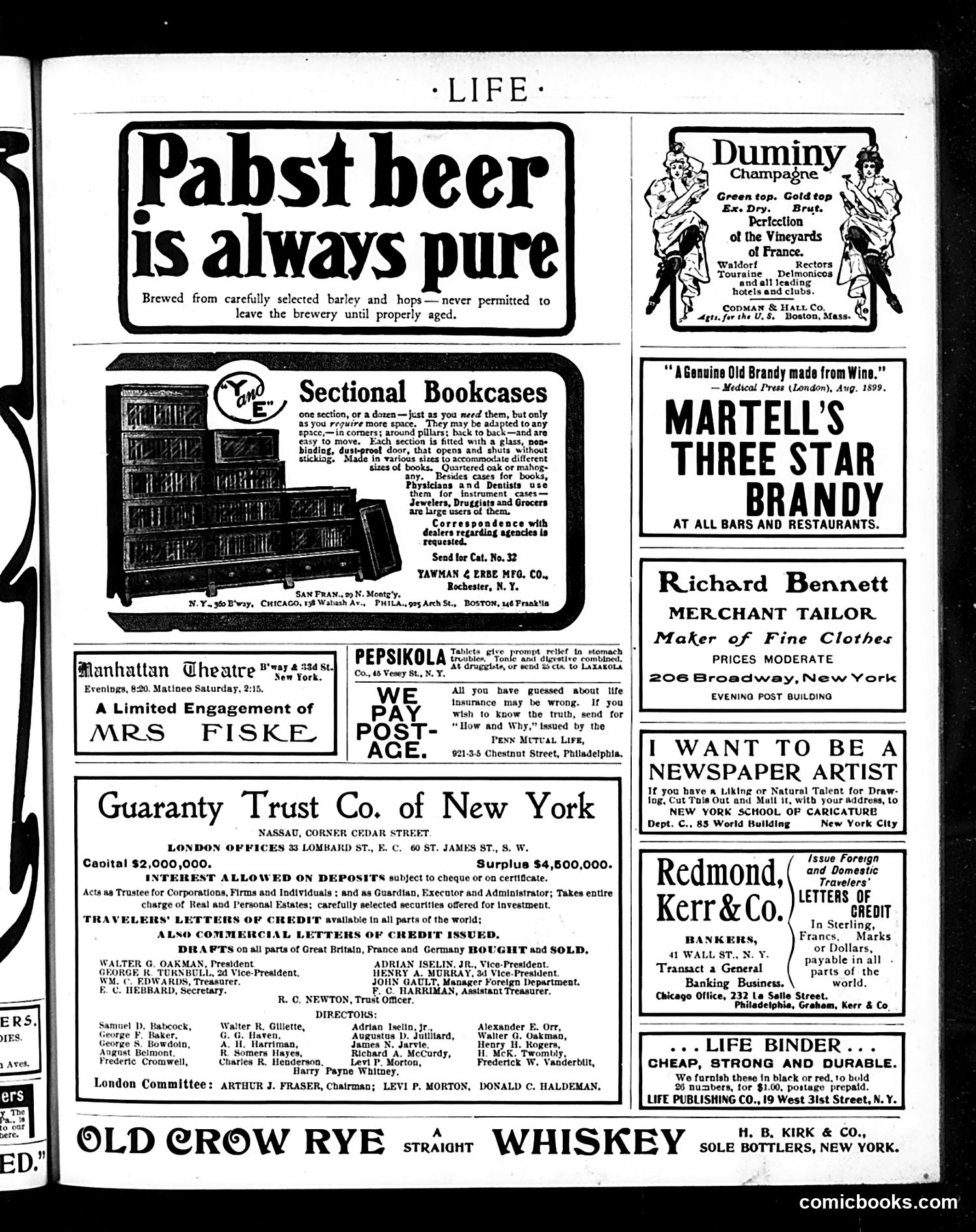
This is primarily an **advertising page** with no cartoon content. The page consists almost entirely of commercial advertisements from early 1900s America, with no satirical commentary or political cartoons. The ads reflect the era's consumer products and services: Pabst beer emphasizes purity and aging; Sectional Bookcases tout modular furniture; Martell's brandy advertises quality; Richard Bennett promotes tailoring services; and financial institutions like Guaranty Trust Co. and Redmond, Kerr & Co. offer banking services. Notable is the absence of editorial content—Life at this period was indeed a satirical magazine, but this particular page dedicates itself entirely to revenue-generating advertisements. The ads themselves reveal period values: alcohol consumption was openly promoted, tailoring was a standard service industry, and financial security through banks and insurance was marketed to affluent readers. The layout and typography are typical of early 20th-century magazine design, with decorative borders and varied text sizes competing for attention.
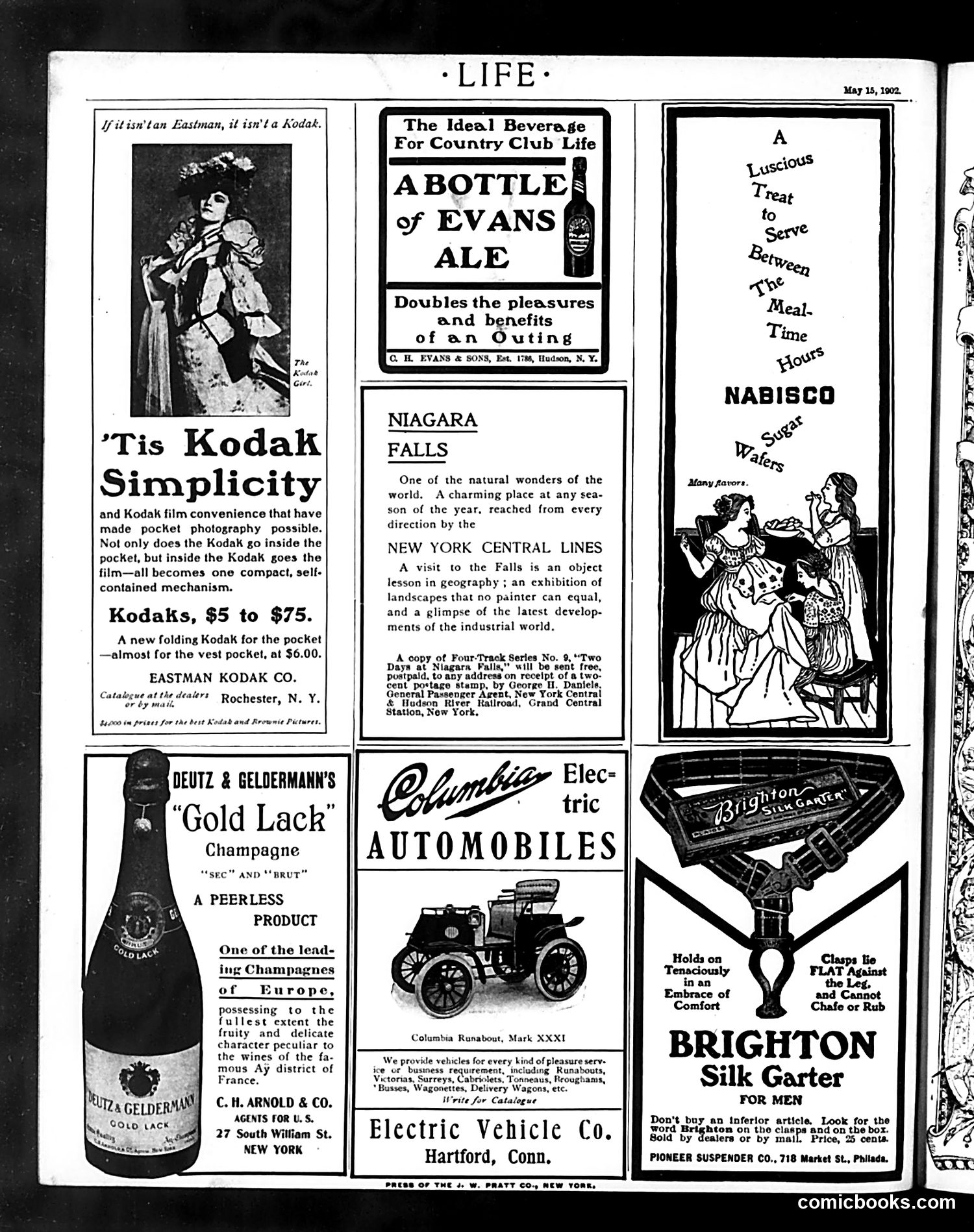
This is primarily an **advertising page** with no political cartoons or satire. The single cartoon element—the photograph labeled "If it isn't an Eastman, it isn't a Kodak"—is not satirical but rather a straightforward product endorsement featuring a woman with a camera. The page advertises luxury goods and services targeting affluent early-1900s consumers: portable cameras (Kodak), champagne, ale for country clubs, train travel to Niagara Falls, electric automobiles, and men's accessories. These ads reflect Gilded Age consumer culture and emerging technologies like electric vehicles. The only implicit "satire" is the general tone common to Life magazine—gentle mockery of upper-class leisure and consumption—but this page itself contains no specific political commentary or caricature worthy of historical analysis beyond documenting what products and aspirations wealthy Americans valued in 1902.