
Life, 1902-05-15 · page 4 of 20
Life — May 15, 1902 — page 4: what you’re looking at
What you’re looking at
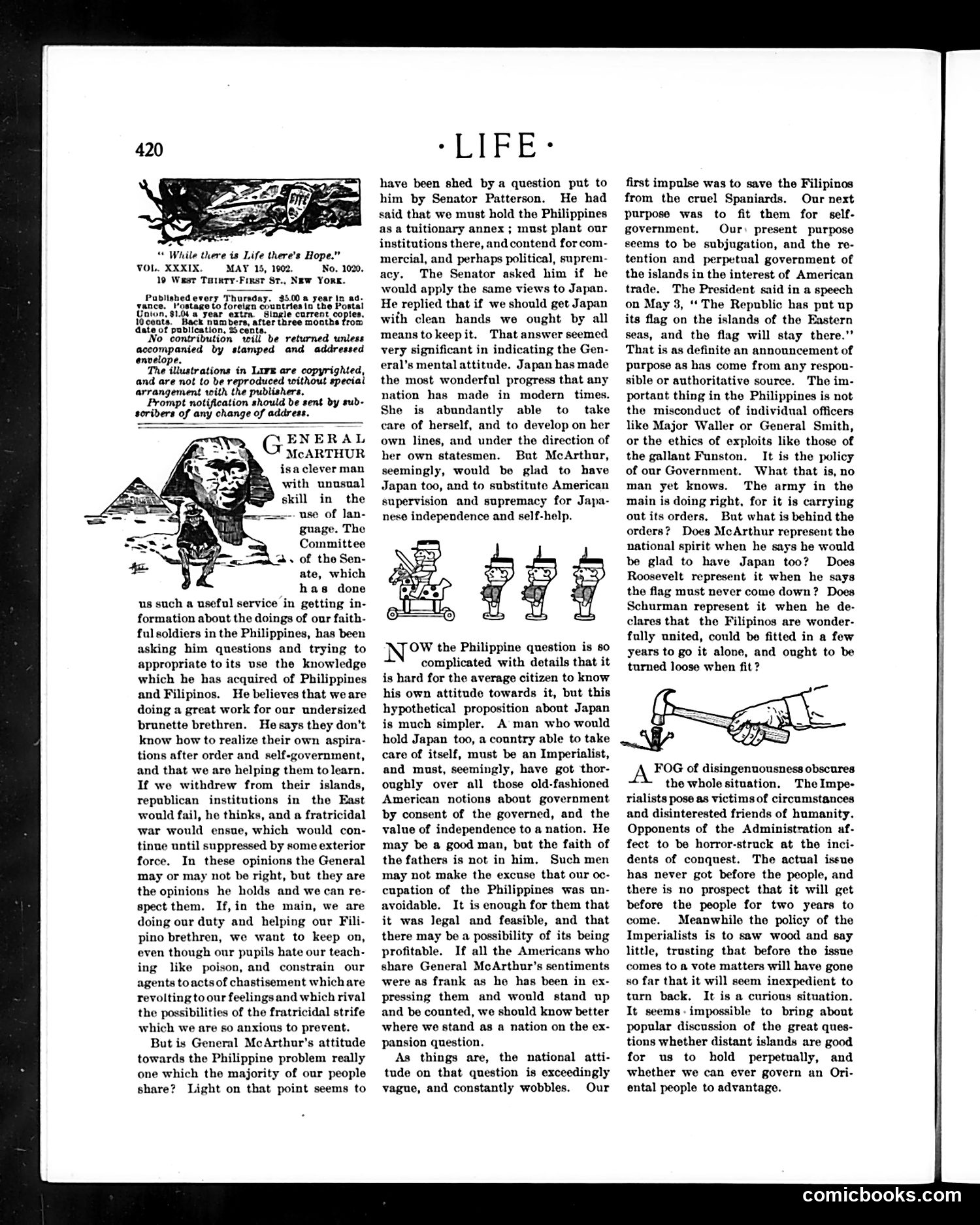
The main cartoon depicts **General MacArthur** as a caricatured figure overlooking terrain, illustrating the text's discussion of his role and attitudes toward the Philippines. The article debates MacArthur's stance on Philippine independence. The text criticizes those who would simultaneously hold the Philippines as a U.S. possession while advocating Japan's independence—viewing this as hypocritical imperialism. The cartoon and surrounding commentary question whether America should govern distant Oriental populations "to advantage," challenging the logic of maintaining colonial control. The smaller illustration shows figures on what appears to be a military vehicle, likely reinforcing themes of American military presence and authority in the region. The piece reflects early 20th-century American debates over imperialism and colonial administration.
📄 Transcribed text from this page (OCR, searchable)
Machine-transcribed from the original scan — historical spelling and the odd misread are preserved.
“ While there is Life there’s Hope.” VOL. XXXIX. MAY 15, 1902. No, 1020. 19 Waar Tarrty-First St., NEw YORK. edevery Thursday. 35.00 a year in ad. stage to foreign countries in the Post: 1.4 a year extra. Single current copies, 10 cet Back numbers, after three months from date of publication, Scents. No contribution will be returned unless accompanied by stamped and addressed envelope. The illustrations in Lure are copyrighted, and are not to be reproduced without special arrangement with the publishers. Prompt notification should be sent by sub- soribers of any change of address. ENERAL McARTHUR isa clever man with unusual skill in the guage. The Committee “a. of the Sen- ate, which has done us such a useful service in getting in- formation about the doings of our faith- ful soldiers in the Philippines, has been asking him questions and trying to appropriate to its use the knowledge which he has acquired of Philippines and Filipinos. He believes that we are doing a great work for our undersized brunette brethren. He says they don't know how to realize their own aspira- tions after order and self-government, and that we are helping them to learn. If we withdrew from their islands, republican institutions in the East would fail, he thinks, and a fratricidal war would ensue, which would con- tinue until suppressed by some exterior force. In these opinions the General may or may not be right, but they are the opinions he holds and we can re- spect them. If,in the main, we are doing our duty and helping our Fili- pino brethren, we want to keep on, even though our pupils hate our teach- ing like poison, and constrain our agents toactsof chastisement which are revolting to our feelings and which rival the possibilities of the fratricidal strife which we are so anxious to prevent. But is General McArthur's attitude towards the Philippine problem really one which the majority of our people share? Light on that point seems to ‘LIFE have been shed by a question put to him by Senator Patterson. He had said that we must hold the Philippines as a tuitionary annex ; must plant our institutions there, and contend forcom- mercial, and perhaps political, suprem- acy. The Senator asked him if he would apply the same views to Japan. He replied that if we should get Japan with clean hands we ought by all meanstokeepit. That answer seemed very significant in indicating the Gen- eral’s mental attitude. Japan has made the most wonderful progress that any nation has made in modern times. She is abundantly able to take care of herself, and to develop on her own lines, and under the direction of her own statesmen. But McArthur, seemingly, would be glad to have Japan too, and to substitute American supervision and supremacy for Japa- nese independence and self-help. OW the Philippine question is so 4N complicated with details that it is hard for the average citizen to know his own attitude towards it, but this hypothetical proposition about Japan is much simpler. A man who would hold Japan too, a country able to take care of itself, must be an Imperialist, and must, seemingly, have got thor- oughly over all those old-fashioned American notions about government by consent of the governed, and the value of independence to a nation. He may be a good man, but the faith of the fathers is not in him, Such men may not make the excuse that our oc- cupation of the Philippines was un- avoidable. It is enough for them that it was legal and feasible, and that there may be a possibility of its being profitable. If all the Americans who share General McArthur’s sentiments were as frank as he has been in ex- pressing them and would stand up and be counted, we should know better where we stand as a nation on the ex- pansion question. As things are, the national atti- tude on that question is exceedingly vague, and constantly wobbles. Our first impulse was to save the Filipinos from the cruel Spaniards. Our next purpose was to fit them for self- government. Our: present purpose seems to be subjugation, and the re- tention and perpetual government of the islands in the interest of American trade. The President said in a speech on May 3, “The Republic has put up its flag on the islands of the Eastern seas, and the flag will stay there.” That is as definite an announcement of purpose as has come from any respon- sible or authoritative source. The im- portant thing in the Philippines is not the misconduct of individual officers like Major Waller or General Smith, or the ethics of exploits like those of the gallant Funston. It is the policy of our Government. What that is, no man yet knows. The army in the main is doing right, for it is carrying out its orders. But what is behind the orders? Does McArthur represent the national spirit when he says he would be glad to have Japan too? Does Roosevelt represent it when he says the flag must never come down? Does Schurman represent it when he de- clares that the Filipinos are wonder- fally united, could be fitted in a few years to go it alone, and ought to be tarned loose when fit? A FOG of disingenuousness obscures the whole situation. The Impe- rialists pose as victims of circumstances and disinterested friends of humanity. Opponents of the Administration af- fect to be horror-struck at the inci- dents of conquest. The actual issue has never got before the people, and there is no prospect that it will get before the people for two years to come. Meanwhile the policy of the Imperialists is to saw wood and say little, trusting that before the issue comes to a vote matters will have gone so far that it will seem inexpedient to turn back. It is a curious situation. It seems. impossible to bring about popular discussion of the great ques- tions whether distant islands are good for us to hold perpetually, and whether we can ever govern an Ori- ental people to advantage. comicbooks.com